
Oracle Critical Security Patch Update November 2026
Released November 2026 · Oracle's advisory ↗ · ← Critical Patch Update, October 2026
942 CVEs in this release, one square each
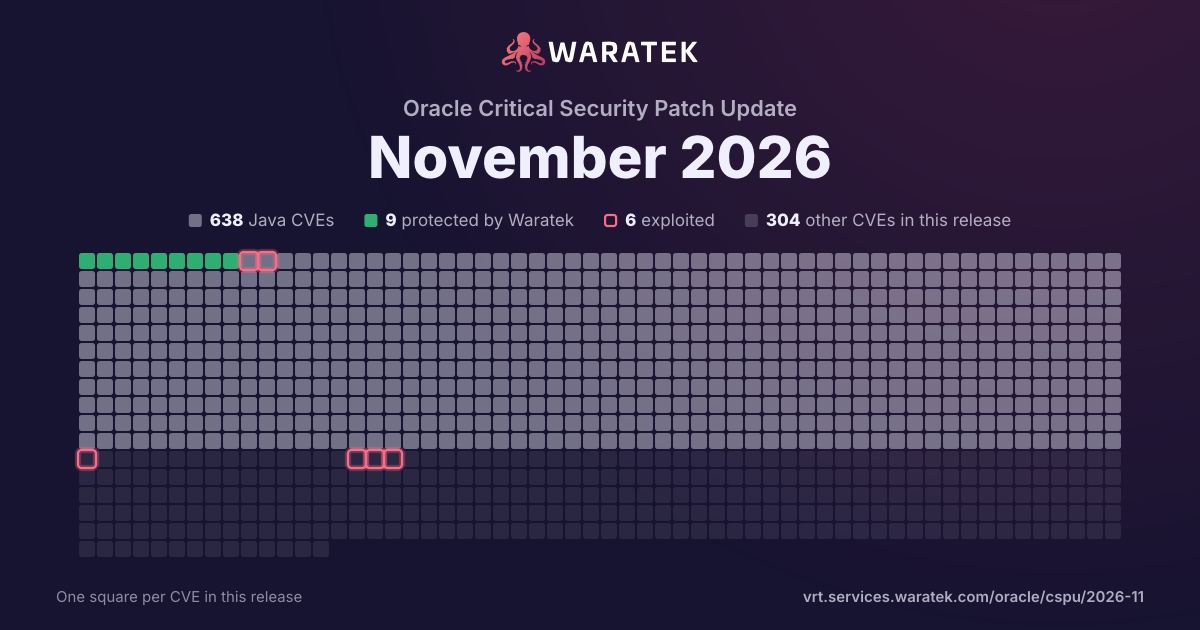
By status
9Protected by Waratek4Mitigation candidate625No exploit published15Outside Waratek scope289Not applicable
6Exploited, marked by the ring
No exploit published. For 554 of them, Oracle's security advisory is the source of public detail.
Protected by Waratek. Waratek RASP can block exploitation of these on systems that have not applied the patch yet.
Overview 9 matches · 0 exploited · 0 CISA KEV · 1 public PoC · 1 EPSS ≥ 0.5
Protected by Waratek
9
100.0%
Rule in development
0
0.0%
Mitigation candidate
0
0.0%
No exploit published
0
0.0%
Outside Waratek scope
0
0.0%
Not applicable
0
0.0%
Withdrawn CVE
0
0.0%
blocked by ARMR today
9
100.0%
partly blocked
0
0.0%
not blocked
0
0.0%
not established
0
0.0%
unrecorded
0
0.0%
Exploited
0
0.0%
Working exploit published
0
0.0%
Proof of concept only
3
33.3%
Forecast only
0
0.0%
No public exploit
6
66.7%
split by
peak 6 / quarter
Q1 221
Protected by Waratek1
Critical1
blocked by ARMR today1
Proof of concept only1
Q2 221
Protected by Waratek1
Critical1
blocked by ARMR today1
Proof of concept only1
Q3 220
Q4 220
Q1 230
Q2 230
Q3 230
Q4 230
Q1 240
Q2 240
Q3 240
Q4 240
Q1 250
Q2 250
Q3 250
Q4 250
Q1 260
Q2 261
Protected by Waratek1
High1
blocked by ARMR today1
No public exploit1
Q3 266
Protected by Waratek6
Critical1
High4
Medium1
blocked by ARMR today6
Proof of concept only1
No public exploit5
Q1 22Q3 22Q1 23Q3 23Q1 24Q3 24Q1 25Q3 25Q1 26Q3 26
| CVE | Severity | Published▾ | Status | Exploitation | Description |
|---|---|---|---|---|---|
| CVE-2026-19032 | Medium | 2026-09-01 | Protected by Waratek | Proof of concept only | jackson-databind's deserializer for java.nio.file.Path resolves an attacker-supplied URI without restricting the URI scheme. In JDKFromStringDeserializer.NioPathHelper.deserialize, a string bound from untrusted JSON is passed to new URI(value) and then to Path.of(uri). When that throws FileSystemNotFoundException, the code enumerates ServiceLoader<FileSystemProvider> and calls provider.getPath(uri) on the first provider whose scheme matches the attacker-chosen scheme. Untrusted JSON can therefore select and drive an arbitrary registered FileSystemProvider during readValue under a default JsonMapper, and forces provider class loading at the same time. With only the JDK built-in providers (file, jar/zipfs) present, the resolved path is inert and no mount or network I/O occurs; further impact requires a side-effecting third-party FileSystemProvider on the classpath. This affects com.fasterxml.jackson.core:jackson-databind from 2.8.0 before 2.18.10, from 2.19.0 before 2.21.6, and from 2.22.0 before 2.22.2, and tools.jackson.core:jackson-databind from 3.0.0 before 3.1.6 and from 3.2.0 before 3.2.2. Users should upgrade to 2.18.10, 2.21.6, 2.22.2, 3.1.6, or 3.2.2. Binding java.nio.file.Path from untrusted JSON should be avoided regardless of version. |
| CVE-2026-66909 | Critical | 2026-08-06 | Protected by Waratek | No public exploit | Apache CXF's JMS transport deserializes the body of any inbound JMS ObjectMessage using native Java deserialization, with no type restrictions in place. Any attacker able to place a message on the service's JMS destination can submit a malicious serialized object, leading to denial of service or, if a suitable gadget class is on the classpath, remote code execution. The fix disables ObjectMessage deserialization by default, with a configuration switch to re-enable it if needed. Users are recommended to upgrade to versions 4.2.3 or 4.1.8 or 3.6.12, which fix this issue. |
| CVE-2026-65432 | High | 2026-08-06 | Protected by Waratek | No public exploit | Apache CXF reads a top-level WSDL through its hardened StaxUtils path, which disables XML DTDs and external entities. However, any <wsdl:import> or <xsd:import> referenced from that top-level WSDL is handed off to WSDL4J, which does not disable DOCTYPE declarations or external entities. As a result, the protections applied to the top-level document do not extend to imported documents, leaving imported WSDL/XSD content vulnerable to XML External Entity (XXE) attacks. Users are recommended to upgrade to versions 4.2.3 or 4.1.8 or 3.6.12, which fix this issue. |
| CVE-2026-47063 | High | 2026-07-21 | Protected by Waratek | No public exploit | Vulnerability in the Oracle Java SE, Oracle GraalVM for JDK, Oracle GraalVM Enterprise Edition product of Oracle Java SE (component: Libraries). Supported versions that are affected are Oracle Java SE: 8u491, 8u491-perf, 11.0.31, 17.0.19, 21.0.11, 25.0.3, 26.0.1; Oracle GraalVM for JDK: 17.0.19 and 21.0.11; Oracle GraalVM Enterprise Edition: 21.3.18. Easily exploitable vulnerability allows unauthenticated attacker with network access via multiple protocols to compromise Oracle Java SE, Oracle GraalVM for JDK, Oracle GraalVM Enterprise Edition. Successful attacks of this vulnerability can result in unauthorized creation, deletion or modification access to critical data or all Oracle Java SE, Oracle GraalVM for JDK, Oracle GraalVM Enterprise Edition accessible data. Note: This vulnerability can be exploited by using APIs in the specified Component, e.g., through a web service which supplies data to the APIs. This vulnerability also applies to Java deployments, typically in clients running sandboxed Java Web Start applications or sandboxed Java applets, that load and run untrusted code (e.g., code that comes from the internet) and rely on the Java sandbox for security. CVSS 3.1 Base Score 7.5 (Integrity impacts). CVSS Vector: (CVSS:3.1/AV:N/AC:L/PR:N/UI:N/S:U/C:N/I:H/A:N). |
| CVE-2026-47058 | High | 2026-07-21 | Protected by Waratek | No public exploit | Vulnerability in Oracle Java SE (component: Scripting). Supported versions that are affected are Oracle Java SE: 8u491, 8u491-perf and 11.0.31. Difficult to exploit vulnerability allows unauthenticated attacker with network access via multiple protocols to compromise Oracle Java SE. Successful attacks of this vulnerability can result in unauthorized creation, deletion or modification access to critical data or all Oracle Java SE accessible data as well as unauthorized access to critical data or complete access to all Oracle Java SE accessible data. Note: This vulnerability can be exploited by using APIs in the specified Component, e.g., through a web service which supplies data to the APIs. This vulnerability also applies to Java deployments, typically in clients running sandboxed Java Web Start applications or sandboxed Java applets, that load and run untrusted code (e.g., code that comes from the internet) and rely on the Java sandbox for security. CVSS 3.1 Base Score 7.4 (Confidentiality and Integrity impacts). CVSS Vector: (CVSS:3.1/AV:N/AC:H/PR:N/UI:N/S:U/C:H/I:H/A:N). |
| CVE-2026-47057 | High | 2026-07-21 | Protected by Waratek | No public exploit | Vulnerability in Oracle Java SE (component: Scripting). Supported versions that are affected are Oracle Java SE: 8u491, 8u491-perf and 11.0.31. Easily exploitable vulnerability allows unauthenticated attacker with network access via multiple protocols to compromise Oracle Java SE. Successful attacks of this vulnerability can result in unauthorized ability to cause a hang or frequently repeatable crash (complete DOS) of Oracle Java SE. Note: This vulnerability can be exploited by using APIs in the specified Component, e.g., through a web service which supplies data to the APIs. This vulnerability also applies to Java deployments, typically in clients running sandboxed Java Web Start applications or sandboxed Java applets, that load and run untrusted code (e.g., code that comes from the internet) and rely on the Java sandbox for security. CVSS 3.1 Base Score 7.5 (Availability impacts). CVSS Vector: (CVSS:3.1/AV:N/AC:L/PR:N/UI:N/S:U/C:N/I:N/A:H). |
| CVE-2026-22016 | High | 2026-04-21 | Protected by Waratek | No public exploit | Vulnerability in the Oracle Java SE, Oracle GraalVM for JDK, Oracle GraalVM Enterprise Edition product of Oracle Java SE (component: JAXP). Supported versions that are affected are Oracle Java SE: 8u481, 8u481-b50, 8u481-perf, 11.0.30, 17.0.18, 21.0.10, 25.0.2, 26; Oracle GraalVM for JDK: 17.0.18 and 21.0.10; Oracle GraalVM Enterprise Edition: 21.3.17. Easily exploitable vulnerability allows unauthenticated attacker with network access via multiple protocols to compromise Oracle Java SE, Oracle GraalVM for JDK, Oracle GraalVM Enterprise Edition. Successful attacks of this vulnerability can result in unauthorized access to critical data or complete access to all Oracle Java SE, Oracle GraalVM for JDK, Oracle GraalVM Enterprise Edition accessible data. Note: This vulnerability can be exploited by using APIs in the specified Component, e.g., through a web service which supplies data to the APIs. This vulnerability also applies to Java deployments, typically in clients running sandboxed Java Web Start applications or sandboxed Java applets, that load and run untrusted code (e.g., code that comes from the internet) and rely on the Java sandbox for security. CVSS 3.1 Base Score 7.5 (Confidentiality impacts). CVSS Vector: (CVSS:3.1/AV:N/AC:L/PR:N/UI:N/S:U/C:H/I:N/A:N). |
| CVE-2022-23457 | Critical | 2022-04-25 | Protected by Waratek | Proof of concept only | ESAPI (The OWASP Enterprise Security API) is a free, open source, web application security control library. Prior to version 2.3.0.0, the default implementation of `Validator.getValidDirectoryPath(String, String, File, boolean)` may incorrectly treat the tested input string as a child of the specified parent directory. This potentially could allow control-flow bypass checks to be defeated if an attack can specify the entire string representing the 'input' path. This vulnerability is patched in release 2.3.0.0 of ESAPI. As a workaround, it is possible to write one's own implementation of the Validator interface. However, maintainers do not recommend this. |
| CVE-2022-23305 | Critical | 2022-01-18 | Protected by Waratek | Proof of concept only | By design, the JDBCAppender in Log4j 1.2.x accepts an SQL statement as a configuration parameter where the values to be inserted are converters from PatternLayout. The message converter, %m, is likely to always be included. This allows attackers to manipulate the SQL by entering crafted strings into input fields or headers of an application that are logged allowing unintended SQL queries to be executed. Note this issue only affects Log4j 1.x when specifically configured to use the JDBCAppender, which is not the default. Beginning in version 2.0-beta8, the JDBCAppender was re-introduced with proper support for parameterized SQL queries and further customization over the columns written to in logs. Apache Log4j 1.2 reached end of life in August 2015. Users should upgrade to Log4j 2 as it addresses numerous other issues from the previous versions. |