
Oracle Critical Security Patch Update November 2026
Released November 2026 · Oracle's advisory ↗ · ← Critical Patch Update, October 2026
942 CVEs in this release, one square each
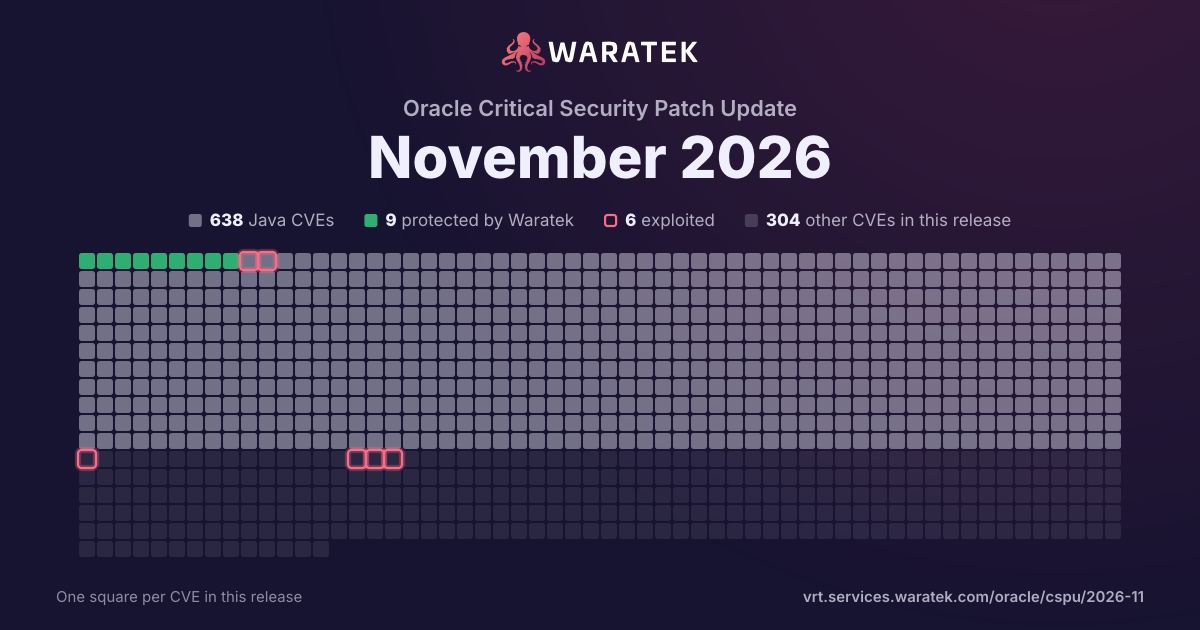
By status
9Protected by Waratek4Mitigation candidate625No exploit published15Outside Waratek scope289Not applicable
6Exploited, marked by the ring
No exploit published. For 554 of them, Oracle's security advisory is the source of public detail.
Protected by Waratek. Waratek RASP can block exploitation of these on systems that have not applied the patch yet.
Overview 8 matches · 4 in Waratek scope · 1 protected · 5 exploited · 3 CISA KEV · 4 EPSS ≥ 0.5
Protected by Waratek
1
12.5%
Rule in development
0
0.0%
Mitigation candidate
3
37.5%
No exploit published
0
0.0%
Outside Waratek scope
1
12.5%
Not applicable
3
37.5%
Withdrawn CVE
0
0.0%
blocked by ARMR today
1
12.5%
partly blocked
0
0.0%
not blocked
7
87.5%
not established
0
0.0%
unrecorded
0
0.0%
Exploited
5
62.5%
Working exploit published
0
0.0%
Proof of concept only
3
37.5%
Forecast only
0
0.0%
No public exploit
0
0.0%
split by
peak 5 / quarter
Q1 221
Protected by Waratek1
Critical1
blocked by ARMR today1
Proof of concept only1
Q2 220
Q3 220
Q4 220
Q1 230
Q2 230
Q3 230
Q4 231
Mitigation candidate1
High1
not blocked1
Exploited1
Q1 240
Q2 240
Q3 240
Q4 240
Q1 250
Q2 250
Q3 250
Q4 251
Mitigation candidate1
Critical1
not blocked1
Exploited1
Q1 260
Q2 260
Q3 260
Q4 265
Mitigation candidate1
Outside Waratek scope1
Not applicable3
Critical1
High3
Medium1
not blocked5
Exploited3
Proof of concept only2
Q2 22Q4 22Q2 23Q4 23Q2 24Q4 24Q2 25Q4 25Q2 26Q4 26
| CVE | Severity | Published▾ | Status | Exploitation | Description |
|---|---|---|---|---|---|
| CVE-2026-114938 | High | 2026-11-17 | Mitigation candidate | Proof of concept only | Vulnerability in the Oracle Java SE, Oracle GraalVM for JDK, Oracle GraalVM Enterprise Edition product of Oracle Java SE (component: Compiler). Supported versions that are affected are Oracle Java SE: 8u511b33-perf, 17.0.21.0.3, 21.0.13.0.3, 25.0.5.0.3, 27.0.1.0.3; Oracle GraalVM for JDK: 17.0.21.0.3 and 21.0.13.0.3; Oracle GraalVM Enterprise Edition: 21.3.20.0.3. Difficult to exploit vulnerability allows unauthenticated attacker with network access via multiple protocols to compromise Oracle Java SE, Oracle GraalVM for JDK, Oracle GraalVM Enterprise Edition. Successful attacks of this vulnerability can result in takeover of Oracle Java SE, Oracle GraalVM for JDK, Oracle GraalVM Enterprise Edition. Note: This vulnerability can only be exploited by supplying data to APIs in the specified Component without using Untrusted Java Web Start applications or Untrusted Java applets, such as through a web service. CVSS 3.1 Base Score 8.1 (Confidentiality, Integrity and Availability impacts). CVSS Vector: (CVSS:3.1/AV:N/AC:H/PR:N/UI:N/S:U/C:H/I:H/A:H). |
| CVE-2026-116690 | High | 2026-10-27 | Not applicable | Exploited | MLflow is an open source AI engineering platform for agents, large language models, and machine learning models. From 3.10.0 until 3.17.0, the prompt branch in _create_model_version() accepts schemeless relative sources because path validation runs only when a source has a URL scheme, and mlflow.prompt.is_prompt is interpreted by tag presence rather than a true value. A remote caller can store a server-local path as the model version artifact location and use /api/2.0/mlflow/model-versions/get-artifact to read files accessible to the MLflow server process. Default unauthenticated servers require no privileges, while basic-auth deployments are exposed to authenticated users who can create registered models. This issue is fixed in version 3.17.0. |
| CVE-2026-115886 | Medium | 2026-10-23 | Not applicable | Exploited | MLflow is an open source AI engineering platform for agents, large language models, and machine learning models. From 3.12.0rc0 until 3.17.0, the scorer invoke, register, and GenAI evaluate endpoints, including unauthenticated POST /ajax-api/3.0/mlflow/scorer/invoke, accept serialized third-party scorer data that Scorer.model_validate_json resolves using a module-path allowlist without constraining the selected class or its constructor arguments. When optional trulens and trulens-providers-litellm packages are installed, an attacker can select mlflow.genai.scorers.trulens, choose a model URI outside MLflow's native provider registry so execution uses the LiteLLM fallback, and supply api_base and api_key values that cause the server to send an outbound request to an attacker-chosen or internal host with attacker-controlled headers and body. The vulnerable deserialization occurs before a tracking-store lookup or job submission. This issue is fixed in version 3.17.0. |
| CVE-2026-105482 | High | 2026-10-23 | Not applicable | Proof of concept only | A flaw in Node.js DNS resolution allows hostnames containing a NUL byte to be silently truncated by the dns.resolve*() functions and dns.reverse(). This is an incomplete fix of CVE-2026-48930, which only covered dns.lookup() and the net/tls host options. Because the name is passed to c-ares as a C string, resolving attacker.example\0.trusted.example queries attacker.example and returns its records without any error. Applications that validate a hostname, for example against a domain allowlist, and then resolve it with dns.resolve*() can act on records for a different name than the one they validated. This vulnerability affects Node.js 26.x, 24.x, and 22.x. |
| CVE-2026-111497 | Critical | 2026-10-22 | Outside Waratek scope | Exploited | A buffer overflow vulnerability in the Brotli decoder (c/dec/decode.c) in Google Brotli versions 1.0.3 through 1.2.0 on all platforms allows a remote unauthenticated attacker to corrupt adjacent decoder state memory, disclose sensitive memory contents, cause a denial of service, or potentially execute arbitrary code using a crafted Brotli-compressed stream. Users need to update any Brotli libraries or binaries between 1.0.3 through 1.2.0 to the latest available version: 1.0.10 or 1.1.1 or 1.2.1. |
| CVE-2025-61882 | Critical | 2025-10-05 | Mitigation candidate | Exploited | Vulnerability in the Oracle Concurrent Processing product of Oracle E-Business Suite (component: BI Publisher Integration). Supported versions that are affected are 12.2.3-12.2.14. Easily exploitable vulnerability allows unauthenticated attacker with network access via HTTP to compromise Oracle Concurrent Processing. Successful attacks of this vulnerability can result in takeover of Oracle Concurrent Processing. CVSS 3.1 Base Score 9.8 (Confidentiality, Integrity and Availability impacts). CVSS Vector: (CVSS:3.1/AV:N/AC:L/PR:N/UI:N/S:U/C:H/I:H/A:H). |
| CVE-2023-44487 | High | 2023-10-10 | Mitigation candidate | Exploited | The HTTP/2 protocol allows a denial of service (server resource consumption) because request cancellation can reset many streams quickly, as exploited in the wild in August through October 2023. |
| CVE-2022-23305 | Critical | 2022-01-18 | Protected by Waratek | Proof of concept only | By design, the JDBCAppender in Log4j 1.2.x accepts an SQL statement as a configuration parameter where the values to be inserted are converters from PatternLayout. The message converter, %m, is likely to always be included. This allows attackers to manipulate the SQL by entering crafted strings into input fields or headers of an application that are logged allowing unintended SQL queries to be executed. Note this issue only affects Log4j 1.x when specifically configured to use the JDBCAppender, which is not the default. Beginning in version 2.0-beta8, the JDBCAppender was re-introduced with proper support for parameterized SQL queries and further customization over the columns written to in logs. Apache Log4j 1.2 reached end of life in August 2015. Users should upgrade to Log4j 2 as it addresses numerous other issues from the previous versions. |