
Oracle Critical Security Patch Update November 2026
Released November 2026 · Oracle's advisory ↗ · ← Critical Patch Update, October 2026
942 CVEs in this release, one square each
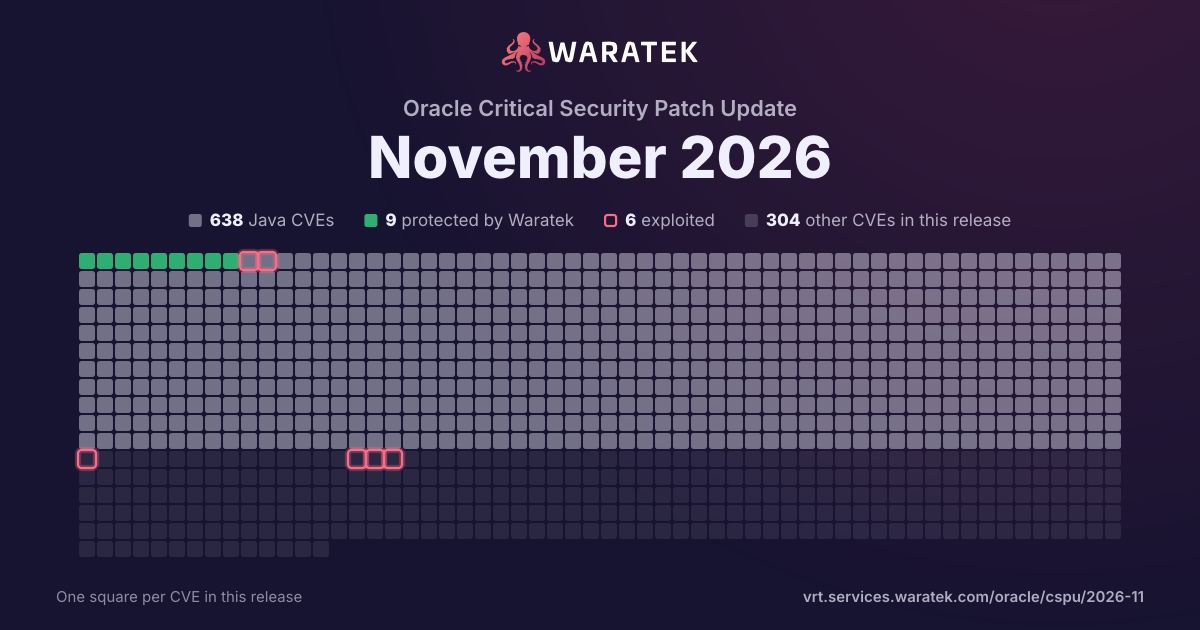
By status
8Protected by Waratek3Mitigation candidate626No exploit published16Outside Waratek scope289Not applicable
8Exploited, marked by the ring
No exploit published. For 554 of them, Oracle's security advisory is the source of public detail.
Protected by Waratek. Waratek RASP can block exploitation of these on systems that have not applied the patch yet.
Overview 94 matches · 13 in Waratek scope · 2 protected · 0 exploited · 0 CISA KEV · 2 public PoC · 1 EPSS ≥ 0.5
94matches
13in Waratek scope13.8%
2protected2.1%
0exploited0.0%
0CISA KEV0.0%
2public PoC2.1%
1EPSS ≥ 0.51.1%
Protected by Waratek
2
2.1%
Rule in development
0
0.0%
Mitigation candidate
0
0.0%
No exploit published
11
11.7%
Outside Waratek scope
0
0.0%
Not applicable
81
86.2%
Withdrawn CVE
0
0.0%
blocked by ARMR today
2
2.1%
partly blocked
0
0.0%
not blocked
92
97.9%
not established
0
0.0%
unrecorded
0
0.0%
Exploited
0
0.0%
Working exploit published
0
0.0%
Proof of concept only
94
100.0%
Forecast only
0
0.0%
No public exploit
0
0.0%
split by
peak 53 / quarter
Q1 221
Protected by Waratek1
Critical1
blocked by ARMR today1
Proof of concept only1
Q2 221
Protected by Waratek1
Critical1
blocked by ARMR today1
Proof of concept only1
Q3 220
Q4 220
Q1 230
Q2 230
Q3 231
Not applicable1
High1
not blocked1
Proof of concept only1
Q4 230
Q1 240
Q2 241
Not applicable1
Medium1
not blocked1
Proof of concept only1
Q3 240
Q4 241
Not applicable1
High1
not blocked1
Proof of concept only1
Q1 251
Not applicable1
High1
not blocked1
Proof of concept only1
Q2 251
No exploit published1
High1
not blocked1
Proof of concept only1
Q3 250
Q4 250
Q1 260
Q2 267
Not applicable7
High3
Medium3
Low1
not blocked7
Proof of concept only7
Q3 2653
No exploit published10
Not applicable43
Critical9
High26
Medium15
Low3
not blocked53
Proof of concept only53
Q4 2627
Not applicable27
Critical7
High17
Medium3
not blocked27
Proof of concept only27
Q2 22Q4 22Q2 23Q4 23Q2 24Q4 24Q2 25Q4 25Q2 26Q4 26
| CVE | Severity | Published▾ | Status | Exploitation | Description |
|---|---|---|---|---|---|
| CVE-2026-116691 | Medium | 2026-10-27 | Not applicable | Proof of concept only | MLflow is an open source AI engineering platform for agents, large language models, and machine learning models. From 2.19.0 until 3.17.0, mlflow.crewai.autolog() records CrewAI Agent objects without consistently sanitizing nested credential-bearing values. mlflow/crewai/autolog.py::_get_agent_attributes() converts the Agent llm field to a string that includes the provider API key, while mlflow/crewai/autolog.py::_construct_full_inputs() expands the Agent object into mlflow.spanInputs. Applications can therefore send plaintext provider credentials to the MLflow trace backend or a configured OTLP destination, where trace readers can obtain them. This issue is fixed in version 3.17.0. |
| CVE-2026-105482 | High | 2026-10-23 | Not applicable | Proof of concept only | A flaw in Node.js DNS resolution allows hostnames containing a NUL byte to be silently truncated by the dns.resolve*() functions and dns.reverse(). This is an incomplete fix of CVE-2026-48930, which only covered dns.lookup() and the net/tls host options. Because the name is passed to c-ares as a C string, resolving attacker.example\0.trusted.example queries attacker.example and returns its records without any error. Applications that validate a hostname, for example against a domain allowlist, and then resolve it with dns.resolve*() can act on records for a different name than the one they validated. This vulnerability affects Node.js 26.x, 24.x, and 22.x. |
| CVE-2026-94266 | High | 2026-10-20 | Not applicable | Proof of concept only | libcurl could accidentally return a URL for `curl_easy_getinfo()`'s `CURLINFO_EFFECTIVE_URL` option containing credentials, even though neither the URL provided to libcurl nor the redirected URL did. |
| CVE-2026-94265 | Critical | 2026-10-20 | Not applicable | Proof of concept only | When processing an HTTP redirect to a URL containing userinfo (a `username:password` component), curl might erroneously retain and re-transmit the original host's HTTP Negotiate authentication state. Consequently, a malicious server can trigger a redirect containing arbitrary userinfo to force curl to send a freshly minted Kerberos ticket—generated using the ambient identity of the client process to an untrusted third-party host, effectively bypassing the domain-scoping restrictions normally enforced by the absence of `--location-trusted`. |
| CVE-2026-92391 | High | 2026-10-20 | Not applicable | Proof of concept only | A deeply nested multipart MIME structure constructed via the public API causes a stack overflow in libcurl during normal cleanup operations. An excessive recursion depth within `curl_mime_free` leads to unbounded stack frame allocation during structure traversal, ultimately crashing the host process. |
| CVE-2026-92390 | High | 2026-10-20 | Not applicable | Proof of concept only | When invoked with `--remote-header-name` (`-J`), curl fails to preserve its documented anti-clobbering protection if an intermediate 103 Early Hints response precedes the final HTTP response, or if an `ETag` header is processed before `Content-Disposition` under `--etag-save`. This flaw allows an HTTP(S) server to overwrite an existing local file specified in the `Content-Disposition` header despite the presence of the `-J` non-overwrite constraint. |
| CVE-2026-92389 | High | 2026-10-20 | Not applicable | Proof of concept only | libcurl's TFTP state machine fails to validate state transitions against the requested transfer direction, accepting opening server responses for both reads and writes interchangeably. A malicious TFTP server can respond to a download request in a way that forces the client into transmit mode, prompting libcurl to consume and transmit data from the handle's persistent `CURLOPT_READDATA` pointer - including data remaining from unrelated prior operations, such as an HTTP POST request executed on a reused handle. |
| CVE-2026-92388 | Critical | 2026-10-20 | Not applicable | Proof of concept only | When an FTP wildcard `LIST` operation fails, libcurl omits the restoration path meant for successful listings, leaving the write callback set to the internal listing parser and the write callback data pointing directly to the easy handle. Subsequent reuse of this handle triggers an immediate crash, and cloning it via `curl_easy_duphandle()` copies this corrupted state into the duplicate. If the original handle is subsequently freed, executing a transfer on the cloned handle causes a heap use-after-free read against the dangling handle reference; alternatively, reusing the original or cloned handle while changing only `CURLOPT_WRITEDATA` (and omitting `CURLOPT_WRITEFUNCTION`) results in type confusion, forcing the internal parser to interpret incoming server response bytes into memory at the application-supplied write data pointer. |
| CVE-2026-92387 | High | 2026-10-20 | Not applicable | Proof of concept only | By permanently omitting the final control-response line, a malicious FTP, IMAP, POP3, or SMTP server can exploit libcurl and completely bypass its configured transfer timeout mechanism, indefinitely blocking all concurrent transfers bound to the same multi-handle. |
| CVE-2026-92386 | High | 2026-10-20 | Not applicable | Proof of concept only | When writing a long cookie name and value to a Netscape cookie jar, a remote HTTP server can make `curl` write a record that exceeds its line-length parsing limit. Consequently, any subsequent `curl` invocation reading from that same cookie jar using `--cookie` silently aborts parsing prematurely upon encountering the too long line, ignoring all subsequent valid cookies in the file. |
| CVE-2026-87866 | Critical | 2026-10-20 | Not applicable | Proof of concept only | When built with wolfSSL, curl can successfully validate a pinned public key hash against a key the TLS peer does not possess. During the TLS handshake, wolfSSL validates the connection, but curl's subsequent re-parsing of the same certificate - tricked by a manipulated validity length field - extracts and matches a different embedded key, incorrectly authorizing the pinned public key. |
| CVE-2026-87865 | High | 2026-10-20 | Not applicable | Proof of concept only | When libcurl uses libssh2 with a hashed `known_hosts` file, an unrelated initial entry can cause host key validation to report a key *mismatch* as a *missing* key to the `CURLOPT_SSH_KEYFUNCTION` callback. |
| CVE-2026-87864 | High | 2026-10-20 | Not applicable | Proof of concept only | Enabling `CURLOPT_CRLF` causes curl to advertise the raw input byte count in the `IMAP APPEND {N}` literal while transmitting line-ending expanded data. The server reads only $N$ bytes for the payload, causing the remaining overflow bytes to be interpreted and executed as pipelined IMAP commands within the authenticated session. |
| CVE-2026-87863 | High | 2026-10-20 | Not applicable | Proof of concept only | An authenticated HTTPS origin can supply an HSTS `max-age` value that the parser accepts, but time serialization later fails to process. On 64-bit systems, extreme max-age values compute an absolute expiry within standard time integer limits that exceeds calendar time structure bounds. During cache saves, the original HSTS file is truncated before writing a temporary replacement; when serialization fails, the temporary file is deleted, leaving an empty or partial cache. Because the save error is silently ignored during cleanup, curl exits successfully despite the data loss. |
| CVE-2026-87862 | High | 2026-10-20 | Not applicable | Proof of concept only | Importing a `includeSubDomains` parent HSTS entry before a longer-lived child entry, silently drops the child. Consequently, when the parent expires, the child's valid HSTS policy is lost, causing curl to issue unencrypted HTTP requests rather than upgrading to HTTPS. |
| CVE-2026-87861 | Critical | 2026-10-20 | Not applicable | Proof of concept only | When using ambient user credentials, an HTTP request directed to one origin may be dispatched over a connection previously authenticated via Negotiate for a different origin, leaving the request's intended credentials unused. |
| CVE-2026-86414 | Critical | 2026-10-20 | Not applicable | Proof of concept only | An HTTP proxy can trick libcurl into sending the origin's credentials (Basic password, or a Negotiate/Kerberos ticket) to the proxy itself, by answering the `CONNECT` tunnel request with 401 `WWW-Authenticate:` instead of the expected 407 `Proxy-Authenticate:`. |
| CVE-2026-86413 | Critical | 2026-10-20 | Not applicable | Proof of concept only | When using an *ambient user* in a first transfer doing Negotiate authentication and asked to follow redirects, curl could pass on its credential details to an unrelated second origin when asked to redirect there. |
| CVE-2026-86412 | High | 2026-10-20 | Not applicable | Proof of concept only | A remote HTTP server can set a cookie that curl accepts and writes to a Netscape cookie jar but cannot reload. On the next invocation using the same path for `--cookie` and `--cookie-jar`, curl fails before connecting, then the cleanup procedure replaces the jar with an empty file, deleting cookies for unrelated domains. |
| CVE-2026-86411 | Critical | 2026-10-20 | Not applicable | Proof of concept only | An `ftp://` transfer configured with `CURLUSESSL_NONE` can reuse a pooled FTP control connection that a previous easy handle upgraded with `STARTTLS` and authenticated using a client certificate. The second handle performs neither a new TLS handshake nor a new FTP login, so the server continues to authorize it under the first handle's certificate identity. |
| CVE-2026-86410 | High | 2026-10-20 | Not applicable | Proof of concept only | A flaw in the curl command line tool's logic makes it only set SSH host verification options when interacting directly using SFTP or SCP, and not as a result of following a redirect. |
| CVE-2026-86409 | High | 2026-10-20 | Not applicable | Proof of concept only | Setting `CURLOPT_AWS_SIGV4` to NULL but does not disable SigV4 authentication, contrary to expectations and documentation. A subsequent transfer on the same handle still sends an `Authorization: AWS4-HMAC-SHA256` header to whatever URL isset next, leaking state information. |
| CVE-2026-107929 | High | 2026-10-20 | Not applicable | Proof of concept only | When `CURLOPT_INTERFACE` (or the command line tool's `--interface` option) is set with one of the documented prefixes (`if!`, `host!`, `ifhost!`), that binding is not part of the connection reuse key, so a later transfer asking for a different source can silently reuse an existing connection and go out from the earlier transfer's source address |
| CVE-2026-107928 | High | 2026-10-20 | Not applicable | Proof of concept only | When curl is built with GnuTLS, a malicious WebSocket server can make curl send memory past its send buffer. This is due to an out of bounds read following when `gnutls_record_send()` returns a number of bytes sent **greater than the number of bytes it was given to send**. GnuTLS does that after a blocked send. |
| CVE-2026-92392 | High | 2026-10-14 | Not applicable | Proof of concept only | During an upload, curl mishandles HTTP/2 `RST_STREAM` received from the server (with reason `HTTP_1_1_REQUIRED` or `REFUSED_STREAM`) leading to a use after free of a `struct Curl_easy` object. |
| CVE-2026-67416 | Medium | 2026-10-14 | Not applicable | Proof of concept only | RabbitMQ is a messaging and streaming broker. From 4.0.0 until 4.0.24, 4.1.15, 4.2.10, and 4.3.4, the optimized AMQP 1.0 server_mode parser in deps/amqp10_common/src/amqp10_binary_parser.erl matches the textual prefixes of symbolic data, sequence, and value body descriptors without verifying their encoded symbol lengths. An authenticated AMQP 1.0 publisher with write permission can submit a well-formed unknown descriptor that begins with a registered body descriptor, and RabbitMQ misclassifies and stores the bytes as a standard body section. Strict AMQP 1.0 consumers can terminate while decoding the stored entry. For bodies misclassified as data, AMQP 0-9-1 or other cross-protocol conversion performs full body decoding and can terminate the consumer protocol process, with acknowledgement-required delivery permitting repeated failures. Sequence and value classifications are normally transported as opaque encoded payloads on that conversion path. The broker remains alive, and the issue does not bypass routing or authorization. This issue is fixed in versions 4.0.24, 4.1.15, 4.2.10, and 4.3.4. |
| CVE-2026-67414 | Medium | 2026-10-14 | Not applicable | Proof of concept only | RabbitMQ is a messaging and streaming broker. From 4.0.0 until 4.0.24, 4.1.15, 4.2.10, and 4.3.4, deps/amqp10_common/src/amqp10_binary_parser.erl materializes each element of AMQP 1.0 arrays whose shared constructor has zero width, while limiting only the number of elements in each array and not the aggregate arrays in a frame. After completing SASL authentication, a low-privilege client can send an ordinary frame containing many individually permitted arrays, causing a small frame to expand into a very large reader-process heap before later frame validation or authorization. Because deps/rabbit/src/rabbit_amqp_reader.erl clears the pre-authentication max_heap_size guard after login, repeated or concurrent frames can trigger the node-wide memory alarm, block publishers, or exhaust broker memory. This issue is fixed in versions 4.0.24, 4.1.15, 4.2.10, and 4.3.4. |
| CVE-2026-88815 | Medium | 2026-09-28 | Not applicable | Proof of concept only | DBI versions before 1.654 for Perl incorrectly treat numeric values as strings in sql_type_cast_svpv. When casting to SQL_NUMERIC, sql_type_cast_svpv passes the string pointer and length of the SV to grok_number without stringifying it first. An integer (IV) or floating-point (NV) value has no valid string pointer, so grok_number reads from an invalid address, triggering a segmentation fault. This is reachable in Perl using the sql_type_cast function: my $num = 42; DBI::sql_type_cast( $num, DBI::SQL_NUMERIC, 0 ); |
| CVE-2026-102274 | High | 2026-09-28 | Not applicable | Proof of concept only | PyJWT is a Python implementation of JSON Web Token standards. From 2.9.0 until 2.14.0, PyJWKSet does not catch the plain ValueError raised for malformed RSA JWK components by RSAAlgorithm.from_jwk in jwt/api_jwk.py. This occurs when a JWK Set contains a malformed RSA key alongside otherwise usable keys. As a result, one malformed member aborts construction of the entire PyJWKSet. Consequently, applications can experience authentication failures or request-level denial of service. This issue is fixed in version 2.14.0. |
| CVE-2026-102272 | High | 2026-09-28 | Not applicable | Proof of concept only | PyJWT is a Python implementation of JSON Web Token standards. From 2.13.0 until 2.14.0, HMACAlgorithm.prepare_key in jwt/algorithms.py is affected because raw-JWK detector does not normalize accepted Unicode byte-order marks before checking for JSON. This occurs when a public JWK is prefixed with a UTF-8 BOM and used in a mixed-algorithm verification path. As a result, public JWK bypasses asymmetric-key detection and becomes the HMAC secret. Consequently, an attacker who knows the public key can forge authenticated tokens. This issue is fixed in version 2.14.0. |
| CVE-2026-102271 | High | 2026-09-28 | Not applicable | Proof of concept only | PyJWT is a Python implementation of JSON Web Token standards. From 2.4.0 until 2.14.0, PyJWT HMACAlgorithm.prepare_key is affected because asymmetric-key guard relies on textual markers that are absent from DER encoding. This occurs when an application mixes HMAC and asymmetric algorithms and supplies a DER public key as the shared verification key. As a result, PyJWT uses public DER bytes as an HMAC secret. Consequently, an attacker who knows the public key can forge authenticated HMAC tokens. This issue is fixed in version 2.14.0. |
| CVE-2026-102270 | Medium | 2026-09-28 | Not applicable | Proof of concept only | PyJWT is a Python implementation of JSON Web Token standards. Prior to 2.14.0, PyJWT is_pem_format is affected because lazy PEM regular expression backtracks extensively. This occurs when a certificate-like input contains repeated BEGIN markers without a matching END marker. As a result, is_pem_format performs unbounded backtracking while searching for a PEM end marker. Consequently, an attacker can cause intensive CPU consumption. This issue is fixed in version 2.14.0. |
| CVE-2026-102269 | Medium | 2026-09-28 | Not applicable | Proof of concept only | PyJWT is a Python implementation of JSON Web Token standards. Prior to 2.14.0, PyJWT signature segment is affected because signature segment decoding accepts characters outside the canonical Base64URL representation. This occurs when non-Base64URL characters are appended to a valid compact JWS signature segment. As a result, base64url_decode produces the same signature bytes for different serialized segments. Consequently, raw-token revocation checks can fail to recognize an equivalent modified token. This issue is fixed in version 2.14.0. |
| CVE-2026-102268 | Critical | 2026-09-28 | Not applicable | Proof of concept only | PyJWT is a Python implementation of JSON Web Token standards. Prior to 2.14.0, is_pem_format in jwt/utils.py is affected because is_pem_format does not recognize every PEM representation accepted by the cryptography loader. This occurs when an application mixes HMAC and asymmetric algorithms and supplies a mutated public-key PEM as raw key bytes. As a result, HMACAlgorithm.prepare_key treats the unrecognized asymmetric public key as an HMAC secret. Consequently, an attacker who knows the public key can forge authenticated HMAC tokens. This issue is fixed in version 2.14.0. |
| CVE-2026-102266 | Critical | 2026-09-28 | Not applicable | Proof of concept only | PyJWT is a Python implementation of JSON Web Token standards. From 2.13.0 until 2.14.0, HMACAlgorithm.from_jwk is affected because PyJWK verification path used the decoded key without applying prepare_key validation. This occurs when a trusted JWK Set contains an oct entry with an empty k value. As a result, an attacker signs an HMAC token with the same zero-length key accepted by PyJWT. Consequently, forged token can carry arbitrary authenticated claims. This issue is fixed in version 2.14.0. |
| CVE-2026-102265 | Medium | 2026-09-28 | Not applicable | Proof of concept only | PyJWT is a Python implementation of JSON Web Token standards. From 2.13.0 until 2.14.0, PyJWS._load in jwt/api_jws.py is affected because parser catches ValueError but not RecursionError. This occurs when a deeply nested token header reaches json.loads. As a result, RecursionError escapes the documented PyJWT error hierarchy. Consequently, an unauthenticated malformed token can cause a request-level failure and HTTP 500. This issue is fixed in version 2.14.0. |
| CVE-2026-101918 | High | 2026-09-28 | Not applicable | Proof of concept only | PyJWT is a Python implementation of JSON Web Token standards. From 2.0.0a1 until 2.15.0, PyJWT PyJWKClient.get_signing_key_from_jwt is affected because payload parser catches ValueError but not RecursionError. This occurs when an attacker-controlled recursively nested payload reaches json.loads. As a result, documented PyJWT exception handling does not contain the failure. Consequently, an unauthenticated request can raise an exception that may produce an HTTP 500 response. The advisory-defined affected implementation also includes jwt/api_jwt.py, verify_signature=False. This issue is fixed in version 2.15.0. |
| CVE-2026-101917 | High | 2026-09-28 | Not applicable | Proof of concept only | PyJWT is a Python implementation of JSON Web Token standards. Prior to 2.14.0, PyJWT get_signing_key_from_jwt is affected because unknown kid misses force refreshes without a negative cache or minimum refresh interval. This occurs when unauthenticated tokens repeatedly use the same unknown kid or varying kid values absent from the cached JWKS. As a result, each cache miss causes PyJWKClient to refresh the JWKS. Consequently, attacker traffic can amplify outbound requests to the configured JWKS endpoint. This issue is fixed in version 2.14.0. |
| CVE-2026-67420 | Low | 2026-09-25 | Not applicable | Proof of concept only | RabbitMQ is a messaging and streaming broker. From 3.13.0 until 3.13.19, 4.0.24, 4.1.15, 4.2.10, and 4.3.5, RabbitMQ OAuth credential refresh retains revoked runtime tags. when an existing AMQP connection refreshes from an OAuth token that grants the impersonator tag to a valid same-username token that no longer grants that tag, RabbitMQ updates the OAuth backend implementation (token/scopes/expiry) but leaves the connection's runtime #user.tags unchanged. rabbitaccesscontrol:checkuserid/2 then still honors the stale impersonator tag, so the connection (including newly opened channels) can continue publishing messages with a foreign AMQP userid after that privilege should have been revoked. A fresh connection using the downgraded token correctly refuses the same publish, proving the defect is stale session state rather than the token Limited to connections that once held impersonator and successfully refresh to a downgraded same-username rabbitauthbackendoauth2 (or an equivalent refresh-capable backend that returns tags) is enabled for This issue is fixed in versions 3.13.19, 4.0.24, 4.1.15, 4.2.10, and 4.3.5. |
| CVE-2026-67419 | High | 2026-09-25 | Not applicable | Proof of concept only | RabbitMQ is a messaging and streaming broker. Prior to 4.3.5, an authenticated user who can bind a queue to a topic exchange and publish to it can use consecutive # segments in a binding key to make both topic matchers revisit the same trie-node and routing-key-suffix states without memoization. The matcher materializes duplicate destinations before deduplication, causing combinatorial CPU work and memory pressure that can disrupt routing for all tenants. This vulnerability is fixed in 4.3.5. |
| CVE-2026-67415 | Medium | 2026-09-25 | Not applicable | Proof of concept only | RabbitMQ is a messaging and streaming broker. From 4.2.0 until 4.2.9 and 4.3.3, the Shovel parameter parser converted attacker-controlled runtime parameter values into non-garbage-collected Erlang atoms before bounding them or checking a fixed allowlist. Exploitation requires network access to the Management HTTP API, valid credentials with both the management and policymaker tags, permission to set Shovel runtime parameters on a vhost, and the rabbitmq_shovel and rabbitmq_shovel_management plugins to be enabled. The attacker can exhaust the node-wide atom table and deny service, and malicious parameters are stored durably and reparsed when workers start, so atom pressure can recur after restart without a live attacker connection. This issue is fixed in versions 4.2.9 and 4.3.3. |
| CVE-2026-67413 | Medium | 2026-09-25 | Not applicable | Proof of concept only | RabbitMQ is a messaging and streaming broker. From 4.0.0 until 4.0.23, 4.1.14, 4.2.9, and 4.3.3, the optional rabbitmq_jms_topic_exchange plugin's x-jms-topic exchange accepted a client-controlled rjms_erlang_selector binding expression whose LIKE evaluator expanded percent and underscore wildcards into overlapping PCRE fragments. It executed those fragments with raw re:run/3 without match or recursion limits, allowing an authenticated tenant that can bind and publish to consume broker scheduler CPU and deny service with pathological selectors. This issue is fixed in versions 4.0.23, 4.1.14, 4.2.9, and 4.3.3. |
| CVE-2026-67412 | Medium | 2026-09-25 | Not applicable | Proof of concept only | RabbitMQ is a messaging and streaming broker. From 3.13.0 until 4.3.3, 4.2.9 , 4.1.14, 4.0.24, and 3.13.18, Federation upstream in RabbitMQ skips vhost authorization allowing cross-vhost message access. what the bug lets you do. A policymaker on one vhost reads and drains messages out of another vhost it has no permission on. With the default ack-mode the source messages are consumed (deleted), not copied. Why that should not 1. Federation validates the upstream URI without any vhost-access Cross-vhost message read/drain from a per-vhost policymaker, breaking vhost tenancy This issue is fixed in versions 4.3.3, 4.2.9 , 4.1.14, 4.0.24, and 3.13.18. |
| CVE-2026-67411 | Medium | 2026-09-25 | Not applicable | Proof of concept only | RabbitMQ is a messaging and streaming broker. From 3.13.0 until 3.13.18, 4.0.23, 4.1.14, 4.2.9, and 4.3.3, native MQTT and MQTT over WebSocket behind a trusted PROXY Protocol frontend could lose the proxy-derived client address before the MQTT authentication path checked loopback_users, causing the frontend-to-broker address to be treated as loopback. An attacker who can reach the trusted frontend and has valid credentials for a loopback-restricted account can therefore bypass the source-address restriction; the issue does not bypass password authentication. This issue is fixed in versions 3.13.18, 4.0.23, 4.1.14, 4.2.9, and 4.3.3. |
| CVE-2026-67410 | High | 2026-09-25 | Not applicable | Proof of concept only | RabbitMQ is a messaging and streaming broker. From 4.2.0 until 4.3.3 and 4.2.9, OAuth2 Client Secret Exposed via Unauthenticated JavaScript Endpoint (CWE-200). when OAuth2 authentication is enabled for the RabbitMQ Management UI and the configured flow, IDP use a client secret, the oauthclientsecret configuration value is included in the JavaScript served by the unauthenticated endpoint /js/oidc-oauth/bootstrap.js. Any user who can reach the management UI port can retrieve the OAuth2 client secret without Files: deps/rabbitmqmanagement/src/rabbitmgmtwmauth.erl, line 186 deps/rabbitmqmanagement/src/rabbitmgmtoauthbootstrap.erl, lines 35-50 deps/rabbitmqmanagement/src/rabbitmgmtdispatcher.erl, lines 45-49 (route registration) Code Path: 1. The route /js/oidc-oauth/bootstrap.js is registered as a plain Cowboy handler (rabbitmgmtdispatcher.erl:46): Credential exposure for the affected configuration: OAuth2 client secret is accessible without any authentication Token theft: Attacker can complete the authorization code flow using stolen authorization codes Client impersonation: Attacker can make requests. Any RabbitMQ deployment with: This issue is fixed in versions 4.3.3 and 4.2.9. |
| CVE-2026-67409 | High | 2026-09-25 | Not applicable | Proof of concept only | RabbitMQ is a messaging and streaming broker. From 3.13.0 until 4.3.3, 4.2.9, 4.1.14, 4.0.23, and 3.13.18, JWKS Fetch Ignores HTTP Response Status Code - Signing Key Destruction Causes Authentication DoS (CWE-252). the JWKS key fetching mechanism in uaajwt.erl does not validate the HTTP response status code when downloading signing keys from the OAuth2 provider's JWKS endpoint. Non-200 responses (including 4xx and 5xx errors) are processed identically to successful responses. When the JWKS endpoint returns an error response with a valid-JSON body that lacks a keys field, all previously cached signing keys are destroyed, causing a persistent authentication denial of Files: deps/rabbitmqauthbackendoauth2/src/uaajwt.erl, lines 50-63 deps/rabbitmqauthbackendoauth2/src/uaajwks.erl, lines 5-7 deps/rabbitmqauthbackendoauth2/src/rabbitoauth2provider.erl, lines 98-107 Bug 1: HTTP status code ignored (uaajwt.erl:50-63): The Erlang httpc module returns {ok, {{HttpVersion, StatusCode, ReasonPhrase}, Headers, Body}}. The pattern {ok, {, , JwksBody}} matches ANY successful HTTP transaction Persistent authentication DoS: Once keys are destroyed, ALL OAuth2/JWT authentication fails for all users until a new successful JWKS refresh occurs Amplification: A single attacker can deny access to all legitimate OAuth2 users across the entire RabbitMQ. This issue is fixed in versions 4.3.3, 4.2.9, 4.1.14, 4.0.23, and 3.13.18. |
| CVE-2026-67408 | High | 2026-09-25 | Not applicable | Proof of concept only | RabbitMQ is a messaging and streaming broker. From 4.1.0 until 4.3.3, 4.2.9, and 4.1.11, Stream Management Super-Stream Binding Keys Allocation Allows Low-Privilege Node Denial of Service. rabbitMQ 4.3.1 with rabbitmqstreammanagement enabled accepts PUT /api/stream/super-streams/{vhost}/{name} requests from an authenticated management user that can access the target vhost. When the request body contains the binding-keys field, the handler parses the attacker-controlled comma-separated string and builds the full stream-name list before checking whether the user has permission to configure the resulting streams. A low-privileged management user with vhost access but no configure, write, or read permission can therefore force large transient allocations before the resource permission check. In a 768 MB memory-limited container, one HTTP PUT with about 4.5 MB of JSON body killed the RabbitMQ container with Docker state exited true An authenticated low-privileged management user can kill a memory-limited RabbitMQ node with one HTTP This issue is fixed in versions 4.3.3, 4.2.9, and 4.1.11. |
| CVE-2026-67242 | Medium | 2026-09-25 | Not applicable | Proof of concept only | RabbitMQ is a messaging and streaming broker. From 4.2.0 until 4.2.9 and 4.3.3, OAuth2 isinteger(Exp) guard skips token-expiry checks for float exp. validatetokenexpiry/1 (lines 208-214) and expirytimestamp/1 (138-144) both guard with 'when isinteger(Exp)' and fall through to ok/never for float values. josejwt:verify validates only the signature, not exp. With float exp, no expiry validation occurs anywhere in the If the IdP emits exp as a JSON float (RFC 7519 permits fractional NumericDate), both the login-time expiry check and the mid-connection disconnect timer are silently skipped , an already-expired token is accepted, and connections never time OAuth2 backend enabled IdP emits float exp (uncommon; mainstream IdPs emit integers) Attacker possesses a previously-valid signed. This issue is fixed in versions 4.2.9 and 4.3.3. |
| CVE-2026-67241 | Medium | 2026-09-25 | Not applicable | Proof of concept only | RabbitMQ is a messaging and streaming broker. From 4.2.0 until 4.2.9 and 4.3.3, AMQP 1.0 management exchange.declare skips alternate-exchange permission check. pUT /exchanges/:name (lines 192-240) checks only configure on the declared exchange and passes XArgs straight to rabbitexchange:declare/7. It omits the checkreadpermitted(X) + checkwritepermitted(AE) that rabbitchannel.erl:2540-2548 enforces for the alternate-exchange argument on the AMQP 0-9-1 path. The same file already implements the analogous DLX check for queues (lines 708-719), confirming this is a missing-check bug rather than intentional A user with only configure on exchange X can route X's unroutable messages into an alternate exchange they have no write permission AMQP 1.0 enabled (default in RabbitMQ 4.x) Attacker has configure on at least one exchange but lacks write on the target. This issue is fixed in versions 4.2.9 and 4.3.3. |
| CVE-2026-67226 | Medium | 2026-09-25 | Not applicable | Proof of concept only | RabbitMQ is a messaging and streaming broker. From 4.0.0 until 4.0.22 and 4.1.14 and 4.2.7, Admin-only atom exhaustion: PUT /api/users tags list. settags/2 maps rabbitdatacoercion:toatom/1 over the user's tags list. The 20 MB management body limit fits ~3-4M short tag strings. An administrator can crash the node in a single request by creating a user (or importing definitions) with ~1M unique tag administrator. This issue is fixed in versions 4.0.22 and 4.1.14 and 4.2.7. |
| CVE-2026-61837 | Medium | 2026-09-25 | Not applicable | Proof of concept only | RabbitMQ is a messaging and streaming broker. From 4.0.0 until 4.3.3, 4.2.9, 4.1.14, and 4.0.23, AMQP 1.0 management GET /bindings exposes full binding topology to any authenticated AMQP user without resource/management permission checks. the AMQP 1.0 HTTP-over-AMQP management endpoint GET /bindings (the rabbitamqpmanagement handler) enumerates bindings between an arbitrary source exchange and destination queue/exchange in the caller's virtual host without performing any resource-level permission check. Unlike every sibling operation in the same module (which call checkresourceaccess / bindingchecks), the GET handler ignores the authenticated User and returns the binding list unchanged. As a result, any authenticated AMQP 1.0 client that can open a management link pair , including users with no management/monitoring/policymaker/administrator tag , can enumerate the complete binding topology (source exchanges, destination queues/exchanges, routing keys, and binding arguments) of the virtual host they can access. The equivalent HTTP management API (GET /api/bindings) Confidentiality impact: a non-management AMQP 1.0 user can enumerate the complete routing topology of any virtual host it can connect to , every (source exchange, destination queue/exchange, routing key, binding arguments) This issue is fixed in versions 4.3.3, 4.2.9, 4.1.14, and 4.0.23. |
| CVE-2026-91777 | High | 2026-09-23 | No exploit published | Proof of concept only | Forward-reference completion for @JsonIdentityInfo object IDs in FasterXML jackson-databind performs a linear scan of the pending-reference accumulator for every resolved ID. The affected paths are CollectionDeserializer.CollectionReferringAccumulator.resolveForwardReference() and the equivalent implementation in MapDeserializer. When a document first creates N unresolved object-ID references in an identity-enabled collection or map and then defines those same IDs in reverse order, completion performs on the order of N * (N + 1) / 2 identity comparisons, so a shallow document whose size grows linearly causes quadratic CPU work during deserialization. The reporter instrumented equals() calls on the ID class and measured exactly 2,003,000 comparisons at N = 2,000, against zero comparisons in the pending-reference lookup path for an equally sized control in which every reference was already resolved. The input requires no deep nesting and no syntactically unusual JSON. Exploitation requires an application that deserializes attacker-influenced JSON into an identity-enabled collection or map. The fix replaces the repeated linear lookup with a keyed pending-reference structure. |
| CVE-2026-91776 | High | 2026-09-23 | No exploit published | Proof of concept only | TypeDeserializerBase._findDeserializer() in FasterXML jackson-databind caches the resolved deserializer under the raw, attacker-supplied type ID. When name-based polymorphism is configured with a fallback, for example @JsonTypeInfo(use = Id.NAME, defaultImpl = ...), every distinct unrecognized type ID resolves to the same fallback deserializer but is retained as its own key in the _deserializers map. That map has no configurable bound and lives for the lifetime of the type deserializer, so an attacker who can repeatedly supply fresh unknown type IDs causes monotonic memory retention across requests. The reporter observed 10,000 retained entries from 10,000 distinct unknown IDs, against a single entry for a control that repeated one unknown ID the same number of times, isolating attacker-controlled key cardinality from request volume. Exploitation requires an application that enables name-based polymorphism with a defaultImpl or equivalent fallback, accepts attacker-influenced type IDs, and reuses a long-lived ObjectMapper across requests. The fix stops caching fallback resolutions for unrecognized IDs and bounds both the number of cached entries and the length of a cacheable type ID. |
| CVE-2026-89425 | High | 2026-09-23 | No exploit published | Proof of concept only | UTF8DataInputJsonParser._reportInvalidToken() in FasterXML jackson-core builds the offending-token text for its error message by appending Java identifier characters to a StringBuilder in a loop that has no upper bound. Unlike the three sibling parser implementations, including UTF8StreamJsonParser, it never consults ErrorReportConfiguration.getMaxErrorTokenLength() (default 256). A malformed token supplied to a parser created through JsonFactory.createParser(DataInput) is therefore accumulated in full. No StreamReadConstraints setting mitigates this: maxDocumentLength cannot be applied to DataInput sources at all, and maxStringLength does not cover this path because the accumulation bypasses ReadConstrainedTextBuffer. The reporter measured a 20,000,109-character exception message from a 20-million-character malformed token on the DataInput path, against 367 characters for identical input on the InputStream path. Scaling the payload drives the StringBuilder, which also incurs byte-to-char expansion and internal array doubling, to many times the raw payload size and can trigger OutOfMemoryError for the whole JVM. UTF8DataInputJsonParser was introduced in 2.8.0 together with createParser(DataInput); releases before 2.8.0 do not contain the affected class. |
| CVE-2026-67240 | Low | 2026-09-23 | Not applicable | Proof of concept only | RabbitMQ is a messaging and streaming broker. Prior to versions 4.2.7 and 4.3.1, pattern_to_regex maps % -> .*? and _ -> ., then compiles ^...$ with only [unicode]; re:run is called with only [{capture, none}] - no explicit match_limit. A pattern like %_%_..._%X becomes ^.*?..*?.....*?.X$ with overlapping lazy quantifiers. The whole-expression cap is ?MAX_EXPRESSION_LENGTH=4096 chars / ?MAX_TOKENS=200; a LIKE string literal is one token, so ~2000 %_ pairs fit. SQL filters are accepted unconditionally at rabbit_amqp_session.erl:3264 (no feature flag). Evaluated per-message at rabbit_stream_queue.erl:1439. OTP's default 10M match_limit caps each match at ~100-200 ms (not seconds), and the re NIF yields to the scheduler. An authenticated AMQP 1.0 consumer with read+write on a stream queue can cause ~100-200 ms of CPU per delivered message via a crafted LIKE filter, multiplied across thousands of messages and parallel sessions - a substantial backtracking-driven CPU amplification. Preconditions include AMQP 1.0 with stream queues in use Attacker can attach a receiver with a filter (read permission) and publish messages with long property values (write permission). This issue is fixed in versions 4.2.7 and 4.3.1. |
| CVE-2026-89407 | High | 2026-09-22 | No exploit published | Proof of concept only | NumberInput.looksLikeValidNumber() in FasterXML jackson-core pre-validates "stringified numbers" with two regular expressions: PATTERN_FLOAT ([+-]?[0-9]*[\.]?[0-9]+([eE][+-]?[0-9]+)?), present since 2.17.0, and PATTERN_FLOAT_TRAILING_DOT, added in 2.17.2. PATTERN_FLOAT places adjacent quantifiers over the same character class -- an optional [0-9]* run, an optional dot, then a required [0-9]+ run -- so input that ultimately fails to match forces Java's backtracking engine to retry every possible split point of the digit run. Matching cost therefore grows with the square of the input length. An attacker who can supply JSON that an application deserializes into a numeric target type reaches this method through jackson-databind's default String-to-number coercion (StdDeserializer and NumberDeserializers for BigDecimal, BigInteger, Double and Float). Because StreamReadConstraints.maxStringLength defaults to 20,000,000 characters, no constraint bounds the input before it reaches the regex. Testing by the reporter confirmed O(n^2) growth across five consecutive input-size doublings, with a single 160,000-character string consuming roughly 74 seconds in one call; a small number of concurrent requests of ordinary body size can therefore exhaust a server's request-handling thread pool. The affected method does not exist before 2.17.0, so 2.16.x and earlier releases are not affected. The fix replaces both regular expressions with a hand-rolled single-pass scan. |
| CVE-2026-68497 | High | 2026-09-11 | No exploit published | Proof of concept only | jackson-databind binds a JSON string to a javax.xml.datatype.Duration or javax.xml.datatype.XMLGregorianCalendar field by passing the raw string verbatim to DatatypeFactory.newDuration(value) or newXMLGregorianCalendar(value) in CoreXMLDeserializers.Std._deserialize. These deserializers are registered by default with no opt-in, so a plain ObjectMapper or JsonMapper with no polymorphic typing and no special configuration reaches this path. The XML Schema lexical grammar permits numeric components of arbitrary length, which the JDK materializes through the native BigInteger(String) and BigDecimal(String) constructors, both quadratic in digit count. Because the digits sit inside a JSON string token rather than a JSON number token, jackson-core's StreamReadConstraints.maxNumberLength guard never applies; jackson's own NumberDeserializers call validateIntegerLength or validateFPLength before parsing a stringified number, but the XML datatype deserializer omits that pre-check. An unauthenticated attacker can therefore submit a single request of a few megabytes, such as a Duration value consisting of the letter P followed by several million digits and the letter Y, and force tens of seconds to several minutes of single-threaded CPU work; a handful of concurrent requests can saturate a server's worker threads. This affects com.fasterxml.jackson.core:jackson-databind from 2.0.0 before 2.18.10, from 2.19.0 before 2.21.6, and from 2.22.0 before 2.22.2, and tools.jackson.core:jackson-databind from 3.0.0 before 3.1.6 and from 3.2.0 before 3.2.2. Users should upgrade to 2.18.10, 2.21.6, 2.22.2, 3.1.6, or 3.2.2. |
| CVE-2026-82209 | High | 2026-09-06 | Not applicable | Proof of concept only | When libpsl support is enabled, libcurl fails to enforce the Public Suffix List boundary check when processing a `Set-Cookie` header where the `Domain` attribute explicitly matches an origin host that is itself a public suffix (e.g., `Domain=co.uk` set by `co.uk`). Instead of coercing it into a strict host-only cookie, libcurl saves the cookie with wildcard domain scope (`.co.uk`). Consequently, the cookie is inappropriately included in subsequent outbound requests or HTTP redirects to arbitrary sibling subdomains under the same public suffix (e.g., `attacker.co.uk`). |
| CVE-2026-82208 | High | 2026-09-06 | Not applicable | Proof of concept only | With the wolfSSL backend, when CA caching is enabled and an `CURLOPT_SSL_CTX_FUNCTION` callback replaces the trust store, libcurl can silently reinstall the cached store after the callback returns. A certificate trusted by the cached store but rejected by the callback-selected store is then incorrectly accepted. |
| CVE-2026-80231 | High | 2026-09-06 | Not applicable | Proof of concept only | A flaw in libcurl makes it wrongly reuse an existing HTTPS connection setup for a given hostname even when using a different Native CA Store setting (`CURLSSLOPT_NATIVE_CA`) than when the connection was created. |
| CVE-2026-80230 | High | 2026-09-06 | Not applicable | Proof of concept only | When `CURLOPT_PINNEDPUBLICKEY` is configured alongside options that disable standard peer verification (`CURLOPT_SSL_VERIFYPEER = 0` and `CURLOPT_SSL_VERIFYHOST = 0`), libcurl fails to enforce public key pinning on connections established without a presented server certificate. Bypassing the pinning check under these disabled-verification conditions allows unauthenticated connections to succeed when they should be rejected. |
| CVE-2026-19931 | Critical | 2026-09-06 | Not applicable | Proof of concept only | A flaw in libcurl makes it wrongly reuse an HTTP connection setup for a given hostname using Negotiate authentication, when the initial request is done using empty credentials. This can make user B's request get sent over user A's previously authenticated connection. |
| CVE-2026-18924 | Critical | 2026-09-06 | Not applicable | Proof of concept only | A flaw in libcurl's handling of HTTP/2 Server Push streams, when the parent handle is set to share connections with other handles, can lead to use-after-free in the cleanup process. |
| CVE-2026-13608 | High | 2026-09-06 | Not applicable | Proof of concept only | A flaw in the libcurl SASL negotiation for LDAP authentication allows an incomplete handshake sequence to be misinterpreted as a successful cryptographic verification. An attacker executing a Man-in-the-Middle (MITM) attack can inject a premature or shortcut response that bypasses complete peer validation. |
| CVE-2026-83557 | Medium | 2026-09-01 | No exploit published | Proof of concept only | DefaultBaseTypeLimitingValidator is the PolymorphicTypeValidator applied automatically whenever @JsonTypeInfo is used without an explicitly configured custom validator. It denies polymorphic resolution only for a fixed set of "unsafe base types", and its isSafeSubType method returns true unconditionally for every base type outside that set. java.lang.Comparable was absent from the list despite being implemented by a very large fraction of JDK and application classes, comparable in breadth to java.io.Serializable, which is on the list for that reason. An application declaring an @JsonTypeInfo-annotated property or class with Comparable as its base type, and no custom PolymorphicTypeValidator, will accept a type identifier for essentially any class implementing Comparable. This yields an attacker-controlled object instantiation primitive; a demonstrated case constructs a java.io.File for an arbitrary attacker-chosen path, which becomes path-traversal-adjacent if the application subsequently calls path-sensitive methods on the value. No class implementing Comparable has been identified that yields code execution through deserialization alone. Global Default Typing via activateDefaultTyping is not affected, because that method structurally requires an explicit PolymorphicTypeValidator argument. This affects com.fasterxml.jackson.core:jackson-databind from 2.11.0 before 2.18.10, from 2.19.0 before 2.21.6, and from 2.22.0 before 2.22.2, and tools.jackson.core:jackson-databind from 3.0.0 before 3.1.6 and from 3.2.0 before 3.2.2. Users should upgrade to 2.18.10, 2.21.6, 2.22.2, 3.1.6, or 3.2.2. |
| CVE-2026-19032 | Medium | 2026-09-01 | No exploit published | Proof of concept only | jackson-databind's deserializer for java.nio.file.Path resolves an attacker-supplied URI without restricting the URI scheme. In JDKFromStringDeserializer.NioPathHelper.deserialize, a string bound from untrusted JSON is passed to new URI(value) and then to Path.of(uri). When that throws FileSystemNotFoundException, the code enumerates ServiceLoader<FileSystemProvider> and calls provider.getPath(uri) on the first provider whose scheme matches the attacker-chosen scheme. Untrusted JSON can therefore select and drive an arbitrary registered FileSystemProvider during readValue under a default JsonMapper, and forces provider class loading at the same time. With only the JDK built-in providers (file, jar/zipfs) present, the resolved path is inert and no mount or network I/O occurs; further impact requires a side-effecting third-party FileSystemProvider on the classpath. This affects com.fasterxml.jackson.core:jackson-databind from 2.8.0 before 2.18.10, from 2.19.0 before 2.21.6, and from 2.22.0 before 2.22.2, and tools.jackson.core:jackson-databind from 3.0.0 before 3.1.6 and from 3.2.0 before 3.2.2. Users should upgrade to 2.18.10, 2.21.6, 2.22.2, 3.1.6, or 3.2.2. Binding java.nio.file.Path from untrusted JSON should be avoided regardless of version. |
| CVE-2026-68494 | High | 2026-08-04 | No exploit published | Proof of concept only | The fix released in jackson-core 2.18.6 and 2.21.1 for CVE-2026-18401 (GHSA-72hv-8253-57qq, number length constraint bypass in the non-blocking parser) is incomplete. This record covers the remaining bypass. The earlier fix wired validateIntegerLength() into a new _setIntLength() helper and invoked it wherever the integer portion of a number is decided: a terminator byte arrives, a '.' or 'e'/'E' is seen, or input ends inside a fully buffered value. It was not invoked on the attacker-relevant path where the parser runs out of input while still inside the MINOR_NUMBER_INTEGER_DIGITS minor state and returns NOT_AVAILABLE to the caller. As a result, an attacker who streams JSON to a non-blocking parser in many small chunks, without ever sending a terminator byte, keeps the parser inside MINOR_NUMBER_INTEGER_DIGITS indefinitely. _textBuffer.expandCurrentSegment() grows the accumulator on every chunk while validateIntegerLength() is never called. The accumulator is bounded only by maxStringLength (20 MiB by default) rather than by maxNumberLength (1000 by default), an amplification of roughly 20,000x over the documented limit. Because Java char values occupy two bytes, a single connection can be driven to approximately 40 MiB of heap before the validator finally fires when the value completes. The equivalent fraction-path code is correct: _finishFloatFraction() calls _setFractLength() before its NOT_AVAILABLE return. The missing call affects the integer-digit paths in _startPositiveNumber(), _startNegativeNumber() and _finishNumberIntegralPart() in NonBlockingUtf8JsonParserBase. Impact: reactive frameworks such as Spring WebFlux/Reactor, Quarkus, Helidon and Vert.x feed inbound HTTP or gRPC bytes to the async parser as they arrive, which is precisely the chunked-feed shape required. Operators who set StreamReadConstraints.maxNumberLength expecting it to cap memory per number value do not get that guarantee; memory accumulates per concurrent connection and attacker-controlled concurrency can exhaust the JVM heap. The synchronous parsers (UTF8StreamJsonParser, ReaderBasedJsonParser) and the async parser operating on complete input are not affected. Exploitation requires only the ability to stream data to a parsing endpoint; no privileges or user interaction are needed. This issue affects com.fasterxml.jackson.core:jackson-core from version 2.15.0 through 2.18.7, and from 2.19.0 through 2.21.3, and tools.jackson.core:jackson-core from 3.0.0 through 3.1.3. Versions prior to 2.15.0 are not affected, because StreamReadConstraints -- which defines the maxNumberLength setting -- was first introduced in jackson-core 2.15.0, so no such constraint exists to be bypassed in earlier releases. Note that GHSA-r7wm-3cxj-wff9 states the affected 2.x range without a lower bound. The 2.22.x and 3.2.x release lines are not affected: those branches were created after the fix commit landed on 2026-05-21 and therefore contain it from their initial releases (2.22.0, tagged 2026-06-03, and 3.2.0, tagged 2026-06-08). |
| CVE-2026-18401 | Medium | 2026-08-04 | No exploit published | Proof of concept only | The non-blocking (asynchronous) JSON parser in jackson-core does not enforce the maxNumberLength constraint defined in StreamReadConstraints (default: 1000 characters). An attacker able to submit JSON to an application that uses the async parser API can supply a number token of arbitrary length, leading to excessive memory allocation and potential CPU exhaustion, resulting in a denial of service. The synchronous parser enforces this limit correctly, so the constraint is applied inconsistently depending on which parsing API the application uses. Root cause: the async parsing path in NonBlockingUtf8JsonParserBase and related classes never invokes the number length validation methods. Number parsing methods such as _finishNumberIntegralPart() accumulate digits into the TextBuffer without any length check, then call _valueComplete() to finalize the token. _valueComplete() does not call resetInt() or resetFloat(), which are the methods in ParserBase where validateIntegerLength() and validateFPLength() are performed. Because that validation step is skipped, maxNumberLength is never enforced on the async code path. Impact: an attacker sending a JSON document containing an arbitrarily long number to an application using the async parser (for example a Spring WebFlux or other reactive application) can cause unbounded allocation in the TextBuffer and an OutOfMemoryError. If the application subsequently calls getBigIntegerValue() or getDecimalValue(), the JVM may additionally be tied up in O(n^2) BigInteger parsing, causing CPU-based denial of service. No privileges or user interaction beyond the ability to submit data for parsing are required. This issue affects com.fasterxml.jackson.core:jackson-core from version 2.15.0 through 2.18.5 and from 2.19.0 through 2.21.0, and tools.jackson.core:jackson-core from 3.0.0 through 3.0.x. Versions prior to 2.15.0 are not affected, because StreamReadConstraints -- which defines the maxNumberLength setting -- was first introduced in jackson-core 2.15.0, so no such constraint exists to be bypassed in earlier releases. Note that GHSA-72hv-8253-57qq records the lower bound of the affected 2.x range as 2.0.0. |
| CVE-2026-10050 | High | 2026-08-04 | No exploit published | Proof of concept only | In Eclipse Jetty, the Digest authentication server-side component uses ISO-8859-1 to encode the password as bytes. This was done because the initial specification for HTTP did not specify explicitly a charset, and it was assumed to be ISO-8859-1 for historical reasons. If the password contains characters that cannot be represented in ISO-8859-1, they are silently replaced by `?`. This happens with passwords that contain Chinese, Cyrillic or Greek characters, for example: `αβ123` converts to `??123`. An attacker can send a request with a digest `Authorization` header crafted with a password made of only `?` characters; the server would match any password of the same length that contains non-ISO-8859-1 characters. Recent HTTP Digest [RFC-7616](https://datatracker.ietf.org/doc/html/rfc7616) supports a `charset` parameters that defaults to UTF-8 that allows for correct encoding/decoding of passwords. |
| CVE-2026-54522 | Low | 2026-07-30 | Not applicable | Proof of concept only | MessagePack for Ruby is an implementation of the MessagePack binary serialization format. Prior to 1.8.2, MessagePack::Buffer#clear in ext/msgpack/buffer.c leaves rmem_last, rmem_end, and rmem_owner stale after _msgpack_buffer_shift_chunk returns an rmem page to the shared pool, allowing a subsequent Buffer#write and a second MessagePack::Buffer to alias the page and disclose or corrupt cross-buffer data. This issue is fixed in version 1.8.2. |
| CVE-2026-9547 | High | 2026-07-03 | Not applicable | Proof of concept only | When a libcurl-based application performs transfers via `SCP://` or `SFTP://` and utilizes the `CURLOPT_SSH_KEYFUNCTION` callback, it may silently accept an untrusted server. This vulnerability occurs when a server presents a host key type that does not match the specific key type already recorded for that host in the `known_hosts` file. Instead of rejecting the mismatch, the callback mechanism fails to properly enforce the restriction, allowing the connection to succeed without warning and risking a potential man-in-the-middle attack. |
| CVE-2026-9545 | High | 2026-07-03 | Not applicable | Proof of concept only | In this scenario, libcurl first uses a proper HTTP/3 server for the initial transfers, and when it makes a second transfer to the same site it has been replaced by the attacker's impostor machine - without a valid certificate. When libcurl returns to the hostname the second time with a cached SSL session (`CURLOPT_SSL_SESSIONID_CACHE` is not disabled) and early data enabled (the `CURLSSLOPT_EARLYDATA` bit is set in `CURLOPT_SSL_OPTIONS`), libcurl might send off the second request's bytes on that new connection *before* enforcing the certificate verification failure. Potentially leaking sensitive information. |
| CVE-2026-9079 | Critical | 2026-07-03 | Not applicable | Proof of concept only | libcurl had a flaw that when instructed to clear proxy authentication credentials which made it not do so, leaving the old credentials around to get used for subsequent transfers that should not know nor use them. |
| CVE-2026-8932 | High | 2026-07-03 | Not applicable | Proof of concept only | libcurl would reuse a previously created connection even when some mTLS config related option had been changed that should have prohibited reuse. libcurl keeps previously used connections in a connection pool for subsequent transfers to reuse if one of them matches the setup. However, some TLS settings related to client certificates were left out from the configuration match checks, making them match too easily. In particular options related to the private key. |
| CVE-2026-8927 | Critical | 2026-07-03 | Not applicable | Proof of concept only | When reusing a libcurl handle for sequential transfers driven by environment-variable proxy configuration, libcurl fails to clear the proxy authentication state between requests. Specifically, if the initial transfer authenticates against `proxyA` using Digest auth, a subsequent transfer routed through `proxyB` erroneously leaks the `Proxy-Authorization:` header intended solely for `proxyA`. |
| CVE-2026-8924 | Critical | 2026-07-03 | Not applicable | Proof of concept only | A flaw in curl’s cookie parsing logic allows a malicious HTTP server to set "super cookies" that bypass the Public Suffix List check. This enables an attacker-controlled origin to inject cookies that curl subsequently scopes and transmits to unrelated third-party domains. |
| CVE-2026-8286 | High | 2026-07-03 | Not applicable | Proof of concept only | A vulnerability exists where a new transfer that uses STARTTLS to upgrade the connection might reuse an existing live connection even though the TLS configuration mismatches so it should not. |
| CVE-2026-12064 | High | 2026-07-03 | Not applicable | Proof of concept only | When a user invokes curl using a schemeless URL combined with `--proto-default` sftp (or scp), a disconnect occurs between the tool layer and libcurl. The tool layer incorrectly infers the URL scheme, which erroneously bypasses the initialization of critical SSH security options like CURLOPT_SSH_HOST_PUBLIC_KEY_SHA256 and CURLOPT_SSH_KNOWNHOSTS. Conversely, the libcurl runtime successfully honors CURLOPT_DEFAULT_PROTOCOL and establishes the connection via SFTP/SCP as specified. Because the tool layer skipped the security configuration, these SSH host verification options are silently omitted, causing curl to connect to an unverified SSH remote host without throwing an error. |
| CVE-2026-11856 | Critical | 2026-07-03 | Not applicable | Proof of concept only | Successfully using libcurl to do a transfer to a specific HTTP origin (`hostA`) with **Digest** authentication and then changing the origin to a different one (`hostB`) for a second transfer, reusing the same handle, makes libcurl wrongly pass on the `Authorization:` header field meant for `hostA`, to `hostB`. |
| CVE-2026-10536 | Critical | 2026-07-03 | Not applicable | Proof of concept only | A use-after-free vulnerability exists in libcurl when an application configures an HTTP/2 stream-dependency tree via `CURLOPT_STREAM_DEPENDS` or `CURLOPT_STREAM_DEPENDS_E`, subsequently invokes `curl_easy_reset()`, and finally terminates the handle with `curl_easy_cleanup()`. During this final cleanup phase, libcurl attempts to access and modify an internal structure that was already freed during the reset operation. |
| CVE-2026-54297 | High | 2026-06-24 | Not applicable | Proof of concept only | Faraday is an HTTP client library abstraction layer that provides a common interface over many adapters. From 1.0.0 until 1.10.6 and 2.14.3, Faraday::NestedParamsEncoder, the default nested query parameter encoder/decoder in Faraday, decodes nested query strings without enforcing a maximum nesting depth. A crafted query string causes Faraday to build a deeply nested Ruby Hash structure. The internal dehash routine then recursively walks this attacker-controlled structure without a depth limit. At sufficient depth, Ruby raises an uncaught SystemStackError (stack level too deep), crashing the calling thread or worker. This can lead to denial of service in applications that pass attacker-controlled query strings to Faraday's nested query parsing or URL-building paths. This vulnerability is fixed in 1.10.6 and 2.14.3. |
| CVE-2026-10803 | Low | 2026-06-04 | Not applicable | Proof of concept only | A flaw has been found in MLflow up to 3.10.0. This issue affects the function mlflow.data.digest_utils of the file mlflow/data/digest_utils.py of the component Dataset Digest Computation. This manipulation causes use of weak hash. It is possible to launch the attack on the local host. The attack is considered to have high complexity. The exploitability is assessed as difficult. The exploit has been published and may be used. The project was informed of the problem early through a pull request but has not reacted yet. |
| CVE-2026-3198 | Medium | 2026-06-02 | Not applicable | Proof of concept only | MLflow 3.9.0 with basic-auth (`--app-name basic-auth`) fails to enforce authorization checks for multiple Gateway API 'list' endpoints. Specifically, the `BEFORE_REQUEST_HANDLERS` dictionary in `mlflow/server/auth/__init__.py` does not include entries for `ListGatewaySecretInfos`, `ListGatewayEndpoints`, and `ListGatewayModelDefinitions`. This allows any authenticated user, regardless of their assigned permissions, to enumerate all gateway secrets, endpoints, and model definitions. This vulnerability exposes sensitive information, such as API keys, endpoint configurations, and proprietary model definitions, to unauthorized users. |
| CVE-2026-33637 | Medium | 2026-05-19 | Not applicable | Proof of concept only | Faraday is an HTTP client library abstraction layer that provides a common interface over many adapters. Versions 2.0.0 through 2.14.1 still allow protocol-relative host override when the request target is passed as a URI object (rather than a String) to Faraday::Connection#build_exclusive_url. This bypasses the February 2026 fix for GHSA-33mh-2634-fwr2 and enables off-host request forgery: a request built from a fixed-base Faraday::Connection can be redirected to an attacker-controlled host, forwarding connection-scoped values such as Authorization headers and default query parameters. This issue has been fixed in version 2.14.3. |
| CVE-2026-7168 | Medium | 2026-05-13 | Not applicable | Proof of concept only | Successfully using libcurl to do a transfer over a specific HTTP proxy (`proxyA`) with **Digest** authentication and then changing the proxy host to a second one (`proxyB`) for a second transfer, reusing the same handle, makes libcurl wrongly pass on the `Proxy-Authorization:` header field meant for `proxyA`, to `proxyB`. |
| CVE-2026-6276 | High | 2026-05-13 | Not applicable | Proof of concept only | Using libcurl, when a custom `Host:` header is first set for an HTTP request and a second request is subsequently done using the same *easy handle* but without the custom `Host:` header set, the second request would use stale information and pass on cookies meant for the first host in the second request. Leak them. |
| CVE-2026-5773 | High | 2026-05-13 | Not applicable | Proof of concept only | libcurl might in some circumstances reuse the wrong connection for SMB(S) transfers. libcurl features a pool of recent connections so that subsequent requests can reuse an existing connection to avoid overhead. When reusing a connection a range of criteria must be met. Due to a logical error in the code, a network transfer operation that was requested by an application could wrongfully reuse an existing SMB connection to the same server that was using a different "share" than the new subsequent transfer should. This could in unlucky situations lead to the download of the wrong file or the upload of a file to the wrong place. When this happens, the same credentials are used and the server name is the same. |
| CVE-2025-48734 | High | 2025-05-28 | No exploit published | Proof of concept only | Improper Access Control vulnerability in Apache Commons. A special BeanIntrospector class was added in version 1.9.2. This can be used to stop attackers from using the declared class property of Java enum objects to get access to the classloader. However this protection was not enabled by default. PropertyUtilsBean (and consequently BeanUtilsBean) now disallows declared class level property access by default. Releases 1.11.0 and 2.0.0-M2 address a potential security issue when accessing enum properties in an uncontrolled way. If an application using Commons BeanUtils passes property paths from an external source directly to the getProperty() method of PropertyUtilsBean, an attacker can access the enum’s class loader via the “declaredClass” property available on all Java “enum” objects. Accessing the enum’s “declaredClass” allows remote attackers to access the ClassLoader and execute arbitrary code. The same issue exists with PropertyUtilsBean.getNestedProperty(). Starting in versions 1.11.0 and 2.0.0-M2 a special BeanIntrospector suppresses the “declaredClass” property. Note that this new BeanIntrospector is enabled by default, but you can disable it to regain the old behavior; see section 2.5 of the user's guide and the unit tests. This issue affects Apache Commons BeanUtils 1.x before 1.11.0, and 2.x before 2.0.0-M2.Users of the artifact commons-beanutils:commons-beanutils 1.x are recommended to upgrade to version 1.11.0, which fixes the issue. Users of the artifact org.apache.commons:commons-beanutils2 2.x are recommended to upgrade to version 2.0.0-M2, which fixes the issue. |
| CVE-2025-0725 | High | 2025-02-05 | Not applicable | Proof of concept only | When libcurl is asked to perform automatic gzip decompression of content-encoded HTTP responses with the `CURLOPT_ACCEPT_ENCODING` option, **using zlib 1.2.0.3 or older**, an attacker-controlled integer overflow would make libcurl perform a buffer overflow. |
| CVE-2024-41311 | High | 2024-10-15 | Not applicable | Proof of concept only | In Libheif 1.17.6, insufficient checks in ImageOverlay::parse() decoding a heif file containing an overlay image with forged offsets can lead to an out-of-bounds read and write. |
| CVE-2024-38949 | Medium | 2024-06-26 | Not applicable | Proof of concept only | Heap Buffer Overflow vulnerability in Libde265 v1.0.15 allows attackers to crash the application via crafted payload to display444as420 function at sdl.cc |
| CVE-2023-35945 | High | 2023-07-13 | Not applicable | Proof of concept only | Envoy is a cloud-native high-performance edge/middle/service proxy. Envoy’s HTTP/2 codec may leak a header map and bookkeeping structures upon receiving `RST_STREAM` immediately followed by the `GOAWAY` frames from an upstream server. In nghttp2, cleanup of pending requests due to receipt of the `GOAWAY` frame skips de-allocation of the bookkeeping structure and pending compressed header. The error return [code path] is taken if connection is already marked for not sending more requests due to `GOAWAY` frame. The clean-up code is right after the return statement, causing memory leak. Denial of service through memory exhaustion. This vulnerability was patched in versions(s) 1.26.3, 1.25.8, 1.24.9, 1.23.11. |
| CVE-2022-23457 | Critical | 2022-04-25 | Protected by Waratek | Proof of concept only | ESAPI (The OWASP Enterprise Security API) is a free, open source, web application security control library. Prior to version 2.3.0.0, the default implementation of `Validator.getValidDirectoryPath(String, String, File, boolean)` may incorrectly treat the tested input string as a child of the specified parent directory. This potentially could allow control-flow bypass checks to be defeated if an attack can specify the entire string representing the 'input' path. This vulnerability is patched in release 2.3.0.0 of ESAPI. As a workaround, it is possible to write one's own implementation of the Validator interface. However, maintainers do not recommend this. |
| CVE-2022-23305 | Critical | 2022-01-18 | Protected by Waratek | Proof of concept only | By design, the JDBCAppender in Log4j 1.2.x accepts an SQL statement as a configuration parameter where the values to be inserted are converters from PatternLayout. The message converter, %m, is likely to always be included. This allows attackers to manipulate the SQL by entering crafted strings into input fields or headers of an application that are logged allowing unintended SQL queries to be executed. Note this issue only affects Log4j 1.x when specifically configured to use the JDBCAppender, which is not the default. Beginning in version 2.0-beta8, the JDBCAppender was re-introduced with proper support for parameterized SQL queries and further customization over the columns written to in logs. Apache Log4j 1.2 reached end of life in August 2015. Users should upgrade to Log4j 2 as it addresses numerous other issues from the previous versions. |