
Oracle Critical Security Patch Update September 2026
Released September 2026 · Oracle's advisory ↗ · ← Security Patch Update, August 2026 · Critical Patch Update, October 2026 →
806 CVEs in this release, one square each
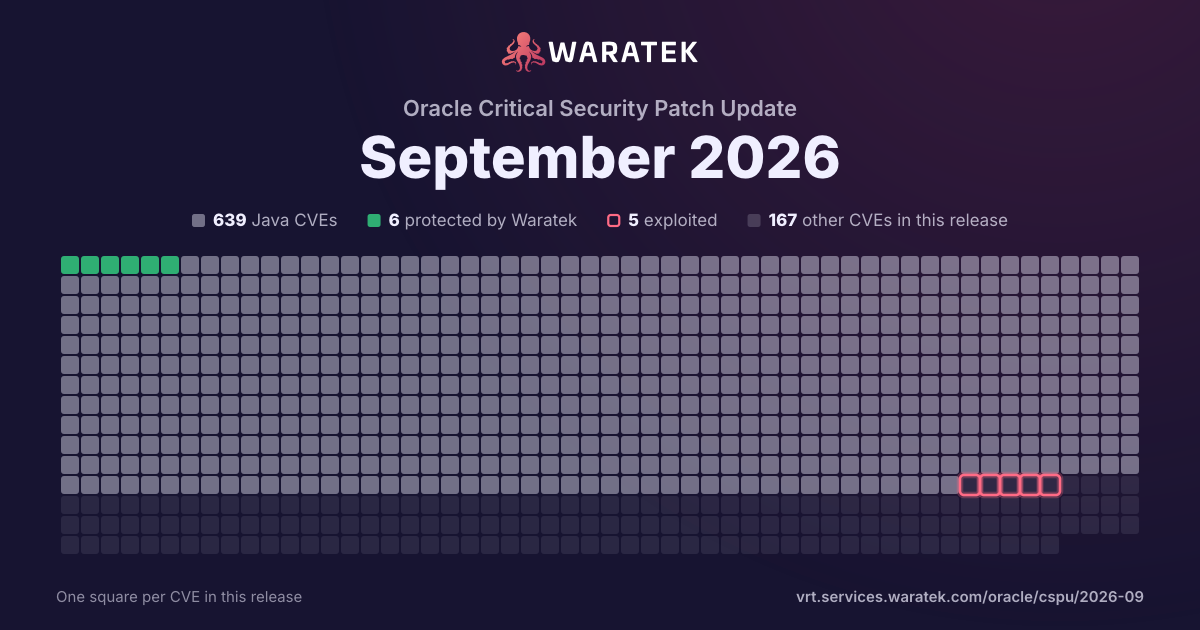
By status
6Protected by Waratek633No exploit published1Outside Waratek scope166Not applicable
5Exploited, marked by the ring
No exploit published. For 596 of them, Oracle's security advisory is the source of public detail.
Protected by Waratek. Waratek RASP can block exploitation of these on systems that have not applied the patch yet.
Overview 54 matches · 0 protected · 0 exploited · 0 CISA KEV · 0 public PoC · 0 EPSS ≥ 0.5
54matches
0protected0.0%
0exploited0.0%
0CISA KEV0.0%
0public PoC0.0%
0EPSS ≥ 0.50.0%
Protected by Waratek
0
0.0%
Rule in development
0
0.0%
Mitigation candidate
0
0.0%
No exploit published
54
100.0%
Outside Waratek scope
0
0.0%
Not applicable
0
0.0%
Withdrawn CVE
0
0.0%
blocked by ARMR today
0
0.0%
partly blocked
0
0.0%
not blocked
54
100.0%
not established
0
0.0%
unrecorded
0
0.0%
Exploited
0
0.0%
Working exploit published
0
0.0%
Proof of concept only
2
3.7%
Forecast only
0
0.0%
No public exploit
52
96.3%
split by
peak 34 / month
Dec 251
No exploit published1
Medium1
not blocked1
No public exploit1
Jan 260
Feb 260
Mar 260
Apr 264
No exploit published4
Medium4
not blocked4
No public exploit4
May 260
Jun 2610
No exploit published10
Medium10
not blocked10
Proof of concept only1
No public exploit9
Jul 265
No exploit published5
Medium5
not blocked5
Proof of concept only1
No public exploit4
Aug 260
Sep 2634
No exploit published34
Medium34
not blocked34
No public exploit34
Dec 25Jan 26Feb 26Mar 26Apr 26May 26Jun 26Jul 26Aug 26Sep 26
| CVE | Severity | Published▾ | Status | Exploitation | Description |
|---|---|---|---|---|---|
| CVE-2026-87253 | Medium | 2026-09-15 | No exploit published | No public exploit | Vulnerability in the Oracle Agile PLM product of Oracle Supply Chain (component: Web Client). The supported version that is affected is 9.3.6. Easily exploitable vulnerability allows unauthenticated attacker with network access via HTTP to compromise Oracle Agile PLM. Successful attacks require human interaction from a person other than the attacker and while the vulnerability is in Oracle Agile PLM, attacks may significantly impact additional products (scope change). Successful attacks of this vulnerability can result in unauthorized update, insert or delete access to some of Oracle Agile PLM accessible data as well as unauthorized read access to a subset of Oracle Agile PLM accessible data. CVSS 3.1 Base Score 6.1 (Confidentiality and Integrity impacts). CVSS Vector: (CVSS:3.1/AV:N/AC:L/PR:N/UI:R/S:C/C:L/I:L/A:N). |
| CVE-2026-87252 | Medium | 2026-09-15 | No exploit published | No public exploit | Vulnerability in the Oracle Agile PLM product of Oracle Supply Chain (component: Application Server). The supported version that is affected is 9.3.6. Difficult to exploit vulnerability allows unauthenticated attacker with access to the physical communication segment attached to the hardware where the Oracle Agile PLM executes to compromise Oracle Agile PLM. Successful attacks of this vulnerability can result in unauthorized creation, deletion or modification access to critical data or all Oracle Agile PLM accessible data as well as unauthorized access to critical data or complete access to all Oracle Agile PLM accessible data. CVSS 3.1 Base Score 6.8 (Confidentiality and Integrity impacts). CVSS Vector: (CVSS:3.1/AV:A/AC:H/PR:N/UI:N/S:U/C:H/I:H/A:N). |
| CVE-2026-87248 | Medium | 2026-09-15 | No exploit published | No public exploit | Vulnerability in the Oracle Hyperion Financial Management product of Oracle Hyperion (component: Security). The supported version that is affected is 11.2.26.0.000. Easily exploitable vulnerability allows high privileged attacker with logon to the infrastructure where Oracle Hyperion Financial Management executes to compromise Oracle Hyperion Financial Management. Successful attacks of this vulnerability can result in takeover of Oracle Hyperion Financial Management. CVSS 3.1 Base Score 6.7 (Confidentiality, Integrity and Availability impacts). CVSS Vector: (CVSS:3.1/AV:L/AC:L/PR:H/UI:N/S:U/C:H/I:H/A:H). |
| CVE-2026-87169 | Medium | 2026-09-15 | No exploit published | No public exploit | Vulnerability in the Oracle Contract Lifecycle Management for Public Sector product of Oracle E-Business Suite (component: Wage Determination Online). Supported versions that are affected are 12.2.3-12.2.15. Easily exploitable vulnerability allows unauthenticated attacker with network access via HTTP to compromise Oracle Contract Lifecycle Management for Public Sector. Successful attacks require human interaction from a person other than the attacker and while the vulnerability is in Oracle Contract Lifecycle Management for Public Sector, attacks may significantly impact additional products (scope change). Successful attacks of this vulnerability can result in unauthorized update, insert or delete access to some of Oracle Contract Lifecycle Management for Public Sector accessible data as well as unauthorized read access to a subset of Oracle Contract Lifecycle Management for Public Sector accessible data. CVSS 3.1 Base Score 6.1 (Confidentiality and Integrity impacts). CVSS Vector: (CVSS:3.1/AV:N/AC:L/PR:N/UI:R/S:C/C:L/I:L/A:N). |
| CVE-2026-83491 | Medium | 2026-09-15 | No exploit published | No public exploit | Vulnerability in the Oracle iRecruitment product of Oracle E-Business Suite (component: Internal Operations). Supported versions that are affected are 12.2.3-12.2.15. Difficult to exploit vulnerability allows unauthenticated attacker with access to the physical communication segment attached to the hardware where the Oracle iRecruitment executes to compromise Oracle iRecruitment. Successful attacks of this vulnerability can result in unauthorized creation, deletion or modification access to critical data or all Oracle iRecruitment accessible data as well as unauthorized access to critical data or complete access to all Oracle iRecruitment accessible data. CVSS 3.1 Base Score 6.8 (Confidentiality and Integrity impacts). CVSS Vector: (CVSS:3.1/AV:A/AC:H/PR:N/UI:N/S:U/C:H/I:H/A:N). |
| CVE-2026-83488 | Medium | 2026-09-15 | No exploit published | No public exploit | Vulnerability in the Helidon product of Oracle Fusion Middleware (component: helidon-microprofile-security). Supported versions that are affected are 4.0.0-4.5.4. Easily exploitable vulnerability allows low privileged attacker with network access via HTTP to compromise Helidon. Successful attacks of this vulnerability can result in unauthorized update, insert or delete access to some of Helidon accessible data as well as unauthorized read access to a subset of Helidon accessible data. CVSS 3.1 Base Score 5.4 (Confidentiality and Integrity impacts). CVSS Vector: (CVSS:3.1/AV:N/AC:L/PR:L/UI:N/S:U/C:L/I:L/A:N). |
| CVE-2026-83480 | Medium | 2026-09-15 | No exploit published | No public exploit | Vulnerability in the Helidon product of Oracle Fusion Middleware (component: WebSocket). Supported versions that are affected are 4.0.0-4.5.4. Easily exploitable vulnerability allows unauthenticated attacker with network access via HTTP to compromise Helidon. Successful attacks of this vulnerability can result in unauthorized ability to cause a partial denial of service (partial DOS) of Helidon. CVSS 3.1 Base Score 5.3 (Availability impacts). CVSS Vector: (CVSS:3.1/AV:N/AC:L/PR:N/UI:N/S:U/C:N/I:N/A:L). |
| CVE-2026-83460 | Medium | 2026-09-15 | No exploit published | No public exploit | Vulnerability in the Helidon product of Oracle Fusion Middleware (component: LRA). Supported versions that are affected are 4.0.0-4.5.4. Easily exploitable vulnerability allows unauthenticated attacker with network access via HTTP to compromise Helidon. Successful attacks of this vulnerability can result in unauthorized update, insert or delete access to some of Helidon accessible data as well as unauthorized read access to a subset of Helidon accessible data. CVSS 3.1 Base Score 6.5 (Confidentiality and Integrity impacts). CVSS Vector: (CVSS:3.1/AV:N/AC:L/PR:N/UI:N/S:U/C:L/I:L/A:N). |
| CVE-2026-83459 | Medium | 2026-09-15 | No exploit published | No public exploit | Vulnerability in the Helidon product of Oracle Fusion Middleware (component: helidon-media-multipart). Supported versions that are affected are 3.0.0-3.2.20. Easily exploitable vulnerability allows unauthenticated attacker with network access via HTTP to compromise Helidon. Successful attacks of this vulnerability can result in unauthorized ability to cause a partial denial of service (partial DOS) of Helidon. CVSS 3.1 Base Score 5.3 (Availability impacts). CVSS Vector: (CVSS:3.1/AV:N/AC:L/PR:N/UI:N/S:U/C:N/I:N/A:L). |
| CVE-2026-83458 | Medium | 2026-09-15 | No exploit published | No public exploit | Vulnerability in the Helidon product of Oracle Fusion Middleware (component: JSON). Supported versions that are affected are 4.0.0-4.5.4. Easily exploitable vulnerability allows unauthenticated attacker with network access via HTTP to compromise Helidon. Successful attacks of this vulnerability can result in unauthorized ability to cause a partial denial of service (partial DOS) of Helidon. CVSS 3.1 Base Score 5.3 (Availability impacts). CVSS Vector: (CVSS:3.1/AV:N/AC:L/PR:N/UI:N/S:U/C:N/I:N/A:L). |
| CVE-2026-83443 | Medium | 2026-09-15 | No exploit published | No public exploit | Vulnerability in the Oracle Assets product of Oracle E-Business Suite (component: Internal Operations). Supported versions that are affected are 12.2.3-12.2.15. Easily exploitable vulnerability allows low privileged attacker with network access via HTTP to compromise Oracle Assets. Successful attacks of this vulnerability can result in unauthorized access to critical data or complete access to all Oracle Assets accessible data. CVSS 3.1 Base Score 6.5 (Confidentiality impacts). CVSS Vector: (CVSS:3.1/AV:N/AC:L/PR:L/UI:N/S:U/C:H/I:N/A:N). |
| CVE-2026-83441 | Medium | 2026-09-15 | No exploit published | No public exploit | Vulnerability in the Oracle Product Hub product of Oracle E-Business Suite (component: Internal Operations). Supported versions that are affected are 12.2.3-12.2.15. Difficult to exploit vulnerability allows low privileged attacker with network access via HTTP to compromise Oracle Product Hub. Successful attacks of this vulnerability can result in unauthorized creation, deletion or modification access to critical data or all Oracle Product Hub accessible data as well as unauthorized access to critical data or complete access to all Oracle Product Hub accessible data. CVSS 3.1 Base Score 6.8 (Confidentiality and Integrity impacts). CVSS Vector: (CVSS:3.1/AV:N/AC:H/PR:L/UI:N/S:U/C:H/I:H/A:N). |
| CVE-2026-83433 | Medium | 2026-09-15 | No exploit published | No public exploit | Vulnerability in the Oracle Depot Repair product of Oracle E-Business Suite (component: Depot Repair Diagnostics). Supported versions that are affected are 12.2.3-12.2.15. Easily exploitable vulnerability allows high privileged attacker with network access via HTTP to compromise Oracle Depot Repair. Successful attacks of this vulnerability can result in unauthorized creation, deletion or modification access to critical data or all Oracle Depot Repair accessible data as well as unauthorized access to critical data or complete access to all Oracle Depot Repair accessible data. CVSS 3.1 Base Score 6.5 (Confidentiality and Integrity impacts). CVSS Vector: (CVSS:3.1/AV:N/AC:L/PR:H/UI:N/S:U/C:H/I:H/A:N). |
| CVE-2026-83431 | Medium | 2026-09-15 | No exploit published | No public exploit | Vulnerability in the Oracle Product Workbench product of Oracle E-Business Suite (component: WebUI). Supported versions that are affected are 12.2.3-12.2.15. Easily exploitable vulnerability allows low privileged attacker with network access via HTTP to compromise Oracle Product Workbench. Successful attacks require human interaction from a person other than the attacker and while the vulnerability is in Oracle Product Workbench, attacks may significantly impact additional products (scope change). Successful attacks of this vulnerability can result in unauthorized update, insert or delete access to some of Oracle Product Workbench accessible data as well as unauthorized read access to a subset of Oracle Product Workbench accessible data. CVSS 3.1 Base Score 5.4 (Confidentiality and Integrity impacts). CVSS Vector: (CVSS:3.1/AV:N/AC:L/PR:L/UI:R/S:C/C:L/I:L/A:N). |
| CVE-2026-83419 | Medium | 2026-09-15 | No exploit published | No public exploit | Vulnerability in the Oracle Communications Cloud Native Core Security Edge Protection Proxy product of Oracle Communications (component: SEPP). Supported versions that are affected are 26.1.200 and 25.2.201. Easily exploitable vulnerability allows low privileged attacker with network access via HTTP to compromise Oracle Communications Cloud Native Core Security Edge Protection Proxy. Successful attacks of this vulnerability can result in unauthorized update, insert or delete access to some of Oracle Communications Cloud Native Core Security Edge Protection Proxy accessible data as well as unauthorized read access to a subset of Oracle Communications Cloud Native Core Security Edge Protection Proxy accessible data. CVSS 3.1 Base Score 5.4 (Confidentiality and Integrity impacts). CVSS Vector: (CVSS:3.1/AV:N/AC:L/PR:L/UI:N/S:U/C:L/I:L/A:N). |
| CVE-2026-83416 | Medium | 2026-09-15 | No exploit published | No public exploit | Vulnerability in the Oracle Coherence product of Oracle Fusion Middleware (component: Core). Supported versions that are affected are 12.2.1.4.0, 14.1.1.0.0, 14.1.2.0.0 and 15.1.1.0.0. Easily exploitable vulnerability allows low privileged attacker with network access via HTTP to compromise Oracle Coherence. Successful attacks of this vulnerability can result in unauthorized ability to cause a partial denial of service (partial DOS) of Oracle Coherence. CVSS 3.1 Base Score 4.3 (Availability impacts). CVSS Vector: (CVSS:3.1/AV:N/AC:L/PR:L/UI:N/S:U/C:N/I:N/A:L). |
| CVE-2026-83354 | Medium | 2026-09-15 | No exploit published | No public exploit | Vulnerability in the Oracle Coherence product of Oracle Fusion Middleware (component: Core). The supported version that is affected is 15.1.1.0.0. Difficult to exploit vulnerability allows low privileged attacker with network access via HTTP to compromise Oracle Coherence. While the vulnerability is in Oracle Coherence, attacks may significantly impact additional products (scope change). Successful attacks of this vulnerability can result in unauthorized access to critical data or complete access to all Oracle Coherence accessible data. CVSS 3.1 Base Score 6.3 (Confidentiality impacts). CVSS Vector: (CVSS:3.1/AV:N/AC:H/PR:L/UI:N/S:C/C:H/I:N/A:N). |
| CVE-2026-83346 | Medium | 2026-09-15 | No exploit published | No public exploit | Vulnerability in the Oracle Fusion Middleware Control product of Oracle Fusion Middleware (component: Framework). Supported versions that are affected are 12.2.1.4.0 and 14.1.2.0.0. Easily exploitable vulnerability allows low privileged attacker with network access via HTTP to compromise Oracle Fusion Middleware Control. Successful attacks require human interaction from a person other than the attacker and while the vulnerability is in Oracle Fusion Middleware Control, attacks may significantly impact additional products (scope change). Successful attacks of this vulnerability can result in unauthorized update, insert or delete access to some of Oracle Fusion Middleware Control accessible data as well as unauthorized read access to a subset of Oracle Fusion Middleware Control accessible data. CVSS 3.1 Base Score 5.4 (Confidentiality and Integrity impacts). CVSS Vector: (CVSS:3.1/AV:N/AC:L/PR:L/UI:R/S:C/C:L/I:L/A:N). |
| CVE-2026-83279 | Medium | 2026-09-15 | No exploit published | No public exploit | Vulnerability in the Oracle Agile PLM MCAD Connector product of Oracle Supply Chain (component: CAX Client). The supported version that is affected is 3.6. Easily exploitable vulnerability allows low privileged attacker with logon to the infrastructure where Oracle Agile PLM MCAD Connector executes to compromise Oracle Agile PLM MCAD Connector. Successful attacks of this vulnerability can result in unauthorized access to critical data or complete access to all Oracle Agile PLM MCAD Connector accessible data. CVSS 3.1 Base Score 5.5 (Confidentiality impacts). CVSS Vector: (CVSS:3.1/AV:L/AC:L/PR:L/UI:N/S:U/C:H/I:N/A:N). |
| CVE-2026-83278 | Medium | 2026-09-15 | No exploit published | No public exploit | Vulnerability in the Helidon product of Oracle Fusion Middleware (component: helidon-integrations-neo4j). Supported versions that are affected are 3.0.0-3.2.20 and 4.0.0-4.5.4. Difficult to exploit vulnerability allows unauthenticated attacker with access to the physical communication segment attached to the hardware where the Helidon executes to compromise Helidon. Successful attacks of this vulnerability can result in unauthorized creation, deletion or modification access to critical data or all Helidon accessible data as well as unauthorized access to critical data or complete access to all Helidon accessible data. CVSS 3.1 Base Score 6.8 (Confidentiality and Integrity impacts). CVSS Vector: (CVSS:3.1/AV:A/AC:H/PR:N/UI:N/S:U/C:H/I:H/A:N). |
| CVE-2026-83274 | Medium | 2026-09-15 | No exploit published | No public exploit | Vulnerability in the Oracle Agile PLM MCAD Connector product of Oracle Supply Chain (component: CAX Client). The supported version that is affected is 3.6. Easily exploitable vulnerability allows low privileged attacker with logon to the infrastructure where Oracle Agile PLM MCAD Connector executes to compromise Oracle Agile PLM MCAD Connector. Successful attacks of this vulnerability can result in unauthorized access to critical data or complete access to all Oracle Agile PLM MCAD Connector accessible data. CVSS 3.1 Base Score 5.5 (Confidentiality impacts). CVSS Vector: (CVSS:3.1/AV:L/AC:L/PR:L/UI:N/S:U/C:H/I:N/A:N). |
| CVE-2026-83251 | Medium | 2026-09-15 | No exploit published | No public exploit | Vulnerability in the Oracle Commerce Guided Search / Oracle Commerce Experience Manager product of Oracle Commerce (component: Forge). The supported version that is affected is 11.4.0. Difficult to exploit vulnerability allows unauthenticated attacker with network access via TLS to compromise Oracle Commerce Guided Search / Oracle Commerce Experience Manager. Successful attacks of this vulnerability can result in unauthorized ability to cause a hang or frequently repeatable crash (complete DOS) of Oracle Commerce Guided Search / Oracle Commerce Experience Manager and unauthorized read access to a subset of Oracle Commerce Guided Search / Oracle Commerce Experience Manager accessible data. CVSS 3.1 Base Score 6.5 (Confidentiality and Availability impacts). CVSS Vector: (CVSS:3.1/AV:N/AC:H/PR:N/UI:N/S:U/C:L/I:N/A:H). |
| CVE-2026-83250 | Medium | 2026-09-15 | No exploit published | No public exploit | Vulnerability in the Oracle Commerce Guided Search / Oracle Commerce Experience Manager product of Oracle Commerce (component: Forge). The supported version that is affected is 11.4.0. Difficult to exploit vulnerability allows unauthenticated attacker with network access via HTTP to compromise Oracle Commerce Guided Search / Oracle Commerce Experience Manager. Successful attacks of this vulnerability can result in unauthorized access to critical data or complete access to all Oracle Commerce Guided Search / Oracle Commerce Experience Manager accessible data and unauthorized ability to cause a partial denial of service (partial DOS) of Oracle Commerce Guided Search / Oracle Commerce Experience Manager. CVSS 3.1 Base Score 6.5 (Confidentiality and Availability impacts). CVSS Vector: (CVSS:3.1/AV:N/AC:H/PR:N/UI:N/S:U/C:H/I:N/A:L). |
| CVE-2026-83200 | Medium | 2026-09-15 | No exploit published | No public exploit | Vulnerability in the Oracle Process Manufacturing Intelligence product of Oracle E-Business Suite (component: Internal Operations). Supported versions that are affected are 12.2.3-12.2.15. Easily exploitable vulnerability allows low privileged attacker with network access via Oracle Net to compromise Oracle Process Manufacturing Intelligence. Successful attacks of this vulnerability can result in unauthorized access to critical data or complete access to all Oracle Process Manufacturing Intelligence accessible data. CVSS 3.1 Base Score 6.5 (Confidentiality impacts). CVSS Vector: (CVSS:3.1/AV:N/AC:L/PR:L/UI:N/S:U/C:H/I:N/A:N). |
| CVE-2026-83198 | Medium | 2026-09-15 | No exploit published | No public exploit | Vulnerability in the Oracle Field Service product of Oracle E-Business Suite (component: Internal Operations). Supported versions that are affected are 12.2.3-12.2.15. Easily exploitable vulnerability allows low privileged attacker with network access via HTTP to compromise Oracle Field Service. Successful attacks require human interaction from a person other than the attacker and while the vulnerability is in Oracle Field Service, attacks may significantly impact additional products (scope change). Successful attacks of this vulnerability can result in unauthorized update, insert or delete access to some of Oracle Field Service accessible data as well as unauthorized read access to a subset of Oracle Field Service accessible data. CVSS 3.1 Base Score 5.4 (Confidentiality and Integrity impacts). CVSS Vector: (CVSS:3.1/AV:N/AC:L/PR:L/UI:R/S:C/C:L/I:L/A:N). |
| CVE-2026-83175 | Medium | 2026-09-15 | No exploit published | No public exploit | Vulnerability in the Oracle Application Object Library product of Oracle E-Business Suite (component: Core). Supported versions that are affected are 12.2.3-12.2.15. Easily exploitable vulnerability allows low privileged attacker with network access via HTTP to compromise Oracle Application Object Library. Successful attacks of this vulnerability can result in unauthorized access to critical data or complete access to all Oracle Application Object Library accessible data. CVSS 3.1 Base Score 6.5 (Confidentiality impacts). CVSS Vector: (CVSS:3.1/AV:N/AC:L/PR:L/UI:N/S:U/C:H/I:N/A:N). |
| CVE-2026-83140 | Medium | 2026-09-15 | No exploit published | No public exploit | Vulnerability in the Oracle Field Service product of Oracle E-Business Suite (component: Internal Operations). Supported versions that are affected are 12.2.3-12.2.15. Easily exploitable vulnerability allows low privileged attacker with network access via HTTP to compromise Oracle Field Service. Successful attacks of this vulnerability can result in unauthorized access to critical data or complete access to all Oracle Field Service accessible data. CVSS 3.1 Base Score 6.5 (Confidentiality impacts). CVSS Vector: (CVSS:3.1/AV:N/AC:L/PR:L/UI:N/S:U/C:H/I:N/A:N). |
| CVE-2026-83109 | Medium | 2026-09-15 | No exploit published | No public exploit | Vulnerability in the Oracle Forms product of Oracle Fusion Middleware (component: Forms Services, C/S, Charmode). Supported versions that are affected are 12.2.1.19.0 and 14.1.2.0.0. Easily exploitable vulnerability allows unauthenticated attacker with network access via HTTP to compromise Oracle Forms. Successful attacks of this vulnerability can result in unauthorized read access to a subset of Oracle Forms accessible data. CVSS 3.1 Base Score 5.3 (Confidentiality impacts). CVSS Vector: (CVSS:3.1/AV:N/AC:L/PR:N/UI:N/S:U/C:L/I:N/A:N). |
| CVE-2026-83097 | Medium | 2026-09-15 | No exploit published | No public exploit | Vulnerability in the Oracle Forms product of Oracle Fusion Middleware (component: Forms Services, C/S, Charmode). Supported versions that are affected are 12.2.1.19.0 and 14.1.2.0.0. Easily exploitable vulnerability allows high privileged attacker with network access via HTTP to compromise Oracle Forms. Successful attacks of this vulnerability can result in unauthorized creation, deletion or modification access to critical data or all Oracle Forms accessible data and unauthorized ability to cause a hang or frequently repeatable crash (complete DOS) of Oracle Forms. CVSS 3.1 Base Score 6.5 (Integrity and Availability impacts). CVSS Vector: (CVSS:3.1/AV:N/AC:L/PR:H/UI:N/S:U/C:N/I:H/A:H). |
| CVE-2026-83077 | Medium | 2026-09-15 | No exploit published | No public exploit | Vulnerability in the Siebel CRM Cloud Applications product of Oracle Siebel CRM (component: Siebel Cloud Manager). Supported versions that are affected are 22.3-26.7. Easily exploitable vulnerability allows low privileged attacker with network access via HTTP to compromise Siebel CRM Cloud Applications. While the vulnerability is in Siebel CRM Cloud Applications, attacks may significantly impact additional products (scope change). Successful attacks of this vulnerability can result in unauthorized update, insert or delete access to some of Siebel CRM Cloud Applications accessible data as well as unauthorized read access to a subset of Siebel CRM Cloud Applications accessible data. CVSS 3.1 Base Score 6.4 (Confidentiality and Integrity impacts). CVSS Vector: (CVSS:3.1/AV:N/AC:L/PR:L/UI:N/S:C/C:L/I:L/A:N). |
| CVE-2026-83076 | Medium | 2026-09-15 | No exploit published | No public exploit | Vulnerability in the Oracle HR Intelligence product of Oracle E-Business Suite (component: Internal Operations). Supported versions that are affected are 12.2.3-12.2.15. Difficult to exploit vulnerability allows low privileged attacker with network access via HTTP to compromise Oracle HR Intelligence. Successful attacks of this vulnerability can result in unauthorized creation, deletion or modification access to critical data or all Oracle HR Intelligence accessible data and unauthorized ability to cause a hang or frequently repeatable crash (complete DOS) of Oracle HR Intelligence. CVSS 3.1 Base Score 6.8 (Integrity and Availability impacts). CVSS Vector: (CVSS:3.1/AV:N/AC:H/PR:L/UI:N/S:U/C:N/I:H/A:H). |
| CVE-2026-73965 | Medium | 2026-09-15 | No exploit published | No public exploit | Vulnerability in the Siebel CRM Deployment product of Oracle Siebel CRM (component: Cloud Gateway). Supported versions that are affected are 17.0-26.7. Difficult to exploit vulnerability allows low privileged attacker with network access via HTTP to compromise Siebel CRM Deployment. Successful attacks of this vulnerability can result in unauthorized creation, deletion or modification access to critical data or all Siebel CRM Deployment accessible data as well as unauthorized access to critical data or complete access to all Siebel CRM Deployment accessible data. CVSS 3.1 Base Score 6.8 (Confidentiality and Integrity impacts). CVSS Vector: (CVSS:3.1/AV:N/AC:H/PR:L/UI:N/S:U/C:H/I:H/A:N). |
| CVE-2026-70755 | Medium | 2026-09-15 | No exploit published | No public exploit | Vulnerability in the Oracle Web Applications Desktop Integrator product of Oracle E-Business Suite (component: File download). Supported versions that are affected are 12.2.3-12.2.15. Easily exploitable vulnerability allows low privileged attacker with network access via HTTP to compromise Oracle Web Applications Desktop Integrator. Successful attacks of this vulnerability can result in unauthorized access to critical data or complete access to all Oracle Web Applications Desktop Integrator accessible data. CVSS 3.1 Base Score 6.5 (Confidentiality impacts). CVSS Vector: (CVSS:3.1/AV:N/AC:L/PR:L/UI:N/S:U/C:H/I:N/A:N). |
| CVE-2026-62597 | Medium | 2026-09-15 | No exploit published | No public exploit | Vulnerability in the Oracle Enterprise Manager Base Platform product of Oracle Enterprise Manager (component: Event Management). Supported versions that are affected are 13.5 and 24.1. Easily exploitable vulnerability allows low privileged attacker with network access via SOAP to compromise Oracle Enterprise Manager Base Platform. Successful attacks of this vulnerability can result in unauthorized creation, deletion or modification access to critical data or all Oracle Enterprise Manager Base Platform accessible data. CVSS 3.1 Base Score 6.5 (Integrity impacts). CVSS Vector: (CVSS:3.1/AV:N/AC:L/PR:L/UI:N/S:U/C:N/I:H/A:N). |
| CVE-2026-59899 | Medium | 2026-07-29 | No exploit published | No public exploit | Netty is an asynchronous, event-driven network application framework. Prior to versions 4.1.136.Final and 4.2.16.Final, `HttpContentEncoder` (the superclass of the production handler `HttpContentCompressor`) maintains a per-channel `ArrayDeque<CharSequence>` named `acceptEncodingQueue` that accumulates attacker-controlled data without any size limit. The queue is filled on the I/O thread for every inbound HTTP request and drained only when the application later writes a non-1xx response. This creates a resource exhaustion vulnerability when an attacker exploits HTTP/1.1 pipelining to flood the connection with requests faster than the application produces responses. This issue has been fixed in versions 4.1.136.Final and 4.2.16.Final. |
| CVE-2026-59898 | Medium | 2026-07-29 | No exploit published | No public exploit | Netty is an asynchronous, event-driven network application framework. Prior to versions 4.1.136.Final and 4.2.16.Final, ab attacker can force WebSocket upgrade via the lax V07 (or V08) handshaker by sending `Sec-WebSocket-Version: 7` and omitting `Connection: Upgrade` / `Upgrade: websocket` headers, completing a protocol switch that a proxy would not recognize as an Upgrade request and enabling HTTP request smuggling / protocol-confusion attacks. This issue has been fixed in versions 4.1.136.Final and 4.2.16.Final. |
| CVE-2026-59921 | Medium | 2026-07-28 | No exploit published | Proof of concept only | Netty is an asynchronous, event-driven network application framework. Prior to versions 4.1.136.Final and 4.2.16.Final, HttpPostRequestEncoder constructs multipart HTTP request bodies by directly concatenating user-supplied filenames and field names into Content-Disposition MIME headers without validating or sanitizing CRLF characters (\r\n). Since MIME headers are delimited by CRLF, an attacker who controls the filename can inject arbitrary MIME headers into the multipart body part. The root cause is that neither the encoder nor the FileUpload implementations' setFilename() methods, which only check for null, neutralize CRLF characters before the filename is embedded into the header. This issue has been fixed in versions 4.1.136.Final and 4.2.16.Final. |
| CVE-2026-56746 | Medium | 2026-07-21 | No exploit published | No public exploit | Netty is a network application framework for development of protocol servers and clients. Versions 4.2.0.Final through 4.2.15.Final and 4.1.0.Final through 4.1.135.Final, are vulnerable to security control bypass during the origin evaluation process. CorsHandler provides a shortCircuit() configuration designed to reject unauthorized cross-origin requests immediately, acting as a security control before requests reach the application. However, due to a logical operator error in the origin evaluation process, this protection can be entirely bypassed. An attacker can bypass the short-circuit mechanism by sending a request with an Origin: null header. This failure forwards unauthorized requests to the backend application, bypassing intended access controls. This issue is fixed in versions 4.1.136.Final and 4.2.16.Final. |
| CVE-2026-49844 | Medium | 2026-07-10 | No exploit published | No public exploit | Improper encoding of non-finite floating-point values during MapMessage JSON serialization in Apache Log4j API produces output that is not valid JSON. This issue affects Apache Log4j API versions 2.13.1 through 2.25.4 and version 2.26.0. The fix for CVE-2026-34481 did not cover all code paths: when a MapMessage contains a non-finite IEEE 754 value (NaN, Infinity, or -Infinity), MapMessage.asJson() emits the corresponding bare token. RFC 8259 does not permit these tokens, so a conformant parser rejects the resulting document. The defect is reachable only when both of the following conditions hold: * The application uses the message resolver https://logging.apache.org/log4j/2.x/manual/json-template-layout.html#event-template-resolver-message of JsonTemplateLayout or any other layout that relies on MapMessage.asJson() or MapMessage.getFormattedMessage(new String[]{"JSON"}). * The application logs a MapMessage that contains an attacker-controlled floating-point value. An attacker who can supply a non-finite value can cause the affected layout to emit malformed JSON, which may corrupt the enclosing log record or disrupt downstream log ingestion and parsing. Users are advised to upgrade to Apache Log4j API 2.25.5 or 2.26.1, both of which emit RFC 8259-compliant JSON for non-finite values. |
| CVE-2026-55956 | Medium | 2026-06-29 | No exploit published | No public exploit | Improper Authorization vulnerability in Apache Tomcat leads to security constraints specified for the default servlet ignoring any method or method omission configured as part of the constraint. This issue affects Apache Tomcat: from 11.0.0-M1 through 11.0.22, from 10.1.0-M1 through 10.1.55, from 9.0.0.M1 through 9.0.118, from 8.5.0 through 8.5.100, from 7.0.0 through 7.0.109. Other versions that have reached end of support may also be affected. Users are recommended to upgrade to version 11.0.23, 10.1.56 or 9.0.119, which fix the issue. |
| CVE-2026-55955 | Medium | 2026-06-29 | No exploit published | No public exploit | Improper Authentication vulnerability in Apache Tomcat allowed a replay attack against the EncryptionInterceptor in the cluster component. This issue affects Apache Tomcat: from 11.0.0-M1 through 11.0.22, from 10.1.0-M1 through 10.1.55, from 9.0.13 through 9.0.18, from 8.5.38 through 8.5.100, from 7.0.100 through 7.0.109. Users are recommended to upgrade to version 11.0.23, 10.1.56, 9.0.119, which fixes the issue. |
| CVE-2026-54518 | Medium | 2026-06-23 | No exploit published | No public exploit | jackson-databind contains the general-purpose data-binding functionality and tree-model for Jackson Data Processor. From 2.21.0 until 2.21.4 and 3.1.4, UnwrappedPropertyHandler.processUnwrappedCreatorProperties() replays buffered JSON into creator parameters but never consults prop.visibleInView(activeView). The normal property-based creator path gates creator properties on the active view, but this unwrapped-creator replay path bypasses that check, so a constructor parameter annotated with both @JsonView(AdminView.class) and @JsonUnwrapped is populated from attacker JSON even when a more restrictive view is active. This vulnerability is fixed in 2.21.4 and 3.1.4. |
| CVE-2026-54517 | Medium | 2026-06-23 | No exploit published | No public exploit | jackson-databind contains the general-purpose data-binding functionality and tree-model for Jackson Data Processor. From 2.21.0 until 2.21.4 and 3.1.4, in BeanDeserializer._deserializeUsingPropertyBased, the active-view (@JsonView) filter was applied only to creator properties; the regular property-buffering branch performed no prop.visibleInView(activeView) check. A change making SetterlessProperty.isMerging() return true routed setterless Collection/Map properties through this unguarded path, so a setterless collection annotated with a restricted @JsonView is populated from attacker JSON even when the active view excludes it. This vulnerability is fixed in 2.21.4 and 3.1.4. |
| CVE-2026-54516 | Medium | 2026-06-23 | No exploit published | No public exploit | jackson-databind contains the general-purpose data-binding functionality and tree-model for Jackson Data Processor. From 2.21.0 until 2.21.4 and 3.1.4, POJOPropertiesCollector._renameProperties() allows a property with @JsonProperty("renamed") on the getter and @JsonIgnore on the setter to be renamed rather than dropped. With MapperFeature.INFER_PROPERTY_MUTATORS enabled (default), the private backing field is retained; during deserialization BeanDeserializerFactory.addBeanProps() sees hasField()==true, builds a FieldProperty, and makes the backing field writable. An attacker supplying the renamed JSON key writes the backing field directly, bypassing the @JsonIgnore on the setter. This vulnerability is fixed in 3.1.4. |
| CVE-2026-54515 | Medium | 2026-06-23 | No exploit published | No public exploit | jackson-databind contains the general-purpose data-binding functionality and tree-model for Jackson Data Processor. From 2.8.0 until 2.18.9, 2.21.5, and 3.1.4, in BeanDeserializerBase.createContextual(), per-property @JsonIgnoreProperties exclusions are applied by _handleByNameInclusion(), producing a contextual deserializer whose BeanPropertyMap has the ignored properties removed. The subsequent per-property case-insensitivity block (triggered by @JsonFormat(ACCEPT_CASE_INSENSITIVE_PROPERTIES)) rebuilds from this._beanProperties (the original, unfiltered map) instead of contextual._beanProperties, then overwrites the filtered map — restoring every property _handleByNameInclusion had just removed. The ignored property becomes writable again. This vulnerability is fixed in 2.18.9, 2.21.5, and 3.1.4. |
| CVE-2026-54514 | Medium | 2026-06-23 | No exploit published | No public exploit | jackson-databind contains the general-purpose data-binding functionality and tree-model for Jackson Data Processor. From 2.0.0 until 2.18.8, 2.21.4, and 3.1.4, JDKFromStringDeserializer constructed InetSocketAddress with new InetSocketAddress(host, port), which performs eager DNS name resolution for hostname inputs at deserialization time. An application that binds untrusted JSON into a type containing an InetSocketAddress field issues an attacker-chosen DNS query during readValue, before any application-level validation or connect logic. The fix uses InetSocketAddress.createUnresolved(host, port), deferring DNS to an explicit connect. This vulnerability is fixed in 2.18.8, 2.21.4, and 3.1.4. |
| CVE-2026-50020 | Medium | 2026-06-12 | No exploit published | Proof of concept only | Netty is a network application framework for development of protocol servers and clients. Prior to versions 4.1.135.Final and 4.2.15.Final, before reading the first request-line, `HttpObjectDecoder` skips every byte for which `Character.isISOControl(b)` is `true` (0x00–0x1F and 0x7F) as well as all whitespace. RFC 9112 §2.2 only asks servers to ignore empty CRLF lines preceding the request-line — a carefully scoped robustness allowance intended to handle HTTP/1.0 POST workarounds. Silently absorbing NUL bytes, SOH, STX, and other non-CRLF control characters goes significantly beyond this, and can be exploited for request-boundary confusion in pipelined or multiplexed transports where a front-end component treats those bytes differently. Versions 4.1.135.Final and 4.2.15.Final patch the issue. |
| CVE-2026-45673 | Medium | 2026-06-12 | No exploit published | No public exploit | Netty is a network application framework for development of protocol servers and clients. Prior to versions 4.1.135.Final and 4.2.15.Final, Netty's DNS resolver uses a predictable PRNG for generating DNS transaction IDs and defaults to a static UDP source port. This combination reduces the entropy of DNS queries, enabling DNS Cache Poisoning (Kaminsky attack). Versions 4.1.135.Final and 4.2.15.Final patch the issue. |
| CVE-2026-45536 | Medium | 2026-06-12 | No exploit published | No public exploit | Netty is a network application framework for development of protocol servers and clients. Prior to versions 4.1.135.Final and 4.2.15.Final, netty_unix_socket_recvFd sets msg_control to `char control[CMSG_SPACE(sizeof(int))]` (line 940) — 24 bytes on 64-bit Linux. A peer-sent SCM_RIGHTS cmsg carrying two ints has cmsg_len = CMSG_LEN(8) = 24, which fits exactly with no MSG_CTRUNC, so the kernel installs both fds in the receiving process. The subsequent check `cmsg->cmsg_len == CMSG_LEN(sizeof(int))` (line 972, expected 20) fails, the branch that would read the fd is skipped, and neither installed fd is closed. The for(;;) loop calls recvmsg again (non-blocking → EAGAIN → Java maps to 0 → read loop exits normally), leaving two leaked fds per message. There is no MSG_CTRUNC handling. Reachable via Epoll/KQueue DomainSocketChannel when the application opts into DomainSocketReadMode.FILE_DESCRIPTORS (non-default). Versions 4.1.135.Final and 4.2.15.Final patch the issue. |
| CVE-2026-34480 | Medium | 2026-04-10 | No exploit published | No public exploit | Apache Log4j Core's XmlLayout https://logging.apache.org/log4j/2.x/manual/layouts.html#XmlLayout , in versions up to and including 2.25.3, fails to sanitize characters forbidden by the XML 1.0 specification https://www.w3.org/TR/xml/#charsets producing invalid XML output whenever a log message or MDC value contains such characters. The impact depends on the StAX implementation in use: * JRE built-in StAX: Forbidden characters are silently written to the output, producing malformed XML. Conforming parsers must reject such documents with a fatal error, which may cause downstream log-processing systems to drop the affected records. * Alternative StAX implementations (e.g., Woodstox https://github.com/FasterXML/woodstox , a transitive dependency of the Jackson XML Dataformat module): An exception is thrown during the logging call, and the log event is never delivered to its intended appender, only to Log4j's internal status logger. Users are advised to upgrade to Apache Log4j Core 2.25.4, which corrects this issue by sanitizing forbidden characters before XML output. |
| CVE-2026-34479 | Medium | 2026-04-10 | No exploit published | No public exploit | The Log4j1XmlLayout from the Apache Log4j 1-to-Log4j 2 bridge fails to escape characters forbidden by the XML 1.0 standard, producing malformed XML output. Conforming XML parsers are required to reject documents containing such characters with a fatal error, which may cause downstream log processing systems to drop or fail to index affected records. Two groups of users are affected: * Those using Log4j1XmlLayout directly in a Log4j Core 2 configuration file. * Those using the Log4j 1 configuration compatibility layer with org.apache.log4j.xml.XMLLayout specified as the layout class. Users are advised to upgrade to Apache Log4j 1-to-Log4j 2 bridge version 2.25.4, which corrects this issue. Note: The Apache Log4j 1-to-Log4j 2 bridge is deprecated and will not be present in Log4j 3. Users are encouraged to consult the Log4j 1 to Log4j 2 migration guide https://logging.apache.org/log4j/2.x/migrate-from-log4j1.html , and specifically the section on eliminating reliance on the bridge. |
| CVE-2026-34478 | Medium | 2026-04-10 | No exploit published | No public exploit | Apache Log4j Core's Rfc5424Layout https://logging.apache.org/log4j/2.x/manual/layouts.html#RFC5424Layout , in versions 2.21.0 through 2.25.3, is vulnerable to log injection via CRLF sequences due to undocumented renames of security-relevant configuration attributes. Two distinct issues affect users of stream-based syslog services who configure Rfc5424Layout directly: * The newLineEscape attribute was silently renamed, causing newline escaping to stop working for users of TCP framing (RFC 6587), exposing them to CRLF injection in log output. * The useTlsMessageFormat attribute was silently renamed, causing users of TLS framing (RFC 5425) to be silently downgraded to unframed TCP (RFC 6587), without newline escaping. Users of the SyslogAppender are not affected, as its configuration attributes were not modified. Users are advised to upgrade to Apache Log4j Core 2.25.4, which corrects this issue. |
| CVE-2026-34477 | Medium | 2026-04-10 | No exploit published | No public exploit | The fix for CVE-2025-68161 https://logging.apache.org/security.html#CVE-2025-68161 was incomplete: it addressed hostname verification only when enabled via the log4j2.sslVerifyHostName https://logging.apache.org/log4j/2.x/manual/systemproperties.html#log4j2.sslVerifyHostName system property, but not when configured through the verifyHostName https://logging.apache.org/log4j/2.x/manual/appenders/network.html#SslConfiguration-attr-verifyHostName attribute of the <Ssl> element. Although the verifyHostName configuration attribute was introduced in Log4j Core 2.12.0, it was silently ignored in all versions through 2.25.3, leaving TLS connections vulnerable to interception regardless of the configured value. A network-based attacker may be able to perform a man-in-the-middle attack when all of the following conditions are met: * An SMTP, Socket, or Syslog appender is in use. * TLS is configured via a nested <Ssl> element. * The attacker can present a certificate issued by a CA trusted by the appender's configured trust store, or by the default Java trust store if none is configured. This issue does not affect users of the HTTP appender, which uses a separate verifyHostname https://logging.apache.org/log4j/2.x/manual/appenders/network.html#HttpAppender-attr-verifyHostName attribute that was not subject to this bug and verifies host names by default. Users are advised to upgrade to Apache Log4j Core 2.25.4, which corrects this issue. |
| CVE-2025-68161 | Medium | 2025-12-18 | No exploit published | No public exploit | The Socket Appender in Apache Log4j Core versions 2.0-beta9 through 2.25.2 does not perform TLS hostname verification of the peer certificate, even when the verifyHostName https://logging.apache.org/log4j/2.x/manual/appenders/network.html#SslConfiguration-attr-verifyHostName configuration attribute or the log4j2.sslVerifyHostName https://logging.apache.org/log4j/2.x/manual/systemproperties.html#log4j2.sslVerifyHostName system property is set to true. This issue may allow a man-in-the-middle attacker to intercept or redirect log traffic under the following conditions: * The attacker is able to intercept or redirect network traffic between the client and the log receiver. * The attacker can present a server certificate issued by a certification authority trusted by the Socket Appender’s configured trust store (or by the default Java trust store if no custom trust store is configured). Users are advised to upgrade to Apache Log4j Core version 2.25.3, which addresses this issue. As an alternative mitigation, the Socket Appender may be configured to use a private or restricted trust root to limit the set of trusted certificates. |