
Oracle Critical Security Patch Update September 2026
Released September 2026 · Oracle's advisory ↗ · ← Security Patch Update, August 2026 · Critical Patch Update, October 2026 →
806 CVEs in this release, one square each
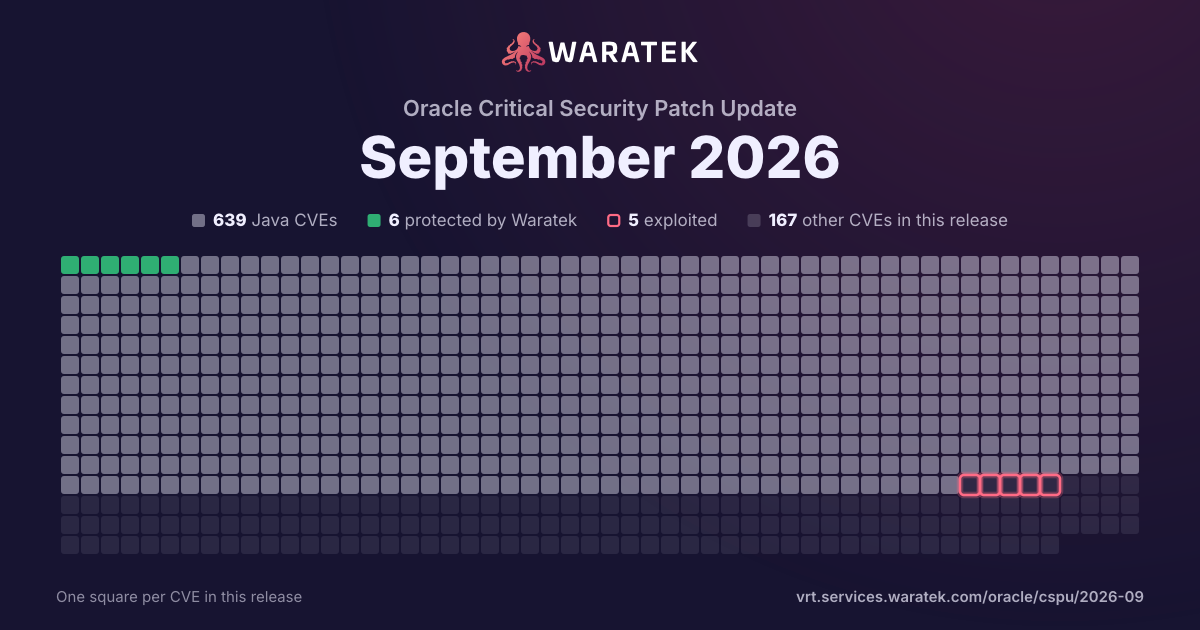
By status
6Protected by Waratek633No exploit published1Outside Waratek scope166Not applicable
5Exploited, marked by the ring
No exploit published. For 596 of them, Oracle's security advisory is the source of public detail.
Protected by Waratek. Waratek RASP can block exploitation of these on systems that have not applied the patch yet.
Overview 135 matches · 56 in Waratek scope · 2 protected · 1 exploited · 0 CISA KEV · 3 public PoC · 1 EPSS ≥ 0.5
135matches
56in Waratek scope41.5%
2protected1.5%
1exploited0.7%
0CISA KEV0.0%
3public PoC2.2%
1EPSS ≥ 0.50.7%
Protected by Waratek
2
1.5%
Rule in development
0
0.0%
Mitigation candidate
0
0.0%
No exploit published
54
40.0%
Outside Waratek scope
1
0.7%
Not applicable
78
57.8%
Withdrawn CVE
0
0.0%
blocked by ARMR today
2
1.5%
partly blocked
0
0.0%
not blocked
133
98.5%
not established
0
0.0%
unrecorded
0
0.0%
split by
peak 102 / quarter
Q4 232
Outside Waratek scope1
Not applicable1
Medium2
not blocked2
Exploited1
No public exploit1
Q1 240
Q2 240
Q3 240
Q4 240
Q1 250
Q2 250
Q3 250
Q4 251
No exploit published1
Medium1
not blocked1
No public exploit1
Q1 261
Not applicable1
Medium1
not blocked1
No public exploit1
Q2 2629
Protected by Waratek1
No exploit published14
Not applicable14
Medium29
blocked by ARMR today1
not blocked28
Working exploit published1
Proof of concept only5
No public exploit23
Q3 26102
Protected by Waratek1
No exploit published39
Not applicable62
Medium102
blocked by ARMR today1
not blocked101
Proof of concept only13
No public exploit89
Q4 23Q1 24Q2 24Q3 24Q4 24Q1 25Q2 25Q3 25Q4 25Q1 26Q2 26Q3 26
| CVE | Severity | Published▾ | Status | Exploitation | Description |
|---|---|---|---|---|---|
| CVE-2026-87285 | Medium | 2026-09-15 | Not applicable | No public exploit | Vulnerability in the Oracle VM VirtualBox product of Oracle Virtualization (component: Core). The supported version that is affected is 7.2.16. Easily exploitable vulnerability allows high privileged attacker with logon to the infrastructure where Oracle VM VirtualBox executes to compromise Oracle VM VirtualBox. While the vulnerability is in Oracle VM VirtualBox, attacks may significantly impact additional products (scope change). Successful attacks of this vulnerability can result in unauthorized ability to cause a hang or frequently repeatable crash (complete DOS) of Oracle VM VirtualBox. CVSS 3.1 Base Score 6.0 (Availability impacts). CVSS Vector: (CVSS:3.1/AV:L/AC:L/PR:H/UI:N/S:C/C:N/I:N/A:H). |
| CVE-2026-87283 | Medium | 2026-09-15 | Not applicable | No public exploit | Vulnerability in the Oracle VM VirtualBox product of Oracle Virtualization (component: Core). The supported version that is affected is 7.2.16. Easily exploitable vulnerability allows high privileged attacker with logon to the infrastructure where Oracle VM VirtualBox executes to compromise Oracle VM VirtualBox. While the vulnerability is in Oracle VM VirtualBox, attacks may significantly impact additional products (scope change). Successful attacks of this vulnerability can result in unauthorized ability to cause a hang or frequently repeatable crash (complete DOS) of Oracle VM VirtualBox. CVSS 3.1 Base Score 6.0 (Availability impacts). CVSS Vector: (CVSS:3.1/AV:L/AC:L/PR:H/UI:N/S:C/C:N/I:N/A:H). |
| CVE-2026-87282 | Medium | 2026-09-15 | Not applicable | No public exploit | Vulnerability in the Oracle VM VirtualBox product of Oracle Virtualization (component: Core). The supported version that is affected is 7.2.16. Easily exploitable vulnerability allows high privileged attacker with logon to the infrastructure where Oracle VM VirtualBox executes to compromise Oracle VM VirtualBox. While the vulnerability is in Oracle VM VirtualBox, attacks may significantly impact additional products (scope change). Successful attacks of this vulnerability can result in unauthorized ability to cause a hang or frequently repeatable crash (complete DOS) of Oracle VM VirtualBox. CVSS 3.1 Base Score 6.0 (Availability impacts). CVSS Vector: (CVSS:3.1/AV:L/AC:L/PR:H/UI:N/S:C/C:N/I:N/A:H). |
| CVE-2026-87280 | Medium | 2026-09-15 | Not applicable | No public exploit | Vulnerability in the Oracle VM VirtualBox product of Oracle Virtualization (component: Core). The supported version that is affected is 7.2.16. Easily exploitable vulnerability allows high privileged attacker with logon to the infrastructure where Oracle VM VirtualBox executes to compromise Oracle VM VirtualBox. Successful attacks require human interaction from a person other than the attacker. Successful attacks of this vulnerability can result in unauthorized ability to cause a hang or frequently repeatable crash (complete DOS) of Oracle VM VirtualBox. CVSS 3.1 Base Score 4.2 (Availability impacts). CVSS Vector: (CVSS:3.1/AV:L/AC:L/PR:H/UI:R/S:U/C:N/I:N/A:H). |
| CVE-2026-87279 | Medium | 2026-09-15 | Not applicable | No public exploit | Vulnerability in the Oracle VM VirtualBox product of Oracle Virtualization (component: Core). The supported version that is affected is 7.2.16. Easily exploitable vulnerability allows low privileged attacker with logon to the infrastructure where Oracle VM VirtualBox executes to compromise Oracle VM VirtualBox. Successful attacks of this vulnerability can result in unauthorized ability to cause a hang or frequently repeatable crash (complete DOS) of Oracle VM VirtualBox as well as unauthorized update, insert or delete access to some of Oracle VM VirtualBox accessible data. CVSS 3.1 Base Score 6.1 (Integrity and Availability impacts). CVSS Vector: (CVSS:3.1/AV:L/AC:L/PR:L/UI:N/S:U/C:N/I:L/A:H). |
| CVE-2026-87278 | Medium | 2026-09-15 | Not applicable | No public exploit | Vulnerability in the Oracle VM VirtualBox product of Oracle Virtualization (component: Core). The supported version that is affected is 7.2.16. Easily exploitable vulnerability allows unauthenticated attacker with logon to the infrastructure where Oracle VM VirtualBox executes to compromise Oracle VM VirtualBox. Successful attacks require human interaction from a person other than the attacker. Successful attacks of this vulnerability can result in unauthorized ability to cause a hang or frequently repeatable crash (complete DOS) of Oracle VM VirtualBox as well as unauthorized update, insert or delete access to some of Oracle VM VirtualBox accessible data. CVSS 3.1 Base Score 6.1 (Integrity and Availability impacts). CVSS Vector: (CVSS:3.1/AV:L/AC:L/PR:N/UI:R/S:U/C:N/I:L/A:H). |
| CVE-2026-87275 | Medium | 2026-09-15 | Not applicable | No public exploit | Vulnerability in the Oracle VM VirtualBox product of Oracle Virtualization (component: Core). The supported version that is affected is 7.2.16. Easily exploitable vulnerability allows high privileged attacker with logon to the infrastructure where Oracle VM VirtualBox executes to compromise Oracle VM VirtualBox. While the vulnerability is in Oracle VM VirtualBox, attacks may significantly impact additional products (scope change). Successful attacks of this vulnerability can result in unauthorized read access to a subset of Oracle VM VirtualBox accessible data and unauthorized ability to cause a partial denial of service (partial DOS) of Oracle VM VirtualBox. CVSS 3.1 Base Score 4.6 (Confidentiality and Availability impacts). CVSS Vector: (CVSS:3.1/AV:L/AC:L/PR:H/UI:N/S:C/C:L/I:N/A:L). |
| CVE-2026-87274 | Medium | 2026-09-15 | Not applicable | No public exploit | Vulnerability in the Oracle VM VirtualBox product of Oracle Virtualization (component: Core). The supported version that is affected is 7.2.16. Difficult to exploit vulnerability allows low privileged attacker with logon to the infrastructure where Oracle VM VirtualBox executes to compromise Oracle VM VirtualBox. Successful attacks require human interaction from a person other than the attacker. Successful attacks of this vulnerability can result in unauthorized ability to cause a hang or frequently repeatable crash (complete DOS) of Oracle VM VirtualBox. CVSS 3.1 Base Score 4.4 (Availability impacts). CVSS Vector: (CVSS:3.1/AV:L/AC:H/PR:L/UI:R/S:U/C:N/I:N/A:H). |
| CVE-2026-87267 | Medium | 2026-09-15 | Not applicable | No public exploit | Vulnerability in the Oracle VM VirtualBox product of Oracle Virtualization (component: Core). The supported version that is affected is 7.2.16. Difficult to exploit vulnerability allows low privileged attacker with network access via RDP to compromise Oracle VM VirtualBox. Successful attacks of this vulnerability can result in unauthorized ability to cause a hang or frequently repeatable crash (complete DOS) of Oracle VM VirtualBox. CVSS 3.1 Base Score 5.3 (Availability impacts). CVSS Vector: (CVSS:3.1/AV:N/AC:H/PR:L/UI:N/S:U/C:N/I:N/A:H). |
| CVE-2026-87253 | Medium | 2026-09-15 | No exploit published | No public exploit | Vulnerability in the Oracle Agile PLM product of Oracle Supply Chain (component: Web Client). The supported version that is affected is 9.3.6. Easily exploitable vulnerability allows unauthenticated attacker with network access via HTTP to compromise Oracle Agile PLM. Successful attacks require human interaction from a person other than the attacker and while the vulnerability is in Oracle Agile PLM, attacks may significantly impact additional products (scope change). Successful attacks of this vulnerability can result in unauthorized update, insert or delete access to some of Oracle Agile PLM accessible data as well as unauthorized read access to a subset of Oracle Agile PLM accessible data. CVSS 3.1 Base Score 6.1 (Confidentiality and Integrity impacts). CVSS Vector: (CVSS:3.1/AV:N/AC:L/PR:N/UI:R/S:C/C:L/I:L/A:N). |
| CVE-2026-87252 | Medium | 2026-09-15 | No exploit published | No public exploit | Vulnerability in the Oracle Agile PLM product of Oracle Supply Chain (component: Application Server). The supported version that is affected is 9.3.6. Difficult to exploit vulnerability allows unauthenticated attacker with access to the physical communication segment attached to the hardware where the Oracle Agile PLM executes to compromise Oracle Agile PLM. Successful attacks of this vulnerability can result in unauthorized creation, deletion or modification access to critical data or all Oracle Agile PLM accessible data as well as unauthorized access to critical data or complete access to all Oracle Agile PLM accessible data. CVSS 3.1 Base Score 6.8 (Confidentiality and Integrity impacts). CVSS Vector: (CVSS:3.1/AV:A/AC:H/PR:N/UI:N/S:U/C:H/I:H/A:N). |
| CVE-2026-87248 | Medium | 2026-09-15 | No exploit published | No public exploit | Vulnerability in the Oracle Hyperion Financial Management product of Oracle Hyperion (component: Security). The supported version that is affected is 11.2.26.0.000. Easily exploitable vulnerability allows high privileged attacker with logon to the infrastructure where Oracle Hyperion Financial Management executes to compromise Oracle Hyperion Financial Management. Successful attacks of this vulnerability can result in takeover of Oracle Hyperion Financial Management. CVSS 3.1 Base Score 6.7 (Confidentiality, Integrity and Availability impacts). CVSS Vector: (CVSS:3.1/AV:L/AC:L/PR:H/UI:N/S:U/C:H/I:H/A:H). |
| CVE-2026-87169 | Medium | 2026-09-15 | No exploit published | No public exploit | Vulnerability in the Oracle Contract Lifecycle Management for Public Sector product of Oracle E-Business Suite (component: Wage Determination Online). Supported versions that are affected are 12.2.3-12.2.15. Easily exploitable vulnerability allows unauthenticated attacker with network access via HTTP to compromise Oracle Contract Lifecycle Management for Public Sector. Successful attacks require human interaction from a person other than the attacker and while the vulnerability is in Oracle Contract Lifecycle Management for Public Sector, attacks may significantly impact additional products (scope change). Successful attacks of this vulnerability can result in unauthorized update, insert or delete access to some of Oracle Contract Lifecycle Management for Public Sector accessible data as well as unauthorized read access to a subset of Oracle Contract Lifecycle Management for Public Sector accessible data. CVSS 3.1 Base Score 6.1 (Confidentiality and Integrity impacts). CVSS Vector: (CVSS:3.1/AV:N/AC:L/PR:N/UI:R/S:C/C:L/I:L/A:N). |
| CVE-2026-83491 | Medium | 2026-09-15 | No exploit published | No public exploit | Vulnerability in the Oracle iRecruitment product of Oracle E-Business Suite (component: Internal Operations). Supported versions that are affected are 12.2.3-12.2.15. Difficult to exploit vulnerability allows unauthenticated attacker with access to the physical communication segment attached to the hardware where the Oracle iRecruitment executes to compromise Oracle iRecruitment. Successful attacks of this vulnerability can result in unauthorized creation, deletion or modification access to critical data or all Oracle iRecruitment accessible data as well as unauthorized access to critical data or complete access to all Oracle iRecruitment accessible data. CVSS 3.1 Base Score 6.8 (Confidentiality and Integrity impacts). CVSS Vector: (CVSS:3.1/AV:A/AC:H/PR:N/UI:N/S:U/C:H/I:H/A:N). |
| CVE-2026-83488 | Medium | 2026-09-15 | No exploit published | No public exploit | Vulnerability in the Helidon product of Oracle Fusion Middleware (component: helidon-microprofile-security). Supported versions that are affected are 4.0.0-4.5.4. Easily exploitable vulnerability allows low privileged attacker with network access via HTTP to compromise Helidon. Successful attacks of this vulnerability can result in unauthorized update, insert or delete access to some of Helidon accessible data as well as unauthorized read access to a subset of Helidon accessible data. CVSS 3.1 Base Score 5.4 (Confidentiality and Integrity impacts). CVSS Vector: (CVSS:3.1/AV:N/AC:L/PR:L/UI:N/S:U/C:L/I:L/A:N). |
| CVE-2026-83480 | Medium | 2026-09-15 | No exploit published | No public exploit | Vulnerability in the Helidon product of Oracle Fusion Middleware (component: WebSocket). Supported versions that are affected are 4.0.0-4.5.4. Easily exploitable vulnerability allows unauthenticated attacker with network access via HTTP to compromise Helidon. Successful attacks of this vulnerability can result in unauthorized ability to cause a partial denial of service (partial DOS) of Helidon. CVSS 3.1 Base Score 5.3 (Availability impacts). CVSS Vector: (CVSS:3.1/AV:N/AC:L/PR:N/UI:N/S:U/C:N/I:N/A:L). |
| CVE-2026-83460 | Medium | 2026-09-15 | No exploit published | No public exploit | Vulnerability in the Helidon product of Oracle Fusion Middleware (component: LRA). Supported versions that are affected are 4.0.0-4.5.4. Easily exploitable vulnerability allows unauthenticated attacker with network access via HTTP to compromise Helidon. Successful attacks of this vulnerability can result in unauthorized update, insert or delete access to some of Helidon accessible data as well as unauthorized read access to a subset of Helidon accessible data. CVSS 3.1 Base Score 6.5 (Confidentiality and Integrity impacts). CVSS Vector: (CVSS:3.1/AV:N/AC:L/PR:N/UI:N/S:U/C:L/I:L/A:N). |
| CVE-2026-83459 | Medium | 2026-09-15 | No exploit published | No public exploit | Vulnerability in the Helidon product of Oracle Fusion Middleware (component: helidon-media-multipart). Supported versions that are affected are 3.0.0-3.2.20. Easily exploitable vulnerability allows unauthenticated attacker with network access via HTTP to compromise Helidon. Successful attacks of this vulnerability can result in unauthorized ability to cause a partial denial of service (partial DOS) of Helidon. CVSS 3.1 Base Score 5.3 (Availability impacts). CVSS Vector: (CVSS:3.1/AV:N/AC:L/PR:N/UI:N/S:U/C:N/I:N/A:L). |
| CVE-2026-83458 | Medium | 2026-09-15 | No exploit published | No public exploit | Vulnerability in the Helidon product of Oracle Fusion Middleware (component: JSON). Supported versions that are affected are 4.0.0-4.5.4. Easily exploitable vulnerability allows unauthenticated attacker with network access via HTTP to compromise Helidon. Successful attacks of this vulnerability can result in unauthorized ability to cause a partial denial of service (partial DOS) of Helidon. CVSS 3.1 Base Score 5.3 (Availability impacts). CVSS Vector: (CVSS:3.1/AV:N/AC:L/PR:N/UI:N/S:U/C:N/I:N/A:L). |
| CVE-2026-83443 | Medium | 2026-09-15 | No exploit published | No public exploit | Vulnerability in the Oracle Assets product of Oracle E-Business Suite (component: Internal Operations). Supported versions that are affected are 12.2.3-12.2.15. Easily exploitable vulnerability allows low privileged attacker with network access via HTTP to compromise Oracle Assets. Successful attacks of this vulnerability can result in unauthorized access to critical data or complete access to all Oracle Assets accessible data. CVSS 3.1 Base Score 6.5 (Confidentiality impacts). CVSS Vector: (CVSS:3.1/AV:N/AC:L/PR:L/UI:N/S:U/C:H/I:N/A:N). |
| CVE-2026-83441 | Medium | 2026-09-15 | No exploit published | No public exploit | Vulnerability in the Oracle Product Hub product of Oracle E-Business Suite (component: Internal Operations). Supported versions that are affected are 12.2.3-12.2.15. Difficult to exploit vulnerability allows low privileged attacker with network access via HTTP to compromise Oracle Product Hub. Successful attacks of this vulnerability can result in unauthorized creation, deletion or modification access to critical data or all Oracle Product Hub accessible data as well as unauthorized access to critical data or complete access to all Oracle Product Hub accessible data. CVSS 3.1 Base Score 6.8 (Confidentiality and Integrity impacts). CVSS Vector: (CVSS:3.1/AV:N/AC:H/PR:L/UI:N/S:U/C:H/I:H/A:N). |
| CVE-2026-83433 | Medium | 2026-09-15 | No exploit published | No public exploit | Vulnerability in the Oracle Depot Repair product of Oracle E-Business Suite (component: Depot Repair Diagnostics). Supported versions that are affected are 12.2.3-12.2.15. Easily exploitable vulnerability allows high privileged attacker with network access via HTTP to compromise Oracle Depot Repair. Successful attacks of this vulnerability can result in unauthorized creation, deletion or modification access to critical data or all Oracle Depot Repair accessible data as well as unauthorized access to critical data or complete access to all Oracle Depot Repair accessible data. CVSS 3.1 Base Score 6.5 (Confidentiality and Integrity impacts). CVSS Vector: (CVSS:3.1/AV:N/AC:L/PR:H/UI:N/S:U/C:H/I:H/A:N). |
| CVE-2026-83431 | Medium | 2026-09-15 | No exploit published | No public exploit | Vulnerability in the Oracle Product Workbench product of Oracle E-Business Suite (component: WebUI). Supported versions that are affected are 12.2.3-12.2.15. Easily exploitable vulnerability allows low privileged attacker with network access via HTTP to compromise Oracle Product Workbench. Successful attacks require human interaction from a person other than the attacker and while the vulnerability is in Oracle Product Workbench, attacks may significantly impact additional products (scope change). Successful attacks of this vulnerability can result in unauthorized update, insert or delete access to some of Oracle Product Workbench accessible data as well as unauthorized read access to a subset of Oracle Product Workbench accessible data. CVSS 3.1 Base Score 5.4 (Confidentiality and Integrity impacts). CVSS Vector: (CVSS:3.1/AV:N/AC:L/PR:L/UI:R/S:C/C:L/I:L/A:N). |
| CVE-2026-83419 | Medium | 2026-09-15 | No exploit published | No public exploit | Vulnerability in the Oracle Communications Cloud Native Core Security Edge Protection Proxy product of Oracle Communications (component: SEPP). Supported versions that are affected are 26.1.200 and 25.2.201. Easily exploitable vulnerability allows low privileged attacker with network access via HTTP to compromise Oracle Communications Cloud Native Core Security Edge Protection Proxy. Successful attacks of this vulnerability can result in unauthorized update, insert or delete access to some of Oracle Communications Cloud Native Core Security Edge Protection Proxy accessible data as well as unauthorized read access to a subset of Oracle Communications Cloud Native Core Security Edge Protection Proxy accessible data. CVSS 3.1 Base Score 5.4 (Confidentiality and Integrity impacts). CVSS Vector: (CVSS:3.1/AV:N/AC:L/PR:L/UI:N/S:U/C:L/I:L/A:N). |
| CVE-2026-83416 | Medium | 2026-09-15 | No exploit published | No public exploit | Vulnerability in the Oracle Coherence product of Oracle Fusion Middleware (component: Core). Supported versions that are affected are 12.2.1.4.0, 14.1.1.0.0, 14.1.2.0.0 and 15.1.1.0.0. Easily exploitable vulnerability allows low privileged attacker with network access via HTTP to compromise Oracle Coherence. Successful attacks of this vulnerability can result in unauthorized ability to cause a partial denial of service (partial DOS) of Oracle Coherence. CVSS 3.1 Base Score 4.3 (Availability impacts). CVSS Vector: (CVSS:3.1/AV:N/AC:L/PR:L/UI:N/S:U/C:N/I:N/A:L). |
| CVE-2026-83354 | Medium | 2026-09-15 | No exploit published | No public exploit | Vulnerability in the Oracle Coherence product of Oracle Fusion Middleware (component: Core). The supported version that is affected is 15.1.1.0.0. Difficult to exploit vulnerability allows low privileged attacker with network access via HTTP to compromise Oracle Coherence. While the vulnerability is in Oracle Coherence, attacks may significantly impact additional products (scope change). Successful attacks of this vulnerability can result in unauthorized access to critical data or complete access to all Oracle Coherence accessible data. CVSS 3.1 Base Score 6.3 (Confidentiality impacts). CVSS Vector: (CVSS:3.1/AV:N/AC:H/PR:L/UI:N/S:C/C:H/I:N/A:N). |
| CVE-2026-83347 | Medium | 2026-09-15 | Not applicable | No public exploit | Vulnerability in the Oracle Net Services component of Oracle Database Server. Supported versions that are affected are 23.4.0-23.26.3. Easily exploitable vulnerability allows unauthenticated attacker with network access via TCPS to compromise Oracle Net Services. Successful attacks require human interaction from a person other than the attacker. Successful attacks of this vulnerability can result in unauthorized ability to cause a hang or frequently repeatable crash (complete DOS) of Oracle Net Services. CVSS 3.1 Base Score 6.5 (Availability impacts). CVSS Vector: (CVSS:3.1/AV:N/AC:L/PR:N/UI:R/S:U/C:N/I:N/A:H). |
| CVE-2026-83346 | Medium | 2026-09-15 | No exploit published | No public exploit | Vulnerability in the Oracle Fusion Middleware Control product of Oracle Fusion Middleware (component: Framework). Supported versions that are affected are 12.2.1.4.0 and 14.1.2.0.0. Easily exploitable vulnerability allows low privileged attacker with network access via HTTP to compromise Oracle Fusion Middleware Control. Successful attacks require human interaction from a person other than the attacker and while the vulnerability is in Oracle Fusion Middleware Control, attacks may significantly impact additional products (scope change). Successful attacks of this vulnerability can result in unauthorized update, insert or delete access to some of Oracle Fusion Middleware Control accessible data as well as unauthorized read access to a subset of Oracle Fusion Middleware Control accessible data. CVSS 3.1 Base Score 5.4 (Confidentiality and Integrity impacts). CVSS Vector: (CVSS:3.1/AV:N/AC:L/PR:L/UI:R/S:C/C:L/I:L/A:N). |
| CVE-2026-83279 | Medium | 2026-09-15 | No exploit published | No public exploit | Vulnerability in the Oracle Agile PLM MCAD Connector product of Oracle Supply Chain (component: CAX Client). The supported version that is affected is 3.6. Easily exploitable vulnerability allows low privileged attacker with logon to the infrastructure where Oracle Agile PLM MCAD Connector executes to compromise Oracle Agile PLM MCAD Connector. Successful attacks of this vulnerability can result in unauthorized access to critical data or complete access to all Oracle Agile PLM MCAD Connector accessible data. CVSS 3.1 Base Score 5.5 (Confidentiality impacts). CVSS Vector: (CVSS:3.1/AV:L/AC:L/PR:L/UI:N/S:U/C:H/I:N/A:N). |
| CVE-2026-83278 | Medium | 2026-09-15 | No exploit published | No public exploit | Vulnerability in the Helidon product of Oracle Fusion Middleware (component: helidon-integrations-neo4j). Supported versions that are affected are 3.0.0-3.2.20 and 4.0.0-4.5.4. Difficult to exploit vulnerability allows unauthenticated attacker with access to the physical communication segment attached to the hardware where the Helidon executes to compromise Helidon. Successful attacks of this vulnerability can result in unauthorized creation, deletion or modification access to critical data or all Helidon accessible data as well as unauthorized access to critical data or complete access to all Helidon accessible data. CVSS 3.1 Base Score 6.8 (Confidentiality and Integrity impacts). CVSS Vector: (CVSS:3.1/AV:A/AC:H/PR:N/UI:N/S:U/C:H/I:H/A:N). |
| CVE-2026-83274 | Medium | 2026-09-15 | No exploit published | No public exploit | Vulnerability in the Oracle Agile PLM MCAD Connector product of Oracle Supply Chain (component: CAX Client). The supported version that is affected is 3.6. Easily exploitable vulnerability allows low privileged attacker with logon to the infrastructure where Oracle Agile PLM MCAD Connector executes to compromise Oracle Agile PLM MCAD Connector. Successful attacks of this vulnerability can result in unauthorized access to critical data or complete access to all Oracle Agile PLM MCAD Connector accessible data. CVSS 3.1 Base Score 5.5 (Confidentiality impacts). CVSS Vector: (CVSS:3.1/AV:L/AC:L/PR:L/UI:N/S:U/C:H/I:N/A:N). |
| CVE-2026-83251 | Medium | 2026-09-15 | No exploit published | No public exploit | Vulnerability in the Oracle Commerce Guided Search / Oracle Commerce Experience Manager product of Oracle Commerce (component: Forge). The supported version that is affected is 11.4.0. Difficult to exploit vulnerability allows unauthenticated attacker with network access via TLS to compromise Oracle Commerce Guided Search / Oracle Commerce Experience Manager. Successful attacks of this vulnerability can result in unauthorized ability to cause a hang or frequently repeatable crash (complete DOS) of Oracle Commerce Guided Search / Oracle Commerce Experience Manager and unauthorized read access to a subset of Oracle Commerce Guided Search / Oracle Commerce Experience Manager accessible data. CVSS 3.1 Base Score 6.5 (Confidentiality and Availability impacts). CVSS Vector: (CVSS:3.1/AV:N/AC:H/PR:N/UI:N/S:U/C:L/I:N/A:H). |
| CVE-2026-83250 | Medium | 2026-09-15 | No exploit published | No public exploit | Vulnerability in the Oracle Commerce Guided Search / Oracle Commerce Experience Manager product of Oracle Commerce (component: Forge). The supported version that is affected is 11.4.0. Difficult to exploit vulnerability allows unauthenticated attacker with network access via HTTP to compromise Oracle Commerce Guided Search / Oracle Commerce Experience Manager. Successful attacks of this vulnerability can result in unauthorized access to critical data or complete access to all Oracle Commerce Guided Search / Oracle Commerce Experience Manager accessible data and unauthorized ability to cause a partial denial of service (partial DOS) of Oracle Commerce Guided Search / Oracle Commerce Experience Manager. CVSS 3.1 Base Score 6.5 (Confidentiality and Availability impacts). CVSS Vector: (CVSS:3.1/AV:N/AC:H/PR:N/UI:N/S:U/C:H/I:N/A:L). |
| CVE-2026-83200 | Medium | 2026-09-15 | No exploit published | No public exploit | Vulnerability in the Oracle Process Manufacturing Intelligence product of Oracle E-Business Suite (component: Internal Operations). Supported versions that are affected are 12.2.3-12.2.15. Easily exploitable vulnerability allows low privileged attacker with network access via Oracle Net to compromise Oracle Process Manufacturing Intelligence. Successful attacks of this vulnerability can result in unauthorized access to critical data or complete access to all Oracle Process Manufacturing Intelligence accessible data. CVSS 3.1 Base Score 6.5 (Confidentiality impacts). CVSS Vector: (CVSS:3.1/AV:N/AC:L/PR:L/UI:N/S:U/C:H/I:N/A:N). |
| CVE-2026-83198 | Medium | 2026-09-15 | No exploit published | No public exploit | Vulnerability in the Oracle Field Service product of Oracle E-Business Suite (component: Internal Operations). Supported versions that are affected are 12.2.3-12.2.15. Easily exploitable vulnerability allows low privileged attacker with network access via HTTP to compromise Oracle Field Service. Successful attacks require human interaction from a person other than the attacker and while the vulnerability is in Oracle Field Service, attacks may significantly impact additional products (scope change). Successful attacks of this vulnerability can result in unauthorized update, insert or delete access to some of Oracle Field Service accessible data as well as unauthorized read access to a subset of Oracle Field Service accessible data. CVSS 3.1 Base Score 5.4 (Confidentiality and Integrity impacts). CVSS Vector: (CVSS:3.1/AV:N/AC:L/PR:L/UI:R/S:C/C:L/I:L/A:N). |
| CVE-2026-83175 | Medium | 2026-09-15 | No exploit published | No public exploit | Vulnerability in the Oracle Application Object Library product of Oracle E-Business Suite (component: Core). Supported versions that are affected are 12.2.3-12.2.15. Easily exploitable vulnerability allows low privileged attacker with network access via HTTP to compromise Oracle Application Object Library. Successful attacks of this vulnerability can result in unauthorized access to critical data or complete access to all Oracle Application Object Library accessible data. CVSS 3.1 Base Score 6.5 (Confidentiality impacts). CVSS Vector: (CVSS:3.1/AV:N/AC:L/PR:L/UI:N/S:U/C:H/I:N/A:N). |
| CVE-2026-83140 | Medium | 2026-09-15 | No exploit published | No public exploit | Vulnerability in the Oracle Field Service product of Oracle E-Business Suite (component: Internal Operations). Supported versions that are affected are 12.2.3-12.2.15. Easily exploitable vulnerability allows low privileged attacker with network access via HTTP to compromise Oracle Field Service. Successful attacks of this vulnerability can result in unauthorized access to critical data or complete access to all Oracle Field Service accessible data. CVSS 3.1 Base Score 6.5 (Confidentiality impacts). CVSS Vector: (CVSS:3.1/AV:N/AC:L/PR:L/UI:N/S:U/C:H/I:N/A:N). |
| CVE-2026-83109 | Medium | 2026-09-15 | No exploit published | No public exploit | Vulnerability in the Oracle Forms product of Oracle Fusion Middleware (component: Forms Services, C/S, Charmode). Supported versions that are affected are 12.2.1.19.0 and 14.1.2.0.0. Easily exploitable vulnerability allows unauthenticated attacker with network access via HTTP to compromise Oracle Forms. Successful attacks of this vulnerability can result in unauthorized read access to a subset of Oracle Forms accessible data. CVSS 3.1 Base Score 5.3 (Confidentiality impacts). CVSS Vector: (CVSS:3.1/AV:N/AC:L/PR:N/UI:N/S:U/C:L/I:N/A:N). |
| CVE-2026-83097 | Medium | 2026-09-15 | No exploit published | No public exploit | Vulnerability in the Oracle Forms product of Oracle Fusion Middleware (component: Forms Services, C/S, Charmode). Supported versions that are affected are 12.2.1.19.0 and 14.1.2.0.0. Easily exploitable vulnerability allows high privileged attacker with network access via HTTP to compromise Oracle Forms. Successful attacks of this vulnerability can result in unauthorized creation, deletion or modification access to critical data or all Oracle Forms accessible data and unauthorized ability to cause a hang or frequently repeatable crash (complete DOS) of Oracle Forms. CVSS 3.1 Base Score 6.5 (Integrity and Availability impacts). CVSS Vector: (CVSS:3.1/AV:N/AC:L/PR:H/UI:N/S:U/C:N/I:H/A:H). |
| CVE-2026-83077 | Medium | 2026-09-15 | No exploit published | No public exploit | Vulnerability in the Siebel CRM Cloud Applications product of Oracle Siebel CRM (component: Siebel Cloud Manager). Supported versions that are affected are 22.3-26.7. Easily exploitable vulnerability allows low privileged attacker with network access via HTTP to compromise Siebel CRM Cloud Applications. While the vulnerability is in Siebel CRM Cloud Applications, attacks may significantly impact additional products (scope change). Successful attacks of this vulnerability can result in unauthorized update, insert or delete access to some of Siebel CRM Cloud Applications accessible data as well as unauthorized read access to a subset of Siebel CRM Cloud Applications accessible data. CVSS 3.1 Base Score 6.4 (Confidentiality and Integrity impacts). CVSS Vector: (CVSS:3.1/AV:N/AC:L/PR:L/UI:N/S:C/C:L/I:L/A:N). |
| CVE-2026-83076 | Medium | 2026-09-15 | No exploit published | No public exploit | Vulnerability in the Oracle HR Intelligence product of Oracle E-Business Suite (component: Internal Operations). Supported versions that are affected are 12.2.3-12.2.15. Difficult to exploit vulnerability allows low privileged attacker with network access via HTTP to compromise Oracle HR Intelligence. Successful attacks of this vulnerability can result in unauthorized creation, deletion or modification access to critical data or all Oracle HR Intelligence accessible data and unauthorized ability to cause a hang or frequently repeatable crash (complete DOS) of Oracle HR Intelligence. CVSS 3.1 Base Score 6.8 (Integrity and Availability impacts). CVSS Vector: (CVSS:3.1/AV:N/AC:H/PR:L/UI:N/S:U/C:N/I:H/A:H). |
| CVE-2026-73965 | Medium | 2026-09-15 | No exploit published | No public exploit | Vulnerability in the Siebel CRM Deployment product of Oracle Siebel CRM (component: Cloud Gateway). Supported versions that are affected are 17.0-26.7. Difficult to exploit vulnerability allows low privileged attacker with network access via HTTP to compromise Siebel CRM Deployment. Successful attacks of this vulnerability can result in unauthorized creation, deletion or modification access to critical data or all Siebel CRM Deployment accessible data as well as unauthorized access to critical data or complete access to all Siebel CRM Deployment accessible data. CVSS 3.1 Base Score 6.8 (Confidentiality and Integrity impacts). CVSS Vector: (CVSS:3.1/AV:N/AC:H/PR:L/UI:N/S:U/C:H/I:H/A:N). |
| CVE-2026-70755 | Medium | 2026-09-15 | No exploit published | No public exploit | Vulnerability in the Oracle Web Applications Desktop Integrator product of Oracle E-Business Suite (component: File download). Supported versions that are affected are 12.2.3-12.2.15. Easily exploitable vulnerability allows low privileged attacker with network access via HTTP to compromise Oracle Web Applications Desktop Integrator. Successful attacks of this vulnerability can result in unauthorized access to critical data or complete access to all Oracle Web Applications Desktop Integrator accessible data. CVSS 3.1 Base Score 6.5 (Confidentiality impacts). CVSS Vector: (CVSS:3.1/AV:N/AC:L/PR:L/UI:N/S:U/C:H/I:N/A:N). |
| CVE-2026-62597 | Medium | 2026-09-15 | No exploit published | No public exploit | Vulnerability in the Oracle Enterprise Manager Base Platform product of Oracle Enterprise Manager (component: Event Management). Supported versions that are affected are 13.5 and 24.1. Easily exploitable vulnerability allows low privileged attacker with network access via SOAP to compromise Oracle Enterprise Manager Base Platform. Successful attacks of this vulnerability can result in unauthorized creation, deletion or modification access to critical data or all Oracle Enterprise Manager Base Platform accessible data. CVSS 3.1 Base Score 6.5 (Integrity impacts). CVSS Vector: (CVSS:3.1/AV:N/AC:L/PR:L/UI:N/S:U/C:N/I:H/A:N). |
| CVE-2026-75838 | Medium | 2026-08-18 | Not applicable | Proof of concept only | DOMPurify before 3.4.13 contains a cross-site scripting vulnerability in IN_PLACE sanitization where element-removal hooks fail to neutralize detached subtrees. Attackers can supply HTML with event handlers on descendant elements that execute after sanitization completes, even though the returned root appears clean. |
| CVE-2026-69146 | Medium | 2026-08-17 | Not applicable | Proof of concept only | MLflow is an open source AI engineering platform for agents, large language models, and machine learning models. From 3.13.0 until 3.15.0, LogInputs is absent from BEFORE_REQUEST_HANDLERS in the mlflow/server/auth package, allowing any authenticated user to call POST /api/2.0/mlflow/runs/log-inputs for another user's run_id and inject attacker-controlled DatasetInput records into the dataset_inputs lineage metadata without UPDATE permission. This issue is fixed in version 3.15.0. |
| CVE-2026-19880 | Medium | 2026-08-14 | Protected by Waratek | No public exploit | Path-traversal vulnerability in QOS.CH Sarl Logback-classic on Java (logback-classic module) allows path-traversal vulnerability. More specifically, an MDC-based discriminator value flows unsanitized into a nested FileAppender path, letting an attacker who influences that MDC value (e.g. via an HTTP header) create and append log files outside the intended directory. This issue affects Logback-classic: from 0.9.14 through 1.6.2. |
| CVE-2026-67353 | Medium | 2026-08-01 | Not applicable | No public exploit | guzzlehttp/guzzle versions before 7.15.1 contain a denial of service vulnerability in the CookieJar that accepts unlimited Set-Cookie header fields with no size restrictions. Attackers can return many large cookies from a malicious server, causing Guzzle to store excessive data in memory and generate oversized Cookie headers that fail in handlers or destination servers. |
| CVE-2026-67339 | Medium | 2026-08-01 | Not applicable | No public exploit | guzzlehttp/guzzle versions before 7.14.2 fail to properly isolate Proxy-Authorization headers from origin servers in cURL handlers. Attackers can capture proxy credentials through origin server access logs when requests are redirected, bypassed, or sent through SOCKS proxies that Guzzle misclassifies as direct connections. |
| CVE-2026-59899 | Medium | 2026-07-29 | No exploit published | No public exploit | Netty is an asynchronous, event-driven network application framework. Prior to versions 4.1.136.Final and 4.2.16.Final, `HttpContentEncoder` (the superclass of the production handler `HttpContentCompressor`) maintains a per-channel `ArrayDeque<CharSequence>` named `acceptEncodingQueue` that accumulates attacker-controlled data without any size limit. The queue is filled on the I/O thread for every inbound HTTP request and drained only when the application later writes a non-1xx response. This creates a resource exhaustion vulnerability when an attacker exploits HTTP/1.1 pipelining to flood the connection with requests faster than the application produces responses. This issue has been fixed in versions 4.1.136.Final and 4.2.16.Final. |
| CVE-2026-59898 | Medium | 2026-07-29 | No exploit published | No public exploit | Netty is an asynchronous, event-driven network application framework. Prior to versions 4.1.136.Final and 4.2.16.Final, ab attacker can force WebSocket upgrade via the lax V07 (or V08) handshaker by sending `Sec-WebSocket-Version: 7` and omitting `Connection: Upgrade` / `Upgrade: websocket` headers, completing a protocol switch that a proxy would not recognize as an Upgrade request and enabling HTTP request smuggling / protocol-confusion attacks. This issue has been fixed in versions 4.1.136.Final and 4.2.16.Final. |
| CVE-2026-59943 | Medium | 2026-07-28 | Not applicable | Proof of concept only | Dompdf is an HTML to PDF converter for PHP. In versions 3.15 and prior, if a malicious actor can supply unrestricted content for rendering by Dompdf they can utilize the SVG rendering functionality to leak filesystem information when rendering PDF files using image references within a data-URI encoded SVG document. Using an <image> element inside a data-URI embedded SVG, an attacker can attempt to embed other files via the href or xlink:href attributes. When processing a file that does not exist (e.g. file:///DOESNOTEXIST), dompdf behaves differently than it does when accessing a file or directory that actually exists on the filesystem. This issue has been fixed in version 3.16. |
| CVE-2026-59942 | Medium | 2026-07-28 | Not applicable | Proof of concept only | Dompdf is an HTML to PDF converter for PHP. Versions 3.15 and prior are vulnerable to a Denial of Service (DoS) attack via resource exhaustion. An attacker can crash the PHP process by providing a specially crafted HTML document containing a single image with massive dimensions (e.g., 30,000x30,000 pixels). While Dompdf implements internal checks to validate image dimensions, these can be bypassed by using a high-entropy image (such as random noise) encoded in Base64 and wrapped in specific CSS containers. The vulnerability exists because the dimension validation happens early, but the resource allocation for calculating the object's bounding box and internal buffers during the rendering phase does not strictly limit the cumulative CPU time or memory usage for a single object that has passed the initial check. An unauthenticated remote attacker can cause a complete Denial of Service on the web server by submitting a crafted HTML string. This affects any application that allows users to provide HTML content or URLs that are subsequently converted to PDF using Dompdf. This issue has been fixed in version 3.16. |
| CVE-2026-59941 | Medium | 2026-07-28 | Not applicable | Proof of concept only | Dompdf is an HTML to PDF converter for PHP. Versions 3.15 and prior accept a BMP image and generates a PDF-compatible PNG based only on its declared header dimensions and never bounds width × height before the image is converted through GD. A 58-byte BMP whose header declares e.g. 6000×6000 is accepted and later drives imagecreatetruecolor($width, $height) (and PHP's native BMP decoder) to allocate the full pixel canvas. A payload can fit in a single HTTP request: the BMP can be inlined as a data:image/bmp;base64,… URI inside attacker-controlled HTML, so no upload, no remote fetch, and no chroot-reachable file is required. I measured a 169-byte request driving a dompdf render to ~412 MB peak RSS and ~4.8 s of CPU/wall time, versus ~34 MB for an identically-sized benign request — roughly a 12× memory amplification per request, repeatable and unauthenticated. This issue has been fixed in version 3.16. |
| CVE-2026-59921 | Medium | 2026-07-28 | No exploit published | Proof of concept only | Netty is an asynchronous, event-driven network application framework. Prior to versions 4.1.136.Final and 4.2.16.Final, HttpPostRequestEncoder constructs multipart HTTP request bodies by directly concatenating user-supplied filenames and field names into Content-Disposition MIME headers without validating or sanitizing CRLF characters (\r\n). Since MIME headers are delimited by CRLF, an attacker who controls the filename can inject arbitrary MIME headers into the multipart body part. The root cause is that neither the encoder nor the FileUpload implementations' setFilename() methods, which only check for null, neutralize CRLF characters before the filename is embedded into the header. This issue has been fixed in versions 4.1.136.Final and 4.2.16.Final. |
| CVE-2026-56722 | Medium | 2026-07-28 | Not applicable | Proof of concept only | Dompdf is an HTML to PDF converter for PHP. In versions 3.15 and prior, aAn attacker who controls the HTML input can bypass this restriction by embedding a target file path inside an SVG image delivered through a data: URI, because dompdf processes the SVG twice and the second pass does not enforce the same protections as the first. When rendering, dompdf hands the SVG to the separate php-svg-lib library with external references forced on, and that library has no knowledge of the chroot directory, blocks only the phar:// scheme, and ultimately reads the referenced file with no path or protocol validation. This lets an external, unauthenticated attacker read arbitrary image files from the server's file system in the default configuration. This issue has been fixed in version 3.16. |
| CVE-2026-61109 | Medium | 2026-07-21 | Not applicable | No public exploit | Vulnerability in the MySQL Server, MySQL Cluster product of Oracle MySQL (component: Server: JSON). Supported versions that are affected are MySQL Server: 8.4.0-8.4.10, 9.7.0-9.7.1; MySQL Cluster: 8.0.0-8.0.47, 8.4.0-8.4.10 and 9.7.0-9.7.1. Easily exploitable vulnerability allows low privileged attacker with network access via multiple protocols to compromise MySQL Server, MySQL Cluster. Successful attacks of this vulnerability can result in unauthorized ability to cause a hang or frequently repeatable crash (complete DOS) of MySQL Server, MySQL Cluster. CVSS 3.1 Base Score 6.5 (Availability impacts). CVSS Vector: (CVSS:3.1/AV:N/AC:L/PR:L/UI:N/S:U/C:N/I:N/A:H). |
| CVE-2026-60747 | Medium | 2026-07-21 | Not applicable | No public exploit | Vulnerability in the MySQL Server, MySQL Cluster product of Oracle MySQL (component: Server: Replication). Supported versions that are affected are MySQL Server: 8.4.0-8.4.10, 9.7.0-9.7.1; MySQL Cluster: 8.0.0-8.0.47, 8.4.0-8.4.10 and 9.7.0-9.7.1. Easily exploitable vulnerability allows unauthenticated attacker with logon to the infrastructure where MySQL Server, MySQL Cluster executes to compromise MySQL Server, MySQL Cluster. Successful attacks of this vulnerability can result in unauthorized ability to cause a hang or frequently repeatable crash (complete DOS) of MySQL Server, MySQL Cluster. CVSS 3.1 Base Score 6.2 (Availability impacts). CVSS Vector: (CVSS:3.1/AV:L/AC:L/PR:N/UI:N/S:U/C:N/I:N/A:H). |
| CVE-2026-60585 | Medium | 2026-07-21 | Not applicable | No public exploit | Vulnerability in the MySQL Server, MySQL Cluster product of Oracle MySQL (component: Server: Replication). Supported versions that are affected are MySQL Server: 8.4.0-8.4.10, 9.7.0-9.7.1; MySQL Cluster: 8.0.0-8.0.47, 8.4.0-8.4.10 and 9.7.0-9.7.1. Difficult to exploit vulnerability allows high privileged attacker with network access via multiple protocols to compromise MySQL Server, MySQL Cluster. Successful attacks of this vulnerability can result in takeover of MySQL Server, MySQL Cluster. CVSS 3.1 Base Score 6.6 (Confidentiality, Integrity and Availability impacts). CVSS Vector: (CVSS:3.1/AV:N/AC:H/PR:H/UI:N/S:U/C:H/I:H/A:H). |
| CVE-2026-60332 | Medium | 2026-07-21 | Not applicable | No public exploit | Vulnerability in the MySQL Server, MySQL Cluster product of Oracle MySQL (component: Server: Group Replication GCS). Supported versions that are affected are MySQL Server: 8.4.0-8.4.10, 9.7.0-9.7.1; MySQL Cluster: 8.0.0-8.0.47, 8.4.0-8.4.10 and 9.7.0-9.7.1. Difficult to exploit vulnerability allows high privileged attacker with logon to the infrastructure where MySQL Server, MySQL Cluster executes to compromise MySQL Server, MySQL Cluster. Successful attacks of this vulnerability can result in takeover of MySQL Server, MySQL Cluster. CVSS 3.1 Base Score 6.4 (Confidentiality, Integrity and Availability impacts). CVSS Vector: (CVSS:3.1/AV:L/AC:H/PR:H/UI:N/S:U/C:H/I:H/A:H). |
| CVE-2026-60331 | Medium | 2026-07-21 | Not applicable | No public exploit | Vulnerability in the MySQL Server, MySQL Cluster product of Oracle MySQL (component: Server: Replication). Supported versions that are affected are MySQL Server: 8.4.0-8.4.10, 9.7.0-9.7.1; MySQL Cluster: 8.0.0-8.0.47, 8.4.0-8.4.10 and 9.7.0-9.7.1. Difficult to exploit vulnerability allows high privileged attacker with logon to the infrastructure where MySQL Server, MySQL Cluster executes to compromise MySQL Server, MySQL Cluster. Successful attacks of this vulnerability can result in takeover of MySQL Server, MySQL Cluster. CVSS 3.1 Base Score 6.4 (Confidentiality, Integrity and Availability impacts). CVSS Vector: (CVSS:3.1/AV:L/AC:H/PR:H/UI:N/S:U/C:H/I:H/A:H). |
| CVE-2026-60191 | Medium | 2026-07-21 | Not applicable | No public exploit | Vulnerability in the MySQL Server, MySQL Cluster product of Oracle MySQL (component: Server: Replication). Supported versions that are affected are MySQL Server: 8.4.0-8.4.10, 9.7.0-9.7.1; MySQL Cluster: 8.0.0-8.0.47, 8.4.0-8.4.10 and 9.7.0-9.7.1. Difficult to exploit vulnerability allows high privileged attacker with logon to the infrastructure where MySQL Server, MySQL Cluster executes to compromise MySQL Server, MySQL Cluster. Successful attacks of this vulnerability can result in unauthorized ability to cause a hang or frequently repeatable crash (complete DOS) of MySQL Server, MySQL Cluster. CVSS 3.1 Base Score 4.1 (Availability impacts). CVSS Vector: (CVSS:3.1/AV:L/AC:H/PR:H/UI:N/S:U/C:N/I:N/A:H). |
| CVE-2026-60189 | Medium | 2026-07-21 | Not applicable | No public exploit | Vulnerability in the MySQL Server, MySQL Cluster product of Oracle MySQL (component: Server: Replication). Supported versions that are affected are MySQL Server: 8.4.0-8.4.10, 9.7.0-9.7.1; MySQL Cluster: 8.0.0-8.0.47, 8.4.0-8.4.10 and 9.7.0-9.7.1. Difficult to exploit vulnerability allows high privileged attacker with network access via multiple protocols to compromise MySQL Server, MySQL Cluster. Successful attacks of this vulnerability can result in unauthorized ability to cause a hang or frequently repeatable crash (complete DOS) of MySQL Server, MySQL Cluster. CVSS 3.1 Base Score 4.4 (Availability impacts). CVSS Vector: (CVSS:3.1/AV:N/AC:H/PR:H/UI:N/S:U/C:N/I:N/A:H). |
| CVE-2026-60188 | Medium | 2026-07-21 | Not applicable | No public exploit | Vulnerability in the MySQL Server, MySQL Cluster product of Oracle MySQL (component: Server: Replication). Supported versions that are affected are MySQL Server: 8.4.0-8.4.10, 9.7.0-9.7.1; MySQL Cluster: 8.0.0-8.0.47, 8.4.0-8.4.10 and 9.7.0-9.7.1. Difficult to exploit vulnerability allows high privileged attacker with network access via multiple protocols to compromise MySQL Server, MySQL Cluster. Successful attacks of this vulnerability can result in unauthorized ability to cause a hang or frequently repeatable crash (complete DOS) of MySQL Server, MySQL Cluster. CVSS 3.1 Base Score 4.4 (Availability impacts). CVSS Vector: (CVSS:3.1/AV:N/AC:H/PR:H/UI:N/S:U/C:N/I:N/A:H). |
| CVE-2026-60187 | Medium | 2026-07-21 | Not applicable | No public exploit | Vulnerability in the MySQL Server, MySQL Cluster product of Oracle MySQL (component: Server: Replication). Supported versions that are affected are MySQL Server: 8.4.0-8.4.10, 9.7.0-9.7.1; MySQL Cluster: 8.0.0-8.0.47, 8.4.0-8.4.10 and 9.7.0-9.7.1. Difficult to exploit vulnerability allows high privileged attacker with network access via multiple protocols to compromise MySQL Server, MySQL Cluster. Successful attacks of this vulnerability can result in unauthorized ability to cause a hang or frequently repeatable crash (complete DOS) of MySQL Server, MySQL Cluster. CVSS 3.1 Base Score 4.4 (Availability impacts). CVSS Vector: (CVSS:3.1/AV:N/AC:H/PR:H/UI:N/S:U/C:N/I:N/A:H). |
| CVE-2026-60186 | Medium | 2026-07-21 | Not applicable | No public exploit | Vulnerability in the MySQL Server, MySQL Cluster product of Oracle MySQL (component: Server: Group Replication Plugin). Supported versions that are affected are MySQL Server: 8.4.0-8.4.10, 9.7.0-9.7.1; MySQL Cluster: 8.0.0-8.0.47, 8.4.0-8.4.10 and 9.7.0-9.7.1. Difficult to exploit vulnerability allows high privileged attacker with network access via multiple protocols to compromise MySQL Server, MySQL Cluster. Successful attacks of this vulnerability can result in unauthorized ability to cause a hang or frequently repeatable crash (complete DOS) of MySQL Server, MySQL Cluster. CVSS 3.1 Base Score 4.4 (Availability impacts). CVSS Vector: (CVSS:3.1/AV:N/AC:H/PR:H/UI:N/S:U/C:N/I:N/A:H). |
| CVE-2026-60185 | Medium | 2026-07-21 | Not applicable | No public exploit | Vulnerability in the MySQL Server, MySQL Cluster product of Oracle MySQL (component: Server: Replication). Supported versions that are affected are MySQL Server: 8.4.0-8.4.10, 9.7.0-9.7.1; MySQL Cluster: 8.0.0-8.0.47, 8.4.0-8.4.10 and 9.7.0-9.7.1. Difficult to exploit vulnerability allows high privileged attacker with network access via multiple protocols to compromise MySQL Server, MySQL Cluster. Successful attacks of this vulnerability can result in unauthorized ability to cause a hang or frequently repeatable crash (complete DOS) of MySQL Server, MySQL Cluster. CVSS 3.1 Base Score 4.4 (Availability impacts). CVSS Vector: (CVSS:3.1/AV:N/AC:H/PR:H/UI:N/S:U/C:N/I:N/A:H). |
| CVE-2026-60184 | Medium | 2026-07-21 | Not applicable | No public exploit | Vulnerability in the MySQL Server, MySQL Cluster product of Oracle MySQL (component: Server: Replication). Supported versions that are affected are MySQL Server: 8.4.0-8.4.10, 9.7.0-9.7.1; MySQL Cluster: 8.0.0-8.0.47, 8.4.0-8.4.10 and 9.7.0-9.7.1. Difficult to exploit vulnerability allows high privileged attacker with network access via multiple protocols to compromise MySQL Server, MySQL Cluster. Successful attacks of this vulnerability can result in unauthorized ability to cause a hang or frequently repeatable crash (complete DOS) of MySQL Server, MySQL Cluster. CVSS 3.1 Base Score 4.4 (Availability impacts). CVSS Vector: (CVSS:3.1/AV:N/AC:H/PR:H/UI:N/S:U/C:N/I:N/A:H). |
| CVE-2026-60183 | Medium | 2026-07-21 | Not applicable | No public exploit | Vulnerability in the MySQL Server, MySQL Cluster product of Oracle MySQL (component: Server: Clone Plugin). Supported versions that are affected are MySQL Server: 8.4.0-8.4.10, 9.7.0-9.7.1; MySQL Cluster: 8.0.0-8.0.47, 8.4.0-8.4.10 and 9.7.0-9.7.1. Difficult to exploit vulnerability allows high privileged attacker with logon to the infrastructure where MySQL Server, MySQL Cluster executes to compromise MySQL Server, MySQL Cluster. Successful attacks of this vulnerability can result in takeover of MySQL Server, MySQL Cluster. CVSS 3.1 Base Score 6.4 (Confidentiality, Integrity and Availability impacts). CVSS Vector: (CVSS:3.1/AV:L/AC:H/PR:H/UI:N/S:U/C:H/I:H/A:H). |
| CVE-2026-60182 | Medium | 2026-07-21 | Not applicable | No public exploit | Vulnerability in the MySQL Server, MySQL Cluster product of Oracle MySQL (component: Server: Clone Plugin). Supported versions that are affected are MySQL Server: 8.4.0-8.4.10, 9.7.0-9.7.1; MySQL Cluster: 8.0.0-8.0.47, 8.4.0-8.4.10 and 9.7.0-9.7.1. Difficult to exploit vulnerability allows high privileged attacker with network access via multiple protocols to compromise MySQL Server, MySQL Cluster. Successful attacks of this vulnerability can result in unauthorized ability to cause a hang or frequently repeatable crash (complete DOS) of MySQL Server, MySQL Cluster. CVSS 3.1 Base Score 4.4 (Availability impacts). CVSS Vector: (CVSS:3.1/AV:N/AC:H/PR:H/UI:N/S:U/C:N/I:N/A:H). |
| CVE-2026-60178 | Medium | 2026-07-21 | Not applicable | No public exploit | Vulnerability in the MySQL Server, MySQL Cluster product of Oracle MySQL (component: Server: Clone Plugin). Supported versions that are affected are MySQL Server: 8.4.0-8.4.10, 9.7.0-9.7.1; MySQL Cluster: 8.0.0-8.0.47, 8.4.0-8.4.10 and 9.7.0-9.7.1. Difficult to exploit vulnerability allows high privileged attacker with network access via multiple protocols to compromise MySQL Server, MySQL Cluster. Successful attacks of this vulnerability can result in takeover of MySQL Server, MySQL Cluster. CVSS 3.1 Base Score 6.6 (Confidentiality, Integrity and Availability impacts). CVSS Vector: (CVSS:3.1/AV:N/AC:H/PR:H/UI:N/S:U/C:H/I:H/A:H). |
| CVE-2026-60177 | Medium | 2026-07-21 | Not applicable | No public exploit | Vulnerability in the MySQL Server, MySQL Cluster product of Oracle MySQL (component: Server: Clone Plugin). Supported versions that are affected are MySQL Server: 8.4.0-8.4.10, 9.7.0-9.7.1; MySQL Cluster: 8.0.0-8.0.47, 8.4.0-8.4.10 and 9.7.0-9.7.1. Difficult to exploit vulnerability allows high privileged attacker with network access via multiple protocols to compromise MySQL Server, MySQL Cluster. Successful attacks of this vulnerability can result in unauthorized ability to cause a hang or frequently repeatable crash (complete DOS) of MySQL Server, MySQL Cluster. CVSS 3.1 Base Score 4.4 (Availability impacts). CVSS Vector: (CVSS:3.1/AV:N/AC:H/PR:H/UI:N/S:U/C:N/I:N/A:H). |
| CVE-2026-60145 | Medium | 2026-07-21 | Not applicable | No public exploit | Vulnerability in the MySQL Server, MySQL Cluster product of Oracle MySQL (component: Server: Optimizer). Supported versions that are affected are MySQL Server: 8.4.0-8.4.10, 9.7.0-9.7.1; MySQL Cluster: 8.0.0-8.0.47, 8.4.0-8.4.10 and 9.7.0-9.7.1. Easily exploitable vulnerability allows high privileged attacker with network access via multiple protocols to compromise MySQL Server, MySQL Cluster. Successful attacks of this vulnerability can result in unauthorized ability to cause a hang or frequently repeatable crash (complete DOS) of MySQL Server, MySQL Cluster. CVSS 3.1 Base Score 4.9 (Availability impacts). CVSS Vector: (CVSS:3.1/AV:N/AC:L/PR:H/UI:N/S:U/C:N/I:N/A:H). |
| CVE-2026-56746 | Medium | 2026-07-21 | No exploit published | No public exploit | Netty is a network application framework for development of protocol servers and clients. Versions 4.2.0.Final through 4.2.15.Final and 4.1.0.Final through 4.1.135.Final, are vulnerable to security control bypass during the origin evaluation process. CorsHandler provides a shortCircuit() configuration designed to reject unauthorized cross-origin requests immediately, acting as a security control before requests reach the application. However, due to a logical operator error in the origin evaluation process, this protection can be entirely bypassed. An attacker can bypass the short-circuit mechanism by sending a request with an Origin: null header. This failure forwards unauthorized requests to the backend application, bypassing intended access controls. This issue is fixed in versions 4.1.136.Final and 4.2.16.Final. |
| CVE-2026-47064 | Medium | 2026-07-21 | Not applicable | No public exploit | Vulnerability in the MySQL Server, MySQL Cluster product of Oracle MySQL (component: Server: Optimizer). Supported versions that are affected are MySQL Server: 8.4.0-8.4.10, 9.7.0-9.7.1; MySQL Cluster: 8.0.0-8.0.47, 8.4.0-8.4.10 and 9.7.0-9.7.1. Easily exploitable vulnerability allows low privileged attacker with network access via multiple protocols to compromise MySQL Server, MySQL Cluster. Successful attacks of this vulnerability can result in unauthorized ability to cause a hang or frequently repeatable crash (complete DOS) of MySQL Server, MySQL Cluster. CVSS 3.1 Base Score 6.5 (Availability impacts). CVSS Vector: (CVSS:3.1/AV:N/AC:L/PR:L/UI:N/S:U/C:N/I:N/A:H). |
| CVE-2026-47052 | Medium | 2026-07-21 | Not applicable | No public exploit | Vulnerability in the MySQL Server, MySQL Cluster product of Oracle MySQL (component: InnoDB). Supported versions that are affected are MySQL Server: 8.4.0-8.4.10, 9.7.0-9.7.1; MySQL Cluster: 8.0.0-8.0.47, 8.4.0-8.4.10 and 9.7.0-9.7.1. Easily exploitable vulnerability allows high privileged attacker with network access via multiple protocols to compromise MySQL Server, MySQL Cluster. Successful attacks of this vulnerability can result in unauthorized ability to cause a hang or frequently repeatable crash (complete DOS) of MySQL Server, MySQL Cluster. CVSS 3.1 Base Score 4.9 (Availability impacts). CVSS Vector: (CVSS:3.1/AV:N/AC:L/PR:H/UI:N/S:U/C:N/I:N/A:H). |
| CVE-2026-47023 | Medium | 2026-07-21 | Not applicable | No public exploit | Vulnerability in the MySQL Server, MySQL Cluster product of Oracle MySQL (component: Server: Replication). Supported versions that are affected are MySQL Server: 8.4.0-8.4.10, 9.7.0-9.7.1; MySQL Cluster: 8.0.0-8.0.47, 8.4.0-8.4.10 and 9.7.0-9.7.1. Easily exploitable vulnerability allows high privileged attacker with network access via multiple protocols to compromise MySQL Server, MySQL Cluster. Successful attacks of this vulnerability can result in unauthorized ability to cause a hang or frequently repeatable crash (complete DOS) of MySQL Server, MySQL Cluster. CVSS 3.1 Base Score 4.9 (Availability impacts). CVSS Vector: (CVSS:3.1/AV:N/AC:L/PR:H/UI:N/S:U/C:N/I:N/A:H). |
| CVE-2026-47012 | Medium | 2026-07-21 | Not applicable | No public exploit | Vulnerability in the MySQL Server, MySQL Cluster product of Oracle MySQL (component: Server: Optimizer). Supported versions that are affected are MySQL Server: 8.4.0-8.4.10, 9.7.0-9.7.1; MySQL Cluster: 8.0.0-8.0.47, 8.4.0-8.4.10 and 9.7.0-9.7.1. Difficult to exploit vulnerability allows high privileged attacker with network access via multiple protocols to compromise MySQL Server, MySQL Cluster. Successful attacks of this vulnerability can result in unauthorized ability to cause a hang or frequently repeatable crash (complete DOS) of MySQL Server, MySQL Cluster. CVSS 3.1 Base Score 4.4 (Availability impacts). CVSS Vector: (CVSS:3.1/AV:N/AC:H/PR:H/UI:N/S:U/C:N/I:N/A:H). |
| CVE-2026-46936 | Medium | 2026-07-21 | Not applicable | No public exploit | Vulnerability in the MySQL Server, MySQL Cluster product of Oracle MySQL (component: Server: DDL). Supported versions that are affected are MySQL Server: 8.4.0-8.4.10, 9.7.0-9.7.1; MySQL Cluster: 8.0.0-8.0.47, 8.4.0-8.4.10 and 9.7.0-9.7.1. Difficult to exploit vulnerability allows high privileged attacker with network access via multiple protocols to compromise MySQL Server, MySQL Cluster. Successful attacks of this vulnerability can result in unauthorized ability to cause a hang or frequently repeatable crash (complete DOS) of MySQL Server, MySQL Cluster. CVSS 3.1 Base Score 4.4 (Availability impacts). CVSS Vector: (CVSS:3.1/AV:N/AC:H/PR:H/UI:N/S:U/C:N/I:N/A:H). |
| CVE-2026-63308 | Medium | 2026-07-17 | Not applicable | Proof of concept only | Helm through 4.2.3, fixed in commit ba6c9a2, contains a denial of service vulnerability in the Files.Lines template helper in pkg/engine/files.go that allows attackers to trigger an index out of range panic by including zero-length byte slices in chart files. Attackers can include empty files in Helm charts to cause deterministic render failures across template, install, upgrade, lint, and SDK Engine.Render operations. |
| CVE-2026-57221 | Medium | 2026-07-10 | Not applicable | No public exploit | RabbitMQ is a messaging and streaming broker. Prior to 3.13.15, 4.0.20, 4.1.11, and 4.2.6, RabbitMQ does not perform authorization checks on passive queue.declare and exchange.declare AMQP 0-9-1 operations, allowing any authenticated user who can connect to a virtual host to enumerate queue and exchange names and read queue message and consumer counts. This issue is fixed in versions 3.13.15, 4.0.20, 4.1.11, and 4.2.6. |
| CVE-2026-57218 | Medium | 2026-07-10 | Not applicable | Proof of concept only | RabbitMQ is a messaging and streaming broker. Prior to 4.2.6, RabbitMQ AMQP 0-9-1 allows an existing consumer to keep receiving messages after OAuth token expiry or connection.update_secret refresh to reduced scopes because existing consumers are not canceled or reauthorized at delivery time after the channel user state changes. This issue is fixed in version 4.2.6. |
| CVE-2026-57213 | Medium | 2026-07-10 | Not applicable | Proof of concept only | RabbitMQ is a messaging and streaming broker. Prior to 3.13.14, 4.0.19, 4.1.10, and 4.2.5, the rabbitmq_federation_management plugin renders the consumer_tag field on the Federation Status page without HTML escaping, allowing a user who can configure a federation upstream or policy to execute JavaScript in the browser of a user viewing that page. This issue is fixed in versions 3.13.14, 4.0.19, 4.1.10, and 4.2.5. |
| CVE-2026-49844 | Medium | 2026-07-10 | No exploit published | No public exploit | Improper encoding of non-finite floating-point values during MapMessage JSON serialization in Apache Log4j API produces output that is not valid JSON. This issue affects Apache Log4j API versions 2.13.1 through 2.25.4 and version 2.26.0. The fix for CVE-2026-34481 did not cover all code paths: when a MapMessage contains a non-finite IEEE 754 value (NaN, Infinity, or -Infinity), MapMessage.asJson() emits the corresponding bare token. RFC 8259 does not permit these tokens, so a conformant parser rejects the resulting document. The defect is reachable only when both of the following conditions hold: * The application uses the message resolver https://logging.apache.org/log4j/2.x/manual/json-template-layout.html#event-template-resolver-message of JsonTemplateLayout or any other layout that relies on MapMessage.asJson() or MapMessage.getFormattedMessage(new String[]{"JSON"}). * The application logs a MapMessage that contains an attacker-controlled floating-point value. An attacker who can supply a non-finite value can cause the affected layout to emit malformed JSON, which may corrupt the enclosing log record or disrupt downstream log ingestion and parsing. Users are advised to upgrade to Apache Log4j API 2.25.5 or 2.26.1, both of which emit RFC 8259-compliant JSON for non-finite values. |
| CVE-2026-12590 | Medium | 2026-07-09 | Not applicable | No public exploit | Impact: In body-parser versions prior to 1.20.6 (1.x line) and 2.3.0 (2.x line), when the parser is configured with an invalid limit option value such as an unparseable string or NaN, bytes.parse returns null and the request body size check is silently skipped. Applications that rely on limit as their primary safeguard against oversized request bodies will accept arbitrarily large payloads, leading to excessive memory and CPU usage and denial of service. Patches: This issue is fixed in body-parser 1.20.6 and 2.3.0. After the fix, invalid limit values throw a clear error at parser construction time instead of silently disabling enforcement, while null and undefined continue to fall back to the default limit of 100kb. Workarounds: Validate the limit value before passing it to body-parser. For example, parse the value at startup and reject any configuration where the result is null or a non-finite number. |
| CVE-2026-59883 | Medium | 2026-07-08 | Not applicable | No public exploit | Guzzle is an extensible PHP HTTP client. Prior to 7.12.3, CookieJar did not restrict cookies scoped to IP-address or bare-numeric Domain values to the exact host that set them, because SetCookie::matchesDomain() applied ordinary suffix matching to domains such as 192.168.0.1, [::1], or 1, allowing cross-host cookie disclosure, cookie injection, or session fixation. This issue is fixed in version 7.12.3. |
| CVE-2026-59882 | Medium | 2026-07-08 | Not applicable | No public exploit | guzzlehttp/psr7 is a PSR-7 HTTP message library implementation in PHP. Prior to 2.12.3, Uri::assertValidHost() does not reject URI host components containing authority delimiters, embedded ports, or malformed IPv6 brackets, allowing Uri::getHost() to disagree with the URI authority used for security or routing decisions. This issue is fixed in version 2.12.3. |
| CVE-2026-42505 | Medium | 2026-07-08 | Not applicable | No public exploit | Handshakes which used Encrypted Client Hello could be de-anonymized by a passive network observer due to a disclosure of pre-shared key identities in the unencrypted client hello. |
| CVE-2026-54887 | Medium | 2026-07-02 | Not applicable | No public exploit | Use of Default Cryptographic Key vulnerability in Erlang/OTP ssl (DTLS server) allows predictable DTLS cookie computation during the startup window, enabling source address verification bypass. On DTLS server startup, dtls_server_connection:initial_hello/3 initializes previous_cookie_secret to the empty binary (<<>>) instead of a random value. Because HMAC with an empty key is deterministic, anyone who observes the plaintext ClientHello can compute dtls_handshake:cookie(<<>>, IP, Port, Hello) and forge a valid DTLS cookie before the first rotation of the cookie secret. The DTLS cookie (RFC 6347 §4.2.1) is a denial-of-service mitigation that prevents spoofed source IPs from forcing the server to allocate state and perform expensive cryptographic operations; it is not an authentication mechanism. During the window from server startup until the first secret rotation (0 to 15 seconds), an attacker who can observe the plaintext ClientHello can bypass the source address verification, enabling DTLS handshake amplification with spoofed source addresses. This vulnerability is associated with program file lib/ssl/src/dtls_server_connection.erl and program routine dtls_server_connection:initial_hello/3. This issue affects OTP from OTP 20.0 before OTP 27.3.4.14, OTP 28.5.0.3, and OTP 29.0.3, corresponding to ssl from 8.2 before 11.2.12.10, 11.6.0.3, and 11.7.3. |
| CVE-2026-54886 | Medium | 2026-07-02 | Not applicable | No public exploit | Loop with Unreachable Exit Condition ('Infinite Loop') vulnerability in Erlang OTP ssh (ssh_sftpd module) allows an authenticated SFTP user to render an SFTP channel permanently unresponsive. The handle_data/4 function in ssh_sftpd contains a catch-all clause that accepts channel data of any type. When channel data with a non-zero type code (SSH_MSG_CHANNEL_EXTENDED_DATA) arrives with an empty pending buffer and a payload at or below the SFTP packet size limit, the clause tail-calls itself with identical arguments, creating an infinite loop. The SFTP protocol operates exclusively on normal channel data (type 0). Extended data (non-zero type) is meaningless for SFTP and is never sent by conforming clients. However, the SSH protocol permits any channel participant to send extended data on an open channel, so an authenticated SFTP client can trigger the loop by sending SSH_MSG_CHANNEL_EXTENDED_DATA with any data_type_code and any non-empty payload at or below the size limit. The targeted ssh_sftpd process enters an infinite tail-recursive loop. It never processes another message, its message queue grows without bound, and it can only be stopped by killing the process. BEAM's reduction-based scheduler preemption continues to function, so other processes on the node are not starved, but each stuck channel process consumes its full CPU time share continuously and accumulates unbounded message queue memory. Opening many channels amplifies the CPU and memory impact. Erlang/OTP SSH configurations using the default max_channels setting (infinity) allow an authenticated user to open unlimited channels per connection, amplifying the attack without requiring multiple TCP connections or authentications. No file contents, credentials, or write access are obtainable through this issue. The impact is limited to denial of service on targeted SFTP channels, with secondary CPU degradation and memory growth. This vulnerability is associated with program file lib/ssh/src/ssh_sftpd.erl and program routine ssh_sftpd:handle_data/4. This issue affects OTP from OTP 17.0 before OTP 27.3.4.14, OTP 28.5.0.3, and OTP 29.0.3, corresponding to ssh from 3.0.1 before 5.2.11.9, 5.5.2.2, and 6.0.2. Whether OTP before OTP 17.0, corresponding to ssh before 3.0.1, is affected is unknown. |
| CVE-2026-58521 | Medium | 2026-07-01 | Not applicable | Proof of concept only | Improper neutralization of special elements used in an SQL command ('SQL injection') vulnerability in The Wikimedia Foundation Mediawiki - Cargo Extension allows SQL Injection. This issue affects Mediawiki - Cargo Extension: from * before 1.43.9,1.44.6,1.45.4. |
| CVE-2026-58520 | Medium | 2026-07-01 | Not applicable | No public exploit | URL redirection to untrusted site ('open redirect') vulnerability in The Wikimedia Foundation Mediawiki - UrlShortener Extension allows Cross-Site Flashing. This issue affects Mediawiki - UrlShortener Extension: from * before 1.43.9, 1.44.6, 1.45.4. |
| CVE-2026-58517 | Medium | 2026-07-01 | Not applicable | No public exploit | Improper neutralization of input terminators vulnerability in The Wikimedia Foundation Mediawiki - WikiLambda Extension allows Authentication Bypass. This issue affects Mediawiki - WikiLambda Extension: from * before 1.43.9,1.44.6,1.45.4. |
| CVE-2026-58033 | Medium | 2026-07-01 | Not applicable | No public exploit | Exposure of Sensitive Information to an Unauthorized Actor vulnerability in Wikimedia Foundation MediaWiki. This vulnerability is associated with program files includes/Actions/InfoAction.Php. This issue affects MediaWiki: from * before 1.46.0, 1.45.4, 1.44.6, 1.43.9. |
| CVE-2026-58032 | Medium | 2026-07-01 | Not applicable | No public exploit | Improper Neutralization of Input During Web Page Generation (XSS or 'Cross-site Scripting') vulnerability in Wikimedia Foundation MediaWiki. This vulnerability is associated with program files resources/src/mediawiki.Api/index.Js. This issue affects MediaWiki: from * before 1.46.0, 1.45.4, 1.44.6, 1.43.9. |
| CVE-2026-58030 | Medium | 2026-07-01 | Not applicable | No public exploit | Improper Neutralization of Input During Web Page Generation (XSS or 'Cross-site Scripting') vulnerability in Wikimedia Foundation SyntaxHighlight_GeSHi. This vulnerability is associated with program files includes/SyntaxHighlight.Php. This issue affects SyntaxHighlight_GeSHi: from * before 1.46.0, 1.45.4, 1.44.6, 1.43.9. |
| CVE-2026-58029 | Medium | 2026-07-01 | Not applicable | No public exploit | Vulnerability in Wikimedia Foundation MediaWiki. This vulnerability is associated with program files includes/Api/ApiChangeAuthenticationData.Php, includes/Api/ApiLinkAccount.Php, includes/Api/ApiRemoveAuthenticationData.Php, includes/Specials/SpecialLinkAccounts.Php, includes/Specials/SpecialUnlinkAccounts.Php. This issue affects MediaWiki: from * before 1.46.0, 1.45.4, 1.44.6, 1.43.9. |
| CVE-2026-58027 | Medium | 2026-07-01 | Not applicable | No public exploit | Exposure of Sensitive Information to an Unauthorized Actor vulnerability in Wikimedia Foundation AbuseFilter. This vulnerability is associated with program files includes/Api/QueryAbuseFilters.Php. This issue affects AbuseFilter: from * before 1.46.0, 1.45.4, 1.44.6, 1.43.9. |
| CVE-2026-58025 | Medium | 2026-07-01 | Not applicable | Proof of concept only | Deserialization of untrusted data vulnerability in Wikimedia Foundation MediaWiki. This vulnerability is associated with program files includes/Import/WikiImporter.Php, includes/Import/WikiRevision.Php, includes/Logging/LogEntryBase.Php. This issue affects MediaWiki: from * before 1.46.0, 1.45.4, 1.44.6, 1.43.9. |
| CVE-2026-58024 | Medium | 2026-07-01 | Not applicable | No public exploit | Exposure of Sensitive Information to an Unauthorized Actor vulnerability in Wikimedia Foundation MediaWiki. This vulnerability is associated with program files includes/Api/ApiUserrights.Php. This issue affects MediaWiki: from * before 1.46.0, 1.45.4, 1.44.6, 1.43.9. |