
Oracle Critical Security Patch Update September 2026
Released September 2026 · Oracle's advisory ↗ · ← Security Patch Update, August 2026 · Critical Patch Update, October 2026 →
806 CVEs in this release, one square each
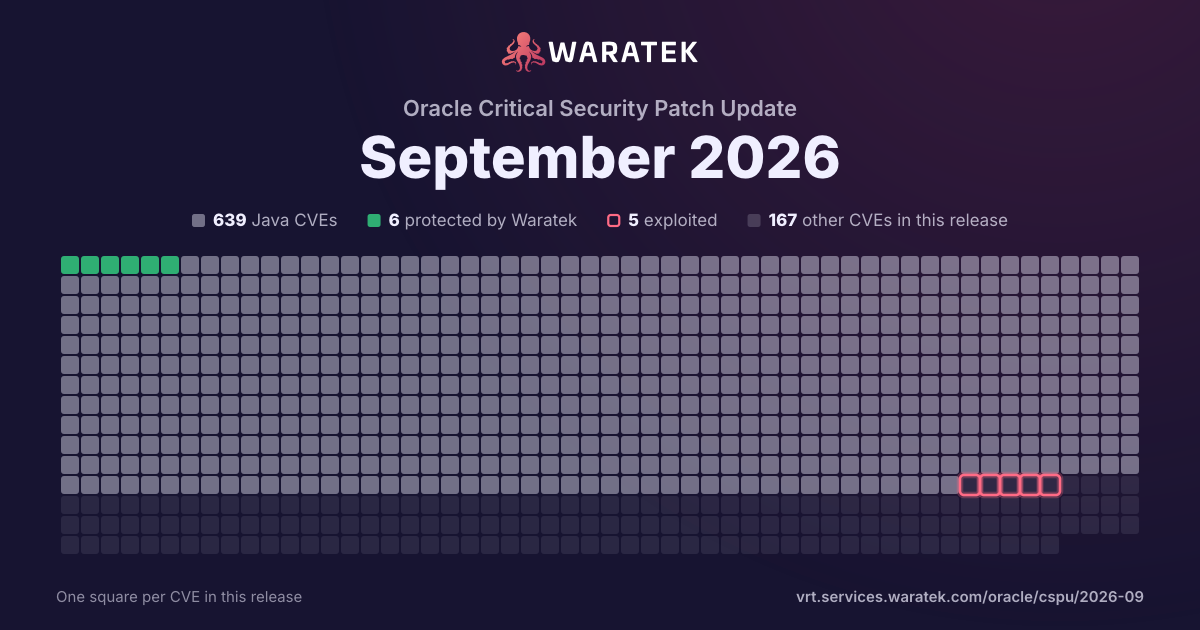
By status
6Protected by Waratek633No exploit published1Outside Waratek scope166Not applicable
5Exploited, marked by the ring
No exploit published. For 596 of them, Oracle's security advisory is the source of public detail.
Protected by Waratek. Waratek RASP can block exploitation of these on systems that have not applied the patch yet.
Overview 20 matches · 0 in Waratek scope · 0 protected · 1 exploited · 1 CISA KEV · 1 public PoC · 0 EPSS ≥ 0.5
20matches
0in Waratek scope0.0%
0protected0.0%
1exploited5.0%
1CISA KEV5.0%
1public PoC5.0%
0EPSS ≥ 0.50.0%
Protected by Waratek
0
0.0%
Rule in development
0
0.0%
Mitigation candidate
0
0.0%
No exploit published
0
0.0%
Outside Waratek scope
0
0.0%
Not applicable
20
100.0%
Withdrawn CVE
0
0.0%
blocked by ARMR today
0
0.0%
partly blocked
0
0.0%
not blocked
20
100.0%
not established
0
0.0%
unrecorded
0
0.0%
Exploited
1
5.0%
Working exploit published
0
0.0%
Proof of concept only
3
15.0%
Forecast only
0
0.0%
No public exploit
16
80.0%
split by
peak 10 / month
Jun 262
Not applicable2
Critical2
not blocked2
No public exploit2
Jul 265
Not applicable5
Critical5
not blocked5
Proof of concept only2
No public exploit3
Aug 263
Not applicable3
Critical3
not blocked3
Exploited1
Proof of concept only1
No public exploit1
Sep 2610
Not applicable10
Critical10
not blocked10
No public exploit10
Jun 26Jul 26Aug 26Sep 26
| CVE | Severity | Published▾ | Status | Exploitation | Description |
|---|---|---|---|---|---|
| CVE-2026-83066 | Critical | 2026-09-15 | Not applicable | No public exploit | Vulnerability in the Oracle Internet Directory product of Oracle Fusion Middleware (component: OID LDAP Server). Supported versions that are affected are 12.2.1.4.0 and 14.1.2.1.0. Easily exploitable vulnerability allows unauthenticated attacker with network access via T3, IIOP to compromise Oracle Internet Directory. Successful attacks of this vulnerability can result in takeover of Oracle Internet Directory. CVSS 3.1 Base Score 9.8 (Confidentiality, Integrity and Availability impacts). CVSS Vector: (CVSS:3.1/AV:N/AC:L/PR:N/UI:N/S:U/C:H/I:H/A:H). |
| CVE-2026-83062 | Critical | 2026-09-15 | Not applicable | No public exploit | Vulnerability in the Oracle Internet Directory product of Oracle Fusion Middleware (component: OID LDAP Server). Supported versions that are affected are 12.2.1.4.0 and 14.1.2.1.0. Easily exploitable vulnerability allows unauthenticated attacker with network access via LDAP to compromise Oracle Internet Directory. Successful attacks of this vulnerability can result in takeover of Oracle Internet Directory. CVSS 3.1 Base Score 9.8 (Confidentiality, Integrity and Availability impacts). CVSS Vector: (CVSS:3.1/AV:N/AC:L/PR:N/UI:N/S:U/C:H/I:H/A:H). |
| CVE-2026-83061 | Critical | 2026-09-15 | Not applicable | No public exploit | Vulnerability in the Oracle Internet Directory product of Oracle Fusion Middleware (component: OID LDAP Server). Supported versions that are affected are 12.2.1.4.0 and 14.1.2.1.0. Easily exploitable vulnerability allows unauthenticated attacker with network access via LDAP to compromise Oracle Internet Directory. Successful attacks of this vulnerability can result in takeover of Oracle Internet Directory. CVSS 3.1 Base Score 9.8 (Confidentiality, Integrity and Availability impacts). CVSS Vector: (CVSS:3.1/AV:N/AC:L/PR:N/UI:N/S:U/C:H/I:H/A:H). |
| CVE-2026-83060 | Critical | 2026-09-15 | Not applicable | No public exploit | Vulnerability in the Oracle Internet Directory product of Oracle Fusion Middleware (component: OID LDAP Server). Supported versions that are affected are 12.2.1.4.0 and 14.1.2.1.0. Easily exploitable vulnerability allows unauthenticated attacker with network access via LDAP to compromise Oracle Internet Directory. Successful attacks of this vulnerability can result in takeover of Oracle Internet Directory. CVSS 3.1 Base Score 9.8 (Confidentiality, Integrity and Availability impacts). CVSS Vector: (CVSS:3.1/AV:N/AC:L/PR:N/UI:N/S:U/C:H/I:H/A:H). |
| CVE-2026-83059 | Critical | 2026-09-15 | Not applicable | No public exploit | Vulnerability in the Oracle Internet Directory product of Oracle Fusion Middleware (component: OID LDAP Server). Supported versions that are affected are 12.2.1.4.0 and 14.1.2.1.0. Easily exploitable vulnerability allows unauthenticated attacker with network access via LDAP to compromise Oracle Internet Directory. While the vulnerability is in Oracle Internet Directory, attacks may significantly impact additional products (scope change). Successful attacks of this vulnerability can result in takeover of Oracle Internet Directory. CVSS 3.1 Base Score 10.0 (Confidentiality, Integrity and Availability impacts). CVSS Vector: (CVSS:3.1/AV:N/AC:L/PR:N/UI:N/S:C/C:H/I:H/A:H). |
| CVE-2026-83058 | Critical | 2026-09-15 | Not applicable | No public exploit | Vulnerability in the Oracle Internet Directory product of Oracle Fusion Middleware (component: OID LDAP Server). Supported versions that are affected are 12.2.1.4.0 and 14.1.2.1.0. Easily exploitable vulnerability allows low privileged attacker with network access via LDAP to compromise Oracle Internet Directory. While the vulnerability is in Oracle Internet Directory, attacks may significantly impact additional products (scope change). Successful attacks of this vulnerability can result in takeover of Oracle Internet Directory. CVSS 3.1 Base Score 9.9 (Confidentiality, Integrity and Availability impacts). CVSS Vector: (CVSS:3.1/AV:N/AC:L/PR:L/UI:N/S:C/C:H/I:H/A:H). |
| CVE-2026-83057 | Critical | 2026-09-15 | Not applicable | No public exploit | Vulnerability in the Oracle Internet Directory product of Oracle Fusion Middleware (component: OID LDAP Server). Supported versions that are affected are 12.2.1.4.0 and 14.1.2.1.0. Easily exploitable vulnerability allows low privileged attacker with network access via LDAP to compromise Oracle Internet Directory. While the vulnerability is in Oracle Internet Directory, attacks may significantly impact additional products (scope change). Successful attacks of this vulnerability can result in takeover of Oracle Internet Directory. CVSS 3.1 Base Score 9.9 (Confidentiality, Integrity and Availability impacts). CVSS Vector: (CVSS:3.1/AV:N/AC:L/PR:L/UI:N/S:C/C:H/I:H/A:H). |
| CVE-2026-83056 | Critical | 2026-09-15 | Not applicable | No public exploit | Vulnerability in the Oracle Internet Directory product of Oracle Fusion Middleware (component: OID LDAP Server). Supported versions that are affected are 12.2.1.4.0 and 14.1.2.1.0. Easily exploitable vulnerability allows low privileged attacker with network access via LDAP to compromise Oracle Internet Directory. While the vulnerability is in Oracle Internet Directory, attacks may significantly impact additional products (scope change). Successful attacks of this vulnerability can result in takeover of Oracle Internet Directory. CVSS 3.1 Base Score 9.9 (Confidentiality, Integrity and Availability impacts). CVSS Vector: (CVSS:3.1/AV:N/AC:L/PR:L/UI:N/S:C/C:H/I:H/A:H). |
| CVE-2026-83055 | Critical | 2026-09-15 | Not applicable | No public exploit | Vulnerability in the Oracle Internet Directory product of Oracle Fusion Middleware (component: OID LDAP Server). Supported versions that are affected are 12.2.1.4.0 and 14.1.2.1.0. Easily exploitable vulnerability allows low privileged attacker with network access via LDAP to compromise Oracle Internet Directory. While the vulnerability is in Oracle Internet Directory, attacks may significantly impact additional products (scope change). Successful attacks of this vulnerability can result in takeover of Oracle Internet Directory. CVSS 3.1 Base Score 9.9 (Confidentiality, Integrity and Availability impacts). CVSS Vector: (CVSS:3.1/AV:N/AC:L/PR:L/UI:N/S:C/C:H/I:H/A:H). |
| CVE-2026-83054 | Critical | 2026-09-15 | Not applicable | No public exploit | Vulnerability in the Oracle Internet Directory product of Oracle Fusion Middleware (component: OID LDAP Server). Supported versions that are affected are 12.2.1.4.0 and 14.1.2.1.0. Easily exploitable vulnerability allows unauthenticated attacker with network access via LDAP to compromise Oracle Internet Directory. Successful attacks of this vulnerability can result in takeover of Oracle Internet Directory. CVSS 3.1 Base Score 9.8 (Confidentiality, Integrity and Availability impacts). CVSS Vector: (CVSS:3.1/AV:N/AC:L/PR:N/UI:N/S:U/C:H/I:H/A:H). |
| CVE-2026-64849 | Critical | 2026-08-17 | Not applicable | Exploited | MLflow is an open source AI engineering platform for agents, large language models, and machine learning models. Starting in 3.3.0 and prior to 3.15.0, the unauthenticated POST /api/2.0/mlflow/webhooks/{id}/test endpoint calls _validate_webhook_url() in mlflow/utils/validation.py only for the original URL while mlflow/webhooks/delivery.py follows redirects and re-resolves the hostname without pinning the validated address, allowing attackers to reach internal or cloud metadata services and receive response_status and response_body. This issue is fixed in version 3.15.0. |
| CVE-2026-73194 | Critical | 2026-08-15 | Not applicable | No public exploit | DBI versions before 1.652 for Perl allow a heap out-of-bounds write via an unvalidated numeric placeholder that sets the binder counter in preparse. preparse reserves seven output bytes per input byte, the width of the longest ':p99999' expansion. The ':N' branch parses the number with `atoi(src)` and assigns it to the binder counter with no range check, so a statement containing ':2147483648' leaves the counter negative (-2147483648 with glibc, where atoi wraps). Each following '?' then expands through `sprintf(start, ":p%d", idx++)` to ':p-2147483648', 14 bytes with the terminating NUL where the buffer budgets 7. The placeholder limit added in 1.650 tests the counter against 99,999, which a negative counter passes. Any caller that preparses an untrusted statement into ':pN' style placeholders gets a heap out-of-bounds write that grows with the number of '?' marks following the poisoned placeholder. The '?' and '%s' return styles compare the parsed number against the expected sequence and error out, and are unaffected. |
| CVE-2026-73193 | Critical | 2026-08-15 | Not applicable | Proof of concept only | DBI versions before 1.652 for Perl allow a heap out-of-bounds write on 32-bit perl via an integer wraparound in the output buffer size computed by preparse. preparse reserves its output buffer with `newSV(strlen(statement) * 7 + 16)`, budgeting seven output bytes per input byte for the longest ':p99999' expansion. The product is computed in STRLEN, which is 32 bits wide on a 32-bit perl build, so a statement of 613,566,757 bytes multiplies to 4,294,967,299, wraps modulo 2^32 to 3, and reserves 19 bytes. The parser then copies the statement out through a raw pointer with no capacity check, writing the whole 585 MB input past the end of the allocation. The 99,999 placeholder limit does not bound this path, which is reached by ordinary non-placeholder content. Any caller that passes an untrusted statement of that length to preparse on a 32-bit perl gets a heap out-of-bounds write of attacker controlled bytes. Builds with a 64-bit STRLEN are not affected, since the wrap there needs a statement of about 2.3 exabytes. |
| CVE-2026-57216 | Critical | 2026-07-10 | Not applicable | Proof of concept only | RabbitMQ is a messaging and streaming broker. Prior to 3.13.15, 4.0.20, 4.1.11, and 4.2.6, AMQP 0-9-1, AMQP 1.0, and Stream Protocol authentication can allow a loopback-restricted user such as guest to connect remotely when traffic is accepted through a trusted PROXY-protocol path and the backend listener is loopback-bound because the loopback check uses the listener-side socket address instead of the real client source. This issue is fixed in versions 3.13.15, 4.0.20, 4.1.11, and 4.2.6. |
| CVE-2026-57211 | Critical | 2026-07-10 | Not applicable | Proof of concept only | RabbitMQ is a messaging and streaming broker. Prior to 4.1.11 and 4.2.6 on Windows, the RabbitMQ management plugin static file handler rabbit_mgmt_wm_static can pass URL-encoded backslashes to erl_prim_loader:read_file_info before path validation when multiple management extension plugins are enabled, causing outbound DNS and SMB requests to attacker-controlled UNC paths. This issue is fixed in versions 4.1.11 and 4.2.6. |
| CVE-2026-44024 | Critical | 2026-07-08 | Not applicable | No public exploit | Fluentd collects events from various data sources and writes them to files, RDBMS, NoSQL, IaaS, SaaS, Hadoop and so on. Prior to 1.19.3, Fluentd allows dynamically constructing file paths using the ${tag} placeholder, and insufficient validation of ${tag} in file configurations such as the path parameter of the out_file plugin allows attackers sending untrusted tags containing path traversal characters to write or overwrite arbitrary files and potentially achieve remote code execution. This issue is fixed in version 1.19.3. |
| CVE-2026-14740 | Critical | 2026-07-07 | Not applicable | No public exploit | DBI versions before 1.650 for Perl read one byte out-of-bounds in preparse when deleting an initial SQL comment. The preparse method normalises SQL and removes comments. When the SQL starts with a comment line, the deletion of that line during normalisation led to an out-of-bounds read by one byte. The result is a fault on memory-hardened builds and nondeterministic newline retention on normal builds. |
| CVE-2026-14739 | Critical | 2026-07-07 | Not applicable | No public exploit | DBI versions before 1.650 for Perl have a heap overflow when preparsing SQL statements with an extreme number of placeholders. The fix for CVE-2026-10879 did not allocate enough memory to handle approximately 1.2-million placeholders. DBI version 1.650 sets a hard limit of 99,999 placeholders. |
| CVE-2026-9698 | Critical | 2026-06-09 | Not applicable | No public exploit | DBI versions before 1.648 for Perl saved errors in a limited-sized buffer. Error messages that were returned when RaiseError, PrintError or HandleError were set were written to a 200-byte buffer without a length limit. Attackers that can influence the error text in an application can trigger a buffer overflow. |
| CVE-2026-10879 | Critical | 2026-06-05 | Not applicable | No public exploit | DBI versions before 1.648 for Perl have a heap overflow when preparsing SQL statements with more than 9 binders. The preparse method expands SQL placeholder characters to numbered binders of the form :pN, but only allocates three characters per binder in the buffer. Placeholders 10-99 require four characters, 100-999 require five characters, et cetera. |