
Oracle Critical Security Patch Update September 2026
Released September 2026 · Oracle's advisory ↗ · ← Security Patch Update, August 2026 · Critical Patch Update, October 2026 →
806 CVEs in this release, one square each
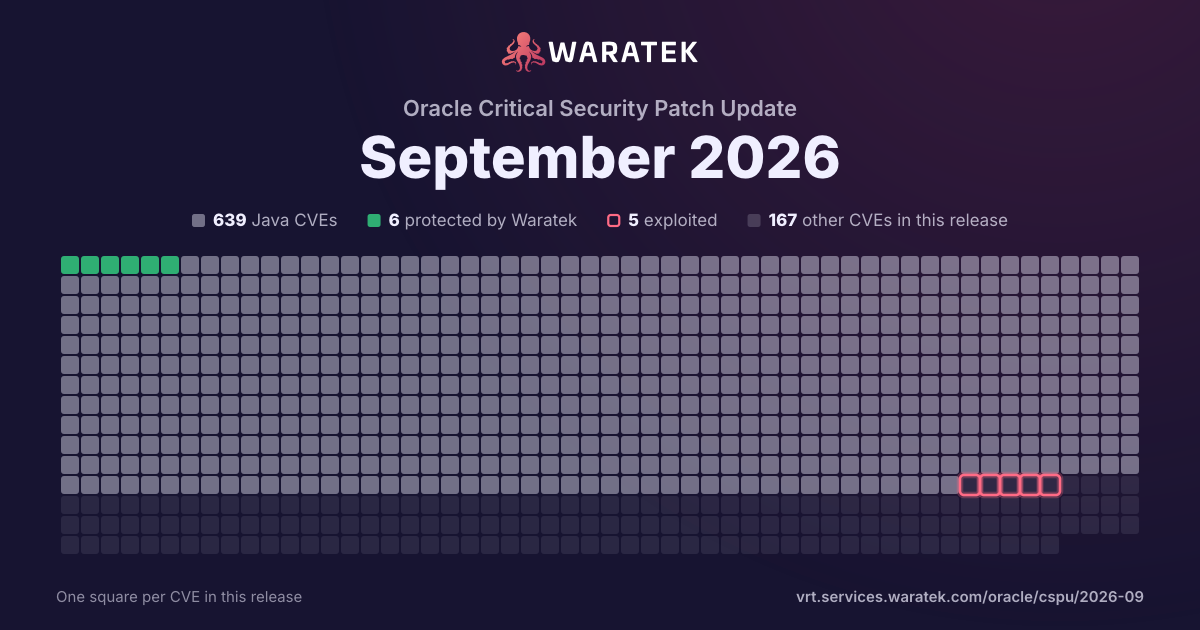
By status
No exploit published. For 596 of them, Oracle's security advisory is the source of public detail.
Protected by Waratek. Waratek RASP can block exploitation of these on systems that have not applied the patch yet.
Overview 44 matches · 14 in Waratek scope · 0 protected · 2 exploited · 0 CISA KEV · 2 public PoC · 0 EPSS ≥ 0.5
44matches
14in Waratek scope31.8%
0protected0.0%
2exploited4.5%
0CISA KEV0.0%
2public PoC4.5%
0EPSS ≥ 0.50.0%
Protected by Waratek
0
0.0%
Rule in development
0
0.0%
Mitigation candidate
0
0.0%
No exploit published
14
31.8%
Outside Waratek scope
0
0.0%
Not applicable
30
68.2%
Withdrawn CVE
0
0.0%
blocked by ARMR today
0
0.0%
partly blocked
0
0.0%
not blocked
44
100.0%
not established
0
0.0%
unrecorded
0
0.0%
split by
peak 26 / month
Feb 261
Not applicable1
High1
not blocked1
Exploited1
Mar 260
Apr 260
May 260
Jun 2612
No exploit published8
Not applicable4
High12
not blocked12
Exploited1
Proof of concept only1
No public exploit10
Jul 2626
No exploit published5
Not applicable21
High26
not blocked26
Working exploit published1
Proof of concept only8
No public exploit17
Aug 265
No exploit published1
Not applicable4
High5
not blocked5
Proof of concept only1
No public exploit4
Feb 26Mar 26Apr 26May 26Jun 26Jul 26Aug 26
| CVE | Severity | Published▾ | Status | Exploitation | Description |
|---|---|---|---|---|---|
| CVE-2026-69148 | High | 2026-08-17 | Not applicable | Proof of concept only | MLflow is an open source AI engineering platform for agents, large language models, and machine learning models. Prior to 3.15.0, CreateModelVersion accepts a run_id or model_id after _validate_source_run() or _validate_source_model() in mlflow/server/handlers.py verifies only path containment, allowing authenticated users to create a model version that references another user's artifact directory and read files through GET /model-versions/get-artifact without the required READ permission. This issue is fixed in version 3.15.0. |
| CVE-2026-73508 | High | 2026-08-13 | No exploit published | No public exploit | Netty is an asynchronous, event-driven network application framework. Prior to 4.1.136.Final and 4.2.16.Final, io.netty.handler.codec.dns.AbstractDnsRecord, io.netty.handler.codec.dns.DefaultDnsRecordDecoder.decodeRecord(), and io.netty.handler.codec.dns.DnsCodecUtil.decompressDomainName() failed to release retained or newly allocated ByteBuf objects when IDN.toASCII() or encodeDomainName() rejected a malformed domain name, allowing unauthenticated remote DNS packets to leak direct memory incrementally until denial of service. This issue is fixed in versions 4.1.136.Final and 4.2.16.Final. |
| CVE-2026-14456 | High | 2026-08-13 | Not applicable | No public exploit | Issue summary: When an OpenSSL QUIC server (Listener SSL object) processes valid QUIC Initial packets for unknown destination connection IDs, it can allocate and queue new incoming channels without enforcing any limit. Impact summary: A remote peer that can make many Initial packets reach the server listener faster than the application accepts connections, can cause the memory allocated to store the per-channel state to grow without any limits, potentially making the QUIC listener unavailable and causing Denial of Service. CWE: CWE-770: Allocation of Resources Without Limits or Throttling Description: The function that handles inbound QUIC packets uses Connection-Id from the packet header to find an existing connection (QUIC channel). If no existing connection is found and the packet type is INITIAL, the function treats the packet as a new connection. It allocates a new channel object and inserts it into a queue where it waits to be accepted by the local application with SSL_accept(3ossl). The memory occupied by these initial channel objects may grow without bounds if the application is not able to call SSL_accept() frequently enough to serve these inbound connection requests. The issue is present since OpenSSL 3.5 when the QUIC server implementation was added. The fix introduces a limit for pending connections. The default limit is set to 256 pending connections (waiting to be accepted by the local application). Applications may change the default by calling SSL_set_value_uint(3ossl). FIPS impact: no The FIPS module is not affected as the QUIC implementation is outside of the OpenSSL FIPS module boundary. |
| CVE-2026-67355 | High | 2026-08-01 | Not applicable | No public exploit | guzzlehttp/guzzle versions before 7.15.1 fail to preserve host-only cookie scope, storing the request host in the Domain field instead of marking cookies as host-only. Attackers controlling child hosts can receive host-only cookies intended only for parent hosts, potentially disclosing session identifiers and authorization tokens when the same cookie jar is reused across trust boundaries. |
| CVE-2026-67354 | High | 2026-08-01 | Not applicable | No public exploit | guzzlehttp/guzzle versions before 7.15.1 contain an information disclosure vulnerability in RedirectMiddleware. When the optional allow_redirects.referer setting is enabled, the middleware copies the URI fragment (the portion after '#') from the referring request into the generated Referer header when following a same-scheme redirect (e.g., HTTPS to HTTPS). An attacker who controls the redirect destination can read this fragment from the incoming Referer header, potentially disclosing one-time login secrets, access tokens, state values, or other sensitive client data to a server never meant to receive it. The referer setting is disabled by default. Fixed in 7.15.1, which strips the fragment before generating the Referer value. |
| CVE-2026-17544 | High | 2026-07-30 | Not applicable | Proof of concept only | Attacker-provided inputs to bccomp() could lead to an out-of-bounds write with stack and heap corruption in PHP versions from 8.4.* before 8.4.24 and from 8.5.* before 8.5.9. |
| CVE-2026-59901 | High | 2026-07-29 | No exploit published | No public exploit | Netty is an asynchronous, event-driven network application framework. Prior to versions 4.1.136.Final and 4.2.16.Final, the `Bzip2Decoder` handler in Netty's compression codec pipeline is vulnerable to a denial-of-service attack through a malformed bzip2 stream that permanently captures the event-loop thread in an infinite loop. The vulnerability exists in the run-length encoding (RLE) state machine within [`Bzip2BlockDecompressor.read()`]. This issue has been fixed in versions 4.1.136.Final and 4.2.16.Final. |
| CVE-2026-66299 | High | 2026-07-28 | No exploit published | No public exploit | Uncontrolled Resource Consumption vulnerability in Apache Tomcat's WebSocket chat example. This issue affects Apache Tomcat: from 11.0.0-M20 through 11.0.24, from 10.1.24 through 10.1.57, from 9.0.89 through 9.0.120. Users who have followed the security guidance to remove the examples web application are not affected by this issue. Users are recommended to remove the examples web application or to upgrade to version 11.0.25, 10.1.58 or 9.0.121 (when released), which fix the issue. |
| CVE-2026-61094 | High | 2026-07-21 | Not applicable | No public exploit | Vulnerability in the MySQL Server, MySQL Cluster product of Oracle MySQL (component: Server: Replication). Supported versions that are affected are MySQL Server: 8.4.0-8.4.10, 9.7.0-9.7.1; MySQL Cluster: 8.0.0-8.0.47, 8.4.0-8.4.10 and 9.7.0-9.7.1. Easily exploitable vulnerability allows high privileged attacker with network access via multiple protocols to compromise MySQL Server, MySQL Cluster. Successful attacks of this vulnerability can result in takeover of MySQL Server, MySQL Cluster. CVSS 3.1 Base Score 7.2 (Confidentiality, Integrity and Availability impacts). CVSS Vector: (CVSS:3.1/AV:N/AC:L/PR:H/UI:N/S:U/C:H/I:H/A:H). |
| CVE-2026-60316 | High | 2026-07-21 | Not applicable | No public exploit | Vulnerability in the MySQL Server, MySQL Cluster product of Oracle MySQL (component: Server: X Plugin). Supported versions that are affected are MySQL Server: 8.4.0-8.4.10, 9.7.0-9.7.1; MySQL Cluster: 8.0.0-8.0.47, 8.4.0-8.4.10 and 9.7.0-9.7.1. Easily exploitable vulnerability allows high privileged attacker with network access via multiple protocols to compromise MySQL Server, MySQL Cluster. Successful attacks of this vulnerability can result in takeover of MySQL Server, MySQL Cluster. CVSS 3.1 Base Score 7.2 (Confidentiality, Integrity and Availability impacts). CVSS Vector: (CVSS:3.1/AV:N/AC:L/PR:H/UI:N/S:U/C:H/I:H/A:H). |
| CVE-2026-60315 | High | 2026-07-21 | Not applicable | No public exploit | Vulnerability in the MySQL Server, MySQL Cluster product of Oracle MySQL (component: Server: X Plugin). Supported versions that are affected are MySQL Server: 8.4.0-8.4.10, 9.7.0-9.7.1; MySQL Cluster: 8.0.0-8.0.47, 8.4.0-8.4.10 and 9.7.0-9.7.1. Easily exploitable vulnerability allows unauthenticated attacker with network access via multiple protocols to compromise MySQL Server, MySQL Cluster. Successful attacks of this vulnerability can result in unauthorized ability to cause a hang or frequently repeatable crash (complete DOS) of MySQL Server, MySQL Cluster and unauthorized read access to a subset of MySQL Server, MySQL Cluster accessible data. CVSS 3.1 Base Score 8.2 (Confidentiality and Availability impacts). CVSS Vector: (CVSS:3.1/AV:N/AC:L/PR:N/UI:N/S:U/C:L/I:N/A:H). |
| CVE-2026-60163 | High | 2026-07-21 | Not applicable | No public exploit | Vulnerability in the MySQL Server, MySQL Cluster product of Oracle MySQL (component: Server: Group Replication Plugin). Supported versions that are affected are MySQL Server: 8.4.0-8.4.10, 9.7.0-9.7.1; MySQL Cluster: 8.0.0-8.0.47, 8.4.0-8.4.10 and 9.7.0-9.7.1. Easily exploitable vulnerability allows unauthenticated attacker with logon to the infrastructure where MySQL Server, MySQL Cluster executes to compromise MySQL Server, MySQL Cluster. Successful attacks of this vulnerability can result in takeover of MySQL Server, MySQL Cluster. CVSS 3.1 Base Score 8.4 (Confidentiality, Integrity and Availability impacts). CVSS Vector: (CVSS:3.1/AV:L/AC:L/PR:N/UI:N/S:U/C:H/I:H/A:H). |
| CVE-2026-56745 | High | 2026-07-21 | No exploit published | No public exploit | Netty is a network application framework for development of protocol servers and clients. In versions 4.2.0.Final through 4.2.15.Final and 4.1.0.Final through 4.1.135.Final, the `SpdyHttpDecoder` handler in Netty's SPDY-to-HTTP codec allocates a pooled `ByteBuf` when processing a client-initiated `SYN_STREAM` frame with `FLAG_FIN=0` and stores the partially constructed `FullHttpRequest` in `messageMap`; when the remote peer sends `RST_STREAM` for that stream or the accumulated content exceeds `maxContentLength`, the decoder removes the entry but does not release the pooled `ByteBuf`, causing native memory exhaustion. This issue is fixed in versions 4.1.136.Final and 4.2.16.Final. |
| CVE-2026-55833 | High | 2026-07-21 | No exploit published | No public exploit | Netty is a network application framework for development of protocol servers and clients. Prior to 4.1.136.Final and 4.2.16.Final, Netty SPDY header decoding continues inflating zlib-compressed header blocks after the raw header parser has exceeded `maxHeaderSize` and marked the frame truncated in `SpdyFrameCodec`, allowing a remote peer to send a small compressed `HEADERS` block that expands into much larger raw header data and causes compression-amplified CPU and allocation churn. This issue is fixed in versions 4.1.136.Final and 4.2.16.Final. |
| CVE-2026-55831 | High | 2026-07-21 | No exploit published | Proof of concept only | Netty is a network application framework for development of protocol servers and clients. Prior to 4.1.136.Final and 4.2.16.Final, Netty's SPDY SETTINGS decoder accepts a peer-declared SETTINGS entry count up to the 24-bit frame-length limit and materializes every unique setting ID in `DefaultSpdySettingsFrame`, allowing a remote SPDY/3.1 peer to send a syntactically valid roughly 2 MiB SETTINGS frame that creates 262144 map entries and amplifies network input into heap growth and ordered-map insertion work. This issue is fixed in versions 4.1.136.Final and 4.2.16.Final. |
| CVE-2026-49284 | High | 2026-07-17 | Not applicable | No public exploit | SimpleSAMLphp versions before 1.18.6 contain an information disclosure vulnerability. Prior to 2.4.7 and 2.5.2, SimpleSAMLphp's SAML SP ACS path does not enforce the IdP selected for an SP-initiated login when unsigned Response/InResponseTo is combined with a signed assertion lacking SubjectConfirmationData/InResponseTo, allowing a response issued by one trusted IdP to be bound to SP state created for another IdP and bypass flows that route users to a specific IdP, including deployments that set enable_unsolicited to false. This issue is fixed in versions 2.4.7 and 2.5.2. |
| CVE-2026-57220 | High | 2026-07-10 | Not applicable | Proof of concept only | RabbitMQ is a messaging and streaming broker. Prior to 4.2.6, the RabbitMQ stream listener does not enforce the configured stream frame-size limit while assembling frames during authentication and before Tune negotiation, allowing an unauthenticated remote client to declare oversized frame lengths and consume broker memory in rabbit_stream_core. This issue is fixed in version 4.2.6. |
| CVE-2026-57219 | High | 2026-07-10 | Not applicable | Working exploit published | RabbitMQ is a messaging and streaming broker. Prior to 3.13.15, 4.0.20, 4.1.11, and 4.2.6, the obsolete GET /api/auth endpoint can disclose the OAuth 2 client secret on RabbitMQ installations configured with management.oauth_client_secret, exposing credentials to unauthenticated callers when the management plugin and that OAuth configuration are enabled. This issue is fixed in versions 3.13.15, 4.0.20, 4.1.11, and 4.2.6. |
| CVE-2026-57217 | High | 2026-07-10 | Not applicable | Proof of concept only | RabbitMQ is a messaging and streaming broker. Prior to 3.13.15, 4.0.21, 4.1.11, and 4.2.6, RabbitMQ topic authorization can allow restricted topic writes and binds during metadata-store failures because topic-permission lookup errors from Khepri can collapse to undefined, which the internal backend treats as allow. This issue is fixed in versions 3.13.15, 4.0.21, 4.1.11, and 4.2.6. |
| CVE-2026-57215 | High | 2026-07-10 | Not applicable | No public exploit | RabbitMQ is a messaging and streaming broker. Prior to 3.13.15, 4.0.20, 4.1.11, and 4.2.6, RabbitMQ allows foreign bindings to amq.rabbitmq.reply-to destinations because volatile direct-reply-to queues can be accepted at bind and route time but are missing from Khepri-backed deletion checks, leaving persistent route entries after unbind. This issue is fixed in versions 3.13.15, 4.0.20, 4.1.11, and 4.2.6. |
| CVE-2026-57214 | High | 2026-07-10 | Not applicable | Proof of concept only | RabbitMQ is a messaging and streaming broker. Prior to 4.2.5, the RabbitMQ management UI renders the x-internal-purpose queue or exchange argument into an HTML title attribute without proper escaping on the Queues and Exchanges pages, allowing a user with permission to declare a queue or exchange to execute JavaScript in another user's browser. This issue is fixed in version 4.2.5. |
| CVE-2026-57212 | High | 2026-07-10 | Not applicable | Proof of concept only | RabbitMQ is a messaging and streaming broker. Prior to 3.13.14, 4.0.19, 4.1.10, and 4.2.5, the rabbitmq_management HTTP API accepts oversized valid JSON bodies on with_decode and direct_request paths because read_complete_body checks the accumulated size before the final chunk but not the final combined size. This issue is fixed in versions 3.13.14, 4.0.19, 4.1.10, and 4.2.5. |
| CVE-2026-44161 | High | 2026-07-08 | Not applicable | No public exploit | Fluentd collects events from various data sources and writes them to files, RDBMS, NoSQL, IaaS, SaaS, Hadoop and so on. Prior to 1.19.3, the Fluentd out_http output plugin allows placeholders such as ${tag} in the endpoint configuration parameter, and if a placeholder value is derived from untrusted input an attacker can control the destination hostname of outbound HTTP requests and force requests to arbitrary internal services. This issue is fixed in version 1.19.3. |
| CVE-2026-44160 | High | 2026-07-08 | Not applicable | No public exploit | Fluentd collects events from various data sources and writes them to files, RDBMS, NoSQL, IaaS, SaaS, Hadoop and so on. Prior to 1.19.3, Fluentd's in_http and in_forward plugins support gzip-compressed data but enforce limits only on compressed payloads through settings such as body_size_limit and chunk_size_limit, allowing crafted compressed payloads to decompress in memory to an excessive size and cause denial of service through memory exhaustion. This issue is fixed in version 1.19.3. |
| CVE-2026-44025 | High | 2026-07-08 | Not applicable | No public exploit | Fluentd collects events from various data sources and writes them to files, RDBMS, NoSQL, IaaS, SaaS, Hadoop and so on. Prior to 1.19.3, Fluentd's Monitor Agent plugin in_monitor_agent exposes internal metrics and plugin information via a REST API, and responses from /api/plugins.json and related endpoints unintentionally include internal instance variables that may contain database passwords, API keys, or cloud credentials. This issue is fixed in version 1.19.3. |
| CVE-2026-39822 | High | 2026-07-08 | Not applicable | No public exploit | On Unix systems, opening a file in an os.Root improperly follows symlinks to locations outside of the Root when the final path component of the a path is a symbolic link and the path ends in /. For example, 'root.Open("symlink/")' will open "symlink" even when "symlink" is a symbolic link pointing outside of the root. |
| CVE-2026-14380 | High | 2026-07-07 | Not applicable | No public exploit | DBI versions before 1.650 for Perl are vulnerable to code injection via caller-influenced Profile. When a string is assigned to a DBI handle's Profile attribute, DBI splits it into path, package and arguments, and interpolates the package part in a string eval with no validation of the package name. Any caller-influenced value that reaches the Profile attribute is therefore arbitrary Perl code execution, including calls to run system commands. The Profile attribute can be set from three different sources that can carry untrusted data: the DBI_PROFILE environment variable, a direct attribute assignment, and a DSN driver-attribute clause dbi:Driver(Profile=>SPEC):db. An attacker controlling any of those inputs runs arbitrary Perl in the host process. The strongest remote position is a network-exposed DBI::Gofer / DBI::ProxyServer whose per-request DSN reaches the Profile attribute, letting a client execute code on the broker host. |
| CVE-2026-9563 | High | 2026-07-02 | Not applicable | Proof of concept only | In Eclipse Parsson published Maven Central artifacts before version 1.1.8, the JSON parser did not enforce a default maximum on the number of characters consumed while parsing a single JSON document. Applications that parse attacker- controlled JSON can be forced to consume excessive CPU and memory by processing very large documents, including large arrays, objects, strings, numbers, whitespace, or nested structures, resulting in a denial of service. Eclipse Parsson 1.1.8 introduces a configurable maximum parsing limit with a default limit of 15 million parser-consumed characters. |
| CVE-2026-8147 | High | 2026-07-02 | Not applicable | Proof of concept only | In MLflow versions prior to 3.14.0, when running with authentication enabled, the trace API endpoints lack proper authorization validators. This allows any authenticated user to bypass experiment-level authorization controls on all trace operations, including reading, deleting, and modifying traces on experiments they do not have permission to access. The issue arises from the `_before_request` handler, which does not register authorization validators for trace endpoints, resulting in requests proceeding without validation. This vulnerability can expose sensitive data, destroy audit logs, and allow unauthorized modifications. |
| CVE-2026-55952 | High | 2026-07-02 | Not applicable | No public exploit | The Erlang/OTP ssl application does not validate that the PSK identity list and binder list carried in a TLS 1.3 ClientHello pre-shared key extension have equal length before passing them to the session ticket handler. In tls_handshake_1_3:handle_pre_shared_key/3, an OfferedPreSharedKeys record with a mismatched number of identities and binders is forwarded directly to tls_server_session_ticket:use/4, which crashes the session ticket handler process. An unauthenticated remote attacker can send a single crafted ClientHello to a TLS 1.3 server with session tickets enabled (stateful or stateless mode) and permanently disrupt session ticket handling on that listener. New TLS 1.3 handshakes complete but subsequently crash when the server attempts to issue a session ticket, effectively making TLS 1.3 unusable on the affected listener until the ssl application is restarted. TLS 1.2 connections are not affected. This issue affects OTP from OTP 22.2 before OTP 27.3.4.14, OTP 28.5.0.3, and OTP 29.0.3, corresponding to ssl from 9.5 before 11.2.12.10, 11.6.0.3, and 11.7.3. |
| CVE-2026-55950 | High | 2026-07-02 | Not applicable | No public exploit | Time-of-check Time-of-use (TOCTOU) race condition vulnerability in Erlang/OTP ssl (dtls_packet_demux module) allows an unauthenticated remote attacker to crash all active DTLS sessions on a listener. A DTLS server listener uses a single shared dtls_packet_demux gen_server process to route incoming UDP datagrams to the correct connection handler. When a DTLS client reconnects rapidly from the same source address and port (sending multiple ClientHello messages in quick succession), a race condition in the demux's internal gb_trees key-value store causes a {key_exists, {old, Client}} crash, terminating the demux process. Because the demux is shared across all DTLS associations on that listener, its crash immediately kills every active DTLS session, not just the attacker's. The attack is pre-authentication: the attacker only needs to send UDP datagrams containing valid ClientHello messages from the same source IP and port before the intermediate DOWN monitor message is processed by the gen_server. No credentials, no completed handshake, and no special configuration are required, and the crash can be repeated indefinitely to create a persistent denial of service for all clients of that listener. This vulnerability is associated with program file lib/ssl/src/dtls_packet_demux.erl. This issue affects OTP from OTP 25.3 before OTP 27.3.4.14, OTP 28.5.0.3, and OTP 29.0.3, corresponding to ssl from 10.9 before 11.2.12.10, 11.6.0.3, and 11.7.3. |
| CVE-2026-50734 | High | 2026-06-30 | No exploit published | No public exploit | Memory Allocation with Excessive Size Value vulnerability in Apache ActiveMQ Client, Apache ActiveMQ, Apache ActiveMQ All. An unauthenticated network attacker can cause a broker DoS by sending a crafted WireFormatInfo frame with a malicious large size value. The value is not validate and causes the broker to attempt allocation during pre-auth negotiation which can trigger OOM and crash the broker. This issue affects Apache ActiveMQ Client: before 5.19.8, from 6.0.0 before 6.2.7; Apache ActiveMQ: before 5.19.8, from 6.0.0 before 6.2.7; Apache ActiveMQ All: before 5.19.8, from 6.0.0 before 6.2.7. Users are recommended to upgrade to version 6.2.7 or 5.19.8, which fixes the issue. |
| CVE-2026-53404 | High | 2026-06-29 | No exploit published | No public exploit | Always-Incorrect Control Flow Implementation vulnerability in Apache Tomcat's rewrite valve meant that if the first condition in an OR chain matched, subsequent non-OR conditions were skipped. This issue affects Apache Tomcat: from 11.0.0-M1 through 11.0.22, from 10.1.0-M1 through 10.1.55, from 9.0.0.M1 through 9.0.118, from 8.5.0 through 8.5.100. Other versions that have reached end of support may also be affected. Users are recommended to upgrade to version 11.0.23, 10.1.56 or 9.0.119, which fix the issue. |
| CVE-2026-13006 | High | 2026-06-24 | No exploit published | No public exploit | ACE vulnerability in conditional configuration file processing by QOS.CH logback-core up to and including version 1.5.36 in Java applications, allows an attacker to execute arbitrary code circumventing existing protections against CVE-2025-11226 by compromising an existing logback configuration file or by injecting an environment variable before program execution. A successful attack requires the presence of Janino library to be present on the user's class path. In addition, the attacker must have write access to a configuration file. Alternatively, the attacker could inject a malicious environment variable pointing to a malicious configuration file. In both cases, the attack requires existing privilege. Please note that in logack version 1.5.37 conditional processing using Janino was removed. |
| CVE-2026-54513 | High | 2026-06-23 | No exploit published | No public exploit | jackson-databind contains the general-purpose data-binding functionality and tree-model for Jackson Data Processor. From 2.10.0 until 2.18.8, 2.21.4, and 3.1.4, BasicPolymorphicTypeValidator.Builder.allowIfSubTypeIsArray() allowlists any array type based only on clazz.isArray(), without validating the array's component (element) type against the configured allowlist. A PTV built with allowIfSubTypeIsArray() plus an explicit concrete-type allowlist therefore still permits EvilType[] even though EvilType is not allowlisted. When Jackson deserializes the elements and no per-element type IDs are present, it instantiates the component type directly with no further PTV check, bypassing the allowlist. This vulnerability is fixed in 2.18.8, 2.21.4, and 3.1.4. |
| CVE-2026-54512 | High | 2026-06-23 | No exploit published | Proof of concept only | jackson-databind contains the general-purpose data-binding functionality and tree-model for Jackson Data Processor. From 2.10.0 until 2.18.8, 2.21.4, and 3.1.4, jackson-databind's PolymorphicTypeValidator (PTV) is the primary safety mechanism guarding polymorphic deserialization. When polymorphic typing is enabled and a type identifier contains generic parameters (i.e. the type ID string contains <), DatabindContext._resolveAndValidateGeneric() validates only the raw container class name (the substring before <) against the configured PTV. If the container type is approved, the method parses the full canonical type string via TypeFactory.constructFromCanonical() and returns the fully parameterized type without ever validating the nested type arguments against the PTV. The nested type arguments are then resolved, instantiated, and populated as beans during deserialization. An attacker who controls the type ID can therefore place a denied class as a generic type parameter of an allowed container — for example java.util.ArrayList<com.evil.Gadget> when only java.util.ArrayList is allow-listed. The container passes the PTV check; com.evil.Gadget is loaded via Class.forName(name, true, loader), instantiated, and its properties are set from attacker-controlled JSON. This completely bypasses an explicitly configured PTV allow-list. This vulnerability is fixed in 2.18.8, 2.21.4, and 3.1.4. |
| CVE-2026-50010 | High | 2026-06-12 | No exploit published | No public exploit | Netty is a network application framework for development of protocol servers and clients. Prior to versions 4.1.135.Final and 4.2.15.Final, SimpleTrustManagerFactory.engineGetTrustManagers() and related paths wrap any user-supplied plain X509TrustManager in X509TrustManagerWrapper, which extends X509ExtendedTrustManager but implements the 3-arg checkServerTrusted(chain, authType, SSLEngine) by discarding the SSLEngine and calling the 2-arg delegate. Because the object now IS an X509ExtendedTrustManager, neither SunJSSE's internal AbstractTrustManagerWrapper nor Netty's own OpenSslX509TrustManagerWrapper will re-wrap it to add endpoint-identification. Consequently, even though Netty 4.2 sets endpointIdentificationAlgorithm="HTTPS" by default, a client built with `SslContextBuilder.forClient().trustManager(somePlainX509TrustManager)` performs no hostname verification at all. Versions 4.1.135.Final and 4.2.15.Final patch the issue. |
| CVE-2026-45416 | High | 2026-06-12 | No exploit published | No public exploit | Netty is a network application framework for development of protocol servers and clients. Prior to versions 4.1.135.Final and 4.2.15.Final, SslClientHelloHandler.decode() reads the 24-bit TLS handshake length and, when the ClientHello does not fit in the first record, eagerly allocates `ctx.alloc().buffer(handshakeLength)` (line 161). The guard at line 140 is `handshakeLength > maxClientHelloLength && maxClientHelloLength != 0`, and the commonly-used SniHandler/AbstractSniHandler constructors (SniHandler(Mapping), SniHandler(AsyncMapping), AbstractSniHandler()) pass maxClientHelloLength=0 and handshakeTimeoutMillis=0, so the length guard is disabled and no timeout is scheduled. A 16 MiB request exceeds the default pooled chunk size and becomes a huge/unpooled allocation performed immediately. The buffer is retained in the handler until the channel closes. Versions 4.1.135.Final and 4.2.15.Final patch the issue. |
| CVE-2026-44249 | High | 2026-06-11 | No exploit published | No public exploit | Netty is a network application framework for development of protocol servers and clients. In netty-handler prior to versions 4.1.135.Final and 4.2.15.Final, an attacker can bypass IPv6 subnet rules due to an incorrect masking operation in IpSubnetFilterRule.compareTo(). Valid public IP addresses can bypass the restrictions. Versions 4.1.135.Final and 4.2.15.Final patch the issue. |
| CVE-2026-49759 | High | 2026-06-10 | Not applicable | No public exploit | Stack-based Buffer Overflow vulnerability in Erlang OTP erts (inet_drv) allows an unauthenticated remote attacker to crash the BEAM VM by sending a crafted SCTP ERROR chunk. The sctp_parse_error_chunk function in erts/emulator/drivers/common/inet_drv.c parses SCTP ERROR chunks and writes cause codes into a fixed-size stack-allocated ErlDrvTermData spec[] array without checking bounds. A remote attacker who has established an SCTP association to a listening port can send a single crafted SCTP ERROR chunk containing enough cause codes to overflow the stack buffer, crashing the VM. The attacker can only write 16-bit values interleaved with a fixed tag, so the overflow does not provide a controlled return address, limiting exploitation to Denial of Service. A crafted SCTP ERROR chunk may also leak bits and pieces of Erlang VM memory into the received error packet observed by the Erlang process. Such data is already readable by the user running the Erlang VM, so the disclosure scope is limited. This issue affects OTP from OTP 17.0 before OTP 27.3.4.13, OTP 28.5.0.2, and OTP 29.0.2, corresponding to erts from 6.0 before 15.2.7.9, 16.4.0.2, and 17.0.2. Whether OTP before OTP 17.0, corresponding to erts before 6.0, is affected is unknown. |
| CVE-2026-48860 | High | 2026-06-10 | Not applicable | No public exploit | Reliance on IP Address for Authentication vulnerability in Erlang/OTP ssl (inet_tls_dist module) allows unauthenticated bypass of the distribution-over-TLS LAN allowlist. The inet_tls_dist:check_ip/1 function, which enforces a LAN allowlist for Erlang distribution over TLS, calls inet:sockname/1 instead of inet:peername/1 to obtain the peer's IP address. Because inet:sockname/1 returns the local socket address, both the local IP and the supposed peer IP resolve to the same value, causing the subnet mask comparison to always succeed regardless of the actual remote address. Any holder of a CA-signed TLS certificate can therefore bypass the LAN restriction and gain full Erlang distribution access to the node, including rpc:call/4 and code:load_binary/3. This vulnerability is associated with program file lib/ssl/src/inet_tls_dist.erl. This issue affects OTP from OTP 26.0 before OTP 27.3.4.13, OTP 28.5.0.2, and OTP 29.0.2, corresponding to ssl from 11.0 before 11.2.12.9, 11.6.0.2, and 11.7.2. |
| CVE-2026-48856 | High | 2026-06-10 | Not applicable | No public exploit | Sensitive Data Exposure vulnerability in Erlang OTP inets (httpc_response module) allows Retrieve Embedded Sensitive Data. The httpc client forwards the Authorization and Proxy-Authorization request headers to redirect targets without checking whether the redirect crosses an origin boundary. httpc_response:redirect/2 constructs the redirected request by updating only the host field of the header record; all other fields (including authorization and proxy_authorization) are copied verbatim. The redirect target host is never compared against the original host. autoredirect defaults to true, so this affects all httpc callers that do not explicitly disable automatic redirects. An attacker who controls a server that the victim contacts via httpc can issue a cross-origin 3xx redirect to a server they also control. The Authorization header (including Basic credentials derived from URL userinfo via httpc_request:handle_user_info/2) is forwarded to the redirect target, allowing credential theft. The same applies to the Proxy-Authorization header. This vulnerability is associated with program files lib/inets/src/http_client/httpc_response.erl. This issue affects OTP from OTP 17.0 before OTP 27.3.4.19, OTP 28.5.0.8, and OTP 29.1.2, corresponding to inets from 5.10 before 9.3.2.8, 9.6.2.4, and 9.8.1. Whether OTP before OTP 17.0, corresponding to inets before 5.10, is affected is unknown. |
| CVE-2026-4035 | High | 2026-06-03 | Not applicable | Exploited | A vulnerability in mlflow/mlflow versions prior to 3.11.0 allows for the resolution of environment variables in AI Gateway secrets, which can be exploited to exfiltrate sensitive server-side environment credentials to an attacker-controlled endpoint. This issue arises because the `api_key` field in gateway secrets can accept `$ENV_VAR` references, which are resolved against the MLflow server's environment during runtime. The resolved secrets are then sent in provider authentication headers to the configured upstream `api_base`. This vulnerability can be exploited by low-privileged authenticated users in basic-auth deployments or by unauthenticated users in default deployments without `basic-auth`. The impact includes potential leakage of sensitive credentials such as cloud artifact credentials (`AWS_ACCESS_KEY_ID`, `AWS_SECRET_ACCESS_KEY`), which could lead to artifact poisoning and cross-boundary code execution in downstream environments. The issue is fixed in version 3.11.0. |
| CVE-2026-25639 | High | 2026-02-09 | Not applicable | Exploited | Axios is a promise based HTTP client for the browser and Node.js. Prior to versions 0.30.3 and 1.13.5, the mergeConfig function in axios crashes with a TypeError when processing configuration objects containing __proto__ as an own property. An attacker can trigger this by providing a malicious configuration object created via JSON.parse(), causing complete denial of service. This vulnerability is fixed in versions 0.30.3 and 1.13.5. |