
Oracle Critical Security Patch Update September 2026
Released September 2026 · Oracle's advisory ↗ · ← Security Patch Update, August 2026 · Critical Patch Update, October 2026 →
806 CVEs in this release, one square each
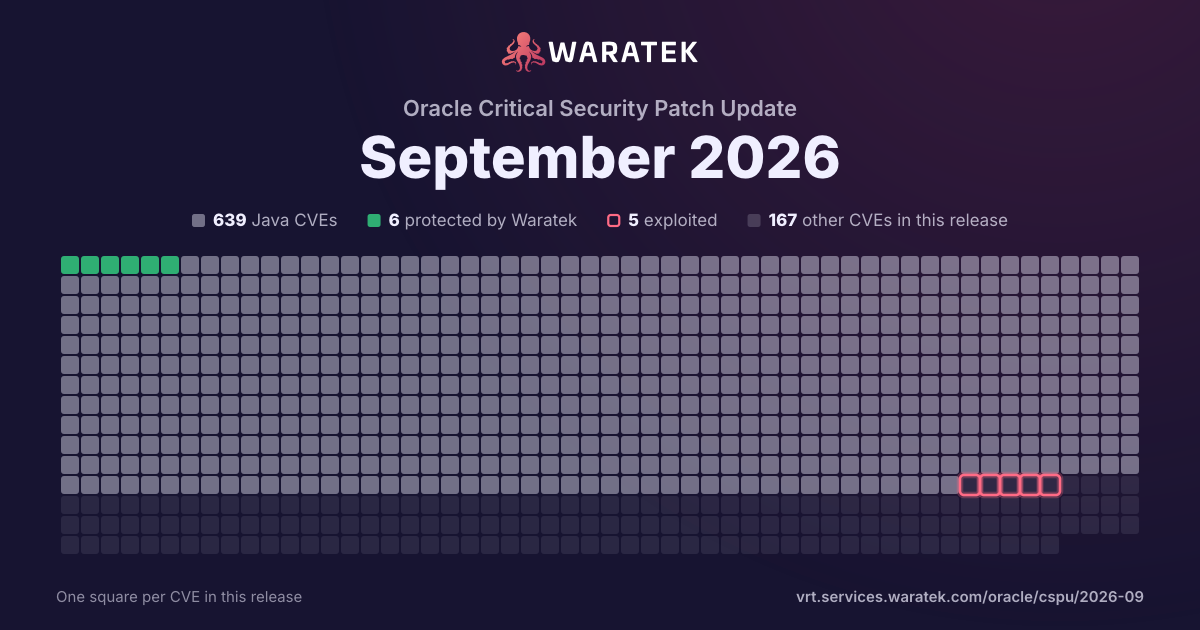
By status
No exploit published. For 596 of them, Oracle's security advisory is the source of public detail.
Protected by Waratek. Waratek RASP can block exploitation of these on systems that have not applied the patch yet.
Overview 13 matches · 8 in Waratek scope · 0 protected · 2 exploited · 0 CISA KEV · 0 public PoC · 0 EPSS ≥ 0.5
13matches
8in Waratek scope61.5%
0protected0.0%
2exploited15.4%
0CISA KEV0.0%
0public PoC0.0%
0EPSS ≥ 0.50.0%
Protected by Waratek
0
0.0%
Rule in development
0
0.0%
Mitigation candidate
0
0.0%
No exploit published
8
61.5%
Outside Waratek scope
0
0.0%
Not applicable
5
38.5%
Withdrawn CVE
0
0.0%
blocked by ARMR today
0
0.0%
partly blocked
0
0.0%
not blocked
13
100.0%
not established
0
0.0%
unrecorded
0
0.0%
Exploited
2
15.4%
Working exploit published
0
0.0%
Proof of concept only
1
7.7%
Forecast only
0
0.0%
No public exploit
10
76.9%
split by
peak 12 / month
Feb 26Mar 26Apr 26May 26Jun 26
| CVE | Severity | Published▾ | Status | Exploitation | Description |
|---|---|---|---|---|---|
| CVE-2026-50734 | High | 2026-06-30 | No exploit published | No public exploit | Memory Allocation with Excessive Size Value vulnerability in Apache ActiveMQ Client, Apache ActiveMQ, Apache ActiveMQ All. An unauthenticated network attacker can cause a broker DoS by sending a crafted WireFormatInfo frame with a malicious large size value. The value is not validate and causes the broker to attempt allocation during pre-auth negotiation which can trigger OOM and crash the broker. This issue affects Apache ActiveMQ Client: before 5.19.8, from 6.0.0 before 6.2.7; Apache ActiveMQ: before 5.19.8, from 6.0.0 before 6.2.7; Apache ActiveMQ All: before 5.19.8, from 6.0.0 before 6.2.7. Users are recommended to upgrade to version 6.2.7 or 5.19.8, which fixes the issue. |
| CVE-2026-53404 | High | 2026-06-29 | No exploit published | No public exploit | Always-Incorrect Control Flow Implementation vulnerability in Apache Tomcat's rewrite valve meant that if the first condition in an OR chain matched, subsequent non-OR conditions were skipped. This issue affects Apache Tomcat: from 11.0.0-M1 through 11.0.22, from 10.1.0-M1 through 10.1.55, from 9.0.0.M1 through 9.0.118, from 8.5.0 through 8.5.100. Other versions that have reached end of support may also be affected. Users are recommended to upgrade to version 11.0.23, 10.1.56 or 9.0.119, which fix the issue. |
| CVE-2026-13006 | High | 2026-06-24 | No exploit published | No public exploit | ACE vulnerability in conditional configuration file processing by QOS.CH logback-core up to and including version 1.5.36 in Java applications, allows an attacker to execute arbitrary code circumventing existing protections against CVE-2025-11226 by compromising an existing logback configuration file or by injecting an environment variable before program execution. A successful attack requires the presence of Janino library to be present on the user's class path. In addition, the attacker must have write access to a configuration file. Alternatively, the attacker could inject a malicious environment variable pointing to a malicious configuration file. In both cases, the attack requires existing privilege. Please note that in logack version 1.5.37 conditional processing using Janino was removed. |
| CVE-2026-54513 | High | 2026-06-23 | No exploit published | No public exploit | jackson-databind contains the general-purpose data-binding functionality and tree-model for Jackson Data Processor. From 2.10.0 until 2.18.8, 2.21.4, and 3.1.4, BasicPolymorphicTypeValidator.Builder.allowIfSubTypeIsArray() allowlists any array type based only on clazz.isArray(), without validating the array's component (element) type against the configured allowlist. A PTV built with allowIfSubTypeIsArray() plus an explicit concrete-type allowlist therefore still permits EvilType[] even though EvilType is not allowlisted. When Jackson deserializes the elements and no per-element type IDs are present, it instantiates the component type directly with no further PTV check, bypassing the allowlist. This vulnerability is fixed in 2.18.8, 2.21.4, and 3.1.4. |
| CVE-2026-54512 | High | 2026-06-23 | No exploit published | Proof of concept only | jackson-databind contains the general-purpose data-binding functionality and tree-model for Jackson Data Processor. From 2.10.0 until 2.18.8, 2.21.4, and 3.1.4, jackson-databind's PolymorphicTypeValidator (PTV) is the primary safety mechanism guarding polymorphic deserialization. When polymorphic typing is enabled and a type identifier contains generic parameters (i.e. the type ID string contains <), DatabindContext._resolveAndValidateGeneric() validates only the raw container class name (the substring before <) against the configured PTV. If the container type is approved, the method parses the full canonical type string via TypeFactory.constructFromCanonical() and returns the fully parameterized type without ever validating the nested type arguments against the PTV. The nested type arguments are then resolved, instantiated, and populated as beans during deserialization. An attacker who controls the type ID can therefore place a denied class as a generic type parameter of an allowed container — for example java.util.ArrayList<com.evil.Gadget> when only java.util.ArrayList is allow-listed. The container passes the PTV check; com.evil.Gadget is loaded via Class.forName(name, true, loader), instantiated, and its properties are set from attacker-controlled JSON. This completely bypasses an explicitly configured PTV allow-list. This vulnerability is fixed in 2.18.8, 2.21.4, and 3.1.4. |
| CVE-2026-50010 | High | 2026-06-12 | No exploit published | No public exploit | Netty is a network application framework for development of protocol servers and clients. Prior to versions 4.1.135.Final and 4.2.15.Final, SimpleTrustManagerFactory.engineGetTrustManagers() and related paths wrap any user-supplied plain X509TrustManager in X509TrustManagerWrapper, which extends X509ExtendedTrustManager but implements the 3-arg checkServerTrusted(chain, authType, SSLEngine) by discarding the SSLEngine and calling the 2-arg delegate. Because the object now IS an X509ExtendedTrustManager, neither SunJSSE's internal AbstractTrustManagerWrapper nor Netty's own OpenSslX509TrustManagerWrapper will re-wrap it to add endpoint-identification. Consequently, even though Netty 4.2 sets endpointIdentificationAlgorithm="HTTPS" by default, a client built with `SslContextBuilder.forClient().trustManager(somePlainX509TrustManager)` performs no hostname verification at all. Versions 4.1.135.Final and 4.2.15.Final patch the issue. |
| CVE-2026-45416 | High | 2026-06-12 | No exploit published | No public exploit | Netty is a network application framework for development of protocol servers and clients. Prior to versions 4.1.135.Final and 4.2.15.Final, SslClientHelloHandler.decode() reads the 24-bit TLS handshake length and, when the ClientHello does not fit in the first record, eagerly allocates `ctx.alloc().buffer(handshakeLength)` (line 161). The guard at line 140 is `handshakeLength > maxClientHelloLength && maxClientHelloLength != 0`, and the commonly-used SniHandler/AbstractSniHandler constructors (SniHandler(Mapping), SniHandler(AsyncMapping), AbstractSniHandler()) pass maxClientHelloLength=0 and handshakeTimeoutMillis=0, so the length guard is disabled and no timeout is scheduled. A 16 MiB request exceeds the default pooled chunk size and becomes a huge/unpooled allocation performed immediately. The buffer is retained in the handler until the channel closes. Versions 4.1.135.Final and 4.2.15.Final patch the issue. |
| CVE-2026-44249 | High | 2026-06-11 | No exploit published | No public exploit | Netty is a network application framework for development of protocol servers and clients. In netty-handler prior to versions 4.1.135.Final and 4.2.15.Final, an attacker can bypass IPv6 subnet rules due to an incorrect masking operation in IpSubnetFilterRule.compareTo(). Valid public IP addresses can bypass the restrictions. Versions 4.1.135.Final and 4.2.15.Final patch the issue. |
| CVE-2026-49759 | High | 2026-06-10 | Not applicable | No public exploit | Stack-based Buffer Overflow vulnerability in Erlang OTP erts (inet_drv) allows an unauthenticated remote attacker to crash the BEAM VM by sending a crafted SCTP ERROR chunk. The sctp_parse_error_chunk function in erts/emulator/drivers/common/inet_drv.c parses SCTP ERROR chunks and writes cause codes into a fixed-size stack-allocated ErlDrvTermData spec[] array without checking bounds. A remote attacker who has established an SCTP association to a listening port can send a single crafted SCTP ERROR chunk containing enough cause codes to overflow the stack buffer, crashing the VM. The attacker can only write 16-bit values interleaved with a fixed tag, so the overflow does not provide a controlled return address, limiting exploitation to Denial of Service. A crafted SCTP ERROR chunk may also leak bits and pieces of Erlang VM memory into the received error packet observed by the Erlang process. Such data is already readable by the user running the Erlang VM, so the disclosure scope is limited. This issue affects OTP from OTP 17.0 before OTP 27.3.4.13, OTP 28.5.0.2, and OTP 29.0.2, corresponding to erts from 6.0 before 15.2.7.9, 16.4.0.2, and 17.0.2. Whether OTP before OTP 17.0, corresponding to erts before 6.0, is affected is unknown. |
| CVE-2026-48860 | High | 2026-06-10 | Not applicable | No public exploit | Reliance on IP Address for Authentication vulnerability in Erlang/OTP ssl (inet_tls_dist module) allows unauthenticated bypass of the distribution-over-TLS LAN allowlist. The inet_tls_dist:check_ip/1 function, which enforces a LAN allowlist for Erlang distribution over TLS, calls inet:sockname/1 instead of inet:peername/1 to obtain the peer's IP address. Because inet:sockname/1 returns the local socket address, both the local IP and the supposed peer IP resolve to the same value, causing the subnet mask comparison to always succeed regardless of the actual remote address. Any holder of a CA-signed TLS certificate can therefore bypass the LAN restriction and gain full Erlang distribution access to the node, including rpc:call/4 and code:load_binary/3. This vulnerability is associated with program file lib/ssl/src/inet_tls_dist.erl. This issue affects OTP from OTP 26.0 before OTP 27.3.4.13, OTP 28.5.0.2, and OTP 29.0.2, corresponding to ssl from 11.0 before 11.2.12.9, 11.6.0.2, and 11.7.2. |
| CVE-2026-48856 | High | 2026-06-10 | Not applicable | No public exploit | Sensitive Data Exposure vulnerability in Erlang OTP inets (httpc_response module) allows Retrieve Embedded Sensitive Data. The httpc client forwards the Authorization and Proxy-Authorization request headers to redirect targets without checking whether the redirect crosses an origin boundary. httpc_response:redirect/2 constructs the redirected request by updating only the host field of the header record; all other fields (including authorization and proxy_authorization) are copied verbatim. The redirect target host is never compared against the original host. autoredirect defaults to true, so this affects all httpc callers that do not explicitly disable automatic redirects. An attacker who controls a server that the victim contacts via httpc can issue a cross-origin 3xx redirect to a server they also control. The Authorization header (including Basic credentials derived from URL userinfo via httpc_request:handle_user_info/2) is forwarded to the redirect target, allowing credential theft. The same applies to the Proxy-Authorization header. This vulnerability is associated with program files lib/inets/src/http_client/httpc_response.erl. This issue affects OTP from OTP 17.0 before OTP 27.3.4.19, OTP 28.5.0.8, and OTP 29.1.2, corresponding to inets from 5.10 before 9.3.2.8, 9.6.2.4, and 9.8.1. Whether OTP before OTP 17.0, corresponding to inets before 5.10, is affected is unknown. |
| CVE-2026-4035 | High | 2026-06-03 | Not applicable | Exploited | A vulnerability in mlflow/mlflow versions prior to 3.11.0 allows for the resolution of environment variables in AI Gateway secrets, which can be exploited to exfiltrate sensitive server-side environment credentials to an attacker-controlled endpoint. This issue arises because the `api_key` field in gateway secrets can accept `$ENV_VAR` references, which are resolved against the MLflow server's environment during runtime. The resolved secrets are then sent in provider authentication headers to the configured upstream `api_base`. This vulnerability can be exploited by low-privileged authenticated users in basic-auth deployments or by unauthenticated users in default deployments without `basic-auth`. The impact includes potential leakage of sensitive credentials such as cloud artifact credentials (`AWS_ACCESS_KEY_ID`, `AWS_SECRET_ACCESS_KEY`), which could lead to artifact poisoning and cross-boundary code execution in downstream environments. The issue is fixed in version 3.11.0. |
| CVE-2026-25639 | High | 2026-02-09 | Not applicable | Exploited | Axios is a promise based HTTP client for the browser and Node.js. Prior to versions 0.30.3 and 1.13.5, the mergeConfig function in axios crashes with a TypeError when processing configuration objects containing __proto__ as an own property. An attacker can trigger this by providing a malicious configuration object created via JSON.parse(), causing complete denial of service. This vulnerability is fixed in versions 0.30.3 and 1.13.5. |