
WaratekVRT Sign in

Oracle Critical Security Patch Update September 2026

Released September 2026 · Oracle's advisory ↗ · ← Security Patch Update, August 2026 · Critical Patch Update, October 2026 →

806 CVEs in this release, one square each
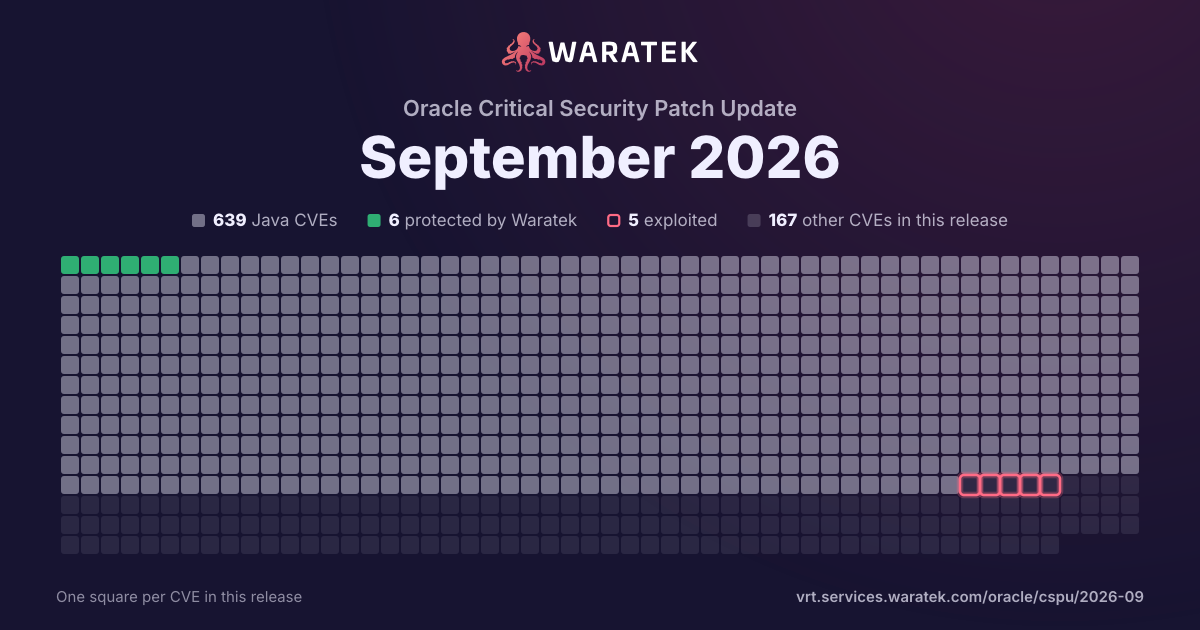
Protected by WaratekProtected by WaratekProtected by WaratekProtected by WaratekProtected by WaratekProtected by WaratekNo exploit publishedNo exploit publishedNo exploit publishedNo exploit publishedNo exploit publishedNo exploit publishedNo exploit publishedNo exploit publishedNo exploit publishedNo exploit publishedNo exploit publishedNo exploit publishedNo exploit publishedNo exploit publishedNo exploit publishedNo exploit publishedNo exploit publishedNo exploit publishedNo exploit publishedNo exploit publishedNo exploit publishedNo exploit publishedNo exploit publishedNo exploit publishedNo exploit publishedNo exploit publishedNo exploit publishedNo exploit publishedNo exploit publishedNo exploit publishedNo exploit publishedNo exploit publishedNo exploit publishedNo exploit publishedNo exploit publishedNo exploit publishedNo exploit publishedNo exploit publishedNo exploit publishedNo exploit publishedNo exploit publishedNo exploit publishedNo exploit publishedNo exploit publishedNo exploit publishedNo exploit publishedNo exploit publishedNo exploit publishedNo exploit publishedNo exploit publishedNo exploit publishedNo exploit publishedNo exploit publishedNo exploit publishedNo exploit publishedNo exploit publishedNo exploit publishedNo exploit publishedNo exploit publishedNo exploit publishedNo exploit publishedNo exploit publishedNo exploit publishedNo exploit publishedNo exploit publishedNo exploit publishedNo exploit publishedNo exploit publishedNo exploit publishedNo exploit publishedNo exploit publishedNo exploit publishedNo exploit publishedNo exploit publishedNo exploit publishedNo exploit publishedNo exploit publishedNo exploit publishedNo exploit publishedNo exploit publishedNo exploit publishedNo exploit publishedNo exploit publishedNo exploit publishedNo exploit publishedNo exploit publishedNo exploit publishedNo exploit publishedNo exploit publishedNo exploit publishedNo exploit publishedNo exploit publishedNo exploit publishedNo exploit publishedNo exploit publishedNo exploit publishedNo exploit publishedNo exploit publishedNo exploit publishedNo exploit publishedNo exploit publishedNo exploit publishedNo exploit publishedNo exploit publishedNo exploit publishedNo exploit publishedNo exploit publishedNo exploit publishedNo exploit publishedNo exploit publishedNo exploit publishedNo exploit publishedNo exploit publishedNo exploit publishedNo exploit publishedNo exploit publishedNo exploit publishedNo exploit publishedNo exploit publishedNo exploit publishedNo exploit publishedNo exploit publishedNo exploit publishedNo exploit publishedNo exploit publishedNo exploit publishedNo exploit publishedNo exploit publishedNo exploit publishedNo exploit publishedNo exploit publishedNo exploit publishedNo exploit publishedNo exploit publishedNo exploit publishedNo exploit publishedNo exploit publishedNo exploit publishedNo exploit publishedNo exploit publishedNo exploit publishedNo exploit publishedNo exploit publishedNo exploit publishedNo exploit publishedNo exploit publishedNo exploit publishedNo exploit publishedNo exploit publishedNo exploit publishedNo exploit publishedNo exploit publishedNo exploit publishedNo exploit publishedNo exploit publishedNo exploit publishedNo exploit publishedNo exploit publishedNo exploit publishedNo exploit publishedNo exploit publishedNo exploit publishedNo exploit publishedNo exploit publishedNo exploit publishedNo exploit publishedNo exploit publishedNo exploit publishedNo exploit publishedNo exploit publishedNo exploit publishedNo exploit publishedNo exploit publishedNo exploit publishedNo exploit publishedNo exploit publishedNo exploit publishedNo exploit publishedNo exploit publishedNo exploit publishedNo exploit publishedNo exploit publishedNo exploit publishedNo exploit publishedNo exploit publishedNo exploit publishedNo exploit publishedNo exploit publishedNo exploit publishedNo exploit publishedNo exploit publishedNo exploit publishedNo exploit publishedNo exploit publishedNo exploit publishedNo exploit publishedNo exploit publishedNo exploit publishedNo exploit publishedNo exploit publishedNo exploit publishedNo exploit publishedNo exploit publishedNo exploit publishedNo exploit publishedNo exploit publishedNo exploit publishedNo exploit publishedNo exploit publishedNo exploit publishedNo exploit publishedNo exploit publishedNo exploit publishedNo exploit publishedNo exploit publishedNo exploit publishedNo exploit publishedNo exploit publishedNo exploit publishedNo exploit publishedNo exploit publishedNo exploit publishedNo exploit publishedNo exploit publishedNo exploit publishedNo exploit publishedNo exploit publishedNo exploit publishedNo exploit publishedNo exploit publishedNo exploit publishedNo exploit publishedNo exploit publishedNo exploit publishedNo exploit publishedNo exploit publishedNo exploit publishedNo exploit publishedNo exploit publishedNo exploit publishedNo exploit publishedNo exploit publishedNo exploit publishedNo exploit publishedNo exploit publishedNo exploit publishedNo exploit publishedNo exploit publishedNo exploit publishedNo exploit publishedNo exploit publishedNo exploit publishedNo exploit publishedNo exploit publishedNo exploit publishedNo exploit publishedNo exploit publishedNo exploit publishedNo exploit publishedNo exploit publishedNo exploit publishedNo exploit publishedNo exploit publishedNo exploit publishedNo exploit publishedNo exploit publishedNo exploit publishedNo exploit publishedNo exploit publishedNo exploit publishedNo exploit publishedNo exploit publishedNo exploit publishedNo exploit publishedNo exploit publishedNo exploit publishedNo exploit publishedNo exploit publishedNo exploit publishedNo exploit publishedNo exploit publishedNo exploit publishedNo exploit publishedNo exploit publishedNo exploit publishedNo exploit publishedNo exploit publishedNo exploit publishedNo exploit publishedNo exploit publishedNo exploit publishedNo exploit publishedNo exploit publishedNo exploit publishedNo exploit publishedNo exploit publishedNo exploit publishedNo exploit publishedNo exploit publishedNo exploit publishedNo exploit publishedNo exploit publishedNo exploit publishedNo exploit publishedNo exploit publishedNo exploit publishedNo exploit publishedNo exploit publishedNo exploit publishedNo exploit publishedNo exploit publishedNo exploit publishedNo exploit publishedNo exploit publishedNo exploit publishedNo exploit publishedNo exploit publishedNo exploit publishedNo exploit publishedNo exploit publishedNo exploit publishedNo exploit publishedNo exploit publishedNo exploit publishedNo exploit publishedNo exploit publishedNo exploit publishedNo exploit publishedNo exploit publishedNo exploit publishedNo exploit publishedNo exploit publishedNo exploit publishedNo exploit publishedNo exploit publishedNo exploit publishedNo exploit publishedNo exploit publishedNo exploit publishedNo exploit publishedNo exploit publishedNo exploit publishedNo exploit publishedNo exploit publishedNo exploit publishedNo exploit publishedNo exploit publishedNo exploit publishedNo exploit publishedNo exploit publishedNo exploit publishedNo exploit publishedNo exploit publishedNo exploit publishedNo exploit publishedNo exploit publishedNo exploit publishedNo exploit publishedNo exploit publishedNo exploit publishedNo exploit publishedNo exploit publishedNo exploit publishedNo exploit publishedNo exploit publishedNo exploit publishedNo exploit publishedNo exploit publishedNo exploit publishedNo exploit publishedNo exploit publishedNo exploit publishedNo exploit publishedNo exploit publishedNo exploit publishedNo exploit publishedNo exploit publishedNo exploit publishedNo exploit publishedNo exploit publishedNo exploit publishedNo exploit publishedNo exploit publishedNo exploit publishedNo exploit publishedNo exploit publishedNo exploit publishedNo exploit publishedNo exploit publishedNo exploit publishedNo exploit publishedNo exploit publishedNo exploit publishedNo exploit publishedNo exploit publishedNo exploit publishedNo exploit publishedNo exploit publishedNo exploit publishedNo exploit publishedNo exploit publishedNo exploit publishedNo exploit publishedNo exploit publishedNo exploit publishedNo exploit publishedNo exploit publishedNo exploit publishedNo exploit publishedNo exploit publishedNo exploit publishedNo exploit publishedNo exploit publishedNo exploit publishedNo exploit publishedNo exploit publishedNo exploit publishedNo exploit publishedNo exploit publishedNo exploit publishedNo exploit publishedNo exploit publishedNo exploit publishedNo exploit publishedNo exploit publishedNo exploit publishedNo exploit publishedNo exploit publishedNo exploit publishedNo exploit publishedNo exploit publishedNo exploit publishedNo exploit publishedNo exploit publishedNo exploit publishedNo exploit publishedNo exploit publishedNo exploit publishedNo exploit publishedNo exploit publishedNo exploit publishedNo exploit publishedNo exploit publishedNo exploit publishedNo exploit publishedNo exploit publishedNo exploit publishedNo exploit publishedNo exploit publishedNo exploit publishedNo exploit publishedNo exploit publishedNo exploit publishedNo exploit publishedNo exploit publishedNo exploit publishedNo exploit publishedNo exploit publishedNo exploit publishedNo exploit publishedNo exploit publishedNo exploit publishedNo exploit publishedNo exploit publishedNo exploit publishedNo exploit publishedNo exploit publishedNo exploit publishedNo exploit publishedNo exploit publishedNo exploit publishedNo exploit publishedNo exploit publishedNo exploit publishedNo exploit publishedNo exploit publishedNo exploit publishedNo exploit publishedNo exploit publishedNo exploit publishedNo exploit publishedNo exploit publishedNo exploit publishedNo exploit publishedNo exploit publishedNo exploit publishedNo exploit publishedNo exploit publishedNo exploit publishedNo exploit publishedNo exploit publishedNo exploit publishedNo exploit publishedNo exploit publishedNo exploit publishedNo exploit publishedNo exploit publishedNo exploit publishedNo exploit publishedNo exploit publishedNo exploit publishedNo exploit publishedNo exploit publishedNo exploit publishedNo exploit publishedNo exploit publishedNo exploit publishedNo exploit publishedNo exploit publishedNo exploit publishedNo exploit publishedNo exploit publishedNo exploit publishedNo exploit publishedNo exploit publishedNo exploit publishedNo exploit publishedNo exploit publishedNo exploit publishedNo exploit publishedNo exploit publishedNo exploit publishedNo exploit publishedNo exploit publishedNo exploit publishedNo exploit publishedNo exploit publishedNo exploit publishedNo exploit publishedNo exploit publishedNo exploit publishedNo exploit publishedNo exploit publishedNo exploit publishedNo exploit publishedNo exploit publishedNo exploit publishedNo exploit publishedNo exploit publishedNo exploit publishedNo exploit publishedNo exploit publishedNo exploit publishedNo exploit publishedNo exploit publishedNo exploit publishedNo exploit publishedNo exploit publishedNo exploit publishedNo exploit publishedNo exploit publishedNo exploit publishedNo exploit publishedNo exploit publishedNo exploit publishedNo exploit publishedNo exploit publishedNo exploit publishedNo exploit publishedNo exploit publishedNo exploit publishedNo exploit publishedNo exploit publishedNo exploit publishedNo exploit publishedNo exploit publishedNo exploit publishedNo exploit publishedNo exploit publishedNo exploit publishedNo exploit publishedNo exploit publishedNo exploit publishedNo exploit publishedNo exploit publishedNo exploit publishedNo exploit publishedNo exploit publishedNo exploit publishedNo exploit publishedNo exploit publishedNo exploit publishedNo exploit publishedNo exploit publishedNo exploit publishedNo exploit publishedNo exploit publishedNo exploit publishedNo exploit publishedNo exploit publishedNo exploit publishedNo exploit publishedNo exploit publishedNo exploit publishedNo exploit publishedNo exploit publishedNo exploit publishedNo exploit publishedNo exploit publishedNo exploit publishedNo exploit publishedNo exploit publishedNo exploit publishedNo exploit publishedNo exploit publishedNo exploit publishedNo exploit publishedNo exploit publishedNo exploit publishedNo exploit publishedNo exploit publishedNo exploit publishedNo exploit publishedNo exploit publishedNo exploit publishedNo exploit publishedNo exploit publishedNo exploit publishedNo exploit publishedNo exploit publishedNo exploit publishedNo exploit publishedNo exploit publishedNo exploit publishedNo exploit publishedNo exploit publishedNo exploit publishedNo exploit publishedNo exploit publishedNo exploit publishedNo exploit publishedNo exploit publishedNo exploit publishedNot applicable, exploitedNot applicable, exploitedNot applicable, exploitedNot applicable, exploitedNot applicable, exploitedNot applicableNot applicableNot applicableNot applicableNot applicableNot applicableNot applicableNot applicableNot applicableNot applicableNot applicableNot applicableNot applicableNot applicableNot applicableNot applicableNot applicableNot applicableNot applicableNot applicableNot applicableNot applicableNot applicableNot applicableNot applicableNot applicableNot applicableNot applicableNot applicableNot applicableNot applicableNot applicableNot applicableNot applicableNot applicableNot applicableNot applicableNot applicableNot applicableNot applicableNot applicableNot applicableNot applicableNot applicableNot applicableNot applicableNot applicableNot applicableNot applicableNot applicableNot applicableNot applicableNot applicableNot applicableNot applicableNot applicableNot applicableNot applicableNot applicableNot applicableNot applicableNot applicableNot applicableNot applicableNot applicableNot applicableNot applicableNot applicableNot applicableNot applicableNot applicableNot applicableNot applicableNot applicableNot applicableNot applicableNot applicableNot applicableNot applicableNot applicableNot applicableNot applicableNot applicableNot applicableNot applicableNot applicableNot applicableNot applicableNot applicableNot applicableNot applicableNot applicableNot applicableNot applicableNot applicableNot applicableNot applicableNot applicableNot applicableNot applicableNot applicableNot applicableNot applicableNot applicableNot applicableNot applicableNot applicableNot applicableNot applicableNot applicableNot applicableNot applicableNot applicableNot applicableNot applicableNot applicableNot applicableNot applicableNot applicableNot applicableNot applicableNot applicableNot applicableNot applicableNot applicableNot applicableNot applicableNot applicableNot applicableNot applicableNot applicableNot applicableNot applicableNot applicableNot applicableNot applicableNot applicableNot applicableNot applicableNot applicableNot applicableNot applicableNot applicableNot applicableNot applicableNot applicableNot applicableNot applicableNot applicableNot applicableNot applicableNot applicableNot applicableNot applicableNot applicableNot applicableNot applicableNot applicableNot applicableNot applicableNot applicableNot applicable
Share this chart Oracle Critical Security Patch Update September 2026, one square per CVE: 639 Java CVEs, 6 protected by Waratek, 5 exploited, 167 other CVEs in this release.

Download the image

By status

No exploit published. For 596 of them, Oracle's security advisory is the source of public detail.

Protected by Waratek. Waratek RASP can block exploitation of these on systems that have not applied the patch yet.

Reset
More filters (2)
Columns
Including CVEs outside Waratek scope✕Published from 2026-08-01✕Published to 2026-08-31✕
Overview 14 matches · 3 in Waratek scope · 1 protected · 1 exploited · 1 CISA KEV · 1 public PoC · 0 EPSS ≥ 0.5
Protected by Waratek 1 7.1% Rule in development 0 0.0% Mitigation candidate 0 0.0% No exploit published 2 14.3% Outside Waratek scope 0 0.0% Not applicable 11 78.6% Withdrawn CVE 0 0.0%
Critical 4 28.6% High 5 35.7% Medium 5 35.7% Low 0 0.0% None 0 0.0% Unknown 0 0.0%
blocked by ARMR today 1 7.1% partly blocked 0 0.0% not blocked 13 92.9% not established 0 0.0% unrecorded 0 0.0%
Exploited 1 7.1% Working exploit published 0 0.0% Proof of concept only 4 28.6% Forecast only 0 0.0% No public exploit 9 64.3%
split by peak 14 / month
Not applicable: 11No exploit published: 2Protected by Waratek: 1 Medium: 5High: 5Critical: 4 not blocked: 13blocked by ARMR today: 1 No public exploit: 9Proof of concept only: 4Exploited: 1
Aug 26
14 matches Sign in to download these CVEs as CSV or JSON, or to follow them in a feed.
CVE Severity Published▾ Status Exploitation Description
CVE-2026-75838 Medium 2026-08-18 Not applicable Proof of concept only DOMPurify before 3.4.13 contains a cross-site scripting vulnerability in IN_PLACE sanitization where element-removal hooks fail to neutralize detached subtrees. Attackers can supply HTML with event handlers on descendant elements that execute after sanitization completes, even though the returned root appears clean.
CVE-2026-69148 High 2026-08-17 Not applicable Proof of concept only MLflow is an open source AI engineering platform for agents, large language models, and machine learning models. Prior to 3.15.0, CreateModelVersion accepts a run_id or model_id after _validate_source_run() or _validate_source_model() in mlflow/server/handlers.py verifies only path containment, allowing authenticated users to create a model version that references another user's artifact directory and read files through GET /model-versions/get-artifact without the required READ permission. This issue is fixed in version 3.15.0.
CVE-2026-69146 Medium 2026-08-17 Not applicable Proof of concept only MLflow is an open source AI engineering platform for agents, large language models, and machine learning models. From 3.13.0 until 3.15.0, LogInputs is absent from BEFORE_REQUEST_HANDLERS in the mlflow/server/auth package, allowing any authenticated user to call POST /api/2.0/mlflow/runs/log-inputs for another user's run_id and inject attacker-controlled DatasetInput records into the dataset_inputs lineage metadata without UPDATE permission. This issue is fixed in version 3.15.0.
CVE-2026-64849 Critical 2026-08-17 Not applicable Exploited MLflow is an open source AI engineering platform for agents, large language models, and machine learning models. Starting in 3.3.0 and prior to 3.15.0, the POST /api/2.0/mlflow/webhooks/{id}/test endpoint (accessible without credentials when server authentication is not enabled) calls _validate_webhook_url() in mlflow/utils/validation.py only for the original URL while mlflow/webhooks/delivery.py follows redirects and re-resolves the hostname without pinning the validated address, allowing attackers to reach internal or cloud metadata services and receive response_status and response_body. The unauthenticated attack scenario described here applies to deployments without authentication. With MLflow’s built-in basic authentication enabled, requests to this endpoint require valid credentials; this issue does not itself bypass authentication. This issue is fixed in version 3.15.0.
CVE-2026-73194 Critical 2026-08-15 Not applicable No public exploit DBI versions before 1.652 for Perl allow a heap out-of-bounds write via an unvalidated numeric placeholder that sets the binder counter in preparse. preparse reserves seven output bytes per input byte, the width of the longest ':p99999' expansion. The ':N' branch parses the number with `atoi(src)` and assigns it to the binder counter with no range check, so a statement containing ':2147483648' leaves the counter negative (-2147483648 with glibc, where atoi wraps). Each following '?' then expands through `sprintf(start, ":p%d", idx++)` to ':p-2147483648', 14 bytes with the terminating NUL where the buffer budgets 7. The placeholder limit added in 1.650 tests the counter against 99,999, which a negative counter passes. Any caller that preparses an untrusted statement into ':pN' style placeholders gets a heap out-of-bounds write that grows with the number of '?' marks following the poisoned placeholder. The '?' and '%s' return styles compare the parsed number against the expected sequence and error out, and are unaffected.
CVE-2026-73193 Critical 2026-08-15 Not applicable Proof of concept only DBI versions before 1.652 for Perl allow a heap out-of-bounds write on 32-bit perl via an integer wraparound in the output buffer size computed by preparse. preparse reserves its output buffer with `newSV(strlen(statement) * 7 + 16)`, budgeting seven output bytes per input byte for the longest ':p99999' expansion. The product is computed in STRLEN, which is 32 bits wide on a 32-bit perl build, so a statement of 613,566,757 bytes multiplies to 4,294,967,299, wraps modulo 2^32 to 3, and reserves 19 bytes. The parser then copies the statement out through a raw pointer with no capacity check, writing the whole 585 MB input past the end of the allocation. The 99,999 placeholder limit does not bound this path, which is reached by ordinary non-placeholder content. Any caller that passes an untrusted statement of that length to preparse on a 32-bit perl gets a heap out-of-bounds write of attacker controlled bytes. Builds with a 64-bit STRLEN are not affected, since the wrap there needs a statement of about 2.3 exabytes.
CVE-2026-19880 Medium 2026-08-14 Protected by Waratek No public exploit Path-traversal vulnerability in QOS.CH Sarl Logback-classic on Java (logback-classic module) allows path-traversal vulnerability. More specifically, an MDC-based discriminator value flows unsanitized into a nested FileAppender path, letting an attacker who influences that MDC value (e.g. via an HTTP header) create and append log files outside the intended directory. This issue affects Logback-classic: from 0.9.14 through 1.6.2.
CVE-2026-73508 High 2026-08-13 No exploit published No public exploit Netty is an asynchronous, event-driven network application framework. Prior to 4.1.136.Final and 4.2.16.Final, io.netty.handler.codec.dns.AbstractDnsRecord, io.netty.handler.codec.dns.DefaultDnsRecordDecoder.decodeRecord(), and io.netty.handler.codec.dns.DnsCodecUtil.decompressDomainName() failed to release retained or newly allocated ByteBuf objects when IDN.toASCII() or encodeDomainName() rejected a malformed domain name, allowing unauthenticated remote DNS packets to leak direct memory incrementally until denial of service. This issue is fixed in versions 4.1.136.Final and 4.2.16.Final.
CVE-2026-14456 High 2026-08-13 Not applicable No public exploit Issue summary: When an OpenSSL QUIC server (Listener SSL object) processes valid QUIC Initial packets for unknown destination connection IDs, it can allocate and queue new incoming channels without enforcing any limit. Impact summary: A remote peer that can make many Initial packets reach the server listener faster than the application accepts connections, can cause the memory allocated to store the per-channel state to grow without any limits, potentially making the QUIC listener unavailable and causing Denial of Service. CWE: CWE-770: Allocation of Resources Without Limits or Throttling Description: The function that handles inbound QUIC packets uses Connection-Id from the packet header to find an existing connection (QUIC channel). If no existing connection is found and the packet type is INITIAL, the function treats the packet as a new connection. It allocates a new channel object and inserts it into a queue where it waits to be accepted by the local application with SSL_accept(3ossl). The memory occupied by these initial channel objects may grow without bounds if the application is not able to call SSL_accept() frequently enough to serve these inbound connection requests. The issue is present since OpenSSL 3.5 when the QUIC server implementation was added. The fix introduces a limit for pending connections. The default limit is set to 256 pending connections (waiting to be accepted by the local application). Applications may change the default by calling SSL_set_value_uint(3ossl). FIPS impact: no The FIPS module is not affected as the QUIC implementation is outside of the OpenSSL FIPS module boundary.
CVE-2026-71290 Critical 2026-08-11 No exploit published No public exploit Improper TLS hostname verification vulnerability in Apache HttpComponents Client 5.4 or newer. HostnameVerificationPolicy#BUILTIN setting has no effect when used with the async version of HttpClient. An attacker that can intercept and modify traffic between the client and the server can impersonate the server by presenting a valid certificate for a different domain.  Please note the classic version of HttpClient is not affected by this vulnerability.  Affected users are recommended to upgrade to at least version 5.6.4, which fixes the issue.
CVE-2026-67355 High 2026-08-01 Not applicable No public exploit guzzlehttp/guzzle versions before 7.15.1 fail to preserve host-only cookie scope, storing the request host in the Domain field instead of marking cookies as host-only. Attackers controlling child hosts can receive host-only cookies intended only for parent hosts, potentially disclosing session identifiers and authorization tokens when the same cookie jar is reused across trust boundaries.
CVE-2026-67354 High 2026-08-01 Not applicable No public exploit guzzlehttp/guzzle versions before 7.15.1 contain an information disclosure vulnerability in RedirectMiddleware. When the optional allow_redirects.referer setting is enabled, the middleware copies the URI fragment (the portion after '#') from the referring request into the generated Referer header when following a same-scheme redirect (e.g., HTTPS to HTTPS). An attacker who controls the redirect destination can read this fragment from the incoming Referer header, potentially disclosing one-time login secrets, access tokens, state values, or other sensitive client data to a server never meant to receive it. The referer setting is disabled by default. Fixed in 7.15.1, which strips the fragment before generating the Referer value.
CVE-2026-67353 Medium 2026-08-01 Not applicable No public exploit guzzlehttp/guzzle versions before 7.15.1 contain a denial of service vulnerability in the CookieJar that accepts unlimited Set-Cookie header fields with no size restrictions. Attackers can return many large cookies from a malicious server, causing Guzzle to store excessive data in memory and generate oversized Cookie headers that fail in handlers or destination servers.
CVE-2026-67339 Medium 2026-08-01 Not applicable No public exploit guzzlehttp/guzzle versions before 7.14.2 fail to properly isolate Proxy-Authorization headers from origin servers in cURL handlers. Attackers can capture proxy credentials through origin server access logs when requests are redirected, bypassed, or sent through SOCKS proxies that Guzzle misclassifies as direct connections.