
Oracle Critical Security Patch Update September 2026
Released September 2026 · Oracle's advisory ↗ · ← Security Patch Update, August 2026 · Critical Patch Update, October 2026 →
806 CVEs in this release, one square each
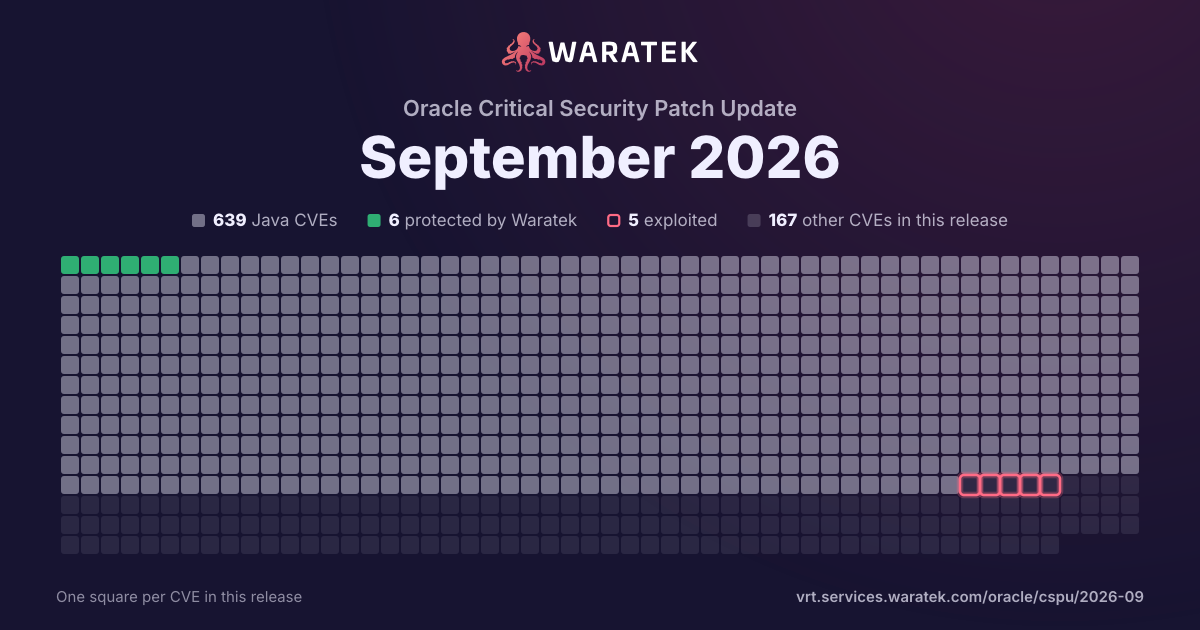
By status
No exploit published. For 596 of them, Oracle's security advisory is the source of public detail.
Protected by Waratek. Waratek RASP can block exploitation of these on systems that have not applied the patch yet.
Overview 97 matches · 10 in Waratek scope · 0 protected · 1 exploited · 0 CISA KEV · 4 public PoC · 0 EPSS ≥ 0.5
97matches
10in Waratek scope10.3%
0protected0.0%
1exploited1.0%
0CISA KEV0.0%
4public PoC4.1%
0EPSS ≥ 0.50.0%
Protected by Waratek
0
0.0%
Rule in development
0
0.0%
Mitigation candidate
0
0.0%
No exploit published
10
10.3%
Outside Waratek scope
0
0.0%
Not applicable
87
89.7%
Withdrawn CVE
0
0.0%
blocked by ARMR today
0
0.0%
partly blocked
0
0.0%
not blocked
97
100.0%
not established
0
0.0%
unrecorded
0
0.0%
| CVE | Severity | Published▾ | Status | Exploitation | Description |
|---|---|---|---|---|---|
| CVE-2026-17544 | High | 2026-07-30 | Not applicable | Proof of concept only | Attacker-provided inputs to bccomp() could lead to an out-of-bounds write with stack and heap corruption in PHP versions from 8.4.* before 8.4.24 and from 8.5.* before 8.5.9. |
| CVE-2026-59901 | High | 2026-07-29 | No exploit published | No public exploit | Netty is an asynchronous, event-driven network application framework. Prior to versions 4.1.136.Final and 4.2.16.Final, the `Bzip2Decoder` handler in Netty's compression codec pipeline is vulnerable to a denial-of-service attack through a malformed bzip2 stream that permanently captures the event-loop thread in an infinite loop. The vulnerability exists in the run-length encoding (RLE) state machine within [`Bzip2BlockDecompressor.read()`]. This issue has been fixed in versions 4.1.136.Final and 4.2.16.Final. |
| CVE-2026-59899 | Medium | 2026-07-29 | No exploit published | No public exploit | Netty is an asynchronous, event-driven network application framework. Prior to versions 4.1.136.Final and 4.2.16.Final, `HttpContentEncoder` (the superclass of the production handler `HttpContentCompressor`) maintains a per-channel `ArrayDeque<CharSequence>` named `acceptEncodingQueue` that accumulates attacker-controlled data without any size limit. The queue is filled on the I/O thread for every inbound HTTP request and drained only when the application later writes a non-1xx response. This creates a resource exhaustion vulnerability when an attacker exploits HTTP/1.1 pipelining to flood the connection with requests faster than the application produces responses. This issue has been fixed in versions 4.1.136.Final and 4.2.16.Final. |
| CVE-2026-59898 | Medium | 2026-07-29 | No exploit published | No public exploit | Netty is an asynchronous, event-driven network application framework. Prior to versions 4.1.136.Final and 4.2.16.Final, ab attacker can force WebSocket upgrade via the lax V07 (or V08) handshaker by sending `Sec-WebSocket-Version: 7` and omitting `Connection: Upgrade` / `Upgrade: websocket` headers, completing a protocol switch that a proxy would not recognize as an Upgrade request and enabling HTTP request smuggling / protocol-confusion attacks. This issue has been fixed in versions 4.1.136.Final and 4.2.16.Final. |
| CVE-2026-66299 | High | 2026-07-28 | No exploit published | No public exploit | Uncontrolled Resource Consumption vulnerability in Apache Tomcat's WebSocket chat example. This issue affects Apache Tomcat: from 11.0.0-M20 through 11.0.24, from 10.1.24 through 10.1.57, from 9.0.89 through 9.0.120. Users who have followed the security guidance to remove the examples web application are not affected by this issue. Users are recommended to remove the examples web application or to upgrade to version 11.0.25, 10.1.58 or 9.0.121 (when released), which fix the issue. |
| CVE-2026-59943 | Medium | 2026-07-28 | Not applicable | Proof of concept only | Dompdf is an HTML to PDF converter for PHP. In versions 3.15 and prior, if a malicious actor can supply unrestricted content for rendering by Dompdf they can utilize the SVG rendering functionality to leak filesystem information when rendering PDF files using image references within a data-URI encoded SVG document. Using an <image> element inside a data-URI embedded SVG, an attacker can attempt to embed other files via the href or xlink:href attributes. When processing a file that does not exist (e.g. file:///DOESNOTEXIST), dompdf behaves differently than it does when accessing a file or directory that actually exists on the filesystem. This issue has been fixed in version 3.16. |
| CVE-2026-59942 | Medium | 2026-07-28 | Not applicable | Proof of concept only | Dompdf is an HTML to PDF converter for PHP. Versions 3.15 and prior are vulnerable to a Denial of Service (DoS) attack via resource exhaustion. An attacker can crash the PHP process by providing a specially crafted HTML document containing a single image with massive dimensions (e.g., 30,000x30,000 pixels). While Dompdf implements internal checks to validate image dimensions, these can be bypassed by using a high-entropy image (such as random noise) encoded in Base64 and wrapped in specific CSS containers. The vulnerability exists because the dimension validation happens early, but the resource allocation for calculating the object's bounding box and internal buffers during the rendering phase does not strictly limit the cumulative CPU time or memory usage for a single object that has passed the initial check. An unauthenticated remote attacker can cause a complete Denial of Service on the web server by submitting a crafted HTML string. This affects any application that allows users to provide HTML content or URLs that are subsequently converted to PDF using Dompdf. This issue has been fixed in version 3.16. |
| CVE-2026-59941 | Medium | 2026-07-28 | Not applicable | Proof of concept only | Dompdf is an HTML to PDF converter for PHP. Versions 3.15 and prior accept a BMP image and generates a PDF-compatible PNG based only on its declared header dimensions and never bounds width × height before the image is converted through GD. A 58-byte BMP whose header declares e.g. 6000×6000 is accepted and later drives imagecreatetruecolor($width, $height) (and PHP's native BMP decoder) to allocate the full pixel canvas. A payload can fit in a single HTTP request: the BMP can be inlined as a data:image/bmp;base64,… URI inside attacker-controlled HTML, so no upload, no remote fetch, and no chroot-reachable file is required. I measured a 169-byte request driving a dompdf render to ~412 MB peak RSS and ~4.8 s of CPU/wall time, versus ~34 MB for an identically-sized benign request — roughly a 12× memory amplification per request, repeatable and unauthenticated. This issue has been fixed in version 3.16. |
| CVE-2026-59921 | Medium | 2026-07-28 | No exploit published | Proof of concept only | Netty is an asynchronous, event-driven network application framework. Prior to versions 4.1.136.Final and 4.2.16.Final, HttpPostRequestEncoder constructs multipart HTTP request bodies by directly concatenating user-supplied filenames and field names into Content-Disposition MIME headers without validating or sanitizing CRLF characters (\r\n). Since MIME headers are delimited by CRLF, an attacker who controls the filename can inject arbitrary MIME headers into the multipart body part. The root cause is that neither the encoder nor the FileUpload implementations' setFilename() methods, which only check for null, neutralize CRLF characters before the filename is embedded into the header. This issue has been fixed in versions 4.1.136.Final and 4.2.16.Final. |
| CVE-2026-56722 | Medium | 2026-07-28 | Not applicable | Proof of concept only | Dompdf is an HTML to PDF converter for PHP. In versions 3.15 and prior, aAn attacker who controls the HTML input can bypass this restriction by embedding a target file path inside an SVG image delivered through a data: URI, because dompdf processes the SVG twice and the second pass does not enforce the same protections as the first. When rendering, dompdf hands the SVG to the separate php-svg-lib library with external references forced on, and that library has no knowledge of the chroot directory, blocks only the phar:// scheme, and ultimately reads the referenced file with no path or protocol validation. This lets an external, unauthenticated attacker read arbitrary image files from the server's file system in the default configuration. This issue has been fixed in version 3.16. |
| CVE-2026-55555 | Low | 2026-07-28 | Not applicable | Proof of concept only | Dompdf is an HTML to PDF converter for PHP. Versions 3.15 and prior are vulnerable to a File Existence Oracle attack through the manipulation of the CSS @font-face directive. By providing malicious HTML that references local files via the file:// protocol repeatedly, an attacker can trigger PHP memory exhaustion. Because Dompdf behaves differently depending on whether a referenced local file exists (an existing file is processed repeatedly until it triggers an "Allowed memory size exhausted" crash, whereas a missing file fails fast or is ignored and never hits the memory limit), an attacker can use this observable discrepancy as an oracle to enumerate sensitive files on the server regardless of CHROOT restrictions. Exploitation requires the attacker to supply unrestricted or unsanitized HTML in a request that permits large data, plus a configuration where Dompdf's memory limit is low enough to be exhausted (with $_dompdf_show_warnings=true making the overflow easier to reach). This issue has been fixed in version 3.16. |
| CVE-2026-55554 | Low | 2026-07-28 | Not applicable | Proof of concept only | Dompdf is an HTML to PDF converter for PHP. In versions 3.15 and prior, the validateLocalUri() method enforces chroot boundaries with a strpos() prefix check after normalizing paths with realpath() . Because normalization strips the trailing directory separator from $chrootPath , the check only verifies that $chrootPath is a string prefix of $realfile, so a chroot of /var/www also matches sibling directories like /var/www2 , /var/www-admin, or /var/www_backup. An attacker who controls part of the rendered HTML could exploit this to escape the chroot and read sensitive files outside the allowed directory. This issue has been fixed in version 3.16. |
| CVE-2026-61109 | Medium | 2026-07-21 | Not applicable | No public exploit | Vulnerability in the MySQL Server, MySQL Cluster product of Oracle MySQL (component: Server: JSON). Supported versions that are affected are MySQL Server: 8.4.0-8.4.10, 9.7.0-9.7.1; MySQL Cluster: 8.0.0-8.0.47, 8.4.0-8.4.10 and 9.7.0-9.7.1. Easily exploitable vulnerability allows low privileged attacker with network access via multiple protocols to compromise MySQL Server, MySQL Cluster. Successful attacks of this vulnerability can result in unauthorized ability to cause a hang or frequently repeatable crash (complete DOS) of MySQL Server, MySQL Cluster. CVSS 3.1 Base Score 6.5 (Availability impacts). CVSS Vector: (CVSS:3.1/AV:N/AC:L/PR:L/UI:N/S:U/C:N/I:N/A:H). |
| CVE-2026-61096 | Low | 2026-07-21 | Not applicable | No public exploit | Vulnerability in the MySQL Server, MySQL Cluster product of Oracle MySQL (component: Server: Pluggable Auth). Supported versions that are affected are MySQL Server: 8.4.0-8.4.10, 9.7.0-9.7.1; MySQL Cluster: 8.0.0-8.0.47, 8.4.0-8.4.10 and 9.7.0-9.7.1. Difficult to exploit vulnerability allows unauthenticated attacker with logon to the infrastructure where MySQL Server, MySQL Cluster executes to compromise MySQL Server, MySQL Cluster. Successful attacks of this vulnerability can result in unauthorized update, insert or delete access to some of MySQL Server, MySQL Cluster accessible data. CVSS 3.1 Base Score 2.9 (Integrity impacts). CVSS Vector: (CVSS:3.1/AV:L/AC:H/PR:N/UI:N/S:U/C:N/I:L/A:N). |
| CVE-2026-61094 | High | 2026-07-21 | Not applicable | No public exploit | Vulnerability in the MySQL Server, MySQL Cluster product of Oracle MySQL (component: Server: Replication). Supported versions that are affected are MySQL Server: 8.4.0-8.4.10, 9.7.0-9.7.1; MySQL Cluster: 8.0.0-8.0.47, 8.4.0-8.4.10 and 9.7.0-9.7.1. Easily exploitable vulnerability allows high privileged attacker with network access via multiple protocols to compromise MySQL Server, MySQL Cluster. Successful attacks of this vulnerability can result in takeover of MySQL Server, MySQL Cluster. CVSS 3.1 Base Score 7.2 (Confidentiality, Integrity and Availability impacts). CVSS Vector: (CVSS:3.1/AV:N/AC:L/PR:H/UI:N/S:U/C:H/I:H/A:H). |
| CVE-2026-61081 | Low | 2026-07-21 | Not applicable | No public exploit | Vulnerability in the MySQL Server, MySQL Cluster product of Oracle MySQL (component: Server: Performance Schema). Supported versions that are affected are MySQL Server: 8.4.0-8.4.10, 9.7.0-9.7.1; MySQL Cluster: 8.0.0-8.0.47, 8.4.0-8.4.10 and 9.7.0-9.7.1. Easily exploitable vulnerability allows high privileged attacker with network access via multiple protocols to compromise MySQL Server, MySQL Cluster. Successful attacks of this vulnerability can result in unauthorized read access to a subset of MySQL Server, MySQL Cluster accessible data. CVSS 3.1 Base Score 2.7 (Confidentiality impacts). CVSS Vector: (CVSS:3.1/AV:N/AC:L/PR:H/UI:N/S:U/C:L/I:N/A:N). |
| CVE-2026-60747 | Medium | 2026-07-21 | Not applicable | No public exploit | Vulnerability in the MySQL Server, MySQL Cluster product of Oracle MySQL (component: Server: Replication). Supported versions that are affected are MySQL Server: 8.4.0-8.4.10, 9.7.0-9.7.1; MySQL Cluster: 8.0.0-8.0.47, 8.4.0-8.4.10 and 9.7.0-9.7.1. Easily exploitable vulnerability allows unauthenticated attacker with logon to the infrastructure where MySQL Server, MySQL Cluster executes to compromise MySQL Server, MySQL Cluster. Successful attacks of this vulnerability can result in unauthorized ability to cause a hang or frequently repeatable crash (complete DOS) of MySQL Server, MySQL Cluster. CVSS 3.1 Base Score 6.2 (Availability impacts). CVSS Vector: (CVSS:3.1/AV:L/AC:L/PR:N/UI:N/S:U/C:N/I:N/A:H). |
| CVE-2026-60585 | Medium | 2026-07-21 | Not applicable | No public exploit | Vulnerability in the MySQL Server, MySQL Cluster product of Oracle MySQL (component: Server: Replication). Supported versions that are affected are MySQL Server: 8.4.0-8.4.10, 9.7.0-9.7.1; MySQL Cluster: 8.0.0-8.0.47, 8.4.0-8.4.10 and 9.7.0-9.7.1. Difficult to exploit vulnerability allows high privileged attacker with network access via multiple protocols to compromise MySQL Server, MySQL Cluster. Successful attacks of this vulnerability can result in takeover of MySQL Server, MySQL Cluster. CVSS 3.1 Base Score 6.6 (Confidentiality, Integrity and Availability impacts). CVSS Vector: (CVSS:3.1/AV:N/AC:H/PR:H/UI:N/S:U/C:H/I:H/A:H). |
| CVE-2026-60332 | Medium | 2026-07-21 | Not applicable | No public exploit | Vulnerability in the MySQL Server, MySQL Cluster product of Oracle MySQL (component: Server: Group Replication GCS). Supported versions that are affected are MySQL Server: 8.4.0-8.4.10, 9.7.0-9.7.1; MySQL Cluster: 8.0.0-8.0.47, 8.4.0-8.4.10 and 9.7.0-9.7.1. Difficult to exploit vulnerability allows high privileged attacker with logon to the infrastructure where MySQL Server, MySQL Cluster executes to compromise MySQL Server, MySQL Cluster. Successful attacks of this vulnerability can result in takeover of MySQL Server, MySQL Cluster. CVSS 3.1 Base Score 6.4 (Confidentiality, Integrity and Availability impacts). CVSS Vector: (CVSS:3.1/AV:L/AC:H/PR:H/UI:N/S:U/C:H/I:H/A:H). |
| CVE-2026-60331 | Medium | 2026-07-21 | Not applicable | No public exploit | Vulnerability in the MySQL Server, MySQL Cluster product of Oracle MySQL (component: Server: Replication). Supported versions that are affected are MySQL Server: 8.4.0-8.4.10, 9.7.0-9.7.1; MySQL Cluster: 8.0.0-8.0.47, 8.4.0-8.4.10 and 9.7.0-9.7.1. Difficult to exploit vulnerability allows high privileged attacker with logon to the infrastructure where MySQL Server, MySQL Cluster executes to compromise MySQL Server, MySQL Cluster. Successful attacks of this vulnerability can result in takeover of MySQL Server, MySQL Cluster. CVSS 3.1 Base Score 6.4 (Confidentiality, Integrity and Availability impacts). CVSS Vector: (CVSS:3.1/AV:L/AC:H/PR:H/UI:N/S:U/C:H/I:H/A:H). |
| CVE-2026-60316 | High | 2026-07-21 | Not applicable | No public exploit | Vulnerability in the MySQL Server, MySQL Cluster product of Oracle MySQL (component: Server: X Plugin). Supported versions that are affected are MySQL Server: 8.4.0-8.4.10, 9.7.0-9.7.1; MySQL Cluster: 8.0.0-8.0.47, 8.4.0-8.4.10 and 9.7.0-9.7.1. Easily exploitable vulnerability allows high privileged attacker with network access via multiple protocols to compromise MySQL Server, MySQL Cluster. Successful attacks of this vulnerability can result in takeover of MySQL Server, MySQL Cluster. CVSS 3.1 Base Score 7.2 (Confidentiality, Integrity and Availability impacts). CVSS Vector: (CVSS:3.1/AV:N/AC:L/PR:H/UI:N/S:U/C:H/I:H/A:H). |
| CVE-2026-60315 | High | 2026-07-21 | Not applicable | No public exploit | Vulnerability in the MySQL Server, MySQL Cluster product of Oracle MySQL (component: Server: X Plugin). Supported versions that are affected are MySQL Server: 8.4.0-8.4.10, 9.7.0-9.7.1; MySQL Cluster: 8.0.0-8.0.47, 8.4.0-8.4.10 and 9.7.0-9.7.1. Easily exploitable vulnerability allows unauthenticated attacker with network access via multiple protocols to compromise MySQL Server, MySQL Cluster. Successful attacks of this vulnerability can result in unauthorized ability to cause a hang or frequently repeatable crash (complete DOS) of MySQL Server, MySQL Cluster and unauthorized read access to a subset of MySQL Server, MySQL Cluster accessible data. CVSS 3.1 Base Score 8.2 (Confidentiality and Availability impacts). CVSS Vector: (CVSS:3.1/AV:N/AC:L/PR:N/UI:N/S:U/C:L/I:N/A:H). |
| CVE-2026-60191 | Medium | 2026-07-21 | Not applicable | No public exploit | Vulnerability in the MySQL Server, MySQL Cluster product of Oracle MySQL (component: Server: Replication). Supported versions that are affected are MySQL Server: 8.4.0-8.4.10, 9.7.0-9.7.1; MySQL Cluster: 8.0.0-8.0.47, 8.4.0-8.4.10 and 9.7.0-9.7.1. Difficult to exploit vulnerability allows high privileged attacker with logon to the infrastructure where MySQL Server, MySQL Cluster executes to compromise MySQL Server, MySQL Cluster. Successful attacks of this vulnerability can result in unauthorized ability to cause a hang or frequently repeatable crash (complete DOS) of MySQL Server, MySQL Cluster. CVSS 3.1 Base Score 4.1 (Availability impacts). CVSS Vector: (CVSS:3.1/AV:L/AC:H/PR:H/UI:N/S:U/C:N/I:N/A:H). |
| CVE-2026-60190 | Low | 2026-07-21 | Not applicable | No public exploit | Vulnerability in the MySQL Server, MySQL Cluster product of Oracle MySQL (component: Server: Replication). Supported versions that are affected are MySQL Server: 8.4.0-8.4.10, 9.7.0-9.7.1; MySQL Cluster: 8.0.0-8.0.47, 8.4.0-8.4.10 and 9.7.0-9.7.1. Difficult to exploit vulnerability allows high privileged attacker with network access via multiple protocols to compromise MySQL Server, MySQL Cluster. Successful attacks of this vulnerability can result in unauthorized ability to cause a partial denial of service (partial DOS) of MySQL Server, MySQL Cluster. CVSS 3.1 Base Score 2.2 (Availability impacts). CVSS Vector: (CVSS:3.1/AV:N/AC:H/PR:H/UI:N/S:U/C:N/I:N/A:L). |
| CVE-2026-60189 | Medium | 2026-07-21 | Not applicable | No public exploit | Vulnerability in the MySQL Server, MySQL Cluster product of Oracle MySQL (component: Server: Replication). Supported versions that are affected are MySQL Server: 8.4.0-8.4.10, 9.7.0-9.7.1; MySQL Cluster: 8.0.0-8.0.47, 8.4.0-8.4.10 and 9.7.0-9.7.1. Difficult to exploit vulnerability allows high privileged attacker with network access via multiple protocols to compromise MySQL Server, MySQL Cluster. Successful attacks of this vulnerability can result in unauthorized ability to cause a hang or frequently repeatable crash (complete DOS) of MySQL Server, MySQL Cluster. CVSS 3.1 Base Score 4.4 (Availability impacts). CVSS Vector: (CVSS:3.1/AV:N/AC:H/PR:H/UI:N/S:U/C:N/I:N/A:H). |
| CVE-2026-60188 | Medium | 2026-07-21 | Not applicable | No public exploit | Vulnerability in the MySQL Server, MySQL Cluster product of Oracle MySQL (component: Server: Replication). Supported versions that are affected are MySQL Server: 8.4.0-8.4.10, 9.7.0-9.7.1; MySQL Cluster: 8.0.0-8.0.47, 8.4.0-8.4.10 and 9.7.0-9.7.1. Difficult to exploit vulnerability allows high privileged attacker with network access via multiple protocols to compromise MySQL Server, MySQL Cluster. Successful attacks of this vulnerability can result in unauthorized ability to cause a hang or frequently repeatable crash (complete DOS) of MySQL Server, MySQL Cluster. CVSS 3.1 Base Score 4.4 (Availability impacts). CVSS Vector: (CVSS:3.1/AV:N/AC:H/PR:H/UI:N/S:U/C:N/I:N/A:H). |
| CVE-2026-60187 | Medium | 2026-07-21 | Not applicable | No public exploit | Vulnerability in the MySQL Server, MySQL Cluster product of Oracle MySQL (component: Server: Replication). Supported versions that are affected are MySQL Server: 8.4.0-8.4.10, 9.7.0-9.7.1; MySQL Cluster: 8.0.0-8.0.47, 8.4.0-8.4.10 and 9.7.0-9.7.1. Difficult to exploit vulnerability allows high privileged attacker with network access via multiple protocols to compromise MySQL Server, MySQL Cluster. Successful attacks of this vulnerability can result in unauthorized ability to cause a hang or frequently repeatable crash (complete DOS) of MySQL Server, MySQL Cluster. CVSS 3.1 Base Score 4.4 (Availability impacts). CVSS Vector: (CVSS:3.1/AV:N/AC:H/PR:H/UI:N/S:U/C:N/I:N/A:H). |
| CVE-2026-60186 | Medium | 2026-07-21 | Not applicable | No public exploit | Vulnerability in the MySQL Server, MySQL Cluster product of Oracle MySQL (component: Server: Group Replication Plugin). Supported versions that are affected are MySQL Server: 8.4.0-8.4.10, 9.7.0-9.7.1; MySQL Cluster: 8.0.0-8.0.47, 8.4.0-8.4.10 and 9.7.0-9.7.1. Difficult to exploit vulnerability allows high privileged attacker with network access via multiple protocols to compromise MySQL Server, MySQL Cluster. Successful attacks of this vulnerability can result in unauthorized ability to cause a hang or frequently repeatable crash (complete DOS) of MySQL Server, MySQL Cluster. CVSS 3.1 Base Score 4.4 (Availability impacts). CVSS Vector: (CVSS:3.1/AV:N/AC:H/PR:H/UI:N/S:U/C:N/I:N/A:H). |
| CVE-2026-60185 | Medium | 2026-07-21 | Not applicable | No public exploit | Vulnerability in the MySQL Server, MySQL Cluster product of Oracle MySQL (component: Server: Replication). Supported versions that are affected are MySQL Server: 8.4.0-8.4.10, 9.7.0-9.7.1; MySQL Cluster: 8.0.0-8.0.47, 8.4.0-8.4.10 and 9.7.0-9.7.1. Difficult to exploit vulnerability allows high privileged attacker with network access via multiple protocols to compromise MySQL Server, MySQL Cluster. Successful attacks of this vulnerability can result in unauthorized ability to cause a hang or frequently repeatable crash (complete DOS) of MySQL Server, MySQL Cluster. CVSS 3.1 Base Score 4.4 (Availability impacts). CVSS Vector: (CVSS:3.1/AV:N/AC:H/PR:H/UI:N/S:U/C:N/I:N/A:H). |
| CVE-2026-60184 | Medium | 2026-07-21 | Not applicable | No public exploit | Vulnerability in the MySQL Server, MySQL Cluster product of Oracle MySQL (component: Server: Replication). Supported versions that are affected are MySQL Server: 8.4.0-8.4.10, 9.7.0-9.7.1; MySQL Cluster: 8.0.0-8.0.47, 8.4.0-8.4.10 and 9.7.0-9.7.1. Difficult to exploit vulnerability allows high privileged attacker with network access via multiple protocols to compromise MySQL Server, MySQL Cluster. Successful attacks of this vulnerability can result in unauthorized ability to cause a hang or frequently repeatable crash (complete DOS) of MySQL Server, MySQL Cluster. CVSS 3.1 Base Score 4.4 (Availability impacts). CVSS Vector: (CVSS:3.1/AV:N/AC:H/PR:H/UI:N/S:U/C:N/I:N/A:H). |
| CVE-2026-60183 | Medium | 2026-07-21 | Not applicable | No public exploit | Vulnerability in the MySQL Server, MySQL Cluster product of Oracle MySQL (component: Server: Clone Plugin). Supported versions that are affected are MySQL Server: 8.4.0-8.4.10, 9.7.0-9.7.1; MySQL Cluster: 8.0.0-8.0.47, 8.4.0-8.4.10 and 9.7.0-9.7.1. Difficult to exploit vulnerability allows high privileged attacker with logon to the infrastructure where MySQL Server, MySQL Cluster executes to compromise MySQL Server, MySQL Cluster. Successful attacks of this vulnerability can result in takeover of MySQL Server, MySQL Cluster. CVSS 3.1 Base Score 6.4 (Confidentiality, Integrity and Availability impacts). CVSS Vector: (CVSS:3.1/AV:L/AC:H/PR:H/UI:N/S:U/C:H/I:H/A:H). |
| CVE-2026-60182 | Medium | 2026-07-21 | Not applicable | No public exploit | Vulnerability in the MySQL Server, MySQL Cluster product of Oracle MySQL (component: Server: Clone Plugin). Supported versions that are affected are MySQL Server: 8.4.0-8.4.10, 9.7.0-9.7.1; MySQL Cluster: 8.0.0-8.0.47, 8.4.0-8.4.10 and 9.7.0-9.7.1. Difficult to exploit vulnerability allows high privileged attacker with network access via multiple protocols to compromise MySQL Server, MySQL Cluster. Successful attacks of this vulnerability can result in unauthorized ability to cause a hang or frequently repeatable crash (complete DOS) of MySQL Server, MySQL Cluster. CVSS 3.1 Base Score 4.4 (Availability impacts). CVSS Vector: (CVSS:3.1/AV:N/AC:H/PR:H/UI:N/S:U/C:N/I:N/A:H). |
| CVE-2026-60178 | Medium | 2026-07-21 | Not applicable | No public exploit | Vulnerability in the MySQL Server, MySQL Cluster product of Oracle MySQL (component: Server: Clone Plugin). Supported versions that are affected are MySQL Server: 8.4.0-8.4.10, 9.7.0-9.7.1; MySQL Cluster: 8.0.0-8.0.47, 8.4.0-8.4.10 and 9.7.0-9.7.1. Difficult to exploit vulnerability allows high privileged attacker with network access via multiple protocols to compromise MySQL Server, MySQL Cluster. Successful attacks of this vulnerability can result in takeover of MySQL Server, MySQL Cluster. CVSS 3.1 Base Score 6.6 (Confidentiality, Integrity and Availability impacts). CVSS Vector: (CVSS:3.1/AV:N/AC:H/PR:H/UI:N/S:U/C:H/I:H/A:H). |
| CVE-2026-60177 | Medium | 2026-07-21 | Not applicable | No public exploit | Vulnerability in the MySQL Server, MySQL Cluster product of Oracle MySQL (component: Server: Clone Plugin). Supported versions that are affected are MySQL Server: 8.4.0-8.4.10, 9.7.0-9.7.1; MySQL Cluster: 8.0.0-8.0.47, 8.4.0-8.4.10 and 9.7.0-9.7.1. Difficult to exploit vulnerability allows high privileged attacker with network access via multiple protocols to compromise MySQL Server, MySQL Cluster. Successful attacks of this vulnerability can result in unauthorized ability to cause a hang or frequently repeatable crash (complete DOS) of MySQL Server, MySQL Cluster. CVSS 3.1 Base Score 4.4 (Availability impacts). CVSS Vector: (CVSS:3.1/AV:N/AC:H/PR:H/UI:N/S:U/C:N/I:N/A:H). |
| CVE-2026-60163 | High | 2026-07-21 | Not applicable | No public exploit | Vulnerability in the MySQL Server, MySQL Cluster product of Oracle MySQL (component: Server: Group Replication Plugin). Supported versions that are affected are MySQL Server: 8.4.0-8.4.10, 9.7.0-9.7.1; MySQL Cluster: 8.0.0-8.0.47, 8.4.0-8.4.10 and 9.7.0-9.7.1. Easily exploitable vulnerability allows unauthenticated attacker with logon to the infrastructure where MySQL Server, MySQL Cluster executes to compromise MySQL Server, MySQL Cluster. Successful attacks of this vulnerability can result in takeover of MySQL Server, MySQL Cluster. CVSS 3.1 Base Score 8.4 (Confidentiality, Integrity and Availability impacts). CVSS Vector: (CVSS:3.1/AV:L/AC:L/PR:N/UI:N/S:U/C:H/I:H/A:H). |
| CVE-2026-60145 | Medium | 2026-07-21 | Not applicable | No public exploit | Vulnerability in the MySQL Server, MySQL Cluster product of Oracle MySQL (component: Server: Optimizer). Supported versions that are affected are MySQL Server: 8.4.0-8.4.10, 9.7.0-9.7.1; MySQL Cluster: 8.0.0-8.0.47, 8.4.0-8.4.10 and 9.7.0-9.7.1. Easily exploitable vulnerability allows high privileged attacker with network access via multiple protocols to compromise MySQL Server, MySQL Cluster. Successful attacks of this vulnerability can result in unauthorized ability to cause a hang or frequently repeatable crash (complete DOS) of MySQL Server, MySQL Cluster. CVSS 3.1 Base Score 4.9 (Availability impacts). CVSS Vector: (CVSS:3.1/AV:N/AC:L/PR:H/UI:N/S:U/C:N/I:N/A:H). |
| CVE-2026-56746 | Medium | 2026-07-21 | No exploit published | No public exploit | Netty is a network application framework for development of protocol servers and clients. Versions 4.2.0.Final through 4.2.15.Final and 4.1.0.Final through 4.1.135.Final, are vulnerable to security control bypass during the origin evaluation process. CorsHandler provides a shortCircuit() configuration designed to reject unauthorized cross-origin requests immediately, acting as a security control before requests reach the application. However, due to a logical operator error in the origin evaluation process, this protection can be entirely bypassed. An attacker can bypass the short-circuit mechanism by sending a request with an Origin: null header. This failure forwards unauthorized requests to the backend application, bypassing intended access controls. This issue is fixed in versions 4.1.136.Final and 4.2.16.Final. |
| CVE-2026-56745 | High | 2026-07-21 | No exploit published | No public exploit | Netty is a network application framework for development of protocol servers and clients. In versions 4.2.0.Final through 4.2.15.Final and 4.1.0.Final through 4.1.135.Final, the `SpdyHttpDecoder` handler in Netty's SPDY-to-HTTP codec allocates a pooled `ByteBuf` when processing a client-initiated `SYN_STREAM` frame with `FLAG_FIN=0` and stores the partially constructed `FullHttpRequest` in `messageMap`; when the remote peer sends `RST_STREAM` for that stream or the accumulated content exceeds `maxContentLength`, the decoder removes the entry but does not release the pooled `ByteBuf`, causing native memory exhaustion. This issue is fixed in versions 4.1.136.Final and 4.2.16.Final. |
| CVE-2026-55833 | High | 2026-07-21 | No exploit published | No public exploit | Netty is a network application framework for development of protocol servers and clients. Prior to 4.1.136.Final and 4.2.16.Final, Netty SPDY header decoding continues inflating zlib-compressed header blocks after the raw header parser has exceeded `maxHeaderSize` and marked the frame truncated in `SpdyFrameCodec`, allowing a remote peer to send a small compressed `HEADERS` block that expands into much larger raw header data and causes compression-amplified CPU and allocation churn. This issue is fixed in versions 4.1.136.Final and 4.2.16.Final. |
| CVE-2026-55831 | High | 2026-07-21 | No exploit published | Proof of concept only | Netty is a network application framework for development of protocol servers and clients. Prior to 4.1.136.Final and 4.2.16.Final, Netty's SPDY SETTINGS decoder accepts a peer-declared SETTINGS entry count up to the 24-bit frame-length limit and materializes every unique setting ID in `DefaultSpdySettingsFrame`, allowing a remote SPDY/3.1 peer to send a syntactically valid roughly 2 MiB SETTINGS frame that creates 262144 map entries and amplifies network input into heap growth and ordered-map insertion work. This issue is fixed in versions 4.1.136.Final and 4.2.16.Final. |
| CVE-2026-47064 | Medium | 2026-07-21 | Not applicable | No public exploit | Vulnerability in the MySQL Server, MySQL Cluster product of Oracle MySQL (component: Server: Optimizer). Supported versions that are affected are MySQL Server: 8.4.0-8.4.10, 9.7.0-9.7.1; MySQL Cluster: 8.0.0-8.0.47, 8.4.0-8.4.10 and 9.7.0-9.7.1. Easily exploitable vulnerability allows low privileged attacker with network access via multiple protocols to compromise MySQL Server, MySQL Cluster. Successful attacks of this vulnerability can result in unauthorized ability to cause a hang or frequently repeatable crash (complete DOS) of MySQL Server, MySQL Cluster. CVSS 3.1 Base Score 6.5 (Availability impacts). CVSS Vector: (CVSS:3.1/AV:N/AC:L/PR:L/UI:N/S:U/C:N/I:N/A:H). |
| CVE-2026-47052 | Medium | 2026-07-21 | Not applicable | No public exploit | Vulnerability in the MySQL Server, MySQL Cluster product of Oracle MySQL (component: InnoDB). Supported versions that are affected are MySQL Server: 8.4.0-8.4.10, 9.7.0-9.7.1; MySQL Cluster: 8.0.0-8.0.47, 8.4.0-8.4.10 and 9.7.0-9.7.1. Easily exploitable vulnerability allows high privileged attacker with network access via multiple protocols to compromise MySQL Server, MySQL Cluster. Successful attacks of this vulnerability can result in unauthorized ability to cause a hang or frequently repeatable crash (complete DOS) of MySQL Server, MySQL Cluster. CVSS 3.1 Base Score 4.9 (Availability impacts). CVSS Vector: (CVSS:3.1/AV:N/AC:L/PR:H/UI:N/S:U/C:N/I:N/A:H). |
| CVE-2026-47023 | Medium | 2026-07-21 | Not applicable | No public exploit | Vulnerability in the MySQL Server, MySQL Cluster product of Oracle MySQL (component: Server: Replication). Supported versions that are affected are MySQL Server: 8.4.0-8.4.10, 9.7.0-9.7.1; MySQL Cluster: 8.0.0-8.0.47, 8.4.0-8.4.10 and 9.7.0-9.7.1. Easily exploitable vulnerability allows high privileged attacker with network access via multiple protocols to compromise MySQL Server, MySQL Cluster. Successful attacks of this vulnerability can result in unauthorized ability to cause a hang or frequently repeatable crash (complete DOS) of MySQL Server, MySQL Cluster. CVSS 3.1 Base Score 4.9 (Availability impacts). CVSS Vector: (CVSS:3.1/AV:N/AC:L/PR:H/UI:N/S:U/C:N/I:N/A:H). |
| CVE-2026-47012 | Medium | 2026-07-21 | Not applicable | No public exploit | Vulnerability in the MySQL Server, MySQL Cluster product of Oracle MySQL (component: Server: Optimizer). Supported versions that are affected are MySQL Server: 8.4.0-8.4.10, 9.7.0-9.7.1; MySQL Cluster: 8.0.0-8.0.47, 8.4.0-8.4.10 and 9.7.0-9.7.1. Difficult to exploit vulnerability allows high privileged attacker with network access via multiple protocols to compromise MySQL Server, MySQL Cluster. Successful attacks of this vulnerability can result in unauthorized ability to cause a hang or frequently repeatable crash (complete DOS) of MySQL Server, MySQL Cluster. CVSS 3.1 Base Score 4.4 (Availability impacts). CVSS Vector: (CVSS:3.1/AV:N/AC:H/PR:H/UI:N/S:U/C:N/I:N/A:H). |
| CVE-2026-46936 | Medium | 2026-07-21 | Not applicable | No public exploit | Vulnerability in the MySQL Server, MySQL Cluster product of Oracle MySQL (component: Server: DDL). Supported versions that are affected are MySQL Server: 8.4.0-8.4.10, 9.7.0-9.7.1; MySQL Cluster: 8.0.0-8.0.47, 8.4.0-8.4.10 and 9.7.0-9.7.1. Difficult to exploit vulnerability allows high privileged attacker with network access via multiple protocols to compromise MySQL Server, MySQL Cluster. Successful attacks of this vulnerability can result in unauthorized ability to cause a hang or frequently repeatable crash (complete DOS) of MySQL Server, MySQL Cluster. CVSS 3.1 Base Score 4.4 (Availability impacts). CVSS Vector: (CVSS:3.1/AV:N/AC:H/PR:H/UI:N/S:U/C:N/I:N/A:H). |
| CVE-2026-63308 | Medium | 2026-07-17 | Not applicable | Proof of concept only | Helm through 4.2.3, fixed in commit ba6c9a2, contains a denial of service vulnerability in the Files.Lines template helper in pkg/engine/files.go that allows attackers to trigger an index out of range panic by including zero-length byte slices in chart files. Attackers can include empty files in Helm charts to cause deterministic render failures across template, install, upgrade, lint, and SDK Engine.Render operations. |
| CVE-2026-49284 | High | 2026-07-17 | Not applicable | No public exploit | SimpleSAMLphp versions before 1.18.6 contain an information disclosure vulnerability. Prior to 2.4.7 and 2.5.2, SimpleSAMLphp's SAML SP ACS path does not enforce the IdP selected for an SP-initiated login when unsigned Response/InResponseTo is combined with a signed assertion lacking SubjectConfirmationData/InResponseTo, allowing a response issued by one trusted IdP to be bound to SP state created for another IdP and bypass flows that route users to a specific IdP, including deployments that set enable_unsolicited to false. This issue is fixed in versions 2.4.7 and 2.5.2. |
| CVE-2026-57221 | Medium | 2026-07-10 | Not applicable | No public exploit | RabbitMQ is a messaging and streaming broker. Prior to 3.13.15, 4.0.20, 4.1.11, and 4.2.6, RabbitMQ does not perform authorization checks on passive queue.declare and exchange.declare AMQP 0-9-1 operations, allowing any authenticated user who can connect to a virtual host to enumerate queue and exchange names and read queue message and consumer counts. This issue is fixed in versions 3.13.15, 4.0.20, 4.1.11, and 4.2.6. |
| CVE-2026-57220 | High | 2026-07-10 | Not applicable | Proof of concept only | RabbitMQ is a messaging and streaming broker. Prior to 4.2.6, the RabbitMQ stream listener does not enforce the configured stream frame-size limit while assembling frames during authentication and before Tune negotiation, allowing an unauthenticated remote client to declare oversized frame lengths and consume broker memory in rabbit_stream_core. This issue is fixed in version 4.2.6. |
| CVE-2026-57219 | High | 2026-07-10 | Not applicable | Working exploit published | RabbitMQ is a messaging and streaming broker. Prior to 3.13.15, 4.0.20, 4.1.11, and 4.2.6, the obsolete GET /api/auth endpoint can disclose the OAuth 2 client secret on RabbitMQ installations configured with management.oauth_client_secret, exposing credentials to unauthenticated callers when the management plugin and that OAuth configuration are enabled. This issue is fixed in versions 3.13.15, 4.0.20, 4.1.11, and 4.2.6. |
| CVE-2026-57218 | Medium | 2026-07-10 | Not applicable | Proof of concept only | RabbitMQ is a messaging and streaming broker. Prior to 4.2.6, RabbitMQ AMQP 0-9-1 allows an existing consumer to keep receiving messages after OAuth token expiry or connection.update_secret refresh to reduced scopes because existing consumers are not canceled or reauthorized at delivery time after the channel user state changes. This issue is fixed in version 4.2.6. |
| CVE-2026-57217 | High | 2026-07-10 | Not applicable | Proof of concept only | RabbitMQ is a messaging and streaming broker. Prior to 3.13.15, 4.0.21, 4.1.11, and 4.2.6, RabbitMQ topic authorization can allow restricted topic writes and binds during metadata-store failures because topic-permission lookup errors from Khepri can collapse to undefined, which the internal backend treats as allow. This issue is fixed in versions 3.13.15, 4.0.21, 4.1.11, and 4.2.6. |
| CVE-2026-57216 | Critical | 2026-07-10 | Not applicable | Proof of concept only | RabbitMQ is a messaging and streaming broker. Prior to 3.13.15, 4.0.20, 4.1.11, and 4.2.6, AMQP 0-9-1, AMQP 1.0, and Stream Protocol authentication can allow a loopback-restricted user such as guest to connect remotely when traffic is accepted through a trusted PROXY-protocol path and the backend listener is loopback-bound because the loopback check uses the listener-side socket address instead of the real client source. This issue is fixed in versions 3.13.15, 4.0.20, 4.1.11, and 4.2.6. |
| CVE-2026-57215 | High | 2026-07-10 | Not applicable | No public exploit | RabbitMQ is a messaging and streaming broker. Prior to 3.13.15, 4.0.20, 4.1.11, and 4.2.6, RabbitMQ allows foreign bindings to amq.rabbitmq.reply-to destinations because volatile direct-reply-to queues can be accepted at bind and route time but are missing from Khepri-backed deletion checks, leaving persistent route entries after unbind. This issue is fixed in versions 3.13.15, 4.0.20, 4.1.11, and 4.2.6. |
| CVE-2026-57214 | High | 2026-07-10 | Not applicable | Proof of concept only | RabbitMQ is a messaging and streaming broker. Prior to 4.2.5, the RabbitMQ management UI renders the x-internal-purpose queue or exchange argument into an HTML title attribute without proper escaping on the Queues and Exchanges pages, allowing a user with permission to declare a queue or exchange to execute JavaScript in another user's browser. This issue is fixed in version 4.2.5. |
| CVE-2026-57213 | Medium | 2026-07-10 | Not applicable | Proof of concept only | RabbitMQ is a messaging and streaming broker. Prior to 3.13.14, 4.0.19, 4.1.10, and 4.2.5, the rabbitmq_federation_management plugin renders the consumer_tag field on the Federation Status page without HTML escaping, allowing a user who can configure a federation upstream or policy to execute JavaScript in the browser of a user viewing that page. This issue is fixed in versions 3.13.14, 4.0.19, 4.1.10, and 4.2.5. |
| CVE-2026-57212 | High | 2026-07-10 | Not applicable | Proof of concept only | RabbitMQ is a messaging and streaming broker. Prior to 3.13.14, 4.0.19, 4.1.10, and 4.2.5, the rabbitmq_management HTTP API accepts oversized valid JSON bodies on with_decode and direct_request paths because read_complete_body checks the accumulated size before the final chunk but not the final combined size. This issue is fixed in versions 3.13.14, 4.0.19, 4.1.10, and 4.2.5. |
| CVE-2026-57211 | Critical | 2026-07-10 | Not applicable | Proof of concept only | RabbitMQ is a messaging and streaming broker. Prior to 4.1.11 and 4.2.6 on Windows, the RabbitMQ management plugin static file handler rabbit_mgmt_wm_static can pass URL-encoded backslashes to erl_prim_loader:read_file_info before path validation when multiple management extension plugins are enabled, causing outbound DNS and SMB requests to attacker-controlled UNC paths. This issue is fixed in versions 4.1.11 and 4.2.6. |
| CVE-2026-49844 | Medium | 2026-07-10 | No exploit published | No public exploit | Improper encoding of non-finite floating-point values during MapMessage JSON serialization in Apache Log4j API produces output that is not valid JSON. This issue affects Apache Log4j API versions 2.13.1 through 2.25.4 and version 2.26.0. The fix for CVE-2026-34481 did not cover all code paths: when a MapMessage contains a non-finite IEEE 754 value (NaN, Infinity, or -Infinity), MapMessage.asJson() emits the corresponding bare token. RFC 8259 does not permit these tokens, so a conformant parser rejects the resulting document. The defect is reachable only when both of the following conditions hold: * The application uses the message resolver https://logging.apache.org/log4j/2.x/manual/json-template-layout.html#event-template-resolver-message of JsonTemplateLayout or any other layout that relies on MapMessage.asJson() or MapMessage.getFormattedMessage(new String[]{"JSON"}). * The application logs a MapMessage that contains an attacker-controlled floating-point value. An attacker who can supply a non-finite value can cause the affected layout to emit malformed JSON, which may corrupt the enclosing log record or disrupt downstream log ingestion and parsing. Users are advised to upgrade to Apache Log4j API 2.25.5 or 2.26.1, both of which emit RFC 8259-compliant JSON for non-finite values. |
| CVE-2026-12590 | Medium | 2026-07-09 | Not applicable | No public exploit | Impact: In body-parser versions prior to 1.20.6 (1.x line) and 2.3.0 (2.x line), when the parser is configured with an invalid limit option value such as an unparseable string or NaN, bytes.parse returns null and the request body size check is silently skipped. Applications that rely on limit as their primary safeguard against oversized request bodies will accept arbitrarily large payloads, leading to excessive memory and CPU usage and denial of service. Patches: This issue is fixed in body-parser 1.20.6 and 2.3.0. After the fix, invalid limit values throw a clear error at parser construction time instead of silently disabling enforcement, while null and undefined continue to fall back to the default limit of 100kb. Workarounds: Validate the limit value before passing it to body-parser. For example, parse the value at startup and reject any configuration where the result is null or a non-finite number. |
| CVE-2026-59883 | Medium | 2026-07-08 | Not applicable | No public exploit | Guzzle is an extensible PHP HTTP client. Prior to 7.12.3, CookieJar did not restrict cookies scoped to IP-address or bare-numeric Domain values to the exact host that set them, because SetCookie::matchesDomain() applied ordinary suffix matching to domains such as 192.168.0.1, [::1], or 1, allowing cross-host cookie disclosure, cookie injection, or session fixation. This issue is fixed in version 7.12.3. |
| CVE-2026-59882 | Medium | 2026-07-08 | Not applicable | No public exploit | guzzlehttp/psr7 is a PSR-7 HTTP message library implementation in PHP. Prior to 2.12.3, Uri::assertValidHost() does not reject URI host components containing authority delimiters, embedded ports, or malformed IPv6 brackets, allowing Uri::getHost() to disagree with the URI authority used for security or routing decisions. This issue is fixed in version 2.12.3. |
| CVE-2026-44161 | High | 2026-07-08 | Not applicable | No public exploit | Fluentd collects events from various data sources and writes them to files, RDBMS, NoSQL, IaaS, SaaS, Hadoop and so on. Prior to 1.19.3, the Fluentd out_http output plugin allows placeholders such as ${tag} in the endpoint configuration parameter, and if a placeholder value is derived from untrusted input an attacker can control the destination hostname of outbound HTTP requests and force requests to arbitrary internal services. This issue is fixed in version 1.19.3. |
| CVE-2026-44160 | High | 2026-07-08 | Not applicable | No public exploit | Fluentd collects events from various data sources and writes them to files, RDBMS, NoSQL, IaaS, SaaS, Hadoop and so on. Prior to 1.19.3, Fluentd's in_http and in_forward plugins support gzip-compressed data but enforce limits only on compressed payloads through settings such as body_size_limit and chunk_size_limit, allowing crafted compressed payloads to decompress in memory to an excessive size and cause denial of service through memory exhaustion. This issue is fixed in version 1.19.3. |
| CVE-2026-44025 | High | 2026-07-08 | Not applicable | No public exploit | Fluentd collects events from various data sources and writes them to files, RDBMS, NoSQL, IaaS, SaaS, Hadoop and so on. Prior to 1.19.3, Fluentd's Monitor Agent plugin in_monitor_agent exposes internal metrics and plugin information via a REST API, and responses from /api/plugins.json and related endpoints unintentionally include internal instance variables that may contain database passwords, API keys, or cloud credentials. This issue is fixed in version 1.19.3. |
| CVE-2026-44024 | Critical | 2026-07-08 | Not applicable | No public exploit | Fluentd collects events from various data sources and writes them to files, RDBMS, NoSQL, IaaS, SaaS, Hadoop and so on. Prior to 1.19.3, Fluentd allows dynamically constructing file paths using the ${tag} placeholder, and insufficient validation of ${tag} in file configurations such as the path parameter of the out_file plugin allows attackers sending untrusted tags containing path traversal characters to write or overwrite arbitrary files and potentially achieve remote code execution. This issue is fixed in version 1.19.3. |
| CVE-2026-42505 | Medium | 2026-07-08 | Not applicable | No public exploit | Handshakes which used Encrypted Client Hello could be de-anonymized by a passive network observer due to a disclosure of pre-shared key identities in the unencrypted client hello. |
| CVE-2026-39822 | High | 2026-07-08 | Not applicable | No public exploit | On Unix systems, opening a file in an os.Root improperly follows symlinks to locations outside of the Root when the final path component of the a path is a symbolic link and the path ends in /. For example, 'root.Open("symlink/")' will open "symlink" even when "symlink" is a symbolic link pointing outside of the root. |
| CVE-2026-14740 | Critical | 2026-07-07 | Not applicable | No public exploit | DBI versions before 1.650 for Perl read one byte out-of-bounds in preparse when deleting an initial SQL comment. The preparse method normalises SQL and removes comments. When the SQL starts with a comment line, the deletion of that line during normalisation led to an out-of-bounds read by one byte. The result is a fault on memory-hardened builds and nondeterministic newline retention on normal builds. |
| CVE-2026-14739 | Critical | 2026-07-07 | Not applicable | No public exploit | DBI versions before 1.650 for Perl have a heap overflow when preparsing SQL statements with an extreme number of placeholders. The fix for CVE-2026-10879 did not allocate enough memory to handle approximately 1.2-million placeholders. DBI version 1.650 sets a hard limit of 99,999 placeholders. |
| CVE-2026-14380 | High | 2026-07-07 | Not applicable | No public exploit | DBI versions before 1.650 for Perl are vulnerable to code injection via caller-influenced Profile. When a string is assigned to a DBI handle's Profile attribute, DBI splits it into path, package and arguments, and interpolates the package part in a string eval with no validation of the package name. Any caller-influenced value that reaches the Profile attribute is therefore arbitrary Perl code execution, including calls to run system commands. The Profile attribute can be set from three different sources that can carry untrusted data: the DBI_PROFILE environment variable, a direct attribute assignment, and a DSN driver-attribute clause dbi:Driver(Profile=>SPEC):db. An attacker controlling any of those inputs runs arbitrary Perl in the host process. The strongest remote position is a network-exposed DBI::Gofer / DBI::ProxyServer whose per-request DSN reaches the Profile attribute, letting a client execute code on the broker host. |
| CVE-2026-9563 | High | 2026-07-02 | Not applicable | Proof of concept only | In Eclipse Parsson published Maven Central artifacts before version 1.1.8, the JSON parser did not enforce a default maximum on the number of characters consumed while parsing a single JSON document. Applications that parse attacker- controlled JSON can be forced to consume excessive CPU and memory by processing very large documents, including large arrays, objects, strings, numbers, whitespace, or nested structures, resulting in a denial of service. Eclipse Parsson 1.1.8 introduces a configurable maximum parsing limit with a default limit of 15 million parser-consumed characters. |
| CVE-2026-8147 | High | 2026-07-02 | Not applicable | Proof of concept only | In MLflow versions prior to 3.14.0, when running with authentication enabled, the trace API endpoints lack proper authorization validators. This allows any authenticated user to bypass experiment-level authorization controls on all trace operations, including reading, deleting, and modifying traces on experiments they do not have permission to access. The issue arises from the `_before_request` handler, which does not register authorization validators for trace endpoints, resulting in requests proceeding without validation. This vulnerability can expose sensitive data, destroy audit logs, and allow unauthorized modifications. |
| CVE-2026-55952 | High | 2026-07-02 | Not applicable | No public exploit | The Erlang/OTP ssl application does not validate that the PSK identity list and binder list carried in a TLS 1.3 ClientHello pre-shared key extension have equal length before passing them to the session ticket handler. In tls_handshake_1_3:handle_pre_shared_key/3, an OfferedPreSharedKeys record with a mismatched number of identities and binders is forwarded directly to tls_server_session_ticket:use/4, which crashes the session ticket handler process. An unauthenticated remote attacker can send a single crafted ClientHello to a TLS 1.3 server with session tickets enabled (stateful or stateless mode) and permanently disrupt session ticket handling on that listener. New TLS 1.3 handshakes complete but subsequently crash when the server attempts to issue a session ticket, effectively making TLS 1.3 unusable on the affected listener until the ssl application is restarted. TLS 1.2 connections are not affected. This issue affects OTP from OTP 22.2 before OTP 27.3.4.14, OTP 28.5.0.3, and OTP 29.0.3, corresponding to ssl from 9.5 before 11.2.12.10, 11.6.0.3, and 11.7.3. |
| CVE-2026-55950 | High | 2026-07-02 | Not applicable | No public exploit | Time-of-check Time-of-use (TOCTOU) race condition vulnerability in Erlang/OTP ssl (dtls_packet_demux module) allows an unauthenticated remote attacker to crash all active DTLS sessions on a listener. A DTLS server listener uses a single shared dtls_packet_demux gen_server process to route incoming UDP datagrams to the correct connection handler. When a DTLS client reconnects rapidly from the same source address and port (sending multiple ClientHello messages in quick succession), a race condition in the demux's internal gb_trees key-value store causes a {key_exists, {old, Client}} crash, terminating the demux process. Because the demux is shared across all DTLS associations on that listener, its crash immediately kills every active DTLS session, not just the attacker's. The attack is pre-authentication: the attacker only needs to send UDP datagrams containing valid ClientHello messages from the same source IP and port before the intermediate DOWN monitor message is processed by the gen_server. No credentials, no completed handshake, and no special configuration are required, and the crash can be repeated indefinitely to create a persistent denial of service for all clients of that listener. This vulnerability is associated with program file lib/ssl/src/dtls_packet_demux.erl. This issue affects OTP from OTP 25.3 before OTP 27.3.4.14, OTP 28.5.0.3, and OTP 29.0.3, corresponding to ssl from 10.9 before 11.2.12.10, 11.6.0.3, and 11.7.3. |
| CVE-2026-54887 | Medium | 2026-07-02 | Not applicable | No public exploit | Use of Default Cryptographic Key vulnerability in Erlang/OTP ssl (DTLS server) allows predictable DTLS cookie computation during the startup window, enabling source address verification bypass. On DTLS server startup, dtls_server_connection:initial_hello/3 initializes previous_cookie_secret to the empty binary (<<>>) instead of a random value. Because HMAC with an empty key is deterministic, anyone who observes the plaintext ClientHello can compute dtls_handshake:cookie(<<>>, IP, Port, Hello) and forge a valid DTLS cookie before the first rotation of the cookie secret. The DTLS cookie (RFC 6347 §4.2.1) is a denial-of-service mitigation that prevents spoofed source IPs from forcing the server to allocate state and perform expensive cryptographic operations; it is not an authentication mechanism. During the window from server startup until the first secret rotation (0 to 15 seconds), an attacker who can observe the plaintext ClientHello can bypass the source address verification, enabling DTLS handshake amplification with spoofed source addresses. This vulnerability is associated with program file lib/ssl/src/dtls_server_connection.erl and program routine dtls_server_connection:initial_hello/3. This issue affects OTP from OTP 20.0 before OTP 27.3.4.14, OTP 28.5.0.3, and OTP 29.0.3, corresponding to ssl from 8.2 before 11.2.12.10, 11.6.0.3, and 11.7.3. |
| CVE-2026-54886 | Medium | 2026-07-02 | Not applicable | No public exploit | Loop with Unreachable Exit Condition ('Infinite Loop') vulnerability in Erlang OTP ssh (ssh_sftpd module) allows an authenticated SFTP user to render an SFTP channel permanently unresponsive. The handle_data/4 function in ssh_sftpd contains a catch-all clause that accepts channel data of any type. When channel data with a non-zero type code (SSH_MSG_CHANNEL_EXTENDED_DATA) arrives with an empty pending buffer and a payload at or below the SFTP packet size limit, the clause tail-calls itself with identical arguments, creating an infinite loop. The SFTP protocol operates exclusively on normal channel data (type 0). Extended data (non-zero type) is meaningless for SFTP and is never sent by conforming clients. However, the SSH protocol permits any channel participant to send extended data on an open channel, so an authenticated SFTP client can trigger the loop by sending SSH_MSG_CHANNEL_EXTENDED_DATA with any data_type_code and any non-empty payload at or below the size limit. The targeted ssh_sftpd process enters an infinite tail-recursive loop. It never processes another message, its message queue grows without bound, and it can only be stopped by killing the process. BEAM's reduction-based scheduler preemption continues to function, so other processes on the node are not starved, but each stuck channel process consumes its full CPU time share continuously and accumulates unbounded message queue memory. Opening many channels amplifies the CPU and memory impact. Erlang/OTP SSH configurations using the default max_channels setting (infinity) allow an authenticated user to open unlimited channels per connection, amplifying the attack without requiring multiple TCP connections or authentications. No file contents, credentials, or write access are obtainable through this issue. The impact is limited to denial of service on targeted SFTP channels, with secondary CPU degradation and memory growth. This vulnerability is associated with program file lib/ssh/src/ssh_sftpd.erl and program routine ssh_sftpd:handle_data/4. This issue affects OTP from OTP 17.0 before OTP 27.3.4.14, OTP 28.5.0.3, and OTP 29.0.3, corresponding to ssh from 3.0.1 before 5.2.11.9, 5.5.2.2, and 6.0.2. Whether OTP before OTP 17.0, corresponding to ssh before 3.0.1, is affected is unknown. |
| CVE-2026-53422 | Low | 2026-07-02 | Not applicable | No public exploit | Observable Response Discrepancy vulnerability in Erlang OTP ssh (ssh_sftpd module) allows an authenticated SFTP user to enumerate the existence of files and directories outside the configured root directory. The SSH_FXP_REALPATH handler in ssh_sftpd calls relate_file_name/3 with Canonicalize=false, unlike every other SFTP operation handler. This allows .. components in the requested path to bypass the is_within_root/2 check without being resolved. The un-canonicalized path then enters resolve_symlinks/2, which walks up the directory tree above the configured root and issues read_link() syscalls on arbitrary filesystem paths. An authenticated SFTP client can exploit this by sending a REALPATH request with a crafted traversal path. The server response differs depending on whether the target path exists on the host filesystem (SSH_FXP_NAME when the path resolves successfully, SSH_FX_NO_SUCH_FILE when it does not). This creates a path-existence oracle that an attacker can use to enumerate the filesystem structure outside the configured root, including the existence of sensitive files, directories, and mount points. The vulnerability leaks only the existence of paths. No file contents, credentials, or write access are obtainable through this issue alone. The information gained may assist further attacks when combined with other vulnerabilities. This vulnerability is associated with program files lib/ssh/src/ssh_sftpd.erl and program routine ssh_sftpd:handle_op/4. This issue affects OTP from OTP 17.0 before OTP 27.3.4.14, OTP 28.5.0.3, and OTP 29.0.3, corresponding to ssh from 3.0.1 before 5.2.11.9, 5.5.2.2, and 6.0.2. Whether OTP before OTP 17.0, corresponding to ssh before 3.0.1, is affected is unknown. |
| CVE-2026-8857 | None | 2026-07-01 | Not applicable | Exploited | A vulnerability in Wikimedia Foundation timeline. This vulnerability is associated with program files scripts/EasyTimeline.Pl, includes/Timeline.Php. This issue affects timeline: from * before 1.46.0, 1.45.4, 1.44.6, 1.43.9. |
| CVE-2026-58521 | Medium | 2026-07-01 | Not applicable | Proof of concept only | Improper neutralization of special elements used in an SQL command ('SQL injection') vulnerability in The Wikimedia Foundation Mediawiki - Cargo Extension allows SQL Injection. This issue affects Mediawiki - Cargo Extension: from * before 1.43.9,1.44.6,1.45.4. |
| CVE-2026-58520 | Medium | 2026-07-01 | Not applicable | No public exploit | URL redirection to untrusted site ('open redirect') vulnerability in The Wikimedia Foundation Mediawiki - UrlShortener Extension allows Cross-Site Flashing. This issue affects Mediawiki - UrlShortener Extension: from * before 1.43.9, 1.44.6, 1.45.4. |
| CVE-2026-58517 | Medium | 2026-07-01 | Not applicable | No public exploit | Improper neutralization of input terminators vulnerability in The Wikimedia Foundation Mediawiki - WikiLambda Extension allows Authentication Bypass. This issue affects Mediawiki - WikiLambda Extension: from * before 1.43.9,1.44.6,1.45.4. |
| CVE-2026-58038 | None | 2026-07-01 | Not applicable | No public exploit | Improper Neutralization of Input During Web Page Generation (XSS or 'Cross-site Scripting') vulnerability in Wikimedia Foundation timeline. This vulnerability is associated with program files includes/Timeline.Php, scripts/EasyTimeline.Pl. This issue affects timeline: from * before 1.46.0, 1.45.4, 1.44.6, 1.43.9. |
| CVE-2026-58037 | None | 2026-07-01 | Not applicable | No public exploit | Improper Neutralization of Input During Web Page Generation (XSS or 'Cross-site Scripting') vulnerability in Wikimedia Foundation MediaWiki. This vulnerability is associated with program files includes/Language/Language.Php, includes/Logging/BlockLogFormatter.Php, includes/Logging/LogFormatter.Php, includes/Logging/PatrolLogFormatter.Php, includes/Logging/RenameuserLogFormatter.Php, includes/Logging/TagLogFormatter.Php, includes/Specials/SpecialVersion.Php. This issue affects MediaWiki: from * before 1.46.0, 1.45.4, 1.44.6, 1.43.9. |
| CVE-2026-58033 | Medium | 2026-07-01 | Not applicable | No public exploit | Exposure of Sensitive Information to an Unauthorized Actor vulnerability in Wikimedia Foundation MediaWiki. This vulnerability is associated with program files includes/Actions/InfoAction.Php. This issue affects MediaWiki: from * before 1.46.0, 1.45.4, 1.44.6, 1.43.9. |
| CVE-2026-58032 | Medium | 2026-07-01 | Not applicable | No public exploit | Improper Neutralization of Input During Web Page Generation (XSS or 'Cross-site Scripting') vulnerability in Wikimedia Foundation MediaWiki. This vulnerability is associated with program files resources/src/mediawiki.Api/index.Js. This issue affects MediaWiki: from * before 1.46.0, 1.45.4, 1.44.6, 1.43.9. |
| CVE-2026-58030 | Medium | 2026-07-01 | Not applicable | No public exploit | Improper Neutralization of Input During Web Page Generation (XSS or 'Cross-site Scripting') vulnerability in Wikimedia Foundation SyntaxHighlight_GeSHi. This vulnerability is associated with program files includes/SyntaxHighlight.Php. This issue affects SyntaxHighlight_GeSHi: from * before 1.46.0, 1.45.4, 1.44.6, 1.43.9. |
| CVE-2026-58029 | Medium | 2026-07-01 | Not applicable | No public exploit | Vulnerability in Wikimedia Foundation MediaWiki. This vulnerability is associated with program files includes/Api/ApiChangeAuthenticationData.Php, includes/Api/ApiLinkAccount.Php, includes/Api/ApiRemoveAuthenticationData.Php, includes/Specials/SpecialLinkAccounts.Php, includes/Specials/SpecialUnlinkAccounts.Php. This issue affects MediaWiki: from * before 1.46.0, 1.45.4, 1.44.6, 1.43.9. |
| CVE-2026-58028 | None | 2026-07-01 | Not applicable | No public exploit | Improper Neutralization of Input During Web Page Generation (XSS or 'Cross-site Scripting') vulnerability in Wikimedia Foundation MediaWiki, Wikimedia Foundation CentralAuth. This vulnerability is associated with program files includes/Api/ApiFormatBase.Php, includes/Api/ApiHelp.Php, includes/ResourceLoader/Module.Php, includes/Hooks/Handlers/PageDisplayHookHandler.Php, includes/LogFormatter/PermissionChangeLogFormatter.Php. This issue affects MediaWiki: from * before 1.46.0, 1.45.4, 1.44.6, 1.43.9; CentralAuth: from * before 1.46.0, 1.45.4, 1.44.6, 1.43.9. |
| CVE-2026-58027 | Medium | 2026-07-01 | Not applicable | No public exploit | Exposure of Sensitive Information to an Unauthorized Actor vulnerability in Wikimedia Foundation AbuseFilter. This vulnerability is associated with program files includes/Api/QueryAbuseFilters.Php. This issue affects AbuseFilter: from * before 1.46.0, 1.45.4, 1.44.6, 1.43.9. |
| CVE-2026-58026 | None | 2026-07-01 | Not applicable | No public exploit | Exposure of Sensitive Information to an Unauthorized Actor vulnerability in Wikimedia Foundation MediaWiki. This vulnerability is associated with program files includes/Parser/Parser.Php. This issue affects MediaWiki: from * before 1.46.0, 1.45.4, 1.44.6, 1.43.9. |
| CVE-2026-58025 | Medium | 2026-07-01 | Not applicable | Proof of concept only | Deserialization of untrusted data vulnerability in Wikimedia Foundation MediaWiki. This vulnerability is associated with program files includes/Import/WikiImporter.Php, includes/Import/WikiRevision.Php, includes/Logging/LogEntryBase.Php. This issue affects MediaWiki: from * before 1.46.0, 1.45.4, 1.44.6, 1.43.9. |
| CVE-2026-58024 | Medium | 2026-07-01 | Not applicable | No public exploit | Exposure of Sensitive Information to an Unauthorized Actor vulnerability in Wikimedia Foundation MediaWiki. This vulnerability is associated with program files includes/Api/ApiUserrights.Php. This issue affects MediaWiki: from * before 1.46.0, 1.45.4, 1.44.6, 1.43.9. |
| CVE-2026-14363 | Medium | 2026-07-01 | Not applicable | Proof of concept only | Improper neutralization of special elements used in an SQL command ('SQL injection') vulnerability in The Wikimedia Foundation Mediawiki - Cargo Extension allows SQL Injection. This issue affects Mediawiki - Cargo Extension: from * before 1.43.9,1.44.6,1.45.4. |
| CVE-2026-14358 | Medium | 2026-07-01 | Not applicable | No public exploit | Improper neutralization of input during web page generation ('cross-site scripting') vulnerability in The Wikimedia Foundation Mediawiki - Charts Extension allows Cross-Site Scripting (XSS). This issue affects Mediawiki - Charts Extension: from * before 1.43.9,1.44.6,1.45.4. |
| CVE-2026-13707 | None | 2026-07-01 | Not applicable | No public exploit | Session fixation vulnerability in Wikimedia Foundation OAuth. This vulnerability is associated with program files src/Backend/MWOAuthServer.Php. This issue affects OAuth: from * through 1.46.0, 1.45.4, 1.44.6, 1.43.9. |
| CVE-2026-13706 | None | 2026-07-01 | Not applicable | No public exploit | Improper input validation vulnerability in Wikimedia Foundation UrlShortener. This vulnerability is associated with program files includes/UrlShortenerUtils.Php. |