
Oracle Critical Security Patch Update September 2026
Released September 2026 · Oracle's advisory ↗ · ← Security Patch Update, August 2026 · Critical Patch Update, October 2026 →
806 CVEs in this release, one square each
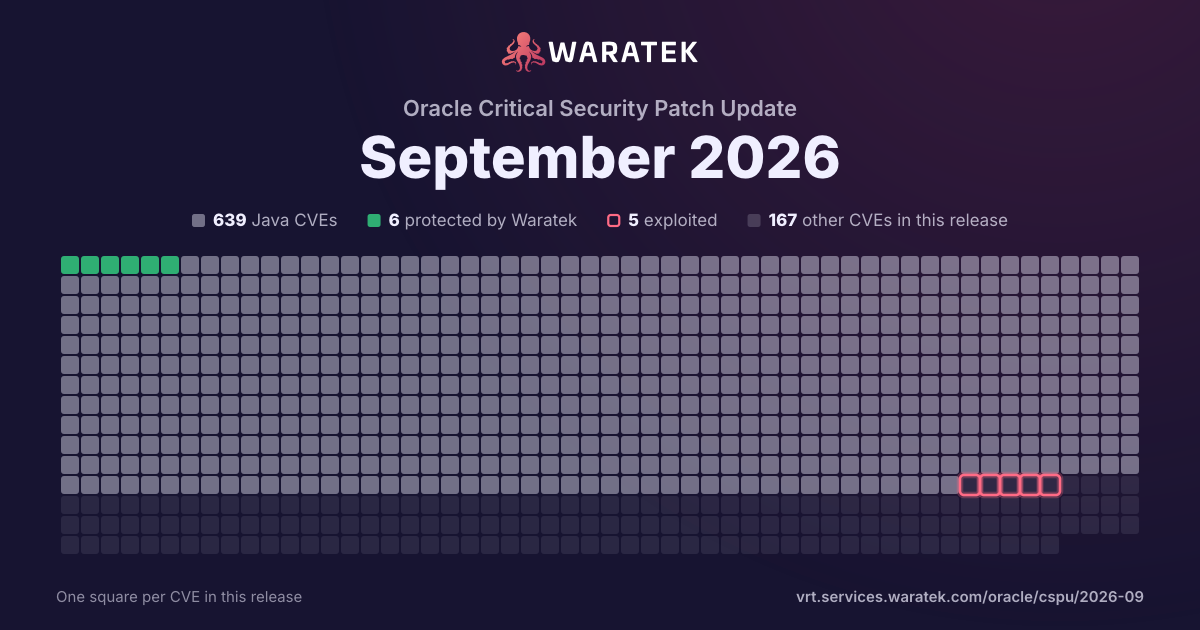
By status
No exploit published. For 596 of them, Oracle's security advisory is the source of public detail.
Protected by Waratek. Waratek RASP can block exploitation of these on systems that have not applied the patch yet.
Overview 7 matches · 2 in Waratek scope · 2 protected · 2 exploited · 1 CISA KEV · 0 EPSS ≥ 0.5
Protected by Waratek
2
28.6%
Rule in development
0
0.0%
Mitigation candidate
0
0.0%
No exploit published
0
0.0%
Outside Waratek scope
0
0.0%
Not applicable
5
71.4%
Withdrawn CVE
0
0.0%
blocked by ARMR today
2
28.6%
partly blocked
0
0.0%
not blocked
5
71.4%
not established
0
0.0%
unrecorded
0
0.0%
Exploited
2
28.6%
Working exploit published
2
28.6%
Proof of concept only
3
42.9%
Forecast only
0
0.0%
No public exploit
0
0.0%
split by
peak 4 / month
May 261
Protected by Waratek1
Critical1
blocked by ARMR today1
Proof of concept only1
Jun 261
Protected by Waratek1
Medium1
blocked by ARMR today1
Working exploit published1
Jul 264
Not applicable4
High2
Medium1
None1
not blocked4
Exploited1
Working exploit published1
Proof of concept only2
Aug 261
Not applicable1
Critical1
not blocked1
Exploited1
May 26Jun 26Jul 26Aug 26
| CVE | Severity | Published▾ | Status | Exploitation | Description |
|---|---|---|---|---|---|
| CVE-2026-64849 | Critical | 2026-08-17 | Not applicable | Exploited | MLflow is an open source AI engineering platform for agents, large language models, and machine learning models. Starting in 3.3.0 and prior to 3.15.0, the POST /api/2.0/mlflow/webhooks/{id}/test endpoint (accessible without credentials when server authentication is not enabled) calls _validate_webhook_url() in mlflow/utils/validation.py only for the original URL while mlflow/webhooks/delivery.py follows redirects and re-resolves the hostname without pinning the validated address, allowing attackers to reach internal or cloud metadata services and receive response_status and response_body. The unauthenticated attack scenario described here applies to deployments without authentication. With MLflow’s built-in basic authentication enabled, requests to this endpoint require valid credentials; this issue does not itself bypass authentication. This issue is fixed in version 3.15.0. |
| CVE-2026-17544 | High | 2026-07-30 | Not applicable | Proof of concept only | Attacker-provided inputs to bccomp() could lead to an out-of-bounds write with stack and heap corruption in PHP versions from 8.4.* before 8.4.24 and from 8.5.* before 8.5.9. |
| CVE-2026-57219 | High | 2026-07-10 | Not applicable | Working exploit published | RabbitMQ is a messaging and streaming broker. Prior to 3.13.15, 4.0.20, 4.1.11, and 4.2.6, the obsolete GET /api/auth endpoint can disclose the OAuth 2 client secret on RabbitMQ installations configured with management.oauth_client_secret, exposing credentials to unauthenticated callers when the management plugin and that OAuth configuration are enabled. This issue is fixed in versions 3.13.15, 4.0.20, 4.1.11, and 4.2.6. |
| CVE-2026-8857 | None | 2026-07-01 | Not applicable | Exploited | A vulnerability in Wikimedia Foundation timeline. This vulnerability is associated with program files scripts/EasyTimeline.Pl, includes/Timeline.Php. This issue affects timeline: from * before 1.46.0, 1.45.4, 1.44.6, 1.43.9. |
| CVE-2026-58025 | Medium | 2026-07-01 | Not applicable | Proof of concept only | Deserialization of untrusted data vulnerability in Wikimedia Foundation MediaWiki. This vulnerability is associated with program files includes/Import/WikiImporter.Php, includes/Import/WikiRevision.Php, includes/Logging/LogEntryBase.Php. This issue affects MediaWiki: from * before 1.46.0, 1.45.4, 1.44.6, 1.43.9. |
| CVE-2026-50229 | Medium | 2026-06-29 | Protected by Waratek | Working exploit published | Improper Neutralization of Script-Related HTML Tags in a Web Page (Basic XSS) vulnerability in the number guess example for Apache Tomcat. This issue affects Apache Tomcat: from 11.0.0-M1 through 11.0.22, from 10.1.0-M1 through 10.1.55, from 9.0.0.M1 through 9.0.118, from 8.5.0 through 8.5.100, from 7.0.0 through 7.0.109. Other versions that have reached end of support may also be affected. Users are recommended to upgrade to version 11.0.23, 10.1.56 or 9.0.119, which fix the issue. |
| CVE-2026-42779 | Critical | 2026-05-01 | Protected by Waratek | Proof of concept only | The fix for CVE-2026-41635 was not applied to the 2.1.X and 2.2.X branches. Here was the original issue description: Apache MINA's AbstractIoBuffer.resolveClass() contains two branches, one of them (for static classes or primitive types) does not check the class at all, bypassing the classname allowlist and allowing arbitrary code to be executed. The fix checks if the class is present in the accepted class filter before calling Class.forName(). Affected versions are Apache MINA 2.1.0 <= 2.1.11, and 2.2.0 <= 2.2.6. The problem is resolved in Apache MINA 2.1.12, and 2.2.7 by applying the classname allowlist earlier. Affected are applications using Apache MINA that call IoBuffer.getObject(). Applications using Apache MINA are advised to upgrade. |