
Oracle Critical Security Patch Update September 2026
Released September 2026 · Oracle's advisory ↗ · ← Security Patch Update, August 2026 · Critical Patch Update, October 2026 →
806 CVEs in this release, one square each
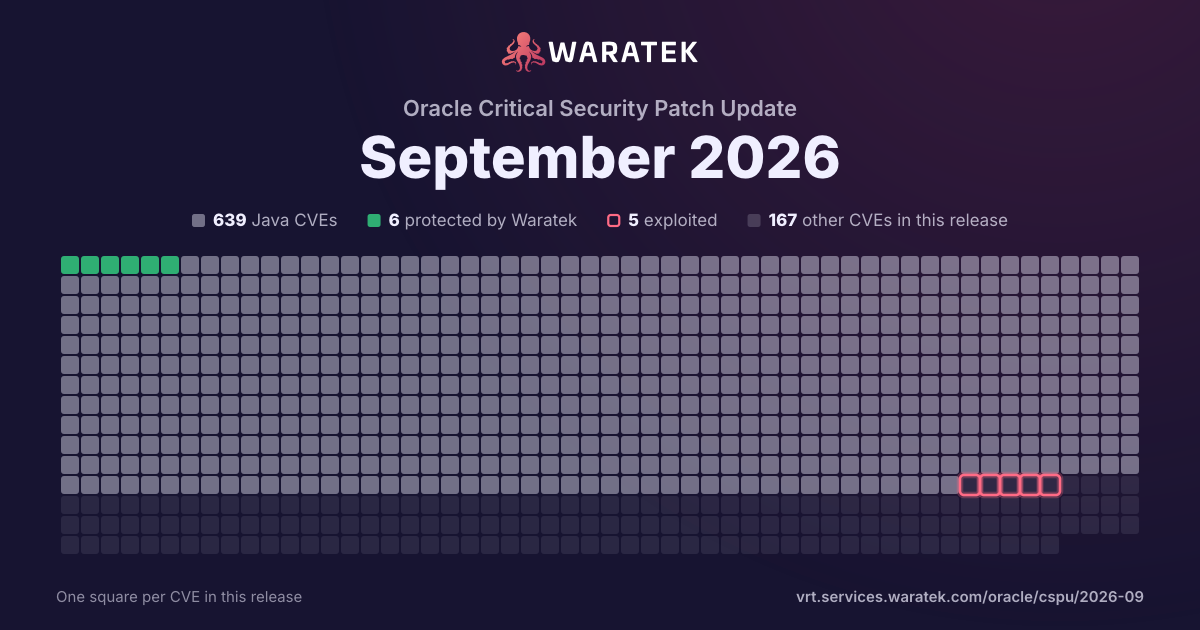
By status
6Protected by Waratek633No exploit published1Outside Waratek scope166Not applicable
5Exploited, marked by the ring
No exploit published. For 596 of them, Oracle's security advisory is the source of public detail.
Protected by Waratek. Waratek RASP can block exploitation of these on systems that have not applied the patch yet.
Overview 166 matches · 0 in Waratek scope · 0 protected · 4 exploited · 1 CISA KEV · 5 public PoC · 0 EPSS ≥ 0.5
166matches
0in Waratek scope0.0%
0protected0.0%
4exploited2.4%
1CISA KEV0.6%
5public PoC3.0%
0EPSS ≥ 0.50.0%
Protected by Waratek
0
0.0%
Rule in development
0
0.0%
Mitigation candidate
0
0.0%
No exploit published
0
0.0%
Outside Waratek scope
0
0.0%
Not applicable
166
100.0%
Withdrawn CVE
0
0.0%
blocked by ARMR today
0
0.0%
partly blocked
0
0.0%
not blocked
166
100.0%
not established
0
0.0%
unrecorded
0
0.0%
split by
peak 139 / quarter
Q4 231
Not applicable1
Medium1
not blocked1
No public exploit1
Q1 240
Q2 240
Q3 240
Q4 240
Q1 250
Q2 250
Q3 250
Q4 250
Q1 262
Not applicable2
High1
Medium1
not blocked2
Exploited1
No public exploit1
Q2 2624
Not applicable24
Critical2
High4
Medium14
Low4
not blocked24
Exploited1
Proof of concept only6
No public exploit17
Q3 26139
Not applicable139
Critical18
High44
Medium62
Low8
None7
not blocked139
Exploited2
Working exploit published1
Proof of concept only25
No public exploit111
Q4 23Q1 24Q2 24Q3 24Q4 24Q1 25Q2 25Q3 25Q4 25Q1 26Q2 26Q3 26
| CVE | Severity | Published▾ | Status | Exploitation | Description |
|---|---|---|---|---|---|
| CVE-2026-57211 | Critical | 2026-07-10 | Not applicable | Proof of concept only | RabbitMQ is a messaging and streaming broker. Prior to 4.1.11 and 4.2.6 on Windows, the RabbitMQ management plugin static file handler rabbit_mgmt_wm_static can pass URL-encoded backslashes to erl_prim_loader:read_file_info before path validation when multiple management extension plugins are enabled, causing outbound DNS and SMB requests to attacker-controlled UNC paths. This issue is fixed in versions 4.1.11 and 4.2.6. |
| CVE-2026-12590 | Medium | 2026-07-09 | Not applicable | No public exploit | Impact: In body-parser versions prior to 1.20.6 (1.x line) and 2.3.0 (2.x line), when the parser is configured with an invalid limit option value such as an unparseable string or NaN, bytes.parse returns null and the request body size check is silently skipped. Applications that rely on limit as their primary safeguard against oversized request bodies will accept arbitrarily large payloads, leading to excessive memory and CPU usage and denial of service. Patches: This issue is fixed in body-parser 1.20.6 and 2.3.0. After the fix, invalid limit values throw a clear error at parser construction time instead of silently disabling enforcement, while null and undefined continue to fall back to the default limit of 100kb. Workarounds: Validate the limit value before passing it to body-parser. For example, parse the value at startup and reject any configuration where the result is null or a non-finite number. |
| CVE-2026-59883 | Medium | 2026-07-08 | Not applicable | No public exploit | Guzzle is an extensible PHP HTTP client. Prior to 7.12.3, CookieJar did not restrict cookies scoped to IP-address or bare-numeric Domain values to the exact host that set them, because SetCookie::matchesDomain() applied ordinary suffix matching to domains such as 192.168.0.1, [::1], or 1, allowing cross-host cookie disclosure, cookie injection, or session fixation. This issue is fixed in version 7.12.3. |
| CVE-2026-59882 | Medium | 2026-07-08 | Not applicable | No public exploit | guzzlehttp/psr7 is a PSR-7 HTTP message library implementation in PHP. Prior to 2.12.3, Uri::assertValidHost() does not reject URI host components containing authority delimiters, embedded ports, or malformed IPv6 brackets, allowing Uri::getHost() to disagree with the URI authority used for security or routing decisions. This issue is fixed in version 2.12.3. |
| CVE-2026-44161 | High | 2026-07-08 | Not applicable | No public exploit | Fluentd collects events from various data sources and writes them to files, RDBMS, NoSQL, IaaS, SaaS, Hadoop and so on. Prior to 1.19.3, the Fluentd out_http output plugin allows placeholders such as ${tag} in the endpoint configuration parameter, and if a placeholder value is derived from untrusted input an attacker can control the destination hostname of outbound HTTP requests and force requests to arbitrary internal services. This issue is fixed in version 1.19.3. |
| CVE-2026-44160 | High | 2026-07-08 | Not applicable | No public exploit | Fluentd collects events from various data sources and writes them to files, RDBMS, NoSQL, IaaS, SaaS, Hadoop and so on. Prior to 1.19.3, Fluentd's in_http and in_forward plugins support gzip-compressed data but enforce limits only on compressed payloads through settings such as body_size_limit and chunk_size_limit, allowing crafted compressed payloads to decompress in memory to an excessive size and cause denial of service through memory exhaustion. This issue is fixed in version 1.19.3. |
| CVE-2026-44025 | High | 2026-07-08 | Not applicable | No public exploit | Fluentd collects events from various data sources and writes them to files, RDBMS, NoSQL, IaaS, SaaS, Hadoop and so on. Prior to 1.19.3, Fluentd's Monitor Agent plugin in_monitor_agent exposes internal metrics and plugin information via a REST API, and responses from /api/plugins.json and related endpoints unintentionally include internal instance variables that may contain database passwords, API keys, or cloud credentials. This issue is fixed in version 1.19.3. |
| CVE-2026-44024 | Critical | 2026-07-08 | Not applicable | No public exploit | Fluentd collects events from various data sources and writes them to files, RDBMS, NoSQL, IaaS, SaaS, Hadoop and so on. Prior to 1.19.3, Fluentd allows dynamically constructing file paths using the ${tag} placeholder, and insufficient validation of ${tag} in file configurations such as the path parameter of the out_file plugin allows attackers sending untrusted tags containing path traversal characters to write or overwrite arbitrary files and potentially achieve remote code execution. This issue is fixed in version 1.19.3. |
| CVE-2026-42505 | Medium | 2026-07-08 | Not applicable | No public exploit | Handshakes which used Encrypted Client Hello could be de-anonymized by a passive network observer due to a disclosure of pre-shared key identities in the unencrypted client hello. |
| CVE-2026-39822 | High | 2026-07-08 | Not applicable | No public exploit | On Unix systems, opening a file in an os.Root improperly follows symlinks to locations outside of the Root when the final path component of the a path is a symbolic link and the path ends in /. For example, 'root.Open("symlink/")' will open "symlink" even when "symlink" is a symbolic link pointing outside of the root. |
| CVE-2026-14740 | Critical | 2026-07-07 | Not applicable | No public exploit | DBI versions before 1.650 for Perl read one byte out-of-bounds in preparse when deleting an initial SQL comment. The preparse method normalises SQL and removes comments. When the SQL starts with a comment line, the deletion of that line during normalisation led to an out-of-bounds read by one byte. The result is a fault on memory-hardened builds and nondeterministic newline retention on normal builds. |
| CVE-2026-14739 | Critical | 2026-07-07 | Not applicable | No public exploit | DBI versions before 1.650 for Perl have a heap overflow when preparsing SQL statements with an extreme number of placeholders. The fix for CVE-2026-10879 did not allocate enough memory to handle approximately 1.2-million placeholders. DBI version 1.650 sets a hard limit of 99,999 placeholders. |
| CVE-2026-14380 | High | 2026-07-07 | Not applicable | No public exploit | DBI versions before 1.650 for Perl are vulnerable to code injection via caller-influenced Profile. When a string is assigned to a DBI handle's Profile attribute, DBI splits it into path, package and arguments, and interpolates the package part in a string eval with no validation of the package name. Any caller-influenced value that reaches the Profile attribute is therefore arbitrary Perl code execution, including calls to run system commands. The Profile attribute can be set from three different sources that can carry untrusted data: the DBI_PROFILE environment variable, a direct attribute assignment, and a DSN driver-attribute clause dbi:Driver(Profile=>SPEC):db. An attacker controlling any of those inputs runs arbitrary Perl in the host process. The strongest remote position is a network-exposed DBI::Gofer / DBI::ProxyServer whose per-request DSN reaches the Profile attribute, letting a client execute code on the broker host. |
| CVE-2026-9563 | High | 2026-07-02 | Not applicable | Proof of concept only | In Eclipse Parsson published Maven Central artifacts before version 1.1.8, the JSON parser did not enforce a default maximum on the number of characters consumed while parsing a single JSON document. Applications that parse attacker- controlled JSON can be forced to consume excessive CPU and memory by processing very large documents, including large arrays, objects, strings, numbers, whitespace, or nested structures, resulting in a denial of service. Eclipse Parsson 1.1.8 introduces a configurable maximum parsing limit with a default limit of 15 million parser-consumed characters. |
| CVE-2026-8147 | High | 2026-07-02 | Not applicable | Proof of concept only | In MLflow versions prior to 3.14.0, when running with authentication enabled, the trace API endpoints lack proper authorization validators. This allows any authenticated user to bypass experiment-level authorization controls on all trace operations, including reading, deleting, and modifying traces on experiments they do not have permission to access. The issue arises from the `_before_request` handler, which does not register authorization validators for trace endpoints, resulting in requests proceeding without validation. This vulnerability can expose sensitive data, destroy audit logs, and allow unauthorized modifications. |
| CVE-2026-55952 | High | 2026-07-02 | Not applicable | No public exploit | The Erlang/OTP ssl application does not validate that the PSK identity list and binder list carried in a TLS 1.3 ClientHello pre-shared key extension have equal length before passing them to the session ticket handler. In tls_handshake_1_3:handle_pre_shared_key/3, an OfferedPreSharedKeys record with a mismatched number of identities and binders is forwarded directly to tls_server_session_ticket:use/4, which crashes the session ticket handler process. An unauthenticated remote attacker can send a single crafted ClientHello to a TLS 1.3 server with session tickets enabled (stateful or stateless mode) and permanently disrupt session ticket handling on that listener. New TLS 1.3 handshakes complete but subsequently crash when the server attempts to issue a session ticket, effectively making TLS 1.3 unusable on the affected listener until the ssl application is restarted. TLS 1.2 connections are not affected. This issue affects OTP from OTP 22.2 before OTP 27.3.4.14, OTP 28.5.0.3, and OTP 29.0.3, corresponding to ssl from 9.5 before 11.2.12.10, 11.6.0.3, and 11.7.3. |
| CVE-2026-55950 | High | 2026-07-02 | Not applicable | No public exploit | Time-of-check Time-of-use (TOCTOU) race condition vulnerability in Erlang/OTP ssl (dtls_packet_demux module) allows an unauthenticated remote attacker to crash all active DTLS sessions on a listener. A DTLS server listener uses a single shared dtls_packet_demux gen_server process to route incoming UDP datagrams to the correct connection handler. When a DTLS client reconnects rapidly from the same source address and port (sending multiple ClientHello messages in quick succession), a race condition in the demux's internal gb_trees key-value store causes a {key_exists, {old, Client}} crash, terminating the demux process. Because the demux is shared across all DTLS associations on that listener, its crash immediately kills every active DTLS session, not just the attacker's. The attack is pre-authentication: the attacker only needs to send UDP datagrams containing valid ClientHello messages from the same source IP and port before the intermediate DOWN monitor message is processed by the gen_server. No credentials, no completed handshake, and no special configuration are required, and the crash can be repeated indefinitely to create a persistent denial of service for all clients of that listener. This vulnerability is associated with program file lib/ssl/src/dtls_packet_demux.erl. This issue affects OTP from OTP 25.3 before OTP 27.3.4.14, OTP 28.5.0.3, and OTP 29.0.3, corresponding to ssl from 10.9 before 11.2.12.10, 11.6.0.3, and 11.7.3. |
| CVE-2026-54887 | Medium | 2026-07-02 | Not applicable | No public exploit | Use of Default Cryptographic Key vulnerability in Erlang/OTP ssl (DTLS server) allows predictable DTLS cookie computation during the startup window, enabling source address verification bypass. On DTLS server startup, dtls_server_connection:initial_hello/3 initializes previous_cookie_secret to the empty binary (<<>>) instead of a random value. Because HMAC with an empty key is deterministic, anyone who observes the plaintext ClientHello can compute dtls_handshake:cookie(<<>>, IP, Port, Hello) and forge a valid DTLS cookie before the first rotation of the cookie secret. The DTLS cookie (RFC 6347 §4.2.1) is a denial-of-service mitigation that prevents spoofed source IPs from forcing the server to allocate state and perform expensive cryptographic operations; it is not an authentication mechanism. During the window from server startup until the first secret rotation (0 to 15 seconds), an attacker who can observe the plaintext ClientHello can bypass the source address verification, enabling DTLS handshake amplification with spoofed source addresses. This vulnerability is associated with program file lib/ssl/src/dtls_server_connection.erl and program routine dtls_server_connection:initial_hello/3. This issue affects OTP from OTP 20.0 before OTP 27.3.4.14, OTP 28.5.0.3, and OTP 29.0.3, corresponding to ssl from 8.2 before 11.2.12.10, 11.6.0.3, and 11.7.3. |
| CVE-2026-54886 | Medium | 2026-07-02 | Not applicable | No public exploit | Loop with Unreachable Exit Condition ('Infinite Loop') vulnerability in Erlang OTP ssh (ssh_sftpd module) allows an authenticated SFTP user to render an SFTP channel permanently unresponsive. The handle_data/4 function in ssh_sftpd contains a catch-all clause that accepts channel data of any type. When channel data with a non-zero type code (SSH_MSG_CHANNEL_EXTENDED_DATA) arrives with an empty pending buffer and a payload at or below the SFTP packet size limit, the clause tail-calls itself with identical arguments, creating an infinite loop. The SFTP protocol operates exclusively on normal channel data (type 0). Extended data (non-zero type) is meaningless for SFTP and is never sent by conforming clients. However, the SSH protocol permits any channel participant to send extended data on an open channel, so an authenticated SFTP client can trigger the loop by sending SSH_MSG_CHANNEL_EXTENDED_DATA with any data_type_code and any non-empty payload at or below the size limit. The targeted ssh_sftpd process enters an infinite tail-recursive loop. It never processes another message, its message queue grows without bound, and it can only be stopped by killing the process. BEAM's reduction-based scheduler preemption continues to function, so other processes on the node are not starved, but each stuck channel process consumes its full CPU time share continuously and accumulates unbounded message queue memory. Opening many channels amplifies the CPU and memory impact. Erlang/OTP SSH configurations using the default max_channels setting (infinity) allow an authenticated user to open unlimited channels per connection, amplifying the attack without requiring multiple TCP connections or authentications. No file contents, credentials, or write access are obtainable through this issue. The impact is limited to denial of service on targeted SFTP channels, with secondary CPU degradation and memory growth. This vulnerability is associated with program file lib/ssh/src/ssh_sftpd.erl and program routine ssh_sftpd:handle_data/4. This issue affects OTP from OTP 17.0 before OTP 27.3.4.14, OTP 28.5.0.3, and OTP 29.0.3, corresponding to ssh from 3.0.1 before 5.2.11.9, 5.5.2.2, and 6.0.2. Whether OTP before OTP 17.0, corresponding to ssh before 3.0.1, is affected is unknown. |
| CVE-2026-53422 | Low | 2026-07-02 | Not applicable | No public exploit | Observable Response Discrepancy vulnerability in Erlang OTP ssh (ssh_sftpd module) allows an authenticated SFTP user to enumerate the existence of files and directories outside the configured root directory. The SSH_FXP_REALPATH handler in ssh_sftpd calls relate_file_name/3 with Canonicalize=false, unlike every other SFTP operation handler. This allows .. components in the requested path to bypass the is_within_root/2 check without being resolved. The un-canonicalized path then enters resolve_symlinks/2, which walks up the directory tree above the configured root and issues read_link() syscalls on arbitrary filesystem paths. An authenticated SFTP client can exploit this by sending a REALPATH request with a crafted traversal path. The server response differs depending on whether the target path exists on the host filesystem (SSH_FXP_NAME when the path resolves successfully, SSH_FX_NO_SUCH_FILE when it does not). This creates a path-existence oracle that an attacker can use to enumerate the filesystem structure outside the configured root, including the existence of sensitive files, directories, and mount points. The vulnerability leaks only the existence of paths. No file contents, credentials, or write access are obtainable through this issue alone. The information gained may assist further attacks when combined with other vulnerabilities. This vulnerability is associated with program files lib/ssh/src/ssh_sftpd.erl and program routine ssh_sftpd:handle_op/4. This issue affects OTP from OTP 17.0 before OTP 27.3.4.14, OTP 28.5.0.3, and OTP 29.0.3, corresponding to ssh from 3.0.1 before 5.2.11.9, 5.5.2.2, and 6.0.2. Whether OTP before OTP 17.0, corresponding to ssh before 3.0.1, is affected is unknown. |
| CVE-2026-8857 | None | 2026-07-01 | Not applicable | Exploited | A vulnerability in Wikimedia Foundation timeline. This vulnerability is associated with program files scripts/EasyTimeline.Pl, includes/Timeline.Php. This issue affects timeline: from * before 1.46.0, 1.45.4, 1.44.6, 1.43.9. |
| CVE-2026-58521 | Medium | 2026-07-01 | Not applicable | Proof of concept only | Improper neutralization of special elements used in an SQL command ('SQL injection') vulnerability in The Wikimedia Foundation Mediawiki - Cargo Extension allows SQL Injection. This issue affects Mediawiki - Cargo Extension: from * before 1.43.9,1.44.6,1.45.4. |
| CVE-2026-58520 | Medium | 2026-07-01 | Not applicable | No public exploit | URL redirection to untrusted site ('open redirect') vulnerability in The Wikimedia Foundation Mediawiki - UrlShortener Extension allows Cross-Site Flashing. This issue affects Mediawiki - UrlShortener Extension: from * before 1.43.9, 1.44.6, 1.45.4. |
| CVE-2026-58517 | Medium | 2026-07-01 | Not applicable | No public exploit | Improper neutralization of input terminators vulnerability in The Wikimedia Foundation Mediawiki - WikiLambda Extension allows Authentication Bypass. This issue affects Mediawiki - WikiLambda Extension: from * before 1.43.9,1.44.6,1.45.4. |
| CVE-2026-58038 | None | 2026-07-01 | Not applicable | No public exploit | Improper Neutralization of Input During Web Page Generation (XSS or 'Cross-site Scripting') vulnerability in Wikimedia Foundation timeline. This vulnerability is associated with program files includes/Timeline.Php, scripts/EasyTimeline.Pl. This issue affects timeline: from * before 1.46.0, 1.45.4, 1.44.6, 1.43.9. |
| CVE-2026-58037 | None | 2026-07-01 | Not applicable | No public exploit | Improper Neutralization of Input During Web Page Generation (XSS or 'Cross-site Scripting') vulnerability in Wikimedia Foundation MediaWiki. This vulnerability is associated with program files includes/Language/Language.Php, includes/Logging/BlockLogFormatter.Php, includes/Logging/LogFormatter.Php, includes/Logging/PatrolLogFormatter.Php, includes/Logging/RenameuserLogFormatter.Php, includes/Logging/TagLogFormatter.Php, includes/Specials/SpecialVersion.Php. This issue affects MediaWiki: from * before 1.46.0, 1.45.4, 1.44.6, 1.43.9. |
| CVE-2026-58033 | Medium | 2026-07-01 | Not applicable | No public exploit | Exposure of Sensitive Information to an Unauthorized Actor vulnerability in Wikimedia Foundation MediaWiki. This vulnerability is associated with program files includes/Actions/InfoAction.Php. This issue affects MediaWiki: from * before 1.46.0, 1.45.4, 1.44.6, 1.43.9. |
| CVE-2026-58032 | Medium | 2026-07-01 | Not applicable | No public exploit | Improper Neutralization of Input During Web Page Generation (XSS or 'Cross-site Scripting') vulnerability in Wikimedia Foundation MediaWiki. This vulnerability is associated with program files resources/src/mediawiki.Api/index.Js. This issue affects MediaWiki: from * before 1.46.0, 1.45.4, 1.44.6, 1.43.9. |
| CVE-2026-58030 | Medium | 2026-07-01 | Not applicable | No public exploit | Improper Neutralization of Input During Web Page Generation (XSS or 'Cross-site Scripting') vulnerability in Wikimedia Foundation SyntaxHighlight_GeSHi. This vulnerability is associated with program files includes/SyntaxHighlight.Php. This issue affects SyntaxHighlight_GeSHi: from * before 1.46.0, 1.45.4, 1.44.6, 1.43.9. |
| CVE-2026-58029 | Medium | 2026-07-01 | Not applicable | No public exploit | Vulnerability in Wikimedia Foundation MediaWiki. This vulnerability is associated with program files includes/Api/ApiChangeAuthenticationData.Php, includes/Api/ApiLinkAccount.Php, includes/Api/ApiRemoveAuthenticationData.Php, includes/Specials/SpecialLinkAccounts.Php, includes/Specials/SpecialUnlinkAccounts.Php. This issue affects MediaWiki: from * before 1.46.0, 1.45.4, 1.44.6, 1.43.9. |
| CVE-2026-58028 | None | 2026-07-01 | Not applicable | No public exploit | Improper Neutralization of Input During Web Page Generation (XSS or 'Cross-site Scripting') vulnerability in Wikimedia Foundation MediaWiki, Wikimedia Foundation CentralAuth. This vulnerability is associated with program files includes/Api/ApiFormatBase.Php, includes/Api/ApiHelp.Php, includes/ResourceLoader/Module.Php, includes/Hooks/Handlers/PageDisplayHookHandler.Php, includes/LogFormatter/PermissionChangeLogFormatter.Php. This issue affects MediaWiki: from * before 1.46.0, 1.45.4, 1.44.6, 1.43.9; CentralAuth: from * before 1.46.0, 1.45.4, 1.44.6, 1.43.9. |
| CVE-2026-58027 | Medium | 2026-07-01 | Not applicable | No public exploit | Exposure of Sensitive Information to an Unauthorized Actor vulnerability in Wikimedia Foundation AbuseFilter. This vulnerability is associated with program files includes/Api/QueryAbuseFilters.Php. This issue affects AbuseFilter: from * before 1.46.0, 1.45.4, 1.44.6, 1.43.9. |
| CVE-2026-58026 | None | 2026-07-01 | Not applicable | No public exploit | Exposure of Sensitive Information to an Unauthorized Actor vulnerability in Wikimedia Foundation MediaWiki. This vulnerability is associated with program files includes/Parser/Parser.Php. This issue affects MediaWiki: from * before 1.46.0, 1.45.4, 1.44.6, 1.43.9. |
| CVE-2026-58025 | Medium | 2026-07-01 | Not applicable | Proof of concept only | Deserialization of untrusted data vulnerability in Wikimedia Foundation MediaWiki. This vulnerability is associated with program files includes/Import/WikiImporter.Php, includes/Import/WikiRevision.Php, includes/Logging/LogEntryBase.Php. This issue affects MediaWiki: from * before 1.46.0, 1.45.4, 1.44.6, 1.43.9. |
| CVE-2026-58024 | Medium | 2026-07-01 | Not applicable | No public exploit | Exposure of Sensitive Information to an Unauthorized Actor vulnerability in Wikimedia Foundation MediaWiki. This vulnerability is associated with program files includes/Api/ApiUserrights.Php. This issue affects MediaWiki: from * before 1.46.0, 1.45.4, 1.44.6, 1.43.9. |
| CVE-2026-14363 | Medium | 2026-07-01 | Not applicable | Proof of concept only | Improper neutralization of special elements used in an SQL command ('SQL injection') vulnerability in The Wikimedia Foundation Mediawiki - Cargo Extension allows SQL Injection. This issue affects Mediawiki - Cargo Extension: from * before 1.43.9,1.44.6,1.45.4. |
| CVE-2026-14358 | Medium | 2026-07-01 | Not applicable | No public exploit | Improper neutralization of input during web page generation ('cross-site scripting') vulnerability in The Wikimedia Foundation Mediawiki - Charts Extension allows Cross-Site Scripting (XSS). This issue affects Mediawiki - Charts Extension: from * before 1.43.9,1.44.6,1.45.4. |
| CVE-2026-13707 | None | 2026-07-01 | Not applicable | No public exploit | Session fixation vulnerability in Wikimedia Foundation OAuth. This vulnerability is associated with program files src/Backend/MWOAuthServer.Php. This issue affects OAuth: from * through 1.46.0, 1.45.4, 1.44.6, 1.43.9. |
| CVE-2026-13706 | None | 2026-07-01 | Not applicable | No public exploit | Improper input validation vulnerability in Wikimedia Foundation UrlShortener. This vulnerability is associated with program files includes/UrlShortenerUtils.Php. |
| CVE-2026-13758 | Low | 2026-06-29 | Not applicable | No public exploit | CryptX versions before 0.088_001 for Perl compare AEAD authentication tags in non-constant time in the streaming decrypt_done path. The decrypt_done($tag) form compares it against the computed tag with memNE (memcmp() != 0), which short-circuits on the first differing byte, so its run time depends on the number of matching leading bytes. This affects all five AEAD modes: GCM, CCM, ChaCha20Poly1305, EAX and OCB. The one-shot *_decrypt_verify helpers are unaffected; they verify the tag inside libtomcrypt with a constant-time comparison. The timing difference is a tag-verification oracle. An attacker who can submit many candidate tags for the same nonce, ciphertext and associated data while measuring the timing precisely enough may recover the expected tag byte by byte and forge a message that verifies. |
| CVE-2026-13484 | Low | 2026-06-28 | Not applicable | Proof of concept only | A vulnerability has been found in MLflow up to 4666cffc7912ea606d592fc38d6a75e2935f65e7. The impacted element is an unknown function of the component Experiment-scoped Label Schema CRUD API. Such manipulation leads to missing authorization. It is possible to launch the attack remotely. A high complexity level is associated with this attack. The exploitability is regarded as difficult. The exploit has been disclosed to the public and may be used. A reply to the GitHub issue explains, that "[t]he labeling schema PR has not been merged yet. The auth handlers will be added before the release." |
| CVE-2026-55767 | Medium | 2026-06-23 | Not applicable | No public exploit | Guzzle is an extensible PHP HTTP client. Prior to 7.12.1, CookieJar incorrectly accepts cookies with a dot-only Domain attribute and whitespace-padded variants. SetCookie::matchesDomain() removes leading dots from the cookie domain, normalizing dot-only values to the empty string; SetCookie::validate() only rejected a strictly empty domain, so these cookies could be stored and the empty normalized domain was treated as matching any request host. An attacker-controlled origin that an application requests with a shared cookie jar can therefore set a cookie that Guzzle later sends to unrelated hosts using the same jar. This may allow cookie injection or session fixation against downstream services, depending on how those services interpret the injected cookie. This vulnerability is fixed in 7.12.1. |
| CVE-2026-55766 | Medium | 2026-06-23 | Not applicable | No public exploit | guzzlehttp/psr7 is a PSR-7 HTTP message library implementation in PHP. Prior to 2.12.1, guzzlehttp/psr7 did not reject CR/LF characters in certain first-party HTTP start-line fields: the request method, protocol version, and response reason phrase. If an application placed attacker-controlled data into one of those fields and later serialized the PSR-7 message as raw HTTP/1.x, for example with Message::toString() or an equivalent serializer, the serialized message could contain attacker-controlled header lines. The issue can also be reached through Message::parseRequest() or Message::parseResponse() when malformed raw messages are parsed into first-party PSR-7 objects and then serialized again. Creating or modifying a Request, Response, or other PSR-7 object alone is not sufficient. The issue requires the malformed message to be serialized and written to the network, forwarded, replayed, or otherwise processed by software that does not independently reject the malformed start line. This vulnerability is fixed in 2.12.1. |
| CVE-2026-55568 | Medium | 2026-06-23 | Not applicable | No public exploit | Guzzle is an extensible PHP HTTP client. Prior to 7.12.1, in certain configurations, traffic expected to be protected by TLS on the hop to the proxy is transmitted in cleartext. Proxy authentication credentials (the Proxy-Authorization header, proxy userinfo in the proxy URL, or CURLOPT_PROXYUSERPWD) are sent without encryption, and the CONNECT target host and port for tunneled HTTPS requests are exposed. The built-in cURL handlers (GuzzleHttp\Handler\CurlHandler and GuzzleHttp\Handler\CurlMultiHandler, used by default whenever the PHP cURL extension is available) accept an https:// proxy. libcurl older than 7.50.2 silently treats an https:// proxy as a plaintext http:// proxy. The TLS connection to the proxy is never established, and the proxy leg is cleartext with no error or warning. An application is affected when it sends requests through one of the built-in cURL handlers, configures an https:// proxy expecting the proxy connection itself to be encrypted, and runs with libcurl older than 7.50.2. This vulnerability is fixed in 7.12.1. |
| CVE-2026-49214 | Medium | 2026-06-11 | Not applicable | No public exploit | guzzlehttp/psr7 is a PSR-7 HTTP message library implementation in PHP. Versions prior to 2.10.2 did not reject ASCII control characters, whitespace, or DEL in first-party URI host components. A vulnerable flow is: First, an application accepts a user-controlled URL. Second, the URL is used to construct a PSR-7 `Uri` or `Request`. Third, the host component contains CRLF or another header-unsafe character. Fourth, the host is copied into the PSR-7 `Host` header when no explicit `Host` header is provided. Finally, the request is serialized or sent by an HTTP client that does not independently reject the malformed host. In that flow, an attacker can cause the serialized request to contain additional attacker-controlled header lines. For example, a host containing `"\r\nX-Injected: yes"` can cause the generated `Host` header to span multiple HTTP header lines. Applications are affected when they use user-controlled URLs for outbound HTTP requests, URL forwarding, proxying, crawling, webhook delivery, or similar request-dispatch flows. In deployments involving HTTP/1.1 connection reuse, proxies, gateways, or load balancers, this malformed request may also contribute to request smuggling or cache poisoning, depending on how downstream components parse the request. The issue is patched in `2.10.2` and later. `1.x` is end-of-life and will not receive a patch. As a workaround, validate and reject all untrusted URI strings before constructing PSR-7 `Uri` or `Request` instances. Reject input containing ASCII control characters, whitespace, or DEL, including CRLF, tab, space, NUL, or DEL characters. Applications that forward requests should also ensure the final HTTP client or serializer rejects invalid URI and header data before writing requests to the network. |
| CVE-2026-48998 | Medium | 2026-06-11 | Not applicable | No public exploit | guzzlehttp/psr7 is a PSR-7 HTTP message library implementation in PHP. Versions prior to 2.10.2 contain improper Host header validation when parsing raw HTTP request messages and when deriving a server request URI from server variables. An attacker can provide a malformed Host header containing URI authority delimiters, such as `trusted.example@evil.example`. When the Host value is used to construct a URI, the malformed value can be reinterpreted as URI userinfo and host. This can cause the PSR-7 request URI host to differ from the original Host header value. Applications are affected if they parse attacker-controlled raw HTTP requests with `GuzzleHttp\Psr7\Message::parseRequest()` or the legacy 1.x `GuzzleHttp\Psr7\parse_request()` function, or if they build server requests from attacker-controlled server variables, then rely on the resulting URI host for routing, allow-list checks, or forwarding decisions. In affected forwarding or gateway scenarios, this may cause requests or credentials to be sent to an unintended host. The issue is patched in `2.10.2`. `1.x` is end-of-life and will not receive a patch. Some workarounds are available. Validate the `Host` header as `uri-host [ ":" port ]` before calling `Message::parseRequest()` or legacy `parse_request()` on untrusted HTTP request data, or before deriving routing and forwarding decisions from a parsed request URI. Reject Host values containing userinfo, path, query, or fragment delimiters. |
| CVE-2026-49760 | Medium | 2026-06-10 | Not applicable | No public exploit | Stack-based Buffer Overflow vulnerability in Erlang OTP (erl_interface) allows Stack-based Buffer Overflow. This vulnerability is associated with program file lib/erl_interface/src/misc/ei_printterm.c and program routine ei_s_print_term. The C function ei_s_print_term uses an internal 2000-character stack buffer to format terms. When called with an encoded Erlang term containing a very large integer (encoded representation exceeding 2000 characters), the buffer overflows. The overflow bytes are restricted to the ASCII values of 0-9 and A-F, which limits exploitation to Denial of Service. The companion function ei_print_term, which prints directly to a FILE instead of a memory buffer, does not contain this bug. This issue affects OTP from OTP 17.0 before OTP 27.3.4.13, OTP 28.5.0.2, and OTP 29.0.2, corresponding to erl_interface from 3.7.16 before 5.5.2.1, 5.7.0.1, and 5.8.1. Whether OTP before OTP 17.0, corresponding to erl_interface before 3.7.16, is affected is unknown. |
| CVE-2026-49759 | High | 2026-06-10 | Not applicable | No public exploit | Stack-based Buffer Overflow vulnerability in Erlang OTP erts (inet_drv) allows an unauthenticated remote attacker to crash the BEAM VM by sending a crafted SCTP ERROR chunk. The sctp_parse_error_chunk function in erts/emulator/drivers/common/inet_drv.c parses SCTP ERROR chunks and writes cause codes into a fixed-size stack-allocated ErlDrvTermData spec[] array without checking bounds. A remote attacker who has established an SCTP association to a listening port can send a single crafted SCTP ERROR chunk containing enough cause codes to overflow the stack buffer, crashing the VM. The attacker can only write 16-bit values interleaved with a fixed tag, so the overflow does not provide a controlled return address, limiting exploitation to Denial of Service. A crafted SCTP ERROR chunk may also leak bits and pieces of Erlang VM memory into the received error packet observed by the Erlang process. Such data is already readable by the user running the Erlang VM, so the disclosure scope is limited. This issue affects OTP from OTP 17.0 before OTP 27.3.4.13, OTP 28.5.0.2, and OTP 29.0.2, corresponding to erts from 6.0 before 15.2.7.9, 16.4.0.2, and 17.0.2. Whether OTP before OTP 17.0, corresponding to erts before 6.0, is affected is unknown. |
| CVE-2026-48860 | High | 2026-06-10 | Not applicable | No public exploit | Reliance on IP Address for Authentication vulnerability in Erlang/OTP ssl (inet_tls_dist module) allows unauthenticated bypass of the distribution-over-TLS LAN allowlist. The inet_tls_dist:check_ip/1 function, which enforces a LAN allowlist for Erlang distribution over TLS, calls inet:sockname/1 instead of inet:peername/1 to obtain the peer's IP address. Because inet:sockname/1 returns the local socket address, both the local IP and the supposed peer IP resolve to the same value, causing the subnet mask comparison to always succeed regardless of the actual remote address. Any holder of a CA-signed TLS certificate can therefore bypass the LAN restriction and gain full Erlang distribution access to the node, including rpc:call/4 and code:load_binary/3. This vulnerability is associated with program file lib/ssl/src/inet_tls_dist.erl. This issue affects OTP from OTP 26.0 before OTP 27.3.4.13, OTP 28.5.0.2, and OTP 29.0.2, corresponding to ssl from 11.0 before 11.2.12.9, 11.6.0.2, and 11.7.2. |
| CVE-2026-48858 | Medium | 2026-06-10 | Not applicable | No public exploit | Server-Side Request Forgery (SSRF) vulnerability in Erlang/OTP ftp (ftp_internal module) allows FTP bounce attacks and SSRF via an unvalidated PASV response IP address. The ftp_internal:handle_ctrl_result/2 PASV handler (mode=passive, ipfamily=inet, ftp_extension=false) extracts the IP address from the server's 227 response and passes it directly to gen_tcp:connect/4 without validating it against the control connection peer address. The adjacent EPSV handlers correctly call peername(CSock) to derive the IP from the control connection, but the PASV handler does not. A malicious or compromised FTP server can redirect the client's data connection to an arbitrary internal host and port. On read operations (ftp:ls/1,2, ftp:nlist/1,2, ftp:recv/2,3), data from the redirected target is returned to the caller. On write operations (ftp:send/2,3, ftp:append/2,3), file content is sent to the redirected target. This enables SSRF against internal hosts, cloud metadata endpoints, and FTP bounce attacks against third-party hosts. The vulnerable path is the default configuration (mode=passive, ipfamily=inet, ftp_extension=false). RFC 2577 section 3 explicitly recommends validating the PASV response IP against the control connection peer. The ftp application is deprecated and scheduled for removal in OTP-30. This vulnerability is associated with program files lib/inets/src/ftp/ftp_internal.erl (inets 5.10.4 through 6.5, OTP 17.4 through 20.3) and lib/ftp/src/ftp_internal.erl (ftp 1.0 and later, OTP 21.0 and later). This issue affects OTP from OTP 17.4 before OTP 27.3.4.13, OTP 28.5.0.2, and OTP 29.0.2, corresponding to inets from 5.10.4 before 7.0, and ftp from 1.0 before 1.2.3.1, 1.2.4.1, and 1.2.6. |
| CVE-2026-48856 | High | 2026-06-10 | Not applicable | No public exploit | Sensitive Data Exposure vulnerability in Erlang OTP inets (httpc_response module) allows Retrieve Embedded Sensitive Data. The httpc client forwards the Authorization and Proxy-Authorization request headers to redirect targets without checking whether the redirect crosses an origin boundary. httpc_response:redirect/2 constructs the redirected request by updating only the host field of the header record; all other fields (including authorization and proxy_authorization) are copied verbatim. The redirect target host is never compared against the original host. autoredirect defaults to true, so this affects all httpc callers that do not explicitly disable automatic redirects. An attacker who controls a server that the victim contacts via httpc can issue a cross-origin 3xx redirect to a server they also control. The Authorization header (including Basic credentials derived from URL userinfo via httpc_request:handle_user_info/2) is forwarded to the redirect target, allowing credential theft. The same applies to the Proxy-Authorization header. This vulnerability is associated with program files lib/inets/src/http_client/httpc_response.erl. This issue affects OTP from OTP 17.0 before OTP 27.3.4.19, OTP 28.5.0.8, and OTP 29.1.2, corresponding to inets from 5.10 before 9.3.2.8, 9.6.2.4, and 9.8.1. Whether OTP before OTP 17.0, corresponding to inets before 5.10, is affected is unknown. |
| CVE-2026-48855 | Low | 2026-06-10 | Not applicable | No public exploit | Exposure of Sensitive Information to an Unauthorized Actor vulnerability in Erlang OTP ssh (ssh_sftpd module) allows File Discovery. The SSH_FXP_READLINK handler in ssh_sftpd sends the raw result of file:read_link/2 to the client without calling chroot_filename/2 to strip the backend root prefix. An authenticated SFTP client can create a symlink inside the chroot pointing to /; ssh_sftpd resolves the target to the absolute backend root and stores it on disk. Reading the symlink back via SSH_FXP_READLINK returns that absolute path, for example /data/sftp, instead of the chrooted value /. The information disclosed is the absolute filesystem path of the SFTP root directory and of any symlink targets within it. No file contents, credentials, or access to paths outside the root directory are obtainable through this issue alone. This vulnerability is associated with program files lib/ssh/src/ssh_sftpd.erl. This issue affects OTP from OTP 17.0 before OTP 27.3.4.13, OTP 28.5.0.2, and OTP 29.0.2, corresponding to ssh from 3.0.1 before 5.2.11.8, 5.5.2.1, and 6.0.1. Whether OTP before OTP 17.0, corresponding to ssh before 3.0.1, is affected is unknown. |
| CVE-2026-9698 | Critical | 2026-06-09 | Not applicable | No public exploit | DBI versions before 1.648 for Perl saved errors in a limited-sized buffer. Error messages that were returned when RaiseError, PrintError or HandleError were set were written to a 200-byte buffer without a length limit. Attackers that can influence the error text in an application can trigger a buffer overflow. |
| CVE-2026-10879 | Critical | 2026-06-05 | Not applicable | No public exploit | DBI versions before 1.648 for Perl have a heap overflow when preparsing SQL statements with more than 9 binders. The preparse method expands SQL placeholder characters to numbered binders of the form :pN, but only allocates three characters per binder in the buffer. Placeholders 10-99 require four characters, 100-999 require five characters, et cetera. |
| CVE-2026-10803 | Low | 2026-06-04 | Not applicable | Proof of concept only | A flaw has been found in MLflow up to 3.10.0. This issue affects the function mlflow.data.digest_utils of the file mlflow/data/digest_utils.py of the component Dataset Digest Computation. This manipulation causes use of weak hash. It is possible to launch the attack on the local host. The attack is considered to have high complexity. The exploitability is assessed as difficult. The exploit has been published and may be used. The project was informed of the problem early through a pull request but has not reacted yet. |
| CVE-2026-4035 | High | 2026-06-03 | Not applicable | Exploited | A vulnerability in mlflow/mlflow versions prior to 3.11.0 allows for the resolution of environment variables in AI Gateway secrets, which can be exploited to exfiltrate sensitive server-side environment credentials to an attacker-controlled endpoint. This issue arises because the `api_key` field in gateway secrets can accept `$ENV_VAR` references, which are resolved against the MLflow server's environment during runtime. The resolved secrets are then sent in provider authentication headers to the configured upstream `api_base`. This vulnerability can be exploited by low-privileged authenticated users in basic-auth deployments or by unauthenticated users in default deployments without `basic-auth`. The impact includes potential leakage of sensitive credentials such as cloud artifact credentials (`AWS_ACCESS_KEY_ID`, `AWS_SECRET_ACCESS_KEY`), which could lead to artifact poisoning and cross-boundary code execution in downstream environments. The issue is fixed in version 3.11.0. |
| CVE-2026-3198 | Medium | 2026-06-02 | Not applicable | Proof of concept only | MLflow 3.9.0 with basic-auth (`--app-name basic-auth`) fails to enforce authorization checks for multiple Gateway API 'list' endpoints. Specifically, the `BEFORE_REQUEST_HANDLERS` dictionary in `mlflow/server/auth/__init__.py` does not include entries for `ListGatewaySecretInfos`, `ListGatewayEndpoints`, and `ListGatewayModelDefinitions`. This allows any authenticated user, regardless of their assigned permissions, to enumerate all gateway secrets, endpoints, and model definitions. This vulnerability exposes sensitive information, such as API keys, endpoint configurations, and proprietary model definitions, to unauthorized users. |
| CVE-2026-7598 | Medium | 2026-05-01 | Not applicable | Proof of concept only | A security vulnerability has been detected in libssh2 up to 1.11.1. The impacted element is the function userauth_password of the file src/userauth.c. Such manipulation of the argument username_len/password_len leads to integer overflow. The attack may be launched remotely. The name of the patch is 256d04b60d80bf1190e96b0ad1e91b2174d744b1. A patch should be applied to remediate this issue. |
| CVE-2026-41990 | Medium | 2026-04-23 | Not applicable | No public exploit | Libgcrypt before 1.12.2 mishandles Dilithium signing. Writes to a static array lack a bounds check but do not use attacker-controlled data. |
| CVE-2026-41989 | Medium | 2026-04-23 | Not applicable | No public exploit | Libgcrypt before 1.12.2 sometimes allows a heap-based buffer overflow and denial of service via crafted ECDH ciphertext to gcry_pk_decrypt. |
| CVE-2026-41240 | Medium | 2026-04-23 | Not applicable | Proof of concept only | DOMPurify is a DOM-only cross-site scripting sanitizer for HTML, MathML, and SVG. Versions prior to 3.4.0 have an inconsistency between FORBID_TAGS and FORBID_ATTR handling when function-based ADD_TAGS is used. Commit c361baa added an early exit for FORBID_ATTR at line 1214. The same fix was not applied to FORBID_TAGS. At line 1118-1123, when EXTRA_ELEMENT_HANDLING.tagCheck returns true, the short-circuit evaluation skips the FORBID_TAGS check entirely. This allows forbidden elements to survive sanitization with their attributes intact. Version 3.4.0 patches the issue. |
| CVE-2026-41239 | Medium | 2026-04-23 | Not applicable | No public exploit | DOMPurify is a DOM-only cross-site scripting sanitizer for HTML, MathML, and SVG. Starting in version 1.0.10 and prior to version 3.4.0, `SAFE_FOR_TEMPLATES` strips `{{...}}` expressions from untrusted HTML. This works in string mode but not with `RETURN_DOM` or `RETURN_DOM_FRAGMENT`, allowing XSS via template-evaluating frameworks like Vue 2. Version 3.4.0 patches the issue. |
| CVE-2026-41238 | Medium | 2026-04-23 | Not applicable | Proof of concept only | DOMPurify is a DOM-only cross-site scripting sanitizer for HTML, MathML, and SVG. Versions 3.0.1 through 3.3.3 are vulnerable to a prototype pollution-based XSS bypass. When an application uses `DOMPurify.sanitize()` with the default configuration (no `CUSTOM_ELEMENT_HANDLING` option), a prior prototype pollution gadget can inject permissive `tagNameCheck` and `attributeNameCheck` regex values into `Object.prototype`, causing DOMPurify to allow arbitrary custom elements with arbitrary attributes — including event handlers — through sanitization. Version 3.4.0 fixes the issue. |
| CVE-2026-0540 | Medium | 2026-03-03 | Not applicable | No public exploit | DOMPurify 3.1.3 through 3.3.1 and 2.5.3 through 2.5.8, fixed in commit 2726c74, contain a cross-site scripting vulnerability that allows attackers to bypass attribute sanitization by exploiting five missing rawtext elements (noscript, xmp, noembed, noframes, iframe) in the SAFE_FOR_XML regex. Attackers can include payloads like </noscript><img src=x onerror=alert(1)> in attribute values to execute JavaScript when sanitized output is placed inside these unprotected rawtext contexts. |
| CVE-2026-25639 | High | 2026-02-09 | Not applicable | Exploited | Axios is a promise based HTTP client for the browser and Node.js. Prior to versions 0.30.3 and 1.13.5, the mergeConfig function in axios crashes with a TypeError when processing configuration objects containing __proto__ as an own property. An attacker can trigger this by providing a malicious configuration object created via JSON.parse(), causing complete denial of service. This vulnerability is fixed in versions 0.30.3 and 1.13.5. |
| CVE-2023-6918 | Medium | 2023-12-19 | Not applicable | No public exploit | A flaw was found in the libssh implements abstract layer for message digest (MD) operations implemented by different supported crypto backends. The return values from these were not properly checked, which could cause low-memory situations failures, NULL dereferences, crashes, or usage of the uninitialized memory as an input for the KDF. In this case, non-matching keys will result in decryption/integrity failures, terminating the connection. |