
Oracle Critical Security Patch Update September 2026
Released September 2026 · Oracle's advisory ↗ · ← Security Patch Update, August 2026 · Critical Patch Update, October 2026 →
806 CVEs in this release, one square each
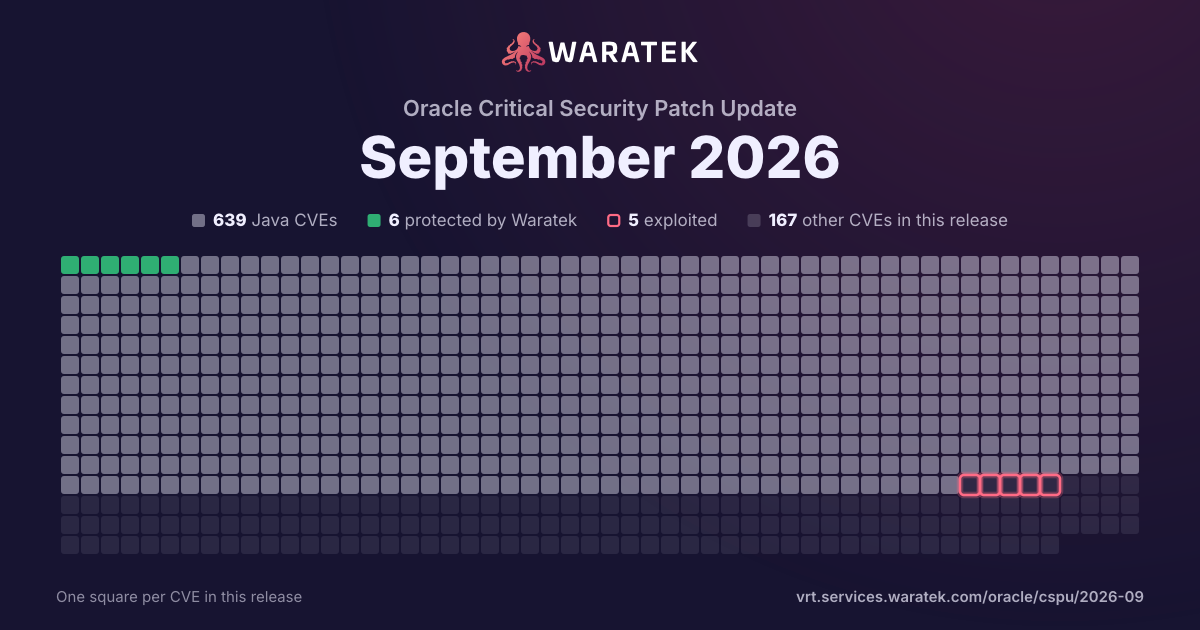
By status
6Protected by Waratek633No exploit published1Outside Waratek scope166Not applicable
5Exploited, marked by the ring
No exploit published. For 596 of them, Oracle's security advisory is the source of public detail.
Protected by Waratek. Waratek RASP can block exploitation of these on systems that have not applied the patch yet.
Overview 135 matches · 56 in Waratek scope · 2 protected · 1 exploited · 0 CISA KEV · 3 public PoC · 1 EPSS ≥ 0.5
135matches
56in Waratek scope41.5%
2protected1.5%
1exploited0.7%
0CISA KEV0.0%
3public PoC2.2%
1EPSS ≥ 0.50.7%
Protected by Waratek
2
1.5%
Rule in development
0
0.0%
Mitigation candidate
0
0.0%
No exploit published
54
40.0%
Outside Waratek scope
1
0.7%
Not applicable
78
57.8%
Withdrawn CVE
0
0.0%
blocked by ARMR today
2
1.5%
partly blocked
0
0.0%
not blocked
133
98.5%
not established
0
0.0%
unrecorded
0
0.0%
split by
peak 102 / quarter
Q4 232
Outside Waratek scope1
Not applicable1
Medium2
not blocked2
Exploited1
No public exploit1
Q1 240
Q2 240
Q3 240
Q4 240
Q1 250
Q2 250
Q3 250
Q4 251
No exploit published1
Medium1
not blocked1
No public exploit1
Q1 261
Not applicable1
Medium1
not blocked1
No public exploit1
Q2 2629
Protected by Waratek1
No exploit published14
Not applicable14
Medium29
blocked by ARMR today1
not blocked28
Working exploit published1
Proof of concept only5
No public exploit23
Q3 26102
Protected by Waratek1
No exploit published39
Not applicable62
Medium102
blocked by ARMR today1
not blocked101
Proof of concept only13
No public exploit89
Q4 23Q1 24Q2 24Q3 24Q4 24Q1 25Q2 25Q3 25Q4 25Q1 26Q2 26Q3 26
| CVE | Severity | Published▾ | Status | Exploitation | Description |
|---|---|---|---|---|---|
| CVE-2026-14363 | Medium | 2026-07-01 | Not applicable | Proof of concept only | Improper neutralization of special elements used in an SQL command ('SQL injection') vulnerability in The Wikimedia Foundation Mediawiki - Cargo Extension allows SQL Injection. This issue affects Mediawiki - Cargo Extension: from * before 1.43.9,1.44.6,1.45.4. |
| CVE-2026-14358 | Medium | 2026-07-01 | Not applicable | No public exploit | Improper neutralization of input during web page generation ('cross-site scripting') vulnerability in The Wikimedia Foundation Mediawiki - Charts Extension allows Cross-Site Scripting (XSS). This issue affects Mediawiki - Charts Extension: from * before 1.43.9,1.44.6,1.45.4. |
| CVE-2026-55956 | Medium | 2026-06-29 | No exploit published | No public exploit | Improper Authorization vulnerability in Apache Tomcat leads to security constraints specified for the default servlet ignoring any method or method omission configured as part of the constraint. This issue affects Apache Tomcat: from 11.0.0-M1 through 11.0.22, from 10.1.0-M1 through 10.1.55, from 9.0.0.M1 through 9.0.118, from 8.5.0 through 8.5.100, from 7.0.0 through 7.0.109. Other versions that have reached end of support may also be affected. Users are recommended to upgrade to version 11.0.23, 10.1.56 or 9.0.119, which fix the issue. |
| CVE-2026-55955 | Medium | 2026-06-29 | No exploit published | No public exploit | Improper Authentication vulnerability in Apache Tomcat allowed a replay attack against the EncryptionInterceptor in the cluster component. This issue affects Apache Tomcat: from 11.0.0-M1 through 11.0.22, from 10.1.0-M1 through 10.1.55, from 9.0.13 through 9.0.18, from 8.5.38 through 8.5.100, from 7.0.100 through 7.0.109. Users are recommended to upgrade to version 11.0.23, 10.1.56, 9.0.119, which fixes the issue. |
| CVE-2026-50229 | Medium | 2026-06-29 | Protected by Waratek | Working exploit published | Improper Neutralization of Script-Related HTML Tags in a Web Page (Basic XSS) vulnerability in the number guess example for Apache Tomcat. This issue affects Apache Tomcat: from 11.0.0-M1 through 11.0.22, from 10.1.0-M1 through 10.1.55, from 9.0.0.M1 through 9.0.118, from 8.5.0 through 8.5.100, from 7.0.0 through 7.0.109. Other versions that have reached end of support may also be affected. Users are recommended to upgrade to version 11.0.23, 10.1.56 or 9.0.119, which fix the issue. |
| CVE-2026-55767 | Medium | 2026-06-23 | Not applicable | No public exploit | Guzzle is an extensible PHP HTTP client. Prior to 7.12.1, CookieJar incorrectly accepts cookies with a dot-only Domain attribute and whitespace-padded variants. SetCookie::matchesDomain() removes leading dots from the cookie domain, normalizing dot-only values to the empty string; SetCookie::validate() only rejected a strictly empty domain, so these cookies could be stored and the empty normalized domain was treated as matching any request host. An attacker-controlled origin that an application requests with a shared cookie jar can therefore set a cookie that Guzzle later sends to unrelated hosts using the same jar. This may allow cookie injection or session fixation against downstream services, depending on how those services interpret the injected cookie. This vulnerability is fixed in 7.12.1. |
| CVE-2026-55766 | Medium | 2026-06-23 | Not applicable | No public exploit | guzzlehttp/psr7 is a PSR-7 HTTP message library implementation in PHP. Prior to 2.12.1, guzzlehttp/psr7 did not reject CR/LF characters in certain first-party HTTP start-line fields: the request method, protocol version, and response reason phrase. If an application placed attacker-controlled data into one of those fields and later serialized the PSR-7 message as raw HTTP/1.x, for example with Message::toString() or an equivalent serializer, the serialized message could contain attacker-controlled header lines. The issue can also be reached through Message::parseRequest() or Message::parseResponse() when malformed raw messages are parsed into first-party PSR-7 objects and then serialized again. Creating or modifying a Request, Response, or other PSR-7 object alone is not sufficient. The issue requires the malformed message to be serialized and written to the network, forwarded, replayed, or otherwise processed by software that does not independently reject the malformed start line. This vulnerability is fixed in 2.12.1. |
| CVE-2026-55568 | Medium | 2026-06-23 | Not applicable | No public exploit | Guzzle is an extensible PHP HTTP client. Prior to 7.12.1, in certain configurations, traffic expected to be protected by TLS on the hop to the proxy is transmitted in cleartext. Proxy authentication credentials (the Proxy-Authorization header, proxy userinfo in the proxy URL, or CURLOPT_PROXYUSERPWD) are sent without encryption, and the CONNECT target host and port for tunneled HTTPS requests are exposed. The built-in cURL handlers (GuzzleHttp\Handler\CurlHandler and GuzzleHttp\Handler\CurlMultiHandler, used by default whenever the PHP cURL extension is available) accept an https:// proxy. libcurl older than 7.50.2 silently treats an https:// proxy as a plaintext http:// proxy. The TLS connection to the proxy is never established, and the proxy leg is cleartext with no error or warning. An application is affected when it sends requests through one of the built-in cURL handlers, configures an https:// proxy expecting the proxy connection itself to be encrypted, and runs with libcurl older than 7.50.2. This vulnerability is fixed in 7.12.1. |
| CVE-2026-54518 | Medium | 2026-06-23 | No exploit published | No public exploit | jackson-databind contains the general-purpose data-binding functionality and tree-model for Jackson Data Processor. From 2.21.0 until 2.21.4 and 3.1.4, UnwrappedPropertyHandler.processUnwrappedCreatorProperties() replays buffered JSON into creator parameters but never consults prop.visibleInView(activeView). The normal property-based creator path gates creator properties on the active view, but this unwrapped-creator replay path bypasses that check, so a constructor parameter annotated with both @JsonView(AdminView.class) and @JsonUnwrapped is populated from attacker JSON even when a more restrictive view is active. This vulnerability is fixed in 2.21.4 and 3.1.4. |
| CVE-2026-54517 | Medium | 2026-06-23 | No exploit published | No public exploit | jackson-databind contains the general-purpose data-binding functionality and tree-model for Jackson Data Processor. From 2.21.0 until 2.21.4 and 3.1.4, in BeanDeserializer._deserializeUsingPropertyBased, the active-view (@JsonView) filter was applied only to creator properties; the regular property-buffering branch performed no prop.visibleInView(activeView) check. A change making SetterlessProperty.isMerging() return true routed setterless Collection/Map properties through this unguarded path, so a setterless collection annotated with a restricted @JsonView is populated from attacker JSON even when the active view excludes it. This vulnerability is fixed in 2.21.4 and 3.1.4. |
| CVE-2026-54516 | Medium | 2026-06-23 | No exploit published | No public exploit | jackson-databind contains the general-purpose data-binding functionality and tree-model for Jackson Data Processor. From 2.21.0 until 2.21.4 and 3.1.4, POJOPropertiesCollector._renameProperties() allows a property with @JsonProperty("renamed") on the getter and @JsonIgnore on the setter to be renamed rather than dropped. With MapperFeature.INFER_PROPERTY_MUTATORS enabled (default), the private backing field is retained; during deserialization BeanDeserializerFactory.addBeanProps() sees hasField()==true, builds a FieldProperty, and makes the backing field writable. An attacker supplying the renamed JSON key writes the backing field directly, bypassing the @JsonIgnore on the setter. This vulnerability is fixed in 3.1.4. |
| CVE-2026-54515 | Medium | 2026-06-23 | No exploit published | No public exploit | jackson-databind contains the general-purpose data-binding functionality and tree-model for Jackson Data Processor. From 2.8.0 until 2.18.9, 2.21.5, and 3.1.4, in BeanDeserializerBase.createContextual(), per-property @JsonIgnoreProperties exclusions are applied by _handleByNameInclusion(), producing a contextual deserializer whose BeanPropertyMap has the ignored properties removed. The subsequent per-property case-insensitivity block (triggered by @JsonFormat(ACCEPT_CASE_INSENSITIVE_PROPERTIES)) rebuilds from this._beanProperties (the original, unfiltered map) instead of contextual._beanProperties, then overwrites the filtered map — restoring every property _handleByNameInclusion had just removed. The ignored property becomes writable again. This vulnerability is fixed in 2.18.9, 2.21.5, and 3.1.4. |
| CVE-2026-54514 | Medium | 2026-06-23 | No exploit published | No public exploit | jackson-databind contains the general-purpose data-binding functionality and tree-model for Jackson Data Processor. From 2.0.0 until 2.18.8, 2.21.4, and 3.1.4, JDKFromStringDeserializer constructed InetSocketAddress with new InetSocketAddress(host, port), which performs eager DNS name resolution for hostname inputs at deserialization time. An application that binds untrusted JSON into a type containing an InetSocketAddress field issues an attacker-chosen DNS query during readValue, before any application-level validation or connect logic. The fix uses InetSocketAddress.createUnresolved(host, port), deferring DNS to an explicit connect. This vulnerability is fixed in 2.18.8, 2.21.4, and 3.1.4. |
| CVE-2026-50020 | Medium | 2026-06-12 | No exploit published | Proof of concept only | Netty is a network application framework for development of protocol servers and clients. Prior to versions 4.1.135.Final and 4.2.15.Final, before reading the first request-line, `HttpObjectDecoder` skips every byte for which `Character.isISOControl(b)` is `true` (0x00–0x1F and 0x7F) as well as all whitespace. RFC 9112 §2.2 only asks servers to ignore empty CRLF lines preceding the request-line — a carefully scoped robustness allowance intended to handle HTTP/1.0 POST workarounds. Silently absorbing NUL bytes, SOH, STX, and other non-CRLF control characters goes significantly beyond this, and can be exploited for request-boundary confusion in pipelined or multiplexed transports where a front-end component treats those bytes differently. Versions 4.1.135.Final and 4.2.15.Final patch the issue. |
| CVE-2026-45673 | Medium | 2026-06-12 | No exploit published | No public exploit | Netty is a network application framework for development of protocol servers and clients. Prior to versions 4.1.135.Final and 4.2.15.Final, Netty's DNS resolver uses a predictable PRNG for generating DNS transaction IDs and defaults to a static UDP source port. This combination reduces the entropy of DNS queries, enabling DNS Cache Poisoning (Kaminsky attack). Versions 4.1.135.Final and 4.2.15.Final patch the issue. |
| CVE-2026-45536 | Medium | 2026-06-12 | No exploit published | No public exploit | Netty is a network application framework for development of protocol servers and clients. Prior to versions 4.1.135.Final and 4.2.15.Final, netty_unix_socket_recvFd sets msg_control to `char control[CMSG_SPACE(sizeof(int))]` (line 940) — 24 bytes on 64-bit Linux. A peer-sent SCM_RIGHTS cmsg carrying two ints has cmsg_len = CMSG_LEN(8) = 24, which fits exactly with no MSG_CTRUNC, so the kernel installs both fds in the receiving process. The subsequent check `cmsg->cmsg_len == CMSG_LEN(sizeof(int))` (line 972, expected 20) fails, the branch that would read the fd is skipped, and neither installed fd is closed. The for(;;) loop calls recvmsg again (non-blocking → EAGAIN → Java maps to 0 → read loop exits normally), leaving two leaked fds per message. There is no MSG_CTRUNC handling. Reachable via Epoll/KQueue DomainSocketChannel when the application opts into DomainSocketReadMode.FILE_DESCRIPTORS (non-default). Versions 4.1.135.Final and 4.2.15.Final patch the issue. |
| CVE-2026-49214 | Medium | 2026-06-11 | Not applicable | No public exploit | guzzlehttp/psr7 is a PSR-7 HTTP message library implementation in PHP. Versions prior to 2.10.2 did not reject ASCII control characters, whitespace, or DEL in first-party URI host components. A vulnerable flow is: First, an application accepts a user-controlled URL. Second, the URL is used to construct a PSR-7 `Uri` or `Request`. Third, the host component contains CRLF or another header-unsafe character. Fourth, the host is copied into the PSR-7 `Host` header when no explicit `Host` header is provided. Finally, the request is serialized or sent by an HTTP client that does not independently reject the malformed host. In that flow, an attacker can cause the serialized request to contain additional attacker-controlled header lines. For example, a host containing `"\r\nX-Injected: yes"` can cause the generated `Host` header to span multiple HTTP header lines. Applications are affected when they use user-controlled URLs for outbound HTTP requests, URL forwarding, proxying, crawling, webhook delivery, or similar request-dispatch flows. In deployments involving HTTP/1.1 connection reuse, proxies, gateways, or load balancers, this malformed request may also contribute to request smuggling or cache poisoning, depending on how downstream components parse the request. The issue is patched in `2.10.2` and later. `1.x` is end-of-life and will not receive a patch. As a workaround, validate and reject all untrusted URI strings before constructing PSR-7 `Uri` or `Request` instances. Reject input containing ASCII control characters, whitespace, or DEL, including CRLF, tab, space, NUL, or DEL characters. Applications that forward requests should also ensure the final HTTP client or serializer rejects invalid URI and header data before writing requests to the network. |
| CVE-2026-48998 | Medium | 2026-06-11 | Not applicable | No public exploit | guzzlehttp/psr7 is a PSR-7 HTTP message library implementation in PHP. Versions prior to 2.10.2 contain improper Host header validation when parsing raw HTTP request messages and when deriving a server request URI from server variables. An attacker can provide a malformed Host header containing URI authority delimiters, such as `trusted.example@evil.example`. When the Host value is used to construct a URI, the malformed value can be reinterpreted as URI userinfo and host. This can cause the PSR-7 request URI host to differ from the original Host header value. Applications are affected if they parse attacker-controlled raw HTTP requests with `GuzzleHttp\Psr7\Message::parseRequest()` or the legacy 1.x `GuzzleHttp\Psr7\parse_request()` function, or if they build server requests from attacker-controlled server variables, then rely on the resulting URI host for routing, allow-list checks, or forwarding decisions. In affected forwarding or gateway scenarios, this may cause requests or credentials to be sent to an unintended host. The issue is patched in `2.10.2`. `1.x` is end-of-life and will not receive a patch. Some workarounds are available. Validate the `Host` header as `uri-host [ ":" port ]` before calling `Message::parseRequest()` or legacy `parse_request()` on untrusted HTTP request data, or before deriving routing and forwarding decisions from a parsed request URI. Reject Host values containing userinfo, path, query, or fragment delimiters. |
| CVE-2026-49760 | Medium | 2026-06-10 | Not applicable | No public exploit | Stack-based Buffer Overflow vulnerability in Erlang OTP (erl_interface) allows Stack-based Buffer Overflow. This vulnerability is associated with program file lib/erl_interface/src/misc/ei_printterm.c and program routine ei_s_print_term. The C function ei_s_print_term uses an internal 2000-character stack buffer to format terms. When called with an encoded Erlang term containing a very large integer (encoded representation exceeding 2000 characters), the buffer overflows. The overflow bytes are restricted to the ASCII values of 0-9 and A-F, which limits exploitation to Denial of Service. The companion function ei_print_term, which prints directly to a FILE instead of a memory buffer, does not contain this bug. This issue affects OTP from OTP 17.0 before OTP 27.3.4.13, OTP 28.5.0.2, and OTP 29.0.2, corresponding to erl_interface from 3.7.16 before 5.5.2.1, 5.7.0.1, and 5.8.1. Whether OTP before OTP 17.0, corresponding to erl_interface before 3.7.16, is affected is unknown. |
| CVE-2026-48858 | Medium | 2026-06-10 | Not applicable | No public exploit | Server-Side Request Forgery (SSRF) vulnerability in Erlang/OTP ftp (ftp_internal module) allows FTP bounce attacks and SSRF via an unvalidated PASV response IP address. The ftp_internal:handle_ctrl_result/2 PASV handler (mode=passive, ipfamily=inet, ftp_extension=false) extracts the IP address from the server's 227 response and passes it directly to gen_tcp:connect/4 without validating it against the control connection peer address. The adjacent EPSV handlers correctly call peername(CSock) to derive the IP from the control connection, but the PASV handler does not. A malicious or compromised FTP server can redirect the client's data connection to an arbitrary internal host and port. On read operations (ftp:ls/1,2, ftp:nlist/1,2, ftp:recv/2,3), data from the redirected target is returned to the caller. On write operations (ftp:send/2,3, ftp:append/2,3), file content is sent to the redirected target. This enables SSRF against internal hosts, cloud metadata endpoints, and FTP bounce attacks against third-party hosts. The vulnerable path is the default configuration (mode=passive, ipfamily=inet, ftp_extension=false). RFC 2577 section 3 explicitly recommends validating the PASV response IP against the control connection peer. The ftp application is deprecated and scheduled for removal in OTP-30. This vulnerability is associated with program files lib/inets/src/ftp/ftp_internal.erl (inets 5.10.4 through 6.5, OTP 17.4 through 20.3) and lib/ftp/src/ftp_internal.erl (ftp 1.0 and later, OTP 21.0 and later). This issue affects OTP from OTP 17.4 before OTP 27.3.4.13, OTP 28.5.0.2, and OTP 29.0.2, corresponding to inets from 5.10.4 before 7.0, and ftp from 1.0 before 1.2.3.1, 1.2.4.1, and 1.2.6. |
| CVE-2026-3198 | Medium | 2026-06-02 | Not applicable | Proof of concept only | MLflow 3.9.0 with basic-auth (`--app-name basic-auth`) fails to enforce authorization checks for multiple Gateway API 'list' endpoints. Specifically, the `BEFORE_REQUEST_HANDLERS` dictionary in `mlflow/server/auth/__init__.py` does not include entries for `ListGatewaySecretInfos`, `ListGatewayEndpoints`, and `ListGatewayModelDefinitions`. This allows any authenticated user, regardless of their assigned permissions, to enumerate all gateway secrets, endpoints, and model definitions. This vulnerability exposes sensitive information, such as API keys, endpoint configurations, and proprietary model definitions, to unauthorized users. |
| CVE-2026-7598 | Medium | 2026-05-01 | Not applicable | Proof of concept only | A security vulnerability has been detected in libssh2 up to 1.11.1. The impacted element is the function userauth_password of the file src/userauth.c. Such manipulation of the argument username_len/password_len leads to integer overflow. The attack may be launched remotely. The name of the patch is 256d04b60d80bf1190e96b0ad1e91b2174d744b1. A patch should be applied to remediate this issue. |
| CVE-2026-41990 | Medium | 2026-04-23 | Not applicable | No public exploit | Libgcrypt before 1.12.2 mishandles Dilithium signing. Writes to a static array lack a bounds check but do not use attacker-controlled data. |
| CVE-2026-41989 | Medium | 2026-04-23 | Not applicable | No public exploit | Libgcrypt before 1.12.2 sometimes allows a heap-based buffer overflow and denial of service via crafted ECDH ciphertext to gcry_pk_decrypt. |
| CVE-2026-41240 | Medium | 2026-04-23 | Not applicable | Proof of concept only | DOMPurify is a DOM-only cross-site scripting sanitizer for HTML, MathML, and SVG. Versions prior to 3.4.0 have an inconsistency between FORBID_TAGS and FORBID_ATTR handling when function-based ADD_TAGS is used. Commit c361baa added an early exit for FORBID_ATTR at line 1214. The same fix was not applied to FORBID_TAGS. At line 1118-1123, when EXTRA_ELEMENT_HANDLING.tagCheck returns true, the short-circuit evaluation skips the FORBID_TAGS check entirely. This allows forbidden elements to survive sanitization with their attributes intact. Version 3.4.0 patches the issue. |
| CVE-2026-41239 | Medium | 2026-04-23 | Not applicable | No public exploit | DOMPurify is a DOM-only cross-site scripting sanitizer for HTML, MathML, and SVG. Starting in version 1.0.10 and prior to version 3.4.0, `SAFE_FOR_TEMPLATES` strips `{{...}}` expressions from untrusted HTML. This works in string mode but not with `RETURN_DOM` or `RETURN_DOM_FRAGMENT`, allowing XSS via template-evaluating frameworks like Vue 2. Version 3.4.0 patches the issue. |
| CVE-2026-41238 | Medium | 2026-04-23 | Not applicable | Proof of concept only | DOMPurify is a DOM-only cross-site scripting sanitizer for HTML, MathML, and SVG. Versions 3.0.1 through 3.3.3 are vulnerable to a prototype pollution-based XSS bypass. When an application uses `DOMPurify.sanitize()` with the default configuration (no `CUSTOM_ELEMENT_HANDLING` option), a prior prototype pollution gadget can inject permissive `tagNameCheck` and `attributeNameCheck` regex values into `Object.prototype`, causing DOMPurify to allow arbitrary custom elements with arbitrary attributes — including event handlers — through sanitization. Version 3.4.0 fixes the issue. |
| CVE-2026-34480 | Medium | 2026-04-10 | No exploit published | No public exploit | Apache Log4j Core's XmlLayout https://logging.apache.org/log4j/2.x/manual/layouts.html#XmlLayout , in versions up to and including 2.25.3, fails to sanitize characters forbidden by the XML 1.0 specification https://www.w3.org/TR/xml/#charsets producing invalid XML output whenever a log message or MDC value contains such characters. The impact depends on the StAX implementation in use: * JRE built-in StAX: Forbidden characters are silently written to the output, producing malformed XML. Conforming parsers must reject such documents with a fatal error, which may cause downstream log-processing systems to drop the affected records. * Alternative StAX implementations (e.g., Woodstox https://github.com/FasterXML/woodstox , a transitive dependency of the Jackson XML Dataformat module): An exception is thrown during the logging call, and the log event is never delivered to its intended appender, only to Log4j's internal status logger. Users are advised to upgrade to Apache Log4j Core 2.25.4, which corrects this issue by sanitizing forbidden characters before XML output. |
| CVE-2026-34479 | Medium | 2026-04-10 | No exploit published | No public exploit | The Log4j1XmlLayout from the Apache Log4j 1-to-Log4j 2 bridge fails to escape characters forbidden by the XML 1.0 standard, producing malformed XML output. Conforming XML parsers are required to reject documents containing such characters with a fatal error, which may cause downstream log processing systems to drop or fail to index affected records. Two groups of users are affected: * Those using Log4j1XmlLayout directly in a Log4j Core 2 configuration file. * Those using the Log4j 1 configuration compatibility layer with org.apache.log4j.xml.XMLLayout specified as the layout class. Users are advised to upgrade to Apache Log4j 1-to-Log4j 2 bridge version 2.25.4, which corrects this issue. Note: The Apache Log4j 1-to-Log4j 2 bridge is deprecated and will not be present in Log4j 3. Users are encouraged to consult the Log4j 1 to Log4j 2 migration guide https://logging.apache.org/log4j/2.x/migrate-from-log4j1.html , and specifically the section on eliminating reliance on the bridge. |
| CVE-2026-34478 | Medium | 2026-04-10 | No exploit published | No public exploit | Apache Log4j Core's Rfc5424Layout https://logging.apache.org/log4j/2.x/manual/layouts.html#RFC5424Layout , in versions 2.21.0 through 2.25.3, is vulnerable to log injection via CRLF sequences due to undocumented renames of security-relevant configuration attributes. Two distinct issues affect users of stream-based syslog services who configure Rfc5424Layout directly: * The newLineEscape attribute was silently renamed, causing newline escaping to stop working for users of TCP framing (RFC 6587), exposing them to CRLF injection in log output. * The useTlsMessageFormat attribute was silently renamed, causing users of TLS framing (RFC 5425) to be silently downgraded to unframed TCP (RFC 6587), without newline escaping. Users of the SyslogAppender are not affected, as its configuration attributes were not modified. Users are advised to upgrade to Apache Log4j Core 2.25.4, which corrects this issue. |
| CVE-2026-34477 | Medium | 2026-04-10 | No exploit published | No public exploit | The fix for CVE-2025-68161 https://logging.apache.org/security.html#CVE-2025-68161 was incomplete: it addressed hostname verification only when enabled via the log4j2.sslVerifyHostName https://logging.apache.org/log4j/2.x/manual/systemproperties.html#log4j2.sslVerifyHostName system property, but not when configured through the verifyHostName https://logging.apache.org/log4j/2.x/manual/appenders/network.html#SslConfiguration-attr-verifyHostName attribute of the <Ssl> element. Although the verifyHostName configuration attribute was introduced in Log4j Core 2.12.0, it was silently ignored in all versions through 2.25.3, leaving TLS connections vulnerable to interception regardless of the configured value. A network-based attacker may be able to perform a man-in-the-middle attack when all of the following conditions are met: * An SMTP, Socket, or Syslog appender is in use. * TLS is configured via a nested <Ssl> element. * The attacker can present a certificate issued by a CA trusted by the appender's configured trust store, or by the default Java trust store if none is configured. This issue does not affect users of the HTTP appender, which uses a separate verifyHostname https://logging.apache.org/log4j/2.x/manual/appenders/network.html#HttpAppender-attr-verifyHostName attribute that was not subject to this bug and verifies host names by default. Users are advised to upgrade to Apache Log4j Core 2.25.4, which corrects this issue. |
| CVE-2026-0540 | Medium | 2026-03-03 | Not applicable | No public exploit | DOMPurify 3.1.3 through 3.3.1 and 2.5.3 through 2.5.8, fixed in commit 2726c74, contain a cross-site scripting vulnerability that allows attackers to bypass attribute sanitization by exploiting five missing rawtext elements (noscript, xmp, noembed, noframes, iframe) in the SAFE_FOR_XML regex. Attackers can include payloads like </noscript><img src=x onerror=alert(1)> in attribute values to execute JavaScript when sanitized output is placed inside these unprotected rawtext contexts. |
| CVE-2025-68161 | Medium | 2025-12-18 | No exploit published | No public exploit | The Socket Appender in Apache Log4j Core versions 2.0-beta9 through 2.25.2 does not perform TLS hostname verification of the peer certificate, even when the verifyHostName https://logging.apache.org/log4j/2.x/manual/appenders/network.html#SslConfiguration-attr-verifyHostName configuration attribute or the log4j2.sslVerifyHostName https://logging.apache.org/log4j/2.x/manual/systemproperties.html#log4j2.sslVerifyHostName system property is set to true. This issue may allow a man-in-the-middle attacker to intercept or redirect log traffic under the following conditions: * The attacker is able to intercept or redirect network traffic between the client and the log receiver. * The attacker can present a server certificate issued by a certification authority trusted by the Socket Appender’s configured trust store (or by the default Java trust store if no custom trust store is configured). Users are advised to upgrade to Apache Log4j Core version 2.25.3, which addresses this issue. As an alternative mitigation, the Socket Appender may be configured to use a private or restricted trust root to limit the set of trusted certificates. |
| CVE-2023-6918 | Medium | 2023-12-19 | Not applicable | No public exploit | A flaw was found in the libssh implements abstract layer for message digest (MD) operations implemented by different supported crypto backends. The return values from these were not properly checked, which could cause low-memory situations failures, NULL dereferences, crashes, or usage of the uninitialized memory as an input for the KDF. In this case, non-matching keys will result in decryption/integrity failures, terminating the connection. |
| CVE-2023-48795 | Medium | 2023-12-18 | Outside Waratek scope | Exploited | The SSH transport protocol with certain OpenSSH extensions, found in OpenSSH before 9.6 and other products, allows remote attackers to bypass integrity checks such that some packets are omitted (from the extension negotiation message), and a client and server may consequently end up with a connection for which some security features have been downgraded or disabled, aka a Terrapin attack. This occurs because the SSH Binary Packet Protocol (BPP), implemented by these extensions, mishandles the handshake phase and mishandles use of sequence numbers. For example, there is an effective attack against SSH's use of ChaCha20-Poly1305 (and CBC with Encrypt-then-MAC). The bypass occurs in chacha20-poly1305@openssh.com and (if CBC is used) the -etm@openssh.com MAC algorithms. This also affects Maverick Synergy Java SSH API before 3.1.0-SNAPSHOT, Dropbear through 2022.83, Ssh before 5.1.1 in Erlang/OTP, PuTTY before 0.80, AsyncSSH before 2.14.2, golang.org/x/crypto before 0.17.0, libssh before 0.10.6, libssh2 through 1.11.0, Thorn Tech SFTP Gateway before 3.4.6, Tera Term before 5.1, Paramiko before 3.4.0, jsch before 0.2.15, SFTPGo before 2.5.6, Netgate pfSense Plus through 23.09.1, Netgate pfSense CE through 2.7.2, HPN-SSH through 18.2.0, ProFTPD before 1.3.8b (and before 1.3.9rc2), ORYX CycloneSSH before 2.3.4, NetSarang XShell 7 before Build 0144, CrushFTP before 10.6.0, ConnectBot SSH library before 2.2.22, Apache MINA sshd through 2.11.0, sshj through 0.37.0, TinySSH through 20230101, trilead-ssh2 6401, LANCOM LCOS and LANconfig, FileZilla before 3.66.4, Nova before 11.8, PKIX-SSH before 14.4, SecureCRT before 9.4.3, Transmit5 before 5.10.4, Win32-OpenSSH before 9.5.0.0p1-Beta, WinSCP before 6.2.2, Bitvise SSH Server before 9.32, Bitvise SSH Client before 9.33, KiTTY through 0.76.1.13, the net-ssh gem 7.2.0 for Ruby, the mscdex ssh2 module before 1.15.0 for Node.js, the thrussh library before 0.35.1 for Rust, and the Russh crate before 0.40.2 for Rust. |