
Oracle Critical Security Patch Update September 2026
Released September 2026 · Oracle's advisory ↗ · ← Security Patch Update, August 2026 · Critical Patch Update, October 2026 →
806 CVEs in this release, one square each
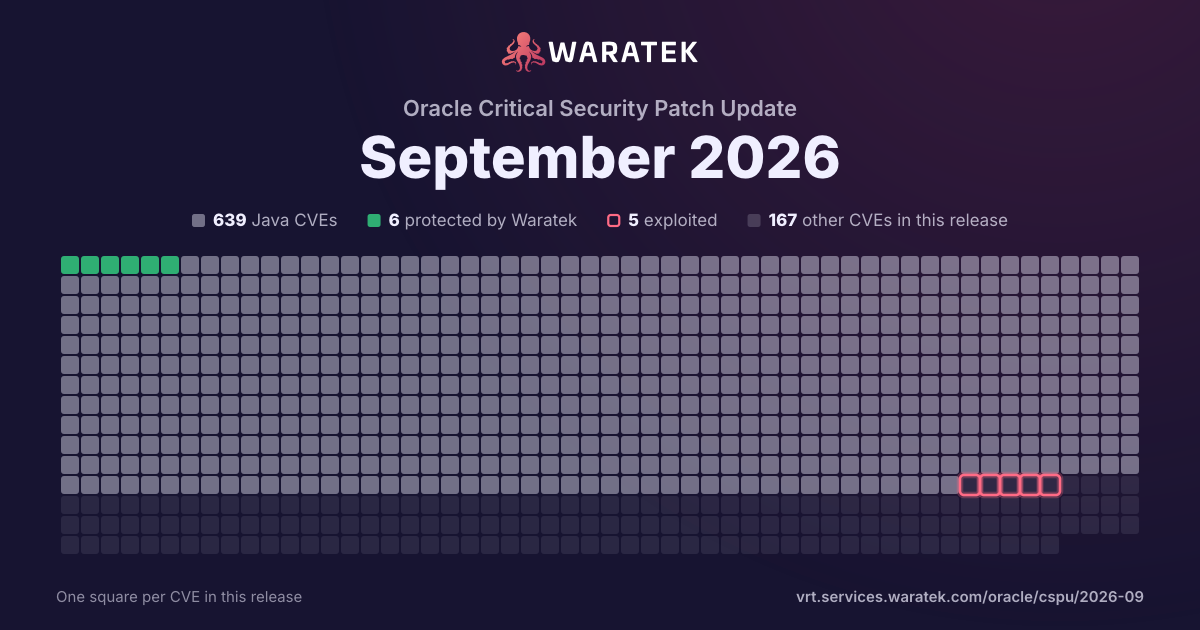
By status
No exploit published. For 596 of them, Oracle's security advisory is the source of public detail.
Protected by Waratek. Waratek RASP can block exploitation of these on systems that have not applied the patch yet.
Overview 130 matches · 0 in Waratek scope · 0 protected · 0 exploited · 0 CISA KEV · 0 public PoC · 0 EPSS ≥ 0.5
130matches
0in Waratek scope0.0%
0protected0.0%
0exploited0.0%
0CISA KEV0.0%
0public PoC0.0%
0EPSS ≥ 0.50.0%
Protected by Waratek
0
0.0%
Rule in development
0
0.0%
Mitigation candidate
0
0.0%
No exploit published
0
0.0%
Outside Waratek scope
0
0.0%
Not applicable
130
100.0%
Withdrawn CVE
0
0.0%
blocked by ARMR today
0
0.0%
partly blocked
0
0.0%
not blocked
130
100.0%
not established
0
0.0%
unrecorded
0
0.0%
Exploited
0
0.0%
Working exploit published
0
0.0%
Proof of concept only
0
0.0%
Forecast only
0
0.0%
No public exploit
130
100.0%
split by
peak 111 / quarter
Q4 231
Not applicable1
Medium1
not blocked1
No public exploit1
Q1 240
Q2 240
Q3 240
Q4 240
Q1 250
Q2 250
Q3 250
Q4 250
Q1 261
Not applicable1
Medium1
not blocked1
No public exploit1
Q2 2617
Not applicable17
Critical2
High3
Medium10
Low2
not blocked17
No public exploit17
Q3 26111
Not applicable111
Critical14
High35
Medium50
Low6
None6
not blocked111
No public exploit111
Q4 23Q1 24Q2 24Q3 24Q4 24Q1 25Q2 25Q3 25Q4 25Q1 26Q2 26Q3 26
| CVE | Severity | Published▾ | Status | Exploitation | Description |
|---|---|---|---|---|---|
| CVE-2026-87285 | Medium | 2026-09-15 | Not applicable | No public exploit | Vulnerability in the Oracle VM VirtualBox product of Oracle Virtualization (component: Core). The supported version that is affected is 7.2.16. Easily exploitable vulnerability allows high privileged attacker with logon to the infrastructure where Oracle VM VirtualBox executes to compromise Oracle VM VirtualBox. While the vulnerability is in Oracle VM VirtualBox, attacks may significantly impact additional products (scope change). Successful attacks of this vulnerability can result in unauthorized ability to cause a hang or frequently repeatable crash (complete DOS) of Oracle VM VirtualBox. CVSS 3.1 Base Score 6.0 (Availability impacts). CVSS Vector: (CVSS:3.1/AV:L/AC:L/PR:H/UI:N/S:C/C:N/I:N/A:H). |
| CVE-2026-87284 | Low | 2026-09-15 | Not applicable | No public exploit | Vulnerability in the Oracle VM VirtualBox product of Oracle Virtualization (component: Core). The supported version that is affected is 7.2.16. Easily exploitable vulnerability allows high privileged attacker with logon to the infrastructure where Oracle VM VirtualBox executes to compromise Oracle VM VirtualBox. While the vulnerability is in Oracle VM VirtualBox, attacks may significantly impact additional products (scope change). Successful attacks of this vulnerability can result in unauthorized ability to cause a partial denial of service (partial DOS) of Oracle VM VirtualBox. CVSS 3.1 Base Score 3.2 (Availability impacts). CVSS Vector: (CVSS:3.1/AV:L/AC:L/PR:H/UI:N/S:C/C:N/I:N/A:L). |
| CVE-2026-87283 | Medium | 2026-09-15 | Not applicable | No public exploit | Vulnerability in the Oracle VM VirtualBox product of Oracle Virtualization (component: Core). The supported version that is affected is 7.2.16. Easily exploitable vulnerability allows high privileged attacker with logon to the infrastructure where Oracle VM VirtualBox executes to compromise Oracle VM VirtualBox. While the vulnerability is in Oracle VM VirtualBox, attacks may significantly impact additional products (scope change). Successful attacks of this vulnerability can result in unauthorized ability to cause a hang or frequently repeatable crash (complete DOS) of Oracle VM VirtualBox. CVSS 3.1 Base Score 6.0 (Availability impacts). CVSS Vector: (CVSS:3.1/AV:L/AC:L/PR:H/UI:N/S:C/C:N/I:N/A:H). |
| CVE-2026-87282 | Medium | 2026-09-15 | Not applicable | No public exploit | Vulnerability in the Oracle VM VirtualBox product of Oracle Virtualization (component: Core). The supported version that is affected is 7.2.16. Easily exploitable vulnerability allows high privileged attacker with logon to the infrastructure where Oracle VM VirtualBox executes to compromise Oracle VM VirtualBox. While the vulnerability is in Oracle VM VirtualBox, attacks may significantly impact additional products (scope change). Successful attacks of this vulnerability can result in unauthorized ability to cause a hang or frequently repeatable crash (complete DOS) of Oracle VM VirtualBox. CVSS 3.1 Base Score 6.0 (Availability impacts). CVSS Vector: (CVSS:3.1/AV:L/AC:L/PR:H/UI:N/S:C/C:N/I:N/A:H). |
| CVE-2026-87281 | Low | 2026-09-15 | Not applicable | No public exploit | Vulnerability in the Oracle VM VirtualBox product of Oracle Virtualization (component: Core). The supported version that is affected is 7.2.16. Easily exploitable vulnerability allows high privileged attacker with logon to the infrastructure where Oracle VM VirtualBox executes to compromise Oracle VM VirtualBox. While the vulnerability is in Oracle VM VirtualBox, attacks may significantly impact additional products (scope change). Successful attacks of this vulnerability can result in unauthorized read access to a subset of Oracle VM VirtualBox accessible data. CVSS 3.1 Base Score 3.2 (Confidentiality impacts). CVSS Vector: (CVSS:3.1/AV:L/AC:L/PR:H/UI:N/S:C/C:L/I:N/A:N). |
| CVE-2026-87280 | Medium | 2026-09-15 | Not applicable | No public exploit | Vulnerability in the Oracle VM VirtualBox product of Oracle Virtualization (component: Core). The supported version that is affected is 7.2.16. Easily exploitable vulnerability allows high privileged attacker with logon to the infrastructure where Oracle VM VirtualBox executes to compromise Oracle VM VirtualBox. Successful attacks require human interaction from a person other than the attacker. Successful attacks of this vulnerability can result in unauthorized ability to cause a hang or frequently repeatable crash (complete DOS) of Oracle VM VirtualBox. CVSS 3.1 Base Score 4.2 (Availability impacts). CVSS Vector: (CVSS:3.1/AV:L/AC:L/PR:H/UI:R/S:U/C:N/I:N/A:H). |
| CVE-2026-87279 | Medium | 2026-09-15 | Not applicable | No public exploit | Vulnerability in the Oracle VM VirtualBox product of Oracle Virtualization (component: Core). The supported version that is affected is 7.2.16. Easily exploitable vulnerability allows low privileged attacker with logon to the infrastructure where Oracle VM VirtualBox executes to compromise Oracle VM VirtualBox. Successful attacks of this vulnerability can result in unauthorized ability to cause a hang or frequently repeatable crash (complete DOS) of Oracle VM VirtualBox as well as unauthorized update, insert or delete access to some of Oracle VM VirtualBox accessible data. CVSS 3.1 Base Score 6.1 (Integrity and Availability impacts). CVSS Vector: (CVSS:3.1/AV:L/AC:L/PR:L/UI:N/S:U/C:N/I:L/A:H). |
| CVE-2026-87278 | Medium | 2026-09-15 | Not applicable | No public exploit | Vulnerability in the Oracle VM VirtualBox product of Oracle Virtualization (component: Core). The supported version that is affected is 7.2.16. Easily exploitable vulnerability allows unauthenticated attacker with logon to the infrastructure where Oracle VM VirtualBox executes to compromise Oracle VM VirtualBox. Successful attacks require human interaction from a person other than the attacker. Successful attacks of this vulnerability can result in unauthorized ability to cause a hang or frequently repeatable crash (complete DOS) of Oracle VM VirtualBox as well as unauthorized update, insert or delete access to some of Oracle VM VirtualBox accessible data. CVSS 3.1 Base Score 6.1 (Integrity and Availability impacts). CVSS Vector: (CVSS:3.1/AV:L/AC:L/PR:N/UI:R/S:U/C:N/I:L/A:H). |
| CVE-2026-87277 | High | 2026-09-15 | Not applicable | No public exploit | Vulnerability in the Oracle VM VirtualBox product of Oracle Virtualization (component: Core). The supported version that is affected is 7.2.16. Easily exploitable vulnerability allows unauthenticated attacker with network access via RDP to compromise Oracle VM VirtualBox. Successful attacks of this vulnerability can result in unauthorized ability to cause a hang or frequently repeatable crash (complete DOS) of Oracle VM VirtualBox. CVSS 3.1 Base Score 7.5 (Availability impacts). CVSS Vector: (CVSS:3.1/AV:N/AC:L/PR:N/UI:N/S:U/C:N/I:N/A:H). |
| CVE-2026-87276 | High | 2026-09-15 | Not applicable | No public exploit | Vulnerability in the Oracle VM VirtualBox product of Oracle Virtualization (component: Core). The supported version that is affected is 7.2.16. Difficult to exploit vulnerability allows low privileged attacker with logon to the infrastructure where Oracle VM VirtualBox executes to compromise Oracle VM VirtualBox. Successful attacks require human interaction from a person other than the attacker and while the vulnerability is in Oracle VM VirtualBox, attacks may significantly impact additional products (scope change). Successful attacks of this vulnerability can result in takeover of Oracle VM VirtualBox. CVSS 3.1 Base Score 7.5 (Confidentiality, Integrity and Availability impacts). CVSS Vector: (CVSS:3.1/AV:L/AC:H/PR:L/UI:R/S:C/C:H/I:H/A:H). |
| CVE-2026-87275 | Medium | 2026-09-15 | Not applicable | No public exploit | Vulnerability in the Oracle VM VirtualBox product of Oracle Virtualization (component: Core). The supported version that is affected is 7.2.16. Easily exploitable vulnerability allows high privileged attacker with logon to the infrastructure where Oracle VM VirtualBox executes to compromise Oracle VM VirtualBox. While the vulnerability is in Oracle VM VirtualBox, attacks may significantly impact additional products (scope change). Successful attacks of this vulnerability can result in unauthorized read access to a subset of Oracle VM VirtualBox accessible data and unauthorized ability to cause a partial denial of service (partial DOS) of Oracle VM VirtualBox. CVSS 3.1 Base Score 4.6 (Confidentiality and Availability impacts). CVSS Vector: (CVSS:3.1/AV:L/AC:L/PR:H/UI:N/S:C/C:L/I:N/A:L). |
| CVE-2026-87274 | Medium | 2026-09-15 | Not applicable | No public exploit | Vulnerability in the Oracle VM VirtualBox product of Oracle Virtualization (component: Core). The supported version that is affected is 7.2.16. Difficult to exploit vulnerability allows low privileged attacker with logon to the infrastructure where Oracle VM VirtualBox executes to compromise Oracle VM VirtualBox. Successful attacks require human interaction from a person other than the attacker. Successful attacks of this vulnerability can result in unauthorized ability to cause a hang or frequently repeatable crash (complete DOS) of Oracle VM VirtualBox. CVSS 3.1 Base Score 4.4 (Availability impacts). CVSS Vector: (CVSS:3.1/AV:L/AC:H/PR:L/UI:R/S:U/C:N/I:N/A:H). |
| CVE-2026-87273 | High | 2026-09-15 | Not applicable | No public exploit | Vulnerability in the Oracle VM VirtualBox product of Oracle Virtualization (component: Core). The supported version that is affected is 7.2.16. Easily exploitable vulnerability allows unauthenticated attacker with logon to the infrastructure where Oracle VM VirtualBox executes to compromise Oracle VM VirtualBox. Successful attacks require human interaction from a person other than the attacker and while the vulnerability is in Oracle VM VirtualBox, attacks may significantly impact additional products (scope change). Successful attacks of this vulnerability can result in takeover of Oracle VM VirtualBox. CVSS 3.1 Base Score 8.6 (Confidentiality, Integrity and Availability impacts). CVSS Vector: (CVSS:3.1/AV:L/AC:L/PR:N/UI:R/S:C/C:H/I:H/A:H). |
| CVE-2026-87272 | High | 2026-09-15 | Not applicable | No public exploit | Vulnerability in the Oracle VM VirtualBox product of Oracle Virtualization (component: Core). The supported version that is affected is 7.2.16. Easily exploitable vulnerability allows low privileged attacker with logon to the infrastructure where Oracle VM VirtualBox executes to compromise Oracle VM VirtualBox. Successful attacks of this vulnerability can result in takeover of Oracle VM VirtualBox. CVSS 3.1 Base Score 7.8 (Confidentiality, Integrity and Availability impacts). CVSS Vector: (CVSS:3.1/AV:L/AC:L/PR:L/UI:N/S:U/C:H/I:H/A:H). |
| CVE-2026-87271 | High | 2026-09-15 | Not applicable | No public exploit | Vulnerability in the Oracle VM VirtualBox product of Oracle Virtualization (component: Core). The supported version that is affected is 7.2.16. Easily exploitable vulnerability allows low privileged attacker with logon to the infrastructure where Oracle VM VirtualBox executes to compromise Oracle VM VirtualBox. Successful attacks of this vulnerability can result in takeover of Oracle VM VirtualBox. Note: This vulnerability applies to Windows host only. CVSS 3.1 Base Score 7.8 (Confidentiality, Integrity and Availability impacts). CVSS Vector: (CVSS:3.1/AV:L/AC:L/PR:L/UI:N/S:U/C:H/I:H/A:H). |
| CVE-2026-87270 | High | 2026-09-15 | Not applicable | No public exploit | Vulnerability in the Oracle VM VirtualBox product of Oracle Virtualization (component: Core). The supported version that is affected is 7.2.16. Easily exploitable vulnerability allows low privileged attacker with logon to the infrastructure where Oracle VM VirtualBox executes to compromise Oracle VM VirtualBox. Successful attacks of this vulnerability can result in takeover of Oracle VM VirtualBox. Note: This vulnerability applies to Windows host only. CVSS 3.1 Base Score 7.8 (Confidentiality, Integrity and Availability impacts). CVSS Vector: (CVSS:3.1/AV:L/AC:L/PR:L/UI:N/S:U/C:H/I:H/A:H). |
| CVE-2026-87269 | High | 2026-09-15 | Not applicable | No public exploit | Vulnerability in the Oracle VM VirtualBox product of Oracle Virtualization (component: Core). The supported version that is affected is 7.2.16. Easily exploitable vulnerability allows low privileged attacker with logon to the infrastructure where Oracle VM VirtualBox executes to compromise Oracle VM VirtualBox. Successful attacks of this vulnerability can result in takeover of Oracle VM VirtualBox. Note: This vulnerability applies to Windows host only. CVSS 3.1 Base Score 7.8 (Confidentiality, Integrity and Availability impacts). CVSS Vector: (CVSS:3.1/AV:L/AC:L/PR:L/UI:N/S:U/C:H/I:H/A:H). |
| CVE-2026-87268 | High | 2026-09-15 | Not applicable | No public exploit | Vulnerability in the Oracle VM VirtualBox product of Oracle Virtualization (component: Core). The supported version that is affected is 7.2.16. Easily exploitable vulnerability allows low privileged attacker with logon to the infrastructure where Oracle VM VirtualBox executes to compromise Oracle VM VirtualBox. Successful attacks of this vulnerability can result in takeover of Oracle VM VirtualBox. Note: This vulnerability applies to Windows host only. CVSS 3.1 Base Score 7.8 (Confidentiality, Integrity and Availability impacts). CVSS Vector: (CVSS:3.1/AV:L/AC:L/PR:L/UI:N/S:U/C:H/I:H/A:H). |
| CVE-2026-87267 | Medium | 2026-09-15 | Not applicable | No public exploit | Vulnerability in the Oracle VM VirtualBox product of Oracle Virtualization (component: Core). The supported version that is affected is 7.2.16. Difficult to exploit vulnerability allows low privileged attacker with network access via RDP to compromise Oracle VM VirtualBox. Successful attacks of this vulnerability can result in unauthorized ability to cause a hang or frequently repeatable crash (complete DOS) of Oracle VM VirtualBox. CVSS 3.1 Base Score 5.3 (Availability impacts). CVSS Vector: (CVSS:3.1/AV:N/AC:H/PR:L/UI:N/S:U/C:N/I:N/A:H). |
| CVE-2026-83351 | High | 2026-09-15 | Not applicable | No public exploit | Vulnerability in the RDBMS component of Oracle Database Server. Supported versions that are affected are 23.4.0-23.26.3. Difficult to exploit vulnerability allows unauthenticated attacker with network access via Oracle Net to compromise RDBMS. Successful attacks of this vulnerability can result in takeover of RDBMS. CVSS 3.1 Base Score 8.1 (Confidentiality, Integrity and Availability impacts). CVSS Vector: (CVSS:3.1/AV:N/AC:H/PR:N/UI:N/S:U/C:H/I:H/A:H). |
| CVE-2026-83350 | High | 2026-09-15 | Not applicable | No public exploit | Vulnerability in the Oracle Net Services component of Oracle Database Server. Supported versions that are affected are 21.3-21.23 and 23.4.0-23.26.3. Easily exploitable vulnerability allows unauthenticated attacker with network access via Oracle Net to compromise Oracle Net Services. Successful attacks of this vulnerability can result in unauthorized ability to cause a hang or frequently repeatable crash (complete DOS) of Oracle Net Services. CVSS 3.1 Base Score 7.5 (Availability impacts). CVSS Vector: (CVSS:3.1/AV:N/AC:L/PR:N/UI:N/S:U/C:N/I:N/A:H). |
| CVE-2026-83349 | High | 2026-09-15 | Not applicable | No public exploit | Vulnerability in the Oracle Net Services component of Oracle Database Server. Supported versions that are affected are 19.3-19.32, 21.3-21.23 and 23.4.0-23.26.3. Easily exploitable vulnerability allows unauthenticated attacker with network access via Oracle Net to compromise Oracle Net Services. Successful attacks of this vulnerability can result in unauthorized ability to cause a hang or frequently repeatable crash (complete DOS) of Oracle Net Services. CVSS 3.1 Base Score 7.5 (Availability impacts). CVSS Vector: (CVSS:3.1/AV:N/AC:L/PR:N/UI:N/S:U/C:N/I:N/A:H). |
| CVE-2026-83348 | High | 2026-09-15 | Not applicable | No public exploit | Vulnerability in the RDBMS component of Oracle Database Server. Supported versions that are affected are 19.3-19.32, 21.3-21.23 and 23.4.0-23.26.3. Easily exploitable vulnerability allows low privileged attacker having Create DB Link privilege with network access via Oracle Net to compromise RDBMS. Successful attacks of this vulnerability can result in takeover of RDBMS. CVSS 3.1 Base Score 8.8 (Confidentiality, Integrity and Availability impacts). CVSS Vector: (CVSS:3.1/AV:N/AC:L/PR:L/UI:N/S:U/C:H/I:H/A:H). |
| CVE-2026-83347 | Medium | 2026-09-15 | Not applicable | No public exploit | Vulnerability in the Oracle Net Services component of Oracle Database Server. Supported versions that are affected are 23.4.0-23.26.3. Easily exploitable vulnerability allows unauthenticated attacker with network access via TCPS to compromise Oracle Net Services. Successful attacks require human interaction from a person other than the attacker. Successful attacks of this vulnerability can result in unauthorized ability to cause a hang or frequently repeatable crash (complete DOS) of Oracle Net Services. CVSS 3.1 Base Score 6.5 (Availability impacts). CVSS Vector: (CVSS:3.1/AV:N/AC:L/PR:N/UI:R/S:U/C:N/I:N/A:H). |
| CVE-2026-83333 | High | 2026-09-15 | Not applicable | No public exploit | Vulnerability in the Oracle Net Services component of Oracle Database Server. Supported versions that are affected are 23.4.0-23.26.3. Easily exploitable vulnerability allows unauthenticated attacker with network access via Oracle Net to compromise Oracle Net Services. Successful attacks of this vulnerability can result in unauthorized ability to cause a hang or frequently repeatable crash (complete DOS) of Oracle Net Services. CVSS 3.1 Base Score 7.5 (Availability impacts). CVSS Vector: (CVSS:3.1/AV:N/AC:L/PR:N/UI:N/S:U/C:N/I:N/A:H). |
| CVE-2026-83272 | High | 2026-09-15 | Not applicable | No public exploit | Vulnerability in the Oracle Text component of Oracle Database Server. Supported versions that are affected are 19.3-19.32, 21.3-21.23 and 23.4.0-23.26.3. Difficult to exploit vulnerability allows low privileged attacker having Create Index privilege with network access via Oracle Net to compromise Oracle Text. While the vulnerability is in Oracle Text, attacks may significantly impact additional products (scope change). Successful attacks of this vulnerability can result in takeover of Oracle Text. CVSS 3.1 Base Score 8.5 (Confidentiality, Integrity and Availability impacts). CVSS Vector: (CVSS:3.1/AV:N/AC:H/PR:L/UI:N/S:C/C:H/I:H/A:H). |
| CVE-2026-83271 | High | 2026-09-15 | Not applicable | No public exploit | Vulnerability in the RDBMS component of Oracle Database Server. Supported versions that are affected are 19.3-19.32, 21.3-21.23 and 23.4.0-23.26.3. Easily exploitable vulnerability allows low privileged attacker having Execute on DBMS_REDEFINITION privilege with network access via Oracle Net to compromise RDBMS. Successful attacks of this vulnerability can result in takeover of RDBMS. CVSS 3.1 Base Score 8.8 (Confidentiality, Integrity and Availability impacts). CVSS Vector: (CVSS:3.1/AV:N/AC:L/PR:L/UI:N/S:U/C:H/I:H/A:H). |
| CVE-2026-83160 | High | 2026-09-15 | Not applicable | No public exploit | Vulnerability in the RDBMS component of Oracle Database Server. Supported versions that are affected are 23.4.0-23.26.3. Easily exploitable vulnerability allows low privileged attacker having Create Table privilege with network access via Oracle Net to compromise RDBMS. Successful attacks of this vulnerability can result in takeover of RDBMS. CVSS 3.1 Base Score 8.8 (Confidentiality, Integrity and Availability impacts). CVSS Vector: (CVSS:3.1/AV:N/AC:L/PR:L/UI:N/S:U/C:H/I:H/A:H). |
| CVE-2026-83156 | High | 2026-09-15 | Not applicable | No public exploit | Vulnerability in the Oracle XML Developers Kit component of Oracle Database Server. Supported versions that are affected are 19.3-19.32, 21.3-21.23 and 23.4.0-23.26.3. Difficult to exploit vulnerability allows low privileged attacker having XDKC privilege with network access via Oracle Net to compromise Oracle XML Developers Kit. Successful attacks of this vulnerability can result in takeover of Oracle XML Developers Kit. CVSS 3.1 Base Score 7.5 (Confidentiality, Integrity and Availability impacts). CVSS Vector: (CVSS:3.1/AV:N/AC:H/PR:L/UI:N/S:U/C:H/I:H/A:H). |
| CVE-2026-83088 | High | 2026-09-15 | Not applicable | No public exploit | Vulnerability in the RDBMS component of Oracle Database Server. Supported versions that are affected are 23.4.0-23.26.3. Easily exploitable vulnerability allows low privileged attacker having Authenticated User privilege with network access via Oracle Net to compromise RDBMS. While the vulnerability is in RDBMS, attacks may significantly impact additional products (scope change). Successful attacks of this vulnerability can result in unauthorized ability to cause a hang or frequently repeatable crash (complete DOS) of RDBMS. CVSS 3.1 Base Score 7.7 (Availability impacts). CVSS Vector: (CVSS:3.1/AV:N/AC:L/PR:L/UI:N/S:C/C:N/I:N/A:H). |
| CVE-2026-83066 | Critical | 2026-09-15 | Not applicable | No public exploit | Vulnerability in the Oracle Internet Directory product of Oracle Fusion Middleware (component: OID LDAP Server). Supported versions that are affected are 12.2.1.4.0 and 14.1.2.1.0. Easily exploitable vulnerability allows unauthenticated attacker with network access via T3, IIOP to compromise Oracle Internet Directory. Successful attacks of this vulnerability can result in takeover of Oracle Internet Directory. CVSS 3.1 Base Score 9.8 (Confidentiality, Integrity and Availability impacts). CVSS Vector: (CVSS:3.1/AV:N/AC:L/PR:N/UI:N/S:U/C:H/I:H/A:H). |
| CVE-2026-83063 | High | 2026-09-15 | Not applicable | No public exploit | Vulnerability in the Oracle Internet Directory product of Oracle Fusion Middleware (component: OID LDAP Server). Supported versions that are affected are 12.2.1.4.0 and 14.1.2.1.0. Easily exploitable vulnerability allows high privileged attacker with network access via LDAP to compromise Oracle Internet Directory. Successful attacks of this vulnerability can result in takeover of Oracle Internet Directory. CVSS 3.1 Base Score 7.2 (Confidentiality, Integrity and Availability impacts). CVSS Vector: (CVSS:3.1/AV:N/AC:L/PR:H/UI:N/S:U/C:H/I:H/A:H). |
| CVE-2026-83062 | Critical | 2026-09-15 | Not applicable | No public exploit | Vulnerability in the Oracle Internet Directory product of Oracle Fusion Middleware (component: OID LDAP Server). Supported versions that are affected are 12.2.1.4.0 and 14.1.2.1.0. Easily exploitable vulnerability allows unauthenticated attacker with network access via LDAP to compromise Oracle Internet Directory. Successful attacks of this vulnerability can result in takeover of Oracle Internet Directory. CVSS 3.1 Base Score 9.8 (Confidentiality, Integrity and Availability impacts). CVSS Vector: (CVSS:3.1/AV:N/AC:L/PR:N/UI:N/S:U/C:H/I:H/A:H). |
| CVE-2026-83061 | Critical | 2026-09-15 | Not applicable | No public exploit | Vulnerability in the Oracle Internet Directory product of Oracle Fusion Middleware (component: OID LDAP Server). Supported versions that are affected are 12.2.1.4.0 and 14.1.2.1.0. Easily exploitable vulnerability allows unauthenticated attacker with network access via LDAP to compromise Oracle Internet Directory. Successful attacks of this vulnerability can result in takeover of Oracle Internet Directory. CVSS 3.1 Base Score 9.8 (Confidentiality, Integrity and Availability impacts). CVSS Vector: (CVSS:3.1/AV:N/AC:L/PR:N/UI:N/S:U/C:H/I:H/A:H). |
| CVE-2026-83060 | Critical | 2026-09-15 | Not applicable | No public exploit | Vulnerability in the Oracle Internet Directory product of Oracle Fusion Middleware (component: OID LDAP Server). Supported versions that are affected are 12.2.1.4.0 and 14.1.2.1.0. Easily exploitable vulnerability allows unauthenticated attacker with network access via LDAP to compromise Oracle Internet Directory. Successful attacks of this vulnerability can result in takeover of Oracle Internet Directory. CVSS 3.1 Base Score 9.8 (Confidentiality, Integrity and Availability impacts). CVSS Vector: (CVSS:3.1/AV:N/AC:L/PR:N/UI:N/S:U/C:H/I:H/A:H). |
| CVE-2026-83059 | Critical | 2026-09-15 | Not applicable | No public exploit | Vulnerability in the Oracle Internet Directory product of Oracle Fusion Middleware (component: OID LDAP Server). Supported versions that are affected are 12.2.1.4.0 and 14.1.2.1.0. Easily exploitable vulnerability allows unauthenticated attacker with network access via LDAP to compromise Oracle Internet Directory. While the vulnerability is in Oracle Internet Directory, attacks may significantly impact additional products (scope change). Successful attacks of this vulnerability can result in takeover of Oracle Internet Directory. CVSS 3.1 Base Score 10.0 (Confidentiality, Integrity and Availability impacts). CVSS Vector: (CVSS:3.1/AV:N/AC:L/PR:N/UI:N/S:C/C:H/I:H/A:H). |
| CVE-2026-83058 | Critical | 2026-09-15 | Not applicable | No public exploit | Vulnerability in the Oracle Internet Directory product of Oracle Fusion Middleware (component: OID LDAP Server). Supported versions that are affected are 12.2.1.4.0 and 14.1.2.1.0. Easily exploitable vulnerability allows low privileged attacker with network access via LDAP to compromise Oracle Internet Directory. While the vulnerability is in Oracle Internet Directory, attacks may significantly impact additional products (scope change). Successful attacks of this vulnerability can result in takeover of Oracle Internet Directory. CVSS 3.1 Base Score 9.9 (Confidentiality, Integrity and Availability impacts). CVSS Vector: (CVSS:3.1/AV:N/AC:L/PR:L/UI:N/S:C/C:H/I:H/A:H). |
| CVE-2026-83057 | Critical | 2026-09-15 | Not applicable | No public exploit | Vulnerability in the Oracle Internet Directory product of Oracle Fusion Middleware (component: OID LDAP Server). Supported versions that are affected are 12.2.1.4.0 and 14.1.2.1.0. Easily exploitable vulnerability allows low privileged attacker with network access via LDAP to compromise Oracle Internet Directory. While the vulnerability is in Oracle Internet Directory, attacks may significantly impact additional products (scope change). Successful attacks of this vulnerability can result in takeover of Oracle Internet Directory. CVSS 3.1 Base Score 9.9 (Confidentiality, Integrity and Availability impacts). CVSS Vector: (CVSS:3.1/AV:N/AC:L/PR:L/UI:N/S:C/C:H/I:H/A:H). |
| CVE-2026-83056 | Critical | 2026-09-15 | Not applicable | No public exploit | Vulnerability in the Oracle Internet Directory product of Oracle Fusion Middleware (component: OID LDAP Server). Supported versions that are affected are 12.2.1.4.0 and 14.1.2.1.0. Easily exploitable vulnerability allows low privileged attacker with network access via LDAP to compromise Oracle Internet Directory. While the vulnerability is in Oracle Internet Directory, attacks may significantly impact additional products (scope change). Successful attacks of this vulnerability can result in takeover of Oracle Internet Directory. CVSS 3.1 Base Score 9.9 (Confidentiality, Integrity and Availability impacts). CVSS Vector: (CVSS:3.1/AV:N/AC:L/PR:L/UI:N/S:C/C:H/I:H/A:H). |
| CVE-2026-83055 | Critical | 2026-09-15 | Not applicable | No public exploit | Vulnerability in the Oracle Internet Directory product of Oracle Fusion Middleware (component: OID LDAP Server). Supported versions that are affected are 12.2.1.4.0 and 14.1.2.1.0. Easily exploitable vulnerability allows low privileged attacker with network access via LDAP to compromise Oracle Internet Directory. While the vulnerability is in Oracle Internet Directory, attacks may significantly impact additional products (scope change). Successful attacks of this vulnerability can result in takeover of Oracle Internet Directory. CVSS 3.1 Base Score 9.9 (Confidentiality, Integrity and Availability impacts). CVSS Vector: (CVSS:3.1/AV:N/AC:L/PR:L/UI:N/S:C/C:H/I:H/A:H). |
| CVE-2026-83054 | Critical | 2026-09-15 | Not applicable | No public exploit | Vulnerability in the Oracle Internet Directory product of Oracle Fusion Middleware (component: OID LDAP Server). Supported versions that are affected are 12.2.1.4.0 and 14.1.2.1.0. Easily exploitable vulnerability allows unauthenticated attacker with network access via LDAP to compromise Oracle Internet Directory. Successful attacks of this vulnerability can result in takeover of Oracle Internet Directory. CVSS 3.1 Base Score 9.8 (Confidentiality, Integrity and Availability impacts). CVSS Vector: (CVSS:3.1/AV:N/AC:L/PR:N/UI:N/S:U/C:H/I:H/A:H). |
| CVE-2026-73194 | Critical | 2026-08-15 | Not applicable | No public exploit | DBI versions before 1.652 for Perl allow a heap out-of-bounds write via an unvalidated numeric placeholder that sets the binder counter in preparse. preparse reserves seven output bytes per input byte, the width of the longest ':p99999' expansion. The ':N' branch parses the number with `atoi(src)` and assigns it to the binder counter with no range check, so a statement containing ':2147483648' leaves the counter negative (-2147483648 with glibc, where atoi wraps). Each following '?' then expands through `sprintf(start, ":p%d", idx++)` to ':p-2147483648', 14 bytes with the terminating NUL where the buffer budgets 7. The placeholder limit added in 1.650 tests the counter against 99,999, which a negative counter passes. Any caller that preparses an untrusted statement into ':pN' style placeholders gets a heap out-of-bounds write that grows with the number of '?' marks following the poisoned placeholder. The '?' and '%s' return styles compare the parsed number against the expected sequence and error out, and are unaffected. |
| CVE-2026-14456 | High | 2026-08-13 | Not applicable | No public exploit | Issue summary: When an OpenSSL QUIC server (Listener SSL object) processes valid QUIC Initial packets for unknown destination connection IDs, it can allocate and queue new incoming channels without enforcing any limit. Impact summary: A remote peer that can make many Initial packets reach the server listener faster than the application accepts connections, can cause the memory allocated to store the per-channel state to grow without any limits, potentially making the QUIC listener unavailable and causing Denial of Service. CWE: CWE-770: Allocation of Resources Without Limits or Throttling Description: The function that handles inbound QUIC packets uses Connection-Id from the packet header to find an existing connection (QUIC channel). If no existing connection is found and the packet type is INITIAL, the function treats the packet as a new connection. It allocates a new channel object and inserts it into a queue where it waits to be accepted by the local application with SSL_accept(3ossl). The memory occupied by these initial channel objects may grow without bounds if the application is not able to call SSL_accept() frequently enough to serve these inbound connection requests. The issue is present since OpenSSL 3.5 when the QUIC server implementation was added. The fix introduces a limit for pending connections. The default limit is set to 256 pending connections (waiting to be accepted by the local application). Applications may change the default by calling SSL_set_value_uint(3ossl). FIPS impact: no The FIPS module is not affected as the QUIC implementation is outside of the OpenSSL FIPS module boundary. |
| CVE-2026-67355 | High | 2026-08-01 | Not applicable | No public exploit | guzzlehttp/guzzle versions before 7.15.1 fail to preserve host-only cookie scope, storing the request host in the Domain field instead of marking cookies as host-only. Attackers controlling child hosts can receive host-only cookies intended only for parent hosts, potentially disclosing session identifiers and authorization tokens when the same cookie jar is reused across trust boundaries. |
| CVE-2026-67354 | High | 2026-08-01 | Not applicable | No public exploit | guzzlehttp/guzzle versions before 7.15.1 contain an information disclosure vulnerability in RedirectMiddleware. When the optional allow_redirects.referer setting is enabled, the middleware copies the URI fragment (the portion after '#') from the referring request into the generated Referer header when following a same-scheme redirect (e.g., HTTPS to HTTPS). An attacker who controls the redirect destination can read this fragment from the incoming Referer header, potentially disclosing one-time login secrets, access tokens, state values, or other sensitive client data to a server never meant to receive it. The referer setting is disabled by default. Fixed in 7.15.1, which strips the fragment before generating the Referer value. |
| CVE-2026-67353 | Medium | 2026-08-01 | Not applicable | No public exploit | guzzlehttp/guzzle versions before 7.15.1 contain a denial of service vulnerability in the CookieJar that accepts unlimited Set-Cookie header fields with no size restrictions. Attackers can return many large cookies from a malicious server, causing Guzzle to store excessive data in memory and generate oversized Cookie headers that fail in handlers or destination servers. |
| CVE-2026-67339 | Medium | 2026-08-01 | Not applicable | No public exploit | guzzlehttp/guzzle versions before 7.14.2 fail to properly isolate Proxy-Authorization headers from origin servers in cURL handlers. Attackers can capture proxy credentials through origin server access logs when requests are redirected, bypassed, or sent through SOCKS proxies that Guzzle misclassifies as direct connections. |
| CVE-2026-61109 | Medium | 2026-07-21 | Not applicable | No public exploit | Vulnerability in the MySQL Server, MySQL Cluster product of Oracle MySQL (component: Server: JSON). Supported versions that are affected are MySQL Server: 8.4.0-8.4.10, 9.7.0-9.7.1; MySQL Cluster: 8.0.0-8.0.47, 8.4.0-8.4.10 and 9.7.0-9.7.1. Easily exploitable vulnerability allows low privileged attacker with network access via multiple protocols to compromise MySQL Server, MySQL Cluster. Successful attacks of this vulnerability can result in unauthorized ability to cause a hang or frequently repeatable crash (complete DOS) of MySQL Server, MySQL Cluster. CVSS 3.1 Base Score 6.5 (Availability impacts). CVSS Vector: (CVSS:3.1/AV:N/AC:L/PR:L/UI:N/S:U/C:N/I:N/A:H). |
| CVE-2026-61096 | Low | 2026-07-21 | Not applicable | No public exploit | Vulnerability in the MySQL Server, MySQL Cluster product of Oracle MySQL (component: Server: Pluggable Auth). Supported versions that are affected are MySQL Server: 8.4.0-8.4.10, 9.7.0-9.7.1; MySQL Cluster: 8.0.0-8.0.47, 8.4.0-8.4.10 and 9.7.0-9.7.1. Difficult to exploit vulnerability allows unauthenticated attacker with logon to the infrastructure where MySQL Server, MySQL Cluster executes to compromise MySQL Server, MySQL Cluster. Successful attacks of this vulnerability can result in unauthorized update, insert or delete access to some of MySQL Server, MySQL Cluster accessible data. CVSS 3.1 Base Score 2.9 (Integrity impacts). CVSS Vector: (CVSS:3.1/AV:L/AC:H/PR:N/UI:N/S:U/C:N/I:L/A:N). |
| CVE-2026-61094 | High | 2026-07-21 | Not applicable | No public exploit | Vulnerability in the MySQL Server, MySQL Cluster product of Oracle MySQL (component: Server: Replication). Supported versions that are affected are MySQL Server: 8.4.0-8.4.10, 9.7.0-9.7.1; MySQL Cluster: 8.0.0-8.0.47, 8.4.0-8.4.10 and 9.7.0-9.7.1. Easily exploitable vulnerability allows high privileged attacker with network access via multiple protocols to compromise MySQL Server, MySQL Cluster. Successful attacks of this vulnerability can result in takeover of MySQL Server, MySQL Cluster. CVSS 3.1 Base Score 7.2 (Confidentiality, Integrity and Availability impacts). CVSS Vector: (CVSS:3.1/AV:N/AC:L/PR:H/UI:N/S:U/C:H/I:H/A:H). |
| CVE-2026-61081 | Low | 2026-07-21 | Not applicable | No public exploit | Vulnerability in the MySQL Server, MySQL Cluster product of Oracle MySQL (component: Server: Performance Schema). Supported versions that are affected are MySQL Server: 8.4.0-8.4.10, 9.7.0-9.7.1; MySQL Cluster: 8.0.0-8.0.47, 8.4.0-8.4.10 and 9.7.0-9.7.1. Easily exploitable vulnerability allows high privileged attacker with network access via multiple protocols to compromise MySQL Server, MySQL Cluster. Successful attacks of this vulnerability can result in unauthorized read access to a subset of MySQL Server, MySQL Cluster accessible data. CVSS 3.1 Base Score 2.7 (Confidentiality impacts). CVSS Vector: (CVSS:3.1/AV:N/AC:L/PR:H/UI:N/S:U/C:L/I:N/A:N). |
| CVE-2026-60747 | Medium | 2026-07-21 | Not applicable | No public exploit | Vulnerability in the MySQL Server, MySQL Cluster product of Oracle MySQL (component: Server: Replication). Supported versions that are affected are MySQL Server: 8.4.0-8.4.10, 9.7.0-9.7.1; MySQL Cluster: 8.0.0-8.0.47, 8.4.0-8.4.10 and 9.7.0-9.7.1. Easily exploitable vulnerability allows unauthenticated attacker with logon to the infrastructure where MySQL Server, MySQL Cluster executes to compromise MySQL Server, MySQL Cluster. Successful attacks of this vulnerability can result in unauthorized ability to cause a hang or frequently repeatable crash (complete DOS) of MySQL Server, MySQL Cluster. CVSS 3.1 Base Score 6.2 (Availability impacts). CVSS Vector: (CVSS:3.1/AV:L/AC:L/PR:N/UI:N/S:U/C:N/I:N/A:H). |
| CVE-2026-60585 | Medium | 2026-07-21 | Not applicable | No public exploit | Vulnerability in the MySQL Server, MySQL Cluster product of Oracle MySQL (component: Server: Replication). Supported versions that are affected are MySQL Server: 8.4.0-8.4.10, 9.7.0-9.7.1; MySQL Cluster: 8.0.0-8.0.47, 8.4.0-8.4.10 and 9.7.0-9.7.1. Difficult to exploit vulnerability allows high privileged attacker with network access via multiple protocols to compromise MySQL Server, MySQL Cluster. Successful attacks of this vulnerability can result in takeover of MySQL Server, MySQL Cluster. CVSS 3.1 Base Score 6.6 (Confidentiality, Integrity and Availability impacts). CVSS Vector: (CVSS:3.1/AV:N/AC:H/PR:H/UI:N/S:U/C:H/I:H/A:H). |
| CVE-2026-60332 | Medium | 2026-07-21 | Not applicable | No public exploit | Vulnerability in the MySQL Server, MySQL Cluster product of Oracle MySQL (component: Server: Group Replication GCS). Supported versions that are affected are MySQL Server: 8.4.0-8.4.10, 9.7.0-9.7.1; MySQL Cluster: 8.0.0-8.0.47, 8.4.0-8.4.10 and 9.7.0-9.7.1. Difficult to exploit vulnerability allows high privileged attacker with logon to the infrastructure where MySQL Server, MySQL Cluster executes to compromise MySQL Server, MySQL Cluster. Successful attacks of this vulnerability can result in takeover of MySQL Server, MySQL Cluster. CVSS 3.1 Base Score 6.4 (Confidentiality, Integrity and Availability impacts). CVSS Vector: (CVSS:3.1/AV:L/AC:H/PR:H/UI:N/S:U/C:H/I:H/A:H). |
| CVE-2026-60331 | Medium | 2026-07-21 | Not applicable | No public exploit | Vulnerability in the MySQL Server, MySQL Cluster product of Oracle MySQL (component: Server: Replication). Supported versions that are affected are MySQL Server: 8.4.0-8.4.10, 9.7.0-9.7.1; MySQL Cluster: 8.0.0-8.0.47, 8.4.0-8.4.10 and 9.7.0-9.7.1. Difficult to exploit vulnerability allows high privileged attacker with logon to the infrastructure where MySQL Server, MySQL Cluster executes to compromise MySQL Server, MySQL Cluster. Successful attacks of this vulnerability can result in takeover of MySQL Server, MySQL Cluster. CVSS 3.1 Base Score 6.4 (Confidentiality, Integrity and Availability impacts). CVSS Vector: (CVSS:3.1/AV:L/AC:H/PR:H/UI:N/S:U/C:H/I:H/A:H). |
| CVE-2026-60316 | High | 2026-07-21 | Not applicable | No public exploit | Vulnerability in the MySQL Server, MySQL Cluster product of Oracle MySQL (component: Server: X Plugin). Supported versions that are affected are MySQL Server: 8.4.0-8.4.10, 9.7.0-9.7.1; MySQL Cluster: 8.0.0-8.0.47, 8.4.0-8.4.10 and 9.7.0-9.7.1. Easily exploitable vulnerability allows high privileged attacker with network access via multiple protocols to compromise MySQL Server, MySQL Cluster. Successful attacks of this vulnerability can result in takeover of MySQL Server, MySQL Cluster. CVSS 3.1 Base Score 7.2 (Confidentiality, Integrity and Availability impacts). CVSS Vector: (CVSS:3.1/AV:N/AC:L/PR:H/UI:N/S:U/C:H/I:H/A:H). |
| CVE-2026-60315 | High | 2026-07-21 | Not applicable | No public exploit | Vulnerability in the MySQL Server, MySQL Cluster product of Oracle MySQL (component: Server: X Plugin). Supported versions that are affected are MySQL Server: 8.4.0-8.4.10, 9.7.0-9.7.1; MySQL Cluster: 8.0.0-8.0.47, 8.4.0-8.4.10 and 9.7.0-9.7.1. Easily exploitable vulnerability allows unauthenticated attacker with network access via multiple protocols to compromise MySQL Server, MySQL Cluster. Successful attacks of this vulnerability can result in unauthorized ability to cause a hang or frequently repeatable crash (complete DOS) of MySQL Server, MySQL Cluster and unauthorized read access to a subset of MySQL Server, MySQL Cluster accessible data. CVSS 3.1 Base Score 8.2 (Confidentiality and Availability impacts). CVSS Vector: (CVSS:3.1/AV:N/AC:L/PR:N/UI:N/S:U/C:L/I:N/A:H). |
| CVE-2026-60191 | Medium | 2026-07-21 | Not applicable | No public exploit | Vulnerability in the MySQL Server, MySQL Cluster product of Oracle MySQL (component: Server: Replication). Supported versions that are affected are MySQL Server: 8.4.0-8.4.10, 9.7.0-9.7.1; MySQL Cluster: 8.0.0-8.0.47, 8.4.0-8.4.10 and 9.7.0-9.7.1. Difficult to exploit vulnerability allows high privileged attacker with logon to the infrastructure where MySQL Server, MySQL Cluster executes to compromise MySQL Server, MySQL Cluster. Successful attacks of this vulnerability can result in unauthorized ability to cause a hang or frequently repeatable crash (complete DOS) of MySQL Server, MySQL Cluster. CVSS 3.1 Base Score 4.1 (Availability impacts). CVSS Vector: (CVSS:3.1/AV:L/AC:H/PR:H/UI:N/S:U/C:N/I:N/A:H). |
| CVE-2026-60190 | Low | 2026-07-21 | Not applicable | No public exploit | Vulnerability in the MySQL Server, MySQL Cluster product of Oracle MySQL (component: Server: Replication). Supported versions that are affected are MySQL Server: 8.4.0-8.4.10, 9.7.0-9.7.1; MySQL Cluster: 8.0.0-8.0.47, 8.4.0-8.4.10 and 9.7.0-9.7.1. Difficult to exploit vulnerability allows high privileged attacker with network access via multiple protocols to compromise MySQL Server, MySQL Cluster. Successful attacks of this vulnerability can result in unauthorized ability to cause a partial denial of service (partial DOS) of MySQL Server, MySQL Cluster. CVSS 3.1 Base Score 2.2 (Availability impacts). CVSS Vector: (CVSS:3.1/AV:N/AC:H/PR:H/UI:N/S:U/C:N/I:N/A:L). |
| CVE-2026-60189 | Medium | 2026-07-21 | Not applicable | No public exploit | Vulnerability in the MySQL Server, MySQL Cluster product of Oracle MySQL (component: Server: Replication). Supported versions that are affected are MySQL Server: 8.4.0-8.4.10, 9.7.0-9.7.1; MySQL Cluster: 8.0.0-8.0.47, 8.4.0-8.4.10 and 9.7.0-9.7.1. Difficult to exploit vulnerability allows high privileged attacker with network access via multiple protocols to compromise MySQL Server, MySQL Cluster. Successful attacks of this vulnerability can result in unauthorized ability to cause a hang or frequently repeatable crash (complete DOS) of MySQL Server, MySQL Cluster. CVSS 3.1 Base Score 4.4 (Availability impacts). CVSS Vector: (CVSS:3.1/AV:N/AC:H/PR:H/UI:N/S:U/C:N/I:N/A:H). |
| CVE-2026-60188 | Medium | 2026-07-21 | Not applicable | No public exploit | Vulnerability in the MySQL Server, MySQL Cluster product of Oracle MySQL (component: Server: Replication). Supported versions that are affected are MySQL Server: 8.4.0-8.4.10, 9.7.0-9.7.1; MySQL Cluster: 8.0.0-8.0.47, 8.4.0-8.4.10 and 9.7.0-9.7.1. Difficult to exploit vulnerability allows high privileged attacker with network access via multiple protocols to compromise MySQL Server, MySQL Cluster. Successful attacks of this vulnerability can result in unauthorized ability to cause a hang or frequently repeatable crash (complete DOS) of MySQL Server, MySQL Cluster. CVSS 3.1 Base Score 4.4 (Availability impacts). CVSS Vector: (CVSS:3.1/AV:N/AC:H/PR:H/UI:N/S:U/C:N/I:N/A:H). |
| CVE-2026-60187 | Medium | 2026-07-21 | Not applicable | No public exploit | Vulnerability in the MySQL Server, MySQL Cluster product of Oracle MySQL (component: Server: Replication). Supported versions that are affected are MySQL Server: 8.4.0-8.4.10, 9.7.0-9.7.1; MySQL Cluster: 8.0.0-8.0.47, 8.4.0-8.4.10 and 9.7.0-9.7.1. Difficult to exploit vulnerability allows high privileged attacker with network access via multiple protocols to compromise MySQL Server, MySQL Cluster. Successful attacks of this vulnerability can result in unauthorized ability to cause a hang or frequently repeatable crash (complete DOS) of MySQL Server, MySQL Cluster. CVSS 3.1 Base Score 4.4 (Availability impacts). CVSS Vector: (CVSS:3.1/AV:N/AC:H/PR:H/UI:N/S:U/C:N/I:N/A:H). |
| CVE-2026-60186 | Medium | 2026-07-21 | Not applicable | No public exploit | Vulnerability in the MySQL Server, MySQL Cluster product of Oracle MySQL (component: Server: Group Replication Plugin). Supported versions that are affected are MySQL Server: 8.4.0-8.4.10, 9.7.0-9.7.1; MySQL Cluster: 8.0.0-8.0.47, 8.4.0-8.4.10 and 9.7.0-9.7.1. Difficult to exploit vulnerability allows high privileged attacker with network access via multiple protocols to compromise MySQL Server, MySQL Cluster. Successful attacks of this vulnerability can result in unauthorized ability to cause a hang or frequently repeatable crash (complete DOS) of MySQL Server, MySQL Cluster. CVSS 3.1 Base Score 4.4 (Availability impacts). CVSS Vector: (CVSS:3.1/AV:N/AC:H/PR:H/UI:N/S:U/C:N/I:N/A:H). |
| CVE-2026-60185 | Medium | 2026-07-21 | Not applicable | No public exploit | Vulnerability in the MySQL Server, MySQL Cluster product of Oracle MySQL (component: Server: Replication). Supported versions that are affected are MySQL Server: 8.4.0-8.4.10, 9.7.0-9.7.1; MySQL Cluster: 8.0.0-8.0.47, 8.4.0-8.4.10 and 9.7.0-9.7.1. Difficult to exploit vulnerability allows high privileged attacker with network access via multiple protocols to compromise MySQL Server, MySQL Cluster. Successful attacks of this vulnerability can result in unauthorized ability to cause a hang or frequently repeatable crash (complete DOS) of MySQL Server, MySQL Cluster. CVSS 3.1 Base Score 4.4 (Availability impacts). CVSS Vector: (CVSS:3.1/AV:N/AC:H/PR:H/UI:N/S:U/C:N/I:N/A:H). |
| CVE-2026-60184 | Medium | 2026-07-21 | Not applicable | No public exploit | Vulnerability in the MySQL Server, MySQL Cluster product of Oracle MySQL (component: Server: Replication). Supported versions that are affected are MySQL Server: 8.4.0-8.4.10, 9.7.0-9.7.1; MySQL Cluster: 8.0.0-8.0.47, 8.4.0-8.4.10 and 9.7.0-9.7.1. Difficult to exploit vulnerability allows high privileged attacker with network access via multiple protocols to compromise MySQL Server, MySQL Cluster. Successful attacks of this vulnerability can result in unauthorized ability to cause a hang or frequently repeatable crash (complete DOS) of MySQL Server, MySQL Cluster. CVSS 3.1 Base Score 4.4 (Availability impacts). CVSS Vector: (CVSS:3.1/AV:N/AC:H/PR:H/UI:N/S:U/C:N/I:N/A:H). |
| CVE-2026-60183 | Medium | 2026-07-21 | Not applicable | No public exploit | Vulnerability in the MySQL Server, MySQL Cluster product of Oracle MySQL (component: Server: Clone Plugin). Supported versions that are affected are MySQL Server: 8.4.0-8.4.10, 9.7.0-9.7.1; MySQL Cluster: 8.0.0-8.0.47, 8.4.0-8.4.10 and 9.7.0-9.7.1. Difficult to exploit vulnerability allows high privileged attacker with logon to the infrastructure where MySQL Server, MySQL Cluster executes to compromise MySQL Server, MySQL Cluster. Successful attacks of this vulnerability can result in takeover of MySQL Server, MySQL Cluster. CVSS 3.1 Base Score 6.4 (Confidentiality, Integrity and Availability impacts). CVSS Vector: (CVSS:3.1/AV:L/AC:H/PR:H/UI:N/S:U/C:H/I:H/A:H). |
| CVE-2026-60182 | Medium | 2026-07-21 | Not applicable | No public exploit | Vulnerability in the MySQL Server, MySQL Cluster product of Oracle MySQL (component: Server: Clone Plugin). Supported versions that are affected are MySQL Server: 8.4.0-8.4.10, 9.7.0-9.7.1; MySQL Cluster: 8.0.0-8.0.47, 8.4.0-8.4.10 and 9.7.0-9.7.1. Difficult to exploit vulnerability allows high privileged attacker with network access via multiple protocols to compromise MySQL Server, MySQL Cluster. Successful attacks of this vulnerability can result in unauthorized ability to cause a hang or frequently repeatable crash (complete DOS) of MySQL Server, MySQL Cluster. CVSS 3.1 Base Score 4.4 (Availability impacts). CVSS Vector: (CVSS:3.1/AV:N/AC:H/PR:H/UI:N/S:U/C:N/I:N/A:H). |
| CVE-2026-60178 | Medium | 2026-07-21 | Not applicable | No public exploit | Vulnerability in the MySQL Server, MySQL Cluster product of Oracle MySQL (component: Server: Clone Plugin). Supported versions that are affected are MySQL Server: 8.4.0-8.4.10, 9.7.0-9.7.1; MySQL Cluster: 8.0.0-8.0.47, 8.4.0-8.4.10 and 9.7.0-9.7.1. Difficult to exploit vulnerability allows high privileged attacker with network access via multiple protocols to compromise MySQL Server, MySQL Cluster. Successful attacks of this vulnerability can result in takeover of MySQL Server, MySQL Cluster. CVSS 3.1 Base Score 6.6 (Confidentiality, Integrity and Availability impacts). CVSS Vector: (CVSS:3.1/AV:N/AC:H/PR:H/UI:N/S:U/C:H/I:H/A:H). |
| CVE-2026-60177 | Medium | 2026-07-21 | Not applicable | No public exploit | Vulnerability in the MySQL Server, MySQL Cluster product of Oracle MySQL (component: Server: Clone Plugin). Supported versions that are affected are MySQL Server: 8.4.0-8.4.10, 9.7.0-9.7.1; MySQL Cluster: 8.0.0-8.0.47, 8.4.0-8.4.10 and 9.7.0-9.7.1. Difficult to exploit vulnerability allows high privileged attacker with network access via multiple protocols to compromise MySQL Server, MySQL Cluster. Successful attacks of this vulnerability can result in unauthorized ability to cause a hang or frequently repeatable crash (complete DOS) of MySQL Server, MySQL Cluster. CVSS 3.1 Base Score 4.4 (Availability impacts). CVSS Vector: (CVSS:3.1/AV:N/AC:H/PR:H/UI:N/S:U/C:N/I:N/A:H). |
| CVE-2026-60163 | High | 2026-07-21 | Not applicable | No public exploit | Vulnerability in the MySQL Server, MySQL Cluster product of Oracle MySQL (component: Server: Group Replication Plugin). Supported versions that are affected are MySQL Server: 8.4.0-8.4.10, 9.7.0-9.7.1; MySQL Cluster: 8.0.0-8.0.47, 8.4.0-8.4.10 and 9.7.0-9.7.1. Easily exploitable vulnerability allows unauthenticated attacker with logon to the infrastructure where MySQL Server, MySQL Cluster executes to compromise MySQL Server, MySQL Cluster. Successful attacks of this vulnerability can result in takeover of MySQL Server, MySQL Cluster. CVSS 3.1 Base Score 8.4 (Confidentiality, Integrity and Availability impacts). CVSS Vector: (CVSS:3.1/AV:L/AC:L/PR:N/UI:N/S:U/C:H/I:H/A:H). |
| CVE-2026-60145 | Medium | 2026-07-21 | Not applicable | No public exploit | Vulnerability in the MySQL Server, MySQL Cluster product of Oracle MySQL (component: Server: Optimizer). Supported versions that are affected are MySQL Server: 8.4.0-8.4.10, 9.7.0-9.7.1; MySQL Cluster: 8.0.0-8.0.47, 8.4.0-8.4.10 and 9.7.0-9.7.1. Easily exploitable vulnerability allows high privileged attacker with network access via multiple protocols to compromise MySQL Server, MySQL Cluster. Successful attacks of this vulnerability can result in unauthorized ability to cause a hang or frequently repeatable crash (complete DOS) of MySQL Server, MySQL Cluster. CVSS 3.1 Base Score 4.9 (Availability impacts). CVSS Vector: (CVSS:3.1/AV:N/AC:L/PR:H/UI:N/S:U/C:N/I:N/A:H). |
| CVE-2026-47064 | Medium | 2026-07-21 | Not applicable | No public exploit | Vulnerability in the MySQL Server, MySQL Cluster product of Oracle MySQL (component: Server: Optimizer). Supported versions that are affected are MySQL Server: 8.4.0-8.4.10, 9.7.0-9.7.1; MySQL Cluster: 8.0.0-8.0.47, 8.4.0-8.4.10 and 9.7.0-9.7.1. Easily exploitable vulnerability allows low privileged attacker with network access via multiple protocols to compromise MySQL Server, MySQL Cluster. Successful attacks of this vulnerability can result in unauthorized ability to cause a hang or frequently repeatable crash (complete DOS) of MySQL Server, MySQL Cluster. CVSS 3.1 Base Score 6.5 (Availability impacts). CVSS Vector: (CVSS:3.1/AV:N/AC:L/PR:L/UI:N/S:U/C:N/I:N/A:H). |
| CVE-2026-47052 | Medium | 2026-07-21 | Not applicable | No public exploit | Vulnerability in the MySQL Server, MySQL Cluster product of Oracle MySQL (component: InnoDB). Supported versions that are affected are MySQL Server: 8.4.0-8.4.10, 9.7.0-9.7.1; MySQL Cluster: 8.0.0-8.0.47, 8.4.0-8.4.10 and 9.7.0-9.7.1. Easily exploitable vulnerability allows high privileged attacker with network access via multiple protocols to compromise MySQL Server, MySQL Cluster. Successful attacks of this vulnerability can result in unauthorized ability to cause a hang or frequently repeatable crash (complete DOS) of MySQL Server, MySQL Cluster. CVSS 3.1 Base Score 4.9 (Availability impacts). CVSS Vector: (CVSS:3.1/AV:N/AC:L/PR:H/UI:N/S:U/C:N/I:N/A:H). |
| CVE-2026-47023 | Medium | 2026-07-21 | Not applicable | No public exploit | Vulnerability in the MySQL Server, MySQL Cluster product of Oracle MySQL (component: Server: Replication). Supported versions that are affected are MySQL Server: 8.4.0-8.4.10, 9.7.0-9.7.1; MySQL Cluster: 8.0.0-8.0.47, 8.4.0-8.4.10 and 9.7.0-9.7.1. Easily exploitable vulnerability allows high privileged attacker with network access via multiple protocols to compromise MySQL Server, MySQL Cluster. Successful attacks of this vulnerability can result in unauthorized ability to cause a hang or frequently repeatable crash (complete DOS) of MySQL Server, MySQL Cluster. CVSS 3.1 Base Score 4.9 (Availability impacts). CVSS Vector: (CVSS:3.1/AV:N/AC:L/PR:H/UI:N/S:U/C:N/I:N/A:H). |
| CVE-2026-47012 | Medium | 2026-07-21 | Not applicable | No public exploit | Vulnerability in the MySQL Server, MySQL Cluster product of Oracle MySQL (component: Server: Optimizer). Supported versions that are affected are MySQL Server: 8.4.0-8.4.10, 9.7.0-9.7.1; MySQL Cluster: 8.0.0-8.0.47, 8.4.0-8.4.10 and 9.7.0-9.7.1. Difficult to exploit vulnerability allows high privileged attacker with network access via multiple protocols to compromise MySQL Server, MySQL Cluster. Successful attacks of this vulnerability can result in unauthorized ability to cause a hang or frequently repeatable crash (complete DOS) of MySQL Server, MySQL Cluster. CVSS 3.1 Base Score 4.4 (Availability impacts). CVSS Vector: (CVSS:3.1/AV:N/AC:H/PR:H/UI:N/S:U/C:N/I:N/A:H). |
| CVE-2026-46936 | Medium | 2026-07-21 | Not applicable | No public exploit | Vulnerability in the MySQL Server, MySQL Cluster product of Oracle MySQL (component: Server: DDL). Supported versions that are affected are MySQL Server: 8.4.0-8.4.10, 9.7.0-9.7.1; MySQL Cluster: 8.0.0-8.0.47, 8.4.0-8.4.10 and 9.7.0-9.7.1. Difficult to exploit vulnerability allows high privileged attacker with network access via multiple protocols to compromise MySQL Server, MySQL Cluster. Successful attacks of this vulnerability can result in unauthorized ability to cause a hang or frequently repeatable crash (complete DOS) of MySQL Server, MySQL Cluster. CVSS 3.1 Base Score 4.4 (Availability impacts). CVSS Vector: (CVSS:3.1/AV:N/AC:H/PR:H/UI:N/S:U/C:N/I:N/A:H). |
| CVE-2026-49284 | High | 2026-07-17 | Not applicable | No public exploit | SimpleSAMLphp versions before 1.18.6 contain an information disclosure vulnerability. Prior to 2.4.7 and 2.5.2, SimpleSAMLphp's SAML SP ACS path does not enforce the IdP selected for an SP-initiated login when unsigned Response/InResponseTo is combined with a signed assertion lacking SubjectConfirmationData/InResponseTo, allowing a response issued by one trusted IdP to be bound to SP state created for another IdP and bypass flows that route users to a specific IdP, including deployments that set enable_unsolicited to false. This issue is fixed in versions 2.4.7 and 2.5.2. |
| CVE-2026-57221 | Medium | 2026-07-10 | Not applicable | No public exploit | RabbitMQ is a messaging and streaming broker. Prior to 3.13.15, 4.0.20, 4.1.11, and 4.2.6, RabbitMQ does not perform authorization checks on passive queue.declare and exchange.declare AMQP 0-9-1 operations, allowing any authenticated user who can connect to a virtual host to enumerate queue and exchange names and read queue message and consumer counts. This issue is fixed in versions 3.13.15, 4.0.20, 4.1.11, and 4.2.6. |
| CVE-2026-57215 | High | 2026-07-10 | Not applicable | No public exploit | RabbitMQ is a messaging and streaming broker. Prior to 3.13.15, 4.0.20, 4.1.11, and 4.2.6, RabbitMQ allows foreign bindings to amq.rabbitmq.reply-to destinations because volatile direct-reply-to queues can be accepted at bind and route time but are missing from Khepri-backed deletion checks, leaving persistent route entries after unbind. This issue is fixed in versions 3.13.15, 4.0.20, 4.1.11, and 4.2.6. |
| CVE-2026-12590 | Medium | 2026-07-09 | Not applicable | No public exploit | Impact: In body-parser versions prior to 1.20.6 (1.x line) and 2.3.0 (2.x line), when the parser is configured with an invalid limit option value such as an unparseable string or NaN, bytes.parse returns null and the request body size check is silently skipped. Applications that rely on limit as their primary safeguard against oversized request bodies will accept arbitrarily large payloads, leading to excessive memory and CPU usage and denial of service. Patches: This issue is fixed in body-parser 1.20.6 and 2.3.0. After the fix, invalid limit values throw a clear error at parser construction time instead of silently disabling enforcement, while null and undefined continue to fall back to the default limit of 100kb. Workarounds: Validate the limit value before passing it to body-parser. For example, parse the value at startup and reject any configuration where the result is null or a non-finite number. |
| CVE-2026-59883 | Medium | 2026-07-08 | Not applicable | No public exploit | Guzzle is an extensible PHP HTTP client. Prior to 7.12.3, CookieJar did not restrict cookies scoped to IP-address or bare-numeric Domain values to the exact host that set them, because SetCookie::matchesDomain() applied ordinary suffix matching to domains such as 192.168.0.1, [::1], or 1, allowing cross-host cookie disclosure, cookie injection, or session fixation. This issue is fixed in version 7.12.3. |
| CVE-2026-59882 | Medium | 2026-07-08 | Not applicable | No public exploit | guzzlehttp/psr7 is a PSR-7 HTTP message library implementation in PHP. Prior to 2.12.3, Uri::assertValidHost() does not reject URI host components containing authority delimiters, embedded ports, or malformed IPv6 brackets, allowing Uri::getHost() to disagree with the URI authority used for security or routing decisions. This issue is fixed in version 2.12.3. |
| CVE-2026-44161 | High | 2026-07-08 | Not applicable | No public exploit | Fluentd collects events from various data sources and writes them to files, RDBMS, NoSQL, IaaS, SaaS, Hadoop and so on. Prior to 1.19.3, the Fluentd out_http output plugin allows placeholders such as ${tag} in the endpoint configuration parameter, and if a placeholder value is derived from untrusted input an attacker can control the destination hostname of outbound HTTP requests and force requests to arbitrary internal services. This issue is fixed in version 1.19.3. |
| CVE-2026-44160 | High | 2026-07-08 | Not applicable | No public exploit | Fluentd collects events from various data sources and writes them to files, RDBMS, NoSQL, IaaS, SaaS, Hadoop and so on. Prior to 1.19.3, Fluentd's in_http and in_forward plugins support gzip-compressed data but enforce limits only on compressed payloads through settings such as body_size_limit and chunk_size_limit, allowing crafted compressed payloads to decompress in memory to an excessive size and cause denial of service through memory exhaustion. This issue is fixed in version 1.19.3. |
| CVE-2026-44025 | High | 2026-07-08 | Not applicable | No public exploit | Fluentd collects events from various data sources and writes them to files, RDBMS, NoSQL, IaaS, SaaS, Hadoop and so on. Prior to 1.19.3, Fluentd's Monitor Agent plugin in_monitor_agent exposes internal metrics and plugin information via a REST API, and responses from /api/plugins.json and related endpoints unintentionally include internal instance variables that may contain database passwords, API keys, or cloud credentials. This issue is fixed in version 1.19.3. |
| CVE-2026-44024 | Critical | 2026-07-08 | Not applicable | No public exploit | Fluentd collects events from various data sources and writes them to files, RDBMS, NoSQL, IaaS, SaaS, Hadoop and so on. Prior to 1.19.3, Fluentd allows dynamically constructing file paths using the ${tag} placeholder, and insufficient validation of ${tag} in file configurations such as the path parameter of the out_file plugin allows attackers sending untrusted tags containing path traversal characters to write or overwrite arbitrary files and potentially achieve remote code execution. This issue is fixed in version 1.19.3. |
| CVE-2026-42505 | Medium | 2026-07-08 | Not applicable | No public exploit | Handshakes which used Encrypted Client Hello could be de-anonymized by a passive network observer due to a disclosure of pre-shared key identities in the unencrypted client hello. |
| CVE-2026-39822 | High | 2026-07-08 | Not applicable | No public exploit | On Unix systems, opening a file in an os.Root improperly follows symlinks to locations outside of the Root when the final path component of the a path is a symbolic link and the path ends in /. For example, 'root.Open("symlink/")' will open "symlink" even when "symlink" is a symbolic link pointing outside of the root. |
| CVE-2026-14740 | Critical | 2026-07-07 | Not applicable | No public exploit | DBI versions before 1.650 for Perl read one byte out-of-bounds in preparse when deleting an initial SQL comment. The preparse method normalises SQL and removes comments. When the SQL starts with a comment line, the deletion of that line during normalisation led to an out-of-bounds read by one byte. The result is a fault on memory-hardened builds and nondeterministic newline retention on normal builds. |
| CVE-2026-14739 | Critical | 2026-07-07 | Not applicable | No public exploit | DBI versions before 1.650 for Perl have a heap overflow when preparsing SQL statements with an extreme number of placeholders. The fix for CVE-2026-10879 did not allocate enough memory to handle approximately 1.2-million placeholders. DBI version 1.650 sets a hard limit of 99,999 placeholders. |
| CVE-2026-14380 | High | 2026-07-07 | Not applicable | No public exploit | DBI versions before 1.650 for Perl are vulnerable to code injection via caller-influenced Profile. When a string is assigned to a DBI handle's Profile attribute, DBI splits it into path, package and arguments, and interpolates the package part in a string eval with no validation of the package name. Any caller-influenced value that reaches the Profile attribute is therefore arbitrary Perl code execution, including calls to run system commands. The Profile attribute can be set from three different sources that can carry untrusted data: the DBI_PROFILE environment variable, a direct attribute assignment, and a DSN driver-attribute clause dbi:Driver(Profile=>SPEC):db. An attacker controlling any of those inputs runs arbitrary Perl in the host process. The strongest remote position is a network-exposed DBI::Gofer / DBI::ProxyServer whose per-request DSN reaches the Profile attribute, letting a client execute code on the broker host. |
| CVE-2026-55952 | High | 2026-07-02 | Not applicable | No public exploit | The Erlang/OTP ssl application does not validate that the PSK identity list and binder list carried in a TLS 1.3 ClientHello pre-shared key extension have equal length before passing them to the session ticket handler. In tls_handshake_1_3:handle_pre_shared_key/3, an OfferedPreSharedKeys record with a mismatched number of identities and binders is forwarded directly to tls_server_session_ticket:use/4, which crashes the session ticket handler process. An unauthenticated remote attacker can send a single crafted ClientHello to a TLS 1.3 server with session tickets enabled (stateful or stateless mode) and permanently disrupt session ticket handling on that listener. New TLS 1.3 handshakes complete but subsequently crash when the server attempts to issue a session ticket, effectively making TLS 1.3 unusable on the affected listener until the ssl application is restarted. TLS 1.2 connections are not affected. This issue affects OTP from OTP 22.2 before OTP 27.3.4.14, OTP 28.5.0.3, and OTP 29.0.3, corresponding to ssl from 9.5 before 11.2.12.10, 11.6.0.3, and 11.7.3. |
| CVE-2026-55950 | High | 2026-07-02 | Not applicable | No public exploit | Time-of-check Time-of-use (TOCTOU) race condition vulnerability in Erlang/OTP ssl (dtls_packet_demux module) allows an unauthenticated remote attacker to crash all active DTLS sessions on a listener. A DTLS server listener uses a single shared dtls_packet_demux gen_server process to route incoming UDP datagrams to the correct connection handler. When a DTLS client reconnects rapidly from the same source address and port (sending multiple ClientHello messages in quick succession), a race condition in the demux's internal gb_trees key-value store causes a {key_exists, {old, Client}} crash, terminating the demux process. Because the demux is shared across all DTLS associations on that listener, its crash immediately kills every active DTLS session, not just the attacker's. The attack is pre-authentication: the attacker only needs to send UDP datagrams containing valid ClientHello messages from the same source IP and port before the intermediate DOWN monitor message is processed by the gen_server. No credentials, no completed handshake, and no special configuration are required, and the crash can be repeated indefinitely to create a persistent denial of service for all clients of that listener. This vulnerability is associated with program file lib/ssl/src/dtls_packet_demux.erl. This issue affects OTP from OTP 25.3 before OTP 27.3.4.14, OTP 28.5.0.3, and OTP 29.0.3, corresponding to ssl from 10.9 before 11.2.12.10, 11.6.0.3, and 11.7.3. |
| CVE-2026-54887 | Medium | 2026-07-02 | Not applicable | No public exploit | Use of Default Cryptographic Key vulnerability in Erlang/OTP ssl (DTLS server) allows predictable DTLS cookie computation during the startup window, enabling source address verification bypass. On DTLS server startup, dtls_server_connection:initial_hello/3 initializes previous_cookie_secret to the empty binary (<<>>) instead of a random value. Because HMAC with an empty key is deterministic, anyone who observes the plaintext ClientHello can compute dtls_handshake:cookie(<<>>, IP, Port, Hello) and forge a valid DTLS cookie before the first rotation of the cookie secret. The DTLS cookie (RFC 6347 §4.2.1) is a denial-of-service mitigation that prevents spoofed source IPs from forcing the server to allocate state and perform expensive cryptographic operations; it is not an authentication mechanism. During the window from server startup until the first secret rotation (0 to 15 seconds), an attacker who can observe the plaintext ClientHello can bypass the source address verification, enabling DTLS handshake amplification with spoofed source addresses. This vulnerability is associated with program file lib/ssl/src/dtls_server_connection.erl and program routine dtls_server_connection:initial_hello/3. This issue affects OTP from OTP 20.0 before OTP 27.3.4.14, OTP 28.5.0.3, and OTP 29.0.3, corresponding to ssl from 8.2 before 11.2.12.10, 11.6.0.3, and 11.7.3. |
| CVE-2026-54886 | Medium | 2026-07-02 | Not applicable | No public exploit | Loop with Unreachable Exit Condition ('Infinite Loop') vulnerability in Erlang OTP ssh (ssh_sftpd module) allows an authenticated SFTP user to render an SFTP channel permanently unresponsive. The handle_data/4 function in ssh_sftpd contains a catch-all clause that accepts channel data of any type. When channel data with a non-zero type code (SSH_MSG_CHANNEL_EXTENDED_DATA) arrives with an empty pending buffer and a payload at or below the SFTP packet size limit, the clause tail-calls itself with identical arguments, creating an infinite loop. The SFTP protocol operates exclusively on normal channel data (type 0). Extended data (non-zero type) is meaningless for SFTP and is never sent by conforming clients. However, the SSH protocol permits any channel participant to send extended data on an open channel, so an authenticated SFTP client can trigger the loop by sending SSH_MSG_CHANNEL_EXTENDED_DATA with any data_type_code and any non-empty payload at or below the size limit. The targeted ssh_sftpd process enters an infinite tail-recursive loop. It never processes another message, its message queue grows without bound, and it can only be stopped by killing the process. BEAM's reduction-based scheduler preemption continues to function, so other processes on the node are not starved, but each stuck channel process consumes its full CPU time share continuously and accumulates unbounded message queue memory. Opening many channels amplifies the CPU and memory impact. Erlang/OTP SSH configurations using the default max_channels setting (infinity) allow an authenticated user to open unlimited channels per connection, amplifying the attack without requiring multiple TCP connections or authentications. No file contents, credentials, or write access are obtainable through this issue. The impact is limited to denial of service on targeted SFTP channels, with secondary CPU degradation and memory growth. This vulnerability is associated with program file lib/ssh/src/ssh_sftpd.erl and program routine ssh_sftpd:handle_data/4. This issue affects OTP from OTP 17.0 before OTP 27.3.4.14, OTP 28.5.0.3, and OTP 29.0.3, corresponding to ssh from 3.0.1 before 5.2.11.9, 5.5.2.2, and 6.0.2. Whether OTP before OTP 17.0, corresponding to ssh before 3.0.1, is affected is unknown. |
| CVE-2026-53422 | Low | 2026-07-02 | Not applicable | No public exploit | Observable Response Discrepancy vulnerability in Erlang OTP ssh (ssh_sftpd module) allows an authenticated SFTP user to enumerate the existence of files and directories outside the configured root directory. The SSH_FXP_REALPATH handler in ssh_sftpd calls relate_file_name/3 with Canonicalize=false, unlike every other SFTP operation handler. This allows .. components in the requested path to bypass the is_within_root/2 check without being resolved. The un-canonicalized path then enters resolve_symlinks/2, which walks up the directory tree above the configured root and issues read_link() syscalls on arbitrary filesystem paths. An authenticated SFTP client can exploit this by sending a REALPATH request with a crafted traversal path. The server response differs depending on whether the target path exists on the host filesystem (SSH_FXP_NAME when the path resolves successfully, SSH_FX_NO_SUCH_FILE when it does not). This creates a path-existence oracle that an attacker can use to enumerate the filesystem structure outside the configured root, including the existence of sensitive files, directories, and mount points. The vulnerability leaks only the existence of paths. No file contents, credentials, or write access are obtainable through this issue alone. The information gained may assist further attacks when combined with other vulnerabilities. This vulnerability is associated with program files lib/ssh/src/ssh_sftpd.erl and program routine ssh_sftpd:handle_op/4. This issue affects OTP from OTP 17.0 before OTP 27.3.4.14, OTP 28.5.0.3, and OTP 29.0.3, corresponding to ssh from 3.0.1 before 5.2.11.9, 5.5.2.2, and 6.0.2. Whether OTP before OTP 17.0, corresponding to ssh before 3.0.1, is affected is unknown. |
| CVE-2026-58520 | Medium | 2026-07-01 | Not applicable | No public exploit | URL redirection to untrusted site ('open redirect') vulnerability in The Wikimedia Foundation Mediawiki - UrlShortener Extension allows Cross-Site Flashing. This issue affects Mediawiki - UrlShortener Extension: from * before 1.43.9, 1.44.6, 1.45.4. |
| CVE-2026-58517 | Medium | 2026-07-01 | Not applicable | No public exploit | Improper neutralization of input terminators vulnerability in The Wikimedia Foundation Mediawiki - WikiLambda Extension allows Authentication Bypass. This issue affects Mediawiki - WikiLambda Extension: from * before 1.43.9,1.44.6,1.45.4. |
| CVE-2026-58038 | None | 2026-07-01 | Not applicable | No public exploit | Improper Neutralization of Input During Web Page Generation (XSS or 'Cross-site Scripting') vulnerability in Wikimedia Foundation timeline. This vulnerability is associated with program files includes/Timeline.Php, scripts/EasyTimeline.Pl. This issue affects timeline: from * before 1.46.0, 1.45.4, 1.44.6, 1.43.9. |
| CVE-2026-58037 | None | 2026-07-01 | Not applicable | No public exploit | Improper Neutralization of Input During Web Page Generation (XSS or 'Cross-site Scripting') vulnerability in Wikimedia Foundation MediaWiki. This vulnerability is associated with program files includes/Language/Language.Php, includes/Logging/BlockLogFormatter.Php, includes/Logging/LogFormatter.Php, includes/Logging/PatrolLogFormatter.Php, includes/Logging/RenameuserLogFormatter.Php, includes/Logging/TagLogFormatter.Php, includes/Specials/SpecialVersion.Php. This issue affects MediaWiki: from * before 1.46.0, 1.45.4, 1.44.6, 1.43.9. |