
Oracle Critical Security Patch Update September 2026
Released September 2026 · Oracle's advisory ↗ · ← Security Patch Update, August 2026 · Critical Patch Update, October 2026 →
806 CVEs in this release, one square each
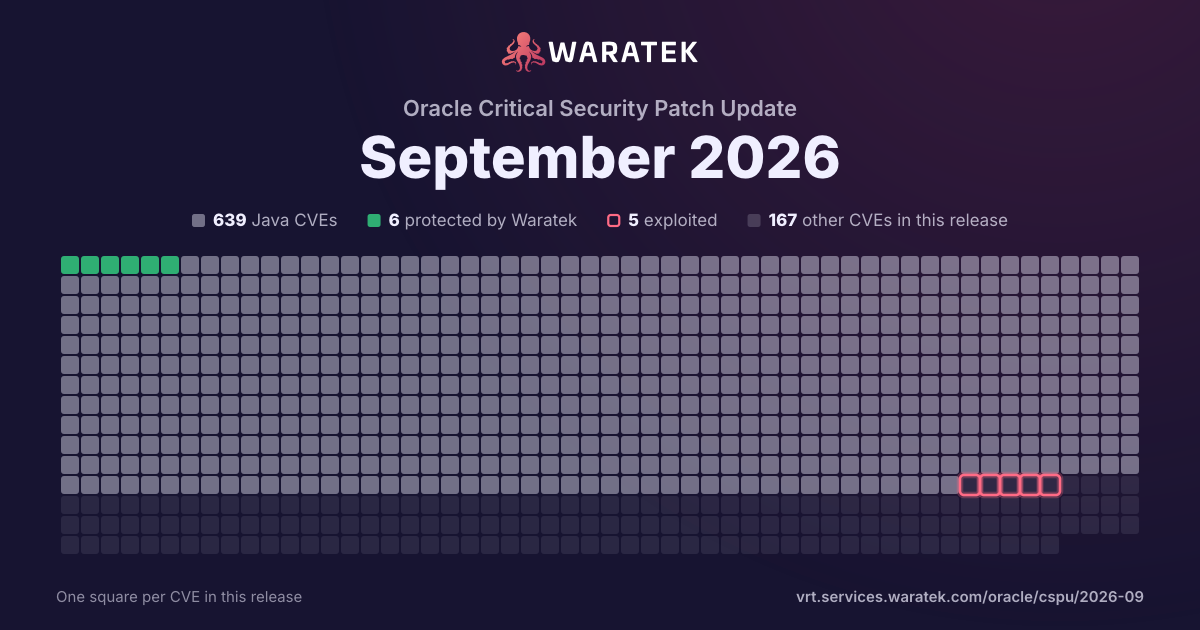
By status
No exploit published. For 596 of them, Oracle's security advisory is the source of public detail.
Protected by Waratek. Waratek RASP can block exploitation of these on systems that have not applied the patch yet.
Overview 10 matches · 2 in Waratek scope · 0 protected · 0 exploited · 0 CISA KEV · 1 public PoC · 0 EPSS ≥ 0.5
10matches
2in Waratek scope20.0%
0protected0.0%
0exploited0.0%
0CISA KEV0.0%
1public PoC10.0%
0EPSS ≥ 0.50.0%
Protected by Waratek
0
0.0%
Rule in development
0
0.0%
Mitigation candidate
0
0.0%
No exploit published
2
20.0%
Outside Waratek scope
0
0.0%
Not applicable
8
80.0%
Withdrawn CVE
0
0.0%
blocked by ARMR today
0
0.0%
partly blocked
0
0.0%
not blocked
10
100.0%
not established
0
0.0%
unrecorded
0
0.0%
Exploited
0
0.0%
Working exploit published
0
0.0%
Proof of concept only
10
100.0%
Forecast only
0
0.0%
No public exploit
0
0.0%
| CVE | Severity | Published▾ | Status | Exploitation | Description |
|---|---|---|---|---|---|
| CVE-2026-69148 | High | 2026-08-17 | Not applicable | Proof of concept only | MLflow is an open source AI engineering platform for agents, large language models, and machine learning models. Prior to 3.15.0, CreateModelVersion accepts a run_id or model_id after _validate_source_run() or _validate_source_model() in mlflow/server/handlers.py verifies only path containment, allowing authenticated users to create a model version that references another user's artifact directory and read files through GET /model-versions/get-artifact without the required READ permission. This issue is fixed in version 3.15.0. |
| CVE-2026-17544 | High | 2026-07-30 | Not applicable | Proof of concept only | Attacker-provided inputs to bccomp() could lead to an out-of-bounds write with stack and heap corruption in PHP versions from 8.4.* before 8.4.24 and from 8.5.* before 8.5.9. |
| CVE-2026-55831 | High | 2026-07-21 | No exploit published | Proof of concept only | Netty is a network application framework for development of protocol servers and clients. Prior to 4.1.136.Final and 4.2.16.Final, Netty's SPDY SETTINGS decoder accepts a peer-declared SETTINGS entry count up to the 24-bit frame-length limit and materializes every unique setting ID in `DefaultSpdySettingsFrame`, allowing a remote SPDY/3.1 peer to send a syntactically valid roughly 2 MiB SETTINGS frame that creates 262144 map entries and amplifies network input into heap growth and ordered-map insertion work. This issue is fixed in versions 4.1.136.Final and 4.2.16.Final. |
| CVE-2026-57220 | High | 2026-07-10 | Not applicable | Proof of concept only | RabbitMQ is a messaging and streaming broker. Prior to 4.2.6, the RabbitMQ stream listener does not enforce the configured stream frame-size limit while assembling frames during authentication and before Tune negotiation, allowing an unauthenticated remote client to declare oversized frame lengths and consume broker memory in rabbit_stream_core. This issue is fixed in version 4.2.6. |
| CVE-2026-57217 | High | 2026-07-10 | Not applicable | Proof of concept only | RabbitMQ is a messaging and streaming broker. Prior to 3.13.15, 4.0.21, 4.1.11, and 4.2.6, RabbitMQ topic authorization can allow restricted topic writes and binds during metadata-store failures because topic-permission lookup errors from Khepri can collapse to undefined, which the internal backend treats as allow. This issue is fixed in versions 3.13.15, 4.0.21, 4.1.11, and 4.2.6. |
| CVE-2026-57214 | High | 2026-07-10 | Not applicable | Proof of concept only | RabbitMQ is a messaging and streaming broker. Prior to 4.2.5, the RabbitMQ management UI renders the x-internal-purpose queue or exchange argument into an HTML title attribute without proper escaping on the Queues and Exchanges pages, allowing a user with permission to declare a queue or exchange to execute JavaScript in another user's browser. This issue is fixed in version 4.2.5. |
| CVE-2026-57212 | High | 2026-07-10 | Not applicable | Proof of concept only | RabbitMQ is a messaging and streaming broker. Prior to 3.13.14, 4.0.19, 4.1.10, and 4.2.5, the rabbitmq_management HTTP API accepts oversized valid JSON bodies on with_decode and direct_request paths because read_complete_body checks the accumulated size before the final chunk but not the final combined size. This issue is fixed in versions 3.13.14, 4.0.19, 4.1.10, and 4.2.5. |
| CVE-2026-9563 | High | 2026-07-02 | Not applicable | Proof of concept only | In Eclipse Parsson published Maven Central artifacts before version 1.1.8, the JSON parser did not enforce a default maximum on the number of characters consumed while parsing a single JSON document. Applications that parse attacker- controlled JSON can be forced to consume excessive CPU and memory by processing very large documents, including large arrays, objects, strings, numbers, whitespace, or nested structures, resulting in a denial of service. Eclipse Parsson 1.1.8 introduces a configurable maximum parsing limit with a default limit of 15 million parser-consumed characters. |
| CVE-2026-8147 | High | 2026-07-02 | Not applicable | Proof of concept only | In MLflow versions prior to 3.14.0, when running with authentication enabled, the trace API endpoints lack proper authorization validators. This allows any authenticated user to bypass experiment-level authorization controls on all trace operations, including reading, deleting, and modifying traces on experiments they do not have permission to access. The issue arises from the `_before_request` handler, which does not register authorization validators for trace endpoints, resulting in requests proceeding without validation. This vulnerability can expose sensitive data, destroy audit logs, and allow unauthorized modifications. |
| CVE-2026-54512 | High | 2026-06-23 | No exploit published | Proof of concept only | jackson-databind contains the general-purpose data-binding functionality and tree-model for Jackson Data Processor. From 2.10.0 until 2.18.8, 2.21.4, and 3.1.4, jackson-databind's PolymorphicTypeValidator (PTV) is the primary safety mechanism guarding polymorphic deserialization. When polymorphic typing is enabled and a type identifier contains generic parameters (i.e. the type ID string contains <), DatabindContext._resolveAndValidateGeneric() validates only the raw container class name (the substring before <) against the configured PTV. If the container type is approved, the method parses the full canonical type string via TypeFactory.constructFromCanonical() and returns the fully parameterized type without ever validating the nested type arguments against the PTV. The nested type arguments are then resolved, instantiated, and populated as beans during deserialization. An attacker who controls the type ID can therefore place a denied class as a generic type parameter of an allowed container — for example java.util.ArrayList<com.evil.Gadget> when only java.util.ArrayList is allow-listed. The container passes the PTV check; com.evil.Gadget is loaded via Class.forName(name, true, loader), instantiated, and its properties are set from attacker-controlled JSON. This completely bypasses an explicitly configured PTV allow-list. This vulnerability is fixed in 2.18.8, 2.21.4, and 3.1.4. |