
Oracle Critical Security Patch Update September 2026
Released September 2026 · Oracle's advisory ↗ · ← Security Patch Update, August 2026 · Critical Patch Update, October 2026 →
806 CVEs in this release, one square each
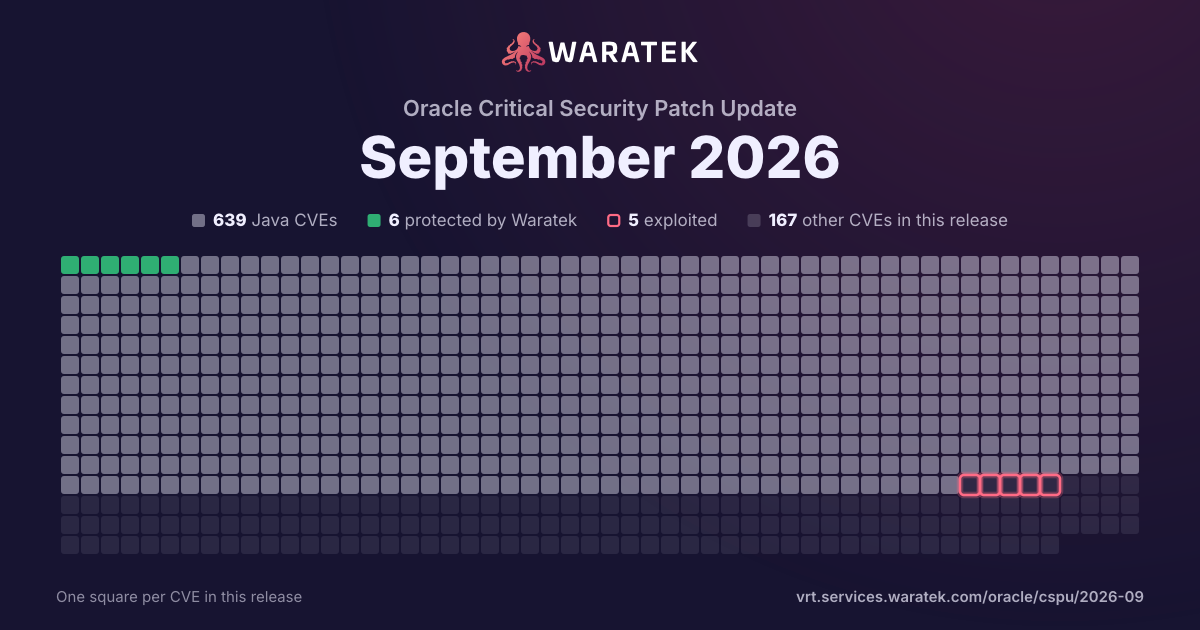
By status
No exploit published. For 596 of them, Oracle's security advisory is the source of public detail.
Protected by Waratek. Waratek RASP can block exploitation of these on systems that have not applied the patch yet.
Overview 37 matches · 6 in Waratek scope · 1 protected · 0 exploited · 0 CISA KEV · 3 public PoC · 0 EPSS ≥ 0.5
37matches
6in Waratek scope16.2%
1protected2.7%
0exploited0.0%
0CISA KEV0.0%
3public PoC8.1%
0EPSS ≥ 0.50.0%
Protected by Waratek
1
2.7%
Rule in development
0
0.0%
Mitigation candidate
0
0.0%
No exploit published
5
13.5%
Outside Waratek scope
0
0.0%
Not applicable
31
83.8%
Withdrawn CVE
0
0.0%
blocked by ARMR today
1
2.7%
partly blocked
0
0.0%
not blocked
36
97.3%
not established
0
0.0%
unrecorded
0
0.0%
Exploited
0
0.0%
Working exploit published
0
0.0%
Proof of concept only
37
100.0%
Forecast only
0
0.0%
No public exploit
0
0.0%
split by
peak 23 / month
Apr 263
No exploit published1
Not applicable2
Critical1
Medium2
not blocked3
Proof of concept only3
May 262
Protected by Waratek1
Not applicable1
Critical1
Medium1
blocked by ARMR today1
not blocked1
Proof of concept only2
Jun 265
No exploit published2
Not applicable3
High1
Medium2
Low2
not blocked5
Proof of concept only5
Jul 2623
No exploit published2
Not applicable21
Critical2
High8
Medium11
Low2
not blocked23
Proof of concept only23
Aug 264
Not applicable4
Critical1
High1
Medium2
not blocked4
Proof of concept only4
Apr 26May 26Jun 26Jul 26Aug 26
| CVE | Severity | Published▾ | Status | Exploitation | Description |
|---|---|---|---|---|---|
| CVE-2026-75838 | Medium | 2026-08-18 | Not applicable | Proof of concept only | DOMPurify before 3.4.13 contains a cross-site scripting vulnerability in IN_PLACE sanitization where element-removal hooks fail to neutralize detached subtrees. Attackers can supply HTML with event handlers on descendant elements that execute after sanitization completes, even though the returned root appears clean. |
| CVE-2026-69148 | High | 2026-08-17 | Not applicable | Proof of concept only | MLflow is an open source AI engineering platform for agents, large language models, and machine learning models. Prior to 3.15.0, CreateModelVersion accepts a run_id or model_id after _validate_source_run() or _validate_source_model() in mlflow/server/handlers.py verifies only path containment, allowing authenticated users to create a model version that references another user's artifact directory and read files through GET /model-versions/get-artifact without the required READ permission. This issue is fixed in version 3.15.0. |
| CVE-2026-69146 | Medium | 2026-08-17 | Not applicable | Proof of concept only | MLflow is an open source AI engineering platform for agents, large language models, and machine learning models. From 3.13.0 until 3.15.0, LogInputs is absent from BEFORE_REQUEST_HANDLERS in the mlflow/server/auth package, allowing any authenticated user to call POST /api/2.0/mlflow/runs/log-inputs for another user's run_id and inject attacker-controlled DatasetInput records into the dataset_inputs lineage metadata without UPDATE permission. This issue is fixed in version 3.15.0. |
| CVE-2026-73193 | Critical | 2026-08-15 | Not applicable | Proof of concept only | DBI versions before 1.652 for Perl allow a heap out-of-bounds write on 32-bit perl via an integer wraparound in the output buffer size computed by preparse. preparse reserves its output buffer with `newSV(strlen(statement) * 7 + 16)`, budgeting seven output bytes per input byte for the longest ':p99999' expansion. The product is computed in STRLEN, which is 32 bits wide on a 32-bit perl build, so a statement of 613,566,757 bytes multiplies to 4,294,967,299, wraps modulo 2^32 to 3, and reserves 19 bytes. The parser then copies the statement out through a raw pointer with no capacity check, writing the whole 585 MB input past the end of the allocation. The 99,999 placeholder limit does not bound this path, which is reached by ordinary non-placeholder content. Any caller that passes an untrusted statement of that length to preparse on a 32-bit perl gets a heap out-of-bounds write of attacker controlled bytes. Builds with a 64-bit STRLEN are not affected, since the wrap there needs a statement of about 2.3 exabytes. |
| CVE-2026-17544 | High | 2026-07-30 | Not applicable | Proof of concept only | Attacker-provided inputs to bccomp() could lead to an out-of-bounds write with stack and heap corruption in PHP versions from 8.4.* before 8.4.24 and from 8.5.* before 8.5.9. |
| CVE-2026-59943 | Medium | 2026-07-28 | Not applicable | Proof of concept only | Dompdf is an HTML to PDF converter for PHP. In versions 3.15 and prior, if a malicious actor can supply unrestricted content for rendering by Dompdf they can utilize the SVG rendering functionality to leak filesystem information when rendering PDF files using image references within a data-URI encoded SVG document. Using an <image> element inside a data-URI embedded SVG, an attacker can attempt to embed other files via the href or xlink:href attributes. When processing a file that does not exist (e.g. file:///DOESNOTEXIST), dompdf behaves differently than it does when accessing a file or directory that actually exists on the filesystem. This issue has been fixed in version 3.16. |
| CVE-2026-59942 | Medium | 2026-07-28 | Not applicable | Proof of concept only | Dompdf is an HTML to PDF converter for PHP. Versions 3.15 and prior are vulnerable to a Denial of Service (DoS) attack via resource exhaustion. An attacker can crash the PHP process by providing a specially crafted HTML document containing a single image with massive dimensions (e.g., 30,000x30,000 pixels). While Dompdf implements internal checks to validate image dimensions, these can be bypassed by using a high-entropy image (such as random noise) encoded in Base64 and wrapped in specific CSS containers. The vulnerability exists because the dimension validation happens early, but the resource allocation for calculating the object's bounding box and internal buffers during the rendering phase does not strictly limit the cumulative CPU time or memory usage for a single object that has passed the initial check. An unauthenticated remote attacker can cause a complete Denial of Service on the web server by submitting a crafted HTML string. This affects any application that allows users to provide HTML content or URLs that are subsequently converted to PDF using Dompdf. This issue has been fixed in version 3.16. |
| CVE-2026-59941 | Medium | 2026-07-28 | Not applicable | Proof of concept only | Dompdf is an HTML to PDF converter for PHP. Versions 3.15 and prior accept a BMP image and generates a PDF-compatible PNG based only on its declared header dimensions and never bounds width × height before the image is converted through GD. A 58-byte BMP whose header declares e.g. 6000×6000 is accepted and later drives imagecreatetruecolor($width, $height) (and PHP's native BMP decoder) to allocate the full pixel canvas. A payload can fit in a single HTTP request: the BMP can be inlined as a data:image/bmp;base64,… URI inside attacker-controlled HTML, so no upload, no remote fetch, and no chroot-reachable file is required. I measured a 169-byte request driving a dompdf render to ~412 MB peak RSS and ~4.8 s of CPU/wall time, versus ~34 MB for an identically-sized benign request — roughly a 12× memory amplification per request, repeatable and unauthenticated. This issue has been fixed in version 3.16. |
| CVE-2026-59921 | Medium | 2026-07-28 | No exploit published | Proof of concept only | Netty is an asynchronous, event-driven network application framework. Prior to versions 4.1.136.Final and 4.2.16.Final, HttpPostRequestEncoder constructs multipart HTTP request bodies by directly concatenating user-supplied filenames and field names into Content-Disposition MIME headers without validating or sanitizing CRLF characters (\r\n). Since MIME headers are delimited by CRLF, an attacker who controls the filename can inject arbitrary MIME headers into the multipart body part. The root cause is that neither the encoder nor the FileUpload implementations' setFilename() methods, which only check for null, neutralize CRLF characters before the filename is embedded into the header. This issue has been fixed in versions 4.1.136.Final and 4.2.16.Final. |
| CVE-2026-56722 | Medium | 2026-07-28 | Not applicable | Proof of concept only | Dompdf is an HTML to PDF converter for PHP. In versions 3.15 and prior, aAn attacker who controls the HTML input can bypass this restriction by embedding a target file path inside an SVG image delivered through a data: URI, because dompdf processes the SVG twice and the second pass does not enforce the same protections as the first. When rendering, dompdf hands the SVG to the separate php-svg-lib library with external references forced on, and that library has no knowledge of the chroot directory, blocks only the phar:// scheme, and ultimately reads the referenced file with no path or protocol validation. This lets an external, unauthenticated attacker read arbitrary image files from the server's file system in the default configuration. This issue has been fixed in version 3.16. |
| CVE-2026-55555 | Low | 2026-07-28 | Not applicable | Proof of concept only | Dompdf is an HTML to PDF converter for PHP. Versions 3.15 and prior are vulnerable to a File Existence Oracle attack through the manipulation of the CSS @font-face directive. By providing malicious HTML that references local files via the file:// protocol repeatedly, an attacker can trigger PHP memory exhaustion. Because Dompdf behaves differently depending on whether a referenced local file exists (an existing file is processed repeatedly until it triggers an "Allowed memory size exhausted" crash, whereas a missing file fails fast or is ignored and never hits the memory limit), an attacker can use this observable discrepancy as an oracle to enumerate sensitive files on the server regardless of CHROOT restrictions. Exploitation requires the attacker to supply unrestricted or unsanitized HTML in a request that permits large data, plus a configuration where Dompdf's memory limit is low enough to be exhausted (with $_dompdf_show_warnings=true making the overflow easier to reach). This issue has been fixed in version 3.16. |
| CVE-2026-55554 | Low | 2026-07-28 | Not applicable | Proof of concept only | Dompdf is an HTML to PDF converter for PHP. In versions 3.15 and prior, the validateLocalUri() method enforces chroot boundaries with a strpos() prefix check after normalizing paths with realpath() . Because normalization strips the trailing directory separator from $chrootPath , the check only verifies that $chrootPath is a string prefix of $realfile, so a chroot of /var/www also matches sibling directories like /var/www2 , /var/www-admin, or /var/www_backup. An attacker who controls part of the rendered HTML could exploit this to escape the chroot and read sensitive files outside the allowed directory. This issue has been fixed in version 3.16. |
| CVE-2026-55831 | High | 2026-07-21 | No exploit published | Proof of concept only | Netty is a network application framework for development of protocol servers and clients. Prior to 4.1.136.Final and 4.2.16.Final, Netty's SPDY SETTINGS decoder accepts a peer-declared SETTINGS entry count up to the 24-bit frame-length limit and materializes every unique setting ID in `DefaultSpdySettingsFrame`, allowing a remote SPDY/3.1 peer to send a syntactically valid roughly 2 MiB SETTINGS frame that creates 262144 map entries and amplifies network input into heap growth and ordered-map insertion work. This issue is fixed in versions 4.1.136.Final and 4.2.16.Final. |
| CVE-2026-63308 | Medium | 2026-07-17 | Not applicable | Proof of concept only | Helm through 4.2.3, fixed in commit ba6c9a2, contains a denial of service vulnerability in the Files.Lines template helper in pkg/engine/files.go that allows attackers to trigger an index out of range panic by including zero-length byte slices in chart files. Attackers can include empty files in Helm charts to cause deterministic render failures across template, install, upgrade, lint, and SDK Engine.Render operations. |
| CVE-2026-57220 | High | 2026-07-10 | Not applicable | Proof of concept only | RabbitMQ is a messaging and streaming broker. Prior to 4.2.6, the RabbitMQ stream listener does not enforce the configured stream frame-size limit while assembling frames during authentication and before Tune negotiation, allowing an unauthenticated remote client to declare oversized frame lengths and consume broker memory in rabbit_stream_core. This issue is fixed in version 4.2.6. |
| CVE-2026-57218 | Medium | 2026-07-10 | Not applicable | Proof of concept only | RabbitMQ is a messaging and streaming broker. Prior to 4.2.6, RabbitMQ AMQP 0-9-1 allows an existing consumer to keep receiving messages after OAuth token expiry or connection.update_secret refresh to reduced scopes because existing consumers are not canceled or reauthorized at delivery time after the channel user state changes. This issue is fixed in version 4.2.6. |
| CVE-2026-57217 | High | 2026-07-10 | Not applicable | Proof of concept only | RabbitMQ is a messaging and streaming broker. Prior to 3.13.15, 4.0.21, 4.1.11, and 4.2.6, RabbitMQ topic authorization can allow restricted topic writes and binds during metadata-store failures because topic-permission lookup errors from Khepri can collapse to undefined, which the internal backend treats as allow. This issue is fixed in versions 3.13.15, 4.0.21, 4.1.11, and 4.2.6. |
| CVE-2026-57216 | Critical | 2026-07-10 | Not applicable | Proof of concept only | RabbitMQ is a messaging and streaming broker. Prior to 3.13.15, 4.0.20, 4.1.11, and 4.2.6, AMQP 0-9-1, AMQP 1.0, and Stream Protocol authentication can allow a loopback-restricted user such as guest to connect remotely when traffic is accepted through a trusted PROXY-protocol path and the backend listener is loopback-bound because the loopback check uses the listener-side socket address instead of the real client source. This issue is fixed in versions 3.13.15, 4.0.20, 4.1.11, and 4.2.6. |
| CVE-2026-57214 | High | 2026-07-10 | Not applicable | Proof of concept only | RabbitMQ is a messaging and streaming broker. Prior to 4.2.5, the RabbitMQ management UI renders the x-internal-purpose queue or exchange argument into an HTML title attribute without proper escaping on the Queues and Exchanges pages, allowing a user with permission to declare a queue or exchange to execute JavaScript in another user's browser. This issue is fixed in version 4.2.5. |
| CVE-2026-57213 | Medium | 2026-07-10 | Not applicable | Proof of concept only | RabbitMQ is a messaging and streaming broker. Prior to 3.13.14, 4.0.19, 4.1.10, and 4.2.5, the rabbitmq_federation_management plugin renders the consumer_tag field on the Federation Status page without HTML escaping, allowing a user who can configure a federation upstream or policy to execute JavaScript in the browser of a user viewing that page. This issue is fixed in versions 3.13.14, 4.0.19, 4.1.10, and 4.2.5. |
| CVE-2026-57212 | High | 2026-07-10 | Not applicable | Proof of concept only | RabbitMQ is a messaging and streaming broker. Prior to 3.13.14, 4.0.19, 4.1.10, and 4.2.5, the rabbitmq_management HTTP API accepts oversized valid JSON bodies on with_decode and direct_request paths because read_complete_body checks the accumulated size before the final chunk but not the final combined size. This issue is fixed in versions 3.13.14, 4.0.19, 4.1.10, and 4.2.5. |
| CVE-2026-57211 | Critical | 2026-07-10 | Not applicable | Proof of concept only | RabbitMQ is a messaging and streaming broker. Prior to 4.1.11 and 4.2.6 on Windows, the RabbitMQ management plugin static file handler rabbit_mgmt_wm_static can pass URL-encoded backslashes to erl_prim_loader:read_file_info before path validation when multiple management extension plugins are enabled, causing outbound DNS and SMB requests to attacker-controlled UNC paths. This issue is fixed in versions 4.1.11 and 4.2.6. |
| CVE-2026-9563 | High | 2026-07-02 | Not applicable | Proof of concept only | In Eclipse Parsson published Maven Central artifacts before version 1.1.8, the JSON parser did not enforce a default maximum on the number of characters consumed while parsing a single JSON document. Applications that parse attacker- controlled JSON can be forced to consume excessive CPU and memory by processing very large documents, including large arrays, objects, strings, numbers, whitespace, or nested structures, resulting in a denial of service. Eclipse Parsson 1.1.8 introduces a configurable maximum parsing limit with a default limit of 15 million parser-consumed characters. |
| CVE-2026-8147 | High | 2026-07-02 | Not applicable | Proof of concept only | In MLflow versions prior to 3.14.0, when running with authentication enabled, the trace API endpoints lack proper authorization validators. This allows any authenticated user to bypass experiment-level authorization controls on all trace operations, including reading, deleting, and modifying traces on experiments they do not have permission to access. The issue arises from the `_before_request` handler, which does not register authorization validators for trace endpoints, resulting in requests proceeding without validation. This vulnerability can expose sensitive data, destroy audit logs, and allow unauthorized modifications. |
| CVE-2026-58521 | Medium | 2026-07-01 | Not applicable | Proof of concept only | Improper neutralization of special elements used in an SQL command ('SQL injection') vulnerability in The Wikimedia Foundation Mediawiki - Cargo Extension allows SQL Injection. This issue affects Mediawiki - Cargo Extension: from * before 1.43.9,1.44.6,1.45.4. |
| CVE-2026-58025 | Medium | 2026-07-01 | Not applicable | Proof of concept only | Deserialization of untrusted data vulnerability in Wikimedia Foundation MediaWiki. This vulnerability is associated with program files includes/Import/WikiImporter.Php, includes/Import/WikiRevision.Php, includes/Logging/LogEntryBase.Php. This issue affects MediaWiki: from * before 1.46.0, 1.45.4, 1.44.6, 1.43.9. |
| CVE-2026-14363 | Medium | 2026-07-01 | Not applicable | Proof of concept only | Improper neutralization of special elements used in an SQL command ('SQL injection') vulnerability in The Wikimedia Foundation Mediawiki - Cargo Extension allows SQL Injection. This issue affects Mediawiki - Cargo Extension: from * before 1.43.9,1.44.6,1.45.4. |
| CVE-2026-13484 | Low | 2026-06-28 | Not applicable | Proof of concept only | A vulnerability has been found in MLflow up to 4666cffc7912ea606d592fc38d6a75e2935f65e7. The impacted element is an unknown function of the component Experiment-scoped Label Schema CRUD API. Such manipulation leads to missing authorization. It is possible to launch the attack remotely. A high complexity level is associated with this attack. The exploitability is regarded as difficult. The exploit has been disclosed to the public and may be used. A reply to the GitHub issue explains, that "[t]he labeling schema PR has not been merged yet. The auth handlers will be added before the release." |
| CVE-2026-54512 | High | 2026-06-23 | No exploit published | Proof of concept only | jackson-databind contains the general-purpose data-binding functionality and tree-model for Jackson Data Processor. From 2.10.0 until 2.18.8, 2.21.4, and 3.1.4, jackson-databind's PolymorphicTypeValidator (PTV) is the primary safety mechanism guarding polymorphic deserialization. When polymorphic typing is enabled and a type identifier contains generic parameters (i.e. the type ID string contains <), DatabindContext._resolveAndValidateGeneric() validates only the raw container class name (the substring before <) against the configured PTV. If the container type is approved, the method parses the full canonical type string via TypeFactory.constructFromCanonical() and returns the fully parameterized type without ever validating the nested type arguments against the PTV. The nested type arguments are then resolved, instantiated, and populated as beans during deserialization. An attacker who controls the type ID can therefore place a denied class as a generic type parameter of an allowed container — for example java.util.ArrayList<com.evil.Gadget> when only java.util.ArrayList is allow-listed. The container passes the PTV check; com.evil.Gadget is loaded via Class.forName(name, true, loader), instantiated, and its properties are set from attacker-controlled JSON. This completely bypasses an explicitly configured PTV allow-list. This vulnerability is fixed in 2.18.8, 2.21.4, and 3.1.4. |
| CVE-2026-50020 | Medium | 2026-06-12 | No exploit published | Proof of concept only | Netty is a network application framework for development of protocol servers and clients. Prior to versions 4.1.135.Final and 4.2.15.Final, before reading the first request-line, `HttpObjectDecoder` skips every byte for which `Character.isISOControl(b)` is `true` (0x00–0x1F and 0x7F) as well as all whitespace. RFC 9112 §2.2 only asks servers to ignore empty CRLF lines preceding the request-line — a carefully scoped robustness allowance intended to handle HTTP/1.0 POST workarounds. Silently absorbing NUL bytes, SOH, STX, and other non-CRLF control characters goes significantly beyond this, and can be exploited for request-boundary confusion in pipelined or multiplexed transports where a front-end component treats those bytes differently. Versions 4.1.135.Final and 4.2.15.Final patch the issue. |
| CVE-2026-10803 | Low | 2026-06-04 | Not applicable | Proof of concept only | A flaw has been found in MLflow up to 3.10.0. This issue affects the function mlflow.data.digest_utils of the file mlflow/data/digest_utils.py of the component Dataset Digest Computation. This manipulation causes use of weak hash. It is possible to launch the attack on the local host. The attack is considered to have high complexity. The exploitability is assessed as difficult. The exploit has been published and may be used. The project was informed of the problem early through a pull request but has not reacted yet. |
| CVE-2026-3198 | Medium | 2026-06-02 | Not applicable | Proof of concept only | MLflow 3.9.0 with basic-auth (`--app-name basic-auth`) fails to enforce authorization checks for multiple Gateway API 'list' endpoints. Specifically, the `BEFORE_REQUEST_HANDLERS` dictionary in `mlflow/server/auth/__init__.py` does not include entries for `ListGatewaySecretInfos`, `ListGatewayEndpoints`, and `ListGatewayModelDefinitions`. This allows any authenticated user, regardless of their assigned permissions, to enumerate all gateway secrets, endpoints, and model definitions. This vulnerability exposes sensitive information, such as API keys, endpoint configurations, and proprietary model definitions, to unauthorized users. |
| CVE-2026-7598 | Medium | 2026-05-01 | Not applicable | Proof of concept only | A security vulnerability has been detected in libssh2 up to 1.11.1. The impacted element is the function userauth_password of the file src/userauth.c. Such manipulation of the argument username_len/password_len leads to integer overflow. The attack may be launched remotely. The name of the patch is 256d04b60d80bf1190e96b0ad1e91b2174d744b1. A patch should be applied to remediate this issue. |
| CVE-2026-42779 | Critical | 2026-05-01 | Protected by Waratek | Proof of concept only | The fix for CVE-2026-41635 was not applied to the 2.1.X and 2.2.X branches. Here was the original issue description: Apache MINA's AbstractIoBuffer.resolveClass() contains two branches, one of them (for static classes or primitive types) does not check the class at all, bypassing the classname allowlist and allowing arbitrary code to be executed. The fix checks if the class is present in the accepted class filter before calling Class.forName(). Affected versions are Apache MINA 2.1.0 <= 2.1.11, and 2.2.0 <= 2.2.6. The problem is resolved in Apache MINA 2.1.12, and 2.2.7 by applying the classname allowlist earlier. Affected are applications using Apache MINA that call IoBuffer.getObject(). Applications using Apache MINA are advised to upgrade. |
| CVE-2026-41240 | Medium | 2026-04-23 | Not applicable | Proof of concept only | DOMPurify is a DOM-only cross-site scripting sanitizer for HTML, MathML, and SVG. Versions prior to 3.4.0 have an inconsistency between FORBID_TAGS and FORBID_ATTR handling when function-based ADD_TAGS is used. Commit c361baa added an early exit for FORBID_ATTR at line 1214. The same fix was not applied to FORBID_TAGS. At line 1118-1123, when EXTRA_ELEMENT_HANDLING.tagCheck returns true, the short-circuit evaluation skips the FORBID_TAGS check entirely. This allows forbidden elements to survive sanitization with their attributes intact. Version 3.4.0 patches the issue. |
| CVE-2026-41238 | Medium | 2026-04-23 | Not applicable | Proof of concept only | DOMPurify is a DOM-only cross-site scripting sanitizer for HTML, MathML, and SVG. Versions 3.0.1 through 3.3.3 are vulnerable to a prototype pollution-based XSS bypass. When an application uses `DOMPurify.sanitize()` with the default configuration (no `CUSTOM_ELEMENT_HANDLING` option), a prior prototype pollution gadget can inject permissive `tagNameCheck` and `attributeNameCheck` regex values into `Object.prototype`, causing DOMPurify to allow arbitrary custom elements with arbitrary attributes — including event handlers — through sanitization. Version 3.4.0 fixes the issue. |
| CVE-2026-2332 | Critical | 2026-04-14 | No exploit published | Proof of concept only | In Eclipse Jetty, the HTTP/1.1 parser is vulnerable to request smuggling when chunk extensions are used, similar to the "funky chunks" techniques outlined here: * https://w4ke.info/2025/06/18/funky-chunks.html * https://w4ke.info/2025/10/29/funky-chunks-2.html Jetty terminates chunk extension parsing at \r\n inside quoted strings instead of treating this as an error. POST / HTTP/1.1 Host: localhost Transfer-Encoding: chunked 1;ext="val X 0 GET /smuggled HTTP/1.1 ... Note how the chunk extension does not close the double quotes, and it is able to inject a smuggled request. |