
Oracle Critical Security Patch Update September 2026
Released September 2026 · Oracle's advisory ↗ · ← Security Patch Update, August 2026 · Critical Patch Update, October 2026 →
806 CVEs in this release, one square each
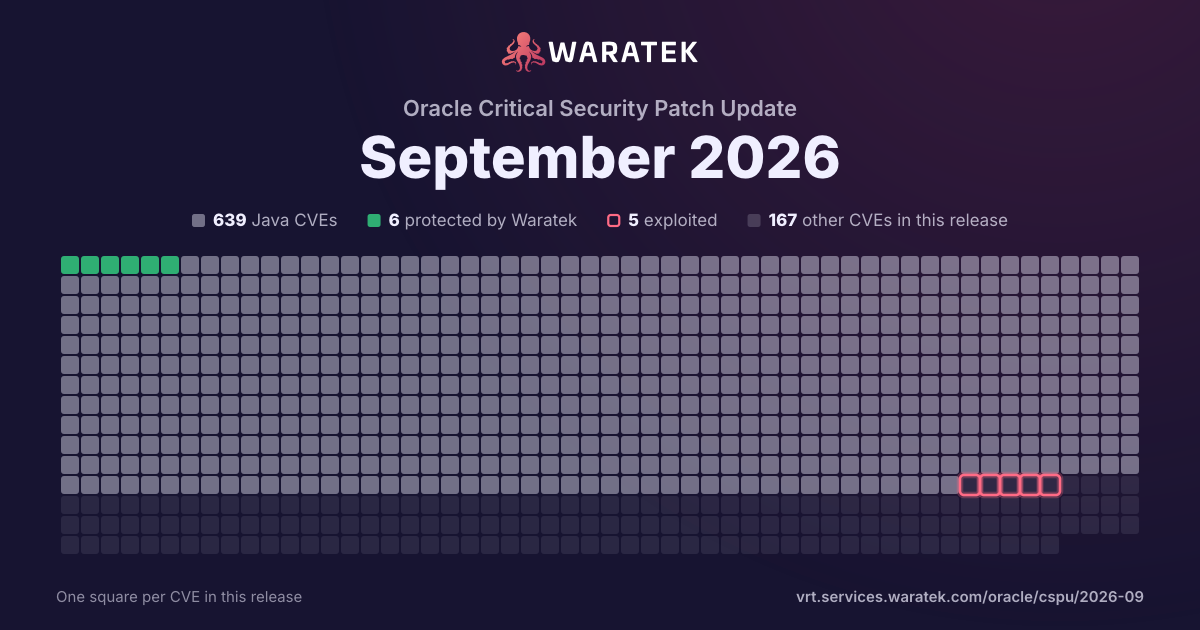
By status
No exploit published. For 596 of them, Oracle's security advisory is the source of public detail.
Protected by Waratek. Waratek RASP can block exploitation of these on systems that have not applied the patch yet.
Overview 10 matches · 4 in Waratek scope · 1 protected · 0 exploited · 0 CISA KEV · 1 public PoC · 0 EPSS ≥ 0.5
10matches
4in Waratek scope40.0%
1protected10.0%
0exploited0.0%
0CISA KEV0.0%
1public PoC10.0%
0EPSS ≥ 0.50.0%
Protected by Waratek
1
10.0%
Rule in development
0
0.0%
Mitigation candidate
0
0.0%
No exploit published
3
30.0%
Outside Waratek scope
0
0.0%
Not applicable
6
60.0%
Withdrawn CVE
0
0.0%
blocked by ARMR today
1
10.0%
partly blocked
0
0.0%
not blocked
9
90.0%
not established
0
0.0%
unrecorded
0
0.0%
Exploited
0
0.0%
Working exploit published
0
0.0%
Proof of concept only
10
100.0%
Forecast only
0
0.0%
No public exploit
0
0.0%
split by
peak 5 / month
Apr 263
No exploit published1
Not applicable2
Critical1
Medium2
not blocked3
Proof of concept only3
May 262
Protected by Waratek1
Not applicable1
Critical1
Medium1
blocked by ARMR today1
not blocked1
Proof of concept only2
Jun 265
No exploit published2
Not applicable3
High1
Medium2
Low2
not blocked5
Proof of concept only5
Apr 26May 26Jun 26
| CVE | Severity | Published▾ | Status | Exploitation | Description |
|---|---|---|---|---|---|
| CVE-2026-13484 | Low | 2026-06-28 | Not applicable | Proof of concept only | A vulnerability has been found in MLflow up to 4666cffc7912ea606d592fc38d6a75e2935f65e7. The impacted element is an unknown function of the component Experiment-scoped Label Schema CRUD API. Such manipulation leads to missing authorization. It is possible to launch the attack remotely. A high complexity level is associated with this attack. The exploitability is regarded as difficult. The exploit has been disclosed to the public and may be used. A reply to the GitHub issue explains, that "[t]he labeling schema PR has not been merged yet. The auth handlers will be added before the release." |
| CVE-2026-54512 | High | 2026-06-23 | No exploit published | Proof of concept only | jackson-databind contains the general-purpose data-binding functionality and tree-model for Jackson Data Processor. From 2.10.0 until 2.18.8, 2.21.4, and 3.1.4, jackson-databind's PolymorphicTypeValidator (PTV) is the primary safety mechanism guarding polymorphic deserialization. When polymorphic typing is enabled and a type identifier contains generic parameters (i.e. the type ID string contains <), DatabindContext._resolveAndValidateGeneric() validates only the raw container class name (the substring before <) against the configured PTV. If the container type is approved, the method parses the full canonical type string via TypeFactory.constructFromCanonical() and returns the fully parameterized type without ever validating the nested type arguments against the PTV. The nested type arguments are then resolved, instantiated, and populated as beans during deserialization. An attacker who controls the type ID can therefore place a denied class as a generic type parameter of an allowed container — for example java.util.ArrayList<com.evil.Gadget> when only java.util.ArrayList is allow-listed. The container passes the PTV check; com.evil.Gadget is loaded via Class.forName(name, true, loader), instantiated, and its properties are set from attacker-controlled JSON. This completely bypasses an explicitly configured PTV allow-list. This vulnerability is fixed in 2.18.8, 2.21.4, and 3.1.4. |
| CVE-2026-50020 | Medium | 2026-06-12 | No exploit published | Proof of concept only | Netty is a network application framework for development of protocol servers and clients. Prior to versions 4.1.135.Final and 4.2.15.Final, before reading the first request-line, `HttpObjectDecoder` skips every byte for which `Character.isISOControl(b)` is `true` (0x00–0x1F and 0x7F) as well as all whitespace. RFC 9112 §2.2 only asks servers to ignore empty CRLF lines preceding the request-line — a carefully scoped robustness allowance intended to handle HTTP/1.0 POST workarounds. Silently absorbing NUL bytes, SOH, STX, and other non-CRLF control characters goes significantly beyond this, and can be exploited for request-boundary confusion in pipelined or multiplexed transports where a front-end component treats those bytes differently. Versions 4.1.135.Final and 4.2.15.Final patch the issue. |
| CVE-2026-10803 | Low | 2026-06-04 | Not applicable | Proof of concept only | A flaw has been found in MLflow up to 3.10.0. This issue affects the function mlflow.data.digest_utils of the file mlflow/data/digest_utils.py of the component Dataset Digest Computation. This manipulation causes use of weak hash. It is possible to launch the attack on the local host. The attack is considered to have high complexity. The exploitability is assessed as difficult. The exploit has been published and may be used. The project was informed of the problem early through a pull request but has not reacted yet. |
| CVE-2026-3198 | Medium | 2026-06-02 | Not applicable | Proof of concept only | MLflow 3.9.0 with basic-auth (`--app-name basic-auth`) fails to enforce authorization checks for multiple Gateway API 'list' endpoints. Specifically, the `BEFORE_REQUEST_HANDLERS` dictionary in `mlflow/server/auth/__init__.py` does not include entries for `ListGatewaySecretInfos`, `ListGatewayEndpoints`, and `ListGatewayModelDefinitions`. This allows any authenticated user, regardless of their assigned permissions, to enumerate all gateway secrets, endpoints, and model definitions. This vulnerability exposes sensitive information, such as API keys, endpoint configurations, and proprietary model definitions, to unauthorized users. |
| CVE-2026-7598 | Medium | 2026-05-01 | Not applicable | Proof of concept only | A security vulnerability has been detected in libssh2 up to 1.11.1. The impacted element is the function userauth_password of the file src/userauth.c. Such manipulation of the argument username_len/password_len leads to integer overflow. The attack may be launched remotely. The name of the patch is 256d04b60d80bf1190e96b0ad1e91b2174d744b1. A patch should be applied to remediate this issue. |
| CVE-2026-42779 | Critical | 2026-05-01 | Protected by Waratek | Proof of concept only | The fix for CVE-2026-41635 was not applied to the 2.1.X and 2.2.X branches. Here was the original issue description: Apache MINA's AbstractIoBuffer.resolveClass() contains two branches, one of them (for static classes or primitive types) does not check the class at all, bypassing the classname allowlist and allowing arbitrary code to be executed. The fix checks if the class is present in the accepted class filter before calling Class.forName(). Affected versions are Apache MINA 2.1.0 <= 2.1.11, and 2.2.0 <= 2.2.6. The problem is resolved in Apache MINA 2.1.12, and 2.2.7 by applying the classname allowlist earlier. Affected are applications using Apache MINA that call IoBuffer.getObject(). Applications using Apache MINA are advised to upgrade. |
| CVE-2026-41240 | Medium | 2026-04-23 | Not applicable | Proof of concept only | DOMPurify is a DOM-only cross-site scripting sanitizer for HTML, MathML, and SVG. Versions prior to 3.4.0 have an inconsistency between FORBID_TAGS and FORBID_ATTR handling when function-based ADD_TAGS is used. Commit c361baa added an early exit for FORBID_ATTR at line 1214. The same fix was not applied to FORBID_TAGS. At line 1118-1123, when EXTRA_ELEMENT_HANDLING.tagCheck returns true, the short-circuit evaluation skips the FORBID_TAGS check entirely. This allows forbidden elements to survive sanitization with their attributes intact. Version 3.4.0 patches the issue. |
| CVE-2026-41238 | Medium | 2026-04-23 | Not applicable | Proof of concept only | DOMPurify is a DOM-only cross-site scripting sanitizer for HTML, MathML, and SVG. Versions 3.0.1 through 3.3.3 are vulnerable to a prototype pollution-based XSS bypass. When an application uses `DOMPurify.sanitize()` with the default configuration (no `CUSTOM_ELEMENT_HANDLING` option), a prior prototype pollution gadget can inject permissive `tagNameCheck` and `attributeNameCheck` regex values into `Object.prototype`, causing DOMPurify to allow arbitrary custom elements with arbitrary attributes — including event handlers — through sanitization. Version 3.4.0 fixes the issue. |
| CVE-2026-2332 | Critical | 2026-04-14 | No exploit published | Proof of concept only | In Eclipse Jetty, the HTTP/1.1 parser is vulnerable to request smuggling when chunk extensions are used, similar to the "funky chunks" techniques outlined here: * https://w4ke.info/2025/06/18/funky-chunks.html * https://w4ke.info/2025/10/29/funky-chunks-2.html Jetty terminates chunk extension parsing at \r\n inside quoted strings instead of treating this as an error. POST / HTTP/1.1 Host: localhost Transfer-Encoding: chunked 1;ext="val X 0 GET /smuggled HTTP/1.1 ... Note how the chunk extension does not close the double quotes, and it is able to inject a smuggled request. |