
Oracle Critical Security Patch Update September 2026
Released September 2026 · Oracle's advisory ↗ · ← Security Patch Update, August 2026 · Critical Patch Update, October 2026 →
806 CVEs in this release, one square each
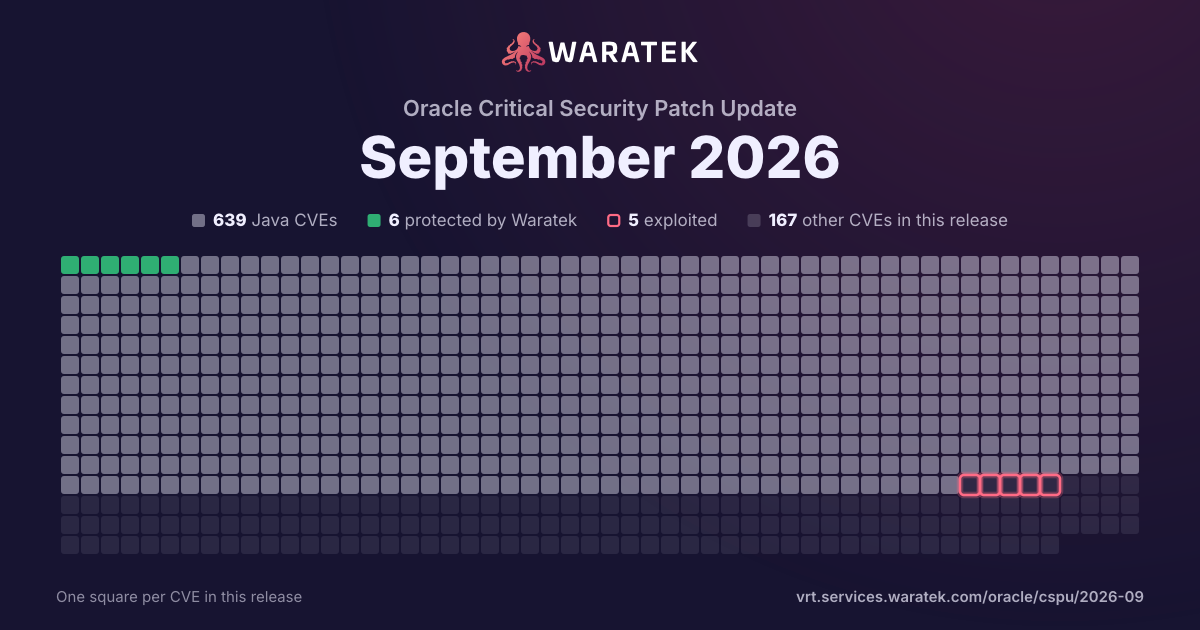
By status
No exploit published. For 596 of them, Oracle's security advisory is the source of public detail.
Protected by Waratek. Waratek RASP can block exploitation of these on systems that have not applied the patch yet.
Overview 150 matches · 2 protected · 0 exploited · 0 CISA KEV · 1 public PoC · 0 EPSS ≥ 0.5
Protected by Waratek
2
1.3%
Rule in development
0
0.0%
Mitigation candidate
0
0.0%
No exploit published
148
98.7%
blocked by ARMR today
2
1.3%
partly blocked
0
0.0%
not blocked
148
98.7%
not established
0
0.0%
unrecorded
0
0.0%
Exploited
0
0.0%
Working exploit published
0
0.0%
Proof of concept only
2
1.3%
Forecast only
0
0.0%
No public exploit
148
98.7%
split by
peak 141 / month
May 261
Protected by Waratek1
Critical1
blocked by ARMR today1
Proof of concept only1
Jun 267
Protected by Waratek1
No exploit published6
Critical1
High2
Medium4
blocked by ARMR today1
not blocked6
Proof of concept only1
No public exploit6
Jul 261
No exploit published1
Medium1
not blocked1
No public exploit1
Aug 260
Sep 26141
No exploit published141
Critical55
High72
Medium11
Low3
not blocked141
No public exploit141
May 26Jun 26Jul 26Aug 26Sep 26
| CVE | Severity | Published▾ | Status | Exploitation | Description |
|---|---|---|---|---|---|
| CVE-2026-83004 | High | 2026-09-15 | No exploit published | No public exploit | Vulnerability in the Oracle WebCenter Enterprise Capture product of Oracle Fusion Middleware (component: Client Bundle). Supported versions that are affected are 12.2.1.4.0 and 14.1.2.0.0. Difficult to exploit vulnerability allows low privileged attacker with logon to the infrastructure where Oracle WebCenter Enterprise Capture executes to compromise Oracle WebCenter Enterprise Capture. Successful attacks require human interaction from a person other than the attacker and while the vulnerability is in Oracle WebCenter Enterprise Capture, attacks may significantly impact additional products (scope change). Successful attacks of this vulnerability can result in unauthorized creation, deletion or modification access to critical data or all Oracle WebCenter Enterprise Capture accessible data as well as unauthorized access to critical data or complete access to all Oracle WebCenter Enterprise Capture accessible data. CVSS 3.1 Base Score 7.2 (Confidentiality and Integrity impacts). CVSS Vector: (CVSS:3.1/AV:L/AC:H/PR:L/UI:R/S:C/C:H/I:H/A:N). |
| CVE-2026-83003 | High | 2026-09-15 | No exploit published | No public exploit | Vulnerability in the Oracle WebCenter Enterprise Capture product of Oracle Fusion Middleware (component: Client Bundle). Supported versions that are affected are 12.2.1.4.0 and 14.1.2.0.0. Easily exploitable vulnerability allows low privileged attacker with network access via SOAP to compromise Oracle WebCenter Enterprise Capture. While the vulnerability is in Oracle WebCenter Enterprise Capture, attacks may significantly impact additional products (scope change). Successful attacks of this vulnerability can result in unauthorized access to critical data or complete access to all Oracle WebCenter Enterprise Capture accessible data as well as unauthorized update, insert or delete access to some of Oracle WebCenter Enterprise Capture accessible data. CVSS 3.1 Base Score 8.5 (Confidentiality and Integrity impacts). CVSS Vector: (CVSS:3.1/AV:N/AC:L/PR:L/UI:N/S:C/C:H/I:L/A:N). |
| CVE-2026-83002 | High | 2026-09-15 | No exploit published | No public exploit | Vulnerability in the Oracle Access Manager product of Oracle Fusion Middleware (component: Authentication Engine). Supported versions that are affected are 12.2.1.4.0 and 14.1.2.1.0. Difficult to exploit vulnerability allows low privileged attacker with network access via HTTP to compromise Oracle Access Manager. While the vulnerability is in Oracle Access Manager, attacks may significantly impact additional products (scope change). Successful attacks of this vulnerability can result in takeover of Oracle Access Manager. CVSS 3.1 Base Score 8.5 (Confidentiality, Integrity and Availability impacts). CVSS Vector: (CVSS:3.1/AV:N/AC:H/PR:L/UI:N/S:C/C:H/I:H/A:H). |
| CVE-2026-83001 | Critical | 2026-09-15 | No exploit published | No public exploit | Vulnerability in the Oracle Access Manager product of Oracle Fusion Middleware (component: Authentication Engine). Supported versions that are affected are 12.2.1.4.0 and 14.1.2.1.0. Easily exploitable vulnerability allows high privileged attacker with network access via HTTP to compromise Oracle Access Manager. While the vulnerability is in Oracle Access Manager, attacks may significantly impact additional products (scope change). Successful attacks of this vulnerability can result in takeover of Oracle Access Manager. CVSS 3.1 Base Score 9.1 (Confidentiality, Integrity and Availability impacts). CVSS Vector: (CVSS:3.1/AV:N/AC:L/PR:H/UI:N/S:C/C:H/I:H/A:H). |
| CVE-2026-83000 | Critical | 2026-09-15 | No exploit published | No public exploit | Vulnerability in the Service Delivery Platform product of Oracle Fusion Middleware (component: Messaging Enabler). Supported versions that are affected are 12.2.1.4.0 and 14.1.2.0.0. Easily exploitable vulnerability allows unauthenticated attacker with network access via HTTP to compromise Service Delivery Platform. Successful attacks of this vulnerability can result in takeover of Service Delivery Platform. CVSS 3.1 Base Score 9.8 (Confidentiality, Integrity and Availability impacts). CVSS Vector: (CVSS:3.1/AV:N/AC:L/PR:N/UI:N/S:U/C:H/I:H/A:H). |
| CVE-2026-82999 | Critical | 2026-09-15 | No exploit published | No public exploit | Vulnerability in the Service Delivery Platform product of Oracle Fusion Middleware (component: Messaging Enabler). Supported versions that are affected are 12.2.1.4.0 and 14.1.2.0.0. Easily exploitable vulnerability allows low privileged attacker with network access via HTTP to compromise Service Delivery Platform. While the vulnerability is in Service Delivery Platform, attacks may significantly impact additional products (scope change). Successful attacks of this vulnerability can result in takeover of Service Delivery Platform. CVSS 3.1 Base Score 9.9 (Confidentiality, Integrity and Availability impacts). CVSS Vector: (CVSS:3.1/AV:N/AC:L/PR:L/UI:N/S:C/C:H/I:H/A:H). |
| CVE-2026-82998 | Critical | 2026-09-15 | No exploit published | No public exploit | Vulnerability in the Service Delivery Platform product of Oracle Fusion Middleware (component: Messaging Enabler). Supported versions that are affected are 12.2.1.4.0 and 14.1.2.0.0. Easily exploitable vulnerability allows low privileged attacker with network access via T3, IIOP to compromise Service Delivery Platform. While the vulnerability is in Service Delivery Platform, attacks may significantly impact additional products (scope change). Successful attacks of this vulnerability can result in takeover of Service Delivery Platform. CVSS 3.1 Base Score 9.9 (Confidentiality, Integrity and Availability impacts). CVSS Vector: (CVSS:3.1/AV:N/AC:L/PR:L/UI:N/S:C/C:H/I:H/A:H). |
| CVE-2026-82997 | Critical | 2026-09-15 | No exploit published | No public exploit | Vulnerability in the Service Delivery Platform product of Oracle Fusion Middleware (component: Messaging Enabler). Supported versions that are affected are 12.2.1.4.0 and 14.1.2.0.0. Easily exploitable vulnerability allows low privileged attacker with network access via T3, IIOP to compromise Service Delivery Platform. While the vulnerability is in Service Delivery Platform, attacks may significantly impact additional products (scope change). Successful attacks of this vulnerability can result in takeover of Service Delivery Platform. CVSS 3.1 Base Score 9.9 (Confidentiality, Integrity and Availability impacts). CVSS Vector: (CVSS:3.1/AV:N/AC:L/PR:L/UI:N/S:C/C:H/I:H/A:H). |
| CVE-2026-82996 | High | 2026-09-15 | No exploit published | No public exploit | Vulnerability in the Oracle Platform Security for Java product of Oracle Fusion Middleware (component: Centralized Thirdparty Jars). Supported versions that are affected are 12.2.1.4.0 and 14.1.2.0.0. Easily exploitable vulnerability allows low privileged attacker with logon to the infrastructure where Oracle Platform Security for Java executes to compromise Oracle Platform Security for Java. Successful attacks of this vulnerability can result in takeover of Oracle Platform Security for Java. CVSS 3.1 Base Score 7.8 (Confidentiality, Integrity and Availability impacts). CVSS Vector: (CVSS:3.1/AV:L/AC:L/PR:L/UI:N/S:U/C:H/I:H/A:H). |
| CVE-2026-82995 | Critical | 2026-09-15 | No exploit published | No public exploit | Vulnerability in the Oracle Platform Security for Java product of Oracle Fusion Middleware (component: Centralized Thirdparty Jars). Supported versions that are affected are 12.2.1.4.0 and 14.1.2.0.0. Easily exploitable vulnerability allows unauthenticated attacker with network access via SOAP to compromise Oracle Platform Security for Java. Successful attacks of this vulnerability can result in takeover of Oracle Platform Security for Java. CVSS 3.1 Base Score 9.8 (Confidentiality, Integrity and Availability impacts). CVSS Vector: (CVSS:3.1/AV:N/AC:L/PR:N/UI:N/S:U/C:H/I:H/A:H). |
| CVE-2026-82994 | Critical | 2026-09-15 | No exploit published | No public exploit | Vulnerability in the Oracle Platform Security for Java product of Oracle Fusion Middleware (component: Centralized Thirdparty Jars). Supported versions that are affected are 12.2.1.4.0 and 14.1.2.0.0. Easily exploitable vulnerability allows unauthenticated attacker with network access via LDAP to compromise Oracle Platform Security for Java. Successful attacks of this vulnerability can result in takeover of Oracle Platform Security for Java. CVSS 3.1 Base Score 9.8 (Confidentiality, Integrity and Availability impacts). CVSS Vector: (CVSS:3.1/AV:N/AC:L/PR:N/UI:N/S:U/C:H/I:H/A:H). |
| CVE-2026-73963 | Critical | 2026-09-15 | No exploit published | No public exploit | Vulnerability in the Oracle WebCenter Portal product of Oracle Fusion Middleware (component: Portlet Services). Supported versions that are affected are 12.2.1.4.0 and 14.1.2.0.0. Easily exploitable vulnerability allows unauthenticated attacker with network access via HTTP to compromise Oracle WebCenter Portal. Successful attacks of this vulnerability can result in takeover of Oracle WebCenter Portal. CVSS 3.1 Base Score 9.8 (Confidentiality, Integrity and Availability impacts). CVSS Vector: (CVSS:3.1/AV:N/AC:L/PR:N/UI:N/S:U/C:H/I:H/A:H). |
| CVE-2026-73962 | Critical | 2026-09-15 | No exploit published | No public exploit | Vulnerability in the Oracle Access Manager product of Oracle Fusion Middleware (component: Authentication Engine). Supported versions that are affected are 12.2.1.4.0 and 14.1.2.1.0. Easily exploitable vulnerability allows low privileged attacker with network access via HTTPS to compromise Oracle Access Manager. While the vulnerability is in Oracle Access Manager, attacks may significantly impact additional products (scope change). Successful attacks of this vulnerability can result in unauthorized creation, deletion or modification access to critical data or all Oracle Access Manager accessible data as well as unauthorized access to critical data or complete access to all Oracle Access Manager accessible data. CVSS 3.1 Base Score 9.6 (Confidentiality and Integrity impacts). CVSS Vector: (CVSS:3.1/AV:N/AC:L/PR:L/UI:N/S:C/C:H/I:H/A:N). |
| CVE-2026-73961 | Critical | 2026-09-15 | No exploit published | No public exploit | Vulnerability in the Oracle JDeveloper product of Oracle Fusion Middleware (component: ADF Faces). Supported versions that are affected are 12.2.1.4.0 and 14.1.2.0.0. Easily exploitable vulnerability allows unauthenticated attacker with network access via HTTP to compromise Oracle JDeveloper. Successful attacks of this vulnerability can result in takeover of Oracle JDeveloper. CVSS 3.1 Base Score 9.8 (Confidentiality, Integrity and Availability impacts). CVSS Vector: (CVSS:3.1/AV:N/AC:L/PR:N/UI:N/S:U/C:H/I:H/A:H). |
| CVE-2026-73959 | High | 2026-09-15 | No exploit published | No public exploit | Vulnerability in the Oracle WebCenter Portal product of Oracle Fusion Middleware (component: Composer). Supported versions that are affected are 12.2.1.4.0 and 14.1.2.0.0. Easily exploitable vulnerability allows low privileged attacker with network access via HTTP to compromise Oracle WebCenter Portal. Successful attacks of this vulnerability can result in takeover of Oracle WebCenter Portal. CVSS 3.1 Base Score 8.8 (Confidentiality, Integrity and Availability impacts). CVSS Vector: (CVSS:3.1/AV:N/AC:L/PR:L/UI:N/S:U/C:H/I:H/A:H). |
| CVE-2026-73958 | High | 2026-09-15 | No exploit published | No public exploit | Vulnerability in the Oracle Access Manager product of Oracle Fusion Middleware (component: Authentication Engine). Supported versions that are affected are 12.2.1.4.0 and 14.1.2.0.0. Difficult to exploit vulnerability allows unauthenticated attacker with network access via HTTP to compromise Oracle Access Manager. Successful attacks of this vulnerability can result in takeover of Oracle Access Manager. CVSS 3.1 Base Score 8.1 (Confidentiality, Integrity and Availability impacts). CVSS Vector: (CVSS:3.1/AV:N/AC:H/PR:N/UI:N/S:U/C:H/I:H/A:H). |
| CVE-2026-73957 | Critical | 2026-09-15 | No exploit published | No public exploit | Vulnerability in the Oracle WebCenter Portal product of Oracle Fusion Middleware (component: Portlet Services). Supported versions that are affected are 12.2.1.4.0 and 14.1.2.0.0. Easily exploitable vulnerability allows unauthenticated attacker with network access via HTTP to compromise Oracle WebCenter Portal. Successful attacks require human interaction from a person other than the attacker and while the vulnerability is in Oracle WebCenter Portal, attacks may significantly impact additional products (scope change). Successful attacks of this vulnerability can result in unauthorized creation, deletion or modification access to critical data or all Oracle WebCenter Portal accessible data as well as unauthorized access to critical data or complete access to all Oracle WebCenter Portal accessible data. CVSS 3.1 Base Score 9.3 (Confidentiality and Integrity impacts). CVSS Vector: (CVSS:3.1/AV:N/AC:L/PR:N/UI:R/S:C/C:H/I:H/A:N). |
| CVE-2026-73956 | Critical | 2026-09-15 | No exploit published | No public exploit | Vulnerability in the Oracle WebCenter Portal product of Oracle Fusion Middleware (component: Composer). Supported versions that are affected are 12.2.1.4.0 and 14.1.2.0.0. Easily exploitable vulnerability allows unauthenticated attacker with network access via HTTP to compromise Oracle WebCenter Portal. Successful attacks of this vulnerability can result in takeover of Oracle WebCenter Portal. CVSS 3.1 Base Score 9.8 (Confidentiality, Integrity and Availability impacts). CVSS Vector: (CVSS:3.1/AV:N/AC:L/PR:N/UI:N/S:U/C:H/I:H/A:H). |
| CVE-2026-73953 | Critical | 2026-09-15 | No exploit published | No public exploit | Vulnerability in the Oracle WebCenter Portal product of Oracle Fusion Middleware (component: Portlet Services). Supported versions that are affected are 12.2.1.4.0 and 14.1.2.0.0. Easily exploitable vulnerability allows unauthenticated attacker with network access via HTTP to compromise Oracle WebCenter Portal. Successful attacks of this vulnerability can result in takeover of Oracle WebCenter Portal. CVSS 3.1 Base Score 9.8 (Confidentiality, Integrity and Availability impacts). CVSS Vector: (CVSS:3.1/AV:N/AC:L/PR:N/UI:N/S:U/C:H/I:H/A:H). |
| CVE-2026-73952 | Critical | 2026-09-15 | No exploit published | No public exploit | Vulnerability in the Oracle WebCenter Portal product of Oracle Fusion Middleware (component: Portlet Services). Supported versions that are affected are 12.2.1.4.0 and 14.1.2.0.0. Easily exploitable vulnerability allows unauthenticated attacker with network access via HTTP to compromise Oracle WebCenter Portal. Successful attacks of this vulnerability can result in unauthorized creation, deletion or modification access to critical data or all Oracle WebCenter Portal accessible data as well as unauthorized access to critical data or complete access to all Oracle WebCenter Portal accessible data. CVSS 3.1 Base Score 9.1 (Confidentiality and Integrity impacts). CVSS Vector: (CVSS:3.1/AV:N/AC:L/PR:N/UI:N/S:U/C:H/I:H/A:N). |
| CVE-2026-73951 | High | 2026-09-15 | No exploit published | No public exploit | Vulnerability in the Oracle WebCenter Portal product of Oracle Fusion Middleware (component: Portlet Services). Supported versions that are affected are 12.2.1.4.0 and 14.1.2.0.0. Difficult to exploit vulnerability allows unauthenticated attacker with network access via HTTP to compromise Oracle WebCenter Portal. Successful attacks of this vulnerability can result in takeover of Oracle WebCenter Portal. CVSS 3.1 Base Score 8.1 (Confidentiality, Integrity and Availability impacts). CVSS Vector: (CVSS:3.1/AV:N/AC:H/PR:N/UI:N/S:U/C:H/I:H/A:H). |
| CVE-2026-73950 | Critical | 2026-09-15 | No exploit published | No public exploit | Vulnerability in the Oracle Access Manager product of Oracle Fusion Middleware (component: Authentication Engine). Supported versions that are affected are 12.2.1.4.0 and 14.1.2.1.0. Easily exploitable vulnerability allows unauthenticated attacker with network access via HTTP to compromise Oracle Access Manager. Successful attacks of this vulnerability can result in takeover of Oracle Access Manager. CVSS 3.1 Base Score 9.8 (Confidentiality, Integrity and Availability impacts). CVSS Vector: (CVSS:3.1/AV:N/AC:L/PR:N/UI:N/S:U/C:H/I:H/A:H). |
| CVE-2026-73949 | High | 2026-09-15 | No exploit published | No public exploit | Vulnerability in the Oracle WebCenter Portal product of Oracle Fusion Middleware (component: Portlet Services). Supported versions that are affected are 12.2.1.4.0 and 14.1.2.0.0. Easily exploitable vulnerability allows low privileged attacker with network access via HTTP to compromise Oracle WebCenter Portal. Successful attacks of this vulnerability can result in takeover of Oracle WebCenter Portal. CVSS 3.1 Base Score 8.8 (Confidentiality, Integrity and Availability impacts). CVSS Vector: (CVSS:3.1/AV:N/AC:L/PR:L/UI:N/S:U/C:H/I:H/A:H). |
| CVE-2026-73948 | Critical | 2026-09-15 | No exploit published | No public exploit | Vulnerability in the Oracle WebCenter Portal product of Oracle Fusion Middleware (component: Composer). Supported versions that are affected are 12.2.1.4.0 and 14.1.2.0.0. Easily exploitable vulnerability allows low privileged attacker with network access via HTTP to compromise Oracle WebCenter Portal. While the vulnerability is in Oracle WebCenter Portal, attacks may significantly impact additional products (scope change). Successful attacks of this vulnerability can result in takeover of Oracle WebCenter Portal. CVSS 3.1 Base Score 9.9 (Confidentiality, Integrity and Availability impacts). CVSS Vector: (CVSS:3.1/AV:N/AC:L/PR:L/UI:N/S:C/C:H/I:H/A:H). |
| CVE-2026-73947 | Critical | 2026-09-15 | No exploit published | No public exploit | Vulnerability in the Oracle Access Manager product of Oracle Fusion Middleware (component: Authentication Engine). Supported versions that are affected are 12.2.1.4.0 and 14.1.2.0.0. Easily exploitable vulnerability allows unauthenticated attacker with network access via HTTP to compromise Oracle Access Manager. Successful attacks of this vulnerability can result in takeover of Oracle Access Manager. CVSS 3.1 Base Score 9.8 (Confidentiality, Integrity and Availability impacts). CVSS Vector: (CVSS:3.1/AV:N/AC:L/PR:N/UI:N/S:U/C:H/I:H/A:H). |
| CVE-2026-73946 | Critical | 2026-09-15 | No exploit published | No public exploit | Vulnerability in the Oracle Access Manager product of Oracle Fusion Middleware (component: Authentication Engine). Supported versions that are affected are 12.2.1.4.0 and 14.1.2.1.0. Easily exploitable vulnerability allows high privileged attacker with network access via HTTP to compromise Oracle Access Manager. While the vulnerability is in Oracle Access Manager, attacks may significantly impact additional products (scope change). Successful attacks of this vulnerability can result in takeover of Oracle Access Manager. CVSS 3.1 Base Score 9.1 (Confidentiality, Integrity and Availability impacts). CVSS Vector: (CVSS:3.1/AV:N/AC:L/PR:H/UI:N/S:C/C:H/I:H/A:H). |
| CVE-2026-73945 | Critical | 2026-09-15 | No exploit published | No public exploit | Vulnerability in the Oracle Access Manager product of Oracle Fusion Middleware (component: Authentication Engine). Supported versions that are affected are 12.2.1.4.0 and 14.1.2.1.0. Easily exploitable vulnerability allows low privileged attacker with network access via HTTP to compromise Oracle Access Manager. While the vulnerability is in Oracle Access Manager, attacks may significantly impact additional products (scope change). Successful attacks of this vulnerability can result in takeover of Oracle Access Manager. CVSS 3.1 Base Score 9.9 (Confidentiality, Integrity and Availability impacts). CVSS Vector: (CVSS:3.1/AV:N/AC:L/PR:L/UI:N/S:C/C:H/I:H/A:H). |
| CVE-2026-73944 | Critical | 2026-09-15 | No exploit published | No public exploit | Vulnerability in the Oracle Access Manager product of Oracle Fusion Middleware (component: Authentication Engine). Supported versions that are affected are 12.2.1.4.0 and 14.1.2.1.0. Easily exploitable vulnerability allows unauthenticated attacker with network access via HTTP to compromise Oracle Access Manager. Successful attacks of this vulnerability can result in unauthorized creation, deletion or modification access to critical data or all Oracle Access Manager accessible data as well as unauthorized access to critical data or complete access to all Oracle Access Manager accessible data. CVSS 3.1 Base Score 9.1 (Confidentiality and Integrity impacts). CVSS Vector: (CVSS:3.1/AV:N/AC:L/PR:N/UI:N/S:U/C:H/I:H/A:N). |
| CVE-2026-73943 | High | 2026-09-15 | No exploit published | No public exploit | Vulnerability in the Oracle Identity Manager product of Oracle Fusion Middleware (component: OIM Legacy UI). Supported versions that are affected are 12.2.1.4.0 and 14.1.2.1.0. Easily exploitable vulnerability allows high privileged attacker with network access via HTTP to compromise Oracle Identity Manager. While the vulnerability is in Oracle Identity Manager, attacks may significantly impact additional products (scope change). Successful attacks of this vulnerability can result in unauthorized access to critical data or complete access to all Oracle Identity Manager accessible data as well as unauthorized update, insert or delete access to some of Oracle Identity Manager accessible data. CVSS 3.1 Base Score 7.6 (Confidentiality and Integrity impacts). CVSS Vector: (CVSS:3.1/AV:N/AC:L/PR:H/UI:N/S:C/C:H/I:L/A:N). |
| CVE-2026-73942 | High | 2026-09-15 | No exploit published | No public exploit | Vulnerability in the Oracle Identity Manager product of Oracle Fusion Middleware (component: OIM Legacy UI). Supported versions that are affected are 12.2.1.4.0 and 14.1.2.1.0. Easily exploitable vulnerability allows low privileged attacker with network access via HTTP to compromise Oracle Identity Manager. Successful attacks of this vulnerability can result in takeover of Oracle Identity Manager. CVSS 3.1 Base Score 8.8 (Confidentiality, Integrity and Availability impacts). CVSS Vector: (CVSS:3.1/AV:N/AC:L/PR:L/UI:N/S:U/C:H/I:H/A:H). |
| CVE-2026-73941 | High | 2026-09-15 | No exploit published | No public exploit | Vulnerability in the Oracle Access Manager product of Oracle Fusion Middleware (component: Authentication Engine). Supported versions that are affected are 12.2.1.4.0 and 14.1.2.1.0. Easily exploitable vulnerability allows unauthenticated attacker with network access via HTTP to compromise Oracle Access Manager. While the vulnerability is in Oracle Access Manager, attacks may significantly impact additional products (scope change). Successful attacks of this vulnerability can result in unauthorized access to critical data or complete access to all Oracle Access Manager accessible data. CVSS 3.1 Base Score 8.6 (Confidentiality impacts). CVSS Vector: (CVSS:3.1/AV:N/AC:L/PR:N/UI:N/S:C/C:H/I:N/A:N). |
| CVE-2026-73940 | Critical | 2026-09-15 | No exploit published | No public exploit | Vulnerability in the Oracle Access Manager product of Oracle Fusion Middleware (component: Authentication Engine). Supported versions that are affected are 12.2.1.4.0 and 14.1.2.1.0. Easily exploitable vulnerability allows unauthenticated attacker with network access via T3, IIOP to compromise Oracle Access Manager. Successful attacks of this vulnerability can result in takeover of Oracle Access Manager. CVSS 3.1 Base Score 9.8 (Confidentiality, Integrity and Availability impacts). CVSS Vector: (CVSS:3.1/AV:N/AC:L/PR:N/UI:N/S:U/C:H/I:H/A:H). |
| CVE-2026-73926 | High | 2026-09-15 | No exploit published | No public exploit | Vulnerability in the Oracle Access Manager product of Oracle Fusion Middleware (component: Authentication Engine). Supported versions that are affected are 12.2.1.4.0 and 14.1.2.1.0. Easily exploitable vulnerability allows high privileged attacker with network access via HTTP to compromise Oracle Access Manager. While the vulnerability is in Oracle Access Manager, attacks may significantly impact additional products (scope change). Successful attacks of this vulnerability can result in unauthorized creation, deletion or modification access to critical data or all Oracle Access Manager accessible data as well as unauthorized access to critical data or complete access to all Oracle Access Manager accessible data. CVSS 3.1 Base Score 8.7 (Confidentiality and Integrity impacts). CVSS Vector: (CVSS:3.1/AV:N/AC:L/PR:H/UI:N/S:C/C:H/I:H/A:N). |
| CVE-2026-71163 | Critical | 2026-09-15 | No exploit published | No public exploit | Vulnerability in the Oracle Access Manager product of Oracle Fusion Middleware (component: Authentication Engine). Supported versions that are affected are 12.2.1.4.0 and 14.1.2.1.0. Easily exploitable vulnerability allows low privileged attacker with network access via HTTP to compromise Oracle Access Manager. While the vulnerability is in Oracle Access Manager, attacks may significantly impact additional products (scope change). Successful attacks of this vulnerability can result in unauthorized creation, deletion or modification access to critical data or all Oracle Access Manager accessible data as well as unauthorized access to critical data or complete access to all Oracle Access Manager accessible data and unauthorized ability to cause a partial denial of service (partial DOS) of Oracle Access Manager. CVSS 3.1 Base Score 9.9 (Confidentiality, Integrity and Availability impacts). CVSS Vector: (CVSS:3.1/AV:N/AC:L/PR:L/UI:N/S:C/C:H/I:H/A:L). |
| CVE-2026-71133 | Critical | 2026-09-15 | No exploit published | No public exploit | Vulnerability in the Oracle Access Manager product of Oracle Fusion Middleware (component: Authentication Engine). Supported versions that are affected are 12.2.1.4.0 and 14.1.2.1.0. Easily exploitable vulnerability allows unauthenticated attacker with network access via HTTP to compromise Oracle Access Manager. While the vulnerability is in Oracle Access Manager, attacks may significantly impact additional products (scope change). Successful attacks of this vulnerability can result in takeover of Oracle Access Manager. CVSS 3.1 Base Score 10.0 (Confidentiality, Integrity and Availability impacts). CVSS Vector: (CVSS:3.1/AV:N/AC:L/PR:N/UI:N/S:C/C:H/I:H/A:H). |
| CVE-2026-71047 | High | 2026-09-15 | No exploit published | No public exploit | Vulnerability in the Oracle Identity Manager product of Oracle Fusion Middleware (component: Core). Supported versions that are affected are 12.2.1.4.0 and 14.1.2.1.0. Easily exploitable vulnerability allows low privileged attacker with network access via HTTP to compromise Oracle Identity Manager. Successful attacks of this vulnerability can result in takeover of Oracle Identity Manager. CVSS 3.1 Base Score 8.8 (Confidentiality, Integrity and Availability impacts). CVSS Vector: (CVSS:3.1/AV:N/AC:L/PR:L/UI:N/S:U/C:H/I:H/A:H). |
| CVE-2026-70915 | High | 2026-09-15 | No exploit published | No public exploit | Vulnerability in the Oracle Identity Manager product of Oracle Fusion Middleware (component: Core). Supported versions that are affected are 12.2.1.4.0 and 14.1.2.1.0. Easily exploitable vulnerability allows low privileged attacker with network access via T3, IIOP to compromise Oracle Identity Manager. Successful attacks of this vulnerability can result in takeover of Oracle Identity Manager. CVSS 3.1 Base Score 8.8 (Confidentiality, Integrity and Availability impacts). CVSS Vector: (CVSS:3.1/AV:N/AC:L/PR:L/UI:N/S:U/C:H/I:H/A:H). |
| CVE-2026-70913 | Critical | 2026-09-15 | No exploit published | No public exploit | Vulnerability in the Oracle Identity Manager product of Oracle Fusion Middleware (component: Core). Supported versions that are affected are 12.2.1.4.0 and 14.1.2.1.0. Easily exploitable vulnerability allows unauthenticated attacker with network access via HTTP to compromise Oracle Identity Manager. Successful attacks of this vulnerability can result in takeover of Oracle Identity Manager. CVSS 3.1 Base Score 9.8 (Confidentiality, Integrity and Availability impacts). CVSS Vector: (CVSS:3.1/AV:N/AC:L/PR:N/UI:N/S:U/C:H/I:H/A:H). |
| CVE-2026-70757 | Critical | 2026-09-15 | No exploit published | No public exploit | Vulnerability in the Oracle WebLogic Server product of Oracle Fusion Middleware (component: Core). Supported versions that are affected are 12.2.1.4.0, 14.1.1.0.0, 14.1.2.0.0 and 15.1.1.0.0. Easily exploitable vulnerability allows unauthenticated attacker with network access via T3, IIOP to compromise Oracle WebLogic Server. Successful attacks of this vulnerability can result in takeover of Oracle WebLogic Server. CVSS 3.1 Base Score 9.8 (Confidentiality, Integrity and Availability impacts). CVSS Vector: (CVSS:3.1/AV:N/AC:L/PR:N/UI:N/S:U/C:H/I:H/A:H). |
| CVE-2026-70756 | Critical | 2026-09-15 | No exploit published | No public exploit | Vulnerability in the Oracle WebLogic Server product of Oracle Fusion Middleware (component: Core). Supported versions that are affected are 12.2.1.4.0, 14.1.1.0.0, 14.1.2.0.0 and 15.1.1.0.0. Easily exploitable vulnerability allows unauthenticated attacker with network access via T3, IIOP to compromise Oracle WebLogic Server. Successful attacks of this vulnerability can result in takeover of Oracle WebLogic Server. CVSS 3.1 Base Score 9.8 (Confidentiality, Integrity and Availability impacts). CVSS Vector: (CVSS:3.1/AV:N/AC:L/PR:N/UI:N/S:U/C:H/I:H/A:H). |
| CVE-2026-70748 | Critical | 2026-09-15 | No exploit published | No public exploit | Vulnerability in the Oracle WebLogic Server product of Oracle Fusion Middleware (component: Core). Supported versions that are affected are 12.2.1.4.0, 14.1.1.0.0, 14.1.2.0.0 and 15.1.1.0.0. Easily exploitable vulnerability allows unauthenticated attacker with network access via T3, IIOP to compromise Oracle WebLogic Server. Successful attacks of this vulnerability can result in takeover of Oracle WebLogic Server. CVSS 3.1 Base Score 9.8 (Confidentiality, Integrity and Availability impacts). CVSS Vector: (CVSS:3.1/AV:N/AC:L/PR:N/UI:N/S:U/C:H/I:H/A:H). |
| CVE-2026-49844 | Medium | 2026-07-10 | No exploit published | No public exploit | Improper encoding of non-finite floating-point values during MapMessage JSON serialization in Apache Log4j API produces output that is not valid JSON. This issue affects Apache Log4j API versions 2.13.1 through 2.25.4 and version 2.26.0. The fix for CVE-2026-34481 did not cover all code paths: when a MapMessage contains a non-finite IEEE 754 value (NaN, Infinity, or -Infinity), MapMessage.asJson() emits the corresponding bare token. RFC 8259 does not permit these tokens, so a conformant parser rejects the resulting document. The defect is reachable only when both of the following conditions hold: * The application uses the message resolver https://logging.apache.org/log4j/2.x/manual/json-template-layout.html#event-template-resolver-message of JsonTemplateLayout or any other layout that relies on MapMessage.asJson() or MapMessage.getFormattedMessage(new String[]{"JSON"}). * The application logs a MapMessage that contains an attacker-controlled floating-point value. An attacker who can supply a non-finite value can cause the affected layout to emit malformed JSON, which may corrupt the enclosing log record or disrupt downstream log ingestion and parsing. Users are advised to upgrade to Apache Log4j API 2.25.5 or 2.26.1, both of which emit RFC 8259-compliant JSON for non-finite values. |
| CVE-2026-54518 | Medium | 2026-06-23 | No exploit published | No public exploit | jackson-databind contains the general-purpose data-binding functionality and tree-model for Jackson Data Processor. From 2.21.0 until 2.21.4 and 3.1.4, UnwrappedPropertyHandler.processUnwrappedCreatorProperties() replays buffered JSON into creator parameters but never consults prop.visibleInView(activeView). The normal property-based creator path gates creator properties on the active view, but this unwrapped-creator replay path bypasses that check, so a constructor parameter annotated with both @JsonView(AdminView.class) and @JsonUnwrapped is populated from attacker JSON even when a more restrictive view is active. This vulnerability is fixed in 2.21.4 and 3.1.4. |
| CVE-2026-54517 | Medium | 2026-06-23 | No exploit published | No public exploit | jackson-databind contains the general-purpose data-binding functionality and tree-model for Jackson Data Processor. From 2.21.0 until 2.21.4 and 3.1.4, in BeanDeserializer._deserializeUsingPropertyBased, the active-view (@JsonView) filter was applied only to creator properties; the regular property-buffering branch performed no prop.visibleInView(activeView) check. A change making SetterlessProperty.isMerging() return true routed setterless Collection/Map properties through this unguarded path, so a setterless collection annotated with a restricted @JsonView is populated from attacker JSON even when the active view excludes it. This vulnerability is fixed in 2.21.4 and 3.1.4. |
| CVE-2026-54516 | Medium | 2026-06-23 | No exploit published | No public exploit | jackson-databind contains the general-purpose data-binding functionality and tree-model for Jackson Data Processor. From 2.21.0 until 2.21.4 and 3.1.4, POJOPropertiesCollector._renameProperties() allows a property with @JsonProperty("renamed") on the getter and @JsonIgnore on the setter to be renamed rather than dropped. With MapperFeature.INFER_PROPERTY_MUTATORS enabled (default), the private backing field is retained; during deserialization BeanDeserializerFactory.addBeanProps() sees hasField()==true, builds a FieldProperty, and makes the backing field writable. An attacker supplying the renamed JSON key writes the backing field directly, bypassing the @JsonIgnore on the setter. This vulnerability is fixed in 3.1.4. |
| CVE-2026-54514 | Medium | 2026-06-23 | No exploit published | No public exploit | jackson-databind contains the general-purpose data-binding functionality and tree-model for Jackson Data Processor. From 2.0.0 until 2.18.8, 2.21.4, and 3.1.4, JDKFromStringDeserializer constructed InetSocketAddress with new InetSocketAddress(host, port), which performs eager DNS name resolution for hostname inputs at deserialization time. An application that binds untrusted JSON into a type containing an InetSocketAddress field issues an attacker-chosen DNS query during readValue, before any application-level validation or connect logic. The fix uses InetSocketAddress.createUnresolved(host, port), deferring DNS to an explicit connect. This vulnerability is fixed in 2.18.8, 2.21.4, and 3.1.4. |
| CVE-2026-54513 | High | 2026-06-23 | No exploit published | No public exploit | jackson-databind contains the general-purpose data-binding functionality and tree-model for Jackson Data Processor. From 2.10.0 until 2.18.8, 2.21.4, and 3.1.4, BasicPolymorphicTypeValidator.Builder.allowIfSubTypeIsArray() allowlists any array type based only on clazz.isArray(), without validating the array's component (element) type against the configured allowlist. A PTV built with allowIfSubTypeIsArray() plus an explicit concrete-type allowlist therefore still permits EvilType[] even though EvilType is not allowlisted. When Jackson deserializes the elements and no per-element type IDs are present, it instantiates the component type directly with no further PTV check, bypassing the allowlist. This vulnerability is fixed in 2.18.8, 2.21.4, and 3.1.4. |
| CVE-2026-54512 | High | 2026-06-23 | No exploit published | Proof of concept only | jackson-databind contains the general-purpose data-binding functionality and tree-model for Jackson Data Processor. From 2.10.0 until 2.18.8, 2.21.4, and 3.1.4, jackson-databind's PolymorphicTypeValidator (PTV) is the primary safety mechanism guarding polymorphic deserialization. When polymorphic typing is enabled and a type identifier contains generic parameters (i.e. the type ID string contains <), DatabindContext._resolveAndValidateGeneric() validates only the raw container class name (the substring before <) against the configured PTV. If the container type is approved, the method parses the full canonical type string via TypeFactory.constructFromCanonical() and returns the fully parameterized type without ever validating the nested type arguments against the PTV. The nested type arguments are then resolved, instantiated, and populated as beans during deserialization. An attacker who controls the type ID can therefore place a denied class as a generic type parameter of an allowed container — for example java.util.ArrayList<com.evil.Gadget> when only java.util.ArrayList is allow-listed. The container passes the PTV check; com.evil.Gadget is loaded via Class.forName(name, true, loader), instantiated, and its properties are set from attacker-controlled JSON. This completely bypasses an explicitly configured PTV allow-list. This vulnerability is fixed in 2.18.8, 2.21.4, and 3.1.4. |
| CVE-2026-47065 | Critical | 2026-06-03 | Protected by Waratek | No public exploit | ZDRES-232: resolveProxyClass Not Overridden - acceptMatchers Filter Bypass via java.lang.reflect.Proxy Assessment: Fully addressed. When the serialised stream contains a TC_PROXYCLASSDESC (the marker for a java.lang.reflect.Proxy ), JDK’s ObjectInputStream.readProxyDesc() is dispatched. JDK then calls the default ObjectInputStream.resolveProxyClass(interfaces) implementation, which performs Class.forName(intf, false, latestUserDefinedLoader()) for EACH interface name and constructs the proxy class — bypassing the accepted classes list . ZDRES-233: Class.forName(name, initialize=true, classLoader) in readClassDescriptor Triggers Static Initialiser of Allow-Listed Classes Assessment: Fully addressed. For ANY class on the allow-list, deserialising a stream that names it triggers the class’s (static initialiser) BEFORE any instance is constructed. This means an attacker who supplies a class name on the allow-list (e.g., the developer wrote accept(“com.myapp.*") , attacker supplies com.myapp.SomeClass ) causes <clinit> of SomeClass — and many real-world classes have side-effecting static initialisers Both issues have been fixed. |
| CVE-2026-42779 | Critical | 2026-05-01 | Protected by Waratek | Proof of concept only | The fix for CVE-2026-41635 was not applied to the 2.1.X and 2.2.X branches. Here was the original issue description: Apache MINA's AbstractIoBuffer.resolveClass() contains two branches, one of them (for static classes or primitive types) does not check the class at all, bypassing the classname allowlist and allowing arbitrary code to be executed. The fix checks if the class is present in the accepted class filter before calling Class.forName(). Affected versions are Apache MINA 2.1.0 <= 2.1.11, and 2.2.0 <= 2.2.6. The problem is resolved in Apache MINA 2.1.12, and 2.2.7 by applying the classname allowlist earlier. Affected are applications using Apache MINA that call IoBuffer.getObject(). Applications using Apache MINA are advised to upgrade. |