
Oracle Critical Security Patch Update September 2026
Released September 2026 · Oracle's advisory ↗ · ← Security Patch Update, August 2026 · Critical Patch Update, October 2026 →
806 CVEs in this release, one square each
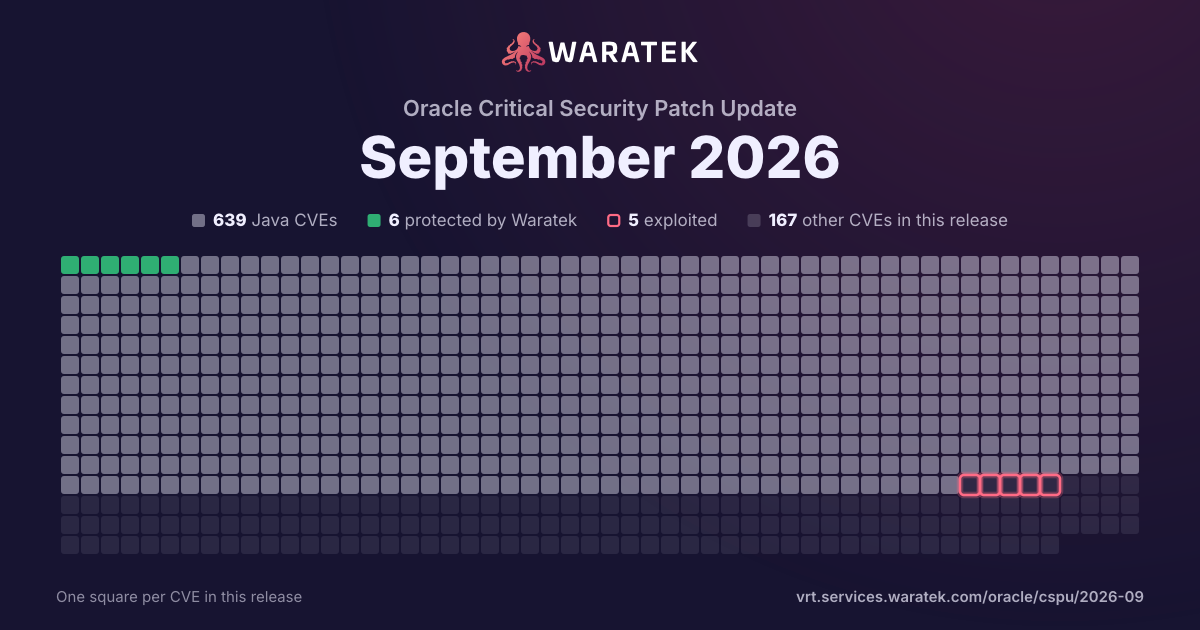
By status
6Protected by Waratek633No exploit published1Outside Waratek scope166Not applicable
5Exploited, marked by the ring
No exploit published. For 596 of them, Oracle's security advisory is the source of public detail.
Protected by Waratek. Waratek RASP can block exploitation of these on systems that have not applied the patch yet.
Overview 15 matches · 3 in Waratek scope · 0 protected · 0 exploited · 0 CISA KEV · 0 public PoC · 0 EPSS ≥ 0.5
15matches
3in Waratek scope20.0%
0protected0.0%
0exploited0.0%
0CISA KEV0.0%
0public PoC0.0%
0EPSS ≥ 0.50.0%
Protected by Waratek
0
0.0%
Rule in development
0
0.0%
Mitigation candidate
0
0.0%
No exploit published
3
20.0%
Outside Waratek scope
0
0.0%
Not applicable
12
80.0%
Withdrawn CVE
0
0.0%
blocked by ARMR today
0
0.0%
partly blocked
0
0.0%
not blocked
15
100.0%
not established
0
0.0%
unrecorded
0
0.0%
Exploited
0
0.0%
Working exploit published
0
0.0%
Proof of concept only
4
26.7%
Forecast only
0
0.0%
No public exploit
11
73.3%
split by
peak 6 / month
Jun 26Jul 26Aug 26Sep 26
| CVE | Severity | Published▾ | Status | Exploitation | Description |
|---|---|---|---|---|---|
| CVE-2026-87284 | Low | 2026-09-15 | Not applicable | No public exploit | Vulnerability in the Oracle VM VirtualBox product of Oracle Virtualization (component: Core). The supported version that is affected is 7.2.16. Easily exploitable vulnerability allows high privileged attacker with logon to the infrastructure where Oracle VM VirtualBox executes to compromise Oracle VM VirtualBox. While the vulnerability is in Oracle VM VirtualBox, attacks may significantly impact additional products (scope change). Successful attacks of this vulnerability can result in unauthorized ability to cause a partial denial of service (partial DOS) of Oracle VM VirtualBox. CVSS 3.1 Base Score 3.2 (Availability impacts). CVSS Vector: (CVSS:3.1/AV:L/AC:L/PR:H/UI:N/S:C/C:N/I:N/A:L). |
| CVE-2026-87281 | Low | 2026-09-15 | Not applicable | No public exploit | Vulnerability in the Oracle VM VirtualBox product of Oracle Virtualization (component: Core). The supported version that is affected is 7.2.16. Easily exploitable vulnerability allows high privileged attacker with logon to the infrastructure where Oracle VM VirtualBox executes to compromise Oracle VM VirtualBox. While the vulnerability is in Oracle VM VirtualBox, attacks may significantly impact additional products (scope change). Successful attacks of this vulnerability can result in unauthorized read access to a subset of Oracle VM VirtualBox accessible data. CVSS 3.1 Base Score 3.2 (Confidentiality impacts). CVSS Vector: (CVSS:3.1/AV:L/AC:L/PR:H/UI:N/S:C/C:L/I:N/A:N). |
| CVE-2026-83414 | Low | 2026-09-15 | No exploit published | No public exploit | Vulnerability in the Oracle Coherence product of Oracle Fusion Middleware (component: Core). The supported version that is affected is 15.1.1.0.0. Difficult to exploit vulnerability allows low privileged attacker with logon to the infrastructure where Oracle Coherence executes to compromise Oracle Coherence. Successful attacks of this vulnerability can result in unauthorized read access to a subset of Oracle Coherence accessible data. CVSS 3.1 Base Score 2.5 (Confidentiality impacts). CVSS Vector: (CVSS:3.1/AV:L/AC:H/PR:L/UI:N/S:U/C:L/I:N/A:N). |
| CVE-2026-83413 | Low | 2026-09-15 | No exploit published | No public exploit | Vulnerability in the Oracle Coherence product of Oracle Fusion Middleware (component: Core). Supported versions that are affected are 12.2.1.4.0, 14.1.1.0.0, 14.1.2.0.0 and 15.1.1.0.0. Difficult to exploit vulnerability allows high privileged attacker with logon to the infrastructure where Oracle Coherence executes to compromise Oracle Coherence. Successful attacks of this vulnerability can result in unauthorized update, insert or delete access to some of Oracle Coherence accessible data. CVSS 3.1 Base Score 1.9 (Integrity impacts). CVSS Vector: (CVSS:3.1/AV:L/AC:H/PR:H/UI:N/S:U/C:N/I:L/A:N). |
| CVE-2026-83369 | Low | 2026-09-15 | No exploit published | No public exploit | Vulnerability in the Oracle Access Manager product of Oracle Fusion Middleware (component: Access SDK). Supported versions that are affected are 12.2.1.4.0 and 14.1.2.1.0. Difficult to exploit vulnerability allows low privileged attacker with network access via HTTP to compromise Oracle Access Manager. Successful attacks of this vulnerability can result in unauthorized ability to cause a partial denial of service (partial DOS) of Oracle Access Manager. CVSS 3.1 Base Score 3.1 (Availability impacts). CVSS Vector: (CVSS:3.1/AV:N/AC:H/PR:L/UI:N/S:U/C:N/I:N/A:L). |
| CVE-2026-55555 | Low | 2026-07-28 | Not applicable | Proof of concept only | Dompdf is an HTML to PDF converter for PHP. Versions 3.15 and prior are vulnerable to a File Existence Oracle attack through the manipulation of the CSS @font-face directive. By providing malicious HTML that references local files via the file:// protocol repeatedly, an attacker can trigger PHP memory exhaustion. Because Dompdf behaves differently depending on whether a referenced local file exists (an existing file is processed repeatedly until it triggers an "Allowed memory size exhausted" crash, whereas a missing file fails fast or is ignored and never hits the memory limit), an attacker can use this observable discrepancy as an oracle to enumerate sensitive files on the server regardless of CHROOT restrictions. Exploitation requires the attacker to supply unrestricted or unsanitized HTML in a request that permits large data, plus a configuration where Dompdf's memory limit is low enough to be exhausted (with $_dompdf_show_warnings=true making the overflow easier to reach). This issue has been fixed in version 3.16. |
| CVE-2026-55554 | Low | 2026-07-28 | Not applicable | Proof of concept only | Dompdf is an HTML to PDF converter for PHP. In versions 3.15 and prior, the validateLocalUri() method enforces chroot boundaries with a strpos() prefix check after normalizing paths with realpath() . Because normalization strips the trailing directory separator from $chrootPath , the check only verifies that $chrootPath is a string prefix of $realfile, so a chroot of /var/www also matches sibling directories like /var/www2 , /var/www-admin, or /var/www_backup. An attacker who controls part of the rendered HTML could exploit this to escape the chroot and read sensitive files outside the allowed directory. This issue has been fixed in version 3.16. |
| CVE-2026-61096 | Low | 2026-07-21 | Not applicable | No public exploit | Vulnerability in the MySQL Server, MySQL Cluster product of Oracle MySQL (component: Server: Pluggable Auth). Supported versions that are affected are MySQL Server: 8.4.0-8.4.10, 9.7.0-9.7.1; MySQL Cluster: 8.0.0-8.0.47, 8.4.0-8.4.10 and 9.7.0-9.7.1. Difficult to exploit vulnerability allows unauthenticated attacker with logon to the infrastructure where MySQL Server, MySQL Cluster executes to compromise MySQL Server, MySQL Cluster. Successful attacks of this vulnerability can result in unauthorized update, insert or delete access to some of MySQL Server, MySQL Cluster accessible data. CVSS 3.1 Base Score 2.9 (Integrity impacts). CVSS Vector: (CVSS:3.1/AV:L/AC:H/PR:N/UI:N/S:U/C:N/I:L/A:N). |
| CVE-2026-61081 | Low | 2026-07-21 | Not applicable | No public exploit | Vulnerability in the MySQL Server, MySQL Cluster product of Oracle MySQL (component: Server: Performance Schema). Supported versions that are affected are MySQL Server: 8.4.0-8.4.10, 9.7.0-9.7.1; MySQL Cluster: 8.0.0-8.0.47, 8.4.0-8.4.10 and 9.7.0-9.7.1. Easily exploitable vulnerability allows high privileged attacker with network access via multiple protocols to compromise MySQL Server, MySQL Cluster. Successful attacks of this vulnerability can result in unauthorized read access to a subset of MySQL Server, MySQL Cluster accessible data. CVSS 3.1 Base Score 2.7 (Confidentiality impacts). CVSS Vector: (CVSS:3.1/AV:N/AC:L/PR:H/UI:N/S:U/C:L/I:N/A:N). |
| CVE-2026-60190 | Low | 2026-07-21 | Not applicable | No public exploit | Vulnerability in the MySQL Server, MySQL Cluster product of Oracle MySQL (component: Server: Replication). Supported versions that are affected are MySQL Server: 8.4.0-8.4.10, 9.7.0-9.7.1; MySQL Cluster: 8.0.0-8.0.47, 8.4.0-8.4.10 and 9.7.0-9.7.1. Difficult to exploit vulnerability allows high privileged attacker with network access via multiple protocols to compromise MySQL Server, MySQL Cluster. Successful attacks of this vulnerability can result in unauthorized ability to cause a partial denial of service (partial DOS) of MySQL Server, MySQL Cluster. CVSS 3.1 Base Score 2.2 (Availability impacts). CVSS Vector: (CVSS:3.1/AV:N/AC:H/PR:H/UI:N/S:U/C:N/I:N/A:L). |
| CVE-2026-53422 | Low | 2026-07-02 | Not applicable | No public exploit | Observable Response Discrepancy vulnerability in Erlang OTP ssh (ssh_sftpd module) allows an authenticated SFTP user to enumerate the existence of files and directories outside the configured root directory. The SSH_FXP_REALPATH handler in ssh_sftpd calls relate_file_name/3 with Canonicalize=false, unlike every other SFTP operation handler. This allows .. components in the requested path to bypass the is_within_root/2 check without being resolved. The un-canonicalized path then enters resolve_symlinks/2, which walks up the directory tree above the configured root and issues read_link() syscalls on arbitrary filesystem paths. An authenticated SFTP client can exploit this by sending a REALPATH request with a crafted traversal path. The server response differs depending on whether the target path exists on the host filesystem (SSH_FXP_NAME when the path resolves successfully, SSH_FX_NO_SUCH_FILE when it does not). This creates a path-existence oracle that an attacker can use to enumerate the filesystem structure outside the configured root, including the existence of sensitive files, directories, and mount points. The vulnerability leaks only the existence of paths. No file contents, credentials, or write access are obtainable through this issue alone. The information gained may assist further attacks when combined with other vulnerabilities. This vulnerability is associated with program files lib/ssh/src/ssh_sftpd.erl and program routine ssh_sftpd:handle_op/4. This issue affects OTP from OTP 17.0 before OTP 27.3.4.14, OTP 28.5.0.3, and OTP 29.0.3, corresponding to ssh from 3.0.1 before 5.2.11.9, 5.5.2.2, and 6.0.2. Whether OTP before OTP 17.0, corresponding to ssh before 3.0.1, is affected is unknown. |
| CVE-2026-13758 | Low | 2026-06-29 | Not applicable | No public exploit | CryptX versions before 0.088_001 for Perl compare AEAD authentication tags in non-constant time in the streaming decrypt_done path. The decrypt_done($tag) form compares it against the computed tag with memNE (memcmp() != 0), which short-circuits on the first differing byte, so its run time depends on the number of matching leading bytes. This affects all five AEAD modes: GCM, CCM, ChaCha20Poly1305, EAX and OCB. The one-shot *_decrypt_verify helpers are unaffected; they verify the tag inside libtomcrypt with a constant-time comparison. The timing difference is a tag-verification oracle. An attacker who can submit many candidate tags for the same nonce, ciphertext and associated data while measuring the timing precisely enough may recover the expected tag byte by byte and forge a message that verifies. |
| CVE-2026-13484 | Low | 2026-06-28 | Not applicable | Proof of concept only | A vulnerability has been found in MLflow up to 4666cffc7912ea606d592fc38d6a75e2935f65e7. The impacted element is an unknown function of the component Experiment-scoped Label Schema CRUD API. Such manipulation leads to missing authorization. It is possible to launch the attack remotely. A high complexity level is associated with this attack. The exploitability is regarded as difficult. The exploit has been disclosed to the public and may be used. A reply to the GitHub issue explains, that "[t]he labeling schema PR has not been merged yet. The auth handlers will be added before the release." |
| CVE-2026-48855 | Low | 2026-06-10 | Not applicable | No public exploit | Exposure of Sensitive Information to an Unauthorized Actor vulnerability in Erlang OTP ssh (ssh_sftpd module) allows File Discovery. The SSH_FXP_READLINK handler in ssh_sftpd sends the raw result of file:read_link/2 to the client without calling chroot_filename/2 to strip the backend root prefix. An authenticated SFTP client can create a symlink inside the chroot pointing to /; ssh_sftpd resolves the target to the absolute backend root and stores it on disk. Reading the symlink back via SSH_FXP_READLINK returns that absolute path, for example /data/sftp, instead of the chrooted value /. The information disclosed is the absolute filesystem path of the SFTP root directory and of any symlink targets within it. No file contents, credentials, or access to paths outside the root directory are obtainable through this issue alone. This vulnerability is associated with program files lib/ssh/src/ssh_sftpd.erl. This issue affects OTP from OTP 17.0 before OTP 27.3.4.13, OTP 28.5.0.2, and OTP 29.0.2, corresponding to ssh from 3.0.1 before 5.2.11.8, 5.5.2.1, and 6.0.1. Whether OTP before OTP 17.0, corresponding to ssh before 3.0.1, is affected is unknown. |
| CVE-2026-10803 | Low | 2026-06-04 | Not applicable | Proof of concept only | A flaw has been found in MLflow up to 3.10.0. This issue affects the function mlflow.data.digest_utils of the file mlflow/data/digest_utils.py of the component Dataset Digest Computation. This manipulation causes use of weak hash. It is possible to launch the attack on the local host. The attack is considered to have high complexity. The exploitability is assessed as difficult. The exploit has been published and may be used. The project was informed of the problem early through a pull request but has not reacted yet. |