
Oracle Critical Security Patch Update September 2026
Released September 2026 · Oracle's advisory ↗ · ← Security Patch Update, August 2026 · Critical Patch Update, October 2026 →
806 CVEs in this release, one square each
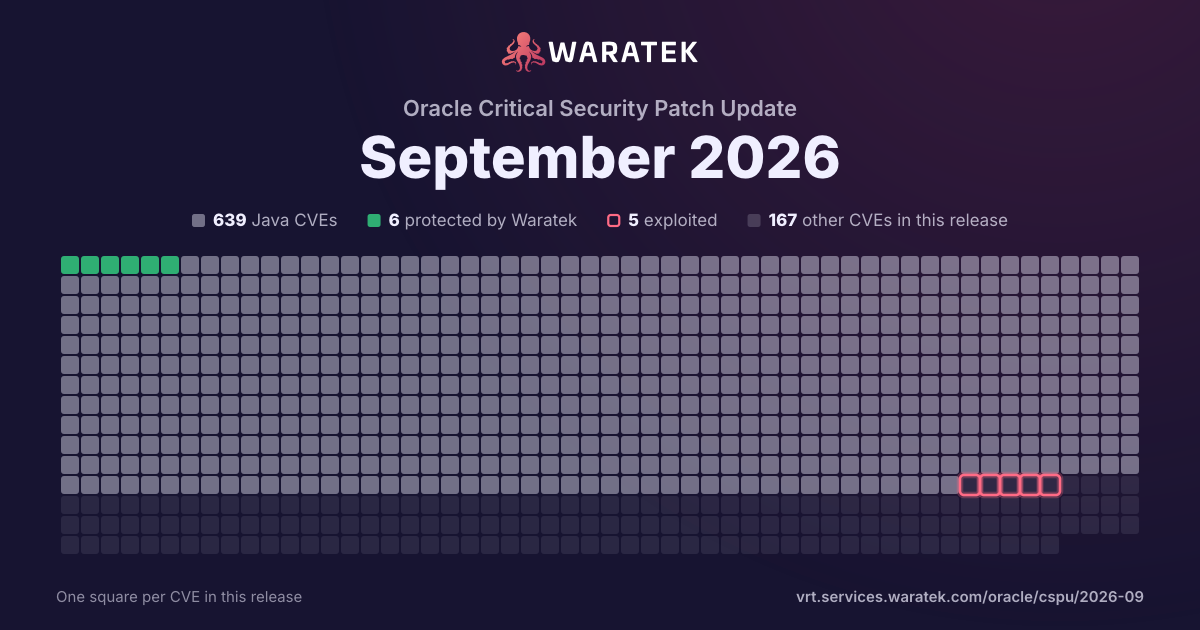
By status
6Protected by Waratek633No exploit published1Outside Waratek scope166Not applicable
5Exploited, marked by the ring
No exploit published. For 596 of them, Oracle's security advisory is the source of public detail.
Protected by Waratek. Waratek RASP can block exploitation of these on systems that have not applied the patch yet.
Overview 6 matches · 1 protected · 0 exploited · 0 CISA KEV · 1 public PoC · 0 EPSS ≥ 0.5
Protected by Waratek
1
16.7%
Rule in development
0
0.0%
Mitigation candidate
0
0.0%
No exploit published
5
83.3%
blocked by ARMR today
1
16.7%
partly blocked
0
0.0%
not blocked
5
83.3%
not established
0
0.0%
unrecorded
0
0.0%
Exploited
0
0.0%
Working exploit published
0
0.0%
Proof of concept only
6
100.0%
Forecast only
0
0.0%
No public exploit
0
0.0%
split by
peak 2 / month
Apr 261
No exploit published1
Critical1
not blocked1
Proof of concept only1
May 261
Protected by Waratek1
Critical1
blocked by ARMR today1
Proof of concept only1
Jun 262
No exploit published2
High1
Medium1
not blocked2
Proof of concept only2
Jul 262
No exploit published2
High1
Medium1
not blocked2
Proof of concept only2
Apr 26May 26Jun 26Jul 26
| CVE | Severity | Published▾ | Status | Exploitation | Description |
|---|---|---|---|---|---|
| CVE-2026-59921 | Medium | 2026-07-28 | No exploit published | Proof of concept only | Netty is an asynchronous, event-driven network application framework. Prior to versions 4.1.136.Final and 4.2.16.Final, HttpPostRequestEncoder constructs multipart HTTP request bodies by directly concatenating user-supplied filenames and field names into Content-Disposition MIME headers without validating or sanitizing CRLF characters (\r\n). Since MIME headers are delimited by CRLF, an attacker who controls the filename can inject arbitrary MIME headers into the multipart body part. The root cause is that neither the encoder nor the FileUpload implementations' setFilename() methods, which only check for null, neutralize CRLF characters before the filename is embedded into the header. This issue has been fixed in versions 4.1.136.Final and 4.2.16.Final. |
| CVE-2026-55831 | High | 2026-07-21 | No exploit published | Proof of concept only | Netty is a network application framework for development of protocol servers and clients. Prior to 4.1.136.Final and 4.2.16.Final, Netty's SPDY SETTINGS decoder accepts a peer-declared SETTINGS entry count up to the 24-bit frame-length limit and materializes every unique setting ID in `DefaultSpdySettingsFrame`, allowing a remote SPDY/3.1 peer to send a syntactically valid roughly 2 MiB SETTINGS frame that creates 262144 map entries and amplifies network input into heap growth and ordered-map insertion work. This issue is fixed in versions 4.1.136.Final and 4.2.16.Final. |
| CVE-2026-54512 | High | 2026-06-23 | No exploit published | Proof of concept only | jackson-databind contains the general-purpose data-binding functionality and tree-model for Jackson Data Processor. From 2.10.0 until 2.18.8, 2.21.4, and 3.1.4, jackson-databind's PolymorphicTypeValidator (PTV) is the primary safety mechanism guarding polymorphic deserialization. When polymorphic typing is enabled and a type identifier contains generic parameters (i.e. the type ID string contains <), DatabindContext._resolveAndValidateGeneric() validates only the raw container class name (the substring before <) against the configured PTV. If the container type is approved, the method parses the full canonical type string via TypeFactory.constructFromCanonical() and returns the fully parameterized type without ever validating the nested type arguments against the PTV. The nested type arguments are then resolved, instantiated, and populated as beans during deserialization. An attacker who controls the type ID can therefore place a denied class as a generic type parameter of an allowed container — for example java.util.ArrayList<com.evil.Gadget> when only java.util.ArrayList is allow-listed. The container passes the PTV check; com.evil.Gadget is loaded via Class.forName(name, true, loader), instantiated, and its properties are set from attacker-controlled JSON. This completely bypasses an explicitly configured PTV allow-list. This vulnerability is fixed in 2.18.8, 2.21.4, and 3.1.4. |
| CVE-2026-50020 | Medium | 2026-06-12 | No exploit published | Proof of concept only | Netty is a network application framework for development of protocol servers and clients. Prior to versions 4.1.135.Final and 4.2.15.Final, before reading the first request-line, `HttpObjectDecoder` skips every byte for which `Character.isISOControl(b)` is `true` (0x00–0x1F and 0x7F) as well as all whitespace. RFC 9112 §2.2 only asks servers to ignore empty CRLF lines preceding the request-line — a carefully scoped robustness allowance intended to handle HTTP/1.0 POST workarounds. Silently absorbing NUL bytes, SOH, STX, and other non-CRLF control characters goes significantly beyond this, and can be exploited for request-boundary confusion in pipelined or multiplexed transports where a front-end component treats those bytes differently. Versions 4.1.135.Final and 4.2.15.Final patch the issue. |
| CVE-2026-42779 | Critical | 2026-05-01 | Protected by Waratek | Proof of concept only | The fix for CVE-2026-41635 was not applied to the 2.1.X and 2.2.X branches. Here was the original issue description: Apache MINA's AbstractIoBuffer.resolveClass() contains two branches, one of them (for static classes or primitive types) does not check the class at all, bypassing the classname allowlist and allowing arbitrary code to be executed. The fix checks if the class is present in the accepted class filter before calling Class.forName(). Affected versions are Apache MINA 2.1.0 <= 2.1.11, and 2.2.0 <= 2.2.6. The problem is resolved in Apache MINA 2.1.12, and 2.2.7 by applying the classname allowlist earlier. Affected are applications using Apache MINA that call IoBuffer.getObject(). Applications using Apache MINA are advised to upgrade. |
| CVE-2026-2332 | Critical | 2026-04-14 | No exploit published | Proof of concept only | In Eclipse Jetty, the HTTP/1.1 parser is vulnerable to request smuggling when chunk extensions are used, similar to the "funky chunks" techniques outlined here: * https://w4ke.info/2025/06/18/funky-chunks.html * https://w4ke.info/2025/10/29/funky-chunks-2.html Jetty terminates chunk extension parsing at \r\n inside quoted strings instead of treating this as an error. POST / HTTP/1.1 Host: localhost Transfer-Encoding: chunked 1;ext="val X 0 GET /smuggled HTTP/1.1 ... Note how the chunk extension does not close the double quotes, and it is able to inject a smuggled request. |