
Oracle Critical Security Patch Update June 2026
Released June 2026 · Oracle's advisory ↗ · ← Security Patch Update, May 2026 · Critical Patch Update, July 2026 →
251 CVEs in this release, one square each
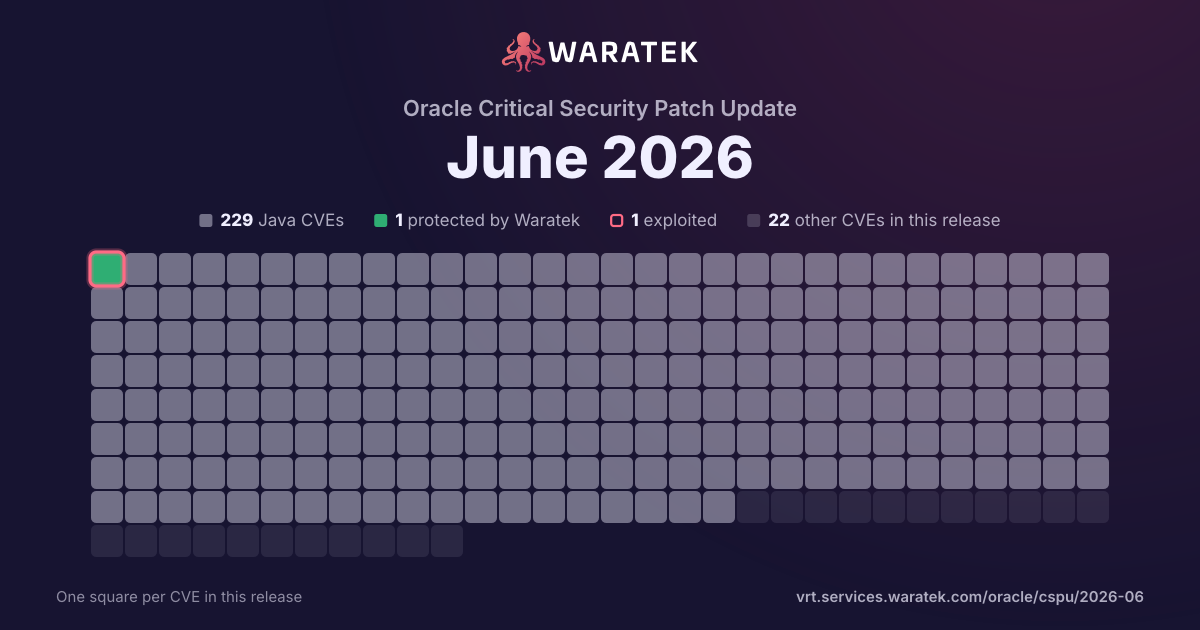
By status
No exploit published. For 222 of them, Oracle's security advisory is the source of public detail.
Protected by Waratek. Waratek RASP can block exploitation of these on systems that have not applied the patch yet.
Overview 6 matches · 0 in Waratek scope · 0 protected · 0 exploited · 0 CISA KEV · 0 public PoC · 0 EPSS ≥ 0.5
6matches
0in Waratek scope0.0%
0protected0.0%
0exploited0.0%
0CISA KEV0.0%
0public PoC0.0%
0EPSS ≥ 0.50.0%
Protected by Waratek
0
0.0%
Rule in development
0
0.0%
Mitigation candidate
0
0.0%
No exploit published
0
0.0%
Outside Waratek scope
0
0.0%
Not applicable
6
100.0%
Withdrawn CVE
0
0.0%
blocked by ARMR today
0
0.0%
partly blocked
0
0.0%
not blocked
6
100.0%
not established
0
0.0%
unrecorded
0
0.0%
Exploited
0
0.0%
Working exploit published
0
0.0%
Proof of concept only
0
0.0%
Forecast only
0
0.0%
No public exploit
6
100.0%
split by
peak 5 / month
May 26Jun 26
| CVE | Severity | Published▾ | Status | Exploitation | Description |
|---|---|---|---|---|---|
| CVE-2026-46877 | Medium | 2026-06-17 | Not applicable | No public exploit | Vulnerability in the Oracle VM VirtualBox product of Oracle Virtualization (component: VMSVGA device). The supported version that is affected is 7.2.8. Easily exploitable vulnerability allows high privileged attacker with logon to the infrastructure where Oracle VM VirtualBox executes to compromise Oracle VM VirtualBox. While the vulnerability is in Oracle VM VirtualBox, attacks may significantly impact additional products (scope change). Successful attacks of this vulnerability can result in unauthorized access to critical data or complete access to all Oracle VM VirtualBox accessible data. CVSS 3.1 Base Score 6.0 (Confidentiality impacts). CVSS Vector: (CVSS:3.1/AV:L/AC:L/PR:H/UI:N/S:C/C:H/I:N/A:N). |
| CVE-2026-46871 | Medium | 2026-06-17 | Not applicable | No public exploit | Vulnerability in the MySQL Shell product of Oracle MySQL (component: Shell for VS Code). The supported version that is affected is 2026.2.0+9.6.1. Easily exploitable vulnerability allows low privileged attacker with network access via multiple protocols to compromise MySQL Shell. Successful attacks of this vulnerability can result in unauthorized access to critical data or complete access to all MySQL Shell accessible data. CVSS 3.1 Base Score 6.5 (Confidentiality impacts). CVSS Vector: (CVSS:3.1/AV:N/AC:L/PR:L/UI:N/S:U/C:H/I:N/A:N). |
| CVE-2026-46869 | Medium | 2026-06-17 | Not applicable | No public exploit | Vulnerability in the MySQL Shell product of Oracle MySQL (component: Shell: Dump and Load). Supported versions that are affected are 8.4.0-8.4.9 and 9.0.0-9.7.0. Easily exploitable vulnerability allows unauthenticated attacker with network access via multiple protocols to compromise MySQL Shell. Successful attacks require human interaction from a person other than the attacker. Successful attacks of this vulnerability can result in unauthorized access to critical data or complete access to all MySQL Shell accessible data. CVSS 3.1 Base Score 6.5 (Confidentiality impacts). CVSS Vector: (CVSS:3.1/AV:N/AC:L/PR:N/UI:R/S:U/C:H/I:N/A:N). |
| CVE-2026-46825 | Medium | 2026-06-17 | Not applicable | No public exploit | Vulnerability in the Oracle VM VirtualBox product of Oracle Virtualization (component: VMSVGA device). The supported version that is affected is 7.2.8. Easily exploitable vulnerability allows high privileged attacker with logon to the infrastructure where Oracle VM VirtualBox executes to compromise Oracle VM VirtualBox. While the vulnerability is in Oracle VM VirtualBox, attacks may significantly impact additional products (scope change). Successful attacks of this vulnerability can result in unauthorized creation, deletion or modification access to critical data or all Oracle VM VirtualBox accessible data. CVSS 3.1 Base Score 6.0 (Integrity impacts). CVSS Vector: (CVSS:3.1/AV:L/AC:L/PR:H/UI:N/S:C/C:N/I:H/A:N). |
| CVE-2026-46768 | Medium | 2026-06-17 | Not applicable | No public exploit | Vulnerability in the Oracle VM VirtualBox product of Oracle Virtualization (component: VMSVGA device). The supported version that is affected is 7.2.8. Easily exploitable vulnerability allows high privileged attacker with logon to the infrastructure where Oracle VM VirtualBox executes to compromise Oracle VM VirtualBox. While the vulnerability is in Oracle VM VirtualBox, attacks may significantly impact additional products (scope change). Successful attacks of this vulnerability can result in unauthorized ability to cause a hang or frequently repeatable crash (complete DOS) of Oracle VM VirtualBox. CVSS 3.1 Base Score 6.0 (Availability impacts). CVSS Vector: (CVSS:3.1/AV:L/AC:L/PR:H/UI:N/S:C/C:N/I:N/A:H). |
| CVE-2026-35233 | Medium | 2026-05-01 | Not applicable | No public exploit | An unprivileged attacker can craft a user-space process with a malicious ELF binary containing an out-of-range sh_link field. When root-level dtrace attaches to -- or instruments -- that process (via dtrace -p , pid probes, or USDT), the ELF parser reads heap memory beyond the allocated section cache array without any bounds check. This results in an uninitialized/out-of-bounds heap read that can cause a NULL pointer dereference crash of the dtrace process (DoS), or -- depending on heap layout -- a read-then-use of a garbage pointer controlled by adjacent allocations, providing a foothold toward further exploitation in a privileged context. |