
Oracle Critical Security Patch Update June 2026
Released June 2026 · Oracle's advisory ↗ · ← Security Patch Update, May 2026 · Critical Patch Update, July 2026 →
251 CVEs in this release, one square each
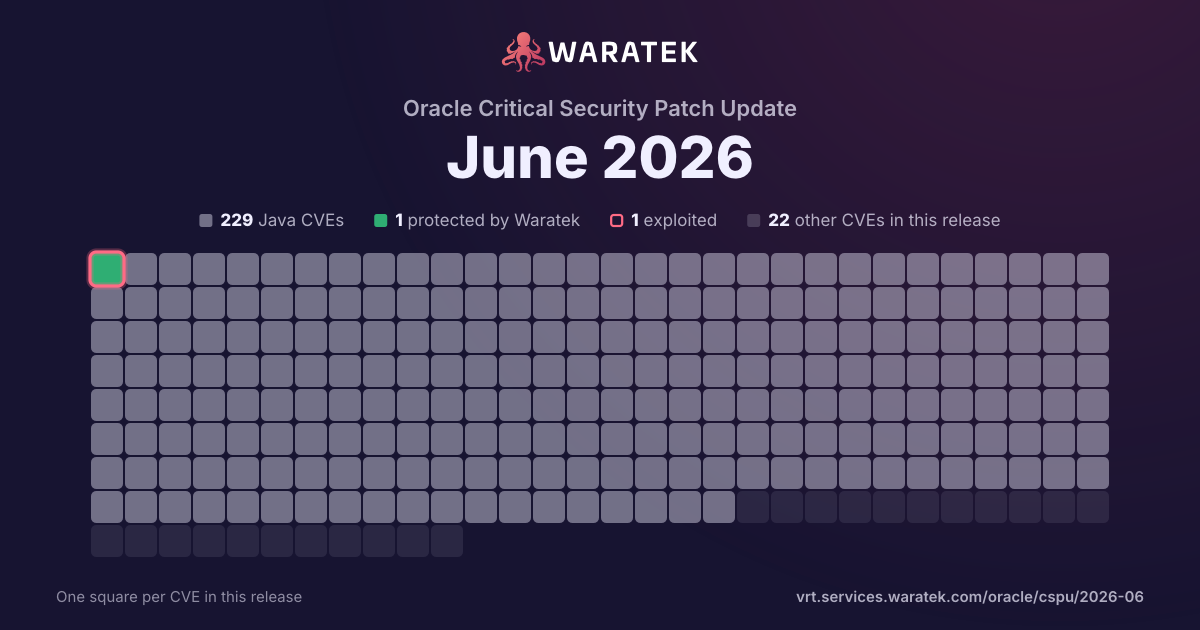
By status
No exploit published. For 222 of them, Oracle's security advisory is the source of public detail.
Protected by Waratek. Waratek RASP can block exploitation of these on systems that have not applied the patch yet.
Overview 229 matches · 1 protected · 1 exploited · 1 CISA KEV · 1 public PoC · 1 EPSS ≥ 0.5
Protected by Waratek
1
0.4%
Rule in development
0
0.0%
Mitigation candidate
0
0.0%
No exploit published
228
99.6%
blocked by ARMR today
1
0.4%
partly blocked
0
0.0%
not blocked
228
99.6%
not established
0
0.0%
unrecorded
0
0.0%
Exploited
1
0.4%
Working exploit published
0
0.0%
Proof of concept only
0
0.0%
Forecast only
0
0.0%
No public exploit
228
99.6%
split by
peak 225 / quarter
Q2 221
Protected by Waratek1
Critical1
blocked by ARMR today1
Exploited1
Q3 221
No exploit published1
High1
not blocked1
No public exploit1
Q4 220
Q1 230
Q2 230
Q3 230
Q4 230
Q1 240
Q2 240
Q3 240
Q4 240
Q1 250
Q2 250
Q3 250
Q4 251
No exploit published1
Medium1
not blocked1
No public exploit1
Q1 261
No exploit published1
High1
not blocked1
No public exploit1
Q2 26225
No exploit published225
Critical118
High93
Medium14
not blocked225
No public exploit225
Q2 22Q4 22Q2 23Q4 23Q2 24Q4 24Q2 25Q4 25Q2 26
| CVE | Severity | Published▾ | Status | Exploitation | Description |
|---|---|---|---|---|---|
| CVE-2026-35283 | Critical | 2026-06-17 | No exploit published | No public exploit | Vulnerability in the Oracle WebCenter Enterprise Capture product of Oracle Fusion Middleware (component: Client Bundle). Supported versions that are affected are 12.2.1.4.0 and 14.1.2.0.0. Easily exploitable vulnerability allows low privileged attacker with network access via T3, IIOP to compromise Oracle WebCenter Enterprise Capture. While the vulnerability is in Oracle WebCenter Enterprise Capture, attacks may significantly impact additional products (scope change). Successful attacks of this vulnerability can result in takeover of Oracle WebCenter Enterprise Capture. CVSS 3.1 Base Score 9.9 (Confidentiality, Integrity and Availability impacts). CVSS Vector: (CVSS:3.1/AV:N/AC:L/PR:L/UI:N/S:C/C:H/I:H/A:H). |
| CVE-2026-35282 | Critical | 2026-06-17 | No exploit published | No public exploit | Vulnerability in the Oracle WebCenter Enterprise Capture product of Oracle Fusion Middleware (component: Client Bundle). Supported versions that are affected are 12.2.1.4.0 and 14.1.2.0.0. Easily exploitable vulnerability allows low privileged attacker with network access via T3, IIOP to compromise Oracle WebCenter Enterprise Capture. While the vulnerability is in Oracle WebCenter Enterprise Capture, attacks may significantly impact additional products (scope change). Successful attacks of this vulnerability can result in takeover of Oracle WebCenter Enterprise Capture. CVSS 3.1 Base Score 9.9 (Confidentiality, Integrity and Availability impacts). CVSS Vector: (CVSS:3.1/AV:N/AC:L/PR:L/UI:N/S:C/C:H/I:H/A:H). |
| CVE-2026-35281 | Critical | 2026-06-17 | No exploit published | No public exploit | Vulnerability in the Oracle WebCenter Enterprise Capture product of Oracle Fusion Middleware (component: Client Bundle). Supported versions that are affected are 12.2.1.4.0 and 14.1.2.0.0. Easily exploitable vulnerability allows low privileged attacker with network access via T3, IIOP to compromise Oracle WebCenter Enterprise Capture. While the vulnerability is in Oracle WebCenter Enterprise Capture, attacks may significantly impact additional products (scope change). Successful attacks of this vulnerability can result in takeover of Oracle WebCenter Enterprise Capture. CVSS 3.1 Base Score 9.9 (Confidentiality, Integrity and Availability impacts). CVSS Vector: (CVSS:3.1/AV:N/AC:L/PR:L/UI:N/S:C/C:H/I:H/A:H). |
| CVE-2026-35280 | Critical | 2026-06-17 | No exploit published | No public exploit | Vulnerability in the Oracle WebCenter Enterprise Capture product of Oracle Fusion Middleware (component: Client Bundle). Supported versions that are affected are 12.2.1.4.0 and 14.1.2.0.0. Easily exploitable vulnerability allows low privileged attacker with network access via T3, IIOP to compromise Oracle WebCenter Enterprise Capture. While the vulnerability is in Oracle WebCenter Enterprise Capture, attacks may significantly impact additional products (scope change). Successful attacks of this vulnerability can result in takeover of Oracle WebCenter Enterprise Capture. CVSS 3.1 Base Score 9.9 (Confidentiality, Integrity and Availability impacts). CVSS Vector: (CVSS:3.1/AV:N/AC:L/PR:L/UI:N/S:C/C:H/I:H/A:H). |
| CVE-2026-35279 | High | 2026-06-17 | No exploit published | No public exploit | Vulnerability in the PeopleSoft Enterprise PT PeopleTools product of Oracle PeopleSoft (component: Performance Monitor). Supported versions that are affected are 8.61 and 8.62. Difficult to exploit vulnerability allows unauthenticated attacker with network access via HTTP to compromise PeopleSoft Enterprise PT PeopleTools. Successful attacks of this vulnerability can result in takeover of PeopleSoft Enterprise PT PeopleTools. CVSS 3.1 Base Score 8.1 (Confidentiality, Integrity and Availability impacts). CVSS Vector: (CVSS:3.1/AV:N/AC:H/PR:N/UI:N/S:U/C:H/I:H/A:H). |
| CVE-2026-35278 | Critical | 2026-06-17 | No exploit published | No public exploit | Vulnerability in the PeopleSoft Enterprise PT PeopleTools product of Oracle PeopleSoft (component: Performance Monitor). Supported versions that are affected are 8.61 and 8.62. Easily exploitable vulnerability allows unauthenticated attacker with network access via HTTP to compromise PeopleSoft Enterprise PT PeopleTools. Successful attacks of this vulnerability can result in takeover of PeopleSoft Enterprise PT PeopleTools. CVSS 3.1 Base Score 9.8 (Confidentiality, Integrity and Availability impacts). CVSS Vector: (CVSS:3.1/AV:N/AC:L/PR:N/UI:N/S:U/C:H/I:H/A:H). |
| CVE-2026-35276 | High | 2026-06-17 | No exploit published | No public exploit | Vulnerability in the PeopleSoft Enterprise PT PeopleTools product of Oracle PeopleSoft (component: Application Server). Supported versions that are affected are 8.61 and 8.62. Difficult to exploit vulnerability allows unauthenticated attacker with network access via HTTP to compromise PeopleSoft Enterprise PT PeopleTools. Successful attacks of this vulnerability can result in takeover of PeopleSoft Enterprise PT PeopleTools. CVSS 3.1 Base Score 8.1 (Confidentiality, Integrity and Availability impacts). CVSS Vector: (CVSS:3.1/AV:N/AC:H/PR:N/UI:N/S:U/C:H/I:H/A:H). |
| CVE-2026-35274 | High | 2026-06-17 | No exploit published | No public exploit | Vulnerability in the PeopleSoft Enterprise PT PeopleTools product of Oracle PeopleSoft (component: Deployment Package). Supported versions that are affected are 8.61 and 8.62. Easily exploitable vulnerability allows unauthenticated attacker with network access via HTTP to compromise PeopleSoft Enterprise PT PeopleTools. Successful attacks of this vulnerability can result in unauthorized access to critical data or complete access to all PeopleSoft Enterprise PT PeopleTools accessible data as well as unauthorized update, insert or delete access to some of PeopleSoft Enterprise PT PeopleTools accessible data. CVSS 3.1 Base Score 8.2 (Confidentiality and Integrity impacts). CVSS Vector: (CVSS:3.1/AV:N/AC:L/PR:N/UI:N/S:U/C:H/I:L/A:N). |
| CVE-2026-35272 | High | 2026-06-17 | No exploit published | No public exploit | Vulnerability in the PeopleSoft Enterprise PT PeopleTools product of Oracle PeopleSoft (component: Deployment Package). Supported versions that are affected are 8.61 and 8.62. Easily exploitable vulnerability allows unauthenticated attacker with logon to the infrastructure where PeopleSoft Enterprise PT PeopleTools executes to compromise PeopleSoft Enterprise PT PeopleTools. Successful attacks of this vulnerability can result in takeover of PeopleSoft Enterprise PT PeopleTools. CVSS 3.1 Base Score 8.4 (Confidentiality, Integrity and Availability impacts). CVSS Vector: (CVSS:3.1/AV:L/AC:L/PR:N/UI:N/S:U/C:H/I:H/A:H). |
| CVE-2026-35271 | High | 2026-06-17 | No exploit published | No public exploit | Vulnerability in the PeopleSoft Enterprise PT PeopleTools product of Oracle PeopleSoft (component: Weblogic). Supported versions that are affected are 8.61 and 8.62. Difficult to exploit vulnerability allows unauthenticated attacker with network access via HTTP to compromise PeopleSoft Enterprise PT PeopleTools. While the vulnerability is in PeopleSoft Enterprise PT PeopleTools, attacks may significantly impact additional products (scope change). Successful attacks of this vulnerability can result in unauthorized creation, deletion or modification access to critical data or all PeopleSoft Enterprise PT PeopleTools accessible data as well as unauthorized access to critical data or complete access to all PeopleSoft Enterprise PT PeopleTools accessible data. CVSS 3.1 Base Score 8.7 (Confidentiality and Integrity impacts). CVSS Vector: (CVSS:3.1/AV:N/AC:H/PR:N/UI:N/S:C/C:H/I:H/A:N). |
| CVE-2026-35270 | Critical | 2026-06-17 | No exploit published | No public exploit | Vulnerability in the Oracle WebCenter Content product of Oracle Fusion Middleware (component: Content Server). Supported versions that are affected are 12.2.1.4.0 and 14.1.2.0.0. Easily exploitable vulnerability allows high privileged attacker with network access via HTTP to compromise Oracle WebCenter Content. While the vulnerability is in Oracle WebCenter Content, attacks may significantly impact additional products (scope change). Successful attacks of this vulnerability can result in takeover of Oracle WebCenter Content. CVSS 3.1 Base Score 9.1 (Confidentiality, Integrity and Availability impacts). CVSS Vector: (CVSS:3.1/AV:N/AC:L/PR:H/UI:N/S:C/C:H/I:H/A:H). |
| CVE-2026-35269 | High | 2026-06-17 | No exploit published | No public exploit | Vulnerability in the Identity Manager product of Oracle Fusion Middleware (component: REST WebServices). Supported versions that are affected are 12.2.1.4.0 and 14.1.2.1.0. Easily exploitable vulnerability allows unauthenticated attacker with network access via HTTP to compromise Identity Manager. Successful attacks of this vulnerability can result in unauthorized creation, deletion or modification access to critical data or all Identity Manager accessible data. CVSS 3.1 Base Score 7.5 (Integrity impacts). CVSS Vector: (CVSS:3.1/AV:N/AC:L/PR:N/UI:N/S:U/C:N/I:H/A:N). |
| CVE-2026-35268 | Critical | 2026-06-17 | No exploit published | No public exploit | Vulnerability in the Identity Manager product of Oracle Fusion Middleware (component: Core). Supported versions that are affected are 12.2.1.4.0 and 14.1.2.1.0. Easily exploitable vulnerability allows low privileged attacker with network access via T3, IIOP to compromise Identity Manager. While the vulnerability is in Identity Manager, attacks may significantly impact additional products (scope change). Successful attacks of this vulnerability can result in takeover of Identity Manager. CVSS 3.1 Base Score 9.9 (Confidentiality, Integrity and Availability impacts). CVSS Vector: (CVSS:3.1/AV:N/AC:L/PR:L/UI:N/S:C/C:H/I:H/A:H). |
| CVE-2026-35267 | High | 2026-06-17 | No exploit published | No public exploit | Vulnerability in the Identity Manager product of Oracle Fusion Middleware (component: REST WebServices). Supported versions that are affected are 12.2.1.4.0 and 14.1.2.1.0. Easily exploitable vulnerability allows low privileged attacker with network access via HTTP to compromise Identity Manager. Successful attacks of this vulnerability can result in takeover of Identity Manager. CVSS 3.1 Base Score 8.8 (Confidentiality, Integrity and Availability impacts). CVSS Vector: (CVSS:3.1/AV:N/AC:L/PR:L/UI:N/S:U/C:H/I:H/A:H). |
| CVE-2026-35265 | High | 2026-06-17 | No exploit published | No public exploit | Vulnerability in the Identity Manager product of Oracle Fusion Middleware (component: Security). Supported versions that are affected are 12.2.1.4.0 and 14.1.2.1.0. Easily exploitable vulnerability allows low privileged attacker with network access via HTTP to compromise Identity Manager. Successful attacks of this vulnerability can result in takeover of Identity Manager. CVSS 3.1 Base Score 8.8 (Confidentiality, Integrity and Availability impacts). CVSS Vector: (CVSS:3.1/AV:N/AC:L/PR:L/UI:N/S:U/C:H/I:H/A:H). |
| CVE-2026-35263 | Critical | 2026-06-17 | No exploit published | No public exploit | Vulnerability in the WebLogic Server product of Oracle Fusion Middleware (component: Core). Supported versions that are affected are 14.1.2.0.0 and 15.1.1.0.0. Easily exploitable vulnerability allows low privileged attacker with network access via HTTP to compromise WebLogic Server. While the vulnerability is in WebLogic Server, attacks may significantly impact additional products (scope change). Successful attacks of this vulnerability can result in takeover of WebLogic Server. CVSS 3.1 Base Score 9.9 (Confidentiality, Integrity and Availability impacts). CVSS Vector: (CVSS:3.1/AV:N/AC:L/PR:L/UI:N/S:C/C:H/I:H/A:H). |
| CVE-2026-35262 | High | 2026-06-17 | No exploit published | No public exploit | Vulnerability in the Oracle Data Integrator product of Oracle Fusion Middleware (component: Market Place). Supported versions that are affected are 12.2.1.4.0 and 14.1.2.0.0. Easily exploitable vulnerability allows low privileged attacker with network access via HTTP to compromise Oracle Data Integrator. Successful attacks of this vulnerability can result in unauthorized creation, deletion or modification access to critical data or all Oracle Data Integrator accessible data as well as unauthorized access to critical data or complete access to all Oracle Data Integrator accessible data and unauthorized ability to cause a partial denial of service (partial DOS) of Oracle Data Integrator. CVSS 3.1 Base Score 8.3 (Confidentiality, Integrity and Availability impacts). CVSS Vector: (CVSS:3.1/AV:N/AC:L/PR:L/UI:N/S:U/C:H/I:H/A:L). |
| CVE-2026-35261 | Medium | 2026-06-17 | No exploit published | No public exploit | Vulnerability in the Oracle Access Manager product of Oracle Fusion Middleware (component: Authentication Engine). Supported versions that are affected are 12.2.1.4.0 and 14.1.2.1.0. Easily exploitable vulnerability allows unauthenticated attacker with network access via HTTP to compromise Oracle Access Manager. Successful attacks of this vulnerability can result in unauthorized update, insert or delete access to some of Oracle Access Manager accessible data as well as unauthorized read access to a subset of Oracle Access Manager accessible data. CVSS 3.1 Base Score 6.5 (Confidentiality and Integrity impacts). CVSS Vector: (CVSS:3.1/AV:N/AC:L/PR:N/UI:N/S:U/C:L/I:L/A:N). |
| CVE-2026-35259 | High | 2026-06-17 | No exploit published | No public exploit | Vulnerability in the WebLogic Server product of Oracle Fusion Middleware (component: Console). Supported versions that are affected are 14.1.2.0.0 and 15.1.1.0.0. Easily exploitable vulnerability allows unauthenticated attacker with network access via HTTPS to compromise WebLogic Server. Successful attacks require human interaction from a person other than the attacker. Successful attacks of this vulnerability can result in takeover of WebLogic Server. CVSS 3.1 Base Score 8.8 (Confidentiality, Integrity and Availability impacts). CVSS Vector: (CVSS:3.1/AV:N/AC:L/PR:N/UI:R/S:U/C:H/I:H/A:H). |
| CVE-2026-35258 | High | 2026-06-17 | No exploit published | No public exploit | Vulnerability in the WebLogic Server product of Oracle Fusion Middleware (component: Console). Supported versions that are affected are 14.1.2.0.0 and 15.1.1.0.0. Easily exploitable vulnerability allows low privileged attacker with network access via HTTPS to compromise WebLogic Server. Successful attacks require human interaction from a person other than the attacker and while the vulnerability is in WebLogic Server, attacks may significantly impact additional products (scope change). Successful attacks of this vulnerability can result in unauthorized creation, deletion or modification access to critical data or all WebLogic Server accessible data as well as unauthorized access to critical data or complete access to all WebLogic Server accessible data. CVSS 3.1 Base Score 8.7 (Confidentiality and Integrity impacts). CVSS Vector: (CVSS:3.1/AV:N/AC:L/PR:L/UI:R/S:C/C:H/I:H/A:N). |
| CVE-2026-34481 | Medium | 2026-04-10 | No exploit published | No public exploit | Apache Log4j's JsonTemplateLayout https://logging.apache.org/log4j/2.x/manual/json-template-layout.html , in versions up to and including 2.25.3, produces invalid JSON output when log events contain non-finite floating-point values (NaN, Infinity, or -Infinity), which are prohibited by RFC 8259. This may cause downstream log processing systems to reject or fail to index affected records. An attacker can exploit this issue only if both of the following conditions are met: * The application uses JsonTemplateLayout. * The application logs a MapMessage, or logs an object directly (e.g., via Logger.info(Object), which wraps it in an ObjectMessage), where the message contains an attacker-controlled floating-point value. Users are advised to upgrade to Apache Log4j JSON Template Layout 2.25.4, which corrects this issue. Note: The fix released in version 2.25.4 did not cover all affected code paths. CVE-2026-49844 was assigned to the remaining issue, which concerns the MapMessage.asJson() serialization in Apache Log4j API and is fixed in versions 2.25.5 and 2.26.1. |
| CVE-2026-34480 | Medium | 2026-04-10 | No exploit published | No public exploit | Apache Log4j Core's XmlLayout https://logging.apache.org/log4j/2.x/manual/layouts.html#XmlLayout , in versions up to and including 2.25.3, fails to sanitize characters forbidden by the XML 1.0 specification https://www.w3.org/TR/xml/#charsets producing invalid XML output whenever a log message or MDC value contains such characters. The impact depends on the StAX implementation in use: * JRE built-in StAX: Forbidden characters are silently written to the output, producing malformed XML. Conforming parsers must reject such documents with a fatal error, which may cause downstream log-processing systems to drop the affected records. * Alternative StAX implementations (e.g., Woodstox https://github.com/FasterXML/woodstox , a transitive dependency of the Jackson XML Dataformat module): An exception is thrown during the logging call, and the log event is never delivered to its intended appender, only to Log4j's internal status logger. Users are advised to upgrade to Apache Log4j Core 2.25.4, which corrects this issue by sanitizing forbidden characters before XML output. |
| CVE-2026-34479 | Medium | 2026-04-10 | No exploit published | No public exploit | The Log4j1XmlLayout from the Apache Log4j 1-to-Log4j 2 bridge fails to escape characters forbidden by the XML 1.0 standard, producing malformed XML output. Conforming XML parsers are required to reject documents containing such characters with a fatal error, which may cause downstream log processing systems to drop or fail to index affected records. Two groups of users are affected: * Those using Log4j1XmlLayout directly in a Log4j Core 2 configuration file. * Those using the Log4j 1 configuration compatibility layer with org.apache.log4j.xml.XMLLayout specified as the layout class. Users are advised to upgrade to Apache Log4j 1-to-Log4j 2 bridge version 2.25.4, which corrects this issue. Note: The Apache Log4j 1-to-Log4j 2 bridge is deprecated and will not be present in Log4j 3. Users are encouraged to consult the Log4j 1 to Log4j 2 migration guide https://logging.apache.org/log4j/2.x/migrate-from-log4j1.html , and specifically the section on eliminating reliance on the bridge. |
| CVE-2026-34478 | Medium | 2026-04-10 | No exploit published | No public exploit | Apache Log4j Core's Rfc5424Layout https://logging.apache.org/log4j/2.x/manual/layouts.html#RFC5424Layout , in versions 2.21.0 through 2.25.3, is vulnerable to log injection via CRLF sequences due to undocumented renames of security-relevant configuration attributes. Two distinct issues affect users of stream-based syslog services who configure Rfc5424Layout directly: * The newLineEscape attribute was silently renamed, causing newline escaping to stop working for users of TCP framing (RFC 6587), exposing them to CRLF injection in log output. * The useTlsMessageFormat attribute was silently renamed, causing users of TLS framing (RFC 5425) to be silently downgraded to unframed TCP (RFC 6587), without newline escaping. Users of the SyslogAppender are not affected, as its configuration attributes were not modified. Users are advised to upgrade to Apache Log4j Core 2.25.4, which corrects this issue. |
| CVE-2026-34477 | Medium | 2026-04-10 | No exploit published | No public exploit | The fix for CVE-2025-68161 https://logging.apache.org/security.html#CVE-2025-68161 was incomplete: it addressed hostname verification only when enabled via the log4j2.sslVerifyHostName https://logging.apache.org/log4j/2.x/manual/systemproperties.html#log4j2.sslVerifyHostName system property, but not when configured through the verifyHostName https://logging.apache.org/log4j/2.x/manual/appenders/network.html#SslConfiguration-attr-verifyHostName attribute of the <Ssl> element. Although the verifyHostName configuration attribute was introduced in Log4j Core 2.12.0, it was silently ignored in all versions through 2.25.3, leaving TLS connections vulnerable to interception regardless of the configured value. A network-based attacker may be able to perform a man-in-the-middle attack when all of the following conditions are met: * An SMTP, Socket, or Syslog appender is in use. * TLS is configured via a nested <Ssl> element. * The attacker can present a certificate issued by a CA trusted by the appender's configured trust store, or by the default Java trust store if none is configured. This issue does not affect users of the HTTP appender, which uses a separate verifyHostname https://logging.apache.org/log4j/2.x/manual/appenders/network.html#HttpAppender-attr-verifyHostName attribute that was not subject to this bug and verifies host names by default. Users are advised to upgrade to Apache Log4j Core 2.25.4, which corrects this issue. |
| CVE-2026-21940 | High | 2026-01-20 | No exploit published | No public exploit | Vulnerability in the Oracle Agile PLM product of Oracle Supply Chain (component: User and User Group). The supported version that is affected is 9.3.6. Easily exploitable vulnerability allows unauthenticated attacker with network access via HTTP to compromise Oracle Agile PLM. Successful attacks of this vulnerability can result in unauthorized access to critical data or complete access to all Oracle Agile PLM accessible data. CVSS 3.1 Base Score 7.5 (Confidentiality impacts). CVSS Vector: (CVSS:3.1/AV:N/AC:L/PR:N/UI:N/S:U/C:H/I:N/A:N). |
| CVE-2025-68161 | Medium | 2025-12-18 | No exploit published | No public exploit | The Socket Appender in Apache Log4j Core versions 2.0-beta9 through 2.25.2 does not perform TLS hostname verification of the peer certificate, even when the verifyHostName https://logging.apache.org/log4j/2.x/manual/appenders/network.html#SslConfiguration-attr-verifyHostName configuration attribute or the log4j2.sslVerifyHostName https://logging.apache.org/log4j/2.x/manual/systemproperties.html#log4j2.sslVerifyHostName system property is set to true. This issue may allow a man-in-the-middle attacker to intercept or redirect log traffic under the following conditions: * The attacker is able to intercept or redirect network traffic between the client and the log receiver. * The attacker can present a server certificate issued by a certification authority trusted by the Socket Appender’s configured trust store (or by the default Java trust store if no custom trust store is configured). Users are advised to upgrade to Apache Log4j Core version 2.25.3, which addresses this issue. As an alternative mitigation, the Socket Appender may be configured to use a private or restricted trust root to limit the set of trusted certificates. |
| CVE-2022-21552 | High | 2022-07-19 | No exploit published | No public exploit | Vulnerability in the Oracle WebCenter Content product of Oracle Fusion Middleware (component: Search). Supported versions that are affected are 12.2.1.3.0 and 12.2.1.4.0. Easily exploitable vulnerability allows unauthenticated attacker with network access via HTTP to compromise Oracle WebCenter Content. While the vulnerability is in Oracle WebCenter Content, attacks may significantly impact additional products (scope change). Successful attacks of this vulnerability can result in unauthorized update, insert or delete access to some of Oracle WebCenter Content accessible data as well as unauthorized read access to a subset of Oracle WebCenter Content accessible data. CVSS 3.1 Base Score 7.2 (Confidentiality and Integrity impacts). CVSS Vector: (CVSS:3.1/AV:N/AC:L/PR:N/UI:N/S:C/C:L/I:L/A:N). |
| CVE-2022-21445 | Critical | 2022-04-19 | Protected by Waratek | Exploited | Vulnerability in the Oracle Application Development Framework (ADF) product of Oracle Fusion Middleware (component: ADF Faces). Supported versions that are affected are 12.2.1.3.0 and 12.2.1.4.0. Easily exploitable vulnerability allows unauthenticated attacker with network access via HTTP to compromise Oracle Application Development Framework (ADF). Successful attacks of this vulnerability can result in takeover of Oracle Application Development Framework (ADF). Note: Oracle Application Development Framework (ADF) is downloaded via Oracle JDeveloper Product. Please refer to Fusion Middleware Patch Advisor for more details. CVSS 3.1 Base Score 9.8 (Confidentiality, Integrity and Availability impacts). CVSS Vector: (CVSS:3.1/AV:N/AC:L/PR:N/UI:N/S:U/C:H/I:H/A:H). |