
Oracle Critical Security Patch Update May 2026
Released May 2026 · Oracle's advisory ↗ · ← Critical Patch Update, April 2026 · Security Patch Update, June 2026 →
74 CVEs in this release, one square each
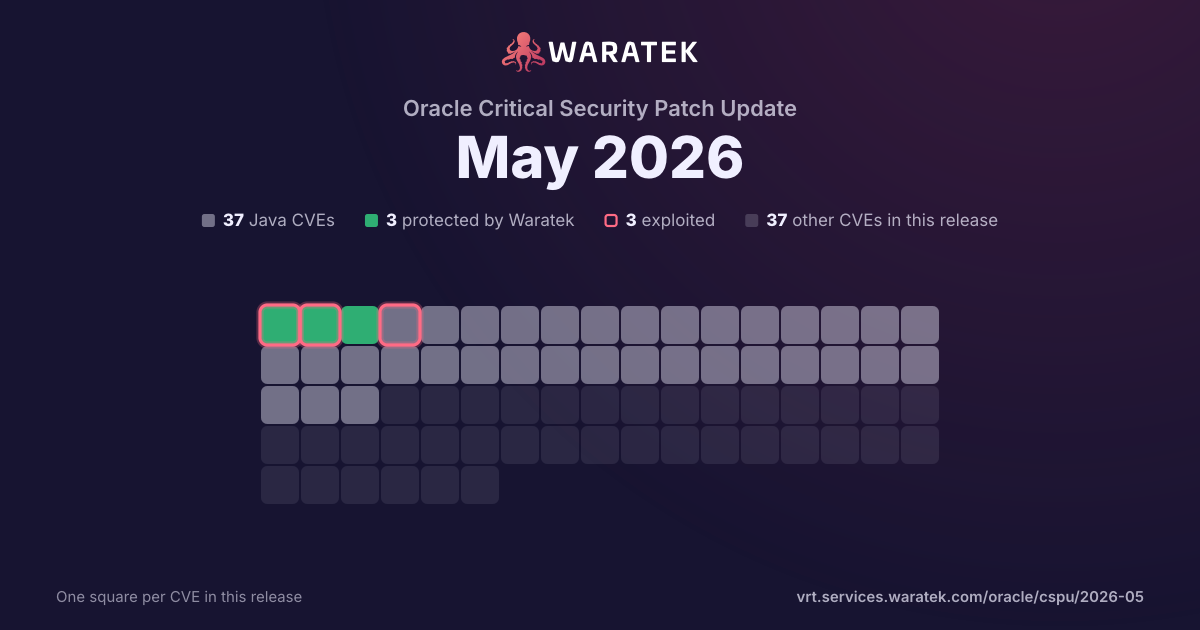
By status
3Protected by Waratek3Mitigation candidate31No exploit published37Not applicable
3Exploited, marked by the ring
No exploit published. For 22 of them, Oracle's security advisory is the source of public detail.
Protected by Waratek. Waratek RASP can block exploitation of these on systems that have not applied the patch yet.
Overview 3 matches · 0 protected · 1 exploited · 0 CISA KEV · 1 public PoC · 0 EPSS ≥ 0.5
Protected by Waratek
0
0.0%
Rule in development
0
0.0%
Mitigation candidate
3
100.0%
No exploit published
0
0.0%
blocked by ARMR today
0
0.0%
partly blocked
0
0.0%
not blocked
3
100.0%
not established
0
0.0%
unrecorded
0
0.0%
Exploited
1
33.3%
Working exploit published
0
0.0%
Proof of concept only
0
0.0%
Forecast only
0
0.0%
No public exploit
2
66.7%
split by
peak 2 / month
Mar 26Apr 26
| CVE | Severity | Published▾ | Status | Exploitation | Description |
|---|---|---|---|---|---|
| CVE-2026-40466 | High | 2026-04-24 | Mitigation candidate | Exploited | Improper Input Validation, Improper Control of Generation of Code ('Code Injection') vulnerability in Apache ActiveMQ Broker, Apache ActiveMQ All, Apache ActiveMQ. An authenticated attacker may bypass the fix in CVE-2026-34197 by adding a connector using an HTTP Discovery transport via BrokerView.addNetworkConnector or BrokerView.addConnector through Jolokia if the activemq-http module is on the classpath. A malicious HTTP endpoint can return a VM transport through the HTTP URI which will bypass the validation added in CVE-2026-34197. The attacker can then use the VM transport's brokerConfig parameter to load a remote Spring XML application context using ResourceXmlApplicationContext. Because Spring's ResourceXmlApplicationContext instantiates all singleton beans before the BrokerService validates the configuration, arbitrary code execution occurs on the broker's JVM through bean factory methods such as Runtime.exec(). This issue affects Apache ActiveMQ Broker: before 5.19.6, from 6.0.0 before 6.2.5; Apache ActiveMQ All: before 5.19.6, from 6.0.0 before 6.2.5; Apache ActiveMQ: before 5.19.6, from 6.0.0 before 6.2.5. Users are recommended to upgrade to version 5.19.6 or 6.2.5, which fixes the issue. |
| CVE-2026-24308 | High | 2026-03-07 | Mitigation candidate | No public exploit | Improper handling of configuration values in ZKConfig in Apache ZooKeeper 3.8.5 and 3.9.4 on all platforms allows an attacker to expose sensitive information stored in client configuration in the client's logfile. Configuration values are exposed at INFO level logging rendering potential production systems affected by the issue. Users are recommended to upgrade to version 3.8.6 or 3.9.5 which fixes this issue. |
| CVE-2026-24281 | High | 2026-03-07 | Mitigation candidate | No public exploit | Hostname verification in Apache ZooKeeper ZKTrustManager falls back to reverse DNS (PTR) when IP SAN validation fails, allowing attackers who control or spoof PTR records to impersonate ZooKeeper servers or clients with a valid certificate for the PTR name. It's important to note that attacker must present a certificate which is trusted by ZKTrustManager which makes the attack vector harder to exploit. Users are recommended to upgrade to version 3.8.6 or 3.9.5, which fixes this issue by introducing a new configuration option to disable reverse DNS lookup in client and quorum protocols. |