
Oracle Critical Security Patch Update May 2026
Released May 2026 · Oracle's advisory ↗ · ← Critical Patch Update, April 2026 · Security Patch Update, June 2026 →
74 CVEs in this release, one square each
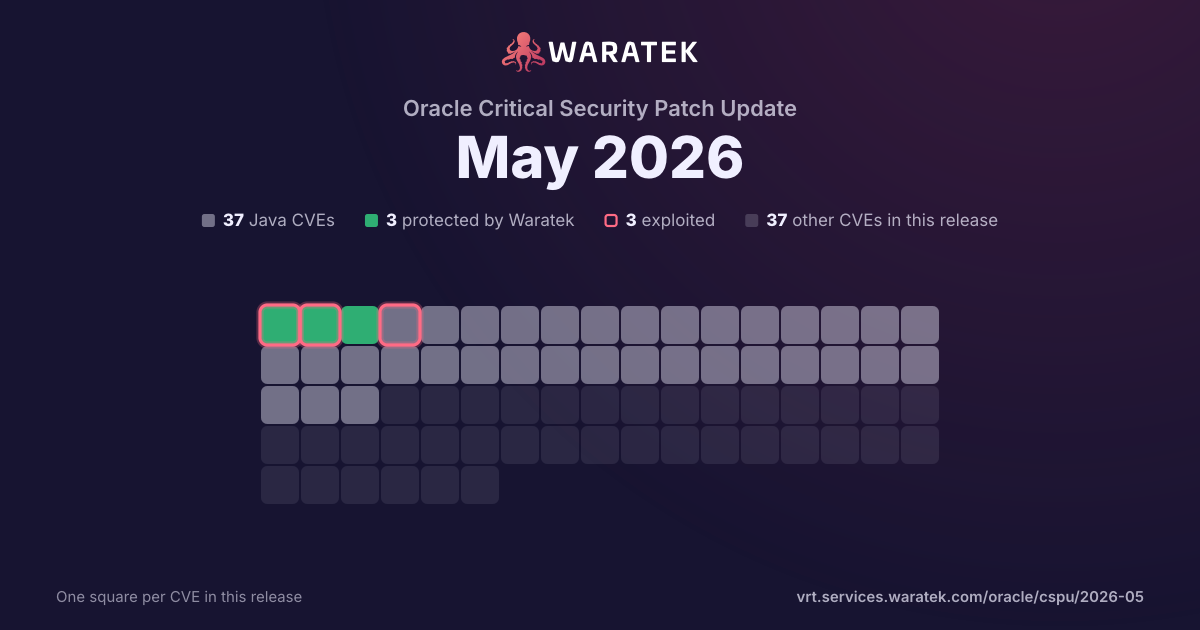
By status
3Protected by Waratek3Mitigation candidate31No exploit published37Not applicable
3Exploited, marked by the ring
No exploit published. For 22 of them, Oracle's security advisory is the source of public detail.
Protected by Waratek. Waratek RASP can block exploitation of these on systems that have not applied the patch yet.
Overview 15 matches · 0 protected · 0 exploited · 0 CISA KEV · 0 public PoC · 0 EPSS ≥ 0.5
15matches
0protected0.0%
0exploited0.0%
0CISA KEV0.0%
0public PoC0.0%
0EPSS ≥ 0.50.0%
Protected by Waratek
0
0.0%
Rule in development
0
0.0%
Mitigation candidate
0
0.0%
No exploit published
15
100.0%
Outside Waratek scope
0
0.0%
Not applicable
0
0.0%
Withdrawn CVE
0
0.0%
blocked by ARMR today
0
0.0%
partly blocked
0
0.0%
not blocked
15
100.0%
not established
0
0.0%
unrecorded
0
0.0%
Exploited
0
0.0%
Working exploit published
0
0.0%
Proof of concept only
0
0.0%
Forecast only
0
0.0%
No public exploit
15
100.0%
split by
peak 11 / month
Apr 26May 26
| CVE | Severity | Published▾ | Status | Exploitation | Description |
|---|---|---|---|---|---|
| CVE-2026-46837 | High | 2026-05-28 | No exploit published | No public exploit | Vulnerability in the Oracle Flow Manufacturing product of Oracle E-Business Suite (component: Security). Supported versions that are affected are 12.2.9-12.2.15. Easily exploitable vulnerability allows low privileged attacker with network access via SQL to compromise Oracle Flow Manufacturing. Successful attacks of this vulnerability can result in takeover of Oracle Flow Manufacturing. CVSS 3.1 Base Score 8.8 (Confidentiality, Integrity and Availability impacts). CVSS Vector: (CVSS:3.1/AV:N/AC:L/PR:L/UI:N/S:U/C:H/I:H/A:H). |
| CVE-2026-46829 | High | 2026-05-28 | No exploit published | No public exploit | Vulnerability in Oracle REST Data Services (component: Mongoapi). Supported versions that are affected are 24.2.0-26.1.0. Easily exploitable vulnerability allows unauthenticated attacker with network access via HTTPS to compromise Oracle REST Data Services. Successful attacks of this vulnerability can result in unauthorized ability to cause a hang or frequently repeatable crash (complete DOS) of Oracle REST Data Services. CVSS 3.1 Base Score 7.5 (Availability impacts). CVSS Vector: (CVSS:3.1/AV:N/AC:L/PR:N/UI:N/S:U/C:N/I:N/A:H). |
| CVE-2026-46828 | High | 2026-05-28 | No exploit published | No public exploit | Vulnerability in the Oracle Payroll product of Oracle E-Business Suite (component: Internal Operations). Supported versions that are affected are 12.2.3-12.2.15. Easily exploitable vulnerability allows low privileged attacker with network access via HTTP to compromise Oracle Payroll. Successful attacks of this vulnerability can result in unauthorized creation, deletion or modification access to critical data or all Oracle Payroll accessible data as well as unauthorized access to critical data or complete access to all Oracle Payroll accessible data. CVSS 3.1 Base Score 8.1 (Confidentiality and Integrity impacts). CVSS Vector: (CVSS:3.1/AV:N/AC:L/PR:L/UI:N/S:U/C:H/I:H/A:N). |
| CVE-2026-46827 | High | 2026-05-28 | No exploit published | No public exploit | Vulnerability in the Oracle Payroll product of Oracle E-Business Suite (component: Self Service Manager). Supported versions that are affected are 12.2.3-12.2.15. Easily exploitable vulnerability allows low privileged attacker with network access via HTTP to compromise Oracle Payroll. Successful attacks of this vulnerability can result in takeover of Oracle Payroll. CVSS 3.1 Base Score 8.8 (Confidentiality, Integrity and Availability impacts). CVSS Vector: (CVSS:3.1/AV:N/AC:L/PR:L/UI:N/S:U/C:H/I:H/A:H). |
| CVE-2026-46826 | High | 2026-05-28 | No exploit published | No public exploit | Vulnerability in the Oracle Payroll product of Oracle E-Business Suite (component: Internal Operations). Supported versions that are affected are 12.2.3-12.2.15. Easily exploitable vulnerability allows low privileged attacker with network access via HTTPS to compromise Oracle Payroll. Successful attacks of this vulnerability can result in takeover of Oracle Payroll. CVSS 3.1 Base Score 8.8 (Confidentiality, Integrity and Availability impacts). CVSS Vector: (CVSS:3.1/AV:N/AC:L/PR:L/UI:N/S:U/C:H/I:H/A:H). |
| CVE-2026-46823 | High | 2026-05-28 | No exploit published | No public exploit | Vulnerability in the Oracle Public Sector Financials (International) product of Oracle E-Business Suite (component: Authorization). Supported versions that are affected are 12.2.6-12.2.15. Easily exploitable vulnerability allows low privileged attacker with network access via HTTPS to compromise Oracle Public Sector Financials (International). While the vulnerability is in Oracle Public Sector Financials (International), attacks may significantly impact additional products (scope change). Successful attacks of this vulnerability can result in unauthorized access to critical data or complete access to all Oracle Public Sector Financials (International) accessible data. CVSS 3.1 Base Score 7.7 (Confidentiality impacts). CVSS Vector: (CVSS:3.1/AV:N/AC:L/PR:L/UI:N/S:C/C:H/I:N/A:N). |
| CVE-2026-46821 | High | 2026-05-28 | No exploit published | No public exploit | Vulnerability in the Oracle Financials Common Modules product of Oracle E-Business Suite (component: Common Components). Supported versions that are affected are 12.2.3-12.2.15. Easily exploitable vulnerability allows low privileged attacker with network access via HTTP to compromise Oracle Financials Common Modules. While the vulnerability is in Oracle Financials Common Modules, attacks may significantly impact additional products (scope change). Successful attacks of this vulnerability can result in unauthorized access to critical data or complete access to all Oracle Financials Common Modules accessible data. CVSS 3.1 Base Score 7.7 (Confidentiality impacts). CVSS Vector: (CVSS:3.1/AV:N/AC:L/PR:L/UI:N/S:C/C:H/I:N/A:N). |
| CVE-2026-46820 | High | 2026-05-28 | No exploit published | No public exploit | Vulnerability in the Oracle Financials Common Modules product of Oracle E-Business Suite (component: Common Components). Supported versions that are affected are 12.2.3-12.2.15. Easily exploitable vulnerability allows low privileged attacker with network access via HTTP to compromise Oracle Financials Common Modules. While the vulnerability is in Oracle Financials Common Modules, attacks may significantly impact additional products (scope change). Successful attacks of this vulnerability can result in unauthorized access to critical data or complete access to all Oracle Financials Common Modules accessible data as well as unauthorized update, insert or delete access to some of Oracle Financials Common Modules accessible data. CVSS 3.1 Base Score 8.5 (Confidentiality and Integrity impacts). CVSS Vector: (CVSS:3.1/AV:N/AC:L/PR:L/UI:N/S:C/C:H/I:L/A:N). |
| CVE-2026-46818 | High | 2026-05-28 | No exploit published | No public exploit | Vulnerability in the Oracle Payments product of Oracle E-Business Suite (component: File Transmission). Supported versions that are affected are 12.2.3-12.2.15. Difficult to exploit vulnerability allows unauthenticated attacker with network access via HTTPS to compromise Oracle Payments. Successful attacks of this vulnerability can result in unauthorized creation, deletion or modification access to critical data or all Oracle Payments accessible data as well as unauthorized access to critical data or complete access to all Oracle Payments accessible data. CVSS 3.1 Base Score 7.4 (Confidentiality and Integrity impacts). CVSS Vector: (CVSS:3.1/AV:N/AC:H/PR:N/UI:N/S:U/C:H/I:H/A:N). |
| CVE-2026-35277 | High | 2026-05-28 | No exploit published | No public exploit | Vulnerability in Oracle REST Data Services (component: Core). Supported versions that are affected are 24.2.0-26.1.0. Easily exploitable vulnerability allows low privileged attacker with network access via HTTPS to compromise Oracle REST Data Services. Successful attacks of this vulnerability can result in unauthorized creation, deletion or modification access to critical data or all Oracle REST Data Services accessible data as well as unauthorized access to critical data or complete access to all Oracle REST Data Services accessible data. CVSS 3.1 Base Score 8.1 (Confidentiality and Integrity impacts). CVSS Vector: (CVSS:3.1/AV:N/AC:L/PR:L/UI:N/S:U/C:H/I:H/A:N). |
| CVE-2026-35266 | High | 2026-05-28 | No exploit published | No public exploit | Vulnerability in Oracle REST Data Services (component: Core). Supported versions that are affected are 24.2.0-26.1.0. Difficult to exploit vulnerability allows low privileged attacker with network access via HTTPS to compromise Oracle REST Data Services. Successful attacks require human interaction from a person other than the attacker and while the vulnerability is in Oracle REST Data Services, attacks may significantly impact additional products (scope change). Successful attacks of this vulnerability can result in unauthorized creation, deletion or modification access to critical data or all Oracle REST Data Services accessible data as well as unauthorized access to critical data or complete access to all Oracle REST Data Services accessible data and unauthorized ability to cause a partial denial of service (partial DOS) of Oracle REST Data Services. CVSS 3.1 Base Score 7.9 (Confidentiality, Integrity and Availability impacts). CVSS Vector: (CVSS:3.1/AV:N/AC:H/PR:L/UI:R/S:C/C:H/I:H/A:L). |
| CVE-2026-41044 | High | 2026-04-24 | No exploit published | No public exploit | Improper Input Validation, Improper Control of Generation of Code ('Code Injection') vulnerability in Apache ActiveMQ, Apache ActiveMQ Broker, Apache ActiveMQ All. An authenticated attacker can use the admin web console page to construct a malicious broker name that bypasses name validation to include an xbean binding that can be later used by a VM transport to load a remote Spring XML application. The attacker can then use the DestinationView mbean to send a message to trigger a VM transport creation that will reference this malicious broker name which can lead to loading the malicious Spring XML context file. Because Spring's ResourceXmlApplicationContext instantiates all singleton beans before the BrokerService validates the configuration, arbitrary code execution occurs on the broker's JVM through bean factory methods such as Runtime.exec(). This issue affects Apache ActiveMQ: before 5.19.6, from 6.0.0 before 6.2.5; Apache ActiveMQ Broker: before 5.19.6, from 6.0.0 before 6.2.5; Apache ActiveMQ All: before 5.19.6, from 6.0.0 before 6.2.5. Users are recommended to upgrade to version 6.2.5 or 5.19.6, which fixes the issue. |
| CVE-2026-34487 | High | 2026-04-09 | No exploit published | No public exploit | Insertion of Sensitive Information into Log File vulnerability in the cloud membership for clustering component of Apache Tomcat exposed the Kubernetes bearer token. This issue affects Apache Tomcat: from 11.0.0-M1 through 11.0.20, from 10.1.0-M1 through 10.1.53, from 9.0.13 through 9.0.116. Users are recommended to upgrade to version 11.0.21, 10.1.54 or 9.0.117, which fix the issue. |
| CVE-2026-34483 | High | 2026-04-09 | No exploit published | No public exploit | Improper Encoding or Escaping of Output vulnerability in the JsonAccessLogValve component of Apache Tomcat. This issue affects Apache Tomcat: from 11.0.0-M1 through 11.0.20, from 10.1.0-M1 through 10.1.53, from 9.0.40 through 9.0.116. Users are recommended to upgrade to version 11.0.21, 10.1.54 or 9.0.117 , which fix the issue. |
| CVE-2026-5795 | High | 2026-04-08 | No exploit published | No public exploit | In Eclipse Jetty, the class JASPIAuthenticator initiates the authentication checks, which set two ThreadLocal variable. Upon returning from the initial checks, there are conditions that cause an early return from the JASPIAuthenticator code without clearing those ThreadLocals. A subsequent request using the same thread inherits the ThreadLocal values, leading to a broken access control and privilege escalation. |