
Oracle Critical Security Patch Update May 2026
Released May 2026 · Oracle's advisory ↗ · ← Critical Patch Update, April 2026 · Security Patch Update, June 2026 →
74 CVEs in this release, one square each
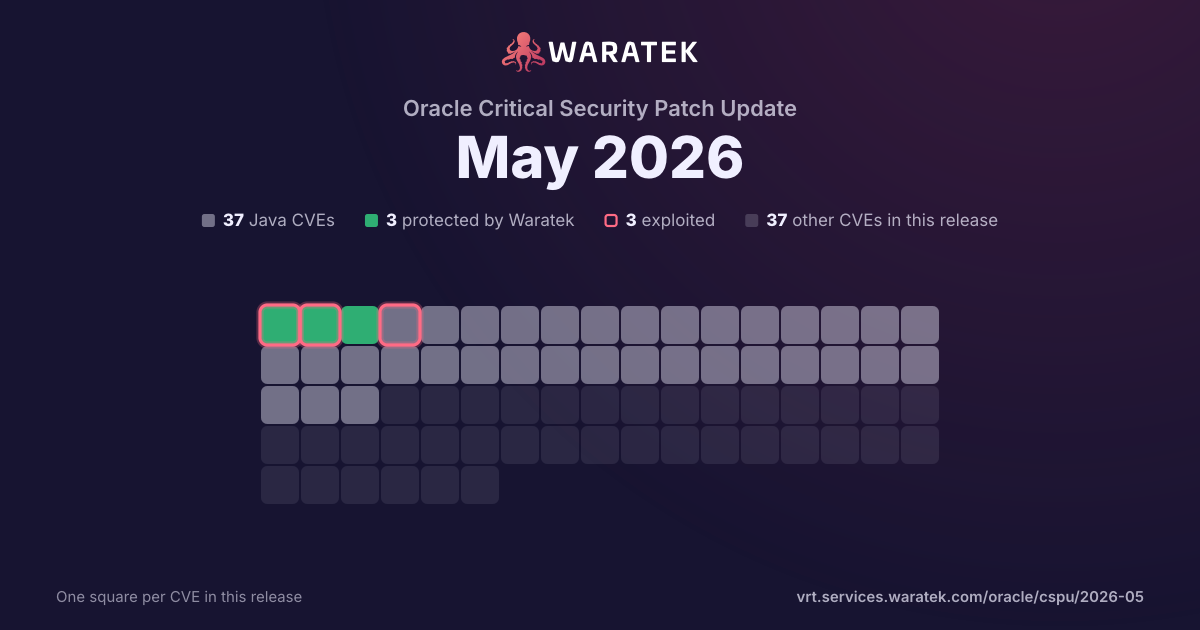
By status
3Protected by Waratek3Mitigation candidate31No exploit published37Not applicable
3Exploited, marked by the ring
No exploit published. For 22 of them, Oracle's security advisory is the source of public detail.
Protected by Waratek. Waratek RASP can block exploitation of these on systems that have not applied the patch yet.
Overview 4 matches · 3 in Waratek scope · 0 protected · 0 exploited · 0 CISA KEV · 1 public PoC · 0 EPSS ≥ 0.5
4matches
3in Waratek scope75.0%
0protected0.0%
0exploited0.0%
0CISA KEV0.0%
1public PoC25.0%
0EPSS ≥ 0.50.0%
Protected by Waratek
0
0.0%
Rule in development
0
0.0%
Mitigation candidate
0
0.0%
No exploit published
3
75.0%
Outside Waratek scope
0
0.0%
Not applicable
1
25.0%
Withdrawn CVE
0
0.0%
blocked by ARMR today
0
0.0%
partly blocked
0
0.0%
not blocked
4
100.0%
not established
0
0.0%
unrecorded
0
0.0%
Exploited
0
0.0%
Working exploit published
0
0.0%
Proof of concept only
2
50.0%
Forecast only
0
0.0%
No public exploit
2
50.0%
split by
peak 3 / month
Jan 26Feb 26Mar 26Apr 26
| CVE | Severity | Published▾ | Status | Exploitation | Description |
|---|---|---|---|---|---|
| CVE-2026-33557 | Critical | 2026-04-20 | No exploit published | No public exploit | A possible security vulnerability has been identified in Apache Kafka. By default, the broker property `sasl.oauthbearer.jwt.validator.class` is set to `org.apache.kafka.common.security.oauthbearer.DefaultJwtValidator`. It accepts any JWT token without validating its signature, issuer, or audience. An attacker can generate a JWT token from any issuer with the `preferred_username` set to any user, and the broker will accept it. We advise the Kafka users using kafka v4.1.0 or v4.1.1 to set the config `sasl.oauthbearer.jwt.validator.class` to `org.apache.kafka.common.security.oauthbearer.BrokerJwtValidator` explicitly to avoid this vulnerability. Since Kafka v4.1.2 and v4.2.0 and later, the issue is fixed and will correctly validate the JWT token. |
| CVE-2026-2332 | Critical | 2026-04-14 | No exploit published | Proof of concept only | In Eclipse Jetty, the HTTP/1.1 parser is vulnerable to request smuggling when chunk extensions are used, similar to the "funky chunks" techniques outlined here: * https://w4ke.info/2025/06/18/funky-chunks.html * https://w4ke.info/2025/10/29/funky-chunks-2.html Jetty terminates chunk extension parsing at \r\n inside quoted strings instead of treating this as an error. POST / HTTP/1.1 Host: localhost Transfer-Encoding: chunked 1;ext="val X 0 GET /smuggled HTTP/1.1 ... Note how the chunk extension does not close the double quotes, and it is able to inject a smuggled request. |
| CVE-2026-29145 | Critical | 2026-04-09 | No exploit published | No public exploit | CLIENT_CERT authentication does not fail as expected for some scenarios when soft fail is disabled vulnerability in Apache Tomcat, Apache Tomcat Native. This issue affects Apache Tomcat: from 11.0.0-M1 through 11.0.18, from 10.1.0-M7 through 10.1.52, from 9.0.83 through 9.0.115; Apache Tomcat Native: from 1.1.23 through 1.1.34, from 1.2.0 through 1.2.39, from 1.3.0 through 1.3.6, from 2.0.0 through 2.0.13. Users are recommended to upgrade to version Tomcat Native 1.3.7 or 2.0.14 and Tomcat 11.0.20, 10.1.53 and 9.0.116, which fix the issue. |
| CVE-2025-15467 | Critical | 2026-01-27 | Not applicable | Proof of concept only | Issue summary: Parsing CMS AuthEnvelopedData or EnvelopedData message with maliciously crafted AEAD parameters can trigger a stack buffer overflow. Impact summary: A stack buffer overflow may lead to a crash, causing Denial of Service, or potentially remote code execution. When parsing CMS (Auth)EnvelopedData structures that use AEAD ciphers such as AES-GCM, the IV (Initialization Vector) encoded in the ASN.1 parameters is copied into a fixed-size stack buffer without verifying that its length fits the destination. An attacker can supply a crafted CMS message with an oversized IV, causing a stack-based out-of-bounds write before any authentication or tag verification occurs. Applications and services that parse untrusted CMS or PKCS#7 content using AEAD ciphers (e.g., S/MIME (Auth)EnvelopedData with AES-GCM) are vulnerable. Because the overflow occurs prior to authentication, no valid key material is required to trigger it. While exploitability to remote code execution depends on platform and toolchain mitigations, the stack-based write primitive represents a severe risk. The FIPS modules in 3.6, 3.5, 3.4, 3.3 and 3.0 are not affected by this issue, as the CMS implementation is outside the OpenSSL FIPS module boundary. OpenSSL 3.6, 3.5, 3.4, 3.3 and 3.0 are vulnerable to this issue. OpenSSL 1.1.1 and 1.0.2 are not affected by this issue. |