
Oracle Critical Security Patch Update May 2026
Released May 2026 · Oracle's advisory ↗ · ← Critical Patch Update, April 2026 · Security Patch Update, June 2026 →
74 CVEs in this release, one square each
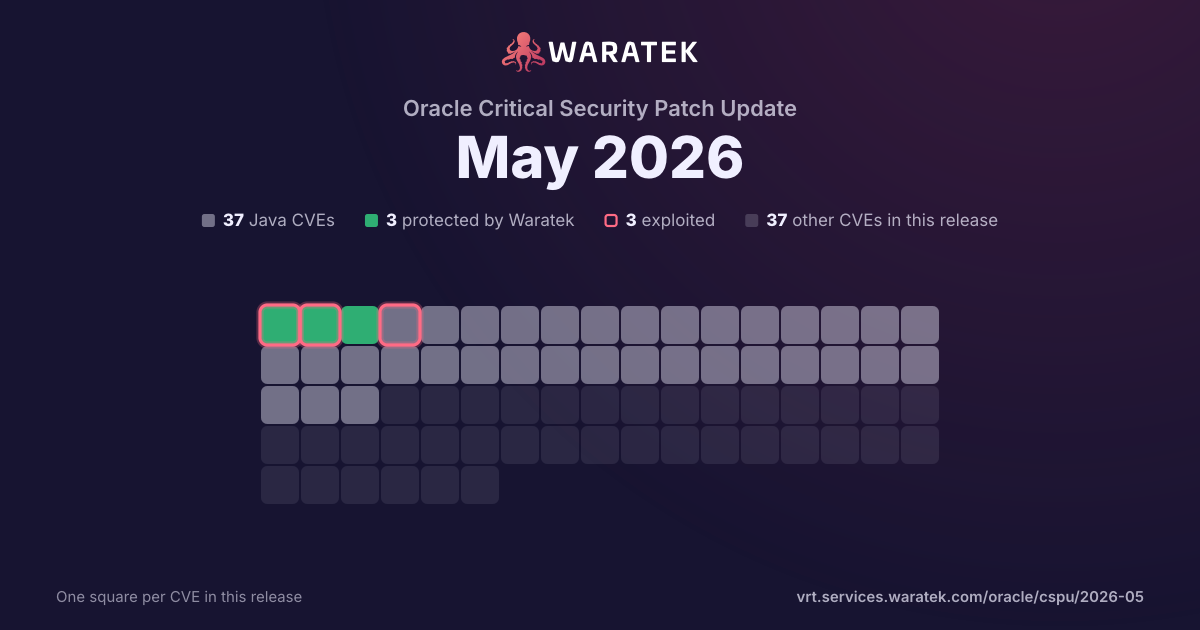
By status
3Protected by Waratek3Mitigation candidate31No exploit published37Not applicable
3Exploited, marked by the ring
No exploit published. For 22 of them, Oracle's security advisory is the source of public detail.
Protected by Waratek. Waratek RASP can block exploitation of these on systems that have not applied the patch yet.
Overview 3 matches · 0 in Waratek scope · 0 protected · 0 exploited · 0 CISA KEV · 1 public PoC · 0 EPSS ≥ 0.5
3matches
0in Waratek scope0.0%
0protected0.0%
0exploited0.0%
0CISA KEV0.0%
1public PoC33.3%
0EPSS ≥ 0.50.0%
Protected by Waratek
0
0.0%
Rule in development
0
0.0%
Mitigation candidate
0
0.0%
No exploit published
0
0.0%
Outside Waratek scope
0
0.0%
Not applicable
3
100.0%
Withdrawn CVE
0
0.0%
blocked by ARMR today
0
0.0%
partly blocked
0
0.0%
not blocked
3
100.0%
not established
0
0.0%
unrecorded
0
0.0%
Exploited
0
0.0%
Working exploit published
0
0.0%
Proof of concept only
2
66.7%
Forecast only
0
0.0%
No public exploit
1
33.3%
split by
peak 2 / month
Aug 25Sep 25Oct 25Nov 25Dec 25Jan 26
| CVE | Severity | Published▾ | Status | Exploitation | Description |
|---|---|---|---|---|---|
| CVE-2025-15467 | Critical | 2026-01-27 | Not applicable | Proof of concept only | Issue summary: Parsing CMS AuthEnvelopedData or EnvelopedData message with maliciously crafted AEAD parameters can trigger a stack buffer overflow. Impact summary: A stack buffer overflow may lead to a crash, causing Denial of Service, or potentially remote code execution. When parsing CMS (Auth)EnvelopedData structures that use AEAD ciphers such as AES-GCM, the IV (Initialization Vector) encoded in the ASN.1 parameters is copied into a fixed-size stack buffer without verifying that its length fits the destination. An attacker can supply a crafted CMS message with an oversized IV, causing a stack-based out-of-bounds write before any authentication or tag verification occurs. Applications and services that parse untrusted CMS or PKCS#7 content using AEAD ciphers (e.g., S/MIME (Auth)EnvelopedData with AES-GCM) are vulnerable. Because the overflow occurs prior to authentication, no valid key material is required to trigger it. While exploitability to remote code execution depends on platform and toolchain mitigations, the stack-based write primitive represents a severe risk. The FIPS modules in 3.6, 3.5, 3.4, 3.3 and 3.0 are not affected by this issue, as the CMS implementation is outside the OpenSSL FIPS module boundary. OpenSSL 3.6, 3.5, 3.4, 3.3 and 3.0 are vulnerable to this issue. OpenSSL 1.1.1 and 1.0.2 are not affected by this issue. |
| CVE-2025-14017 | Medium | 2026-01-08 | Not applicable | No public exploit | When doing multi-threaded LDAPS transfers (LDAP over TLS) with libcurl, changing TLS options in one thread would inadvertently change them globally and therefore possibly also affect other concurrently setup transfers. Disabling certificate verification for a specific transfer could unintentionally disable the feature for other threads as well. |
| CVE-2025-58050 | Medium | 2025-08-27 | Not applicable | Proof of concept only | The PCRE2 library is a set of C functions that implement regular expression pattern matching. In version 10.45, a heap-buffer-overflow read vulnerability exists in the PCRE2 regular expression matching engine, specifically within the handling of the (*scs:...) (Scan SubString) verb when combined with (*ACCEPT) in src/pcre2_match.c. This vulnerability may potentially lead to information disclosure if the out-of-bounds data read during the memcmp affects the final match result in a way observable by the attacker. This issue has been resolved in version 10.46. |