
Oracle Critical Security Patch Update May 2026
Released May 2026 · Oracle's advisory ↗ · ← Critical Patch Update, April 2026 · Security Patch Update, June 2026 →
74 CVEs in this release, one square each
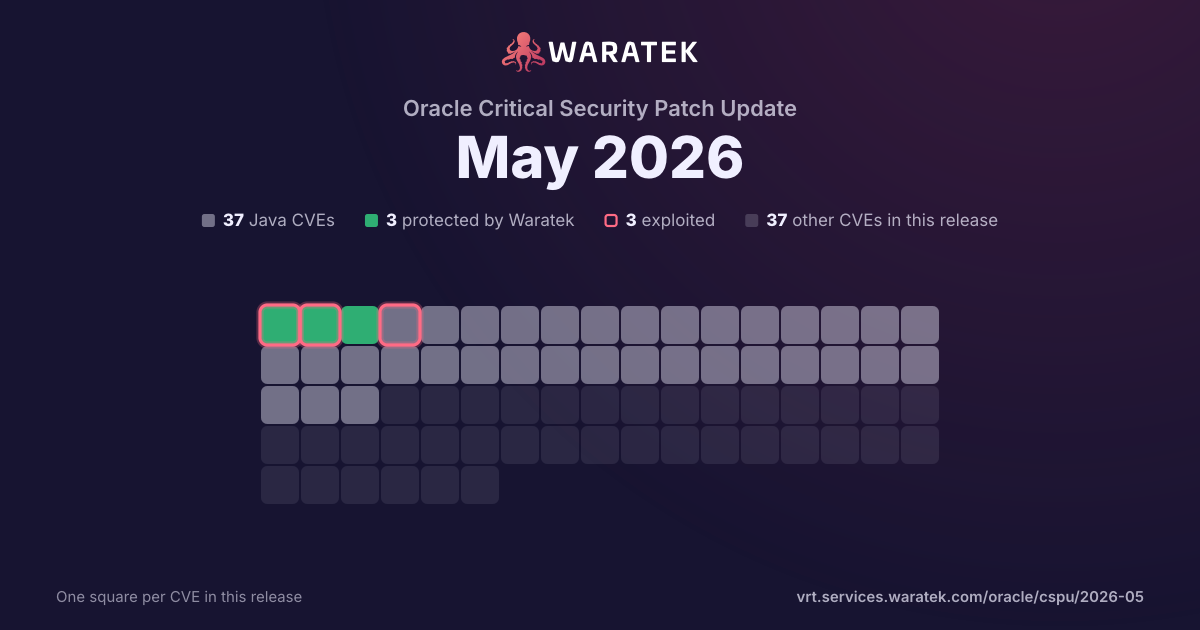
By status
3Protected by Waratek3Mitigation candidate31No exploit published37Not applicable
3Exploited, marked by the ring
No exploit published. For 22 of them, Oracle's security advisory is the source of public detail.
Protected by Waratek. Waratek RASP can block exploitation of these on systems that have not applied the patch yet.
Overview 14 matches · 11 in Waratek scope · 1 protected · 1 exploited · 1 CISA KEV · 1 public PoC · 1 EPSS ≥ 0.5
14matches
11in Waratek scope78.6%
1protected7.1%
1exploited7.1%
1CISA KEV7.1%
1public PoC7.1%
1EPSS ≥ 0.57.1%
Protected by Waratek
1
7.1%
Rule in development
0
0.0%
Mitigation candidate
0
0.0%
No exploit published
10
71.4%
Outside Waratek scope
0
0.0%
Not applicable
3
21.4%
Withdrawn CVE
0
0.0%
blocked by ARMR today
1
7.1%
partly blocked
0
0.0%
not blocked
13
92.9%
not established
0
0.0%
unrecorded
0
0.0%
Exploited
1
7.1%
Working exploit published
0
0.0%
Proof of concept only
2
14.3%
Forecast only
0
0.0%
No public exploit
11
78.6%
split by
peak 10 / month
Jan 261
Not applicable1
Critical1
not blocked1
Proof of concept only1
Feb 260
Mar 260
Apr 263
No exploit published3
Critical3
not blocked3
Proof of concept only1
No public exploit2
May 2610
Protected by Waratek1
No exploit published7
Not applicable2
Critical10
blocked by ARMR today1
not blocked9
Exploited1
No public exploit9
Jan 26Feb 26Mar 26Apr 26May 26
| CVE | Severity | Published▾ | Status | Exploitation | Description |
|---|---|---|---|---|---|
| CVE-2026-46840 | Critical | 2026-05-28 | No exploit published | No public exploit | Vulnerability in Oracle REST Data Services (component: Backend-as-a-Service). Supported versions that are affected are 24.2.0-26.1.0. Easily exploitable vulnerability allows unauthenticated attacker with network access via HTTPS to compromise Oracle REST Data Services. While the vulnerability is in Oracle REST Data Services, attacks may significantly impact additional products (scope change). Successful attacks of this vulnerability can result in takeover of Oracle REST Data Services. CVSS 3.1 Base Score 10.0 (Confidentiality, Integrity and Availability impacts). CVSS Vector: (CVSS:3.1/AV:N/AC:L/PR:N/UI:N/S:C/C:H/I:H/A:H). |
| CVE-2026-46839 | Critical | 2026-05-28 | No exploit published | No public exploit | Vulnerability in Oracle REST Data Services (component: Core). Supported versions that are affected are 24.2.0-26.1.0. Easily exploitable vulnerability allows low privileged attacker with network access via HTTPS to compromise Oracle REST Data Services. While the vulnerability is in Oracle REST Data Services, attacks may significantly impact additional products (scope change). Successful attacks of this vulnerability can result in takeover of Oracle REST Data Services. CVSS 3.1 Base Score 9.9 (Confidentiality, Integrity and Availability impacts). CVSS Vector: (CVSS:3.1/AV:N/AC:L/PR:L/UI:N/S:C/C:H/I:H/A:H). |
| CVE-2026-46833 | Critical | 2026-05-28 | Not applicable | No public exploit | Vulnerability in the Net Service component of Oracle Database Server. Supported versions that are affected are 23.4.0-23.26.2. Difficult to exploit vulnerability allows unauthenticated attacker with network access via TLS to compromise Net Service. While the vulnerability is in Net Service, attacks may significantly impact additional products (scope change). Successful attacks of this vulnerability can result in takeover of Net Service. CVSS 3.1 Base Score 9.0 (Confidentiality, Integrity and Availability impacts). CVSS Vector: (CVSS:3.1/AV:N/AC:H/PR:N/UI:N/S:C/C:H/I:H/A:H). |
| CVE-2026-46824 | Critical | 2026-05-28 | No exploit published | No public exploit | Vulnerability in the Oracle Universal Work Queue product of Oracle E-Business Suite (component: Work Provider Site Level Administration). Supported versions that are affected are 12.2.3-12.2.15. Easily exploitable vulnerability allows low privileged attacker with network access via HTTP to compromise Oracle Universal Work Queue. While the vulnerability is in Oracle Universal Work Queue, attacks may significantly impact additional products (scope change). Successful attacks of this vulnerability can result in takeover of Oracle Universal Work Queue. CVSS 3.1 Base Score 9.9 (Confidentiality, Integrity and Availability impacts). CVSS Vector: (CVSS:3.1/AV:N/AC:L/PR:L/UI:N/S:C/C:H/I:H/A:H). |
| CVE-2026-46822 | Critical | 2026-05-28 | No exploit published | No public exploit | Vulnerability in the Oracle iAssets product of Oracle E-Business Suite (component: Internal Operations). Supported versions that are affected are 12.2.3-12.2.15. Easily exploitable vulnerability allows low privileged attacker with network access via HTTP to compromise Oracle iAssets. While the vulnerability is in Oracle iAssets, attacks may significantly impact additional products (scope change). Successful attacks of this vulnerability can result in takeover of Oracle iAssets. CVSS 3.1 Base Score 9.9 (Confidentiality, Integrity and Availability impacts). CVSS Vector: (CVSS:3.1/AV:N/AC:L/PR:L/UI:N/S:C/C:H/I:H/A:H). |
| CVE-2026-46819 | Critical | 2026-05-28 | No exploit published | No public exploit | Vulnerability in the Oracle Internet Procurement Connector product of Oracle E-Business Suite (component: Internal Operations). Supported versions that are affected are 12.2.3-12.2.15. Easily exploitable vulnerability allows unauthenticated attacker with network access via HTTP to compromise Oracle Internet Procurement Connector. Successful attacks of this vulnerability can result in unauthorized creation, deletion or modification access to critical data or all Oracle Internet Procurement Connector accessible data as well as unauthorized access to critical data or complete access to all Oracle Internet Procurement Connector accessible data. CVSS 3.1 Base Score 9.1 (Confidentiality and Integrity impacts). CVSS Vector: (CVSS:3.1/AV:N/AC:L/PR:N/UI:N/S:U/C:H/I:H/A:N). |
| CVE-2026-46817 | Critical | 2026-05-28 | Protected by Waratek | Exploited | Vulnerability in the Oracle Payments product of Oracle E-Business Suite (component: File Transmission). Supported versions that are affected are 12.2.3-12.2.15. Easily exploitable vulnerability allows unauthenticated attacker with network access via HTTP to compromise Oracle Payments. Successful attacks of this vulnerability can result in takeover of Oracle Payments. CVSS 3.1 Base Score 9.8 (Confidentiality, Integrity and Availability impacts). CVSS Vector: (CVSS:3.1/AV:N/AC:L/PR:N/UI:N/S:U/C:H/I:H/A:H). |
| CVE-2026-46775 | Critical | 2026-05-28 | No exploit published | No public exploit | Vulnerability in Oracle REST Data Services (component: Core). Supported versions that are affected are 24.2.0-26.1.0. Easily exploitable vulnerability allows low privileged attacker with network access via HTTPS to compromise Oracle REST Data Services. While the vulnerability is in Oracle REST Data Services, attacks may significantly impact additional products (scope change). Successful attacks of this vulnerability can result in takeover of Oracle REST Data Services. CVSS 3.1 Base Score 9.9 (Confidentiality, Integrity and Availability impacts). CVSS Vector: (CVSS:3.1/AV:N/AC:L/PR:L/UI:N/S:C/C:H/I:H/A:H). |
| CVE-2026-34311 | Critical | 2026-05-28 | No exploit published | No public exploit | Vulnerability in the Oracle Hospitality OPERA 5 Property Services product of Oracle Hospitality Applications (component: Opera). Supported versions that are affected are 5.6.19.24, 5.6.22, 5.6.25.19, 5.6.27.6 and 5.6.28. Easily exploitable vulnerability allows unauthenticated attacker with network access via HTTP to compromise Oracle Hospitality OPERA 5 Property Services. Successful attacks of this vulnerability can result in takeover of Oracle Hospitality OPERA 5 Property Services. CVSS 3.1 Base Score 9.8 (Confidentiality, Integrity and Availability impacts). CVSS Vector: (CVSS:3.1/AV:N/AC:L/PR:N/UI:N/S:U/C:H/I:H/A:H). |
| CVE-2026-28780 | Critical | 2026-05-05 | Not applicable | No public exploit | Heap-based Buffer Overflow vulnerability in mod_proxy_ajp of Apache HTTP Server. If mod_proxy_ajp connects to a malicious AJP server this AJP server can send a malicious AJP message back to mod_proxy_ajp and cause it to write 4 attacker controlled bytes after the end of a heap based buffer. This issue affects Apache HTTP Server: through 2.4.66. Users are recommended to upgrade to version 2.4.67, which fixes the issue. |
| CVE-2026-33557 | Critical | 2026-04-20 | No exploit published | No public exploit | A possible security vulnerability has been identified in Apache Kafka. By default, the broker property `sasl.oauthbearer.jwt.validator.class` is set to `org.apache.kafka.common.security.oauthbearer.DefaultJwtValidator`. It accepts any JWT token without validating its signature, issuer, or audience. An attacker can generate a JWT token from any issuer with the `preferred_username` set to any user, and the broker will accept it. We advise the Kafka users using kafka v4.1.0 or v4.1.1 to set the config `sasl.oauthbearer.jwt.validator.class` to `org.apache.kafka.common.security.oauthbearer.BrokerJwtValidator` explicitly to avoid this vulnerability. Since Kafka v4.1.2 and v4.2.0 and later, the issue is fixed and will correctly validate the JWT token. |
| CVE-2026-2332 | Critical | 2026-04-14 | No exploit published | Proof of concept only | In Eclipse Jetty, the HTTP/1.1 parser is vulnerable to request smuggling when chunk extensions are used, similar to the "funky chunks" techniques outlined here: * https://w4ke.info/2025/06/18/funky-chunks.html * https://w4ke.info/2025/10/29/funky-chunks-2.html Jetty terminates chunk extension parsing at \r\n inside quoted strings instead of treating this as an error. POST / HTTP/1.1 Host: localhost Transfer-Encoding: chunked 1;ext="val X 0 GET /smuggled HTTP/1.1 ... Note how the chunk extension does not close the double quotes, and it is able to inject a smuggled request. |
| CVE-2026-29145 | Critical | 2026-04-09 | No exploit published | No public exploit | CLIENT_CERT authentication does not fail as expected for some scenarios when soft fail is disabled vulnerability in Apache Tomcat, Apache Tomcat Native. This issue affects Apache Tomcat: from 11.0.0-M1 through 11.0.18, from 10.1.0-M7 through 10.1.52, from 9.0.83 through 9.0.115; Apache Tomcat Native: from 1.1.23 through 1.1.34, from 1.2.0 through 1.2.39, from 1.3.0 through 1.3.6, from 2.0.0 through 2.0.13. Users are recommended to upgrade to version Tomcat Native 1.3.7 or 2.0.14 and Tomcat 11.0.20, 10.1.53 and 9.0.116, which fix the issue. |
| CVE-2025-15467 | Critical | 2026-01-27 | Not applicable | Proof of concept only | Issue summary: Parsing CMS AuthEnvelopedData or EnvelopedData message with maliciously crafted AEAD parameters can trigger a stack buffer overflow. Impact summary: A stack buffer overflow may lead to a crash, causing Denial of Service, or potentially remote code execution. When parsing CMS (Auth)EnvelopedData structures that use AEAD ciphers such as AES-GCM, the IV (Initialization Vector) encoded in the ASN.1 parameters is copied into a fixed-size stack buffer without verifying that its length fits the destination. An attacker can supply a crafted CMS message with an oversized IV, causing a stack-based out-of-bounds write before any authentication or tag verification occurs. Applications and services that parse untrusted CMS or PKCS#7 content using AEAD ciphers (e.g., S/MIME (Auth)EnvelopedData with AES-GCM) are vulnerable. Because the overflow occurs prior to authentication, no valid key material is required to trigger it. While exploitability to remote code execution depends on platform and toolchain mitigations, the stack-based write primitive represents a severe risk. The FIPS modules in 3.6, 3.5, 3.4, 3.3 and 3.0 are not affected by this issue, as the CMS implementation is outside the OpenSSL FIPS module boundary. OpenSSL 3.6, 3.5, 3.4, 3.3 and 3.0 are vulnerable to this issue. OpenSSL 1.1.1 and 1.0.2 are not affected by this issue. |