
Oracle Critical Patch Update October 2026
Released October 2026 · Oracle's advisory ↗ · ← Security Patch Update, September 2026
1,693 CVEs in this release, one square each
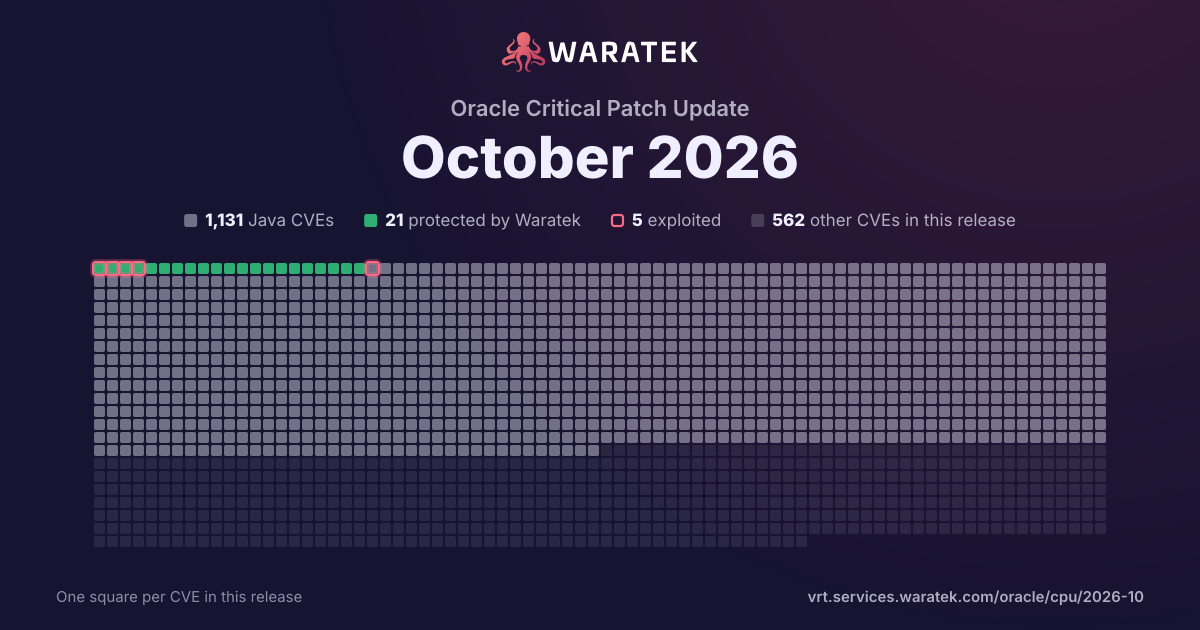
By status
21Protected by Waratek1Mitigation candidate1,109No exploit published13Outside Waratek scope549Not applicable
5Exploited, marked by the ring
No exploit published. For 858 of them, Oracle's security advisory is the source of public detail.
Protected by Waratek. Waratek RASP can block exploitation of these on systems that have not applied the patch yet.
Overview 89 matches · 0 protected · 0 exploited · 0 CISA KEV · 0 public PoC · 0 EPSS ≥ 0.5
89matches
0protected0.0%
0exploited0.0%
0CISA KEV0.0%
0public PoC0.0%
0EPSS ≥ 0.50.0%
Protected by Waratek
0
0.0%
Rule in development
0
0.0%
Mitigation candidate
0
0.0%
No exploit published
89
100.0%
Outside Waratek scope
0
0.0%
Not applicable
0
0.0%
Withdrawn CVE
0
0.0%
blocked by ARMR today
0
0.0%
partly blocked
0
0.0%
not blocked
89
100.0%
not established
0
0.0%
unrecorded
0
0.0%
Exploited
0
0.0%
Working exploit published
0
0.0%
Proof of concept only
1
1.1%
Forecast only
0
0.0%
No public exploit
88
98.9%
split by
peak 79 / quarter
Q3 221
No exploit published1
Low1
not blocked1
No public exploit1
Q4 220
Q1 230
Q2 230
Q3 230
Q4 230
Q1 241
No exploit published1
Low1
not blocked1
No public exploit1
Q2 240
Q3 240
Q4 240
Q1 250
Q2 250
Q3 250
Q4 250
Q1 262
No exploit published2
Low2
not blocked2
No public exploit2
Q2 265
No exploit published5
Low5
not blocked5
Proof of concept only1
No public exploit4
Q3 261
No exploit published1
Low1
not blocked1
No public exploit1
Q4 2679
No exploit published79
Low79
not blocked79
No public exploit79
Q4 22Q2 23Q4 23Q2 24Q4 24Q2 25Q4 25Q2 26Q4 26
| CVE | Severity | Published▾ | Status | Exploitation | Description |
|---|---|---|---|---|---|
| CVE-2026-91650 | Low | 2026-10-20 | No exploit published | No public exploit | Vulnerability in Oracle Essbase (component: Java Based Agent). The supported version that is affected is 21.8.3.0.0. Difficult to exploit vulnerability allows unauthenticated attacker with network access via HTTP to compromise Oracle Essbase. Successful attacks of this vulnerability can result in unauthorized read access to a subset of Oracle Essbase accessible data. CVSS 3.1 Base Score 3.7 (Confidentiality impacts). CVSS Vector: (CVSS:3.1/AV:N/AC:H/PR:N/UI:N/S:U/C:L/I:N/A:N). |
| CVE-2026-91616 | Low | 2026-10-20 | No exploit published | No public exploit | Vulnerability in the Oracle Middleware Common Libraries and Tools product of Oracle Fusion Middleware (component: Remote Diagnostic Agent). Supported versions that are affected are 12.2.1.4.0 and 14.1.1.0.0. Difficult to exploit vulnerability allows unauthenticated attacker with network access via HTTP to compromise Oracle Middleware Common Libraries and Tools. Successful attacks of this vulnerability can result in unauthorized read access to a subset of Oracle Middleware Common Libraries and Tools accessible data. CVSS 3.1 Base Score 3.7 (Confidentiality impacts). CVSS Vector: (CVSS:3.1/AV:N/AC:H/PR:N/UI:N/S:U/C:L/I:N/A:N). |
| CVE-2026-91614 | Low | 2026-10-20 | No exploit published | No public exploit | Vulnerability in the Oracle Communications Unified Inventory Management product of Oracle Communications (component: Security). Supported versions that are affected are 7.5.0, 7.5.1, 7.6.0, 7.7.0, 7.8.0 and 8.0.1. Easily exploitable vulnerability allows low privileged attacker with logon to the infrastructure where Oracle Communications Unified Inventory Management executes to compromise Oracle Communications Unified Inventory Management. Successful attacks of this vulnerability can result in unauthorized read access to a subset of Oracle Communications Unified Inventory Management accessible data. CVSS 3.1 Base Score 3.3 (Confidentiality impacts). CVSS Vector: (CVSS:3.1/AV:L/AC:L/PR:L/UI:N/S:U/C:L/I:N/A:N). |
| CVE-2026-91613 | Low | 2026-10-20 | No exploit published | No public exploit | Vulnerability in the Oracle Communications Unified Inventory Management product of Oracle Communications (component: Security). Supported versions that are affected are 7.5.0, 7.5.1, 7.6.0, 7.7.0, 7.8.0 and 8.0.1. Easily exploitable vulnerability allows low privileged attacker with logon to the infrastructure where Oracle Communications Unified Inventory Management executes to compromise Oracle Communications Unified Inventory Management. Successful attacks of this vulnerability can result in unauthorized read access to a subset of Oracle Communications Unified Inventory Management accessible data. CVSS 3.1 Base Score 3.3 (Confidentiality impacts). CVSS Vector: (CVSS:3.1/AV:L/AC:L/PR:L/UI:N/S:U/C:L/I:N/A:N). |
| CVE-2026-91612 | Low | 2026-10-20 | No exploit published | No public exploit | Vulnerability in the Oracle Communications Unified Inventory Management product of Oracle Communications (component: Security). Supported versions that are affected are 7.5.0, 7.5.1, 7.6.0, 7.7.0, 7.8.0 and 8.0.1. Easily exploitable vulnerability allows low privileged attacker with logon to the infrastructure where Oracle Communications Unified Inventory Management executes to compromise Oracle Communications Unified Inventory Management. Successful attacks of this vulnerability can result in unauthorized read access to a subset of Oracle Communications Unified Inventory Management accessible data. CVSS 3.1 Base Score 3.3 (Confidentiality impacts). CVSS Vector: (CVSS:3.1/AV:L/AC:L/PR:L/UI:N/S:U/C:L/I:N/A:N). |
| CVE-2026-91582 | Low | 2026-10-20 | No exploit published | No public exploit | Vulnerability in the Oracle Business Intelligence Enterprise Edition product of Oracle Analytics (component: BI Search). The supported version that is affected is 12.2.1.4.0. Difficult to exploit vulnerability allows unauthenticated attacker with network access via HTTP to compromise Oracle Business Intelligence Enterprise Edition. Successful attacks of this vulnerability can result in unauthorized ability to cause a partial denial of service (partial DOS) of Oracle Business Intelligence Enterprise Edition. CVSS 3.1 Base Score 3.7 (Availability impacts). CVSS Vector: (CVSS:3.1/AV:N/AC:H/PR:N/UI:N/S:U/C:N/I:N/A:L). |
| CVE-2026-91485 | Low | 2026-10-20 | No exploit published | No public exploit | Vulnerability in the PeopleSoft Enterprise FIN Cash Management product of Oracle PeopleSoft (component: Cash Management). The supported version that is affected is 9.2. Difficult to exploit vulnerability allows high privileged attacker with logon to the infrastructure where PeopleSoft Enterprise FIN Cash Management executes to compromise PeopleSoft Enterprise FIN Cash Management. Successful attacks require human interaction from a person other than the attacker. Successful attacks of this vulnerability can result in unauthorized update, insert or delete access to some of PeopleSoft Enterprise FIN Cash Management accessible data as well as unauthorized read access to a subset of PeopleSoft Enterprise FIN Cash Management accessible data and unauthorized ability to cause a partial denial of service (partial DOS) of PeopleSoft Enterprise FIN Cash Management. CVSS 3.1 Base Score 3.8 (Confidentiality, Integrity and Availability impacts). CVSS Vector: (CVSS:3.1/AV:L/AC:H/PR:H/UI:R/S:U/C:L/I:L/A:L). |
| CVE-2026-91471 | Low | 2026-10-20 | No exploit published | No public exploit | Vulnerability in the PeopleSoft Enterprise CC Common Application Objects product of Oracle PeopleSoft (component: BAM Framework). The supported version that is affected is 9.2. Difficult to exploit vulnerability allows unauthenticated attacker with network access via HTTP to compromise PeopleSoft Enterprise CC Common Application Objects. Successful attacks of this vulnerability can result in unauthorized update, insert or delete access to some of PeopleSoft Enterprise CC Common Application Objects accessible data. CVSS 3.1 Base Score 3.7 (Integrity impacts). CVSS Vector: (CVSS:3.1/AV:N/AC:H/PR:N/UI:N/S:U/C:N/I:L/A:N). |
| CVE-2026-91461 | Low | 2026-10-20 | No exploit published | No public exploit | Vulnerability in the Oracle Java SE, Oracle GraalVM for JDK, Oracle GraalVM Enterprise Edition product of Oracle Java SE (component: JSSE). Supported versions that are affected are Oracle Java SE: 8u503, 8u503-perf, 11.0.32.1, 17.0.20.1, 21.0.12.1, 25.0.4.1, 27; Oracle GraalVM for JDK: 17.0.20.1 and 21.0.12.1; Oracle GraalVM Enterprise Edition: 21.3.19.1.1. Difficult to exploit vulnerability allows unauthenticated attacker with network access via TLS to compromise Oracle Java SE, Oracle GraalVM for JDK, Oracle GraalVM Enterprise Edition. Successful attacks of this vulnerability can result in unauthorized update, insert or delete access to some of Oracle Java SE, Oracle GraalVM for JDK, Oracle GraalVM Enterprise Edition accessible data. Note: This vulnerability can only be exploited by supplying data to APIs in the specified Component without using Untrusted Java Web Start applications or Untrusted Java applets, such as through a web service. CVSS 3.1 Base Score 3.7 (Integrity impacts). CVSS Vector: (CVSS:3.1/AV:N/AC:H/PR:N/UI:N/S:U/C:N/I:L/A:N). |
| CVE-2026-91436 | Low | 2026-10-20 | No exploit published | No public exploit | Vulnerability in the Siebel CRM Deployment product of Oracle Siebel CRM (component: Server Infrastructure). Supported versions that are affected are 17.0-26.9. Difficult to exploit vulnerability allows high privileged attacker with logon to the infrastructure where Siebel CRM Deployment executes to compromise Siebel CRM Deployment. Successful attacks of this vulnerability can result in unauthorized update, insert or delete access to some of Siebel CRM Deployment accessible data as well as unauthorized read access to a subset of Siebel CRM Deployment accessible data and unauthorized ability to cause a partial denial of service (partial DOS) of Siebel CRM Deployment. CVSS 3.1 Base Score 3.9 (Confidentiality, Integrity and Availability impacts). CVSS Vector: (CVSS:3.1/AV:L/AC:H/PR:H/UI:N/S:U/C:L/I:L/A:L). |
| CVE-2026-91427 | Low | 2026-10-20 | No exploit published | No public exploit | Vulnerability in the Siebel CRM Deployment product of Oracle Siebel CRM (component: Server Infrastructure). Supported versions that are affected are 17.0-26.9. Easily exploitable vulnerability allows high privileged attacker with logon to the infrastructure where Siebel CRM Deployment executes to compromise Siebel CRM Deployment. Successful attacks of this vulnerability can result in unauthorized ability to cause a partial denial of service (partial DOS) of Siebel CRM Deployment. CVSS 3.1 Base Score 2.3 (Availability impacts). CVSS Vector: (CVSS:3.1/AV:L/AC:L/PR:H/UI:N/S:U/C:N/I:N/A:L). |
| CVE-2026-91409 | Low | 2026-10-20 | No exploit published | No public exploit | Vulnerability in Oracle Java SE (component: Networking). The supported version that is affected is Oracle Java SE: 27. Difficult to exploit vulnerability allows unauthenticated attacker with network access via multiple protocols to compromise Oracle Java SE. Successful attacks of this vulnerability can result in unauthorized ability to cause a partial denial of service (partial DOS) of Oracle Java SE. Note: This vulnerability can be exploited by using APIs in the specified Component, e.g., through a web service which supplies data to the APIs. This vulnerability also applies to Java deployments, typically in clients running sandboxed Java Web Start applications or sandboxed Java applets, that load and run untrusted code (e.g., code that comes from the internet) and rely on the Java sandbox for security. CVSS 3.1 Base Score 3.7 (Availability impacts). CVSS Vector: (CVSS:3.1/AV:N/AC:H/PR:N/UI:N/S:U/C:N/I:N/A:L). |
| CVE-2026-91397 | Low | 2026-10-20 | No exploit published | No public exploit | Vulnerability in the Oracle Java SE, Oracle GraalVM for JDK, Oracle GraalVM Enterprise Edition product of Oracle Java SE (component: Serviceability). Supported versions that are affected are Oracle Java SE: 8u503, 8u503-perf, 11.0.32.1, 17.0.20.1, 21.0.12.1, 25.0.4.1, 27; Oracle GraalVM for JDK: 17.0.20.1 and 21.0.12.1; Oracle GraalVM Enterprise Edition: 21.3.19.1.1. Difficult to exploit vulnerability allows unauthenticated attacker with logon to the infrastructure where Oracle Java SE, Oracle GraalVM for JDK, Oracle GraalVM Enterprise Edition executes to compromise Oracle Java SE, Oracle GraalVM for JDK, Oracle GraalVM Enterprise Edition. Successful attacks require human interaction from a person other than the attacker. Successful attacks of this vulnerability can result in unauthorized update, insert or delete access to some of Oracle Java SE, Oracle GraalVM for JDK, Oracle GraalVM Enterprise Edition accessible data and unauthorized ability to cause a partial denial of service (partial DOS) of Oracle Java SE, Oracle GraalVM for JDK, Oracle GraalVM Enterprise Edition. Note: This vulnerability can be exploited by using APIs in the specified Component, e.g., through a web service which supplies data to the APIs. This vulnerability also applies to Java deployments, typically in clients running sandboxed Java Web Start applications or sandboxed Java applets, that load and run untrusted code (e.g., code that comes from the internet) and rely on the Java sandbox for security. CVSS 3.1 Base Score 3.6 (Integrity and Availability impacts). CVSS Vector: (CVSS:3.1/AV:L/AC:H/PR:N/UI:R/S:U/C:N/I:L/A:L). |
| CVE-2026-91393 | Low | 2026-10-20 | No exploit published | No public exploit | Vulnerability in the Siebel CRM End User product of Oracle Siebel CRM (component: Open UI). Supported versions that are affected are 17.0-26.9. Difficult to exploit vulnerability allows unauthenticated attacker with network access via HTTP to compromise Siebel CRM End User. Successful attacks require human interaction from a person other than the attacker. Successful attacks of this vulnerability can result in unauthorized update, insert or delete access to some of Siebel CRM End User accessible data. CVSS 3.1 Base Score 3.1 (Integrity impacts). CVSS Vector: (CVSS:3.1/AV:N/AC:H/PR:N/UI:R/S:U/C:N/I:L/A:N). |
| CVE-2026-91392 | Low | 2026-10-20 | No exploit published | No public exploit | Vulnerability in the Siebel CRM End User product of Oracle Siebel CRM (component: Open UI). Supported versions that are affected are 17.0-26.9. Difficult to exploit vulnerability allows unauthenticated attacker with network access via HTTP to compromise Siebel CRM End User. Successful attacks of this vulnerability can result in unauthorized update, insert or delete access to some of Siebel CRM End User accessible data. CVSS 3.1 Base Score 3.7 (Integrity impacts). CVSS Vector: (CVSS:3.1/AV:N/AC:H/PR:N/UI:N/S:U/C:N/I:L/A:N). |
| CVE-2026-91391 | Low | 2026-10-20 | No exploit published | No public exploit | Vulnerability in the Siebel CRM End User product of Oracle Siebel CRM (component: Open UI). Supported versions that are affected are 17.0-26.9. Difficult to exploit vulnerability allows unauthenticated attacker with network access via HTTP to compromise Siebel CRM End User. Successful attacks of this vulnerability can result in unauthorized read access to a subset of Siebel CRM End User accessible data. CVSS 3.1 Base Score 3.7 (Confidentiality impacts). CVSS Vector: (CVSS:3.1/AV:N/AC:H/PR:N/UI:N/S:U/C:L/I:N/A:N). |
| CVE-2026-91381 | Low | 2026-10-20 | No exploit published | No public exploit | Vulnerability in the Oracle Java SE, Oracle GraalVM Enterprise Edition product of Oracle Java SE (component: 2D). Supported versions that are affected are Oracle Java SE: 8u503 and 8u503-perf; Oracle GraalVM Enterprise Edition: 21.3.19.1.1. Difficult to exploit vulnerability allows unauthenticated attacker with network access via multiple protocols to compromise Oracle Java SE, Oracle GraalVM Enterprise Edition. Successful attacks of this vulnerability can result in unauthorized update, insert or delete access to some of Oracle Java SE, Oracle GraalVM Enterprise Edition accessible data. Note: This vulnerability can be exploited by using APIs in the specified Component, e.g., through a web service which supplies data to the APIs. This vulnerability also applies to Java deployments, typically in clients running sandboxed Java Web Start applications or sandboxed Java applets, that load and run untrusted code (e.g., code that comes from the internet) and rely on the Java sandbox for security. CVSS 3.1 Base Score 3.7 (Integrity impacts). CVSS Vector: (CVSS:3.1/AV:N/AC:H/PR:N/UI:N/S:U/C:N/I:L/A:N). |
| CVE-2026-91372 | Low | 2026-10-20 | No exploit published | No public exploit | Vulnerability in the Siebel CRM Cloud Applications product of Oracle Siebel CRM (component: Siebel Cloud Manager). Supported versions that are affected are 22.3-26.9. Easily exploitable vulnerability allows low privileged attacker with logon to the infrastructure where Siebel CRM Cloud Applications executes to compromise Siebel CRM Cloud Applications. Successful attacks of this vulnerability can result in unauthorized read access to a subset of Siebel CRM Cloud Applications accessible data. CVSS 3.1 Base Score 3.3 (Confidentiality impacts). CVSS Vector: (CVSS:3.1/AV:L/AC:L/PR:L/UI:N/S:U/C:L/I:N/A:N). |
| CVE-2026-91363 | Low | 2026-10-20 | No exploit published | No public exploit | Vulnerability in the Siebel CRM Cloud Applications product of Oracle Siebel CRM (component: Siebel Cloud Manager). Supported versions that are affected are 22.3-26.9. Difficult to exploit vulnerability allows unauthenticated attacker with network access via HTTP to compromise Siebel CRM Cloud Applications. Successful attacks of this vulnerability can result in unauthorized read access to a subset of Siebel CRM Cloud Applications accessible data. CVSS 3.1 Base Score 3.7 (Confidentiality impacts). CVSS Vector: (CVSS:3.1/AV:N/AC:H/PR:N/UI:N/S:U/C:L/I:N/A:N). |
| CVE-2026-91334 | Low | 2026-10-20 | No exploit published | No public exploit | Vulnerability in the Oracle Java SE, Oracle GraalVM for JDK, Oracle GraalVM Enterprise Edition product of Oracle Java SE (component: ImageIO). Supported versions that are affected are Oracle Java SE: 8u503, 8u503-perf, 11.0.32.1, 17.0.20.1, 21.0.12.1, 25.0.4.1, 27; Oracle GraalVM for JDK: 17.0.20.1 and 21.0.12.1; Oracle GraalVM Enterprise Edition: 21.3.19.1.1. Difficult to exploit vulnerability allows unauthenticated attacker with network access via multiple protocols to compromise Oracle Java SE, Oracle GraalVM for JDK, Oracle GraalVM Enterprise Edition. Successful attacks of this vulnerability can result in unauthorized read access to a subset of Oracle Java SE, Oracle GraalVM for JDK, Oracle GraalVM Enterprise Edition accessible data. Note: This vulnerability can be exploited by using APIs in the specified Component, e.g., through a web service which supplies data to the APIs. This vulnerability also applies to Java deployments, typically in clients running sandboxed Java Web Start applications or sandboxed Java applets, that load and run untrusted code (e.g., code that comes from the internet) and rely on the Java sandbox for security. CVSS 3.1 Base Score 3.7 (Confidentiality impacts). CVSS Vector: (CVSS:3.1/AV:N/AC:H/PR:N/UI:N/S:U/C:L/I:N/A:N). |
| CVE-2026-91333 | Low | 2026-10-20 | No exploit published | No public exploit | Vulnerability in Oracle Java SE (component: Security). Supported versions that are affected are Oracle Java SE: 21.0.12.1, 25.0.4.1 and 27. Difficult to exploit vulnerability allows unauthenticated attacker with network access via multiple protocols to compromise Oracle Java SE. Successful attacks of this vulnerability can result in unauthorized update, insert or delete access to some of Oracle Java SE accessible data. Note: This vulnerability can be exploited by using APIs in the specified Component, e.g., through a web service which supplies data to the APIs. This vulnerability also applies to Java deployments, typically in clients running sandboxed Java Web Start applications or sandboxed Java applets, that load and run untrusted code (e.g., code that comes from the internet) and rely on the Java sandbox for security. CVSS 3.1 Base Score 3.7 (Integrity impacts). CVSS Vector: (CVSS:3.1/AV:N/AC:H/PR:N/UI:N/S:U/C:N/I:L/A:N). |
| CVE-2026-91331 | Low | 2026-10-20 | No exploit published | No public exploit | Vulnerability in the PeopleSoft Enterprise CC Common Application Objects product of Oracle PeopleSoft (component: Common Application Objects). The supported version that is affected is 9.2. Easily exploitable vulnerability allows high privileged attacker with network access via HTTP to compromise PeopleSoft Enterprise CC Common Application Objects. Successful attacks of this vulnerability can result in unauthorized update, insert or delete access to some of PeopleSoft Enterprise CC Common Application Objects accessible data as well as unauthorized read access to a subset of PeopleSoft Enterprise CC Common Application Objects accessible data. CVSS 3.1 Base Score 3.8 (Confidentiality and Integrity impacts). CVSS Vector: (CVSS:3.1/AV:N/AC:L/PR:H/UI:N/S:U/C:L/I:L/A:N). |
| CVE-2026-91330 | Low | 2026-10-20 | No exploit published | No public exploit | Vulnerability in the JD Edwards EnterpriseOne Tools product of Oracle JD Edwards (component: Installation Security). Supported versions that are affected are 9.2.0.0-9.2.26.5. Easily exploitable vulnerability allows low privileged attacker with logon to the infrastructure where JD Edwards EnterpriseOne Tools executes to compromise JD Edwards EnterpriseOne Tools. Successful attacks of this vulnerability can result in unauthorized ability to cause a partial denial of service (partial DOS) of JD Edwards EnterpriseOne Tools. CVSS 3.1 Base Score 3.3 (Availability impacts). CVSS Vector: (CVSS:3.1/AV:L/AC:L/PR:L/UI:N/S:U/C:N/I:N/A:L). |
| CVE-2026-91322 | Low | 2026-10-20 | No exploit published | No public exploit | Vulnerability in the Oracle JDeveloper product of Oracle Fusion Middleware (component: Oracle JDeveloper). Supported versions that are affected are 12.2.1.4.0 and 14.1.2.0.0. Easily exploitable vulnerability allows low privileged attacker with logon to the infrastructure where Oracle JDeveloper executes to compromise Oracle JDeveloper. Successful attacks of this vulnerability can result in unauthorized read access to a subset of Oracle JDeveloper accessible data. CVSS 3.1 Base Score 3.3 (Confidentiality impacts). CVSS Vector: (CVSS:3.1/AV:L/AC:L/PR:L/UI:N/S:U/C:L/I:N/A:N). |
| CVE-2026-91302 | Low | 2026-10-20 | No exploit published | No public exploit | Vulnerability in the JD Edwards EnterpriseOne Tools product of Oracle JD Edwards (component: Enterprise Infrastructure SEC). Supported versions that are affected are 9.2.0.0-9.2.26.5. Easily exploitable vulnerability allows unauthenticated attacker with logon to the infrastructure where JD Edwards EnterpriseOne Tools executes to compromise JD Edwards EnterpriseOne Tools. Successful attacks require human interaction from a person other than the attacker. Successful attacks of this vulnerability can result in unauthorized ability to cause a partial denial of service (partial DOS) of JD Edwards EnterpriseOne Tools. CVSS 3.1 Base Score 3.3 (Availability impacts). CVSS Vector: (CVSS:3.1/AV:L/AC:L/PR:N/UI:R/S:U/C:N/I:N/A:L). |
| CVE-2026-91301 | Low | 2026-10-20 | No exploit published | No public exploit | Vulnerability in the JD Edwards EnterpriseOne Tools product of Oracle JD Edwards (component: Monitoring and Diagnostics SEC). Supported versions that are affected are 9.2.0.0-9.2.26.5. Difficult to exploit vulnerability allows low privileged attacker with logon to the infrastructure where JD Edwards EnterpriseOne Tools executes to compromise JD Edwards EnterpriseOne Tools. Successful attacks of this vulnerability can result in unauthorized update, insert or delete access to some of JD Edwards EnterpriseOne Tools accessible data and unauthorized ability to cause a partial denial of service (partial DOS) of JD Edwards EnterpriseOne Tools. CVSS 3.1 Base Score 3.6 (Integrity and Availability impacts). CVSS Vector: (CVSS:3.1/AV:L/AC:H/PR:L/UI:N/S:U/C:N/I:L/A:L). |
| CVE-2026-91300 | Low | 2026-10-20 | No exploit published | No public exploit | Vulnerability in the JD Edwards EnterpriseOne Tools product of Oracle JD Edwards (component: Web Runtime SEC). Supported versions that are affected are 9.2.0.0-9.2.26.5. Difficult to exploit vulnerability allows unauthenticated attacker with network access via HTTP to compromise JD Edwards EnterpriseOne Tools. Successful attacks require human interaction from a person other than the attacker. Successful attacks of this vulnerability can result in unauthorized update, insert or delete access to some of JD Edwards EnterpriseOne Tools accessible data. CVSS 3.1 Base Score 3.1 (Integrity impacts). CVSS Vector: (CVSS:3.1/AV:N/AC:H/PR:N/UI:R/S:U/C:N/I:L/A:N). |
| CVE-2026-91291 | Low | 2026-10-20 | No exploit published | No public exploit | Vulnerability in the JD Edwards EnterpriseOne Tools product of Oracle JD Edwards (component: Business Logic Infra SEC). Supported versions that are affected are 9.2.0.0-9.2.26.5. Difficult to exploit vulnerability allows low privileged attacker with logon to the infrastructure where JD Edwards EnterpriseOne Tools executes to compromise JD Edwards EnterpriseOne Tools. Successful attacks of this vulnerability can result in unauthorized update, insert or delete access to some of JD Edwards EnterpriseOne Tools accessible data as well as unauthorized read access to a subset of JD Edwards EnterpriseOne Tools accessible data. CVSS 3.1 Base Score 3.6 (Confidentiality and Integrity impacts). CVSS Vector: (CVSS:3.1/AV:L/AC:H/PR:L/UI:N/S:U/C:L/I:L/A:N). |
| CVE-2026-91264 | Low | 2026-10-20 | No exploit published | No public exploit | Vulnerability in the PeopleSoft Enterprise SCM Manufacturing product of Oracle PeopleSoft (component: Security). The supported version that is affected is 9.2. Difficult to exploit vulnerability allows unauthenticated attacker with network access via HTTP to compromise PeopleSoft Enterprise SCM Manufacturing. Successful attacks of this vulnerability can result in unauthorized update, insert or delete access to some of PeopleSoft Enterprise SCM Manufacturing accessible data. CVSS 3.1 Base Score 3.7 (Integrity impacts). CVSS Vector: (CVSS:3.1/AV:N/AC:H/PR:N/UI:N/S:U/C:N/I:L/A:N). |
| CVE-2026-91261 | Low | 2026-10-20 | No exploit published | No public exploit | Vulnerability in the Oracle WebCenter Content product of Oracle Fusion Middleware (component: Content Server). The supported version that is affected is 14.1.2.0.0. Difficult to exploit vulnerability allows low privileged attacker with network access via HTTP to compromise Oracle WebCenter Content. Successful attacks of this vulnerability can result in unauthorized read access to a subset of Oracle WebCenter Content accessible data. CVSS 3.1 Base Score 3.1 (Confidentiality impacts). CVSS Vector: (CVSS:3.1/AV:N/AC:H/PR:L/UI:N/S:U/C:L/I:N/A:N). |
| CVE-2026-87418 | Low | 2026-10-20 | No exploit published | No public exploit | Vulnerability in the PeopleSoft Enterprise PeopleTools product of Oracle PeopleSoft (component: Updates Environment Mgmt). Supported versions that are affected are 8.61-8.63. Difficult to exploit vulnerability allows low privileged attacker with logon to the infrastructure where PeopleSoft Enterprise PeopleTools executes to compromise PeopleSoft Enterprise PeopleTools. Successful attacks of this vulnerability can result in unauthorized read access to a subset of PeopleSoft Enterprise PeopleTools accessible data. CVSS 3.1 Base Score 2.5 (Confidentiality impacts). CVSS Vector: (CVSS:3.1/AV:L/AC:H/PR:L/UI:N/S:U/C:L/I:N/A:N). |
| CVE-2026-87416 | Low | 2026-10-20 | No exploit published | No public exploit | Vulnerability in the PeopleSoft Enterprise PeopleTools product of Oracle PeopleSoft (component: Report Distribution). Supported versions that are affected are 8.61-8.63. Difficult to exploit vulnerability allows unauthenticated attacker with network access via HTTP to compromise PeopleSoft Enterprise PeopleTools. Successful attacks of this vulnerability can result in unauthorized read access to a subset of PeopleSoft Enterprise PeopleTools accessible data. CVSS 3.1 Base Score 3.7 (Confidentiality impacts). CVSS Vector: (CVSS:3.1/AV:N/AC:H/PR:N/UI:N/S:U/C:L/I:N/A:N). |
| CVE-2026-87412 | Low | 2026-10-20 | No exploit published | No public exploit | Vulnerability in the PeopleSoft Enterprise PeopleTools product of Oracle PeopleSoft (component: Report Distribution). Supported versions that are affected are 8.61-8.63. Easily exploitable vulnerability allows high privileged attacker with network access via HTTP to compromise PeopleSoft Enterprise PeopleTools. Successful attacks of this vulnerability can result in unauthorized read access to a subset of PeopleSoft Enterprise PeopleTools accessible data. CVSS 3.1 Base Score 2.7 (Confidentiality impacts). CVSS Vector: (CVSS:3.1/AV:N/AC:L/PR:H/UI:N/S:U/C:L/I:N/A:N). |
| CVE-2026-87401 | Low | 2026-10-20 | No exploit published | No public exploit | Vulnerability in the PeopleSoft Enterprise PeopleTools product of Oracle PeopleSoft (component: XML Publisher). Supported versions that are affected are 8.61-8.63. Easily exploitable vulnerability allows low privileged attacker with logon to the infrastructure where PeopleSoft Enterprise PeopleTools executes to compromise PeopleSoft Enterprise PeopleTools. Successful attacks of this vulnerability can result in unauthorized read access to a subset of PeopleSoft Enterprise PeopleTools accessible data. CVSS 3.1 Base Score 3.3 (Confidentiality impacts). CVSS Vector: (CVSS:3.1/AV:L/AC:L/PR:L/UI:N/S:U/C:L/I:N/A:N). |
| CVE-2026-87389 | Low | 2026-10-20 | No exploit published | No public exploit | Vulnerability in the JD Edwards EnterpriseOne Human Resources Management product of Oracle JD Edwards (component: Human Resources). The supported version that is affected is 9.2. Difficult to exploit vulnerability allows unauthenticated attacker with network access via HTTP to compromise JD Edwards EnterpriseOne Human Resources Management. Successful attacks of this vulnerability can result in unauthorized update, insert or delete access to some of JD Edwards EnterpriseOne Human Resources Management accessible data. CVSS 3.1 Base Score 3.7 (Integrity impacts). CVSS Vector: (CVSS:3.1/AV:N/AC:H/PR:N/UI:N/S:U/C:N/I:L/A:N). |
| CVE-2026-87367 | Low | 2026-10-20 | No exploit published | No public exploit | Vulnerability in the Oracle Java SE, Oracle GraalVM for JDK, Oracle GraalVM Enterprise Edition product of Oracle Java SE (component: JAXP). Supported versions that are affected are Oracle Java SE: 8u503, 8u503-perf, 11.0.32.1, 17.0.20.1, 21.0.12.1, 25.0.4.1, 27; Oracle GraalVM for JDK: 17.0.20.1 and 21.0.12.1; Oracle GraalVM Enterprise Edition: 21.3.19.1.1. Difficult to exploit vulnerability allows unauthenticated attacker with network access via multiple protocols to compromise Oracle Java SE, Oracle GraalVM for JDK, Oracle GraalVM Enterprise Edition. Successful attacks of this vulnerability can result in unauthorized update, insert or delete access to some of Oracle Java SE, Oracle GraalVM for JDK, Oracle GraalVM Enterprise Edition accessible data. Note: This vulnerability can be exploited by using APIs in the specified Component, e.g., through a web service which supplies data to the APIs. This vulnerability also applies to Java deployments, typically in clients running sandboxed Java Web Start applications or sandboxed Java applets, that load and run untrusted code (e.g., code that comes from the internet) and rely on the Java sandbox for security. CVSS 3.1 Base Score 3.7 (Integrity impacts). CVSS Vector: (CVSS:3.1/AV:N/AC:H/PR:N/UI:N/S:U/C:N/I:L/A:N). |
| CVE-2026-87340 | Low | 2026-10-20 | No exploit published | No public exploit | Vulnerability in the PeopleSoft Enterprise PeopleTools product of Oracle PeopleSoft (component: Portal). Supported versions that are affected are 8.61-8.63. Difficult to exploit vulnerability allows unauthenticated attacker with network access via HTTP to compromise PeopleSoft Enterprise PeopleTools. Successful attacks of this vulnerability can result in unauthorized update, insert or delete access to some of PeopleSoft Enterprise PeopleTools accessible data. CVSS 3.1 Base Score 3.7 (Integrity impacts). CVSS Vector: (CVSS:3.1/AV:N/AC:H/PR:N/UI:N/S:U/C:N/I:L/A:N). |
| CVE-2026-87339 | Low | 2026-10-20 | No exploit published | No public exploit | Vulnerability in the Siebel CRM Integration product of Oracle Siebel CRM (component: REST). Supported versions that are affected are 17.0-26.9. Difficult to exploit vulnerability allows unauthenticated attacker with network access via HTTP to compromise Siebel CRM Integration. Successful attacks require human interaction from a person other than the attacker. Successful attacks of this vulnerability can result in unauthorized read access to a subset of Siebel CRM Integration accessible data. CVSS 3.1 Base Score 3.1 (Confidentiality impacts). CVSS Vector: (CVSS:3.1/AV:N/AC:H/PR:N/UI:R/S:U/C:L/I:N/A:N). |
| CVE-2026-87333 | Low | 2026-10-20 | No exploit published | No public exploit | Vulnerability in the JD Edwards EnterpriseOne Tools product of Oracle JD Edwards (component: Enterprise Infrastructure SEC). Supported versions that are affected are 9.2.0.0-9.2.26.5. Difficult to exploit vulnerability allows low privileged attacker with logon to the infrastructure where JD Edwards EnterpriseOne Tools executes to compromise JD Edwards EnterpriseOne Tools. Successful attacks of this vulnerability can result in unauthorized update, insert or delete access to some of JD Edwards EnterpriseOne Tools accessible data as well as unauthorized read access to a subset of JD Edwards EnterpriseOne Tools accessible data. CVSS 3.1 Base Score 3.6 (Confidentiality and Integrity impacts). CVSS Vector: (CVSS:3.1/AV:L/AC:H/PR:L/UI:N/S:U/C:L/I:L/A:N). |
| CVE-2026-87332 | Low | 2026-10-20 | No exploit published | No public exploit | Vulnerability in the JD Edwards EnterpriseOne Tools product of Oracle JD Edwards (component: E1 Dev Platform Tech - Cloud). Supported versions that are affected are 9.2.0.0-9.2.26.5. Difficult to exploit vulnerability allows high privileged attacker with logon to the infrastructure where JD Edwards EnterpriseOne Tools executes to compromise JD Edwards EnterpriseOne Tools. Successful attacks of this vulnerability can result in unauthorized update, insert or delete access to some of JD Edwards EnterpriseOne Tools accessible data and unauthorized ability to cause a partial denial of service (partial DOS) of JD Edwards EnterpriseOne Tools. CVSS 3.1 Base Score 3.0 (Integrity and Availability impacts). CVSS Vector: (CVSS:3.1/AV:L/AC:H/PR:H/UI:N/S:U/C:N/I:L/A:L). |
| CVE-2026-87331 | Low | 2026-10-20 | No exploit published | No public exploit | Vulnerability in the JD Edwards EnterpriseOne Tools product of Oracle JD Edwards (component: E1 Dev Platform Tech - UNIX). Supported versions that are affected are 9.2.0.0-9.2.26.5. Easily exploitable vulnerability allows high privileged attacker with logon to the infrastructure where JD Edwards EnterpriseOne Tools executes to compromise JD Edwards EnterpriseOne Tools. Successful attacks of this vulnerability can result in unauthorized update, insert or delete access to some of JD Edwards EnterpriseOne Tools accessible data and unauthorized ability to cause a partial denial of service (partial DOS) of JD Edwards EnterpriseOne Tools. CVSS 3.1 Base Score 3.4 (Integrity and Availability impacts). CVSS Vector: (CVSS:3.1/AV:L/AC:L/PR:H/UI:N/S:U/C:N/I:L/A:L). |
| CVE-2026-87292 | Low | 2026-10-20 | No exploit published | No public exploit | Vulnerability in the Oracle Java SE, Oracle GraalVM for JDK, Oracle GraalVM Enterprise Edition product of Oracle Java SE (component: Networking). Supported versions that are affected are Oracle Java SE: 8u503, 8u503-perf, 11.0.32.1, 17.0.20.1, 21.0.12.1, 25.0.4.1, 27; Oracle GraalVM for JDK: 17.0.20.1 and 21.0.12.1; Oracle GraalVM Enterprise Edition: 21.3.19.1.1. Difficult to exploit vulnerability allows unauthenticated attacker with network access via multiple protocols to compromise Oracle Java SE, Oracle GraalVM for JDK, Oracle GraalVM Enterprise Edition. Successful attacks of this vulnerability can result in unauthorized update, insert or delete access to some of Oracle Java SE, Oracle GraalVM for JDK, Oracle GraalVM Enterprise Edition accessible data. Note: This vulnerability can be exploited by using APIs in the specified Component, e.g., through a web service which supplies data to the APIs. This vulnerability also applies to Java deployments, typically in clients running sandboxed Java Web Start applications or sandboxed Java applets, that load and run untrusted code (e.g., code that comes from the internet) and rely on the Java sandbox for security. CVSS 3.1 Base Score 3.7 (Integrity impacts). CVSS Vector: (CVSS:3.1/AV:N/AC:H/PR:N/UI:N/S:U/C:N/I:L/A:N). |
| CVE-2026-87255 | Low | 2026-10-20 | No exploit published | No public exploit | Vulnerability in Oracle Java SE (component: Compiler). Supported versions that are affected are Oracle Java SE: 25.0.4.1 and 27. Difficult to exploit vulnerability allows unauthenticated attacker with network access via multiple protocols to compromise Oracle Java SE. Successful attacks of this vulnerability can result in unauthorized read access to a subset of Oracle Java SE accessible data. Note: This vulnerability can only be exploited by supplying data to APIs in the specified Component without using Untrusted Java Web Start applications or Untrusted Java applets, such as through a web service. CVSS 3.1 Base Score 3.7 (Confidentiality impacts). CVSS Vector: (CVSS:3.1/AV:N/AC:H/PR:N/UI:N/S:U/C:L/I:N/A:N). |
| CVE-2026-83392 | Low | 2026-10-20 | No exploit published | No public exploit | Vulnerability in the Oracle Applications Manager product of Oracle E-Business Suite (component: Diagnostics). Supported versions that are affected are 12.2.3-12.2.15. Difficult to exploit vulnerability allows low privileged attacker with network access via HTTP to compromise Oracle Applications Manager. Successful attacks of this vulnerability can result in unauthorized read access to a subset of Oracle Applications Manager accessible data. CVSS 3.1 Base Score 3.1 (Confidentiality impacts). CVSS Vector: (CVSS:3.1/AV:N/AC:H/PR:L/UI:N/S:U/C:L/I:N/A:N). |
| CVE-2026-83388 | Low | 2026-10-20 | No exploit published | No public exploit | Vulnerability in the Oracle Applications Manager product of Oracle E-Business Suite (component: Diagnostics). Supported versions that are affected are 12.2.3-12.2.15. Difficult to exploit vulnerability allows high privileged attacker with network access via HTTP to compromise Oracle Applications Manager. Successful attacks of this vulnerability can result in unauthorized read access to a subset of Oracle Applications Manager accessible data. CVSS 3.1 Base Score 2.2 (Confidentiality impacts). CVSS Vector: (CVSS:3.1/AV:N/AC:H/PR:H/UI:N/S:U/C:L/I:N/A:N). |
| CVE-2026-83376 | Low | 2026-10-20 | No exploit published | No public exploit | Vulnerability in the Oracle Java SE, Oracle GraalVM for JDK, Oracle GraalVM Enterprise Edition product of Oracle Java SE (component: JSSE). Supported versions that are affected are Oracle Java SE: 8u503, 8u503-perf, 11.0.32.1, 17.0.20.1, 21.0.12.1, 25.0.4.1, 27; Oracle GraalVM for JDK: 17.0.20.1 and 21.0.12.1; Oracle GraalVM Enterprise Edition: 21.3.19.1.1. Difficult to exploit vulnerability allows unauthenticated attacker with network access via TLS to compromise Oracle Java SE, Oracle GraalVM for JDK, Oracle GraalVM Enterprise Edition. Successful attacks of this vulnerability can result in unauthorized update, insert or delete access to some of Oracle Java SE, Oracle GraalVM for JDK, Oracle GraalVM Enterprise Edition accessible data. Note: This vulnerability can be exploited by using APIs in the specified Component, e.g., through a web service which supplies data to the APIs. This vulnerability also applies to Java deployments, typically in clients running sandboxed Java Web Start applications or sandboxed Java applets, that load and run untrusted code (e.g., code that comes from the internet) and rely on the Java sandbox for security. CVSS 3.1 Base Score 3.7 (Integrity impacts). CVSS Vector: (CVSS:3.1/AV:N/AC:H/PR:N/UI:N/S:U/C:N/I:L/A:N). |
| CVE-2026-83373 | Low | 2026-10-20 | No exploit published | No public exploit | Vulnerability in the PeopleSoft Enterprise PeopleTools product of Oracle PeopleSoft (component: Portal). Supported versions that are affected are 8.61-8.63. Difficult to exploit vulnerability allows low privileged attacker with network access via HTTP to compromise PeopleSoft Enterprise PeopleTools. Successful attacks require human interaction from a person other than the attacker and while the vulnerability is in PeopleSoft Enterprise PeopleTools, attacks may significantly impact additional products (scope change). Successful attacks of this vulnerability can result in unauthorized read access to a subset of PeopleSoft Enterprise PeopleTools accessible data. CVSS 3.1 Base Score 3.0 (Confidentiality impacts). CVSS Vector: (CVSS:3.1/AV:N/AC:H/PR:L/UI:R/S:C/C:L/I:N/A:N). |
| CVE-2026-60964 | Low | 2026-10-20 | No exploit published | No public exploit | Vulnerability in the PeopleSoft Enterprise PeopleTools product of Oracle PeopleSoft (component: Open Query). Supported versions that are affected are 8.61 and 8.62. Difficult to exploit vulnerability allows high privileged attacker with logon to the infrastructure where PeopleSoft Enterprise PeopleTools executes to compromise PeopleSoft Enterprise PeopleTools. Successful attacks of this vulnerability can result in unauthorized read access to a subset of PeopleSoft Enterprise PeopleTools accessible data. CVSS 3.1 Base Score 1.9 (Confidentiality impacts). CVSS Vector: (CVSS:3.1/AV:L/AC:H/PR:H/UI:N/S:U/C:L/I:N/A:N). |
| CVE-2026-60887 | Low | 2026-10-20 | No exploit published | No public exploit | Vulnerability in the PeopleSoft Enterprise PeopleTools product of Oracle PeopleSoft (component: Data Mover). Supported versions that are affected are 8.61-8.63. Difficult to exploit vulnerability allows high privileged attacker with logon to the infrastructure where PeopleSoft Enterprise PeopleTools executes to compromise PeopleSoft Enterprise PeopleTools. Successful attacks require human interaction from a person other than the attacker. Successful attacks of this vulnerability can result in unauthorized update, insert or delete access to some of PeopleSoft Enterprise PeopleTools accessible data as well as unauthorized read access to a subset of PeopleSoft Enterprise PeopleTools accessible data and unauthorized ability to cause a partial denial of service (partial DOS) of PeopleSoft Enterprise PeopleTools. CVSS 3.1 Base Score 3.8 (Confidentiality, Integrity and Availability impacts). CVSS Vector: (CVSS:3.1/AV:L/AC:H/PR:H/UI:R/S:U/C:L/I:L/A:L). |
| CVE-2026-60819 | Low | 2026-10-20 | No exploit published | No public exploit | Vulnerability in the PeopleSoft Enterprise PeopleTools product of Oracle PeopleSoft (component: Application Server - JRE). Supported versions that are affected are 8.61-8.63. Difficult to exploit vulnerability allows unauthenticated attacker with network access via SSH to compromise PeopleSoft Enterprise PeopleTools. Successful attacks of this vulnerability can result in unauthorized update, insert or delete access to some of PeopleSoft Enterprise PeopleTools accessible data. CVSS 3.1 Base Score 3.7 (Integrity impacts). CVSS Vector: (CVSS:3.1/AV:N/AC:H/PR:N/UI:N/S:U/C:N/I:L/A:N). |
| CVE-2026-60814 | Low | 2026-10-20 | No exploit published | No public exploit | Vulnerability in the PeopleSoft Enterprise PeopleTools product of Oracle PeopleSoft (component: Business Interlink). Supported versions that are affected are 8.61-8.63. Difficult to exploit vulnerability allows high privileged attacker with logon to the infrastructure where PeopleSoft Enterprise PeopleTools executes to compromise PeopleSoft Enterprise PeopleTools. Successful attacks of this vulnerability can result in unauthorized update, insert or delete access to some of PeopleSoft Enterprise PeopleTools accessible data as well as unauthorized read access to a subset of PeopleSoft Enterprise PeopleTools accessible data and unauthorized ability to cause a partial denial of service (partial DOS) of PeopleSoft Enterprise PeopleTools. CVSS 3.1 Base Score 3.9 (Confidentiality, Integrity and Availability impacts). CVSS Vector: (CVSS:3.1/AV:L/AC:H/PR:H/UI:N/S:U/C:L/I:L/A:L). |
| CVE-2026-101846 | Low | 2026-10-20 | No exploit published | No public exploit | Vulnerability in the Oracle Purchasing product of Oracle E-Business Suite (component: Internal Operations). Supported versions that are affected are 12.2.3-12.2.15. Easily exploitable vulnerability allows low privileged attacker with network access via HTTP to compromise Oracle Purchasing. Successful attacks require human interaction from a person other than the attacker. Successful attacks of this vulnerability can result in unauthorized update, insert or delete access to some of Oracle Purchasing accessible data. CVSS 3.1 Base Score 3.5 (Integrity impacts). CVSS Vector: (CVSS:3.1/AV:N/AC:L/PR:L/UI:R/S:U/C:N/I:L/A:N). |
| CVE-2026-101845 | Low | 2026-10-20 | No exploit published | No public exploit | Vulnerability in the Oracle Purchasing product of Oracle E-Business Suite (component: Internal Operations). Supported versions that are affected are 12.2.3-12.2.15. Difficult to exploit vulnerability allows low privileged attacker with network access via HTTP to compromise Oracle Purchasing. Successful attacks of this vulnerability can result in unauthorized update, insert or delete access to some of Oracle Purchasing accessible data. CVSS 3.1 Base Score 3.1 (Integrity impacts). CVSS Vector: (CVSS:3.1/AV:N/AC:H/PR:L/UI:N/S:U/C:N/I:L/A:N). |
| CVE-2026-101844 | Low | 2026-10-20 | No exploit published | No public exploit | Vulnerability in the Oracle Concurrent Processing product of Oracle E-Business Suite (component: Concurrent Requests). Supported versions that are affected are 12.2.3-12.2.15. Difficult to exploit vulnerability allows low privileged attacker with network access via HTTP to compromise Oracle Concurrent Processing. Successful attacks of this vulnerability can result in unauthorized read access to a subset of Oracle Concurrent Processing accessible data. CVSS 3.1 Base Score 3.1 (Confidentiality impacts). CVSS Vector: (CVSS:3.1/AV:N/AC:H/PR:L/UI:N/S:U/C:L/I:N/A:N). |
| CVE-2026-101805 | Low | 2026-10-20 | No exploit published | No public exploit | Vulnerability in the Oracle Applications Manager product of Oracle E-Business Suite (component: Diagnostics). Supported versions that are affected are 12.2.3-12.2.15. Difficult to exploit vulnerability allows high privileged attacker with network access via HTTP to compromise Oracle Applications Manager. Successful attacks of this vulnerability can result in unauthorized read access to a subset of Oracle Applications Manager accessible data and unauthorized ability to cause a partial denial of service (partial DOS) of Oracle Applications Manager. CVSS 3.1 Base Score 3.3 (Confidentiality and Availability impacts). CVSS Vector: (CVSS:3.1/AV:N/AC:H/PR:H/UI:N/S:U/C:L/I:N/A:L). |
| CVE-2026-101790 | Low | 2026-10-20 | No exploit published | No public exploit | Vulnerability in the Oracle Communications BRM - Elastic Charging Engine product of Oracle Communications (component: Security). Supported versions that are affected are 15.0.0.0.0, 15.0.1.0.0, 15.1.0.0.0 and 15.2.0.0.0. Easily exploitable vulnerability allows low privileged attacker with logon to the infrastructure where Oracle Communications BRM - Elastic Charging Engine executes to compromise Oracle Communications BRM - Elastic Charging Engine. Successful attacks of this vulnerability can result in unauthorized read access to a subset of Oracle Communications BRM - Elastic Charging Engine accessible data. CVSS 3.1 Base Score 3.3 (Confidentiality impacts). CVSS Vector: (CVSS:3.1/AV:L/AC:L/PR:L/UI:N/S:U/C:L/I:N/A:N). |
| CVE-2026-101740 | Low | 2026-10-20 | No exploit published | No public exploit | Vulnerability in the Oracle Agile Engineering Data Management product of Oracle Supply Chain (component: Engineering Communication Interface). The supported version that is affected is 6.2.1. Difficult to exploit vulnerability allows low privileged attacker with logon to the infrastructure where Oracle Agile Engineering Data Management executes to compromise Oracle Agile Engineering Data Management. Successful attacks of this vulnerability can result in unauthorized update, insert or delete access to some of Oracle Agile Engineering Data Management accessible data as well as unauthorized read access to a subset of Oracle Agile Engineering Data Management accessible data. CVSS 3.1 Base Score 3.6 (Confidentiality and Integrity impacts). CVSS Vector: (CVSS:3.1/AV:L/AC:H/PR:L/UI:N/S:U/C:L/I:L/A:N). |
| CVE-2026-101738 | Low | 2026-10-20 | No exploit published | No public exploit | Vulnerability in the Oracle Agile Engineering Data Management product of Oracle Supply Chain (component: Engineering Communication Interface). The supported version that is affected is 6.2.1. Difficult to exploit vulnerability allows low privileged attacker with network access via HTTP to compromise Oracle Agile Engineering Data Management. Successful attacks of this vulnerability can result in unauthorized update, insert or delete access to some of Oracle Agile Engineering Data Management accessible data. CVSS 3.1 Base Score 3.1 (Integrity impacts). CVSS Vector: (CVSS:3.1/AV:N/AC:H/PR:L/UI:N/S:U/C:N/I:L/A:N). |
| CVE-2026-101577 | Low | 2026-10-20 | No exploit published | No public exploit | Vulnerability in the Helidon product of Oracle Fusion Middleware (component: helidon-cors). Supported versions that are affected are 4.0.0-4.5.5. Difficult to exploit vulnerability allows unauthenticated attacker with network access via HTTP to compromise Helidon. Successful attacks require human interaction from a person other than the attacker. Successful attacks of this vulnerability can result in unauthorized update, insert or delete access to some of Helidon accessible data. CVSS 3.1 Base Score 3.1 (Integrity impacts). CVSS Vector: (CVSS:3.1/AV:N/AC:H/PR:N/UI:R/S:U/C:N/I:L/A:N). |
| CVE-2026-101576 | Low | 2026-10-20 | No exploit published | No public exploit | Vulnerability in the Helidon product of Oracle Fusion Middleware (component: LRA). Supported versions that are affected are 4.0.0-4.5.5. Difficult to exploit vulnerability allows unauthenticated attacker with network access via HTTP to compromise Helidon. Successful attacks of this vulnerability can result in unauthorized read access to a subset of Helidon accessible data. CVSS 3.1 Base Score 3.7 (Confidentiality impacts). CVSS Vector: (CVSS:3.1/AV:N/AC:H/PR:N/UI:N/S:U/C:L/I:N/A:N). |
| CVE-2026-101570 | Low | 2026-10-20 | No exploit published | No public exploit | Vulnerability in the Helidon product of Oracle Fusion Middleware (component: helidon-webserver-http2). Supported versions that are affected are 4.0.0-4.5.5. Difficult to exploit vulnerability allows unauthenticated attacker with network access via HTTP/2 to compromise Helidon. Successful attacks of this vulnerability can result in unauthorized ability to cause a partial denial of service (partial DOS) of Helidon. CVSS 3.1 Base Score 3.7 (Availability impacts). CVSS Vector: (CVSS:3.1/AV:N/AC:H/PR:N/UI:N/S:U/C:N/I:N/A:L). |
| CVE-2026-101449 | Low | 2026-10-20 | No exploit published | No public exploit | Vulnerability in the Siebel CRM Deployment product of Oracle Siebel CRM (component: Siebel Management Console). Supported versions that are affected are 17.0-26.9. Easily exploitable vulnerability allows physical access to compromise Siebel CRM Deployment. Successful attacks of this vulnerability can result in unauthorized read access to a subset of Siebel CRM Deployment accessible data. CVSS 3.1 Base Score 2.4 (Confidentiality impacts). CVSS Vector: (CVSS:3.1/AV:P/AC:L/PR:N/UI:N/S:U/C:L/I:N/A:N). |
| CVE-2026-101445 | Low | 2026-10-20 | No exploit published | No public exploit | Vulnerability in the Siebel CRM Cloud Applications product of Oracle Siebel CRM (component: Siebel Cloud Manager). Supported versions that are affected are 22.3-26.9. Difficult to exploit vulnerability allows low privileged attacker with logon to the infrastructure where Siebel CRM Cloud Applications executes to compromise Siebel CRM Cloud Applications. Successful attacks of this vulnerability can result in unauthorized update, insert or delete access to some of Siebel CRM Cloud Applications accessible data as well as unauthorized read access to a subset of Siebel CRM Cloud Applications accessible data. CVSS 3.1 Base Score 3.6 (Confidentiality and Integrity impacts). CVSS Vector: (CVSS:3.1/AV:L/AC:H/PR:L/UI:N/S:U/C:L/I:L/A:N). |
| CVE-2026-101442 | Low | 2026-10-20 | No exploit published | No public exploit | Vulnerability in the Siebel CRM Cloud Applications product of Oracle Siebel CRM (component: Siebel Cloud Manager). Supported versions that are affected are 22.3-26.9. Difficult to exploit vulnerability allows low privileged attacker with network access via HTTP to compromise Siebel CRM Cloud Applications. Successful attacks of this vulnerability can result in unauthorized read access to a subset of Siebel CRM Cloud Applications accessible data. CVSS 3.1 Base Score 3.1 (Confidentiality impacts). CVSS Vector: (CVSS:3.1/AV:N/AC:H/PR:L/UI:N/S:U/C:L/I:N/A:N). |
| CVE-2026-101425 | Low | 2026-10-20 | No exploit published | No public exploit | Vulnerability in the PeopleSoft Enterprise PeopleTools product of Oracle PeopleSoft (component: SQR). Supported versions that are affected are 8.61-8.63. Difficult to exploit vulnerability allows low privileged attacker with logon to the infrastructure where PeopleSoft Enterprise PeopleTools executes to compromise PeopleSoft Enterprise PeopleTools. Successful attacks of this vulnerability can result in unauthorized read access to a subset of PeopleSoft Enterprise PeopleTools accessible data. CVSS 3.1 Base Score 2.5 (Confidentiality impacts). CVSS Vector: (CVSS:3.1/AV:L/AC:H/PR:L/UI:N/S:U/C:L/I:N/A:N). |
| CVE-2026-101417 | Low | 2026-10-20 | No exploit published | No public exploit | Vulnerability in the PeopleSoft Enterprise PeopleTools product of Oracle PeopleSoft (component: Tuxedo). Supported versions that are affected are 8.61-8.63. Difficult to exploit vulnerability allows unauthenticated attacker with network access via HTTP to compromise PeopleSoft Enterprise PeopleTools. Successful attacks of this vulnerability can result in unauthorized read access to a subset of PeopleSoft Enterprise PeopleTools accessible data. CVSS 3.1 Base Score 3.7 (Confidentiality impacts). CVSS Vector: (CVSS:3.1/AV:N/AC:H/PR:N/UI:N/S:U/C:L/I:N/A:N). |
| CVE-2026-101415 | Low | 2026-10-20 | No exploit published | No public exploit | Vulnerability in the PeopleSoft Enterprise PeopleTools product of Oracle PeopleSoft (component: Analytic Server). Supported versions that are affected are 8.61-8.63. Difficult to exploit vulnerability allows low privileged attacker with network access via HTTP to compromise PeopleSoft Enterprise PeopleTools. Successful attacks of this vulnerability can result in unauthorized ability to cause a partial denial of service (partial DOS) of PeopleSoft Enterprise PeopleTools. CVSS 3.1 Base Score 3.1 (Availability impacts). CVSS Vector: (CVSS:3.1/AV:N/AC:H/PR:L/UI:N/S:U/C:N/I:N/A:L). |
| CVE-2026-101414 | Low | 2026-10-20 | No exploit published | No public exploit | Vulnerability in the PeopleSoft Enterprise PeopleTools product of Oracle PeopleSoft (component: Porting). Supported versions that are affected are 8.61-8.63. Difficult to exploit vulnerability allows unauthenticated attacker with logon to the infrastructure where PeopleSoft Enterprise PeopleTools executes to compromise PeopleSoft Enterprise PeopleTools. Successful attacks of this vulnerability can result in unauthorized update, insert or delete access to some of PeopleSoft Enterprise PeopleTools accessible data. CVSS 3.1 Base Score 2.9 (Integrity impacts). CVSS Vector: (CVSS:3.1/AV:L/AC:H/PR:N/UI:N/S:U/C:N/I:L/A:N). |
| CVE-2026-101406 | Low | 2026-10-20 | No exploit published | No public exploit | Vulnerability in the Siebel Apps - Marketing product of Oracle Siebel CRM (component: Marketing). Supported versions that are affected are 17.0-26.9. Difficult to exploit vulnerability allows unauthenticated attacker with network access via HTTP to compromise Siebel Apps - Marketing. Successful attacks of this vulnerability can result in unauthorized read access to a subset of Siebel Apps - Marketing accessible data. CVSS 3.1 Base Score 3.7 (Confidentiality impacts). CVSS Vector: (CVSS:3.1/AV:N/AC:H/PR:N/UI:N/S:U/C:L/I:N/A:N). |
| CVE-2026-101404 | Low | 2026-10-20 | No exploit published | No public exploit | Vulnerability in the Siebel Apps - Marketing product of Oracle Siebel CRM (component: Marketing). Supported versions that are affected are 17.0-26.9. Difficult to exploit vulnerability allows high privileged attacker with logon to the infrastructure where Siebel Apps - Marketing executes to compromise Siebel Apps - Marketing. Successful attacks of this vulnerability can result in unauthorized update, insert or delete access to some of Siebel Apps - Marketing accessible data as well as unauthorized read access to a subset of Siebel Apps - Marketing accessible data and unauthorized ability to cause a partial denial of service (partial DOS) of Siebel Apps - Marketing. CVSS 3.1 Base Score 3.9 (Confidentiality, Integrity and Availability impacts). CVSS Vector: (CVSS:3.1/AV:L/AC:H/PR:H/UI:N/S:U/C:L/I:L/A:L). |
| CVE-2026-101402 | Low | 2026-10-20 | No exploit published | No public exploit | Vulnerability in the Siebel Apps - Marketing product of Oracle Siebel CRM (component: Email Marketing). Supported versions that are affected are 17.0-26.9. Difficult to exploit vulnerability allows unauthenticated attacker with network access via HTTP to compromise Siebel Apps - Marketing. Successful attacks of this vulnerability can result in unauthorized ability to cause a partial denial of service (partial DOS) of Siebel Apps - Marketing. CVSS 3.1 Base Score 3.7 (Availability impacts). CVSS Vector: (CVSS:3.1/AV:N/AC:H/PR:N/UI:N/S:U/C:N/I:N/A:L). |
| CVE-2026-101401 | Low | 2026-10-20 | No exploit published | No public exploit | Vulnerability in the Siebel Apps - Marketing product of Oracle Siebel CRM (component: Marketing). Supported versions that are affected are 17.0-26.9. Difficult to exploit vulnerability allows unauthenticated attacker with logon to the infrastructure where Siebel Apps - Marketing executes to compromise Siebel Apps - Marketing. Successful attacks of this vulnerability can result in unauthorized ability to cause a partial denial of service (partial DOS) of Siebel Apps - Marketing. CVSS 3.1 Base Score 2.9 (Availability impacts). CVSS Vector: (CVSS:3.1/AV:L/AC:H/PR:N/UI:N/S:U/C:N/I:N/A:L). |
| CVE-2026-101400 | Low | 2026-10-20 | No exploit published | No public exploit | Vulnerability in the Siebel Apps - Marketing product of Oracle Siebel CRM (component: Marketing). Supported versions that are affected are 17.0-26.9. Difficult to exploit vulnerability allows unauthenticated attacker with logon to the infrastructure where Siebel Apps - Marketing executes to compromise Siebel Apps - Marketing. Successful attacks of this vulnerability can result in unauthorized ability to cause a partial denial of service (partial DOS) of Siebel Apps - Marketing. CVSS 3.1 Base Score 2.9 (Availability impacts). CVSS Vector: (CVSS:3.1/AV:L/AC:H/PR:N/UI:N/S:U/C:N/I:N/A:L). |
| CVE-2026-101397 | Low | 2026-10-20 | No exploit published | No public exploit | Vulnerability in the Siebel Apps - Marketing product of Oracle Siebel CRM (component: Marketing). Supported versions that are affected are 17.0-26.9. Difficult to exploit vulnerability allows high privileged attacker with network access via HTTP to compromise Siebel Apps - Marketing. Successful attacks of this vulnerability can result in unauthorized read access to a subset of Siebel Apps - Marketing accessible data. CVSS 3.1 Base Score 2.2 (Confidentiality impacts). CVSS Vector: (CVSS:3.1/AV:N/AC:H/PR:H/UI:N/S:U/C:L/I:N/A:N). |
| CVE-2026-101377 | Low | 2026-10-20 | No exploit published | No public exploit | Vulnerability in Oracle REST Data Services (component: Database Actions). Supported versions that are affected are 24.2.0-26.1.0. Easily exploitable vulnerability allows high privileged attacker with network access via HTTP to compromise Oracle REST Data Services. Successful attacks of this vulnerability can result in unauthorized ability to cause a partial denial of service (partial DOS) of Oracle REST Data Services. CVSS 3.1 Base Score 2.7 (Availability impacts). CVSS Vector: (CVSS:3.1/AV:N/AC:L/PR:H/UI:N/S:U/C:N/I:N/A:L). |
| CVE-2026-101373 | Low | 2026-10-20 | No exploit published | No public exploit | Vulnerability in Oracle REST Data Services (component: Core). Supported versions that are affected are 24.2.0-26.1.0. Easily exploitable vulnerability allows high privileged attacker with network access via HTTP to compromise Oracle REST Data Services. Successful attacks require human interaction from a person other than the attacker. Successful attacks of this vulnerability can result in unauthorized update, insert or delete access to some of Oracle REST Data Services accessible data. CVSS 3.1 Base Score 2.4 (Integrity impacts). CVSS Vector: (CVSS:3.1/AV:N/AC:L/PR:H/UI:R/S:U/C:N/I:L/A:N). |
| CVE-2026-101372 | Low | 2026-10-20 | No exploit published | No public exploit | Vulnerability in Oracle REST Data Services (component: Core). Supported versions that are affected are 24.2.0-26.1.0. Difficult to exploit vulnerability allows unauthenticated attacker with network access via HTTP to compromise Oracle REST Data Services. Successful attacks of this vulnerability can result in unauthorized read access to a subset of Oracle REST Data Services accessible data. CVSS 3.1 Base Score 3.7 (Confidentiality impacts). CVSS Vector: (CVSS:3.1/AV:N/AC:H/PR:N/UI:N/S:U/C:L/I:N/A:N). |
| CVE-2026-101371 | Low | 2026-10-20 | No exploit published | No public exploit | Vulnerability in Oracle REST Data Services (component: Core). Supported versions that are affected are 24.2.0-26.1.0. Difficult to exploit vulnerability allows high privileged attacker with network access via HTTP to compromise Oracle REST Data Services. Successful attacks require human interaction from a person other than the attacker. Successful attacks of this vulnerability can result in unauthorized update, insert or delete access to some of Oracle REST Data Services accessible data as well as unauthorized read access to a subset of Oracle REST Data Services accessible data. CVSS 3.1 Base Score 3.1 (Confidentiality and Integrity impacts). CVSS Vector: (CVSS:3.1/AV:N/AC:H/PR:H/UI:R/S:U/C:L/I:L/A:N). |
| CVE-2026-101370 | Low | 2026-10-20 | No exploit published | No public exploit | Vulnerability in Oracle REST Data Services (component: Core). Supported versions that are affected are 24.2.0-26.1.0. Difficult to exploit vulnerability allows unauthenticated attacker with network access via HTTP to compromise Oracle REST Data Services. Successful attacks require human interaction from a person other than the attacker. Successful attacks of this vulnerability can result in unauthorized read access to a subset of Oracle REST Data Services accessible data. CVSS 3.1 Base Score 3.1 (Confidentiality impacts). CVSS Vector: (CVSS:3.1/AV:N/AC:H/PR:N/UI:R/S:U/C:L/I:N/A:N). |
| CVE-2026-59314 | Low | 2026-08-27 | No exploit published | No public exploit | Applications that build a Content-Disposition header value from untrusted input may be vulnerable to HTTP response splitting when the input is a malicious file name. Spring Framework 7.0.0 - 7.0.8 Spring Framework 6.2.0 - 6.2.19 Spring Framework 6.1.0 - 6.1.28 Spring Framework 6.0.0 - 6.0.30 Spring Framework 5.3.0 - 5.3.49 Spring Framework 5.2.25.RELEASE and earlier |
| CVE-2026-56130 | Low | 2026-06-25 | No exploit published | No public exploit | "Remember me" cookie age is not verified on the server. This potentially allows an attacker to intercept a valid cookie and reuse it indefinitely, even after the configured expiration time has passed. This issue affects all Apache Shiro versions from 1.2.4 through 2.x, and 3.0.0-alpha-1, only when RememberMe functionality is enabled. Upgrade to version 3.0.0 or later, which fixes the issue. |
| CVE-2026-42578 | Low | 2026-05-13 | No exploit published | Proof of concept only | Netty is an asynchronous, event-driven network application framework. Prior to 4.2.13.Final and 4.1.133.Final, Netty's HttpProxyHandler constructs HTTP CONNECT requests with header validation explicitly disabled. The newInitialMessage() method creates headers using DefaultHttpHeadersFactory.headersFactory().withValidation(false), then adds user-provided outboundHeaders without any CRLF validation. This allows an attacker who can influence the outbound headers to inject arbitrary HTTP headers into the CONNECT request sent to the proxy server. This vulnerability is fixed in 4.2.13.Final and 4.1.133.Final. |
| CVE-2026-43514 | Low | 2026-05-12 | No exploit published | No public exploit | Observable Timing Discrepancy vulnerability when comparing AJP secret in Apache Tomcat. This issue affects Apache Tomcat: from 11.0.0-M1 through 11.0.21, from 10.1.0-M1 through 10.1.54, from 9.0.0.M1 through 9.0.117, from 8.5.0 through 8.5.100, from 7.0.0 through 7.0.109. Older unsupported versions may also be affected. Users are recommended to upgrade to version 11.0.22, 10.1.55 or 9.0.118 which fix the issue. |
| CVE-2026-22741 | Low | 2026-04-29 | No exploit published | No public exploit | Spring MVC and WebFlux applications are vulnerable to cache poisoning when resolving static resources. More precisely, an application can be vulnerable when all the following are true: * the application is using Spring MVC or Spring WebFlux * the application is configuring the resource chain support https://docs.spring.io/spring-framework/reference/web/webmvc/mvc-config/static-resources.html#page-title with caching enabled * the application adds support for encoded resources resolution * the resource cache must be empty when the attacker has access to the application When all the conditions above are met, the attacker can send malicious requests and poison the resource cache with resources using the wrong encoding. This can cause a denial of service by breaking the front-end application for clients. |
| CVE-2026-22746 | Low | 2026-04-22 | No exploit published | No public exploit | Vulnerability in Spring Spring Security. If an application is using the UserDetails#isEnabled, #isAccountNonExpired, or #isAccountNonLocked user attributes, to enable, expire, or lock users, then DaoAuthenticationProvider's timing attack defense can be bypassed for users who are disabled, expired, or locked.This issue affects Spring Security: from 5.7.0 through 5.7.22, from 5.8.0 through 5.8.24, from 6.3.0 through 6.3.15, from 6.5.0 through 6.5.9, from 7.0.0 through 7.0.4. |
| CVE-2026-22735 | Low | 2026-03-20 | No exploit published | No public exploit | Spring MVC and WebFlux applications are vulnerable to stream corruption when using Server-Sent Events (SSE). This issue affects Spring Foundation: from 7.0.0 through 7.0.5, from 6.2.0 through 6.2.16, from 6.1.0 through 6.1.25, from 5.3.0 through 5.3.46. |
| CVE-2026-1225 | Low | 2026-01-22 | No exploit published | No public exploit | ACE vulnerability in configuration file processing by QOS.CH logback-core up to and including version 1.5.24 in Java applications, allows an attacker to instantiate classes already present on the class path by compromising an existing logback configuration file. The instantiation of a potentially malicious Java class requires that said class is present on the user's class-path. In addition, the attacker must have write access to a configuration file. However, after successful instantiation, the instance is very likely to be discarded with no further ado. |
| CVE-2024-20925 | Low | 2024-02-17 | No exploit published | No public exploit | Vulnerability in the Oracle Java SE, Oracle GraalVM Enterprise Edition product of Oracle Java SE (component: JavaFX). Supported versions that are affected are Oracle Java SE: 8u391; Oracle GraalVM Enterprise Edition: 20.3.12 and 21.3.8. Difficult to exploit vulnerability allows unauthenticated attacker with network access via multiple protocols to compromise Oracle Java SE, Oracle GraalVM Enterprise Edition. Successful attacks require human interaction from a person other than the attacker. Successful attacks of this vulnerability can result in unauthorized update, insert or delete access to some of Oracle Java SE, Oracle GraalVM Enterprise Edition accessible data. Note: This vulnerability applies to Java deployments, typically in clients running sandboxed Java Web Start applications or sandboxed Java applets, that load and run untrusted code (e.g., code that comes from the internet) and rely on the Java sandbox for security. This vulnerability does not apply to Java deployments, typically in servers, that load and run only trusted code (e.g., code installed by an administrator). CVSS 3.1 Base Score 3.1 (Integrity impacts). CVSS Vector: (CVSS:3.1/AV:N/AC:H/PR:N/UI:R/S:U/C:N/I:L/A:N). |
| CVE-2022-2047 | Low | 2022-07-07 | No exploit published | No public exploit | In Eclipse Jetty versions 9.4.0 thru 9.4.46, and 10.0.0 thru 10.0.9, and 11.0.0 thru 11.0.9 versions, the parsing of the authority segment of an http scheme URI, the Jetty HttpURI class improperly detects an invalid input as a hostname. This can lead to failures in a Proxy scenario. |