
Oracle Critical Patch Update October 2026
Released October 2026 · Oracle's advisory ↗ · ← Security Patch Update, September 2026
1,693 CVEs in this release, one square each
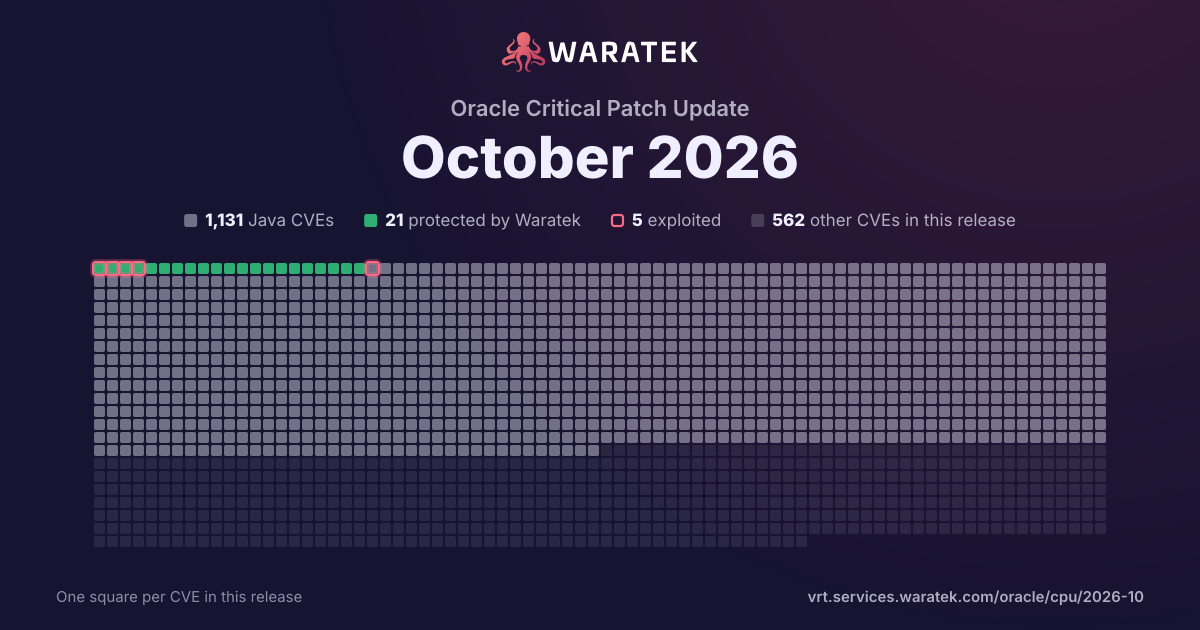
By status
21Protected by Waratek1Mitigation candidate1,109No exploit published13Outside Waratek scope549Not applicable
5Exploited, marked by the ring
No exploit published. For 858 of them, Oracle's security advisory is the source of public detail.
Protected by Waratek. Waratek RASP can block exploitation of these on systems that have not applied the patch yet.
Overview 123 matches · 89 in Waratek scope · 0 protected · 0 exploited · 0 CISA KEV · 0 public PoC · 0 EPSS ≥ 0.5
123matches
89in Waratek scope72.4%
0protected0.0%
0exploited0.0%
0CISA KEV0.0%
0public PoC0.0%
0EPSS ≥ 0.50.0%
Protected by Waratek
0
0.0%
Rule in development
0
0.0%
Mitigation candidate
0
0.0%
No exploit published
89
72.4%
Outside Waratek scope
4
3.3%
Not applicable
30
24.4%
Withdrawn CVE
0
0.0%
blocked by ARMR today
0
0.0%
partly blocked
0
0.0%
not blocked
123
100.0%
not established
0
0.0%
unrecorded
0
0.0%
Exploited
0
0.0%
Working exploit published
0
0.0%
Proof of concept only
4
3.3%
Forecast only
0
0.0%
No public exploit
119
96.7%
split by
peak 91 / quarter
Q3 221
No exploit published1
Low1
not blocked1
No public exploit1
Q4 220
Q1 230
Q2 230
Q3 230
Q4 231
Not applicable1
Low1
not blocked1
No public exploit1
Q1 241
No exploit published1
Low1
not blocked1
No public exploit1
Q2 240
Q3 241
Not applicable1
Low1
not blocked1
No public exploit1
Q4 240
Q1 250
Q2 250
Q3 250
Q4 250
Q1 267
No exploit published2
Not applicable5
Low7
not blocked7
Proof of concept only1
No public exploit6
Q2 2618
No exploit published5
Not applicable13
Low18
not blocked18
Proof of concept only3
No public exploit15
Q3 263
No exploit published1
Not applicable2
Low3
not blocked3
No public exploit3
Q4 2691
No exploit published79
Outside Waratek scope4
Not applicable8
Low91
not blocked91
No public exploit91
Q4 22Q2 23Q4 23Q2 24Q4 24Q2 25Q4 25Q2 26Q4 26
| CVE | Severity | Published▾ | Status | Exploitation | Description |
|---|---|---|---|---|---|
| CVE-2026-91650 | Low | 2026-10-20 | No exploit published | No public exploit | Vulnerability in Oracle Essbase (component: Java Based Agent). The supported version that is affected is 21.8.3.0.0. Difficult to exploit vulnerability allows unauthenticated attacker with network access via HTTP to compromise Oracle Essbase. Successful attacks of this vulnerability can result in unauthorized read access to a subset of Oracle Essbase accessible data. CVSS 3.1 Base Score 3.7 (Confidentiality impacts). CVSS Vector: (CVSS:3.1/AV:N/AC:H/PR:N/UI:N/S:U/C:L/I:N/A:N). |
| CVE-2026-91616 | Low | 2026-10-20 | No exploit published | No public exploit | Vulnerability in the Oracle Middleware Common Libraries and Tools product of Oracle Fusion Middleware (component: Remote Diagnostic Agent). Supported versions that are affected are 12.2.1.4.0 and 14.1.1.0.0. Difficult to exploit vulnerability allows unauthenticated attacker with network access via HTTP to compromise Oracle Middleware Common Libraries and Tools. Successful attacks of this vulnerability can result in unauthorized read access to a subset of Oracle Middleware Common Libraries and Tools accessible data. CVSS 3.1 Base Score 3.7 (Confidentiality impacts). CVSS Vector: (CVSS:3.1/AV:N/AC:H/PR:N/UI:N/S:U/C:L/I:N/A:N). |
| CVE-2026-91614 | Low | 2026-10-20 | No exploit published | No public exploit | Vulnerability in the Oracle Communications Unified Inventory Management product of Oracle Communications (component: Security). Supported versions that are affected are 7.5.0, 7.5.1, 7.6.0, 7.7.0, 7.8.0 and 8.0.1. Easily exploitable vulnerability allows low privileged attacker with logon to the infrastructure where Oracle Communications Unified Inventory Management executes to compromise Oracle Communications Unified Inventory Management. Successful attacks of this vulnerability can result in unauthorized read access to a subset of Oracle Communications Unified Inventory Management accessible data. CVSS 3.1 Base Score 3.3 (Confidentiality impacts). CVSS Vector: (CVSS:3.1/AV:L/AC:L/PR:L/UI:N/S:U/C:L/I:N/A:N). |
| CVE-2026-91613 | Low | 2026-10-20 | No exploit published | No public exploit | Vulnerability in the Oracle Communications Unified Inventory Management product of Oracle Communications (component: Security). Supported versions that are affected are 7.5.0, 7.5.1, 7.6.0, 7.7.0, 7.8.0 and 8.0.1. Easily exploitable vulnerability allows low privileged attacker with logon to the infrastructure where Oracle Communications Unified Inventory Management executes to compromise Oracle Communications Unified Inventory Management. Successful attacks of this vulnerability can result in unauthorized read access to a subset of Oracle Communications Unified Inventory Management accessible data. CVSS 3.1 Base Score 3.3 (Confidentiality impacts). CVSS Vector: (CVSS:3.1/AV:L/AC:L/PR:L/UI:N/S:U/C:L/I:N/A:N). |
| CVE-2026-91612 | Low | 2026-10-20 | No exploit published | No public exploit | Vulnerability in the Oracle Communications Unified Inventory Management product of Oracle Communications (component: Security). Supported versions that are affected are 7.5.0, 7.5.1, 7.6.0, 7.7.0, 7.8.0 and 8.0.1. Easily exploitable vulnerability allows low privileged attacker with logon to the infrastructure where Oracle Communications Unified Inventory Management executes to compromise Oracle Communications Unified Inventory Management. Successful attacks of this vulnerability can result in unauthorized read access to a subset of Oracle Communications Unified Inventory Management accessible data. CVSS 3.1 Base Score 3.3 (Confidentiality impacts). CVSS Vector: (CVSS:3.1/AV:L/AC:L/PR:L/UI:N/S:U/C:L/I:N/A:N). |
| CVE-2026-91582 | Low | 2026-10-20 | No exploit published | No public exploit | Vulnerability in the Oracle Business Intelligence Enterprise Edition product of Oracle Analytics (component: BI Search). The supported version that is affected is 12.2.1.4.0. Difficult to exploit vulnerability allows unauthenticated attacker with network access via HTTP to compromise Oracle Business Intelligence Enterprise Edition. Successful attacks of this vulnerability can result in unauthorized ability to cause a partial denial of service (partial DOS) of Oracle Business Intelligence Enterprise Edition. CVSS 3.1 Base Score 3.7 (Availability impacts). CVSS Vector: (CVSS:3.1/AV:N/AC:H/PR:N/UI:N/S:U/C:N/I:N/A:L). |
| CVE-2026-91485 | Low | 2026-10-20 | No exploit published | No public exploit | Vulnerability in the PeopleSoft Enterprise FIN Cash Management product of Oracle PeopleSoft (component: Cash Management). The supported version that is affected is 9.2. Difficult to exploit vulnerability allows high privileged attacker with logon to the infrastructure where PeopleSoft Enterprise FIN Cash Management executes to compromise PeopleSoft Enterprise FIN Cash Management. Successful attacks require human interaction from a person other than the attacker. Successful attacks of this vulnerability can result in unauthorized update, insert or delete access to some of PeopleSoft Enterprise FIN Cash Management accessible data as well as unauthorized read access to a subset of PeopleSoft Enterprise FIN Cash Management accessible data and unauthorized ability to cause a partial denial of service (partial DOS) of PeopleSoft Enterprise FIN Cash Management. CVSS 3.1 Base Score 3.8 (Confidentiality, Integrity and Availability impacts). CVSS Vector: (CVSS:3.1/AV:L/AC:H/PR:H/UI:R/S:U/C:L/I:L/A:L). |
| CVE-2026-91477 | Low | 2026-10-20 | Outside Waratek scope | No public exploit | Vulnerability in the Oracle JavaFX product of Oracle Java SE (component: JavaFX). Supported versions that are affected are Oracle JavaFX: 25.0.4 and 27. Difficult to exploit vulnerability allows unauthenticated attacker with network access via multiple protocols to compromise Oracle JavaFX. Successful attacks require human interaction from a person other than the attacker. Successful attacks of this vulnerability can result in unauthorized read access to a subset of Oracle JavaFX accessible data. Note: This vulnerability applies to Java deployments, typically in clients running sandboxed Java Web Start applications or sandboxed Java applets, that load and run untrusted code (e.g., code that comes from the internet) and rely on the Java sandbox for security. This vulnerability does not apply to Java deployments, typically in servers, that load and run only trusted code (e.g., code installed by an administrator). CVSS 3.1 Base Score 3.1 (Confidentiality impacts). CVSS Vector: (CVSS:3.1/AV:N/AC:H/PR:N/UI:R/S:U/C:L/I:N/A:N). |
| CVE-2026-91471 | Low | 2026-10-20 | No exploit published | No public exploit | Vulnerability in the PeopleSoft Enterprise CC Common Application Objects product of Oracle PeopleSoft (component: BAM Framework). The supported version that is affected is 9.2. Difficult to exploit vulnerability allows unauthenticated attacker with network access via HTTP to compromise PeopleSoft Enterprise CC Common Application Objects. Successful attacks of this vulnerability can result in unauthorized update, insert or delete access to some of PeopleSoft Enterprise CC Common Application Objects accessible data. CVSS 3.1 Base Score 3.7 (Integrity impacts). CVSS Vector: (CVSS:3.1/AV:N/AC:H/PR:N/UI:N/S:U/C:N/I:L/A:N). |
| CVE-2026-91461 | Low | 2026-10-20 | No exploit published | No public exploit | Vulnerability in the Oracle Java SE, Oracle GraalVM for JDK, Oracle GraalVM Enterprise Edition product of Oracle Java SE (component: JSSE). Supported versions that are affected are Oracle Java SE: 8u503, 8u503-perf, 11.0.32.1, 17.0.20.1, 21.0.12.1, 25.0.4.1, 27; Oracle GraalVM for JDK: 17.0.20.1 and 21.0.12.1; Oracle GraalVM Enterprise Edition: 21.3.19.1.1. Difficult to exploit vulnerability allows unauthenticated attacker with network access via TLS to compromise Oracle Java SE, Oracle GraalVM for JDK, Oracle GraalVM Enterprise Edition. Successful attacks of this vulnerability can result in unauthorized update, insert or delete access to some of Oracle Java SE, Oracle GraalVM for JDK, Oracle GraalVM Enterprise Edition accessible data. Note: This vulnerability can only be exploited by supplying data to APIs in the specified Component without using Untrusted Java Web Start applications or Untrusted Java applets, such as through a web service. CVSS 3.1 Base Score 3.7 (Integrity impacts). CVSS Vector: (CVSS:3.1/AV:N/AC:H/PR:N/UI:N/S:U/C:N/I:L/A:N). |
| CVE-2026-91436 | Low | 2026-10-20 | No exploit published | No public exploit | Vulnerability in the Siebel CRM Deployment product of Oracle Siebel CRM (component: Server Infrastructure). Supported versions that are affected are 17.0-26.9. Difficult to exploit vulnerability allows high privileged attacker with logon to the infrastructure where Siebel CRM Deployment executes to compromise Siebel CRM Deployment. Successful attacks of this vulnerability can result in unauthorized update, insert or delete access to some of Siebel CRM Deployment accessible data as well as unauthorized read access to a subset of Siebel CRM Deployment accessible data and unauthorized ability to cause a partial denial of service (partial DOS) of Siebel CRM Deployment. CVSS 3.1 Base Score 3.9 (Confidentiality, Integrity and Availability impacts). CVSS Vector: (CVSS:3.1/AV:L/AC:H/PR:H/UI:N/S:U/C:L/I:L/A:L). |
| CVE-2026-91427 | Low | 2026-10-20 | No exploit published | No public exploit | Vulnerability in the Siebel CRM Deployment product of Oracle Siebel CRM (component: Server Infrastructure). Supported versions that are affected are 17.0-26.9. Easily exploitable vulnerability allows high privileged attacker with logon to the infrastructure where Siebel CRM Deployment executes to compromise Siebel CRM Deployment. Successful attacks of this vulnerability can result in unauthorized ability to cause a partial denial of service (partial DOS) of Siebel CRM Deployment. CVSS 3.1 Base Score 2.3 (Availability impacts). CVSS Vector: (CVSS:3.1/AV:L/AC:L/PR:H/UI:N/S:U/C:N/I:N/A:L). |
| CVE-2026-91409 | Low | 2026-10-20 | No exploit published | No public exploit | Vulnerability in Oracle Java SE (component: Networking). The supported version that is affected is Oracle Java SE: 27. Difficult to exploit vulnerability allows unauthenticated attacker with network access via multiple protocols to compromise Oracle Java SE. Successful attacks of this vulnerability can result in unauthorized ability to cause a partial denial of service (partial DOS) of Oracle Java SE. Note: This vulnerability can be exploited by using APIs in the specified Component, e.g., through a web service which supplies data to the APIs. This vulnerability also applies to Java deployments, typically in clients running sandboxed Java Web Start applications or sandboxed Java applets, that load and run untrusted code (e.g., code that comes from the internet) and rely on the Java sandbox for security. CVSS 3.1 Base Score 3.7 (Availability impacts). CVSS Vector: (CVSS:3.1/AV:N/AC:H/PR:N/UI:N/S:U/C:N/I:N/A:L). |
| CVE-2026-91402 | Low | 2026-10-20 | Outside Waratek scope | No public exploit | Vulnerability in the Oracle Java SE, Oracle JavaFX, Oracle GraalVM Enterprise Edition product of Oracle Java SE (component: JavaFX). Supported versions that are affected are Oracle Java SE: 8u503; Oracle JavaFX: 21.0.12, 25.0.4 and 27; Oracle GraalVM Enterprise Edition: 21.3.19.1.1. Difficult to exploit vulnerability allows unauthenticated attacker with network access via multiple protocols to compromise Oracle Java SE, Oracle JavaFX, Oracle GraalVM Enterprise Edition. Successful attacks require human interaction from a person other than the attacker. Successful attacks of this vulnerability can result in unauthorized read access to a subset of Oracle Java SE, Oracle JavaFX, Oracle GraalVM Enterprise Edition accessible data. Note: This vulnerability applies to Java deployments, typically in clients running sandboxed Java Web Start applications or sandboxed Java applets, that load and run untrusted code (e.g., code that comes from the internet) and rely on the Java sandbox for security. This vulnerability does not apply to Java deployments, typically in servers, that load and run only trusted code (e.g., code installed by an administrator). CVSS 3.1 Base Score 3.1 (Confidentiality impacts). CVSS Vector: (CVSS:3.1/AV:N/AC:H/PR:N/UI:R/S:U/C:L/I:N/A:N). |
| CVE-2026-91400 | Low | 2026-10-20 | Outside Waratek scope | No public exploit | Vulnerability in the Oracle Java SE, Oracle GraalVM for JDK, Oracle GraalVM Enterprise Edition product of Oracle Java SE (component: Sound). Supported versions that are affected are Oracle Java SE: 8u503, 8u503-perf, 11.0.32.1, 17.0.20.1, 21.0.12.1, 25.0.4.1, 27; Oracle GraalVM for JDK: 17.0.20.1 and 21.0.12.1; Oracle GraalVM Enterprise Edition: 21.3.19.1.1. Difficult to exploit vulnerability allows unauthenticated attacker with network access via multiple protocols to compromise Oracle Java SE, Oracle GraalVM for JDK, Oracle GraalVM Enterprise Edition. Successful attacks require human interaction from a person other than the attacker. Successful attacks of this vulnerability can result in unauthorized ability to cause a partial denial of service (partial DOS) of Oracle Java SE, Oracle GraalVM for JDK, Oracle GraalVM Enterprise Edition. Note: This vulnerability applies to Java deployments, typically in clients running sandboxed Java Web Start applications or sandboxed Java applets, that load and run untrusted code (e.g., code that comes from the internet) and rely on the Java sandbox for security. This vulnerability does not apply to Java deployments, typically in servers, that load and run only trusted code (e.g., code installed by an administrator). CVSS 3.1 Base Score 3.1 (Availability impacts). CVSS Vector: (CVSS:3.1/AV:N/AC:H/PR:N/UI:R/S:U/C:N/I:N/A:L). |
| CVE-2026-91397 | Low | 2026-10-20 | No exploit published | No public exploit | Vulnerability in the Oracle Java SE, Oracle GraalVM for JDK, Oracle GraalVM Enterprise Edition product of Oracle Java SE (component: Serviceability). Supported versions that are affected are Oracle Java SE: 8u503, 8u503-perf, 11.0.32.1, 17.0.20.1, 21.0.12.1, 25.0.4.1, 27; Oracle GraalVM for JDK: 17.0.20.1 and 21.0.12.1; Oracle GraalVM Enterprise Edition: 21.3.19.1.1. Difficult to exploit vulnerability allows unauthenticated attacker with logon to the infrastructure where Oracle Java SE, Oracle GraalVM for JDK, Oracle GraalVM Enterprise Edition executes to compromise Oracle Java SE, Oracle GraalVM for JDK, Oracle GraalVM Enterprise Edition. Successful attacks require human interaction from a person other than the attacker. Successful attacks of this vulnerability can result in unauthorized update, insert or delete access to some of Oracle Java SE, Oracle GraalVM for JDK, Oracle GraalVM Enterprise Edition accessible data and unauthorized ability to cause a partial denial of service (partial DOS) of Oracle Java SE, Oracle GraalVM for JDK, Oracle GraalVM Enterprise Edition. Note: This vulnerability can be exploited by using APIs in the specified Component, e.g., through a web service which supplies data to the APIs. This vulnerability also applies to Java deployments, typically in clients running sandboxed Java Web Start applications or sandboxed Java applets, that load and run untrusted code (e.g., code that comes from the internet) and rely on the Java sandbox for security. CVSS 3.1 Base Score 3.6 (Integrity and Availability impacts). CVSS Vector: (CVSS:3.1/AV:L/AC:H/PR:N/UI:R/S:U/C:N/I:L/A:L). |
| CVE-2026-91393 | Low | 2026-10-20 | No exploit published | No public exploit | Vulnerability in the Siebel CRM End User product of Oracle Siebel CRM (component: Open UI). Supported versions that are affected are 17.0-26.9. Difficult to exploit vulnerability allows unauthenticated attacker with network access via HTTP to compromise Siebel CRM End User. Successful attacks require human interaction from a person other than the attacker. Successful attacks of this vulnerability can result in unauthorized update, insert or delete access to some of Siebel CRM End User accessible data. CVSS 3.1 Base Score 3.1 (Integrity impacts). CVSS Vector: (CVSS:3.1/AV:N/AC:H/PR:N/UI:R/S:U/C:N/I:L/A:N). |
| CVE-2026-91392 | Low | 2026-10-20 | No exploit published | No public exploit | Vulnerability in the Siebel CRM End User product of Oracle Siebel CRM (component: Open UI). Supported versions that are affected are 17.0-26.9. Difficult to exploit vulnerability allows unauthenticated attacker with network access via HTTP to compromise Siebel CRM End User. Successful attacks of this vulnerability can result in unauthorized update, insert or delete access to some of Siebel CRM End User accessible data. CVSS 3.1 Base Score 3.7 (Integrity impacts). CVSS Vector: (CVSS:3.1/AV:N/AC:H/PR:N/UI:N/S:U/C:N/I:L/A:N). |
| CVE-2026-91391 | Low | 2026-10-20 | No exploit published | No public exploit | Vulnerability in the Siebel CRM End User product of Oracle Siebel CRM (component: Open UI). Supported versions that are affected are 17.0-26.9. Difficult to exploit vulnerability allows unauthenticated attacker with network access via HTTP to compromise Siebel CRM End User. Successful attacks of this vulnerability can result in unauthorized read access to a subset of Siebel CRM End User accessible data. CVSS 3.1 Base Score 3.7 (Confidentiality impacts). CVSS Vector: (CVSS:3.1/AV:N/AC:H/PR:N/UI:N/S:U/C:L/I:N/A:N). |
| CVE-2026-91381 | Low | 2026-10-20 | No exploit published | No public exploit | Vulnerability in the Oracle Java SE, Oracle GraalVM Enterprise Edition product of Oracle Java SE (component: 2D). Supported versions that are affected are Oracle Java SE: 8u503 and 8u503-perf; Oracle GraalVM Enterprise Edition: 21.3.19.1.1. Difficult to exploit vulnerability allows unauthenticated attacker with network access via multiple protocols to compromise Oracle Java SE, Oracle GraalVM Enterprise Edition. Successful attacks of this vulnerability can result in unauthorized update, insert or delete access to some of Oracle Java SE, Oracle GraalVM Enterprise Edition accessible data. Note: This vulnerability can be exploited by using APIs in the specified Component, e.g., through a web service which supplies data to the APIs. This vulnerability also applies to Java deployments, typically in clients running sandboxed Java Web Start applications or sandboxed Java applets, that load and run untrusted code (e.g., code that comes from the internet) and rely on the Java sandbox for security. CVSS 3.1 Base Score 3.7 (Integrity impacts). CVSS Vector: (CVSS:3.1/AV:N/AC:H/PR:N/UI:N/S:U/C:N/I:L/A:N). |
| CVE-2026-91372 | Low | 2026-10-20 | No exploit published | No public exploit | Vulnerability in the Siebel CRM Cloud Applications product of Oracle Siebel CRM (component: Siebel Cloud Manager). Supported versions that are affected are 22.3-26.9. Easily exploitable vulnerability allows low privileged attacker with logon to the infrastructure where Siebel CRM Cloud Applications executes to compromise Siebel CRM Cloud Applications. Successful attacks of this vulnerability can result in unauthorized read access to a subset of Siebel CRM Cloud Applications accessible data. CVSS 3.1 Base Score 3.3 (Confidentiality impacts). CVSS Vector: (CVSS:3.1/AV:L/AC:L/PR:L/UI:N/S:U/C:L/I:N/A:N). |
| CVE-2026-91363 | Low | 2026-10-20 | No exploit published | No public exploit | Vulnerability in the Siebel CRM Cloud Applications product of Oracle Siebel CRM (component: Siebel Cloud Manager). Supported versions that are affected are 22.3-26.9. Difficult to exploit vulnerability allows unauthenticated attacker with network access via HTTP to compromise Siebel CRM Cloud Applications. Successful attacks of this vulnerability can result in unauthorized read access to a subset of Siebel CRM Cloud Applications accessible data. CVSS 3.1 Base Score 3.7 (Confidentiality impacts). CVSS Vector: (CVSS:3.1/AV:N/AC:H/PR:N/UI:N/S:U/C:L/I:N/A:N). |
| CVE-2026-91335 | Low | 2026-10-20 | Outside Waratek scope | No public exploit | Vulnerability in the Oracle Java SE, Oracle GraalVM for JDK, Oracle GraalVM Enterprise Edition product of Oracle Java SE (component: AWT). Supported versions that are affected are Oracle Java SE: 8u503, 8u503-perf, 11.0.32.1, 17.0.20.1, 21.0.12.1, 25.0.4.1, 27; Oracle GraalVM for JDK: 17.0.20.1 and 21.0.12.1; Oracle GraalVM Enterprise Edition: 21.3.19.1.1. Difficult to exploit vulnerability allows low privileged attacker with network access via multiple protocols to compromise Oracle Java SE, Oracle GraalVM for JDK, Oracle GraalVM Enterprise Edition. Successful attacks require human interaction from a person other than the attacker. Successful attacks of this vulnerability can result in unauthorized read access to a subset of Oracle Java SE, Oracle GraalVM for JDK, Oracle GraalVM Enterprise Edition accessible data. Note: This vulnerability applies to Java deployments, typically in clients running sandboxed Java Web Start applications or sandboxed Java applets, that load and run untrusted code (e.g., code that comes from the internet) and rely on the Java sandbox for security. This vulnerability does not apply to Java deployments, typically in servers, that load and run only trusted code (e.g., code installed by an administrator). CVSS 3.1 Base Score 2.6 (Confidentiality impacts). CVSS Vector: (CVSS:3.1/AV:N/AC:H/PR:L/UI:R/S:U/C:L/I:N/A:N). |
| CVE-2026-91334 | Low | 2026-10-20 | No exploit published | No public exploit | Vulnerability in the Oracle Java SE, Oracle GraalVM for JDK, Oracle GraalVM Enterprise Edition product of Oracle Java SE (component: ImageIO). Supported versions that are affected are Oracle Java SE: 8u503, 8u503-perf, 11.0.32.1, 17.0.20.1, 21.0.12.1, 25.0.4.1, 27; Oracle GraalVM for JDK: 17.0.20.1 and 21.0.12.1; Oracle GraalVM Enterprise Edition: 21.3.19.1.1. Difficult to exploit vulnerability allows unauthenticated attacker with network access via multiple protocols to compromise Oracle Java SE, Oracle GraalVM for JDK, Oracle GraalVM Enterprise Edition. Successful attacks of this vulnerability can result in unauthorized read access to a subset of Oracle Java SE, Oracle GraalVM for JDK, Oracle GraalVM Enterprise Edition accessible data. Note: This vulnerability can be exploited by using APIs in the specified Component, e.g., through a web service which supplies data to the APIs. This vulnerability also applies to Java deployments, typically in clients running sandboxed Java Web Start applications or sandboxed Java applets, that load and run untrusted code (e.g., code that comes from the internet) and rely on the Java sandbox for security. CVSS 3.1 Base Score 3.7 (Confidentiality impacts). CVSS Vector: (CVSS:3.1/AV:N/AC:H/PR:N/UI:N/S:U/C:L/I:N/A:N). |
| CVE-2026-91333 | Low | 2026-10-20 | No exploit published | No public exploit | Vulnerability in Oracle Java SE (component: Security). Supported versions that are affected are Oracle Java SE: 21.0.12.1, 25.0.4.1 and 27. Difficult to exploit vulnerability allows unauthenticated attacker with network access via multiple protocols to compromise Oracle Java SE. Successful attacks of this vulnerability can result in unauthorized update, insert or delete access to some of Oracle Java SE accessible data. Note: This vulnerability can be exploited by using APIs in the specified Component, e.g., through a web service which supplies data to the APIs. This vulnerability also applies to Java deployments, typically in clients running sandboxed Java Web Start applications or sandboxed Java applets, that load and run untrusted code (e.g., code that comes from the internet) and rely on the Java sandbox for security. CVSS 3.1 Base Score 3.7 (Integrity impacts). CVSS Vector: (CVSS:3.1/AV:N/AC:H/PR:N/UI:N/S:U/C:N/I:L/A:N). |
| CVE-2026-91331 | Low | 2026-10-20 | No exploit published | No public exploit | Vulnerability in the PeopleSoft Enterprise CC Common Application Objects product of Oracle PeopleSoft (component: Common Application Objects). The supported version that is affected is 9.2. Easily exploitable vulnerability allows high privileged attacker with network access via HTTP to compromise PeopleSoft Enterprise CC Common Application Objects. Successful attacks of this vulnerability can result in unauthorized update, insert or delete access to some of PeopleSoft Enterprise CC Common Application Objects accessible data as well as unauthorized read access to a subset of PeopleSoft Enterprise CC Common Application Objects accessible data. CVSS 3.1 Base Score 3.8 (Confidentiality and Integrity impacts). CVSS Vector: (CVSS:3.1/AV:N/AC:L/PR:H/UI:N/S:U/C:L/I:L/A:N). |
| CVE-2026-91330 | Low | 2026-10-20 | No exploit published | No public exploit | Vulnerability in the JD Edwards EnterpriseOne Tools product of Oracle JD Edwards (component: Installation Security). Supported versions that are affected are 9.2.0.0-9.2.26.5. Easily exploitable vulnerability allows low privileged attacker with logon to the infrastructure where JD Edwards EnterpriseOne Tools executes to compromise JD Edwards EnterpriseOne Tools. Successful attacks of this vulnerability can result in unauthorized ability to cause a partial denial of service (partial DOS) of JD Edwards EnterpriseOne Tools. CVSS 3.1 Base Score 3.3 (Availability impacts). CVSS Vector: (CVSS:3.1/AV:L/AC:L/PR:L/UI:N/S:U/C:N/I:N/A:L). |
| CVE-2026-91322 | Low | 2026-10-20 | No exploit published | No public exploit | Vulnerability in the Oracle JDeveloper product of Oracle Fusion Middleware (component: Oracle JDeveloper). Supported versions that are affected are 12.2.1.4.0 and 14.1.2.0.0. Easily exploitable vulnerability allows low privileged attacker with logon to the infrastructure where Oracle JDeveloper executes to compromise Oracle JDeveloper. Successful attacks of this vulnerability can result in unauthorized read access to a subset of Oracle JDeveloper accessible data. CVSS 3.1 Base Score 3.3 (Confidentiality impacts). CVSS Vector: (CVSS:3.1/AV:L/AC:L/PR:L/UI:N/S:U/C:L/I:N/A:N). |
| CVE-2026-91302 | Low | 2026-10-20 | No exploit published | No public exploit | Vulnerability in the JD Edwards EnterpriseOne Tools product of Oracle JD Edwards (component: Enterprise Infrastructure SEC). Supported versions that are affected are 9.2.0.0-9.2.26.5. Easily exploitable vulnerability allows unauthenticated attacker with logon to the infrastructure where JD Edwards EnterpriseOne Tools executes to compromise JD Edwards EnterpriseOne Tools. Successful attacks require human interaction from a person other than the attacker. Successful attacks of this vulnerability can result in unauthorized ability to cause a partial denial of service (partial DOS) of JD Edwards EnterpriseOne Tools. CVSS 3.1 Base Score 3.3 (Availability impacts). CVSS Vector: (CVSS:3.1/AV:L/AC:L/PR:N/UI:R/S:U/C:N/I:N/A:L). |
| CVE-2026-91301 | Low | 2026-10-20 | No exploit published | No public exploit | Vulnerability in the JD Edwards EnterpriseOne Tools product of Oracle JD Edwards (component: Monitoring and Diagnostics SEC). Supported versions that are affected are 9.2.0.0-9.2.26.5. Difficult to exploit vulnerability allows low privileged attacker with logon to the infrastructure where JD Edwards EnterpriseOne Tools executes to compromise JD Edwards EnterpriseOne Tools. Successful attacks of this vulnerability can result in unauthorized update, insert or delete access to some of JD Edwards EnterpriseOne Tools accessible data and unauthorized ability to cause a partial denial of service (partial DOS) of JD Edwards EnterpriseOne Tools. CVSS 3.1 Base Score 3.6 (Integrity and Availability impacts). CVSS Vector: (CVSS:3.1/AV:L/AC:H/PR:L/UI:N/S:U/C:N/I:L/A:L). |
| CVE-2026-91300 | Low | 2026-10-20 | No exploit published | No public exploit | Vulnerability in the JD Edwards EnterpriseOne Tools product of Oracle JD Edwards (component: Web Runtime SEC). Supported versions that are affected are 9.2.0.0-9.2.26.5. Difficult to exploit vulnerability allows unauthenticated attacker with network access via HTTP to compromise JD Edwards EnterpriseOne Tools. Successful attacks require human interaction from a person other than the attacker. Successful attacks of this vulnerability can result in unauthorized update, insert or delete access to some of JD Edwards EnterpriseOne Tools accessible data. CVSS 3.1 Base Score 3.1 (Integrity impacts). CVSS Vector: (CVSS:3.1/AV:N/AC:H/PR:N/UI:R/S:U/C:N/I:L/A:N). |
| CVE-2026-91291 | Low | 2026-10-20 | No exploit published | No public exploit | Vulnerability in the JD Edwards EnterpriseOne Tools product of Oracle JD Edwards (component: Business Logic Infra SEC). Supported versions that are affected are 9.2.0.0-9.2.26.5. Difficult to exploit vulnerability allows low privileged attacker with logon to the infrastructure where JD Edwards EnterpriseOne Tools executes to compromise JD Edwards EnterpriseOne Tools. Successful attacks of this vulnerability can result in unauthorized update, insert or delete access to some of JD Edwards EnterpriseOne Tools accessible data as well as unauthorized read access to a subset of JD Edwards EnterpriseOne Tools accessible data. CVSS 3.1 Base Score 3.6 (Confidentiality and Integrity impacts). CVSS Vector: (CVSS:3.1/AV:L/AC:H/PR:L/UI:N/S:U/C:L/I:L/A:N). |
| CVE-2026-91264 | Low | 2026-10-20 | No exploit published | No public exploit | Vulnerability in the PeopleSoft Enterprise SCM Manufacturing product of Oracle PeopleSoft (component: Security). The supported version that is affected is 9.2. Difficult to exploit vulnerability allows unauthenticated attacker with network access via HTTP to compromise PeopleSoft Enterprise SCM Manufacturing. Successful attacks of this vulnerability can result in unauthorized update, insert or delete access to some of PeopleSoft Enterprise SCM Manufacturing accessible data. CVSS 3.1 Base Score 3.7 (Integrity impacts). CVSS Vector: (CVSS:3.1/AV:N/AC:H/PR:N/UI:N/S:U/C:N/I:L/A:N). |
| CVE-2026-91261 | Low | 2026-10-20 | No exploit published | No public exploit | Vulnerability in the Oracle WebCenter Content product of Oracle Fusion Middleware (component: Content Server). The supported version that is affected is 14.1.2.0.0. Difficult to exploit vulnerability allows low privileged attacker with network access via HTTP to compromise Oracle WebCenter Content. Successful attacks of this vulnerability can result in unauthorized read access to a subset of Oracle WebCenter Content accessible data. CVSS 3.1 Base Score 3.1 (Confidentiality impacts). CVSS Vector: (CVSS:3.1/AV:N/AC:H/PR:L/UI:N/S:U/C:L/I:N/A:N). |
| CVE-2026-91249 | Low | 2026-10-20 | Not applicable | No public exploit | Vulnerability in the Oracle Solaris product of Oracle Systems (component: Libraries). The supported version that is affected is 11.4. Easily exploitable vulnerability allows low privileged attacker with logon to the infrastructure where Oracle Solaris executes to compromise Oracle Solaris. Successful attacks of this vulnerability can result in unauthorized read access to a subset of Oracle Solaris accessible data. CVSS 3.1 Base Score 3.3 (Confidentiality impacts). CVSS Vector: (CVSS:3.1/AV:L/AC:L/PR:L/UI:N/S:U/C:L/I:N/A:N). |
| CVE-2026-87422 | Low | 2026-10-20 | Not applicable | No public exploit | Vulnerability in the Oracle Solaris product of Oracle Systems (component: Services). The supported version that is affected is 11.4. Difficult to exploit vulnerability allows unauthenticated attacker with logon to the infrastructure where Oracle Solaris executes to compromise Oracle Solaris. Successful attacks require human interaction from a person other than the attacker. Successful attacks of this vulnerability can result in unauthorized update, insert or delete access to some of Oracle Solaris accessible data. CVSS 3.1 Base Score 2.5 (Integrity impacts). CVSS Vector: (CVSS:3.1/AV:L/AC:H/PR:N/UI:R/S:U/C:N/I:L/A:N). |
| CVE-2026-87418 | Low | 2026-10-20 | No exploit published | No public exploit | Vulnerability in the PeopleSoft Enterprise PeopleTools product of Oracle PeopleSoft (component: Updates Environment Mgmt). Supported versions that are affected are 8.61-8.63. Difficult to exploit vulnerability allows low privileged attacker with logon to the infrastructure where PeopleSoft Enterprise PeopleTools executes to compromise PeopleSoft Enterprise PeopleTools. Successful attacks of this vulnerability can result in unauthorized read access to a subset of PeopleSoft Enterprise PeopleTools accessible data. CVSS 3.1 Base Score 2.5 (Confidentiality impacts). CVSS Vector: (CVSS:3.1/AV:L/AC:H/PR:L/UI:N/S:U/C:L/I:N/A:N). |
| CVE-2026-87416 | Low | 2026-10-20 | No exploit published | No public exploit | Vulnerability in the PeopleSoft Enterprise PeopleTools product of Oracle PeopleSoft (component: Report Distribution). Supported versions that are affected are 8.61-8.63. Difficult to exploit vulnerability allows unauthenticated attacker with network access via HTTP to compromise PeopleSoft Enterprise PeopleTools. Successful attacks of this vulnerability can result in unauthorized read access to a subset of PeopleSoft Enterprise PeopleTools accessible data. CVSS 3.1 Base Score 3.7 (Confidentiality impacts). CVSS Vector: (CVSS:3.1/AV:N/AC:H/PR:N/UI:N/S:U/C:L/I:N/A:N). |
| CVE-2026-87414 | Low | 2026-10-20 | Not applicable | No public exploit | Vulnerability in the Oracle Solaris product of Oracle Systems (component: Image Packaging System). The supported version that is affected is 11.4. Difficult to exploit vulnerability allows unauthenticated attacker with network access via TLS to compromise Oracle Solaris. Successful attacks require human interaction from a person other than the attacker. Successful attacks of this vulnerability can result in unauthorized update, insert or delete access to some of Oracle Solaris accessible data. CVSS 3.1 Base Score 3.1 (Integrity impacts). CVSS Vector: (CVSS:3.1/AV:N/AC:H/PR:N/UI:R/S:U/C:N/I:L/A:N). |
| CVE-2026-87412 | Low | 2026-10-20 | No exploit published | No public exploit | Vulnerability in the PeopleSoft Enterprise PeopleTools product of Oracle PeopleSoft (component: Report Distribution). Supported versions that are affected are 8.61-8.63. Easily exploitable vulnerability allows high privileged attacker with network access via HTTP to compromise PeopleSoft Enterprise PeopleTools. Successful attacks of this vulnerability can result in unauthorized read access to a subset of PeopleSoft Enterprise PeopleTools accessible data. CVSS 3.1 Base Score 2.7 (Confidentiality impacts). CVSS Vector: (CVSS:3.1/AV:N/AC:L/PR:H/UI:N/S:U/C:L/I:N/A:N). |
| CVE-2026-87401 | Low | 2026-10-20 | No exploit published | No public exploit | Vulnerability in the PeopleSoft Enterprise PeopleTools product of Oracle PeopleSoft (component: XML Publisher). Supported versions that are affected are 8.61-8.63. Easily exploitable vulnerability allows low privileged attacker with logon to the infrastructure where PeopleSoft Enterprise PeopleTools executes to compromise PeopleSoft Enterprise PeopleTools. Successful attacks of this vulnerability can result in unauthorized read access to a subset of PeopleSoft Enterprise PeopleTools accessible data. CVSS 3.1 Base Score 3.3 (Confidentiality impacts). CVSS Vector: (CVSS:3.1/AV:L/AC:L/PR:L/UI:N/S:U/C:L/I:N/A:N). |
| CVE-2026-87389 | Low | 2026-10-20 | No exploit published | No public exploit | Vulnerability in the JD Edwards EnterpriseOne Human Resources Management product of Oracle JD Edwards (component: Human Resources). The supported version that is affected is 9.2. Difficult to exploit vulnerability allows unauthenticated attacker with network access via HTTP to compromise JD Edwards EnterpriseOne Human Resources Management. Successful attacks of this vulnerability can result in unauthorized update, insert or delete access to some of JD Edwards EnterpriseOne Human Resources Management accessible data. CVSS 3.1 Base Score 3.7 (Integrity impacts). CVSS Vector: (CVSS:3.1/AV:N/AC:H/PR:N/UI:N/S:U/C:N/I:L/A:N). |
| CVE-2026-87367 | Low | 2026-10-20 | No exploit published | No public exploit | Vulnerability in the Oracle Java SE, Oracle GraalVM for JDK, Oracle GraalVM Enterprise Edition product of Oracle Java SE (component: JAXP). Supported versions that are affected are Oracle Java SE: 8u503, 8u503-perf, 11.0.32.1, 17.0.20.1, 21.0.12.1, 25.0.4.1, 27; Oracle GraalVM for JDK: 17.0.20.1 and 21.0.12.1; Oracle GraalVM Enterprise Edition: 21.3.19.1.1. Difficult to exploit vulnerability allows unauthenticated attacker with network access via multiple protocols to compromise Oracle Java SE, Oracle GraalVM for JDK, Oracle GraalVM Enterprise Edition. Successful attacks of this vulnerability can result in unauthorized update, insert or delete access to some of Oracle Java SE, Oracle GraalVM for JDK, Oracle GraalVM Enterprise Edition accessible data. Note: This vulnerability can be exploited by using APIs in the specified Component, e.g., through a web service which supplies data to the APIs. This vulnerability also applies to Java deployments, typically in clients running sandboxed Java Web Start applications or sandboxed Java applets, that load and run untrusted code (e.g., code that comes from the internet) and rely on the Java sandbox for security. CVSS 3.1 Base Score 3.7 (Integrity impacts). CVSS Vector: (CVSS:3.1/AV:N/AC:H/PR:N/UI:N/S:U/C:N/I:L/A:N). |
| CVE-2026-87340 | Low | 2026-10-20 | No exploit published | No public exploit | Vulnerability in the PeopleSoft Enterprise PeopleTools product of Oracle PeopleSoft (component: Portal). Supported versions that are affected are 8.61-8.63. Difficult to exploit vulnerability allows unauthenticated attacker with network access via HTTP to compromise PeopleSoft Enterprise PeopleTools. Successful attacks of this vulnerability can result in unauthorized update, insert or delete access to some of PeopleSoft Enterprise PeopleTools accessible data. CVSS 3.1 Base Score 3.7 (Integrity impacts). CVSS Vector: (CVSS:3.1/AV:N/AC:H/PR:N/UI:N/S:U/C:N/I:L/A:N). |
| CVE-2026-87339 | Low | 2026-10-20 | No exploit published | No public exploit | Vulnerability in the Siebel CRM Integration product of Oracle Siebel CRM (component: REST). Supported versions that are affected are 17.0-26.9. Difficult to exploit vulnerability allows unauthenticated attacker with network access via HTTP to compromise Siebel CRM Integration. Successful attacks require human interaction from a person other than the attacker. Successful attacks of this vulnerability can result in unauthorized read access to a subset of Siebel CRM Integration accessible data. CVSS 3.1 Base Score 3.1 (Confidentiality impacts). CVSS Vector: (CVSS:3.1/AV:N/AC:H/PR:N/UI:R/S:U/C:L/I:N/A:N). |
| CVE-2026-87333 | Low | 2026-10-20 | No exploit published | No public exploit | Vulnerability in the JD Edwards EnterpriseOne Tools product of Oracle JD Edwards (component: Enterprise Infrastructure SEC). Supported versions that are affected are 9.2.0.0-9.2.26.5. Difficult to exploit vulnerability allows low privileged attacker with logon to the infrastructure where JD Edwards EnterpriseOne Tools executes to compromise JD Edwards EnterpriseOne Tools. Successful attacks of this vulnerability can result in unauthorized update, insert or delete access to some of JD Edwards EnterpriseOne Tools accessible data as well as unauthorized read access to a subset of JD Edwards EnterpriseOne Tools accessible data. CVSS 3.1 Base Score 3.6 (Confidentiality and Integrity impacts). CVSS Vector: (CVSS:3.1/AV:L/AC:H/PR:L/UI:N/S:U/C:L/I:L/A:N). |
| CVE-2026-87332 | Low | 2026-10-20 | No exploit published | No public exploit | Vulnerability in the JD Edwards EnterpriseOne Tools product of Oracle JD Edwards (component: E1 Dev Platform Tech - Cloud). Supported versions that are affected are 9.2.0.0-9.2.26.5. Difficult to exploit vulnerability allows high privileged attacker with logon to the infrastructure where JD Edwards EnterpriseOne Tools executes to compromise JD Edwards EnterpriseOne Tools. Successful attacks of this vulnerability can result in unauthorized update, insert or delete access to some of JD Edwards EnterpriseOne Tools accessible data and unauthorized ability to cause a partial denial of service (partial DOS) of JD Edwards EnterpriseOne Tools. CVSS 3.1 Base Score 3.0 (Integrity and Availability impacts). CVSS Vector: (CVSS:3.1/AV:L/AC:H/PR:H/UI:N/S:U/C:N/I:L/A:L). |
| CVE-2026-87331 | Low | 2026-10-20 | No exploit published | No public exploit | Vulnerability in the JD Edwards EnterpriseOne Tools product of Oracle JD Edwards (component: E1 Dev Platform Tech - UNIX). Supported versions that are affected are 9.2.0.0-9.2.26.5. Easily exploitable vulnerability allows high privileged attacker with logon to the infrastructure where JD Edwards EnterpriseOne Tools executes to compromise JD Edwards EnterpriseOne Tools. Successful attacks of this vulnerability can result in unauthorized update, insert or delete access to some of JD Edwards EnterpriseOne Tools accessible data and unauthorized ability to cause a partial denial of service (partial DOS) of JD Edwards EnterpriseOne Tools. CVSS 3.1 Base Score 3.4 (Integrity and Availability impacts). CVSS Vector: (CVSS:3.1/AV:L/AC:L/PR:H/UI:N/S:U/C:N/I:L/A:L). |
| CVE-2026-87292 | Low | 2026-10-20 | No exploit published | No public exploit | Vulnerability in the Oracle Java SE, Oracle GraalVM for JDK, Oracle GraalVM Enterprise Edition product of Oracle Java SE (component: Networking). Supported versions that are affected are Oracle Java SE: 8u503, 8u503-perf, 11.0.32.1, 17.0.20.1, 21.0.12.1, 25.0.4.1, 27; Oracle GraalVM for JDK: 17.0.20.1 and 21.0.12.1; Oracle GraalVM Enterprise Edition: 21.3.19.1.1. Difficult to exploit vulnerability allows unauthenticated attacker with network access via multiple protocols to compromise Oracle Java SE, Oracle GraalVM for JDK, Oracle GraalVM Enterprise Edition. Successful attacks of this vulnerability can result in unauthorized update, insert or delete access to some of Oracle Java SE, Oracle GraalVM for JDK, Oracle GraalVM Enterprise Edition accessible data. Note: This vulnerability can be exploited by using APIs in the specified Component, e.g., through a web service which supplies data to the APIs. This vulnerability also applies to Java deployments, typically in clients running sandboxed Java Web Start applications or sandboxed Java applets, that load and run untrusted code (e.g., code that comes from the internet) and rely on the Java sandbox for security. CVSS 3.1 Base Score 3.7 (Integrity impacts). CVSS Vector: (CVSS:3.1/AV:N/AC:H/PR:N/UI:N/S:U/C:N/I:L/A:N). |
| CVE-2026-87255 | Low | 2026-10-20 | No exploit published | No public exploit | Vulnerability in Oracle Java SE (component: Compiler). Supported versions that are affected are Oracle Java SE: 25.0.4.1 and 27. Difficult to exploit vulnerability allows unauthenticated attacker with network access via multiple protocols to compromise Oracle Java SE. Successful attacks of this vulnerability can result in unauthorized read access to a subset of Oracle Java SE accessible data. Note: This vulnerability can only be exploited by supplying data to APIs in the specified Component without using Untrusted Java Web Start applications or Untrusted Java applets, such as through a web service. CVSS 3.1 Base Score 3.7 (Confidentiality impacts). CVSS Vector: (CVSS:3.1/AV:N/AC:H/PR:N/UI:N/S:U/C:L/I:N/A:N). |
| CVE-2026-83392 | Low | 2026-10-20 | No exploit published | No public exploit | Vulnerability in the Oracle Applications Manager product of Oracle E-Business Suite (component: Diagnostics). Supported versions that are affected are 12.2.3-12.2.15. Difficult to exploit vulnerability allows low privileged attacker with network access via HTTP to compromise Oracle Applications Manager. Successful attacks of this vulnerability can result in unauthorized read access to a subset of Oracle Applications Manager accessible data. CVSS 3.1 Base Score 3.1 (Confidentiality impacts). CVSS Vector: (CVSS:3.1/AV:N/AC:H/PR:L/UI:N/S:U/C:L/I:N/A:N). |
| CVE-2026-83388 | Low | 2026-10-20 | No exploit published | No public exploit | Vulnerability in the Oracle Applications Manager product of Oracle E-Business Suite (component: Diagnostics). Supported versions that are affected are 12.2.3-12.2.15. Difficult to exploit vulnerability allows high privileged attacker with network access via HTTP to compromise Oracle Applications Manager. Successful attacks of this vulnerability can result in unauthorized read access to a subset of Oracle Applications Manager accessible data. CVSS 3.1 Base Score 2.2 (Confidentiality impacts). CVSS Vector: (CVSS:3.1/AV:N/AC:H/PR:H/UI:N/S:U/C:L/I:N/A:N). |
| CVE-2026-83376 | Low | 2026-10-20 | No exploit published | No public exploit | Vulnerability in the Oracle Java SE, Oracle GraalVM for JDK, Oracle GraalVM Enterprise Edition product of Oracle Java SE (component: JSSE). Supported versions that are affected are Oracle Java SE: 8u503, 8u503-perf, 11.0.32.1, 17.0.20.1, 21.0.12.1, 25.0.4.1, 27; Oracle GraalVM for JDK: 17.0.20.1 and 21.0.12.1; Oracle GraalVM Enterprise Edition: 21.3.19.1.1. Difficult to exploit vulnerability allows unauthenticated attacker with network access via TLS to compromise Oracle Java SE, Oracle GraalVM for JDK, Oracle GraalVM Enterprise Edition. Successful attacks of this vulnerability can result in unauthorized update, insert or delete access to some of Oracle Java SE, Oracle GraalVM for JDK, Oracle GraalVM Enterprise Edition accessible data. Note: This vulnerability can be exploited by using APIs in the specified Component, e.g., through a web service which supplies data to the APIs. This vulnerability also applies to Java deployments, typically in clients running sandboxed Java Web Start applications or sandboxed Java applets, that load and run untrusted code (e.g., code that comes from the internet) and rely on the Java sandbox for security. CVSS 3.1 Base Score 3.7 (Integrity impacts). CVSS Vector: (CVSS:3.1/AV:N/AC:H/PR:N/UI:N/S:U/C:N/I:L/A:N). |
| CVE-2026-83373 | Low | 2026-10-20 | No exploit published | No public exploit | Vulnerability in the PeopleSoft Enterprise PeopleTools product of Oracle PeopleSoft (component: Portal). Supported versions that are affected are 8.61-8.63. Difficult to exploit vulnerability allows low privileged attacker with network access via HTTP to compromise PeopleSoft Enterprise PeopleTools. Successful attacks require human interaction from a person other than the attacker and while the vulnerability is in PeopleSoft Enterprise PeopleTools, attacks may significantly impact additional products (scope change). Successful attacks of this vulnerability can result in unauthorized read access to a subset of PeopleSoft Enterprise PeopleTools accessible data. CVSS 3.1 Base Score 3.0 (Confidentiality impacts). CVSS Vector: (CVSS:3.1/AV:N/AC:H/PR:L/UI:R/S:C/C:L/I:N/A:N). |
| CVE-2026-73964 | Low | 2026-10-20 | Not applicable | No public exploit | Vulnerability in the RDBMS component of Oracle Database Server. Supported versions that are affected are 19.3-19.32 and 21.3-21.23. Easily exploitable vulnerability allows high privileged attacker having Query Optimizer privilege with network access via Oracle Net to compromise RDBMS. Successful attacks of this vulnerability can result in unauthorized read access to a subset of RDBMS accessible data. CVSS 3.1 Base Score 2.7 (Confidentiality impacts). CVSS Vector: (CVSS:3.1/AV:N/AC:L/PR:H/UI:N/S:U/C:L/I:N/A:N). |
| CVE-2026-60964 | Low | 2026-10-20 | No exploit published | No public exploit | Vulnerability in the PeopleSoft Enterprise PeopleTools product of Oracle PeopleSoft (component: Open Query). Supported versions that are affected are 8.61 and 8.62. Difficult to exploit vulnerability allows high privileged attacker with logon to the infrastructure where PeopleSoft Enterprise PeopleTools executes to compromise PeopleSoft Enterprise PeopleTools. Successful attacks of this vulnerability can result in unauthorized read access to a subset of PeopleSoft Enterprise PeopleTools accessible data. CVSS 3.1 Base Score 1.9 (Confidentiality impacts). CVSS Vector: (CVSS:3.1/AV:L/AC:H/PR:H/UI:N/S:U/C:L/I:N/A:N). |
| CVE-2026-60887 | Low | 2026-10-20 | No exploit published | No public exploit | Vulnerability in the PeopleSoft Enterprise PeopleTools product of Oracle PeopleSoft (component: Data Mover). Supported versions that are affected are 8.61-8.63. Difficult to exploit vulnerability allows high privileged attacker with logon to the infrastructure where PeopleSoft Enterprise PeopleTools executes to compromise PeopleSoft Enterprise PeopleTools. Successful attacks require human interaction from a person other than the attacker. Successful attacks of this vulnerability can result in unauthorized update, insert or delete access to some of PeopleSoft Enterprise PeopleTools accessible data as well as unauthorized read access to a subset of PeopleSoft Enterprise PeopleTools accessible data and unauthorized ability to cause a partial denial of service (partial DOS) of PeopleSoft Enterprise PeopleTools. CVSS 3.1 Base Score 3.8 (Confidentiality, Integrity and Availability impacts). CVSS Vector: (CVSS:3.1/AV:L/AC:H/PR:H/UI:R/S:U/C:L/I:L/A:L). |
| CVE-2026-60819 | Low | 2026-10-20 | No exploit published | No public exploit | Vulnerability in the PeopleSoft Enterprise PeopleTools product of Oracle PeopleSoft (component: Application Server - JRE). Supported versions that are affected are 8.61-8.63. Difficult to exploit vulnerability allows unauthenticated attacker with network access via SSH to compromise PeopleSoft Enterprise PeopleTools. Successful attacks of this vulnerability can result in unauthorized update, insert or delete access to some of PeopleSoft Enterprise PeopleTools accessible data. CVSS 3.1 Base Score 3.7 (Integrity impacts). CVSS Vector: (CVSS:3.1/AV:N/AC:H/PR:N/UI:N/S:U/C:N/I:L/A:N). |
| CVE-2026-60814 | Low | 2026-10-20 | No exploit published | No public exploit | Vulnerability in the PeopleSoft Enterprise PeopleTools product of Oracle PeopleSoft (component: Business Interlink). Supported versions that are affected are 8.61-8.63. Difficult to exploit vulnerability allows high privileged attacker with logon to the infrastructure where PeopleSoft Enterprise PeopleTools executes to compromise PeopleSoft Enterprise PeopleTools. Successful attacks of this vulnerability can result in unauthorized update, insert or delete access to some of PeopleSoft Enterprise PeopleTools accessible data as well as unauthorized read access to a subset of PeopleSoft Enterprise PeopleTools accessible data and unauthorized ability to cause a partial denial of service (partial DOS) of PeopleSoft Enterprise PeopleTools. CVSS 3.1 Base Score 3.9 (Confidentiality, Integrity and Availability impacts). CVSS Vector: (CVSS:3.1/AV:L/AC:H/PR:H/UI:N/S:U/C:L/I:L/A:L). |
| CVE-2026-101846 | Low | 2026-10-20 | No exploit published | No public exploit | Vulnerability in the Oracle Purchasing product of Oracle E-Business Suite (component: Internal Operations). Supported versions that are affected are 12.2.3-12.2.15. Easily exploitable vulnerability allows low privileged attacker with network access via HTTP to compromise Oracle Purchasing. Successful attacks require human interaction from a person other than the attacker. Successful attacks of this vulnerability can result in unauthorized update, insert or delete access to some of Oracle Purchasing accessible data. CVSS 3.1 Base Score 3.5 (Integrity impacts). CVSS Vector: (CVSS:3.1/AV:N/AC:L/PR:L/UI:R/S:U/C:N/I:L/A:N). |
| CVE-2026-101845 | Low | 2026-10-20 | No exploit published | No public exploit | Vulnerability in the Oracle Purchasing product of Oracle E-Business Suite (component: Internal Operations). Supported versions that are affected are 12.2.3-12.2.15. Difficult to exploit vulnerability allows low privileged attacker with network access via HTTP to compromise Oracle Purchasing. Successful attacks of this vulnerability can result in unauthorized update, insert or delete access to some of Oracle Purchasing accessible data. CVSS 3.1 Base Score 3.1 (Integrity impacts). CVSS Vector: (CVSS:3.1/AV:N/AC:H/PR:L/UI:N/S:U/C:N/I:L/A:N). |
| CVE-2026-101844 | Low | 2026-10-20 | No exploit published | No public exploit | Vulnerability in the Oracle Concurrent Processing product of Oracle E-Business Suite (component: Concurrent Requests). Supported versions that are affected are 12.2.3-12.2.15. Difficult to exploit vulnerability allows low privileged attacker with network access via HTTP to compromise Oracle Concurrent Processing. Successful attacks of this vulnerability can result in unauthorized read access to a subset of Oracle Concurrent Processing accessible data. CVSS 3.1 Base Score 3.1 (Confidentiality impacts). CVSS Vector: (CVSS:3.1/AV:N/AC:H/PR:L/UI:N/S:U/C:L/I:N/A:N). |
| CVE-2026-101805 | Low | 2026-10-20 | No exploit published | No public exploit | Vulnerability in the Oracle Applications Manager product of Oracle E-Business Suite (component: Diagnostics). Supported versions that are affected are 12.2.3-12.2.15. Difficult to exploit vulnerability allows high privileged attacker with network access via HTTP to compromise Oracle Applications Manager. Successful attacks of this vulnerability can result in unauthorized read access to a subset of Oracle Applications Manager accessible data and unauthorized ability to cause a partial denial of service (partial DOS) of Oracle Applications Manager. CVSS 3.1 Base Score 3.3 (Confidentiality and Availability impacts). CVSS Vector: (CVSS:3.1/AV:N/AC:H/PR:H/UI:N/S:U/C:L/I:N/A:L). |
| CVE-2026-101804 | Low | 2026-10-20 | Not applicable | No public exploit | Vulnerability in the MySQL Connectors product of Oracle MySQL (component: Connector/ODBC). The supported version that is affected is 26.7.1. Difficult to exploit vulnerability allows unauthenticated attacker with logon to the infrastructure where MySQL Connectors executes to compromise MySQL Connectors. Successful attacks require human interaction from a person other than the attacker. Successful attacks of this vulnerability can result in unauthorized ability to cause a partial denial of service (partial DOS) of MySQL Connectors. CVSS 3.1 Base Score 2.5 (Availability impacts). CVSS Vector: (CVSS:3.1/AV:L/AC:H/PR:N/UI:R/S:U/C:N/I:N/A:L). |
| CVE-2026-101790 | Low | 2026-10-20 | No exploit published | No public exploit | Vulnerability in the Oracle Communications BRM - Elastic Charging Engine product of Oracle Communications (component: Security). Supported versions that are affected are 15.0.0.0.0, 15.0.1.0.0, 15.1.0.0.0 and 15.2.0.0.0. Easily exploitable vulnerability allows low privileged attacker with logon to the infrastructure where Oracle Communications BRM - Elastic Charging Engine executes to compromise Oracle Communications BRM - Elastic Charging Engine. Successful attacks of this vulnerability can result in unauthorized read access to a subset of Oracle Communications BRM - Elastic Charging Engine accessible data. CVSS 3.1 Base Score 3.3 (Confidentiality impacts). CVSS Vector: (CVSS:3.1/AV:L/AC:L/PR:L/UI:N/S:U/C:L/I:N/A:N). |
| CVE-2026-101779 | Low | 2026-10-20 | Not applicable | No public exploit | Vulnerability in the MySQL Server, MySQL Cluster product of Oracle MySQL (component: Server: Telemetry). Supported versions that are affected are MySQL Server: 8.4.0-8.4.12, 9.7.0-9.7.3, 26.7.0-26.7.1; MySQL Cluster: 8.4.0-8.4.12, 9.7.0-9.7.3 and 26.7.0-26.7.1. Easily exploitable vulnerability allows high privileged attacker with network access via multiple protocols to compromise MySQL Server, MySQL Cluster. Successful attacks of this vulnerability can result in unauthorized ability to cause a partial denial of service (partial DOS) of MySQL Server, MySQL Cluster. CVSS 3.1 Base Score 2.7 (Availability impacts). CVSS Vector: (CVSS:3.1/AV:N/AC:L/PR:H/UI:N/S:U/C:N/I:N/A:L). |
| CVE-2026-101740 | Low | 2026-10-20 | No exploit published | No public exploit | Vulnerability in the Oracle Agile Engineering Data Management product of Oracle Supply Chain (component: Engineering Communication Interface). The supported version that is affected is 6.2.1. Difficult to exploit vulnerability allows low privileged attacker with logon to the infrastructure where Oracle Agile Engineering Data Management executes to compromise Oracle Agile Engineering Data Management. Successful attacks of this vulnerability can result in unauthorized update, insert or delete access to some of Oracle Agile Engineering Data Management accessible data as well as unauthorized read access to a subset of Oracle Agile Engineering Data Management accessible data. CVSS 3.1 Base Score 3.6 (Confidentiality and Integrity impacts). CVSS Vector: (CVSS:3.1/AV:L/AC:H/PR:L/UI:N/S:U/C:L/I:L/A:N). |
| CVE-2026-101738 | Low | 2026-10-20 | No exploit published | No public exploit | Vulnerability in the Oracle Agile Engineering Data Management product of Oracle Supply Chain (component: Engineering Communication Interface). The supported version that is affected is 6.2.1. Difficult to exploit vulnerability allows low privileged attacker with network access via HTTP to compromise Oracle Agile Engineering Data Management. Successful attacks of this vulnerability can result in unauthorized update, insert or delete access to some of Oracle Agile Engineering Data Management accessible data. CVSS 3.1 Base Score 3.1 (Integrity impacts). CVSS Vector: (CVSS:3.1/AV:N/AC:H/PR:L/UI:N/S:U/C:N/I:L/A:N). |
| CVE-2026-101600 | Low | 2026-10-20 | Not applicable | No public exploit | Vulnerability in Oracle TimesTen In-Memory Database (component: TimesTen IMDB). Supported versions that are affected are 26.1-26.1.1.3.0. Difficult to exploit vulnerability allows low privileged attacker with logon to the infrastructure where Oracle TimesTen In-Memory Database executes to compromise Oracle TimesTen In-Memory Database. Successful attacks of this vulnerability can result in unauthorized update, insert or delete access to some of Oracle TimesTen In-Memory Database accessible data as well as unauthorized read access to a subset of Oracle TimesTen In-Memory Database accessible data. CVSS 3.1 Base Score 3.6 (Confidentiality and Integrity impacts). CVSS Vector: (CVSS:3.1/AV:L/AC:H/PR:L/UI:N/S:U/C:L/I:L/A:N). |
| CVE-2026-101577 | Low | 2026-10-20 | No exploit published | No public exploit | Vulnerability in the Helidon product of Oracle Fusion Middleware (component: helidon-cors). Supported versions that are affected are 4.0.0-4.5.5. Difficult to exploit vulnerability allows unauthenticated attacker with network access via HTTP to compromise Helidon. Successful attacks require human interaction from a person other than the attacker. Successful attacks of this vulnerability can result in unauthorized update, insert or delete access to some of Helidon accessible data. CVSS 3.1 Base Score 3.1 (Integrity impacts). CVSS Vector: (CVSS:3.1/AV:N/AC:H/PR:N/UI:R/S:U/C:N/I:L/A:N). |
| CVE-2026-101576 | Low | 2026-10-20 | No exploit published | No public exploit | Vulnerability in the Helidon product of Oracle Fusion Middleware (component: LRA). Supported versions that are affected are 4.0.0-4.5.5. Difficult to exploit vulnerability allows unauthenticated attacker with network access via HTTP to compromise Helidon. Successful attacks of this vulnerability can result in unauthorized read access to a subset of Helidon accessible data. CVSS 3.1 Base Score 3.7 (Confidentiality impacts). CVSS Vector: (CVSS:3.1/AV:N/AC:H/PR:N/UI:N/S:U/C:L/I:N/A:N). |
| CVE-2026-101570 | Low | 2026-10-20 | No exploit published | No public exploit | Vulnerability in the Helidon product of Oracle Fusion Middleware (component: helidon-webserver-http2). Supported versions that are affected are 4.0.0-4.5.5. Difficult to exploit vulnerability allows unauthenticated attacker with network access via HTTP/2 to compromise Helidon. Successful attacks of this vulnerability can result in unauthorized ability to cause a partial denial of service (partial DOS) of Helidon. CVSS 3.1 Base Score 3.7 (Availability impacts). CVSS Vector: (CVSS:3.1/AV:N/AC:H/PR:N/UI:N/S:U/C:N/I:N/A:L). |
| CVE-2026-101513 | Low | 2026-10-20 | Not applicable | No public exploit | Vulnerability in the MySQL Cluster product of Oracle MySQL (component: InnoDB). Supported versions that are affected are 8.0.0-8.0.37. Difficult to exploit vulnerability allows physical access to compromise MySQL Cluster. Successful attacks of this vulnerability can result in unauthorized ability to cause a hang or frequently repeatable crash (complete DOS) of MySQL Cluster. CVSS 3.1 Base Score 3.8 (Availability impacts). CVSS Vector: (CVSS:3.1/AV:P/AC:H/PR:H/UI:N/S:U/C:N/I:N/A:H). |
| CVE-2026-101449 | Low | 2026-10-20 | No exploit published | No public exploit | Vulnerability in the Siebel CRM Deployment product of Oracle Siebel CRM (component: Siebel Management Console). Supported versions that are affected are 17.0-26.9. Easily exploitable vulnerability allows physical access to compromise Siebel CRM Deployment. Successful attacks of this vulnerability can result in unauthorized read access to a subset of Siebel CRM Deployment accessible data. CVSS 3.1 Base Score 2.4 (Confidentiality impacts). CVSS Vector: (CVSS:3.1/AV:P/AC:L/PR:N/UI:N/S:U/C:L/I:N/A:N). |
| CVE-2026-101445 | Low | 2026-10-20 | No exploit published | No public exploit | Vulnerability in the Siebel CRM Cloud Applications product of Oracle Siebel CRM (component: Siebel Cloud Manager). Supported versions that are affected are 22.3-26.9. Difficult to exploit vulnerability allows low privileged attacker with logon to the infrastructure where Siebel CRM Cloud Applications executes to compromise Siebel CRM Cloud Applications. Successful attacks of this vulnerability can result in unauthorized update, insert or delete access to some of Siebel CRM Cloud Applications accessible data as well as unauthorized read access to a subset of Siebel CRM Cloud Applications accessible data. CVSS 3.1 Base Score 3.6 (Confidentiality and Integrity impacts). CVSS Vector: (CVSS:3.1/AV:L/AC:H/PR:L/UI:N/S:U/C:L/I:L/A:N). |
| CVE-2026-101442 | Low | 2026-10-20 | No exploit published | No public exploit | Vulnerability in the Siebel CRM Cloud Applications product of Oracle Siebel CRM (component: Siebel Cloud Manager). Supported versions that are affected are 22.3-26.9. Difficult to exploit vulnerability allows low privileged attacker with network access via HTTP to compromise Siebel CRM Cloud Applications. Successful attacks of this vulnerability can result in unauthorized read access to a subset of Siebel CRM Cloud Applications accessible data. CVSS 3.1 Base Score 3.1 (Confidentiality impacts). CVSS Vector: (CVSS:3.1/AV:N/AC:H/PR:L/UI:N/S:U/C:L/I:N/A:N). |
| CVE-2026-101425 | Low | 2026-10-20 | No exploit published | No public exploit | Vulnerability in the PeopleSoft Enterprise PeopleTools product of Oracle PeopleSoft (component: SQR). Supported versions that are affected are 8.61-8.63. Difficult to exploit vulnerability allows low privileged attacker with logon to the infrastructure where PeopleSoft Enterprise PeopleTools executes to compromise PeopleSoft Enterprise PeopleTools. Successful attacks of this vulnerability can result in unauthorized read access to a subset of PeopleSoft Enterprise PeopleTools accessible data. CVSS 3.1 Base Score 2.5 (Confidentiality impacts). CVSS Vector: (CVSS:3.1/AV:L/AC:H/PR:L/UI:N/S:U/C:L/I:N/A:N). |
| CVE-2026-101417 | Low | 2026-10-20 | No exploit published | No public exploit | Vulnerability in the PeopleSoft Enterprise PeopleTools product of Oracle PeopleSoft (component: Tuxedo). Supported versions that are affected are 8.61-8.63. Difficult to exploit vulnerability allows unauthenticated attacker with network access via HTTP to compromise PeopleSoft Enterprise PeopleTools. Successful attacks of this vulnerability can result in unauthorized read access to a subset of PeopleSoft Enterprise PeopleTools accessible data. CVSS 3.1 Base Score 3.7 (Confidentiality impacts). CVSS Vector: (CVSS:3.1/AV:N/AC:H/PR:N/UI:N/S:U/C:L/I:N/A:N). |
| CVE-2026-101415 | Low | 2026-10-20 | No exploit published | No public exploit | Vulnerability in the PeopleSoft Enterprise PeopleTools product of Oracle PeopleSoft (component: Analytic Server). Supported versions that are affected are 8.61-8.63. Difficult to exploit vulnerability allows low privileged attacker with network access via HTTP to compromise PeopleSoft Enterprise PeopleTools. Successful attacks of this vulnerability can result in unauthorized ability to cause a partial denial of service (partial DOS) of PeopleSoft Enterprise PeopleTools. CVSS 3.1 Base Score 3.1 (Availability impacts). CVSS Vector: (CVSS:3.1/AV:N/AC:H/PR:L/UI:N/S:U/C:N/I:N/A:L). |
| CVE-2026-101414 | Low | 2026-10-20 | No exploit published | No public exploit | Vulnerability in the PeopleSoft Enterprise PeopleTools product of Oracle PeopleSoft (component: Porting). Supported versions that are affected are 8.61-8.63. Difficult to exploit vulnerability allows unauthenticated attacker with logon to the infrastructure where PeopleSoft Enterprise PeopleTools executes to compromise PeopleSoft Enterprise PeopleTools. Successful attacks of this vulnerability can result in unauthorized update, insert or delete access to some of PeopleSoft Enterprise PeopleTools accessible data. CVSS 3.1 Base Score 2.9 (Integrity impacts). CVSS Vector: (CVSS:3.1/AV:L/AC:H/PR:N/UI:N/S:U/C:N/I:L/A:N). |
| CVE-2026-101406 | Low | 2026-10-20 | No exploit published | No public exploit | Vulnerability in the Siebel Apps - Marketing product of Oracle Siebel CRM (component: Marketing). Supported versions that are affected are 17.0-26.9. Difficult to exploit vulnerability allows unauthenticated attacker with network access via HTTP to compromise Siebel Apps - Marketing. Successful attacks of this vulnerability can result in unauthorized read access to a subset of Siebel Apps - Marketing accessible data. CVSS 3.1 Base Score 3.7 (Confidentiality impacts). CVSS Vector: (CVSS:3.1/AV:N/AC:H/PR:N/UI:N/S:U/C:L/I:N/A:N). |
| CVE-2026-101404 | Low | 2026-10-20 | No exploit published | No public exploit | Vulnerability in the Siebel Apps - Marketing product of Oracle Siebel CRM (component: Marketing). Supported versions that are affected are 17.0-26.9. Difficult to exploit vulnerability allows high privileged attacker with logon to the infrastructure where Siebel Apps - Marketing executes to compromise Siebel Apps - Marketing. Successful attacks of this vulnerability can result in unauthorized update, insert or delete access to some of Siebel Apps - Marketing accessible data as well as unauthorized read access to a subset of Siebel Apps - Marketing accessible data and unauthorized ability to cause a partial denial of service (partial DOS) of Siebel Apps - Marketing. CVSS 3.1 Base Score 3.9 (Confidentiality, Integrity and Availability impacts). CVSS Vector: (CVSS:3.1/AV:L/AC:H/PR:H/UI:N/S:U/C:L/I:L/A:L). |
| CVE-2026-101402 | Low | 2026-10-20 | No exploit published | No public exploit | Vulnerability in the Siebel Apps - Marketing product of Oracle Siebel CRM (component: Email Marketing). Supported versions that are affected are 17.0-26.9. Difficult to exploit vulnerability allows unauthenticated attacker with network access via HTTP to compromise Siebel Apps - Marketing. Successful attacks of this vulnerability can result in unauthorized ability to cause a partial denial of service (partial DOS) of Siebel Apps - Marketing. CVSS 3.1 Base Score 3.7 (Availability impacts). CVSS Vector: (CVSS:3.1/AV:N/AC:H/PR:N/UI:N/S:U/C:N/I:N/A:L). |
| CVE-2026-101401 | Low | 2026-10-20 | No exploit published | No public exploit | Vulnerability in the Siebel Apps - Marketing product of Oracle Siebel CRM (component: Marketing). Supported versions that are affected are 17.0-26.9. Difficult to exploit vulnerability allows unauthenticated attacker with logon to the infrastructure where Siebel Apps - Marketing executes to compromise Siebel Apps - Marketing. Successful attacks of this vulnerability can result in unauthorized ability to cause a partial denial of service (partial DOS) of Siebel Apps - Marketing. CVSS 3.1 Base Score 2.9 (Availability impacts). CVSS Vector: (CVSS:3.1/AV:L/AC:H/PR:N/UI:N/S:U/C:N/I:N/A:L). |
| CVE-2026-101400 | Low | 2026-10-20 | No exploit published | No public exploit | Vulnerability in the Siebel Apps - Marketing product of Oracle Siebel CRM (component: Marketing). Supported versions that are affected are 17.0-26.9. Difficult to exploit vulnerability allows unauthenticated attacker with logon to the infrastructure where Siebel Apps - Marketing executes to compromise Siebel Apps - Marketing. Successful attacks of this vulnerability can result in unauthorized ability to cause a partial denial of service (partial DOS) of Siebel Apps - Marketing. CVSS 3.1 Base Score 2.9 (Availability impacts). CVSS Vector: (CVSS:3.1/AV:L/AC:H/PR:N/UI:N/S:U/C:N/I:N/A:L). |
| CVE-2026-101397 | Low | 2026-10-20 | No exploit published | No public exploit | Vulnerability in the Siebel Apps - Marketing product of Oracle Siebel CRM (component: Marketing). Supported versions that are affected are 17.0-26.9. Difficult to exploit vulnerability allows high privileged attacker with network access via HTTP to compromise Siebel Apps - Marketing. Successful attacks of this vulnerability can result in unauthorized read access to a subset of Siebel Apps - Marketing accessible data. CVSS 3.1 Base Score 2.2 (Confidentiality impacts). CVSS Vector: (CVSS:3.1/AV:N/AC:H/PR:H/UI:N/S:U/C:L/I:N/A:N). |
| CVE-2026-101377 | Low | 2026-10-20 | No exploit published | No public exploit | Vulnerability in Oracle REST Data Services (component: Database Actions). Supported versions that are affected are 24.2.0-26.1.0. Easily exploitable vulnerability allows high privileged attacker with network access via HTTP to compromise Oracle REST Data Services. Successful attacks of this vulnerability can result in unauthorized ability to cause a partial denial of service (partial DOS) of Oracle REST Data Services. CVSS 3.1 Base Score 2.7 (Availability impacts). CVSS Vector: (CVSS:3.1/AV:N/AC:L/PR:H/UI:N/S:U/C:N/I:N/A:L). |
| CVE-2026-101373 | Low | 2026-10-20 | No exploit published | No public exploit | Vulnerability in Oracle REST Data Services (component: Core). Supported versions that are affected are 24.2.0-26.1.0. Easily exploitable vulnerability allows high privileged attacker with network access via HTTP to compromise Oracle REST Data Services. Successful attacks require human interaction from a person other than the attacker. Successful attacks of this vulnerability can result in unauthorized update, insert or delete access to some of Oracle REST Data Services accessible data. CVSS 3.1 Base Score 2.4 (Integrity impacts). CVSS Vector: (CVSS:3.1/AV:N/AC:L/PR:H/UI:R/S:U/C:N/I:L/A:N). |
| CVE-2026-101372 | Low | 2026-10-20 | No exploit published | No public exploit | Vulnerability in Oracle REST Data Services (component: Core). Supported versions that are affected are 24.2.0-26.1.0. Difficult to exploit vulnerability allows unauthenticated attacker with network access via HTTP to compromise Oracle REST Data Services. Successful attacks of this vulnerability can result in unauthorized read access to a subset of Oracle REST Data Services accessible data. CVSS 3.1 Base Score 3.7 (Confidentiality impacts). CVSS Vector: (CVSS:3.1/AV:N/AC:H/PR:N/UI:N/S:U/C:L/I:N/A:N). |
| CVE-2026-101371 | Low | 2026-10-20 | No exploit published | No public exploit | Vulnerability in Oracle REST Data Services (component: Core). Supported versions that are affected are 24.2.0-26.1.0. Difficult to exploit vulnerability allows high privileged attacker with network access via HTTP to compromise Oracle REST Data Services. Successful attacks require human interaction from a person other than the attacker. Successful attacks of this vulnerability can result in unauthorized update, insert or delete access to some of Oracle REST Data Services accessible data as well as unauthorized read access to a subset of Oracle REST Data Services accessible data. CVSS 3.1 Base Score 3.1 (Confidentiality and Integrity impacts). CVSS Vector: (CVSS:3.1/AV:N/AC:H/PR:H/UI:R/S:U/C:L/I:L/A:N). |
| CVE-2026-101370 | Low | 2026-10-20 | No exploit published | No public exploit | Vulnerability in Oracle REST Data Services (component: Core). Supported versions that are affected are 24.2.0-26.1.0. Difficult to exploit vulnerability allows unauthenticated attacker with network access via HTTP to compromise Oracle REST Data Services. Successful attacks require human interaction from a person other than the attacker. Successful attacks of this vulnerability can result in unauthorized read access to a subset of Oracle REST Data Services accessible data. CVSS 3.1 Base Score 3.1 (Confidentiality impacts). CVSS Vector: (CVSS:3.1/AV:N/AC:H/PR:N/UI:R/S:U/C:L/I:N/A:N). |
| CVE-2026-59314 | Low | 2026-08-27 | No exploit published | No public exploit | Applications that build a Content-Disposition header value from untrusted input may be vulnerable to HTTP response splitting when the input is a malicious file name. Spring Framework 7.0.0 - 7.0.8 Spring Framework 6.2.0 - 6.2.19 Spring Framework 6.1.0 - 6.1.28 Spring Framework 6.0.0 - 6.0.30 Spring Framework 5.3.0 - 5.3.49 Spring Framework 5.2.25.RELEASE and earlier |
| CVE-2026-58044 | Low | 2026-08-04 | Not applicable | No public exploit | A flaw in Node.js HTTP client can cause a request desynchronization for Node.js-based forwarding proxies that rebuild outbound headers from the visible `IncomingMessage` headers while piping the original body to a reused backend connection. Node.js can omit headers beyond `maxHeadersCount` / `maxHeaderPairs` from `req.headers`, `req.rawHeaders`, and `req.headersDistinct`, while still using those omitted headers internally for HTTP message framing. In particular, `Content-Length` can be hidden from userland while the request body is still delivered. This vulnerability affects all supported release lines: **Node.js 22**, **Node.js 24**, and **Node.js 26**. |
| CVE-2026-58039 | Low | 2026-07-31 | Not applicable | No public exploit | A flaw in Node.js Permission Model enforcement allows process.report writes (and overwrites) files outside --allow-fs-write paths. This can lead to confidentiality impact or bypass of the intended security boundary under affected configurations. This vulnerability affects Node.js **22.x**, **24.x**, and **26.x**. |
| CVE-2026-11979 | Low | 2026-06-29 | Not applicable | No public exploit | libxml2 is vulnerable to multiple stack-based buffer overflows in the xmlcatalog utility when running in --shell mode. The usershell() function processes user input using fixed-size stack buffers without proper bounds checking. By supplying an overly long input line, an attacker can overflow internal buffers (command, arg, and argv) during input parsing. This results in memory corruption within the stack frame. Successful exploitation may cause a crash or potentially allow arbitrary code execution in the context of the xmlcatalog process. This issue has been fixed in the commit c2e233fc. NOTE: The maintainers of this project did not agree that this issue is a vulnerability and considered it a bug. |
| CVE-2026-48935 | Low | 2026-06-26 | Not applicable | No public exploit | A flaw in Node.js Permission API can cause a file metadata to be modified even on a path that was set as read-only with e.g. `--allow-fs-read`. This vulnerability affects all supported release lines: **Node.js 22**, **Node.js 24**, and **Node.js 26**. |
| CVE-2026-57438 | Low | 2026-06-25 | Not applicable | No public exploit | Nokogiri is an open source XML and HTML library for the Ruby programming language. Prior to 1.19.4, XInclude substitution performed by Nokogiri::XML::Node#do_xinclude replaced each <xi:include> in place, freeing the include node along with its children (such as <xi:fallback> and its descendants) and any namespaces declared on them. If an application had already exposed one of those nodes or namespaces to Ruby, the corresponding Ruby object was left pointing at freed memory. Using the object could result in invalid reads or writes to memory. This vulnerability is fixed in 1.19.4. |
| CVE-2026-57437 | Low | 2026-06-25 | Not applicable | No public exploit | Nokogiri is an open source XML and HTML library for the Ruby programming language. Prior to 1.19.4, Nokogiri::XML::XPathContext did not keep its source document alive for garbage collection. If an XPathContext outlived its document and the document was collected, evaluating an XPath expression could read invalid memory and potentially segfault. This is only reachable when application code constructs an XPathContext directly and lets the document become unreachable while continuing to use the context. The normal Document#xpath, #css, and related search methods are not affected, and it is not triggerable by malicious document input. This vulnerability is fixed in 1.19.4. |
| CVE-2026-57436 | Low | 2026-06-25 | Not applicable | No public exploit | Nokogiri is an open source XML and HTML library for the Ruby programming language. Prior to 1.19.4, Nokogiri::XML::Document#root= validated only that the new root was a Nokogiri::XML::Node, allowing a DTD node to be set as the document root. The result is a heap use-after-free during garbage collection or finalization, leading to an invalid memory read or potentially a segfault. This vulnerability is fixed in 1.19.4. |
| CVE-2026-57435 | Low | 2026-06-25 | Not applicable | No public exploit | Nokogiri is an open source XML and HTML library for the Ruby programming language. Prior to 1.19.4, Nokogiri’s CRuby native extension could leave a Ruby wrapper pointing to freed memory when replacing the value of an XML attribute. If Ruby code had already accessed an attribute child node, Nokogiri::XML::Attr#value= could free the underlying native child node while the wrapper remained reachable through the document node cache. A later use of the freed child node or a Ruby GC mark could dereference an invalid pointer, causing an invalid read and a possible segfault. This vulnerability is fixed in 1.19.4. |