
Oracle Critical Patch Update October 2026
Released October 2026 · Oracle's advisory ↗ · ← Security Patch Update, September 2026
1,693 CVEs in this release, one square each
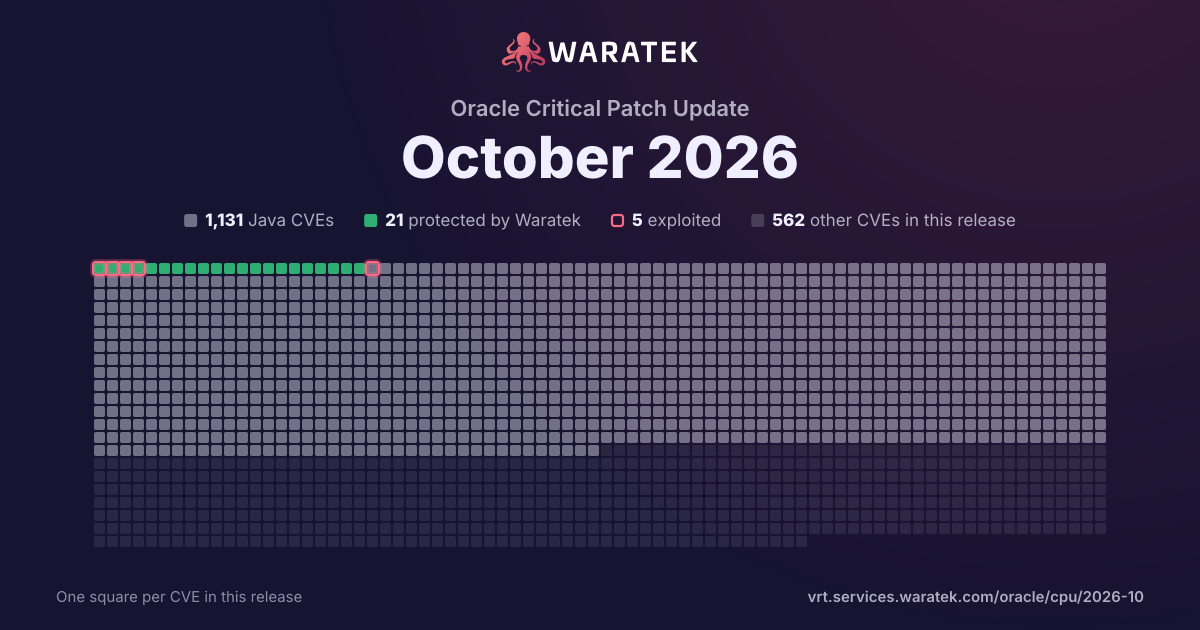
By status
21Protected by Waratek1Mitigation candidate1,109No exploit published13Outside Waratek scope549Not applicable
5Exploited, marked by the ring
No exploit published. For 858 of them, Oracle's security advisory is the source of public detail.
Protected by Waratek. Waratek RASP can block exploitation of these on systems that have not applied the patch yet.
Overview 235 matches · 0 in Waratek scope · 0 protected · 0 exploited · 0 CISA KEV · 2 public PoC · 1 EPSS ≥ 0.5
235matches
0in Waratek scope0.0%
0protected0.0%
0exploited0.0%
0CISA KEV0.0%
2public PoC0.9%
1EPSS ≥ 0.50.4%
Protected by Waratek
0
0.0%
Rule in development
0
0.0%
Mitigation candidate
0
0.0%
No exploit published
0
0.0%
Outside Waratek scope
0
0.0%
Not applicable
235
100.0%
Withdrawn CVE
0
0.0%
blocked by ARMR today
0
0.0%
partly blocked
0
0.0%
not blocked
235
100.0%
not established
0
0.0%
unrecorded
0
0.0%
Exploited
0
0.0%
Working exploit published
0
0.0%
Proof of concept only
26
11.1%
Forecast only
0
0.0%
No public exploit
209
88.9%
split by
peak 74 / quarter
Q4 231
Not applicable1
High1
not blocked1
Proof of concept only1
Q1 240
Q2 240
Q3 240
Q4 243
Not applicable3
High3
not blocked3
Proof of concept only2
No public exploit1
Q1 250
Q2 250
Q3 251
Not applicable1
High1
not blocked1
No public exploit1
Q4 252
Not applicable2
High2
not blocked2
No public exploit2
Q1 2618
Not applicable18
High18
not blocked18
Proof of concept only5
No public exploit13
Q2 2674
Not applicable74
High74
not blocked74
Proof of concept only8
No public exploit66
Q3 2664
Not applicable64
High64
not blocked64
Proof of concept only10
No public exploit54
Q4 2672
Not applicable72
High72
not blocked72
No public exploit72
Q4 23Q2 24Q4 24Q2 25Q4 25Q2 26Q4 26
| CVE | Severity | Published▾ | Status | Exploitation | Description |
|---|---|---|---|---|---|
| CVE-2026-91568 | High | 2026-10-20 | Not applicable | No public exploit | Vulnerability in the RDBMS component of Oracle Database Server. Supported versions that are affected are 23.4.0-23.26.3. Easily exploitable vulnerability allows low privileged attacker having Create Session privilege with network access via Oracle Net to compromise RDBMS. While the vulnerability is in RDBMS, attacks may significantly impact additional products (scope change). Successful attacks of this vulnerability can result in unauthorized access to critical data or complete access to all RDBMS accessible data. CVSS 3.1 Base Score 7.7 (Confidentiality impacts). CVSS Vector: (CVSS:3.1/AV:N/AC:L/PR:L/UI:N/S:C/C:H/I:N/A:N). |
| CVE-2026-91563 | High | 2026-10-20 | Not applicable | No public exploit | Vulnerability in the Oracle OLAP component of Oracle Database Server. Supported versions that are affected are 19.3-19.32, 21.3-21.23 and 23.4.0-23.26.3. Easily exploitable vulnerability allows low privileged attacker having DBMS_AW privilege with network access via Oracle Net to compromise Oracle OLAP. Successful attacks of this vulnerability can result in takeover of Oracle OLAP. CVSS 3.1 Base Score 8.8 (Confidentiality, Integrity and Availability impacts). CVSS Vector: (CVSS:3.1/AV:N/AC:L/PR:L/UI:N/S:U/C:H/I:H/A:H). |
| CVE-2026-91537 | High | 2026-10-20 | Not applicable | No public exploit | Vulnerability in the Oracle Solaris product of Oracle Systems (component: Utility). The supported version that is affected is 11.4. Easily exploitable vulnerability allows low privileged attacker with logon to the infrastructure where Oracle Solaris executes to compromise Oracle Solaris. Successful attacks of this vulnerability can result in takeover of Oracle Solaris. CVSS 3.1 Base Score 7.8 (Confidentiality, Integrity and Availability impacts). CVSS Vector: (CVSS:3.1/AV:L/AC:L/PR:L/UI:N/S:U/C:H/I:H/A:H). |
| CVE-2026-91527 | High | 2026-10-20 | Not applicable | No public exploit | Vulnerability in the Oracle ZFS Storage Appliance Kit product of Oracle Systems (component: Core). The supported version that is affected is 8.8. Easily exploitable vulnerability allows low privileged attacker with network access via HTTP to compromise Oracle ZFS Storage Appliance Kit. Successful attacks of this vulnerability can result in takeover of Oracle ZFS Storage Appliance Kit. CVSS 3.1 Base Score 8.8 (Confidentiality, Integrity and Availability impacts). CVSS Vector: (CVSS:3.1/AV:N/AC:L/PR:L/UI:N/S:U/C:H/I:H/A:H). |
| CVE-2026-91503 | High | 2026-10-20 | Not applicable | No public exploit | Vulnerability in the VPD component of Oracle Database Server. Supported versions that are affected are 19.3-19.32, 21.3-21.23 and 23.4.0-23.26.3. Easily exploitable vulnerability allows low privileged attacker having Create Table privilege with network access via Oracle Net to compromise VPD. Successful attacks of this vulnerability can result in unauthorized creation, deletion or modification access to critical data or all VPD accessible data as well as unauthorized access to critical data or complete access to all VPD accessible data. CVSS 3.1 Base Score 8.1 (Confidentiality and Integrity impacts). CVSS Vector: (CVSS:3.1/AV:N/AC:L/PR:L/UI:N/S:U/C:H/I:H/A:N). |
| CVE-2026-91499 | High | 2026-10-20 | Not applicable | No public exploit | Vulnerability in the RDBMS component of Oracle Database Server. Supported versions that are affected are 23.4.0-23.26.3. Easily exploitable vulnerability allows low privileged attacker having DBMS_VECTOR privilege with network access via Oracle Net to compromise RDBMS. Successful attacks of this vulnerability can result in takeover of RDBMS. CVSS 3.1 Base Score 8.8 (Confidentiality, Integrity and Availability impacts). CVSS Vector: (CVSS:3.1/AV:N/AC:L/PR:L/UI:N/S:U/C:H/I:H/A:H). |
| CVE-2026-91483 | High | 2026-10-20 | Not applicable | No public exploit | Vulnerability in the Oracle Outside In Technology product of Oracle Fusion Middleware (component: Outside In Core). The supported version that is affected is 8.5.8. Easily exploitable vulnerability allows unauthenticated attacker with logon to the infrastructure where Oracle Outside In Technology executes to compromise Oracle Outside In Technology. Successful attacks require human interaction from a person other than the attacker. Successful attacks of this vulnerability can result in takeover of Oracle Outside In Technology. CVSS 3.1 Base Score 7.8 (Confidentiality, Integrity and Availability impacts). CVSS Vector: (CVSS:3.1/AV:L/AC:L/PR:N/UI:R/S:U/C:H/I:H/A:H). |
| CVE-2026-91473 | High | 2026-10-20 | Not applicable | No public exploit | Vulnerability in the Oracle HTTP Server product of Oracle Fusion Middleware (component: Web Listener). The supported version that is affected is 12.2.1.4.0. Easily exploitable vulnerability allows low privileged attacker with logon to the infrastructure where Oracle HTTP Server executes to compromise Oracle HTTP Server. Successful attacks of this vulnerability can result in takeover of Oracle HTTP Server. CVSS 3.1 Base Score 7.8 (Confidentiality, Integrity and Availability impacts). CVSS Vector: (CVSS:3.1/AV:L/AC:L/PR:L/UI:N/S:U/C:H/I:H/A:H). |
| CVE-2026-91460 | High | 2026-10-20 | Not applicable | No public exploit | Vulnerability in the Oracle Outside In Technology product of Oracle Fusion Middleware (component: Outside In Image Export SDK). The supported version that is affected is 8.5.8. Easily exploitable vulnerability allows unauthenticated attacker with logon to the infrastructure where Oracle Outside In Technology executes to compromise Oracle Outside In Technology. Successful attacks require human interaction from a person other than the attacker. Successful attacks of this vulnerability can result in takeover of Oracle Outside In Technology. CVSS 3.1 Base Score 7.8 (Confidentiality, Integrity and Availability impacts). CVSS Vector: (CVSS:3.1/AV:L/AC:L/PR:N/UI:R/S:U/C:H/I:H/A:H). |
| CVE-2026-91459 | High | 2026-10-20 | Not applicable | No public exploit | Vulnerability in the Oracle Outside In Technology product of Oracle Fusion Middleware (component: Outside In Image Export SDK). The supported version that is affected is 8.5.8. Easily exploitable vulnerability allows unauthenticated attacker with logon to the infrastructure where Oracle Outside In Technology executes to compromise Oracle Outside In Technology. Successful attacks require human interaction from a person other than the attacker. Successful attacks of this vulnerability can result in takeover of Oracle Outside In Technology. CVSS 3.1 Base Score 7.8 (Confidentiality, Integrity and Availability impacts). CVSS Vector: (CVSS:3.1/AV:L/AC:L/PR:N/UI:R/S:U/C:H/I:H/A:H). |
| CVE-2026-91458 | High | 2026-10-20 | Not applicable | No public exploit | Vulnerability in the Oracle Outside In Technology product of Oracle Fusion Middleware (component: Outside In Core). The supported version that is affected is 8.5.8. Easily exploitable vulnerability allows unauthenticated attacker with logon to the infrastructure where Oracle Outside In Technology executes to compromise Oracle Outside In Technology. Successful attacks require human interaction from a person other than the attacker. Successful attacks of this vulnerability can result in takeover of Oracle Outside In Technology. CVSS 3.1 Base Score 7.8 (Confidentiality, Integrity and Availability impacts). CVSS Vector: (CVSS:3.1/AV:L/AC:L/PR:N/UI:R/S:U/C:H/I:H/A:H). |
| CVE-2026-91457 | High | 2026-10-20 | Not applicable | No public exploit | Vulnerability in the Oracle Outside In Technology product of Oracle Fusion Middleware (component: Outside In Image Export SDK). The supported version that is affected is 8.5.8. Easily exploitable vulnerability allows unauthenticated attacker with logon to the infrastructure where Oracle Outside In Technology executes to compromise Oracle Outside In Technology. Successful attacks require human interaction from a person other than the attacker. Successful attacks of this vulnerability can result in takeover of Oracle Outside In Technology. CVSS 3.1 Base Score 7.8 (Confidentiality, Integrity and Availability impacts). CVSS Vector: (CVSS:3.1/AV:L/AC:L/PR:N/UI:R/S:U/C:H/I:H/A:H). |
| CVE-2026-91419 | High | 2026-10-20 | Not applicable | No public exploit | Vulnerability in the Oracle HTTP Server product of Oracle Fusion Middleware (component: OSSL Module). The supported version that is affected is 12.2.1.4.0. Easily exploitable vulnerability allows low privileged attacker with logon to the infrastructure where Oracle HTTP Server executes to compromise Oracle HTTP Server. Successful attacks of this vulnerability can result in takeover of Oracle HTTP Server. CVSS 3.1 Base Score 7.8 (Confidentiality, Integrity and Availability impacts). CVSS Vector: (CVSS:3.1/AV:L/AC:L/PR:L/UI:N/S:U/C:H/I:H/A:H). |
| CVE-2026-91406 | High | 2026-10-20 | Not applicable | No public exploit | Vulnerability in the Oracle Outside In Technology product of Oracle Fusion Middleware (component: Outside In PDF Export SDK). The supported version that is affected is 8.5.8. Difficult to exploit vulnerability allows unauthenticated attacker with network access via HTTP to compromise Oracle Outside In Technology. Successful attacks require human interaction from a person other than the attacker. Successful attacks of this vulnerability can result in takeover of Oracle Outside In Technology. CVSS 3.1 Base Score 7.5 (Confidentiality, Integrity and Availability impacts). CVSS Vector: (CVSS:3.1/AV:N/AC:H/PR:N/UI:R/S:U/C:H/I:H/A:H). |
| CVE-2026-91405 | High | 2026-10-20 | Not applicable | No public exploit | Vulnerability in the Oracle Outside In Technology product of Oracle Fusion Middleware (component: Outside In PDF Export SDK). The supported version that is affected is 8.5.8. Difficult to exploit vulnerability allows unauthenticated attacker with network access via HTTP to compromise Oracle Outside In Technology. Successful attacks require human interaction from a person other than the attacker. Successful attacks of this vulnerability can result in takeover of Oracle Outside In Technology. CVSS 3.1 Base Score 7.5 (Confidentiality, Integrity and Availability impacts). CVSS Vector: (CVSS:3.1/AV:N/AC:H/PR:N/UI:R/S:U/C:H/I:H/A:H). |
| CVE-2026-91355 | High | 2026-10-20 | Not applicable | No public exploit | Vulnerability in the Oracle Outside In Technology product of Oracle Fusion Middleware (component: Outside In Clean Content SDK). The supported version that is affected is 8.5.8. Easily exploitable vulnerability allows unauthenticated attacker with logon to the infrastructure where Oracle Outside In Technology executes to compromise Oracle Outside In Technology. Successful attacks of this vulnerability can result in takeover of Oracle Outside In Technology. CVSS 3.1 Base Score 8.4 (Confidentiality, Integrity and Availability impacts). CVSS Vector: (CVSS:3.1/AV:L/AC:L/PR:N/UI:N/S:U/C:H/I:H/A:H). |
| CVE-2026-91353 | High | 2026-10-20 | Not applicable | No public exploit | Vulnerability in the Oracle Outside In Technology product of Oracle Fusion Middleware (component: Outside In Clean Content SDK). The supported version that is affected is 8.5.8. Easily exploitable vulnerability allows unauthenticated attacker with network access via HTTP to compromise Oracle Outside In Technology. While the vulnerability is in Oracle Outside In Technology, attacks may significantly impact additional products (scope change). Successful attacks of this vulnerability can result in unauthorized access to critical data or complete access to all Oracle Outside In Technology accessible data. CVSS 3.1 Base Score 8.6 (Confidentiality impacts). CVSS Vector: (CVSS:3.1/AV:N/AC:L/PR:N/UI:N/S:C/C:H/I:N/A:N). |
| CVE-2026-91350 | High | 2026-10-20 | Not applicable | No public exploit | Vulnerability in the Oracle Outside In Technology product of Oracle Fusion Middleware (component: Outside In Clean Content SDK). The supported version that is affected is 8.5.8. Easily exploitable vulnerability allows unauthenticated attacker with network access via HTTP to compromise Oracle Outside In Technology. Successful attacks of this vulnerability can result in unauthorized ability to cause a hang or frequently repeatable crash (complete DOS) of Oracle Outside In Technology. CVSS 3.1 Base Score 7.5 (Availability impacts). CVSS Vector: (CVSS:3.1/AV:N/AC:L/PR:N/UI:N/S:U/C:N/I:N/A:H). |
| CVE-2026-91349 | High | 2026-10-20 | Not applicable | No public exploit | Vulnerability in the Oracle Outside In Technology product of Oracle Fusion Middleware (component: Outside In Clean Content SDK). The supported version that is affected is 8.5.8. Easily exploitable vulnerability allows unauthenticated attacker with network access via HTTP to compromise Oracle Outside In Technology. Successful attacks of this vulnerability can result in unauthorized ability to cause a hang or frequently repeatable crash (complete DOS) of Oracle Outside In Technology. CVSS 3.1 Base Score 7.5 (Availability impacts). CVSS Vector: (CVSS:3.1/AV:N/AC:L/PR:N/UI:N/S:U/C:N/I:N/A:H). |
| CVE-2026-91348 | High | 2026-10-20 | Not applicable | No public exploit | Vulnerability in the Oracle Solaris product of Oracle Systems (component: Utility). Supported versions that are affected are 11.3 and 11.4. Easily exploitable vulnerability allows unauthenticated attacker with logon to the infrastructure where Oracle Solaris executes to compromise Oracle Solaris. Successful attacks of this vulnerability can result in takeover of Oracle Solaris. CVSS 3.1 Base Score 8.4 (Confidentiality, Integrity and Availability impacts). CVSS Vector: (CVSS:3.1/AV:L/AC:L/PR:N/UI:N/S:U/C:H/I:H/A:H). |
| CVE-2026-91346 | High | 2026-10-20 | Not applicable | No public exploit | Vulnerability in the Oracle Outside In Technology product of Oracle Fusion Middleware (component: Outside In Clean Content SDK). The supported version that is affected is 8.5.8. Easily exploitable vulnerability allows unauthenticated attacker with network access via HTTP to compromise Oracle Outside In Technology. Successful attacks require human interaction from a person other than the attacker and while the vulnerability is in Oracle Outside In Technology, attacks may significantly impact additional products (scope change). Successful attacks of this vulnerability can result in unauthorized access to critical data or complete access to all Oracle Outside In Technology accessible data as well as unauthorized update, insert or delete access to some of Oracle Outside In Technology accessible data. CVSS 3.1 Base Score 8.2 (Confidentiality and Integrity impacts). CVSS Vector: (CVSS:3.1/AV:N/AC:L/PR:N/UI:R/S:C/C:H/I:L/A:N). |
| CVE-2026-91345 | High | 2026-10-20 | Not applicable | No public exploit | Vulnerability in the Oracle Outside In Technology product of Oracle Fusion Middleware (component: Outside In Clean Content SDK). The supported version that is affected is 8.5.8. Easily exploitable vulnerability allows unauthenticated attacker with network access via HTTP to compromise Oracle Outside In Technology. Successful attacks of this vulnerability can result in unauthorized ability to cause a hang or frequently repeatable crash (complete DOS) of Oracle Outside In Technology. CVSS 3.1 Base Score 7.5 (Availability impacts). CVSS Vector: (CVSS:3.1/AV:N/AC:L/PR:N/UI:N/S:U/C:N/I:N/A:H). |
| CVE-2026-91344 | High | 2026-10-20 | Not applicable | No public exploit | Vulnerability in the Oracle Outside In Technology product of Oracle Fusion Middleware (component: Outside In Clean Content SDK). The supported version that is affected is 8.5.8. Easily exploitable vulnerability allows unauthenticated attacker with network access via HTTP to compromise Oracle Outside In Technology. Successful attacks of this vulnerability can result in unauthorized ability to cause a hang or frequently repeatable crash (complete DOS) of Oracle Outside In Technology. CVSS 3.1 Base Score 7.5 (Availability impacts). CVSS Vector: (CVSS:3.1/AV:N/AC:L/PR:N/UI:N/S:U/C:N/I:N/A:H). |
| CVE-2026-91343 | High | 2026-10-20 | Not applicable | No public exploit | Vulnerability in the Oracle Outside In Technology product of Oracle Fusion Middleware (component: Outside In Clean Content SDK). The supported version that is affected is 8.5.8. Easily exploitable vulnerability allows unauthenticated attacker with network access via HTTP to compromise Oracle Outside In Technology. While the vulnerability is in Oracle Outside In Technology, attacks may significantly impact additional products (scope change). Successful attacks of this vulnerability can result in unauthorized creation, deletion or modification access to critical data or all Oracle Outside In Technology accessible data. CVSS 3.1 Base Score 8.6 (Integrity impacts). CVSS Vector: (CVSS:3.1/AV:N/AC:L/PR:N/UI:N/S:C/C:N/I:H/A:N). |
| CVE-2026-91342 | High | 2026-10-20 | Not applicable | No public exploit | Vulnerability in the Oracle Outside In Technology product of Oracle Fusion Middleware (component: Outside In Clean Content SDK). The supported version that is affected is 8.5.8. Easily exploitable vulnerability allows unauthenticated attacker with network access via HTTP to compromise Oracle Outside In Technology. Successful attacks require human interaction from a person other than the attacker and while the vulnerability is in Oracle Outside In Technology, attacks may significantly impact additional products (scope change). Successful attacks of this vulnerability can result in unauthorized creation, deletion or modification access to critical data or all Oracle Outside In Technology accessible data as well as unauthorized read access to a subset of Oracle Outside In Technology accessible data. CVSS 3.1 Base Score 8.2 (Confidentiality and Integrity impacts). CVSS Vector: (CVSS:3.1/AV:N/AC:L/PR:N/UI:R/S:C/C:L/I:H/A:N). |
| CVE-2026-91340 | High | 2026-10-20 | Not applicable | No public exploit | Vulnerability in the Oracle Outside In Technology product of Oracle Fusion Middleware (component: Outside In Clean Content SDK). The supported version that is affected is 8.5.8. Easily exploitable vulnerability allows low privileged attacker with network access via HTTP to compromise Oracle Outside In Technology. Successful attacks of this vulnerability can result in takeover of Oracle Outside In Technology. CVSS 3.1 Base Score 8.8 (Confidentiality, Integrity and Availability impacts). CVSS Vector: (CVSS:3.1/AV:N/AC:L/PR:L/UI:N/S:U/C:H/I:H/A:H). |
| CVE-2026-91256 | High | 2026-10-20 | Not applicable | No public exploit | Vulnerability in the Oracle Solaris product of Oracle Systems (component: Services). The supported version that is affected is 11.4. Easily exploitable vulnerability allows low privileged attacker with network access via HTTP to compromise Oracle Solaris. Successful attacks of this vulnerability can result in unauthorized ability to cause a hang or frequently repeatable crash (complete DOS) of Oracle Solaris and unauthorized read access to a subset of Oracle Solaris accessible data. CVSS 3.1 Base Score 7.1 (Confidentiality and Availability impacts). CVSS Vector: (CVSS:3.1/AV:N/AC:L/PR:L/UI:N/S:U/C:L/I:N/A:H). |
| CVE-2026-91255 | High | 2026-10-20 | Not applicable | No public exploit | Vulnerability in the Oracle Solaris product of Oracle Systems (component: Kernel). The supported version that is affected is 11.4. Easily exploitable vulnerability allows unauthenticated attacker with network access via HTTP to compromise Oracle Solaris. Successful attacks of this vulnerability can result in unauthorized ability to cause a hang or frequently repeatable crash (complete DOS) of Oracle Solaris. CVSS 3.1 Base Score 7.5 (Availability impacts). CVSS Vector: (CVSS:3.1/AV:N/AC:L/PR:N/UI:N/S:U/C:N/I:N/A:H). |
| CVE-2026-91254 | High | 2026-10-20 | Not applicable | No public exploit | Vulnerability in the Oracle Solaris product of Oracle Systems (component: Kernel). The supported version that is affected is 11.4. Easily exploitable vulnerability allows unauthenticated attacker with network access via HTTP to compromise Oracle Solaris. Successful attacks of this vulnerability can result in unauthorized ability to cause a hang or frequently repeatable crash (complete DOS) of Oracle Solaris. CVSS 3.1 Base Score 7.5 (Availability impacts). CVSS Vector: (CVSS:3.1/AV:N/AC:L/PR:N/UI:N/S:U/C:N/I:N/A:H). |
| CVE-2026-91253 | High | 2026-10-20 | Not applicable | No public exploit | Vulnerability in the Oracle Solaris product of Oracle Systems (component: Kernel). The supported version that is affected is 11.4. Easily exploitable vulnerability allows low privileged attacker with logon to the infrastructure where Oracle Solaris executes to compromise Oracle Solaris. Successful attacks of this vulnerability can result in takeover of Oracle Solaris. CVSS 3.1 Base Score 7.8 (Confidentiality, Integrity and Availability impacts). CVSS Vector: (CVSS:3.1/AV:L/AC:L/PR:L/UI:N/S:U/C:H/I:H/A:H). |
| CVE-2026-91252 | High | 2026-10-20 | Not applicable | No public exploit | Vulnerability in the Oracle Solaris product of Oracle Systems (component: Services). The supported version that is affected is 11.4. Easily exploitable vulnerability allows unauthenticated attacker with network access via HTTP to compromise Oracle Solaris. Successful attacks of this vulnerability can result in unauthorized ability to cause a hang or frequently repeatable crash (complete DOS) of Oracle Solaris and unauthorized read access to a subset of Oracle Solaris accessible data. CVSS 3.1 Base Score 8.2 (Confidentiality and Availability impacts). CVSS Vector: (CVSS:3.1/AV:N/AC:L/PR:N/UI:N/S:U/C:L/I:N/A:H). |
| CVE-2026-91242 | High | 2026-10-20 | Not applicable | No public exploit | Vulnerability in the Oracle Solaris product of Oracle Systems (component: Plugins). The supported version that is affected is 11.4. Easily exploitable vulnerability allows high privileged attacker with logon to the infrastructure where Oracle Solaris executes to compromise Oracle Solaris. Successful attacks require human interaction from a person other than the attacker and while the vulnerability is in Oracle Solaris, attacks may significantly impact additional products (scope change). Successful attacks of this vulnerability can result in unauthorized creation, deletion or modification access to critical data or all Oracle Solaris accessible data as well as unauthorized access to critical data or complete access to all Oracle Solaris accessible data. CVSS 3.1 Base Score 7.4 (Confidentiality and Integrity impacts). CVSS Vector: (CVSS:3.1/AV:L/AC:L/PR:H/UI:R/S:C/C:H/I:H/A:N). |
| CVE-2026-87421 | High | 2026-10-20 | Not applicable | No public exploit | Vulnerability in the Oracle Solaris product of Oracle Systems (component: Image Packaging System). The supported version that is affected is 11.4. Easily exploitable vulnerability allows unauthenticated attacker with network access via HTTP to compromise Oracle Solaris. Successful attacks require human interaction from a person other than the attacker. Successful attacks of this vulnerability can result in unauthorized access to critical data or complete access to all Oracle Solaris accessible data as well as unauthorized update, insert or delete access to some of Oracle Solaris accessible data. CVSS 3.1 Base Score 7.1 (Confidentiality and Integrity impacts). CVSS Vector: (CVSS:3.1/AV:N/AC:L/PR:N/UI:R/S:U/C:H/I:L/A:N). |
| CVE-2026-87417 | High | 2026-10-20 | Not applicable | No public exploit | Vulnerability in the Oracle Solaris product of Oracle Systems (component: Image Packaging System). The supported version that is affected is 11.4. Easily exploitable vulnerability allows unauthenticated attacker with network access via HTTP to compromise Oracle Solaris. Successful attacks of this vulnerability can result in unauthorized access to critical data or complete access to all Oracle Solaris accessible data. CVSS 3.1 Base Score 7.5 (Confidentiality impacts). CVSS Vector: (CVSS:3.1/AV:N/AC:L/PR:N/UI:N/S:U/C:H/I:N/A:N). |
| CVE-2026-87398 | High | 2026-10-20 | Not applicable | No public exploit | Vulnerability in the Oracle Outside In Technology product of Oracle Fusion Middleware (component: Outside In Core). The supported version that is affected is 8.5.8. Easily exploitable vulnerability allows unauthenticated attacker with network access via HTTP to compromise Oracle Outside In Technology. Successful attacks of this vulnerability can result in unauthorized ability to cause a hang or frequently repeatable crash (complete DOS) of Oracle Outside In Technology. CVSS 3.1 Base Score 7.5 (Availability impacts). CVSS Vector: (CVSS:3.1/AV:N/AC:L/PR:N/UI:N/S:U/C:N/I:N/A:H). |
| CVE-2026-87397 | High | 2026-10-20 | Not applicable | No public exploit | Vulnerability in the Oracle Outside In Technology product of Oracle Fusion Middleware (component: Outside In Core). The supported version that is affected is 8.5.8. Easily exploitable vulnerability allows unauthenticated attacker with network access via HTTP to compromise Oracle Outside In Technology. Successful attacks require human interaction from a person other than the attacker. Successful attacks of this vulnerability can result in takeover of Oracle Outside In Technology. CVSS 3.1 Base Score 8.8 (Confidentiality, Integrity and Availability impacts). CVSS Vector: (CVSS:3.1/AV:N/AC:L/PR:N/UI:R/S:U/C:H/I:H/A:H). |
| CVE-2026-87395 | High | 2026-10-20 | Not applicable | No public exploit | Vulnerability in the Oracle Outside In Technology product of Oracle Fusion Middleware (component: Outside In Core). The supported version that is affected is 8.5.8. Easily exploitable vulnerability allows unauthenticated attacker with network access via HTTP to compromise Oracle Outside In Technology. Successful attacks of this vulnerability can result in unauthorized ability to cause a hang or frequently repeatable crash (complete DOS) of Oracle Outside In Technology. CVSS 3.1 Base Score 7.5 (Availability impacts). CVSS Vector: (CVSS:3.1/AV:N/AC:L/PR:N/UI:N/S:U/C:N/I:N/A:H). |
| CVE-2026-87394 | High | 2026-10-20 | Not applicable | No public exploit | Vulnerability in the Oracle Outside In Technology product of Oracle Fusion Middleware (component: Outside In Core). The supported version that is affected is 8.5.8. Easily exploitable vulnerability allows unauthenticated attacker with network access via HTTP to compromise Oracle Outside In Technology. Successful attacks of this vulnerability can result in unauthorized access to critical data or complete access to all Oracle Outside In Technology accessible data and unauthorized ability to cause a partial denial of service (partial DOS) of Oracle Outside In Technology. CVSS 3.1 Base Score 8.2 (Confidentiality and Availability impacts). CVSS Vector: (CVSS:3.1/AV:N/AC:L/PR:N/UI:N/S:U/C:H/I:N/A:L). |
| CVE-2026-87351 | High | 2026-10-20 | Not applicable | No public exploit | Vulnerability in Oracle GoldenGate (component: Admin Server Executable). Supported versions that are affected are 19.1.0.0.0-19.32.0.0, 21.3-21.23 and 23.4-23.26.3.0.0. Easily exploitable vulnerability allows low privileged attacker with network access via HTTPS to compromise Oracle GoldenGate. Successful attacks of this vulnerability can result in takeover of Oracle GoldenGate. CVSS 3.1 Base Score 8.8 (Confidentiality, Integrity and Availability impacts). CVSS Vector: (CVSS:3.1/AV:N/AC:L/PR:L/UI:N/S:U/C:H/I:H/A:H). |
| CVE-2026-87346 | High | 2026-10-20 | Not applicable | No public exploit | Vulnerability in the Oracle HTTP Server product of Oracle Fusion Middleware (component: Oracle Weblogic Server Proxy Plug-in for Oracle HTTP Server). Supported versions that are affected are 12.2.1.4.0 and 14.1.2.0.0. Difficult to exploit vulnerability allows unauthenticated attacker with network access via HTTP to compromise Oracle HTTP Server. While the vulnerability is in Oracle HTTP Server, attacks may significantly impact additional products (scope change). Successful attacks of this vulnerability can result in unauthorized creation, deletion or modification access to critical data or all Oracle HTTP Server accessible data as well as unauthorized access to critical data or complete access to all Oracle HTTP Server accessible data. CVSS 3.1 Base Score 8.7 (Confidentiality and Integrity impacts). CVSS Vector: (CVSS:3.1/AV:N/AC:H/PR:N/UI:N/S:C/C:H/I:H/A:N). |
| CVE-2026-87322 | High | 2026-10-20 | Not applicable | No public exploit | Vulnerability in the Oracle VM VirtualBox product of Oracle Virtualization (component: Core). The supported version that is affected is 7.2.20. Easily exploitable vulnerability allows high privileged attacker with access to the physical communication segment attached to the hardware where the Oracle VM VirtualBox executes to compromise Oracle VM VirtualBox. While the vulnerability is in Oracle VM VirtualBox, attacks may significantly impact additional products (scope change). Successful attacks of this vulnerability can result in takeover of Oracle VM VirtualBox. CVSS 3.1 Base Score 8.4 (Confidentiality, Integrity and Availability impacts). CVSS Vector: (CVSS:3.1/AV:A/AC:L/PR:H/UI:N/S:C/C:H/I:H/A:H). |
| CVE-2026-87304 | High | 2026-10-20 | Not applicable | No public exploit | Vulnerability in the Oracle Outside In Technology product of Oracle Fusion Middleware (component: Outside In Core). The supported version that is affected is 8.5.8. Easily exploitable vulnerability allows unauthenticated attacker with network access via HTTP to compromise Oracle Outside In Technology. While the vulnerability is in Oracle Outside In Technology, attacks may significantly impact additional products (scope change). Successful attacks of this vulnerability can result in unauthorized access to critical data or complete access to all Oracle Outside In Technology accessible data. CVSS 3.1 Base Score 8.6 (Confidentiality impacts). CVSS Vector: (CVSS:3.1/AV:N/AC:L/PR:N/UI:N/S:C/C:H/I:N/A:N). |
| CVE-2026-87301 | High | 2026-10-20 | Not applicable | No public exploit | Vulnerability in the Oracle VM VirtualBox product of Oracle Virtualization (component: Core). The supported version that is affected is 7.2.16. Easily exploitable vulnerability allows low privileged attacker with logon to the infrastructure where Oracle VM VirtualBox executes to compromise Oracle VM VirtualBox. While the vulnerability is in Oracle VM VirtualBox, attacks may significantly impact additional products (scope change). Successful attacks of this vulnerability can result in unauthorized access to critical data or complete access to all Oracle VM VirtualBox accessible data and unauthorized ability to cause a hang or frequently repeatable crash (complete DOS) of Oracle VM VirtualBox. CVSS 3.1 Base Score 8.4 (Confidentiality and Availability impacts). CVSS Vector: (CVSS:3.1/AV:L/AC:L/PR:L/UI:N/S:C/C:H/I:N/A:H). |
| CVE-2026-87300 | High | 2026-10-20 | Not applicable | No public exploit | Vulnerability in the Oracle Weblogic Server Proxy Plug-in product of Oracle Fusion Middleware (component: WebLogic Server Proxy Plug-In for Third-Party Web Servers). Supported versions that are affected are 12.2.1.4.0, 14.1.1.0.0 and 14.1.2.0.0. Difficult to exploit vulnerability allows unauthenticated attacker with network access via HTTP to compromise Oracle Weblogic Server Proxy Plug-in. While the vulnerability is in Oracle Weblogic Server Proxy Plug-in, attacks may significantly impact additional products (scope change). Successful attacks of this vulnerability can result in unauthorized creation, deletion or modification access to critical data or all Oracle Weblogic Server Proxy Plug-in accessible data as well as unauthorized access to critical data or complete access to all Oracle Weblogic Server Proxy Plug-in accessible data. CVSS 3.1 Base Score 8.7 (Confidentiality and Integrity impacts). CVSS Vector: (CVSS:3.1/AV:N/AC:H/PR:N/UI:N/S:C/C:H/I:H/A:N). |
| CVE-2026-83404 | High | 2026-10-20 | Not applicable | No public exploit | Vulnerability in the MySQL Connectors product of Oracle MySQL (component: Connector/Python). The supported version that is affected is 26.7.0. Easily exploitable vulnerability allows unauthenticated attacker with network access via multiple protocols to compromise MySQL Connectors. Successful attacks of this vulnerability can result in unauthorized access to critical data or complete access to all MySQL Connectors accessible data. CVSS 3.1 Base Score 7.5 (Confidentiality impacts). CVSS Vector: (CVSS:3.1/AV:N/AC:L/PR:N/UI:N/S:U/C:H/I:N/A:N). |
| CVE-2026-83379 | High | 2026-10-20 | Not applicable | No public exploit | Vulnerability in the Oracle Weblogic Server Proxy Plug-in product of Oracle Fusion Middleware (component: WebLogic Server Proxy Plug-In for Third-Party Web Servers). Supported versions that are affected are 12.2.1.4.0, 14.1.1.0.0 and 14.1.2.0.0. Difficult to exploit vulnerability allows unauthenticated attacker with network access via HTTP to compromise Oracle Weblogic Server Proxy Plug-in. While the vulnerability is in Oracle Weblogic Server Proxy Plug-in, attacks may significantly impact additional products (scope change). Successful attacks of this vulnerability can result in unauthorized creation, deletion or modification access to critical data or all Oracle Weblogic Server Proxy Plug-in accessible data as well as unauthorized access to critical data or complete access to all Oracle Weblogic Server Proxy Plug-in accessible data. CVSS 3.1 Base Score 8.7 (Confidentiality and Integrity impacts). CVSS Vector: (CVSS:3.1/AV:N/AC:H/PR:N/UI:N/S:C/C:H/I:H/A:N). |
| CVE-2026-60662 | High | 2026-10-20 | Not applicable | No public exploit | Vulnerability in the Oracle Solaris product of Oracle Systems (component: Services). The supported version that is affected is 11.4. Easily exploitable vulnerability allows low privileged attacker with logon to the infrastructure where Oracle Solaris executes to compromise Oracle Solaris. Successful attacks of this vulnerability can result in takeover of Oracle Solaris. CVSS 3.1 Base Score 7.8 (Confidentiality, Integrity and Availability impacts). CVSS Vector: (CVSS:3.1/AV:L/AC:L/PR:L/UI:N/S:U/C:H/I:H/A:H). |
| CVE-2026-47025 | High | 2026-10-20 | Not applicable | No public exploit | Vulnerability in the Oracle Solaris product of Oracle Systems (component: Utility). Supported versions that are affected are 11.3 and 11.4. Easily exploitable vulnerability allows low privileged attacker with network access via HTTP to compromise Oracle Solaris. Successful attacks of this vulnerability can result in takeover of Oracle Solaris. CVSS 3.1 Base Score 8.8 (Confidentiality, Integrity and Availability impacts). CVSS Vector: (CVSS:3.1/AV:N/AC:L/PR:L/UI:N/S:U/C:H/I:H/A:H). |
| CVE-2026-101810 | High | 2026-10-20 | Not applicable | No public exploit | Vulnerability in the MySQL Router product of Oracle MySQL (component: Router: General). The supported version that is affected is 26.7.0. Easily exploitable vulnerability allows unauthenticated attacker with network access via multiple protocols to compromise MySQL Router. Successful attacks of this vulnerability can result in unauthorized ability to cause a hang or frequently repeatable crash (complete DOS) of MySQL Router. CVSS 3.1 Base Score 7.5 (Availability impacts). CVSS Vector: (CVSS:3.1/AV:N/AC:L/PR:N/UI:N/S:U/C:N/I:N/A:H). |
| CVE-2026-101797 | High | 2026-10-20 | Not applicable | No public exploit | Vulnerability in the MySQL Server, MySQL Cluster product of Oracle MySQL (component: Client: mysqldump). Supported versions that are affected are MySQL Server: 8.4.0-8.4.12, 9.7.0-9.7.3, 26.7.0-26.7.1; MySQL Cluster: 8.0.0-8.0.49, 8.4.0-8.4.12, 9.7.0-9.7.3 and 26.7.0-26.7.1. Difficult to exploit vulnerability allows unauthenticated attacker with network access via multiple protocols to compromise MySQL Server, MySQL Cluster. Successful attacks require human interaction from a person other than the attacker. Successful attacks of this vulnerability can result in takeover of MySQL Server, MySQL Cluster. CVSS 3.1 Base Score 7.5 (Confidentiality, Integrity and Availability impacts). CVSS Vector: (CVSS:3.1/AV:N/AC:H/PR:N/UI:R/S:U/C:H/I:H/A:H). |
| CVE-2026-101796 | High | 2026-10-20 | Not applicable | No public exploit | Vulnerability in the MySQL Server, MySQL Cluster product of Oracle MySQL (component: Server: Replication). Supported versions that are affected are MySQL Server: 8.4.0-8.4.12, 9.7.0-9.7.3, 26.7.0-26.7.1; MySQL Cluster: 8.0.0-8.0.49, 8.4.0-8.4.12, 9.7.0-9.7.3 and 26.7.0-26.7.1. Difficult to exploit vulnerability allows unauthenticated attacker with network access via multiple protocols to compromise MySQL Server, MySQL Cluster. Successful attacks require human interaction from a person other than the attacker. Successful attacks of this vulnerability can result in takeover of MySQL Server, MySQL Cluster. CVSS 3.1 Base Score 7.5 (Confidentiality, Integrity and Availability impacts). CVSS Vector: (CVSS:3.1/AV:N/AC:H/PR:N/UI:R/S:U/C:H/I:H/A:H). |
| CVE-2026-101786 | High | 2026-10-20 | Not applicable | No public exploit | Vulnerability in the MySQL Server, MySQL Cluster product of Oracle MySQL (component: Server: Optimizer). Supported versions that are affected are MySQL Server: 26.7.0-26.7.1; MySQL Cluster: 26.7.0-26.7.1. Easily exploitable vulnerability allows high privileged attacker with network access via multiple protocols to compromise MySQL Server, MySQL Cluster. Successful attacks of this vulnerability can result in takeover of MySQL Server, MySQL Cluster. CVSS 3.1 Base Score 7.2 (Confidentiality, Integrity and Availability impacts). CVSS Vector: (CVSS:3.1/AV:N/AC:L/PR:H/UI:N/S:U/C:H/I:H/A:H). |
| CVE-2026-101785 | High | 2026-10-20 | Not applicable | No public exploit | Vulnerability in the MySQL Server, MySQL Cluster product of Oracle MySQL (component: Server: JSON). Supported versions that are affected are MySQL Server: 8.4.0-8.4.12, 9.7.0-9.7.3, 26.7.0-26.7.1; MySQL Cluster: 8.0.0-8.0.49, 8.4.0-8.4.12, 9.7.0-9.7.3 and 26.7.0-26.7.1. Easily exploitable vulnerability allows low privileged attacker with network access via multiple protocols to compromise MySQL Server, MySQL Cluster. Successful attacks of this vulnerability can result in unauthorized creation, deletion or modification access to critical data or all MySQL Server, MySQL Cluster accessible data as well as unauthorized read access to a subset of MySQL Server, MySQL Cluster accessible data and unauthorized ability to cause a hang or frequently repeatable crash (complete DOS) of MySQL Server, MySQL Cluster. CVSS 3.1 Base Score 8.3 (Confidentiality, Integrity and Availability impacts). CVSS Vector: (CVSS:3.1/AV:N/AC:L/PR:L/UI:N/S:U/C:L/I:H/A:H). |
| CVE-2026-101783 | High | 2026-10-20 | Not applicable | No public exploit | Vulnerability in the MySQL Router product of Oracle MySQL (component: Router: General). The supported version that is affected is 26.7.0. Difficult to exploit vulnerability allows unauthenticated attacker with network access via HTTPS to compromise MySQL Router. Successful attacks of this vulnerability can result in unauthorized creation, deletion or modification access to critical data or all MySQL Router accessible data as well as unauthorized access to critical data or complete access to all MySQL Router accessible data. CVSS 3.1 Base Score 7.4 (Confidentiality and Integrity impacts). CVSS Vector: (CVSS:3.1/AV:N/AC:H/PR:N/UI:N/S:U/C:H/I:H/A:N). |
| CVE-2026-101781 | High | 2026-10-20 | Not applicable | No public exploit | Vulnerability in the MySQL Server, MySQL Cluster product of Oracle MySQL (component: Server: Group Replication GCS). Supported versions that are affected are MySQL Server: 8.4.0-8.4.12, 9.7.0-9.7.3, 26.7.0-26.7.1; MySQL Cluster: 8.0.0-8.0.49, 8.4.0-8.4.12, 9.7.0-9.7.3 and 26.7.0-26.7.1. Easily exploitable vulnerability allows unauthenticated attacker with access to the physical communication segment attached to the hardware where the MySQL Server, MySQL Cluster executes to compromise MySQL Server, MySQL Cluster. Successful attacks of this vulnerability can result in takeover of MySQL Server, MySQL Cluster. CVSS 3.1 Base Score 8.8 (Confidentiality, Integrity and Availability impacts). CVSS Vector: (CVSS:3.1/AV:A/AC:L/PR:N/UI:N/S:U/C:H/I:H/A:H). |
| CVE-2026-101775 | High | 2026-10-20 | Not applicable | No public exploit | Vulnerability in the MySQL Server, MySQL Cluster product of Oracle MySQL (component: Server: Replication). Supported versions that are affected are MySQL Server: 8.4.0-8.4.12, 9.7.0-9.7.3, 26.7.0-26.7.1; MySQL Cluster: 8.0.0-8.0.49, 8.4.0-8.4.12, 9.7.0-9.7.3 and 26.7.0-26.7.1. Difficult to exploit vulnerability allows unauthenticated attacker with network access via multiple protocols to compromise MySQL Server, MySQL Cluster. Successful attacks of this vulnerability can result in unauthorized creation, deletion or modification access to critical data or all MySQL Server, MySQL Cluster accessible data and unauthorized ability to cause a hang or frequently repeatable crash (complete DOS) of MySQL Server, MySQL Cluster. CVSS 3.1 Base Score 7.4 (Integrity and Availability impacts). CVSS Vector: (CVSS:3.1/AV:N/AC:H/PR:N/UI:N/S:U/C:N/I:H/A:H). |
| CVE-2026-101773 | High | 2026-10-20 | Not applicable | No public exploit | Vulnerability in the MySQL Server, MySQL Cluster product of Oracle MySQL (component: Server: Group Replication Plugin). Supported versions that are affected are MySQL Server: 8.4.0-8.4.12, 9.7.0-9.7.3, 26.7.0-26.7.1; MySQL Cluster: 8.0.0-8.0.49, 8.4.0-8.4.12, 9.7.0-9.7.3 and 26.7.0-26.7.1. Easily exploitable vulnerability allows unauthenticated attacker with access to the physical communication segment attached to the hardware where the MySQL Server, MySQL Cluster executes to compromise MySQL Server, MySQL Cluster. Successful attacks of this vulnerability can result in unauthorized ability to cause a hang or frequently repeatable crash (complete DOS) of MySQL Server, MySQL Cluster as well as unauthorized update, insert or delete access to some of MySQL Server, MySQL Cluster accessible data. CVSS 3.1 Base Score 7.1 (Integrity and Availability impacts). CVSS Vector: (CVSS:3.1/AV:A/AC:L/PR:N/UI:N/S:U/C:N/I:L/A:H). |
| CVE-2026-101772 | High | 2026-10-20 | Not applicable | No public exploit | Vulnerability in the MySQL Server, MySQL Cluster product of Oracle MySQL (component: Client programs). Supported versions that are affected are MySQL Server: 8.4.0-8.4.12, 9.7.0-9.7.3, 26.7.0-26.7.1; MySQL Cluster: 8.0.0-8.0.49, 8.4.0-8.4.12, 9.7.0-9.7.3 and 26.7.0-26.7.1. Difficult to exploit vulnerability allows unauthenticated attacker with network access via multiple protocols to compromise MySQL Server, MySQL Cluster. Successful attacks of this vulnerability can result in takeover of MySQL Server, MySQL Cluster. CVSS 3.1 Base Score 8.1 (Confidentiality, Integrity and Availability impacts). CVSS Vector: (CVSS:3.1/AV:N/AC:H/PR:N/UI:N/S:U/C:H/I:H/A:H). |
| CVE-2026-101771 | High | 2026-10-20 | Not applicable | No public exploit | Vulnerability in the MySQL Server, MySQL Cluster product of Oracle MySQL (component: Client programs). Supported versions that are affected are MySQL Server: 8.4.0-8.4.12, 9.7.0-9.7.3, 26.7.0-26.7.1; MySQL Cluster: 8.0.0-8.0.49, 8.4.0-8.4.12, 9.7.0-9.7.3 and 26.7.0-26.7.1. Difficult to exploit vulnerability allows unauthenticated attacker with network access via multiple protocols to compromise MySQL Server, MySQL Cluster. Successful attacks of this vulnerability can result in takeover of MySQL Server, MySQL Cluster. CVSS 3.1 Base Score 8.1 (Confidentiality, Integrity and Availability impacts). CVSS Vector: (CVSS:3.1/AV:N/AC:H/PR:N/UI:N/S:U/C:H/I:H/A:H). |
| CVE-2026-101770 | High | 2026-10-20 | Not applicable | No public exploit | Vulnerability in the MySQL Server, MySQL Cluster product of Oracle MySQL (component: Client programs). Supported versions that are affected are MySQL Server: 8.4.0-8.4.12, 9.7.0-9.7.3, 26.7.0-26.7.1; MySQL Cluster: 8.0.0-8.0.49, 8.4.0-8.4.12, 9.7.0-9.7.3 and 26.7.0-26.7.1. Difficult to exploit vulnerability allows unauthenticated attacker with network access via multiple protocols to compromise MySQL Server, MySQL Cluster. Successful attacks of this vulnerability can result in takeover of MySQL Server, MySQL Cluster. CVSS 3.1 Base Score 8.1 (Confidentiality, Integrity and Availability impacts). CVSS Vector: (CVSS:3.1/AV:N/AC:H/PR:N/UI:N/S:U/C:H/I:H/A:H). |
| CVE-2026-101769 | High | 2026-10-20 | Not applicable | No public exploit | Vulnerability in the MySQL Cluster product of Oracle MySQL (component: Cluster: General). Supported versions that are affected are 26.7.0-26.7.1. Difficult to exploit vulnerability allows unauthenticated attacker with network access via TCP to compromise MySQL Cluster. Successful attacks of this vulnerability can result in unauthorized ability to cause a hang or frequently repeatable crash (complete DOS) of MySQL Cluster as well as unauthorized update, insert or delete access to some of MySQL Cluster accessible data and unauthorized read access to a subset of MySQL Cluster accessible data. CVSS 3.1 Base Score 7.0 (Confidentiality, Integrity and Availability impacts). CVSS Vector: (CVSS:3.1/AV:N/AC:H/PR:N/UI:N/S:U/C:L/I:L/A:H). |
| CVE-2026-101768 | High | 2026-10-20 | Not applicable | No public exploit | Vulnerability in the MySQL Connectors product of Oracle MySQL (component: Connector/J). The supported version that is affected is 26.7.0. Difficult to exploit vulnerability allows unauthenticated attacker with network access via HTTP to compromise MySQL Connectors. Successful attacks of this vulnerability can result in takeover of MySQL Connectors. CVSS 3.1 Base Score 8.1 (Confidentiality, Integrity and Availability impacts). CVSS Vector: (CVSS:3.1/AV:N/AC:H/PR:N/UI:N/S:U/C:H/I:H/A:H). |
| CVE-2026-101679 | High | 2026-10-20 | Not applicable | No public exploit | Vulnerability in the MySQL Server, MySQL Cluster product of Oracle MySQL (component: Client programs). Supported versions that are affected are MySQL Server: 8.4.0-8.4.12, 9.7.0-9.7.3, 26.7.0-26.7.1; MySQL Cluster: 8.0.0-8.0.49, 8.4.0-8.4.12, 9.7.0-9.7.3 and 26.7.0-26.7.1. Easily exploitable vulnerability allows unauthenticated attacker with network access via multiple protocols to compromise MySQL Server, MySQL Cluster. Successful attacks of this vulnerability can result in unauthorized ability to cause a hang or frequently repeatable crash (complete DOS) of MySQL Server, MySQL Cluster. CVSS 3.1 Base Score 7.5 (Availability impacts). CVSS Vector: (CVSS:3.1/AV:N/AC:L/PR:N/UI:N/S:U/C:N/I:N/A:H). |
| CVE-2026-101599 | High | 2026-10-20 | Not applicable | No public exploit | Vulnerability in the Oracle VM VirtualBox product of Oracle Virtualization (component: Core). The supported version that is affected is 7.2.20. Difficult to exploit vulnerability allows low privileged attacker with logon to the infrastructure where Oracle VM VirtualBox executes to compromise Oracle VM VirtualBox. Successful attacks require human interaction from a person other than the attacker and while the vulnerability is in Oracle VM VirtualBox, attacks may significantly impact additional products (scope change). Successful attacks of this vulnerability can result in takeover of Oracle VM VirtualBox. CVSS 3.1 Base Score 7.5 (Confidentiality, Integrity and Availability impacts). CVSS Vector: (CVSS:3.1/AV:L/AC:H/PR:L/UI:R/S:C/C:H/I:H/A:H). |
| CVE-2026-101598 | High | 2026-10-20 | Not applicable | No public exploit | Vulnerability in the Oracle VM VirtualBox product of Oracle Virtualization (component: Core). The supported version that is affected is 7.2.20. Easily exploitable vulnerability allows low privileged attacker with logon to the infrastructure where Oracle VM VirtualBox executes to compromise Oracle VM VirtualBox. Successful attacks of this vulnerability can result in takeover of Oracle VM VirtualBox. CVSS 3.1 Base Score 7.8 (Confidentiality, Integrity and Availability impacts). CVSS Vector: (CVSS:3.1/AV:L/AC:L/PR:L/UI:N/S:U/C:H/I:H/A:H). |
| CVE-2026-101506 | High | 2026-10-20 | Not applicable | No public exploit | Vulnerability in Oracle Trusted Answer Search (component: Application expert UI). The supported version that is affected is 26.1. Easily exploitable vulnerability allows low privileged attacker with network access via HTTP to compromise Oracle Trusted Answer Search. While the vulnerability is in Oracle Trusted Answer Search, attacks may significantly impact additional products (scope change). Successful attacks of this vulnerability can result in unauthorized access to critical data or complete access to all Oracle Trusted Answer Search accessible data. CVSS 3.1 Base Score 7.7 (Confidentiality impacts). CVSS Vector: (CVSS:3.1/AV:N/AC:L/PR:L/UI:N/S:C/C:H/I:N/A:N). |
| CVE-2026-101505 | High | 2026-10-20 | Not applicable | No public exploit | Vulnerability in Oracle Trusted Answer Search (component: Application expert UI). The supported version that is affected is 26.1. Easily exploitable vulnerability allows low privileged attacker with network access via HTTP to compromise Oracle Trusted Answer Search. Successful attacks require human interaction from a person other than the attacker and while the vulnerability is in Oracle Trusted Answer Search, attacks may significantly impact additional products (scope change). Successful attacks of this vulnerability can result in unauthorized creation, deletion or modification access to critical data or all Oracle Trusted Answer Search accessible data as well as unauthorized access to critical data or complete access to all Oracle Trusted Answer Search accessible data. CVSS 3.1 Base Score 8.7 (Confidentiality and Integrity impacts). CVSS Vector: (CVSS:3.1/AV:N/AC:L/PR:L/UI:R/S:C/C:H/I:H/A:N). |
| CVE-2026-101504 | High | 2026-10-20 | Not applicable | No public exploit | Vulnerability in Oracle Trusted Answer Search (component: Application expert UI). The supported version that is affected is 26.1. Easily exploitable vulnerability allows low privileged attacker with network access via HTTP to compromise Oracle Trusted Answer Search. Successful attacks require human interaction from a person other than the attacker and while the vulnerability is in Oracle Trusted Answer Search, attacks may significantly impact additional products (scope change). Successful attacks of this vulnerability can result in unauthorized access to critical data or complete access to all Oracle Trusted Answer Search accessible data as well as unauthorized update, insert or delete access to some of Oracle Trusted Answer Search accessible data. CVSS 3.1 Base Score 7.6 (Confidentiality and Integrity impacts). CVSS Vector: (CVSS:3.1/AV:N/AC:L/PR:L/UI:R/S:C/C:H/I:L/A:N). |
| CVE-2026-101498 | High | 2026-10-20 | Not applicable | No public exploit | Vulnerability in Oracle Trusted Answer Search (component: PLSQL package). The supported version that is affected is 26.1. Difficult to exploit vulnerability allows unauthenticated attacker with network access via Oracle Net to compromise Oracle Trusted Answer Search. Successful attacks of this vulnerability can result in takeover of Oracle Trusted Answer Search. CVSS 3.1 Base Score 8.1 (Confidentiality, Integrity and Availability impacts). CVSS Vector: (CVSS:3.1/AV:N/AC:H/PR:N/UI:N/S:U/C:H/I:H/A:H). |
| CVE-2026-101482 | High | 2026-10-20 | Not applicable | No public exploit | Vulnerability in Oracle Secure Backup (component: Device Management and Support). Supported versions that are affected are 19.1.0.0.0 and 19.1.0.1.0. Easily exploitable vulnerability allows low privileged attacker with logon to the infrastructure where Oracle Secure Backup executes to compromise Oracle Secure Backup. Successful attacks of this vulnerability can result in takeover of Oracle Secure Backup. CVSS 3.1 Base Score 7.8 (Confidentiality, Integrity and Availability impacts). CVSS Vector: (CVSS:3.1/AV:L/AC:L/PR:L/UI:N/S:U/C:H/I:H/A:H). |
| CVE-2026-101481 | High | 2026-10-20 | Not applicable | No public exploit | Vulnerability in Oracle Secure Backup (component: Device Management and Support). Supported versions that are affected are 19.1.0.0.0 and 19.1.0.1.0. Easily exploitable vulnerability allows low privileged attacker with logon to the infrastructure where Oracle Secure Backup executes to compromise Oracle Secure Backup. While the vulnerability is in Oracle Secure Backup, attacks may significantly impact additional products (scope change). Successful attacks of this vulnerability can result in takeover of Oracle Secure Backup. CVSS 3.1 Base Score 8.8 (Confidentiality, Integrity and Availability impacts). CVSS Vector: (CVSS:3.1/AV:L/AC:L/PR:L/UI:N/S:C/C:H/I:H/A:H). |
| CVE-2026-101479 | High | 2026-10-20 | Not applicable | No public exploit | Vulnerability in Oracle Secure Backup (component: Backup and Restore). Supported versions that are affected are 19.1.0.0.0 and 19.1.0.1.0. Easily exploitable vulnerability allows unauthenticated attacker with network access via TCP to compromise Oracle Secure Backup. While the vulnerability is in Oracle Secure Backup, attacks may significantly impact additional products (scope change). Successful attacks of this vulnerability can result in unauthorized ability to cause a hang or frequently repeatable crash (complete DOS) of Oracle Secure Backup. CVSS 3.1 Base Score 8.6 (Availability impacts). CVSS Vector: (CVSS:3.1/AV:N/AC:L/PR:N/UI:N/S:C/C:N/I:N/A:H). |
| CVE-2026-93560 | High | 2026-09-18 | Not applicable | No public exploit | A flaw was found in the Netty STOMP codec. A remote attacker could send a specially crafted STOMP frame with a content-length header exceeding the maximum integer value. This integer truncation vulnerability could lead to an infinite decode loop, causing a Denial of Service (DoS) by exhausting memory and CPU resources. |
| CVE-2026-74860 | High | 2026-09-08 | Not applicable | No public exploit | A flaw was found in libxml2 with Python bindings enabled. A remote attacker could exploit this vulnerability by providing a specially crafted XML document containing a Document Type Definition (DTD) with enumerated attribute values. This triggers a double-free error in the SAX attributeDecl callback handler, where a string is freed twice. This flaw can lead to a denial of service (DoS) due to a reproducible crash in Python applications using the libxml2 SAX bindings. |
| CVE-2026-13608 | High | 2026-09-06 | Not applicable | Proof of concept only | A flaw in the libcurl SASL negotiation for LDAP authentication allows an incomplete handshake sequence to be misinterpreted as a successful cryptographic verification. An attacker executing a Man-in-the-Middle (MITM) attack can inject a premature or shortcut response that bypasses complete peer validation. |
| CVE-2026-86144 | High | 2026-09-05 | Not applicable | No public exploit | In xinclude in libxml2 before 2.15.4, xmlXIncludeProcess and xmlXIncludeProcessTree do not propagate parseFlags. This has security relevance for, for example, the XML_PARSE_NONET flag, if (without it) a custom resource loader accesses the internet and triggers XML external entity injection, SSRF, or a denial of service (e.g., for an attacker-controlled internet resource that is intentionally slow). |
| CVE-2026-86143 | High | 2026-09-05 | Not applicable | No public exploit | In xmlIO in libxml2 before 2.15.4, an inconsistency in xmlOutputWriteCallback and xmlBufUse causes negative lengths to reach write callbacks, aka a lack of a check for integer overflow before calling writecallback. This has security relevance for many types of uses of that length value within a callback. |
| CVE-2026-86142 | High | 2026-09-05 | Not applicable | No public exploit | In libxml2 before 2.15.4, there is a heap-based buffer overflow in xmlXPtrEvalXPtrPart because of xmlXPtrEval xpointer length saturation. |
| CVE-2026-86140 | High | 2026-09-05 | Not applicable | No public exploit | In libxml2 before 2.15.4, xmlSnprintfElements in valid.c has a strcat stack-based buffer overflow. |
| CVE-2026-86138 | High | 2026-09-05 | Not applicable | No public exploit | In libxml2 before 2.15.4, xmlDictAddQString in dict.c has an integer overflow and resultant heap-based buffer overflow. |
| CVE-2026-74835 | High | 2026-09-01 | Not applicable | No public exploit | The inets application HTTP server httpd fails to enforce a configured body-size limit on chunked request. This issue affects OTP from OTP 17.0 before OTP 27.3.4.17, OTP 28.5.0.6, and OTP 29.0.6, corresponding to inets from 5.10 before 9.3.2.7, 9.6.2.3, and 9.7.2. Whether OTP before OTP 17.0, corresponding to inets before 5.10, is affected is unknown. |
| CVE-2026-73812 | High | 2026-09-01 | Not applicable | No public exploit | httpd function check_header/3 rejects duplicate Content-Length (per CVE-2026-23941) but never checks for the TE+CL co-presence that RFC 9112 §6.3 identifies as a probable smuggling attempt. handle_body/3 frames by chunked and silently discards Content-Length. A CL-preferring front-end paired with chunked-preferring inets creates a classic CL.TE front-end/back-end desync. This issue affects OTP from OTP 17.0 before OTP 27.3.4.17, OTP 28.5.0.6, and OTP 29.0.6, corresponding to inets from 5.10 before 9.3.2.7, 9.6.2.3, and 9.7.2. Whether OTP before OTP 17.0, corresponding to inets before 5.10, is affected is unknown. |
| CVE-2026-66357 | High | 2026-09-01 | Not applicable | No public exploit | httpd has never implemented obs-fold (RFC 2616 §2.2 / RFC 7230 §3.2.4 header continuation lines). Every CRLF followed by a non-CRLF octet unconditionally starts a new header. This missing feature became a security concern as the understanding of HTTP request smuggling attacks evolved. This issue affects OTP from OTP 17.0 before OTP 27.3.4.17, OTP 28.5.0.6, and OTP 29.0.6, corresponding to inets from 5.10 before 9.3.2.7, 9.6.2.3, and 9.7.2. Whether OTP before OTP 17.0, corresponding to inets before 5.10, is affected is unknown. |
| CVE-2026-79770 | High | 2026-08-25 | Not applicable | No public exploit | Nokogiri versions before 1.19.3 contain regular expression denial of service vulnerabilities in the CSS selector tokenizer affecting string-literal and identifier tokenization. Attackers can inject adversarial CSS selectors into methods like Node#css, Node#at_css, and Searchable#search to cause exponential regex backtracking and denial of service. |
| CVE-2026-79769 | High | 2026-08-25 | Not applicable | No public exploit | Nokogiri versions before 1.19.4 contain a possible invalid (out-of-bounds) memory read in the protected internal Node#initialize_copy_with_args helper behind Node#dup and #clone, which unwrapped its source argument as an xmlNode without a type check. If application code calls this protected method with a non-Node argument (e.g., a Namespace), it reads an xmlNs out of bounds, crashing the process. This is only triggerable by a programming error and cannot be triggered by untrusted input or normal use of the public API. Only CRuby is affected. Version 1.19.4 adds a type check and raises TypeError. |
| CVE-2026-63076 | High | 2026-08-25 | Not applicable | No public exploit | Issue summary: OpenSSL CMP password based protection verification only checks whether the protectionAlg parameter was not NULL and not its ASN.1 type, before treating it as a PBMParameter. A crafted message can contain a parameter of a different type, which is then dereferenced as an invalid pointer. Impact summary: A remote, unauthenticated attacker can crash an application acting as a CMP server that accepts PBM-protected messages, or a CMP client talking to a malicious or intercepted CMP server, resulting in a Denial of Service. CWE: CWE-476: NULL Pointer Dereference Description: When verifying the password-based MAC protection of a CMP message, OpenSSL library reads the protectionAlg algorithm parameter with X509_ALGOR_get0(), which returns both the parameter type and its value pointer. The value is then cast to an ASN1_STRING and treated as the expected PBMParameter after only checking that pointer is not NULL. The parameter type returned by X509_ALGOR_get0() was never consulted. This happens during protection verification, before any MAC is computed, so no knowledge of the PBM shared secret is required; the only precondition is that PBM verification is reachable. On the server side this is reached from OSSL_CMP_SRV_process_request() for any application that stands up a CMP server accepting PBM-protected messages, and on the client side from CMP response validation against a malicious or on-path (MITM) server. The reliable consequence is a denial of service; there is no memory disclosure, no controlled memory write, and no path to code execution. CMP is a specialized feature that an application must explicitly enable. FIPS impact: no As the CMP code lives outside the FIPS module boundary, no FIPS modules are affected by this CVE. |
| CVE-2026-63075 | High | 2026-08-25 | Not applicable | No public exploit | Issue summary: When OpenSSL processes QUIC traffic from a peer that repeatedly sends ack-eliciting packets while not acknowledging ACK-only responses, the QUIC stack can retain ACK-only packet metadata for the lifetime of the connection. Impact summary: A remote peer that can complete a QUIC handshake can cause connection-scoped memory growth which may lead to Denial of Service through memory exhaustion, especially with sustained traffic or many concurrent QUIC connections. CWE: CWE-770: Allocation of Resources Without Limits or Throttling Description: When the OpenSSL QUIC stack sends an ACK-only packet, there is no requirement by the QUIC protocol that the peer will acknowledge that ACK-only packet (i.e. it is itself not ack-eliciting). However, the OpenSSL implementation stores the metadata about the ACK frames regardless. In and of itself that's ok, but if a malicious peer establishes a connection, and then drives the connection such that ACK-only packets are forced from the OpenSSL implementation peer (i.e., by sending numerous PING frames), and then withholding any subsequent acks for ack-eliciting data, like legitimate data, said malicious peer can force inappropriate memory growth on the OpenSSL peer, potentially leading to a Denial of Service. The fix is to ensure that we account for the transmission of the ACK-only packet in the packet histories high and low watermark without actually storing the ACK-only packet metadata itself. FIPS impact: no The OpenSSL FIPS module is not affected as the QUIC code is outside the FIPS module boundary. |
| CVE-2026-63072 | High | 2026-08-25 | Not applicable | No public exploit | Issue summary: OpenSSL CMS decryption sizes the key-unwrap output buffer based on querying the unwrapped key size, but the AES-WRAP-PAD unwrap primitive can write and cleanse more bytes than that query reports, causing an 8-byte out-of-bounds heap write. Impact summary: An attacker who supplies a crafted CMS message can trigger a deterministic 8-byte out-of-bounds heap write when the victim decrypts it with CMS_decrypt(), corrupting the heap and typically resulting in a Denial of Service. CWE: CWE-787: Out-of-bounds Write Description: The key-wrap OID is potentially attacker-controlled on the wire. CMS unwrapping allows both id-aesNNN-wrap-pad and id-aesNNN-wrap ciphers. An attacker can take a legitimate message and change a single OID byte to select the padded variant while leaving the message otherwise valid. Since the unwrap key is derived from the recipient's private operation (ECDH key agreement or ML-KEM decapsulation), the RFC 5649 integrity check cannot pass, and the decryption fails with integrity failure. The write is a fixed-size (8-byte), fixed-value (zero) heap overflow immediately past the allocation, requires no special configuration, and is reachable from the public CMS_decrypt() function. The consequence is a heap corruption leading to a Denial of Service. The fix in the CMS code sizes the unwrap output buffer for the worst case so a failed unwrap cannot write past the allocation. FIPS impact: no As the CMS code lives outside the FIPS module boundary, no FIPS modules are affected by this CVE. |
| CVE-2026-54874 | High | 2026-08-25 | Not applicable | No public exploit | Issue summary: Receiving a DTLS record for a future epoch while a handshake is in progress causes OpenSSL to buffer far more memory than the record itself requires. Impact summary: A peer can use a small amount of network traffic to make an OpenSSL DTLS endpoint retain a disproportionately large amount of memory, which may lead to a Denial of Service. CWE: CWE-405: Asymmetric Resource Consumption (Amplification) Description: While a DTLS handshake is in progress, a peer may legitimately have already moved on to the next epoch (for example, having sent its ChangeCipherSpec and Finished messages) before the local endpoint has processed the same transition, typically because of reordering on the underlying UDP transport. OpenSSL buffers such early records so that they can be processed once the local endpoint catches up. Buffering a record currently retains the entire read buffer it arrived in, which is sized to hold the largest possible DTLS record (around 16 kilobytes), rather than just the bytes that make up the record itself. Up to 100 such records may be buffered per connection. As a result, a peer that sends a stream of small forged records claiming to belong to the next epoch can cause an OpenSSL DTLS endpoint to retain around 1.7 megabytes of memory, despite sending only a small fraction of that amount of data over the network. An attacker therefore gains a memory amplification factor of around 1200, and can multiply the effect across as many associations as it is able to open, making this a remote memory exhaustion Denial of Service risk for DTLS servers. Since the memory retained per connection remains bounded, and any limit an application already places on the number of concurrent associations also bounds the total exposure, this issue has been assessed as Low severity. FIPS impact: no No FIPS modules are affected by this issue as the affected code is outside the OpenSSL FIPS module boundary. OpenSSL 4.0, 3.6, 3.5, 3.4, 3.0, 1.1.1 and 1.0.2 are vulnerable to this issue. OpenSSL 4.0 users should upgrade to OpenSSL 4.0.2. OpenSSL 3.6 users should upgrade to OpenSSL 3.6.4. OpenSSL 3.5 users should upgrade to OpenSSL 3.5.8. OpenSSL 3.4 users should upgrade to OpenSSL 3.4.7. OpenSSL 3.0 users should upgrade to OpenSSL 3.0.22. Premium support customers only: OpenSSL 1.1.1 users should upgrade to OpenSSL 1.1.1zi OpenSSL 1.0.2 users should upgrade to OpenSSL 1.0.2zr This issue was reported on 18 May 2026 by Amazon Web Services. The fix has been developed by Matt Caswell. -- cut (non-publishing metadata for internal use) -- Reported by: Amazon Web Services Fixed by: Matt Caswell |
| CVE-2026-18798 | High | 2026-08-25 | Not applicable | No public exploit | Issue summary: QUIC server may double free QRX (QUIC record layer RX) object when channel creation fails for initial packet. Impact summary: Double free leads to heap corruption, which typically results in termination of QUIC server process, leading to Denial of Service. There is so far no evidence that this double free is exploitable for remote code execution, thus it is considered highly improbable. CWE: CWE-415: Double Free Description: In order to validate initial packet, OpenSSL QUIC stack default packet handler (port_default_packet_handler()) creates a so-called QRX object. If the initial packet validates successfully with QRX object, the default packet handler proceeds to channel (connection object) creation. The QRX object used for packet validation is passed to port_bind_channel(), so it becomes part of the newly created connection. If port_bind_channel() fails, then it also frees the QRX object. Once port_bind_channel() returns, the port_default_packet_handler() detects the failure and proceeds to the error branch, where the same QRX object is freed for the second time. The failure in port_bind_channel() function can be induced with a relatively low effort by a malformed (non RFC 9000 compliant) INITIAL packet. If the packet carries DCID (destination connection ID) which is shorter than 8 bytes, then port_bind_channel() jumps to the error path after ossl_quic_lcidm_enrol_odcid() detects that the DCID has invalid length. FIPS impact: no The FIPS module is not affected, as the QUIC implementation is outside of the OpenSSL FIPS module boundary. |
| CVE-2026-14457 | High | 2026-08-25 | Not applicable | No public exploit | Issue summary: In a server or client configuration with RFC7250 Raw Public Keys (RPKs) enabled, and only the private key (with no associated certificate) configured locally, a NULL pointer dereference may occur when the remote peer solicits raw public keys and also sends the typically omitted "signature_algorithms_cert" TLS extension. Impact summary: The impact is limited to a possible Denial of Service as a result of an application abort, no data disclosure or remote command execution are possible. CWE: CWE-476: NULL Pointer Dereference Description: While a passing comment in sample code in the documentation suggests that key-only RPK configurations are supported, the best-practice RPK configuration is to always configure a corresponding certificate (possibly self-signed or signed by any convenient CA). When the private key is configured along with a matching certificate, the "signature_algorithms_cert" extension is handled reliably even without the fix, and peer clients or servers that don't support raw public keys may be able to complete a TLS connection by pinning or verifying the corresponding certificate or its public key. Deployments that prefer to configure just a private key with no certificate need to upgrade to an updated release as noted below. FIPS impact: no No FIPS modules are affected by this issue, as the SSL protocol implementation is outside the OpenSSL FIPS module boundary. |
| CVE-2026-63388 | High | 2026-08-20 | Not applicable | No public exploit | Libevent is an event notification library. Prior to 2.1.13 and 2.2.2-alpha, libevent has a heap out-of-bounds write in bufferevent_sock.c when bufferevent_socket_set_conn_address_ copies a kernel-supplied AF_UNIX peer address into bufferevent_private.conn_address. Release builds compiled with NDEBUG disable the EVUTIL_ASSERT length guard, and the evhttp accept path can pass a 110-byte sockaddr from accept() into the 28-byte field. An unauthenticated local peer able to connect to an AF_UNIX listener can overwrite the adjacent dns_request pointer and heap data, causing memory corruption with confidentiality, integrity, and availability impact. This issue is fixed in versions 2.1.13 and 2.2.2-alpha. |
| CVE-2026-63387 | High | 2026-08-20 | Not applicable | Proof of concept only | Libevent is an event notification library. Prior to 2.1.13 and 2.2.2-alpha, libevent has an off-by-one stack buffer overflow in evdns.c when dnsname_to_labels formats a name-bearing DNS record at the end of the 64 KB stack buffer allocated by evdns_server_request_format_response. The final-label check permits j plus label_len plus one to equal buf_len, after which the terminating null byte is written to buf[buf_len]. A crafted DNS server response containing PTR, CNAME, MX, NS, or SOA data can trigger the one-byte out-of-bounds write and crash or corrupt the process. This issue is fixed in versions 2.1.13 and 2.2.2-alpha. |
| CVE-2026-63639 | High | 2026-08-18 | Not applicable | No public exploit | Valkey is a distributed key-value database. Prior to 7.2.14, 8.0.10, 8.1.9, 9.0.5, and 9.1.1, Valkey's RESTORE command accepts a malformed RDB stream payload that assigns one Pending Entry List NACK to multiple consumers during stream consumer-group deserialization, causing a use-after-free when one consumer is deleted while another still references the shared NACK and potentially allowing remote code execution. This issue is fixed in versions 7.2.14, 8.0.10, 8.1.9, 9.0.5, and 9.1.1. |
| CVE-2026-56684 | High | 2026-08-18 | Not applicable | No public exploit | Valkey is a distributed key-value database. Prior to 7.2.14, 8.0.10, 8.1.9, 9.0.5, and 9.1.1, Valkey's tlsProcessPendingData function iterates pending_list while an authenticated client can trigger CLIENT KILL, causing connTLSClose to delete the iterator's cached next node and producing a use-after-free that can crash the server or potentially allow remote code execution when TLS is enabled. This issue is fixed in versions 7.2.14, 8.0.10, 8.1.9, 9.0.5, and 9.1.1. |
| CVE-2026-14456 | High | 2026-08-13 | Not applicable | No public exploit | Issue summary: When an OpenSSL QUIC server (Listener SSL object) processes valid QUIC Initial packets for unknown destination connection IDs, it can allocate and queue new incoming channels without enforcing any limit. Impact summary: A remote peer that can make many Initial packets reach the server listener faster than the application accepts connections, can cause the memory allocated to store the per-channel state to grow without any limits, potentially making the QUIC listener unavailable and causing Denial of Service. CWE: CWE-770: Allocation of Resources Without Limits or Throttling Description: The function that handles inbound QUIC packets uses Connection-Id from the packet header to find an existing connection (QUIC channel). If no existing connection is found and the packet type is INITIAL, the function treats the packet as a new connection. It allocates a new channel object and inserts it into a queue where it waits to be accepted by the local application with SSL_accept(3ossl). The memory occupied by these initial channel objects may grow without bounds if the application is not able to call SSL_accept() frequently enough to serve these inbound connection requests. The issue is present since OpenSSL 3.5 when the QUIC server implementation was added. The fix introduces a limit for pending connections. The default limit is set to 256 pending connections (waiting to be accepted by the local application). Applications may change the default by calling SSL_set_value_uint(3ossl). FIPS impact: no The FIPS module is not affected as the QUIC implementation is outside of the OpenSSL FIPS module boundary. |
| CVE-2026-34502 | High | 2026-08-06 | Not applicable | No public exploit | Heap-based Buffer Overflow vulnerability in Apache Portable Runtime Utility memcached client This issue affects Apache Portable Runtime Utility: from 1.3.0 through 1.6.3. |
| CVE-2025-49506 | High | 2026-08-06 | Not applicable | No public exploit | APR-util versions 1.6.3 (and earlier) function apr_password_validate() was not constant-time with regards to hashes or passwords comparisons, potentially leaking their content via a side channel timing attack particularly on platforms without crypt() such as Windows, BeOS, NetWare, or Android. Users are recommended to upgrade to version 1.6.4, which fixes this issue. |
| CVE-2026-54876 | High | 2026-08-05 | Not applicable | No public exploit | Issue summary: A malicious TLS server can cause a memory leak in a TLS client that has enabled OCSP response checking by sending an OCSP response that contains no single response entries. Impact summary: An attacker can leak an attacker-tunable amount of memory per TLS handshake in a victim client application. A long-running client that repeatedly connects to a malicious server can have its memory exhausted, resulting in a Denial of Service. CWE: CWE-401: Missing Release of Memory after Effective Lifetime Description: The affected function is called during X.509 certificate chain verification when OCSP response checking is enabled with the X509_V_FLAG_OCSP_RESP_CHECK or X509_V_FLAG_OCSP_RESP_CHECK_ALL verification flags, for example when a TLS client verifies an OCSP response stapled into the TLS handshake by the server. When the received BasicOCSPResponse contains an empty SEQUENCE OF SingleResponse, which is permitted on the wire and accepted by the OpenSSL decoder, the OCSP_BASICRESP structure allocated by OCSP_response_get1_basic() was not freed because an early return bypassed the cleanup code at the end of the function. The amount of memory leaked per handshake can be amplified by the attacker by padding the certs field of the BasicOCSPResponse with bogus certificates, which are parsed and stored in the leaked structure before the empty response check triggers the early return. A long-running TLS client that repeatedly connects to a malicious server can have its memory exhausted over time. OCSP response checking is not enabled by default. Only client applications that explicitly enable the OCSP response check verification flags are affected. FIPS impact: no The FIPS modules in 4.0 and 3.6 are not affected by this issue as the affected code is outside the OpenSSL FIPS module boundary. |
| CVE-2026-56848 | High | 2026-08-04 | Not applicable | No public exploit | A flaw in Node.js HTTP/2 handling allows `nghttp2_session_mem_send()` to be called re-entrantly while `nghttp2_session_mem_recv()` is executing, resulting in a heap-use-after-free. This vulnerability affects Node.js **26.x**, **24.x**, and **22.x**. |