
Oracle Critical Patch Update October 2026
Released October 2026 · Oracle's advisory ↗ · ← Security Patch Update, September 2026 · Security Patch Update, November 2026 →
1,693 CVEs in this release, one square each
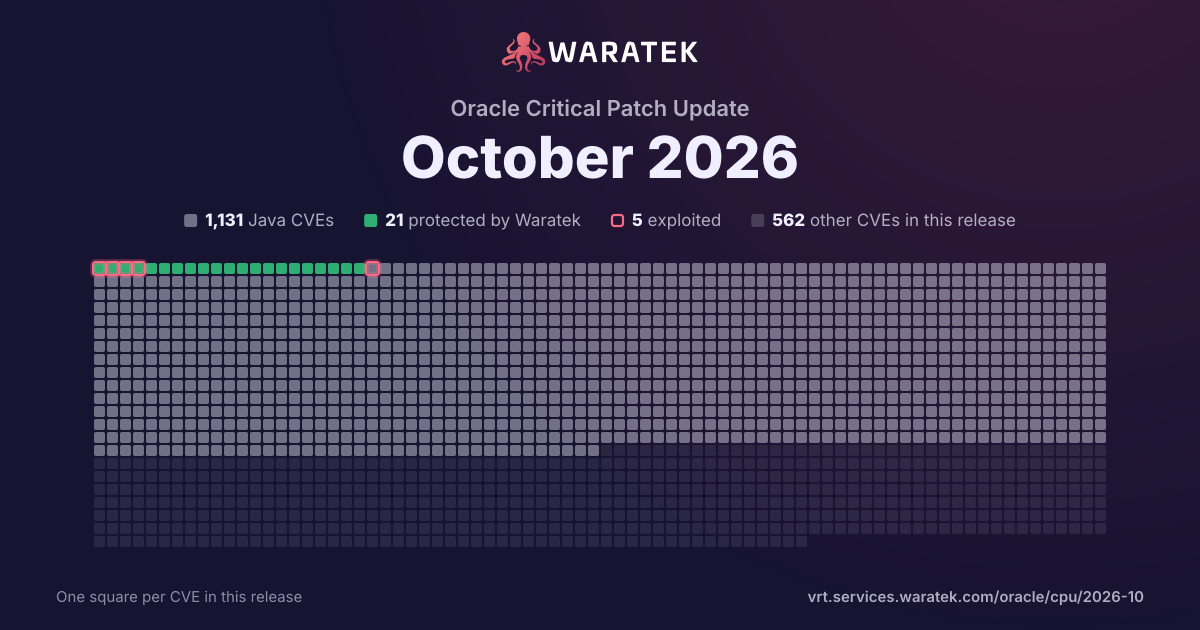
By status
20Protected by Waratek1Mitigation candidate1,111No exploit published12Outside Waratek scope549Not applicable
5Exploited, marked by the ring
No exploit published. For 855 of them, Oracle's security advisory is the source of public detail.
Protected by Waratek. Waratek RASP can block exploitation of these on systems that have not applied the patch yet.
Overview 12 matches · 0 in Waratek scope · 0 protected · 0 exploited · 0 CISA KEV · 1 public PoC · 0 EPSS ≥ 0.5
12matches
0in Waratek scope0.0%
0protected0.0%
0exploited0.0%
0CISA KEV0.0%
1public PoC8.3%
0EPSS ≥ 0.50.0%
Protected by Waratek
0
0.0%
Rule in development
0
0.0%
Mitigation candidate
0
0.0%
No exploit published
0
0.0%
Outside Waratek scope
12
100.0%
Not applicable
0
0.0%
Withdrawn CVE
0
0.0%
blocked by ARMR today
0
0.0%
partly blocked
0
0.0%
not blocked
12
100.0%
not established
0
0.0%
unrecorded
0
0.0%
Exploited
0
0.0%
Working exploit published
1
8.3%
Proof of concept only
0
0.0%
Forecast only
0
0.0%
No public exploit
11
91.7%
split by
peak 9 / quarter
Q1 241
Outside Waratek scope1
Low1
not blocked1
No public exploit1
Q2 241
Outside Waratek scope1
High1
not blocked1
Working exploit published1
Q3 240
Q4 240
Q1 250
Q2 250
Q3 250
Q4 250
Q1 260
Q2 261
Outside Waratek scope1
Medium1
not blocked1
No public exploit1
Q3 260
Q4 269
Outside Waratek scope9
High1
Medium4
Low4
not blocked9
No public exploit9
Q1 24Q2 24Q3 24Q4 24Q1 25Q2 25Q3 25Q4 25Q1 26Q2 26Q3 26Q4 26
| CVE | Severity | Published▾ | Status | Exploitation | Description |
|---|---|---|---|---|---|
| CVE-2026-91484 | High | 2026-10-20 | Outside Waratek scope | No public exploit | Vulnerability in Oracle Java SE (component: Java plugin). Supported versions that are affected are Oracle Java SE: 8u503 and 8u503-perf. Difficult to exploit vulnerability allows low privileged attacker with logon to the infrastructure where Oracle Java SE executes to compromise Oracle Java SE. While the vulnerability is in Oracle Java SE, attacks may significantly impact additional products (scope change). Successful attacks of this vulnerability can result in unauthorized creation, deletion or modification access to critical data or all Oracle Java SE accessible data as well as unauthorized access to critical data or complete access to all Oracle Java SE accessible data. Note: This vulnerability applies to Java deployments, typically in clients running sandboxed Java Web Start applications or sandboxed Java applets, that load and run untrusted code (e.g., code that comes from the internet) and rely on the Java sandbox for security. This vulnerability does not apply to Java deployments, typically in servers, that load and run only trusted code (e.g., code installed by an administrator). CVSS 3.1 Base Score 7.5 (Confidentiality and Integrity impacts). CVSS Vector: (CVSS:3.1/AV:L/AC:H/PR:L/UI:N/S:C/C:H/I:H/A:N). |
| CVE-2026-91477 | Low | 2026-10-20 | Outside Waratek scope | No public exploit | Vulnerability in the Oracle JavaFX product of Oracle Java SE (component: JavaFX). Supported versions that are affected are Oracle JavaFX: 25.0.4 and 27. Difficult to exploit vulnerability allows unauthenticated attacker with network access via multiple protocols to compromise Oracle JavaFX. Successful attacks require human interaction from a person other than the attacker. Successful attacks of this vulnerability can result in unauthorized read access to a subset of Oracle JavaFX accessible data. Note: This vulnerability applies to Java deployments, typically in clients running sandboxed Java Web Start applications or sandboxed Java applets, that load and run untrusted code (e.g., code that comes from the internet) and rely on the Java sandbox for security. This vulnerability does not apply to Java deployments, typically in servers, that load and run only trusted code (e.g., code installed by an administrator). CVSS 3.1 Base Score 3.1 (Confidentiality impacts). CVSS Vector: (CVSS:3.1/AV:N/AC:H/PR:N/UI:R/S:U/C:L/I:N/A:N). |
| CVE-2026-91464 | Medium | 2026-10-20 | Outside Waratek scope | No public exploit | Vulnerability in the Oracle Java SE, Oracle GraalVM for JDK, Oracle GraalVM Enterprise Edition product of Oracle Java SE (component: JGSS). Supported versions that are affected are Oracle Java SE: 8u503, 8u503-perf, 11.0.32.1, 17.0.20.1, 21.0.12.1, 25.0.4.1, 27; Oracle GraalVM for JDK: 17.0.20.1 and 21.0.12.1; Oracle GraalVM Enterprise Edition: 21.3.19.1.1. Difficult to exploit vulnerability allows unauthenticated attacker with network access via multiple protocols to compromise Oracle Java SE, Oracle GraalVM for JDK, Oracle GraalVM Enterprise Edition. Successful attacks require human interaction from a person other than the attacker. Successful attacks of this vulnerability can result in unauthorized access to critical data or complete access to all Oracle Java SE, Oracle GraalVM for JDK, Oracle GraalVM Enterprise Edition accessible data. Note: This vulnerability applies to Java deployments, typically in clients running sandboxed Java Web Start applications or sandboxed Java applets, that load and run untrusted code (e.g., code that comes from the internet) and rely on the Java sandbox for security. This vulnerability does not apply to Java deployments, typically in servers, that load and run only trusted code (e.g., code installed by an administrator). CVSS 3.1 Base Score 5.3 (Confidentiality impacts). CVSS Vector: (CVSS:3.1/AV:N/AC:H/PR:N/UI:R/S:U/C:H/I:N/A:N). |
| CVE-2026-91463 | Medium | 2026-10-20 | Outside Waratek scope | No public exploit | Vulnerability in the Oracle Java SE, Oracle GraalVM for JDK, Oracle GraalVM Enterprise Edition product of Oracle Java SE (component: JGSS). Supported versions that are affected are Oracle Java SE: 8u503, 8u503-perf, 11.0.32.1, 17.0.20.1, 21.0.12.1, 25.0.4.1, 27; Oracle GraalVM for JDK: 17.0.20.1 and 21.0.12.1; Oracle GraalVM Enterprise Edition: 21.3.19.1.1. Difficult to exploit vulnerability allows unauthenticated attacker with network access via multiple protocols to compromise Oracle Java SE, Oracle GraalVM for JDK, Oracle GraalVM Enterprise Edition. Successful attacks require human interaction from a person other than the attacker. Successful attacks of this vulnerability can result in unauthorized access to critical data or complete access to all Oracle Java SE, Oracle GraalVM for JDK, Oracle GraalVM Enterprise Edition accessible data. Note: This vulnerability applies to Java deployments, typically in clients running sandboxed Java Web Start applications or sandboxed Java applets, that load and run untrusted code (e.g., code that comes from the internet) and rely on the Java sandbox for security. This vulnerability does not apply to Java deployments, typically in servers, that load and run only trusted code (e.g., code installed by an administrator). CVSS 3.1 Base Score 5.3 (Confidentiality impacts). CVSS Vector: (CVSS:3.1/AV:N/AC:H/PR:N/UI:R/S:U/C:H/I:N/A:N). |
| CVE-2026-91402 | Low | 2026-10-20 | Outside Waratek scope | No public exploit | Vulnerability in the Oracle Java SE, Oracle JavaFX, Oracle GraalVM Enterprise Edition product of Oracle Java SE (component: JavaFX). Supported versions that are affected are Oracle Java SE: 8u503; Oracle JavaFX: 21.0.12, 25.0.4 and 27; Oracle GraalVM Enterprise Edition: 21.3.19.1.1. Difficult to exploit vulnerability allows unauthenticated attacker with network access via multiple protocols to compromise Oracle Java SE, Oracle JavaFX, Oracle GraalVM Enterprise Edition. Successful attacks require human interaction from a person other than the attacker. Successful attacks of this vulnerability can result in unauthorized read access to a subset of Oracle Java SE, Oracle JavaFX, Oracle GraalVM Enterprise Edition accessible data. Note: This vulnerability applies to Java deployments, typically in clients running sandboxed Java Web Start applications or sandboxed Java applets, that load and run untrusted code (e.g., code that comes from the internet) and rely on the Java sandbox for security. This vulnerability does not apply to Java deployments, typically in servers, that load and run only trusted code (e.g., code installed by an administrator). CVSS 3.1 Base Score 3.1 (Confidentiality impacts). CVSS Vector: (CVSS:3.1/AV:N/AC:H/PR:N/UI:R/S:U/C:L/I:N/A:N). |
| CVE-2026-91400 | Low | 2026-10-20 | Outside Waratek scope | No public exploit | Vulnerability in the Oracle Java SE, Oracle GraalVM for JDK, Oracle GraalVM Enterprise Edition product of Oracle Java SE (component: Sound). Supported versions that are affected are Oracle Java SE: 8u503, 8u503-perf, 11.0.32.1, 17.0.20.1, 21.0.12.1, 25.0.4.1, 27; Oracle GraalVM for JDK: 17.0.20.1 and 21.0.12.1; Oracle GraalVM Enterprise Edition: 21.3.19.1.1. Difficult to exploit vulnerability allows unauthenticated attacker with network access via multiple protocols to compromise Oracle Java SE, Oracle GraalVM for JDK, Oracle GraalVM Enterprise Edition. Successful attacks require human interaction from a person other than the attacker. Successful attacks of this vulnerability can result in unauthorized ability to cause a partial denial of service (partial DOS) of Oracle Java SE, Oracle GraalVM for JDK, Oracle GraalVM Enterprise Edition. Note: This vulnerability applies to Java deployments, typically in clients running sandboxed Java Web Start applications or sandboxed Java applets, that load and run untrusted code (e.g., code that comes from the internet) and rely on the Java sandbox for security. This vulnerability does not apply to Java deployments, typically in servers, that load and run only trusted code (e.g., code installed by an administrator). CVSS 3.1 Base Score 3.1 (Availability impacts). CVSS Vector: (CVSS:3.1/AV:N/AC:H/PR:N/UI:R/S:U/C:N/I:N/A:L). |
| CVE-2026-91385 | Medium | 2026-10-20 | Outside Waratek scope | No public exploit | Vulnerability in the Oracle Java SE, Oracle JavaFX, Oracle GraalVM Enterprise Edition product of Oracle Java SE (component: JavaFX). Supported versions that are affected are Oracle Java SE: 8u503; Oracle JavaFX: 21.0.12, 25.0.4 and 27; Oracle GraalVM Enterprise Edition: 21.3.19.1.1. Easily exploitable vulnerability allows unauthenticated attacker with network access via multiple protocols to compromise Oracle Java SE, Oracle JavaFX, Oracle GraalVM Enterprise Edition. Successful attacks require human interaction from a person other than the attacker. Successful attacks of this vulnerability can result in unauthorized update, insert or delete access to some of Oracle Java SE, Oracle JavaFX, Oracle GraalVM Enterprise Edition accessible data as well as unauthorized read access to a subset of Oracle Java SE, Oracle JavaFX, Oracle GraalVM Enterprise Edition accessible data. Note: This vulnerability applies to Java deployments, typically in clients running sandboxed Java Web Start applications or sandboxed Java applets, that load and run untrusted code (e.g., code that comes from the internet) and rely on the Java sandbox for security. This vulnerability does not apply to Java deployments, typically in servers, that load and run only trusted code (e.g., code installed by an administrator). CVSS 3.1 Base Score 5.4 (Confidentiality and Integrity impacts). CVSS Vector: (CVSS:3.1/AV:N/AC:L/PR:N/UI:R/S:U/C:L/I:L/A:N). |
| CVE-2026-91379 | Medium | 2026-10-20 | Outside Waratek scope | No public exploit | Vulnerability in the Oracle Java SE, Oracle GraalVM for JDK, Oracle GraalVM Enterprise Edition product of Oracle Java SE (component: JDK tools). Supported versions that are affected are Oracle Java SE: 8u503-perf, 11.0.32.1, 17.0.20.1, 21.0.12.1, 25.0.4.1, 27; Oracle GraalVM for JDK: 17.0.20.1 and 21.0.12.1; Oracle GraalVM Enterprise Edition: 21.3.19.1.1. Difficult to exploit vulnerability allows unauthenticated attacker with logon to the infrastructure where Oracle Java SE, Oracle GraalVM for JDK, Oracle GraalVM Enterprise Edition executes to compromise Oracle Java SE, Oracle GraalVM for JDK, Oracle GraalVM Enterprise Edition. Successful attacks require human interaction from a person other than the attacker. Successful attacks of this vulnerability can result in unauthorized creation, deletion or modification access to critical data or all Oracle Java SE, Oracle GraalVM for JDK, Oracle GraalVM Enterprise Edition accessible data. Note: This vulnerability applies to Java deployments, typically in clients running sandboxed Java Web Start applications or sandboxed Java applets, that load and run untrusted code (e.g., code that comes from the internet) and rely on the Java sandbox for security. This vulnerability does not apply to Java deployments, typically in servers, that load and run only trusted code (e.g., code installed by an administrator). CVSS 3.1 Base Score 4.7 (Integrity impacts). CVSS Vector: (CVSS:3.1/AV:L/AC:H/PR:N/UI:R/S:U/C:N/I:H/A:N). |
| CVE-2026-91335 | Low | 2026-10-20 | Outside Waratek scope | No public exploit | Vulnerability in the Oracle Java SE, Oracle GraalVM for JDK, Oracle GraalVM Enterprise Edition product of Oracle Java SE (component: AWT). Supported versions that are affected are Oracle Java SE: 8u503, 8u503-perf, 11.0.32.1, 17.0.20.1, 21.0.12.1, 25.0.4.1, 27; Oracle GraalVM for JDK: 17.0.20.1 and 21.0.12.1; Oracle GraalVM Enterprise Edition: 21.3.19.1.1. Difficult to exploit vulnerability allows low privileged attacker with network access via multiple protocols to compromise Oracle Java SE, Oracle GraalVM for JDK, Oracle GraalVM Enterprise Edition. Successful attacks require human interaction from a person other than the attacker. Successful attacks of this vulnerability can result in unauthorized read access to a subset of Oracle Java SE, Oracle GraalVM for JDK, Oracle GraalVM Enterprise Edition accessible data. Note: This vulnerability applies to Java deployments, typically in clients running sandboxed Java Web Start applications or sandboxed Java applets, that load and run untrusted code (e.g., code that comes from the internet) and rely on the Java sandbox for security. This vulnerability does not apply to Java deployments, typically in servers, that load and run only trusted code (e.g., code installed by an administrator). CVSS 3.1 Base Score 2.6 (Confidentiality impacts). CVSS Vector: (CVSS:3.1/AV:N/AC:H/PR:L/UI:R/S:U/C:L/I:N/A:N). |
| CVE-2026-20060 | Medium | 2026-04-15 | Outside Waratek scope | No public exploit | A vulnerability in the web-based management interface of Cisco Unity Connection could allow an unauthenticated, remote attacker to redirect a user to a malicious web page. This vulnerability is due to improper input validation of HTTP request parameters. An attacker could exploit this vulnerability by persuading a user to click a crafted link. A successful exploit could allow the attacker to redirect a user to a malicious web page. |
| CVE-2024-4367 | High | 2024-05-14 | Outside Waratek scope | Working exploit published | A type check was missing when handling fonts in PDF.js, which would allow arbitrary JavaScript execution in the PDF.js context. This vulnerability affects Firefox < 126, Firefox ESR < 115.11, and Thunderbird < 115.11. |
| CVE-2024-20925 | Low | 2024-02-17 | Outside Waratek scope | No public exploit | Vulnerability in the Oracle Java SE, Oracle GraalVM Enterprise Edition product of Oracle Java SE (component: JavaFX). Supported versions that are affected are Oracle Java SE: 8u391; Oracle GraalVM Enterprise Edition: 20.3.12 and 21.3.8. Difficult to exploit vulnerability allows unauthenticated attacker with network access via multiple protocols to compromise Oracle Java SE, Oracle GraalVM Enterprise Edition. Successful attacks require human interaction from a person other than the attacker. Successful attacks of this vulnerability can result in unauthorized update, insert or delete access to some of Oracle Java SE, Oracle GraalVM Enterprise Edition accessible data. Note: This vulnerability applies to Java deployments, typically in clients running sandboxed Java Web Start applications or sandboxed Java applets, that load and run untrusted code (e.g., code that comes from the internet) and rely on the Java sandbox for security. This vulnerability does not apply to Java deployments, typically in servers, that load and run only trusted code (e.g., code installed by an administrator). CVSS 3.1 Base Score 3.1 (Integrity impacts). CVSS Vector: (CVSS:3.1/AV:N/AC:H/PR:N/UI:R/S:U/C:N/I:L/A:N). |