
Oracle Critical Patch Update October 2026
Released October 2026 · Oracle's advisory ↗ · ← Security Patch Update, September 2026 · Security Patch Update, November 2026 →
1,693 CVEs in this release, one square each
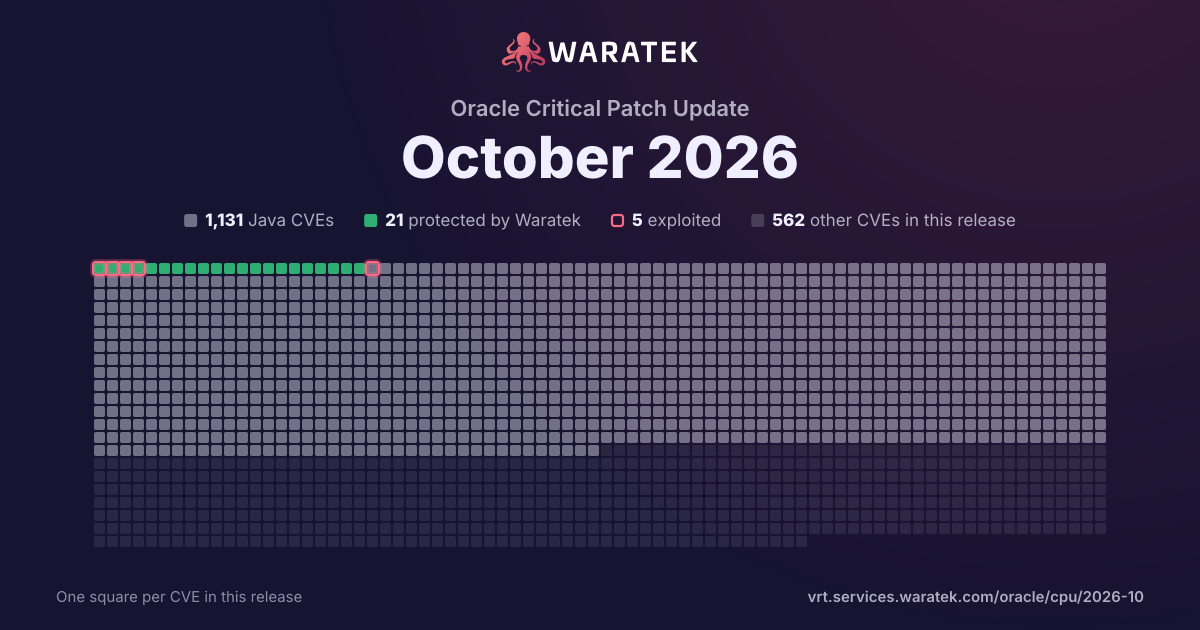
By status
20Protected by Waratek1Mitigation candidate1,112No exploit published11Outside Waratek scope549Not applicable
5Exploited, marked by the ring
No exploit published. For 858 of them, Oracle's security advisory is the source of public detail.
Protected by Waratek. Waratek RASP can block exploitation of these on systems that have not applied the patch yet.
Overview 12 matches · 0 protected · 0 exploited · 0 CISA KEV · 0 public PoC · 0 EPSS ≥ 0.5
12matches
0protected0.0%
0exploited0.0%
0CISA KEV0.0%
0public PoC0.0%
0EPSS ≥ 0.50.0%
Protected by Waratek
0
0.0%
Rule in development
0
0.0%
Mitigation candidate
0
0.0%
No exploit published
12
100.0%
blocked by ARMR today
0
0.0%
partly blocked
0
0.0%
not blocked
12
100.0%
not established
0
0.0%
unrecorded
0
0.0%
Exploited
0
0.0%
Working exploit published
0
0.0%
Proof of concept only
0
0.0%
Forecast only
0
0.0%
No public exploit
12
100.0%
split by
peak 12 / month
Aug 26
| CVE | Severity | Published▾ | Status | Exploitation | Description |
|---|---|---|---|---|---|
| CVE-2026-59313 | Critical | 2026-08-27 | No exploit published | No public exploit | Spring MVC applications using the functional web framework are vulnerable to stream corruption when using Server-Sent Events (SSE). Spring Framework 7.0.0 - 7.0.8 Spring Framework 6.2.0 - 6.2.19 Spring Framework 6.1.0 - 6.1.28 Spring Framework 6.0.0 - 6.0.30 Spring Framework 5.3.0 - 5.3.49 |
| CVE-2026-59283 | Critical | 2026-08-27 | No exploit published | No public exploit | Applications that evaluate Spring Expression Language (SpEL) expressions using SimpleEvaluationContext may be vulnerable to a safety guard bypass when the SpEL expression compiler is active. Spring Framework 7.0.0 - 7.0.8 Spring Framework 6.2.0 - 6.2.19 Spring Framework 6.1.0 - 6.1.28 Spring Framework 6.0.0 - 6.0.30 Spring Framework 5.3.0 - 5.3.49 Spring Framework 5.2.25.RELEASE and earlier |
| CVE-2026-47892 | Critical | 2026-08-27 | No exploit published | No public exploit | A WebFlux application using functional endpoints and deployed with DispatcherServlet may be vulnerable to a header predicate bypass in a pre-flight request. Spring Framework 7.0.0 - 7.0.8 Spring Framework 6.2.0 - 6.2.19 Spring Framework 6.1.0 - 6.1.28 Spring Framework 6.0.0 - 6.0.30 Spring Framework 5.3.0 - 5.3.49 Spring Framework 5.2.5.RELEASE - 5.2.25.RELEASE |
| CVE-2026-47891 | Critical | 2026-08-27 | No exploit published | No public exploit | A Spring WebFlux application that relies on the Aalto XML processor to parse XML input does not correctly enforce the maxInMemorySize limit. Spring Framework 7.0.0 - 7.0.8 Spring Framework 6.2.0 - 6.2.19 Spring Framework 6.1.0 - 6.1.28 Spring Framework 6.0.0 - 6.0.30 Spring Framework 5.3.0 - 5.3.49 Spring Framework 5.2.25.RELEASE and earlier |
| CVE-2026-68525 | Critical | 2026-08-25 | No exploit published | No public exploit | Incorrect Authorization vulnerability in Apache Tomcat's FORM authentication process allows the bypassing of a security constraint that limits user has access to a resource POST but not GET. This issue affects Apache Tomcat: from 11.0.0-M1 through 11.0.24, from 10.1.0-M1 through 10.1.57, from 9.0.0.M1 through 9.0.120. The following versions were EOL at the time the CVE was created but are known to be affected: from 8.5.0 through 8.5.100, from 7.0.0 through 7.0.109. Other unsupported versions may also be affected. Users are recommended to upgrade to version 11.0.25, 10.1.58 or 9.0.121, which fixes the issue. |
| CVE-2026-65905 | Critical | 2026-08-25 | No exploit published | No public exploit | Authentication Bypass by Capture-replay vulnerability in Apache Tomcat's DIGEST authenticator. If, before windowSize requests have been made, a client makes a DIGEST authenticated request with a nonceCount on the upper boundary of the replay window then that request is replayable once only while the associated nonceCount remains within the replay window. This issue affects Apache Tomcat: from 11.0.0-M1 through 11.0.24, from 10.1.0-M1 through 10.1.57, from 9.0.0.M1 through 9.0.120. The following versions were EOL at the time the CVE was created but are known to be affected: from 8.5.0 through 8.5.100, from 7.0.30 through 7.0.109. Other unsupported versions may also be affected. Users are recommended to upgrade to version 11.0.25, 10.1.58 or 9.0.121, which fix the issue. |
| CVE-2026-65637 | Critical | 2026-08-25 | No exploit published | No public exploit | Improper Input Validation vulnerability in Apache Tomcat due to incomplete fix for CVE-2026-32990. This issue affects Apache Tomcat: from 11.0.20 through 11.0.24, from 10.1.53 through 10.1.57, from 9.0.115 through 9.0.120. Users are recommended to upgrade to version 11.0.25, 10.1.58 or 9.0.121, which fix the issue. |
| CVE-2026-65182 | Critical | 2026-08-25 | No exploit published | No public exploit | Improper Access Control, Incorrect Authorization vulnerability in Apache Tomcat leads to security constraint bypass if a constraint for a longer path is specified before a more restrictive constraint for a shorter sub-path. This issue affects Apache Tomcat: from 11.0.0-M1 through 11.0.24, from 10.1.0-M1 through 10.1.57, from 9.0.0.M1 through 9.0.120, from 8.5.0 through 8.5.100, from 7.0.0 through 7.0.109. Users are recommended to upgrade to version 11.0.25, 10.1.58, 9.0.121, which fixes the issue. |
| CVE-2026-75595 | Critical | 2026-08-19 | No exploit published | No public exploit | Netty is an asynchronous, event-driven network application framework. Prior to 4.1.137.Fina and 4.2.17.Final, io.netty.handler.ssl.SslClientHelloHandler#decode checks the wrong offset before reading the four-byte TLS handshake header, so a ClientHello whose handshake header spans records can cause an IndexOutOfBoundsException and invoke select(ctx, null). This selects the default SslContext instead of the SNI-specific context. In deployments where per-SNI clientAuth=REQUIRE is the sole mutual TLS gate, the default SslContext uses clientAuth=NONE or clientAuth=OPTIONAL, and no application-layer certificate verification exists, an unauthenticated remote attacker can bypass the protected route's mutual TLS requirement. This issue is fixed in versions 4.1.137.Final and 4.2.17.Final. |
| CVE-2026-8763 | Critical | 2026-08-03 | No exploit published | No public exploit | In Bouncy Castle for Java before 1.85, Name Constraints bypass via trailing dot in rfc822Name and URI. This issue also affects Bouncy Castle for Java LTS before 2.73.12, and Bouncy Castle for Java FIPS (BC-FJA) before bc-fips 1.0.2.7 (1.0.X series), 2.0.2 (2.0.X series) and 2.1.3 (2.1.X series). |
| CVE-2026-59650 | Critical | 2026-08-03 | No exploit published | No public exploit | In Bouncy Castle for Java before 1.85, MTI/A0 DH agreement exponentiates unvalidated peer value. This issue also affects Bouncy Castle for Java LTS before 2.73.12. |
| CVE-2026-58062 | Critical | 2026-08-03 | No exploit published | No public exploit | In Bouncy Castle for Java before 1.85, Stapled OCSP response accepted without binding to the checked certificate. This issue also affects Bouncy Castle for Java LTS before 2.73.12, and Bouncy Castle for Java FIPS (BC-FJA) before bc-fips 2.0.2 (2.0.X series) and 2.1.3 (2.1.X series). |