
Oracle Critical Patch Update October 2026
Released October 2026 · Oracle's advisory ↗ · ← Security Patch Update, September 2026 · Security Patch Update, November 2026 →
1,693 CVEs in this release, one square each
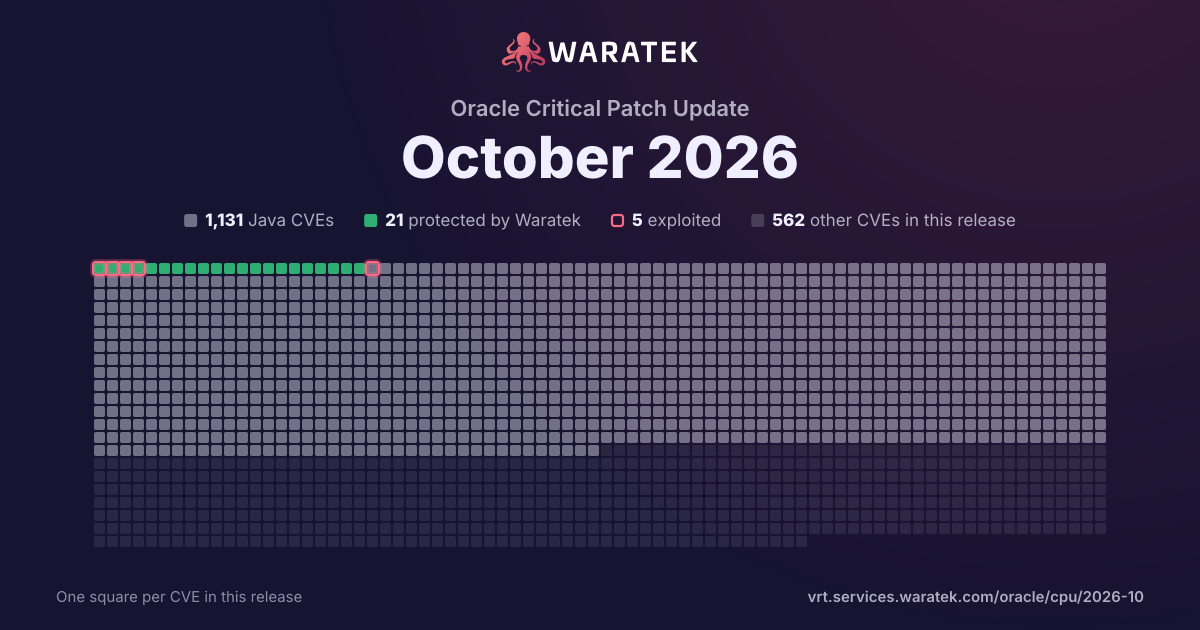
By status
20Protected by Waratek1Mitigation candidate1,111No exploit published12Outside Waratek scope549Not applicable
5Exploited, marked by the ring
No exploit published. For 855 of them, Oracle's security advisory is the source of public detail.
Protected by Waratek. Waratek RASP can block exploitation of these on systems that have not applied the patch yet.
Overview 9 matches · 0 protected · 0 exploited · 0 CISA KEV · 0 public PoC · 0 EPSS ≥ 0.5
9matches
0protected0.0%
0exploited0.0%
0CISA KEV0.0%
0public PoC0.0%
0EPSS ≥ 0.50.0%
Protected by Waratek
0
0.0%
Rule in development
0
0.0%
Mitigation candidate
0
0.0%
No exploit published
9
100.0%
blocked by ARMR today
0
0.0%
partly blocked
0
0.0%
not blocked
9
100.0%
not established
0
0.0%
unrecorded
0
0.0%
Exploited
0
0.0%
Working exploit published
0
0.0%
Proof of concept only
1
11.1%
Forecast only
0
0.0%
No public exploit
8
88.9%
| CVE | Severity | Published▾ | Status | Exploitation | Description |
|---|---|---|---|---|---|
| CVE-2026-33870 | High | 2026-03-27 | No exploit published | Proof of concept only | Netty is an asynchronous, event-driven network application framework. In versions prior to 4.1.132.Final and 4.2.10.Final, Netty incorrectly parses quoted strings in HTTP/1.1 chunked transfer encoding extension values, enabling request smuggling attacks. Versions 4.1.132.Final and 4.2.10.Final fix the issue. |
| CVE-2026-28369 | Critical | 2026-03-27 | No exploit published | No public exploit | A flaw was found in Undertow. When Undertow receives an HTTP request where the first header line starts with one or more spaces, it incorrectly processes the request by stripping these leading spaces. This behavior, which violates HTTP standards, can be exploited by a remote attacker to perform request smuggling. Request smuggling allows an attacker to bypass security mechanisms, access restricted information, or manipulate web caches, potentially leading to unauthorized actions or data exposure. |
| CVE-2026-28368 | Critical | 2026-03-27 | No exploit published | No public exploit | A flaw was found in Undertow. This vulnerability allows a remote attacker to construct specially crafted requests where header names are parsed differently by Undertow compared to upstream proxies. This discrepancy in header interpretation can be exploited to launch request smuggling attacks, potentially bypassing security controls and accessing unauthorized resources. |
| CVE-2026-28367 | Critical | 2026-03-27 | No exploit published | No public exploit | A flaw was found in Undertow. A remote attacker can exploit this vulnerability by sending `\r\r\r` as a header block terminator. This can be used for request smuggling with certain proxy servers, such as older versions of Apache Traffic Server and Google Cloud Classic Application Load Balancer, potentially leading to unauthorized access or manipulation of web requests. |
| CVE-2026-22737 | Medium | 2026-03-20 | No exploit published | No public exploit | Use of Java scripting engine enabled (e.g. JRuby, Jython) template views in Spring MVC and Spring WebFlux applications can result in disclosure of content from files outside the configured locations for script template views. This issue affects Spring Framework: from 7.0.0 through 7.0.5, from 6.2.0 through 6.2.16, from 6.1.0 through 6.1.25, from 5.3.0 through 5.3.46. |
| CVE-2026-22735 | Low | 2026-03-20 | No exploit published | No public exploit | Spring MVC and WebFlux applications are vulnerable to stream corruption when using Server-Sent Events (SSE). This issue affects Spring Foundation: from 7.0.0 through 7.0.5, from 6.2.0 through 6.2.16, from 6.1.0 through 6.1.25, from 5.3.0 through 5.3.46. |
| CVE-2025-11143 | Medium | 2026-03-05 | No exploit published | No public exploit | The Jetty URI parser has some key differences to other common parsers when evaluating invalid or unusual URIs. Differential parsing of URIs in systems using multiple components may result in security by-pass. For example a component that enforces a black list may interpret the URIs differently from one that generates a response. At the very least, differential parsing may divulge implementation details. |
| CVE-2026-24733 | Medium | 2026-02-17 | No exploit published | No public exploit | Improper Input Validation vulnerability in Apache Tomcat. Tomcat did not limit HTTP/0.9 requests to the GET method. If a security constraint was configured to allow HEAD requests to a URI but deny GET requests, the user could bypass that constraint on GET requests by sending a (specification invalid) HEAD request using HTTP/0.9. This issue affects Apache Tomcat: from 11.0.0-M1 through 11.0.14, from 10.1.0-M1 through 10.1.49, from 9.0.0.M1 through 9.0.112. Older, EOL versions are also affected. Users are recommended to upgrade to version 11.0.15 or later, 10.1.50 or later or 9.0.113 or later, which fixes the issue. |
| CVE-2026-1225 | Low | 2026-01-22 | No exploit published | No public exploit | ACE vulnerability in configuration file processing by QOS.CH logback-core up to and including version 1.5.24 in Java applications, allows an attacker to instantiate classes already present on the class path by compromising an existing logback configuration file. The instantiation of a potentially malicious Java class requires that said class is present on the user's class-path. In addition, the attacker must have write access to a configuration file. However, after successful instantiation, the instance is very likely to be discarded with no further ado. |