
Oracle Critical Patch Update October 2026
Released October 2026 · Oracle's advisory ↗ · ← Security Patch Update, September 2026
1,693 CVEs in this release, one square each
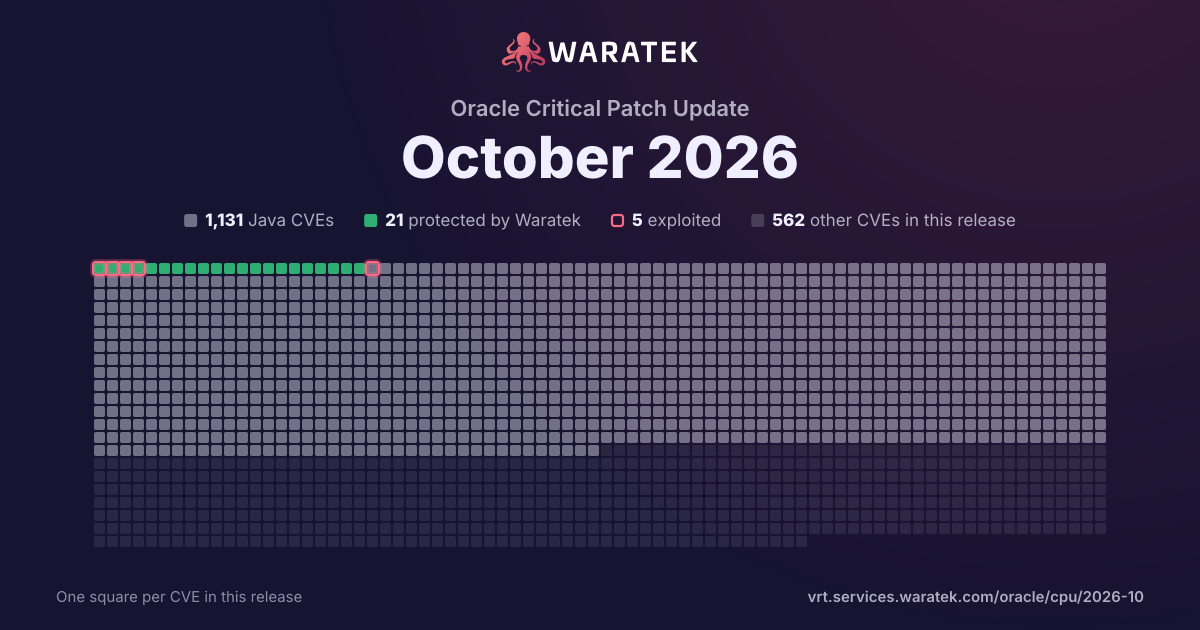
By status
21Protected by Waratek1Mitigation candidate1,109No exploit published13Outside Waratek scope549Not applicable
5Exploited, marked by the ring
No exploit published. For 858 of them, Oracle's security advisory is the source of public detail.
Protected by Waratek. Waratek RASP can block exploitation of these on systems that have not applied the patch yet.
Overview 549 matches · 0 in Waratek scope · 0 protected · 0 exploited · 0 CISA KEV · 6 public PoC · 2 EPSS ≥ 0.5
549matches
0in Waratek scope0.0%
0protected0.0%
0exploited0.0%
0CISA KEV0.0%
6public PoC1.1%
2EPSS ≥ 0.50.4%
Protected by Waratek
0
0.0%
Rule in development
0
0.0%
Mitigation candidate
0
0.0%
No exploit published
0
0.0%
Outside Waratek scope
0
0.0%
Not applicable
549
100.0%
Withdrawn CVE
0
0.0%
blocked by ARMR today
0
0.0%
partly blocked
0
0.0%
not blocked
549
100.0%
not established
0
0.0%
unrecorded
0
0.0%
Exploited
0
0.0%
Working exploit published
0
0.0%
Proof of concept only
65
11.8%
Forecast only
0
0.0%
No public exploit
484
88.2%
split by
peak 195 / quarter
Q4 211
Not applicable1
Critical1
not blocked1
No public exploit1
Q1 220
Q2 220
Q3 220
Q4 220
Q1 236
Not applicable6
Critical1
Medium5
not blocked6
Proof of concept only3
No public exploit3
Q2 232
Not applicable2
Medium2
not blocked2
Proof of concept only2
Q3 230
Q4 233
Not applicable3
High1
Medium1
Low1
not blocked3
Proof of concept only2
No public exploit1
Q1 240
Q2 244
Not applicable4
Medium4
not blocked4
Proof of concept only2
No public exploit2
Q3 242
Not applicable2
Medium1
Low1
not blocked2
No public exploit2
Q4 244
Not applicable4
High3
Medium1
not blocked4
Proof of concept only3
No public exploit1
Q1 250
Q2 251
Not applicable1
Medium1
not blocked1
No public exploit1
Q3 254
Not applicable4
Critical1
High1
Medium2
not blocked4
No public exploit4
Q4 254
Not applicable4
High2
Medium2
not blocked4
No public exploit4
Q1 2655
Not applicable55
Critical5
High18
Medium27
Low5
not blocked55
Proof of concept only12
No public exploit43
Q2 26152
Not applicable152
Critical14
High74
Medium51
Low13
not blocked152
Proof of concept only17
No public exploit135
Q3 26116
Not applicable116
Critical21
High64
Medium29
Low2
not blocked116
Proof of concept only24
No public exploit92
Q4 26195
Not applicable195
Critical9
High72
Medium106
Low8
not blocked195
No public exploit195
Q4 21Q2 22Q4 22Q2 23Q4 23Q2 24Q4 24Q2 25Q4 25Q2 26Q4 26
| CVE | Severity | Published▾ | Status | Exploitation | Description |
|---|---|---|---|---|---|
| CVE-2026-74860 | High | 2026-09-08 | Not applicable | No public exploit | A flaw was found in libxml2 with Python bindings enabled. A remote attacker could exploit this vulnerability by providing a specially crafted XML document containing a Document Type Definition (DTD) with enumerated attribute values. This triggers a double-free error in the SAX attributeDecl callback handler, where a string is freed twice. This flaw can lead to a denial of service (DoS) due to a reproducible crash in Python applications using the libxml2 SAX bindings. |
| CVE-2026-86219 | Critical | 2026-09-06 | Not applicable | No public exploit | Authen::SASL::Perl::DIGEST_MD5 versions before 2.2100 for Perl accept replayed authentication responses via unverified nonce in server_step. server_start generates a fresh nonce and sends it in the challenge, and nothing later compares that value against the nonce the client returns. server_step derives the expected digest from the client's own parameters, so a response verifies whenever its digest matches the nonce it carries. The count table it also checks is keyed on the client-supplied nonce and starts empty in each new server object, so a captured first response, carrying `nc=00000001`, passes that too. RFC 2831 defines the nonce in the response as the value the server sent in the preceding challenge. An attacker who observes one successful `qop=auth` exchange can replay the captured response against a later session for the same service, host, realm and user, and authenticate as that user without knowing the password. |
| CVE-2026-19931 | Critical | 2026-09-06 | Not applicable | Proof of concept only | A flaw in libcurl makes it wrongly reuse an HTTP connection setup for a given hostname using Negotiate authentication, when the initial request is done using empty credentials. This can make user B's request get sent over user A's previously authenticated connection. |
| CVE-2026-18924 | Critical | 2026-09-06 | Not applicable | Proof of concept only | A flaw in libcurl's handling of HTTP/2 Server Push streams, when the parent handle is set to share connections with other handles, can lead to use-after-free in the cleanup process. |
| CVE-2026-13608 | High | 2026-09-06 | Not applicable | Proof of concept only | A flaw in the libcurl SASL negotiation for LDAP authentication allows an incomplete handshake sequence to be misinterpreted as a successful cryptographic verification. An attacker executing a Man-in-the-Middle (MITM) attack can inject a premature or shortcut response that bypasses complete peer validation. |
| CVE-2026-86144 | High | 2026-09-05 | Not applicable | No public exploit | In xinclude in libxml2 before 2.15.4, xmlXIncludeProcess and xmlXIncludeProcessTree do not propagate parseFlags. This has security relevance for, for example, the XML_PARSE_NONET flag, if (without it) a custom resource loader accesses the internet and triggers XML external entity injection, SSRF, or a denial of service (e.g., for an attacker-controlled internet resource that is intentionally slow). |
| CVE-2026-86143 | High | 2026-09-05 | Not applicable | No public exploit | In xmlIO in libxml2 before 2.15.4, an inconsistency in xmlOutputWriteCallback and xmlBufUse causes negative lengths to reach write callbacks, aka a lack of a check for integer overflow before calling writecallback. This has security relevance for many types of uses of that length value within a callback. |
| CVE-2026-86142 | High | 2026-09-05 | Not applicable | No public exploit | In libxml2 before 2.15.4, there is a heap-based buffer overflow in xmlXPtrEvalXPtrPart because of xmlXPtrEval xpointer length saturation. |
| CVE-2026-86140 | High | 2026-09-05 | Not applicable | No public exploit | In libxml2 before 2.15.4, xmlSnprintfElements in valid.c has a strcat stack-based buffer overflow. |
| CVE-2026-86138 | High | 2026-09-05 | Not applicable | No public exploit | In libxml2 before 2.15.4, xmlDictAddQString in dict.c has an integer overflow and resultant heap-based buffer overflow. |
| CVE-2026-74994 | Medium | 2026-09-01 | Not applicable | No public exploit | The mod_auth module in OTP's inets httpd server, when configured with dets or mnesia authentication backends and multiple directory configuration blocks, collapses all directory blocks into a single shared user/group namespace. A user added to one protected directory is accepted as valid for all other protected directories on the same server instance. This issue affects OTP from OTP 17.0 before OTP 27.3.4.17, OTP 28.5.0.6, and OTP 29.0.6, corresponding to inets from 5.10 before 9.3.2.7, 9.6.2.3, and 9.7.2. Whether OTP before OTP 17.0, corresponding to inets before 5.10, is affected is unknown. |
| CVE-2026-74835 | High | 2026-09-01 | Not applicable | No public exploit | The inets application HTTP server httpd fails to enforce a configured body-size limit on chunked request. This issue affects OTP from OTP 17.0 before OTP 27.3.4.17, OTP 28.5.0.6, and OTP 29.0.6, corresponding to inets from 5.10 before 9.3.2.7, 9.6.2.3, and 9.7.2. Whether OTP before OTP 17.0, corresponding to inets before 5.10, is affected is unknown. |
| CVE-2026-73812 | High | 2026-09-01 | Not applicable | No public exploit | httpd function check_header/3 rejects duplicate Content-Length (per CVE-2026-23941) but never checks for the TE+CL co-presence that RFC 9112 §6.3 identifies as a probable smuggling attempt. handle_body/3 frames by chunked and silently discards Content-Length. A CL-preferring front-end paired with chunked-preferring inets creates a classic CL.TE front-end/back-end desync. This issue affects OTP from OTP 17.0 before OTP 27.3.4.17, OTP 28.5.0.6, and OTP 29.0.6, corresponding to inets from 5.10 before 9.3.2.7, 9.6.2.3, and 9.7.2. Whether OTP before OTP 17.0, corresponding to inets before 5.10, is affected is unknown. |
| CVE-2026-66357 | High | 2026-09-01 | Not applicable | No public exploit | httpd has never implemented obs-fold (RFC 2616 §2.2 / RFC 7230 §3.2.4 header continuation lines). Every CRLF followed by a non-CRLF octet unconditionally starts a new header. This missing feature became a security concern as the understanding of HTTP request smuggling attacks evolved. This issue affects OTP from OTP 17.0 before OTP 27.3.4.17, OTP 28.5.0.6, and OTP 29.0.6, corresponding to inets from 5.10 before 9.3.2.7, 9.6.2.3, and 9.7.2. Whether OTP before OTP 17.0, corresponding to inets before 5.10, is affected is unknown. |
| CVE-2026-59696 | Medium | 2026-09-01 | Not applicable | No public exploit | Improper Validation of Specified Quantity in Input vulnerability in Erlang/OTP stdlib allows a remote attacker to degrade availability by supplying a URI whose port component is a very long run of digits. uri_string:get_port/1 passes the port substring to binary_to_integer/1 with no length bound, catching only error:badarg, so a syntactically valid port of up to roughly 1.26 million digits converts successfully and costs the calling process hundreds of milliseconds of arbitrary-precision arithmetic. The conversion is reached from every authority-parsing path in uri_string:parse/1, including the host, registered-name, and IPv4 and IPv6 forms. parse/1 is the documented interface for parsing URIs, so any application that parses an attacker-supplied URI is exposed without further configuration. The conversion function is documented to accept integers of any size, so bounding the input is the caller's responsibility. This issue affects OTP from OTP 21.0 before OTP 27.3.4.17, OTP 28.5.0.6, and OTP 29.0.6, corresponding to stdlib from 3.5 before 6.2.2.5, 7.3.0.2, and 8.0.4. |
| CVE-2026-79772 | Medium | 2026-08-25 | Not applicable | No public exploit | Nokogiri versions before 1.19.1 fail to check the return value from xmlC14NExecute in the canonicalize method, returning an empty string on failure instead of raising an exception. Attackers can exploit this to bypass signature validation in downstream SAML libraries by providing invalid canonicalized XML that is incorrectly accepted as valid. |
| CVE-2026-79771 | Medium | 2026-08-25 | Not applicable | No public exploit | Nokogiri versions before 1.19.3 contain a memory leak in the XSLT Stylesheet transform method when processing Ruby strings containing null bytes. Attackers can exploit this by passing attacker-controlled input with null bytes to transform parameters, causing heap allocations to leak and enabling denial of service against long-running processes. |
| CVE-2026-79770 | High | 2026-08-25 | Not applicable | No public exploit | Nokogiri versions before 1.19.3 contain regular expression denial of service vulnerabilities in the CSS selector tokenizer affecting string-literal and identifier tokenization. Attackers can inject adversarial CSS selectors into methods like Node#css, Node#at_css, and Searchable#search to cause exponential regex backtracking and denial of service. |
| CVE-2026-79769 | High | 2026-08-25 | Not applicable | No public exploit | Nokogiri versions before 1.19.4 contain a possible invalid (out-of-bounds) memory read in the protected internal Node#initialize_copy_with_args helper behind Node#dup and #clone, which unwrapped its source argument as an xmlNode without a type check. If application code calls this protected method with a non-Node argument (e.g., a Namespace), it reads an xmlNs out of bounds, crashing the process. This is only triggerable by a programming error and cannot be triggered by untrusted input or normal use of the public API. Only CRuby is affected. Version 1.19.4 adds a type check and raises TypeError. |
| CVE-2026-75803 | Critical | 2026-08-25 | Not applicable | No public exploit | Issue summary: ChaCha20-Poly1305 and AES-OCB decryption with an empty ciphertext can report success without verifying the supplied authentication tag when the operation is finalized by calling the EVP_Cipher() function. Impact summary: Applications calling EVP_Cipher() on an empty ciphertext and expecting the call to check the AEAD tag may accept forged messages. CWE: CWE-354 (Improper Validation of Integrity Check Value) Description: The EVP_Cipher() API call for AEAD ciphers behaves like a one shot encryption and decryption call. It also verifies the AEAD tag after the decryption operation. However for AES-OCB and ChaCha20-Poly1305 ciphers it skipped the AEAD tag verification when an empty ciphertext was passed to the function. The callers of this function might believe that a successful return indicates a valid AEAD tag for these ciphers, even when that has not truly been validated in this case. FIPS impact: no The FIPS modules in 4.0, 3.6, 3.5, 3.4, and 3.0 are not affected by this CVE as the affected algorithms are not FIPS approved and thus not implemented in the FIPS module. |
| CVE-2026-63076 | High | 2026-08-25 | Not applicable | No public exploit | Issue summary: OpenSSL CMP password based protection verification only checks whether the protectionAlg parameter was not NULL and not its ASN.1 type, before treating it as a PBMParameter. A crafted message can contain a parameter of a different type, which is then dereferenced as an invalid pointer. Impact summary: A remote, unauthenticated attacker can crash an application acting as a CMP server that accepts PBM-protected messages, or a CMP client talking to a malicious or intercepted CMP server, resulting in a Denial of Service. CWE: CWE-476: NULL Pointer Dereference Description: When verifying the password-based MAC protection of a CMP message, OpenSSL library reads the protectionAlg algorithm parameter with X509_ALGOR_get0(), which returns both the parameter type and its value pointer. The value is then cast to an ASN1_STRING and treated as the expected PBMParameter after only checking that pointer is not NULL. The parameter type returned by X509_ALGOR_get0() was never consulted. This happens during protection verification, before any MAC is computed, so no knowledge of the PBM shared secret is required; the only precondition is that PBM verification is reachable. On the server side this is reached from OSSL_CMP_SRV_process_request() for any application that stands up a CMP server accepting PBM-protected messages, and on the client side from CMP response validation against a malicious or on-path (MITM) server. The reliable consequence is a denial of service; there is no memory disclosure, no controlled memory write, and no path to code execution. CMP is a specialized feature that an application must explicitly enable. FIPS impact: no As the CMP code lives outside the FIPS module boundary, no FIPS modules are affected by this CVE. |
| CVE-2026-63075 | High | 2026-08-25 | Not applicable | No public exploit | Issue summary: When OpenSSL processes QUIC traffic from a peer that repeatedly sends ack-eliciting packets while not acknowledging ACK-only responses, the QUIC stack can retain ACK-only packet metadata for the lifetime of the connection. Impact summary: A remote peer that can complete a QUIC handshake can cause connection-scoped memory growth which may lead to Denial of Service through memory exhaustion, especially with sustained traffic or many concurrent QUIC connections. CWE: CWE-770: Allocation of Resources Without Limits or Throttling Description: When the OpenSSL QUIC stack sends an ACK-only packet, there is no requirement by the QUIC protocol that the peer will acknowledge that ACK-only packet (i.e. it is itself not ack-eliciting). However, the OpenSSL implementation stores the metadata about the ACK frames regardless. In and of itself that's ok, but if a malicious peer establishes a connection, and then drives the connection such that ACK-only packets are forced from the OpenSSL implementation peer (i.e., by sending numerous PING frames), and then withholding any subsequent acks for ack-eliciting data, like legitimate data, said malicious peer can force inappropriate memory growth on the OpenSSL peer, potentially leading to a Denial of Service. The fix is to ensure that we account for the transmission of the ACK-only packet in the packet histories high and low watermark without actually storing the ACK-only packet metadata itself. FIPS impact: no The OpenSSL FIPS module is not affected as the QUIC code is outside the FIPS module boundary. |
| CVE-2026-63074 | Medium | 2026-08-25 | Not applicable | No public exploit | Issue summary: The OpenSSL Certificate Management Protocol (CMP) caches additional certificates (extraCerts) sent in a CMP message, but never expunges them (for instance if they are invalid). If a server reuses an OSSL_CMP_CTX frequently, this cache of extraCerts may grow unboundedly, and a malicious client may flood a CMP server with requests driving this growth. Impact summary: Users utilizing a CMP server that reuses a single OSSL_CMP_CTX for the lifetime of a server process may observe unbounded memory growth in the event a malicious client repeatedly sends requests containing unique extra certificates, which may lead to OOM conditions. CWE: CWE-770: Allocation of Resources Without Limits or Throttling Description: If a remote user sends CMP messages to a server with a list of extraCerts and the message is rejected, the extraCerts from the message remains in the server contexts untrusted certificate stack. This exposes servers with long lived ctx objects to Denial of Service attacks in which an attacker sends messages intending to be rejected with a large list of additional certificates repeatedly, forcing the server to store them indefinitely. The issue was fixed by removing the added extra certs if the message is rejected, using the same method as when the context is configured to not do caching at all. FIPS impact: no As the CMP code lives outside the FIPS module boundary, no FIPS modules are affected by this CVE. |
| CVE-2026-63073 | Critical | 2026-08-25 | Not applicable | No public exploit | Issue summary: OpenSSL CMP response validation passed an unexpected response sender distinguished name directly as the format string to `ERR_raise_data()`. Impact summary: A malicious or intercepted CMP endpoint can crash a CMP client that enforces an expected sender or uses a pinned server certificate whose subject becomes the default expected sender. CWE: CWE-134 (Use of Externally-Controlled Format String) Description: When validating a received CMP message, ossl_cmp_msg_check_update() converts the peer-supplied sender distinguished name with X509_NAME_oneline() and passes it directly as the format argument to ERR_raise_data(). Percent characters survive the conversion, so a sender DN such as "CN=%s%n" reaches BIO_vsnprintf() as an attacker-controlled format string with no matching variadic arguments. This path is only reached when the caller configures an expected sender or pins a server certificate, which is the normal configuration for a CMP client validating server responses. Since the attacker controls the format string but none of the variadic arguments, such specifiers as %s and %n dereference or write through unrelated stack contents and crash the client. The reliable consequence is a denial of service, when the response comes from a malicious or intercepted CMP endpoint. There is no controlled memory write, arbitrary-address read, or reliable path to remote code execution. FIPS impact: no No FIPS modules are affected by this issue, as the CMP protocol implementation is outside the OpenSSL FIPS module boundary. |
| CVE-2026-63072 | High | 2026-08-25 | Not applicable | No public exploit | Issue summary: OpenSSL CMS decryption sizes the key-unwrap output buffer based on querying the unwrapped key size, but the AES-WRAP-PAD unwrap primitive can write and cleanse more bytes than that query reports, causing an 8-byte out-of-bounds heap write. Impact summary: An attacker who supplies a crafted CMS message can trigger a deterministic 8-byte out-of-bounds heap write when the victim decrypts it with CMS_decrypt(), corrupting the heap and typically resulting in a Denial of Service. CWE: CWE-787: Out-of-bounds Write Description: The key-wrap OID is potentially attacker-controlled on the wire. CMS unwrapping allows both id-aesNNN-wrap-pad and id-aesNNN-wrap ciphers. An attacker can take a legitimate message and change a single OID byte to select the padded variant while leaving the message otherwise valid. Since the unwrap key is derived from the recipient's private operation (ECDH key agreement or ML-KEM decapsulation), the RFC 5649 integrity check cannot pass, and the decryption fails with integrity failure. The write is a fixed-size (8-byte), fixed-value (zero) heap overflow immediately past the allocation, requires no special configuration, and is reachable from the public CMS_decrypt() function. The consequence is a heap corruption leading to a Denial of Service. The fix in the CMS code sizes the unwrap output buffer for the worst case so a failed unwrap cannot write past the allocation. FIPS impact: no As the CMS code lives outside the FIPS module boundary, no FIPS modules are affected by this CVE. |
| CVE-2026-54874 | High | 2026-08-25 | Not applicable | No public exploit | Issue summary: Receiving a DTLS record for a future epoch while a handshake is in progress causes OpenSSL to buffer far more memory than the record itself requires. Impact summary: A peer can use a small amount of network traffic to make an OpenSSL DTLS endpoint retain a disproportionately large amount of memory, which may lead to a Denial of Service. CWE: CWE-405: Asymmetric Resource Consumption (Amplification) Description: While a DTLS handshake is in progress, a peer may legitimately have already moved on to the next epoch (for example, having sent its ChangeCipherSpec and Finished messages) before the local endpoint has processed the same transition, typically because of reordering on the underlying UDP transport. OpenSSL buffers such early records so that they can be processed once the local endpoint catches up. Buffering a record currently retains the entire read buffer it arrived in, which is sized to hold the largest possible DTLS record (around 16 kilobytes), rather than just the bytes that make up the record itself. Up to 100 such records may be buffered per connection. As a result, a peer that sends a stream of small forged records claiming to belong to the next epoch can cause an OpenSSL DTLS endpoint to retain around 1.7 megabytes of memory, despite sending only a small fraction of that amount of data over the network. An attacker therefore gains a memory amplification factor of around 1200, and can multiply the effect across as many associations as it is able to open, making this a remote memory exhaustion Denial of Service risk for DTLS servers. Since the memory retained per connection remains bounded, and any limit an application already places on the number of concurrent associations also bounds the total exposure, this issue has been assessed as Low severity. FIPS impact: no No FIPS modules are affected by this issue as the affected code is outside the OpenSSL FIPS module boundary. OpenSSL 4.0, 3.6, 3.5, 3.4, 3.0, 1.1.1 and 1.0.2 are vulnerable to this issue. OpenSSL 4.0 users should upgrade to OpenSSL 4.0.2. OpenSSL 3.6 users should upgrade to OpenSSL 3.6.4. OpenSSL 3.5 users should upgrade to OpenSSL 3.5.8. OpenSSL 3.4 users should upgrade to OpenSSL 3.4.7. OpenSSL 3.0 users should upgrade to OpenSSL 3.0.22. Premium support customers only: OpenSSL 1.1.1 users should upgrade to OpenSSL 1.1.1zi OpenSSL 1.0.2 users should upgrade to OpenSSL 1.0.2zr This issue was reported on 18 May 2026 by Amazon Web Services. The fix has been developed by Matt Caswell. -- cut (non-publishing metadata for internal use) -- Reported by: Amazon Web Services Fixed by: Matt Caswell |
| CVE-2026-18798 | High | 2026-08-25 | Not applicable | No public exploit | Issue summary: QUIC server may double free QRX (QUIC record layer RX) object when channel creation fails for initial packet. Impact summary: Double free leads to heap corruption, which typically results in termination of QUIC server process, leading to Denial of Service. There is so far no evidence that this double free is exploitable for remote code execution, thus it is considered highly improbable. CWE: CWE-415: Double Free Description: In order to validate initial packet, OpenSSL QUIC stack default packet handler (port_default_packet_handler()) creates a so-called QRX object. If the initial packet validates successfully with QRX object, the default packet handler proceeds to channel (connection object) creation. The QRX object used for packet validation is passed to port_bind_channel(), so it becomes part of the newly created connection. If port_bind_channel() fails, then it also frees the QRX object. Once port_bind_channel() returns, the port_default_packet_handler() detects the failure and proceeds to the error branch, where the same QRX object is freed for the second time. The failure in port_bind_channel() function can be induced with a relatively low effort by a malformed (non RFC 9000 compliant) INITIAL packet. If the packet carries DCID (destination connection ID) which is shorter than 8 bytes, then port_bind_channel() jumps to the error path after ossl_quic_lcidm_enrol_odcid() detects that the DCID has invalid length. FIPS impact: no The FIPS module is not affected, as the QUIC implementation is outside of the OpenSSL FIPS module boundary. |
| CVE-2026-14457 | High | 2026-08-25 | Not applicable | No public exploit | Issue summary: In a server or client configuration with RFC7250 Raw Public Keys (RPKs) enabled, and only the private key (with no associated certificate) configured locally, a NULL pointer dereference may occur when the remote peer solicits raw public keys and also sends the typically omitted "signature_algorithms_cert" TLS extension. Impact summary: The impact is limited to a possible Denial of Service as a result of an application abort, no data disclosure or remote command execution are possible. CWE: CWE-476: NULL Pointer Dereference Description: While a passing comment in sample code in the documentation suggests that key-only RPK configurations are supported, the best-practice RPK configuration is to always configure a corresponding certificate (possibly self-signed or signed by any convenient CA). When the private key is configured along with a matching certificate, the "signature_algorithms_cert" extension is handled reliably even without the fix, and peer clients or servers that don't support raw public keys may be able to complete a TLS connection by pinning or verifying the corresponding certificate or its public key. Deployments that prefer to configure just a private key with no certificate need to upgrade to an updated release as noted below. FIPS impact: no No FIPS modules are affected by this issue, as the SSL protocol implementation is outside the OpenSSL FIPS module boundary. |
| CVE-2026-63388 | High | 2026-08-20 | Not applicable | No public exploit | Libevent is an event notification library. Prior to 2.1.13 and 2.2.2-alpha, libevent has a heap out-of-bounds write in bufferevent_sock.c when bufferevent_socket_set_conn_address_ copies a kernel-supplied AF_UNIX peer address into bufferevent_private.conn_address. Release builds compiled with NDEBUG disable the EVUTIL_ASSERT length guard, and the evhttp accept path can pass a 110-byte sockaddr from accept() into the 28-byte field. An unauthenticated local peer able to connect to an AF_UNIX listener can overwrite the adjacent dns_request pointer and heap data, causing memory corruption with confidentiality, integrity, and availability impact. This issue is fixed in versions 2.1.13 and 2.2.2-alpha. |
| CVE-2026-63387 | High | 2026-08-20 | Not applicable | Proof of concept only | Libevent is an event notification library. Prior to 2.1.13 and 2.2.2-alpha, libevent has an off-by-one stack buffer overflow in evdns.c when dnsname_to_labels formats a name-bearing DNS record at the end of the 64 KB stack buffer allocated by evdns_server_request_format_response. The final-label check permits j plus label_len plus one to equal buf_len, after which the terminating null byte is written to buf[buf_len]. A crafted DNS server response containing PTR, CNAME, MX, NS, or SOA data can trigger the one-byte out-of-bounds write and crash or corrupt the process. This issue is fixed in versions 2.1.13 and 2.2.2-alpha. |
| CVE-2026-63385 | Critical | 2026-08-20 | Not applicable | No public exploit | Libevent is an event notification library. Prior to 2.1.13 and 2.2.2-alpha, libevent has two HTTP parsing weaknesses in http.c. evhttp_decode_uri_internal decodes percent-encoded %00 bytes into literal NUL characters, which can cause downstream C string operations to truncate a path and bypass validation performed on a different representation. evhttp_header_is_valid_value also accepts obsolete line folding in header values containing carriage return or line feed characters, allowing a proxy and libevent to interpret headers differently and enabling header injection or access control bypass. The CRLF header acceptance is fixed in versions 2.1.13 and 2.2.2-alpha, but the reviewed patches do not clearly remediate the URI NUL-truncation condition. |
| CVE-2026-63382 | Critical | 2026-08-20 | Not applicable | Proof of concept only | Libevent is an event notification library. Prior to 2.1.13 and 2.2.2-alpha, the libevent evhttp parser in http.c inconsistently handles duplicate Transfer-Encoding headers, comma-separated Transfer-Encoding values, and bare line feeds in chunked framing. evhttp_find_header can select only the first header, evhttp_check_transfer_encoding_ was absent so the previous whole-string comparison fails to recognize valid lists ending in chunked, and evhttp_handle_chunked_read uses EVBUFFER_EOL_CRLF rather than EVBUFFER_EOL_CRLF_STRICT, accepting bare LF chunk terminators. When libevent is deployed behind a proxy that frames the same request differently, an unauthenticated remote attacker can desynchronize request boundaries and smuggle a second request, potentially bypassing access controls or poisoning caches. This issue is fixed in versions 2.1.13 and 2.2.2-alpha. |
| CVE-2026-63639 | High | 2026-08-18 | Not applicable | No public exploit | Valkey is a distributed key-value database. Prior to 7.2.14, 8.0.10, 8.1.9, 9.0.5, and 9.1.1, Valkey's RESTORE command accepts a malformed RDB stream payload that assigns one Pending Entry List NACK to multiple consumers during stream consumer-group deserialization, causing a use-after-free when one consumer is deleted while another still references the shared NACK and potentially allowing remote code execution. This issue is fixed in versions 7.2.14, 8.0.10, 8.1.9, 9.0.5, and 9.1.1. |
| CVE-2026-56684 | High | 2026-08-18 | Not applicable | No public exploit | Valkey is a distributed key-value database. Prior to 7.2.14, 8.0.10, 8.1.9, 9.0.5, and 9.1.1, Valkey's tlsProcessPendingData function iterates pending_list while an authenticated client can trigger CLIENT KILL, causing connTLSClose to delete the iterator's cached next node and producing a use-after-free that can crash the server or potentially allow remote code execution when TLS is enabled. This issue is fixed in versions 7.2.14, 8.0.10, 8.1.9, 9.0.5, and 9.1.1. |
| CVE-2026-64787 | Medium | 2026-08-17 | Not applicable | No public exploit | A use-after-free issue was addressed with improved memory management. This issue is fixed in Safari 26.6.1, iOS 18.7.10 and iPadOS 18.7.10, iOS 26.6.1 and iPadOS 26.6.1, macOS Tahoe 26.6.2, tvOS 27, visionOS 27, watchOS 27. Processing maliciously crafted web content may lead to an unexpected process termination. |
| CVE-2026-28984 | Medium | 2026-08-17 | Not applicable | No public exploit | The issue was addressed with improved memory handling. This issue is fixed in Safari 26.5, iOS 18.7.10 and iPadOS 18.7.10, iOS 26.5 and iPadOS 26.5, macOS Tahoe 26.5, tvOS 26.5, visionOS 26.5, watchOS 26.5. Processing maliciously crafted web content may lead to an unexpected Safari crash. |
| CVE-2026-14456 | High | 2026-08-13 | Not applicable | No public exploit | Issue summary: When an OpenSSL QUIC server (Listener SSL object) processes valid QUIC Initial packets for unknown destination connection IDs, it can allocate and queue new incoming channels without enforcing any limit. Impact summary: A remote peer that can make many Initial packets reach the server listener faster than the application accepts connections, can cause the memory allocated to store the per-channel state to grow without any limits, potentially making the QUIC listener unavailable and causing Denial of Service. CWE: CWE-770: Allocation of Resources Without Limits or Throttling Description: The function that handles inbound QUIC packets uses Connection-Id from the packet header to find an existing connection (QUIC channel). If no existing connection is found and the packet type is INITIAL, the function treats the packet as a new connection. It allocates a new channel object and inserts it into a queue where it waits to be accepted by the local application with SSL_accept(3ossl). The memory occupied by these initial channel objects may grow without bounds if the application is not able to call SSL_accept() frequently enough to serve these inbound connection requests. The issue is present since OpenSSL 3.5 when the QUIC server implementation was added. The fix introduces a limit for pending connections. The default limit is set to 256 pending connections (waiting to be accepted by the local application). Applications may change the default by calling SSL_set_value_uint(3ossl). FIPS impact: no The FIPS module is not affected as the QUIC implementation is outside of the OpenSSL FIPS module boundary. |
| CVE-2026-34502 | High | 2026-08-06 | Not applicable | No public exploit | Heap-based Buffer Overflow vulnerability in Apache Portable Runtime Utility memcached client This issue affects Apache Portable Runtime Utility: from 1.3.0 through 1.6.3. |
| CVE-2026-32327 | Critical | 2026-08-06 | Not applicable | No public exploit | A bug in APR-util version 1.6.3 (and earlier) allows a stack recursion attack against any library consumer which parses XML from untrusted sources and uses the apr_xml_quote_elem() function. Users are recommended to upgrade to version 1.6.4, which fixes this issue. |
| CVE-2025-49506 | High | 2026-08-06 | Not applicable | No public exploit | APR-util versions 1.6.3 (and earlier) function apr_password_validate() was not constant-time with regards to hashes or passwords comparisons, potentially leaking their content via a side channel timing attack particularly on platforms without crypt() such as Windows, BeOS, NetWare, or Android. Users are recommended to upgrade to version 1.6.4, which fixes this issue. |
| CVE-2026-54876 | High | 2026-08-05 | Not applicable | No public exploit | Issue summary: A malicious TLS server can cause a memory leak in a TLS client that has enabled OCSP response checking by sending an OCSP response that contains no single response entries. Impact summary: An attacker can leak an attacker-tunable amount of memory per TLS handshake in a victim client application. A long-running client that repeatedly connects to a malicious server can have its memory exhausted, resulting in a Denial of Service. CWE: CWE-401: Missing Release of Memory after Effective Lifetime Description: The affected function is called during X.509 certificate chain verification when OCSP response checking is enabled with the X509_V_FLAG_OCSP_RESP_CHECK or X509_V_FLAG_OCSP_RESP_CHECK_ALL verification flags, for example when a TLS client verifies an OCSP response stapled into the TLS handshake by the server. When the received BasicOCSPResponse contains an empty SEQUENCE OF SingleResponse, which is permitted on the wire and accepted by the OpenSSL decoder, the OCSP_BASICRESP structure allocated by OCSP_response_get1_basic() was not freed because an early return bypassed the cleanup code at the end of the function. The amount of memory leaked per handshake can be amplified by the attacker by padding the certs field of the BasicOCSPResponse with bogus certificates, which are parsed and stored in the leaked structure before the empty response check triggers the early return. A long-running TLS client that repeatedly connects to a malicious server can have its memory exhausted over time. OCSP response checking is not enabled by default. Only client applications that explicitly enable the OCSP response check verification flags are affected. FIPS impact: no The FIPS modules in 4.0 and 3.6 are not affected by this issue as the affected code is outside the OpenSSL FIPS module boundary. |
| CVE-2026-58045 | Medium | 2026-08-04 | Not applicable | No public exploit | A flaw in Node.js allows a spoofed `TypedArray` `byteLength` to trigger a reachable assertion in the synchronous `node:zlib` APIs, causing the entire process to crash. All 11 synchronous zlib functions are affected. Repeated exploitation of this condition can result in a denial of service. This vulnerability affects Node.js **22.x**, **24.x**, and **26.x**. |
| CVE-2026-58044 | Low | 2026-08-04 | Not applicable | No public exploit | A flaw in Node.js HTTP client can cause a request desynchronization for Node.js-based forwarding proxies that rebuild outbound headers from the visible `IncomingMessage` headers while piping the original body to a reused backend connection. Node.js can omit headers beyond `maxHeadersCount` / `maxHeaderPairs` from `req.headers`, `req.rawHeaders`, and `req.headersDistinct`, while still using those omitted headers internally for HTTP message framing. In particular, `Content-Length` can be hidden from userland while the request body is still delivered. This vulnerability affects all supported release lines: **Node.js 22**, **Node.js 24**, and **Node.js 26**. |
| CVE-2026-58042 | Medium | 2026-08-04 | Not applicable | No public exploit | A flaw in Node.js can cause dns.resolveAny() Aborts the Node.js Process When a DNS Response Contains More Than 256 A Records. Repeated triggering of this condition can lead to denial of service. This vulnerability affects Node.js **26.x**, **24.x**, and **22.x**. |
| CVE-2026-58041 | Medium | 2026-08-04 | Not applicable | No public exploit | A flaw in Node.js node:sqlite allows a stale StatementSyncIterator created through DatabaseSync#createTagStore() to continue executing a cached prepared statement after it has been reset and rebound with new parameters. SQLTagStore resets cached statements using sqlite3_reset() directly, bypassing the iterator invalidation mechanism introduced for StatementSync in recent releases This vulnerability affects Node.js **22.x**, **24.x**, and **26.x**. |
| CVE-2026-56848 | High | 2026-08-04 | Not applicable | No public exploit | A flaw in Node.js HTTP/2 handling allows `nghttp2_session_mem_send()` to be called re-entrantly while `nghttp2_session_mem_recv()` is executing, resulting in a heap-use-after-free. This vulnerability affects Node.js **26.x**, **24.x**, and **22.x**. |
| CVE-2026-56846 | High | 2026-08-04 | Not applicable | No public exploit | A flaw in Node.js HTTP/2 handling can cause HTTP/2 retained header blocks evade maxSessionMemory and enable remote memory exhaustion. This vulnerability affects Node.js **24.x** and **22.x**. |
| CVE-2026-69249 | High | 2026-08-03 | Not applicable | Proof of concept only | python-cryptography is a package designed to expose cryptographic primitives and recipes to Python developers. In versions 42.0.0 through 48.0.0, when resolving invalid certificate chains that include duplicate copies of self-signed certificates, the processing recursively invokes the same candidate, leading to an exponential blowup. Although the limitation that the chain depth cannot exceed a specified maximum depth prevents unbounded recursion and guarantees termination, an attacker-controlled certificate chain can lead the processing to easily take more than 5s to reject in testing. This amplification could form the basis for a resource exhaustion denial of service attack. The core issue arises in the recursive nature of build_chain_inner, which does not de-duplicate against previously analyzed candidates. As the correctness of validation is not affected, the integrity of a system cannot be compromised through this vector, only its availability. This issue is fixed in 49.0.0. |
| CVE-2026-69248 | Medium | 2026-08-03 | Not applicable | Proof of concept only | cryptography is a package designed to expose cryptographic primitives and recipes to Python developers. In versions 45.0.0 through 48.0.0, if an intermediate constrained CA permits the DNS name foo.example.com, and the leaf certificate has a wildcard in its DNS SAN of *.example.com, python-cryptography's verifier accepts which allows escaping outside of the permitted names. The core issue is in DNSConstraint::matches, where a wildcard pattern was treated as matching a more-specific permitted constraint even though *.example.com can expand to sibling names such as bar.example.com outside foo.example.com. This allows acceptance of an invalid certificate chain. This issue is fixed in 49.0.0. |
| CVE-2026-69247 | High | 2026-08-03 | Not applicable | No public exploit | cryptography is a package designed to expose cryptographic primitives and recipes to Python developers. From 44.0.0 until 50.0.0, pkcs7_decrypt_der, pkcs7_decrypt_pem, and pkcs7_decrypt_smime reported the outcome of decrypting a RecipientInfo's encryptedKey in several distinguishable ways, one of which disclosed the exact length recovered from the RSA operation. The same distinction was also observable by timing. An application that decrypts attacker-supplied EnvelopedData and reflects the outcome gives the attacker a Bleichenbacher oracle against the content-encryption key. Decryption ran as RSA PKCS#1 v1.5 decrypt of encryptedKey, build an AES cipher from the result, then AES-CBC decrypt and PKCS#7 unpad. Invalid RSA padding, a valid padding with a bad key length, a correct length with a wrong key, and the real key each failed or succeeded differently. Case 1 is reachable only where the linked library lacks implicit rejection: OpenSSL 3.0 and 3.1, LibreSSL, and BoringSSL. Exploitation requires a service that auto-decrypts untrusted EnvelopedData matching the victim certificate and answers adaptively at high volume, such as an S/MIME gateway or mail filter. This issue is fixed in 50.0.0. |
| CVE-2026-18508 | Medium | 2026-08-03 | Not applicable | No public exploit | A flaw was found in GNU tar. When extracting an archive with the --one-top-level option, hardlink targets are not confined to the designated top-level directory and may resolve relative to the extraction working directory. A crafted archive can create hardlinks that escape the intended boundary and, when combined with a preexisting symbolic link under the working directory, may allow writing outside that boundary during a single extraction. |
| CVE-2026-18477 | Medium | 2026-08-03 | Not applicable | No public exploit | A TOCTOU (Time-of-Check Time-of-Use) vulnerability in GNU tar's incremental dumpdir 'X' rename handling allows a local attacker with write access to a directory being backed up to influence the restore process if the attacker has access to the system where the restore is being performed. During restoration, files or directories may be created, renamed or overwritten outside the intended extraction directory. This could lead to unauthorized file modification or, in some cases, privilege escalation. Exploitation does not require the attacker to modify or craft the archive, and standard backup and restore workflows—including extracting into a newly created directory without using the -P option do not mitigate the issue. |
| CVE-2026-58039 | Low | 2026-07-31 | Not applicable | No public exploit | A flaw in Node.js Permission Model enforcement allows process.report writes (and overwrites) files outside --allow-fs-write paths. This can lead to confidentiality impact or bypass of the intended security boundary under affected configurations. This vulnerability affects Node.js **22.x**, **24.x**, and **26.x**. |
| CVE-2026-60075 | High | 2026-07-30 | Not applicable | No public exploit | Date::Manip versions through 7.00 for Perl allow CPU exhaustion via quadratic backtracking in the unanchored time substitution in _parse_time. _parse_time removes a time from anywhere in the string with the unanchored substitution `s/$timerx/ /`, where $timerx is an auto-generated alternation of time patterns reached through a leading `(?:$atrx|^|\s+)`. The engine therefore retries the match at every position of an interior whitespace run: at each start position the leading `\s+` consumes the rest of the run greedily, the time alternation fails because the run holds no digits, and the engine backtracks a space at a time across the run before advancing the start position, which is quadratic in the length of the run. No time need be present in the string for this to happen, only a long run of whitespace, and the parse time rises about fourfold for each doubling of the run: a few kilobytes of whitespace costs seconds of CPU per parse and tens of kilobytes costs minutes. Any caller that passes an untrusted string of unbounded length to ParseDate(), Date::Manip::Date->parse() or ->parse_time() can be made to spend unbounded CPU in a single parse, a denial of service. |
| CVE-2026-60074 | High | 2026-07-30 | Not applicable | No public exploit | Date::Manip versions through 7.00 for Perl return corrupted dates via non-ASCII decimal digits that pass the numeric range tests in check. The parse regexes capture year, month and day with the `\d` shorthand, which on a character string matches the whole Unicode decimal digit property `\p{Nd}` and not just `[0-9]`. Date::Manip::Base::check then validates the captured fields with numeric comparisons alone (`$y<1 || $y>9999`, `$m<1 || $m>12`, `$d<1 || $d>$days`), and _parse_check stores the numified fields (`$y+0`). Perl truncates a string at the first character that is not an ASCII digit, so a field whose leading characters are ASCII digits numifies to an in-range prefix and satisfies every test: a year field of three ASCII digits followed by U+0664 ARABIC-INDIC DIGIT FOUR numifies to 202, giving the year 0202, and one non-ASCII digit in the month or day field shifts those fields the same way. The hour, minute and second fields match explicit ASCII character classes (`0?[0-9]`, `[0-5][0-9]`) and do not shift, though a non-ASCII digit in a fractional hour or minute field truncates the fraction. Any caller that passes an untrusted character string to ParseDate() or Date::Manip::Date->parse() can get back a date that differs from the string it parsed, with no parse error. Where the parsed date gates logic such as an expiry check or a retention window, the shift goes unnoticed. |
| CVE-2026-58043 | High | 2026-07-30 | Not applicable | No public exploit | A flaw in Node.js Permission Model enforcement can over-grant filesystem access across radix-tree prefix boundaries. Under `--permission`, an attacker who is granted access to one path can abuse boundary handling to read from or write to paths outside the intended filesystem allowlist. This vulnerability affects Node.js **main**, **22.x**, **24.x**, and **26.x**. |
| CVE-2026-56850 | Medium | 2026-07-30 | Not applicable | No public exploit | A flaw in Node.js HTTPS Agent connection reuse can cause PFX object-array key collisions, allowing mutual TLS (mTLS) client identities to be reused across requests configured with different client certificates. This vulnerability affects Node.js **26.x**, **24.x**, and **22.x**. |
| CVE-2026-56847 | Medium | 2026-07-30 | Not applicable | No public exploit | A flaw in Node.js Permission Model enforcement allows `trace_events.createTracing().enable()` Writes Trace Logs Outside `--allow-fs-write`. This can lead to confidentiality impact or bypass of the intended security boundary under affected configurations. This vulnerability affects Node.js **22.x**, **24.x**, and **26.x**. |
| CVE-2026-64783 | High | 2026-07-27 | Not applicable | No public exploit | A use-after-free issue was addressed with improved memory management. This issue is fixed in Safari 26.6, iOS 26.6 and iPadOS 26.6, macOS Tahoe 26.6, visionOS 26.6, watchOS 26.6. Processing maliciously crafted web content may lead to an unexpected Safari crash. |
| CVE-2026-64757 | High | 2026-07-27 | Not applicable | No public exploit | A memory corruption issue was addressed with improved state management. This issue is fixed in Safari 26.6, iOS 18.7.10 and iPadOS 18.7.10, iOS 26.6 and iPadOS 26.6, macOS Tahoe 26.6, visionOS 26.6, watchOS 26.6. Processing maliciously crafted web content may lead to an unexpected Safari crash. |
| CVE-2026-64730 | Medium | 2026-07-27 | Not applicable | No public exploit | The issue was addressed with improved UI. This issue is fixed in Safari 26.6, iOS 26.6 and iPadOS 26.6, macOS Tahoe 26.6, tvOS 26.6, visionOS 26.6, watchOS 26.6. Visiting a website that frames malicious content may lead to UI spoofing. |
| CVE-2026-64728 | Medium | 2026-07-27 | Not applicable | No public exploit | A permissions issue was addressed with improved validation. This issue is fixed in Safari 26.6, iOS 26.6 and iPadOS 26.6, macOS Tahoe 26.6, tvOS 26.6, visionOS 26.6, watchOS 26.6. Maliciously crafted web content may violate iframe sandboxing policy. |
| CVE-2026-64719 | High | 2026-07-27 | Not applicable | No public exploit | An out-of-bounds access issue was addressed with improved bounds checking. This issue is fixed in Safari 26.6, iOS 18.7.10 and iPadOS 18.7.10, iOS 26.6 and iPadOS 26.6, macOS Tahoe 26.6, tvOS 26.6, visionOS 26.6, watchOS 26.6. Processing maliciously crafted web content may lead to an unexpected Safari crash. |
| CVE-2026-64713 | High | 2026-07-27 | Not applicable | No public exploit | This issue was addressed with improved checks. This issue is fixed in Safari 26.6, iOS 26.6 and iPadOS 26.6, macOS Tahoe 26.6, tvOS 26.6, visionOS 26.6, watchOS 26.6. Websites may know if the user has visited a given link. |
| CVE-2026-59251 | High | 2026-07-27 | Not applicable | No public exploit | Allocation of resources without limits in Erlang/OTP public_key certificate path validation allows a remote unauthenticated attacker to cause denial of service by sending a crafted X.509 certificate chain during the TLS handshake. During RFC 5280 policy processing in public_key:pkix_path_validation/3, the certificate policy tree maintained by pubkey_policy_tree grows without an upper bound. When a certificate chain contains M policies per certificate and K certificates, the tree grows on the order of M^K nodes because pubkey_policy_tree:add_leaves/2 and pubkey_policy_tree:add_leaf_siblings/2 extend the tree per policy per certificate. A modest chain with many policies per certificate is enough to pin BEAM schedulers and exhaust the node's memory, taking down the entire VM. The attacker only needs to be able to present a certificate chain to the victim, which is the normal precondition for a TLS handshake, so exploitation succeeds against any incoming or outgoing TLS connection that validates the peer's chain (the default for SSL/TLS clients and mutual-TLS servers). This is the same vulnerability class as OpenSSL's X509_verify_cert policy tree DoS. This vulnerability is associated with program files lib/public_key/src/pubkey_policy_tree.erl and program routines pubkey_policy_tree:add_leaves/2 and pubkey_policy_tree:add_leaf_siblings/2. This issue affects OTP from OTP 26.2 before OTP 27.3.4.15, OTP 28.5.0.4, and OTP 29.0.4, corresponding to public_key from 1.15 before 1.17.1.5, 1.20.3.4, and 1.21.4. |
| CVE-2026-59250 | High | 2026-07-27 | Not applicable | No public exploit | Classic buffer overflow in the Erlang/OTP megaco flex scanner C driver allows a remote unauthenticated attacker to corrupt the driver's memory (and potentially achieve remote code execution or a denial-of-service crash) by sending a single text-encoded H.248/Megaco message containing an oversized property parm name. When tokenizing a Local/Remote descriptor, mfs_load_property_groups extracts the attacker-controlled property name (bounded only by the message length) and, when no value follows, formats it into a fixed 512-byte error_msg field of the MfsErlDrvData struct using an unchecked sprintf call. Names longer than roughly 452 bytes overflow into the immediately following struct fields (text_buf, text_ptr, term_spec, term_spec_size, term_spec_index), overwriting live pointers and counters with attacker-chosen bytes. Subsequent scanner code writes and frees through the corrupted pointers, producing arbitrary write and arbitrary free primitives inside the BEAM VM process, which can be leveraged for remote code execution. On builds compiled with _FORTIFY_SOURCE the overflow is detected at runtime and terminates the process with SIGABRT, resulting in denial of service. The overflow occurs in the flex scanner before any grammar or Megaco-level authentication processing, so exploitation requires only network reachability to the megaco transport port on a node configured with {scanner, flex}. This vulnerability is associated with program files lib/megaco/src/flex/megaco_flex_scanner_drv.flex.src and program routines mfs_load_property_groups. This issue affects OTP from OTP 17.0 before OTP 27.3.4.15, from OTP 28.0 before OTP 28.5.0.4, and from OTP 29.0 before OTP 29.0.4, corresponding to megaco from 3.17.1 before 4.7.2.2, from 4.8 before 4.8.3.1, and from 4.9 before 4.9.1. Whether OTP before OTP 17.0, corresponding to megaco before 3.17.1, is affected is unknown. |
| CVE-2026-58389 | High | 2026-07-27 | Not applicable | No public exploit | Allocation of Resources Without Limits or Throttling vulnerability in Apache Thrift Rust bindings. This issue affects Apache Thrift: before 0.24.0. Users are recommended to upgrade to version 0.24.0, which fixes the issue. |
| CVE-2026-58227 | High | 2026-07-27 | Not applicable | No public exploit | The Erlang/OTP ssl application does not detect cycles when reconstructing an incomplete peer certificate chain during a TLS or DTLS handshake. In ssl_certificate:handle_incomplete_chain/5, the received chain is passed to ssl_certificate:build_certificate_chain/5, which walks issuer relationships via ssl_certificate:do_certificate_chain/7 with no cycle detection and no depth limit. When the peer supplies two mutually cross-signed certificates in unordered form (A issues B, B issues A), the issuer lookup alternates between the two certificates and the pair of functions recurses indefinitely, growing the call stack and chain accumulator without bound. An unauthenticated remote attacker can send a crafted certificate chain in a TLS or DTLS Certificate handshake message to exhaust available memory and crash the BEAM node. Only a TCP connection and a partial handshake are required; no authentication or completed handshake is needed, and both TLS/DTLS servers and clients are affected when processing peer certificate messages. This issue affects OTP from OTP 23.2 before OTP 27.3.4.15, OTP 28.5.0.4, and OTP 29.0.4, corresponding to ssl from 10.2 before 11.2.12.11, 11.6.0.4, and 11.7.4. |
| CVE-2026-58023 | Medium | 2026-07-27 | Not applicable | No public exploit | Out-of-bounds Read vulnerability in Apache Thrift c_glib bindings. This issue affects Apache Thrift: before 0.24.0. Users are recommended to upgrade to version 0.24.0, which fixes the issue. |
| CVE-2026-55971 | Critical | 2026-07-27 | Not applicable | No public exploit | Heap-based Buffer Overflow vulnerability in Apache Thrift C++ bindings. This issue affects Apache Thrift: before 0.24.0. Users are recommended to upgrade to version 0.24.0, which fixes the issue. |
| CVE-2026-55970 | Medium | 2026-07-27 | Not applicable | No public exploit | Buffer Over-read vulnerability in Apache Thrift C++ bindings. This issue affects Apache Thrift: before 0.24.0. Users are recommended to upgrade to version 0.24.0, which fixes the issue. |
| CVE-2026-55969 | High | 2026-07-27 | Not applicable | No public exploit | Integer Overflow or Wraparound vulnerability in Apache Thrift C++, c_glib, Go, netstd, Delphi and Haxe bindings. This issue affects Apache Thrift: before 0.24.0. Users are recommended to upgrade to version 0.24.0, which fixes the issue. |
| CVE-2026-55968 | High | 2026-07-27 | Not applicable | No public exploit | Inefficient Algorithmic Complexity, Allocation of Resources Without Limits or Throttling vulnerability in Apache Thrift Node.js bindings. This issue affects Apache Thrift: before 0.24.0. Users are recommended to upgrade to version 0.24.0, which fixes the issue. |
| CVE-2026-55953 | Critical | 2026-07-27 | Not applicable | No public exploit | The Erlang/OTP ssl TLS 1.2 (and earlier) and DTLS client does not verify that the cipher suite selected by the server in ServerHello was among the suites offered by the client in ClientHello. The client-side tls_handshake:hello/5 handler validates the negotiated protocol version and the downgrade sentinel but hands the server-chosen suite directly to ssl_handshake:handle_server_hello_extensions/9, which installs it without a membership check. The TLS 1.3 client path performs this check (per RFC 8446), so it is not affected. An on-path attacker between the client and the intended server can respond with a ServerHello selecting an anonymous key exchange suite such as TLS_DH_anon_* or TLS_ECDH_anon_* that the client never offered. Anonymous suites do not require the server to present a certificate, so the entire verify_peer and cacerts configuration is bypassed: the attacker completes the handshake with its own ephemeral parameters, no certificate is validated, no hostname is checked, and ssl:connect returns {ok, Socket}. All subsequent application traffic is readable and modifiable by the attacker. This issue affects OTP from OTP 17.0 before OTP 27.3.4.15, from OTP 28.0 before OTP 28.5.0.4, and from OTP 29.0 before OTP 29.0.4, corresponding to ssl from 5.3.4 before 11.2.12.11, from 11.3 before 11.6.0.4, and from 11.7 before 11.7.4. Whether OTP before OTP 17.0, corresponding to ssl before 5.3.4, is affected is unknown. |
| CVE-2026-55737 | Medium | 2026-07-27 | Not applicable | No public exploit | Signed to Unsigned Conversion Error and Out-of-bounds Write vulnerability in Erlang OTP erts allows an attacker who can supply a crafted Erlang external term format (ETF) binary to binary_to_term/1 to corrupt the BEAM heap pointer and crash the virtual machine. When decoding a LARGE_TUPLE_EXT term, the validation pass decoded_size() in erts/emulator/beam/external.c reads the 32-bit arity field as unsigned (get_uint32()), while the decode pass dec_term() reads the same field as a signed 32-bit integer (get_int32()) into an int. An arity wire value of 0x80000000 passes validation as 2147483648 but decodes as -2147483648, so the subsequent hp += n moves the heap allocation pointer backward. Neither pass enforces the runtime tuple-arity limit MAX_ARITYVAL. The result is an out-of-bounds heap write; in practice the VM detects an impossible heap size and aborts, denying service. The required padding is large when uncompressed but the compressed-ETF envelope shrinks it to a small payload on the wire. This issue affects OTP from OTP 25.0 before OTP 27.3.4.15, OTP 28.5.0.4, and OTP 29.0.4, corresponding to erts from 13.0 before 15.2.7.11, 16.4.0.4, and 17.0.4. |
| CVE-2026-54890 | High | 2026-07-27 | Not applicable | No public exploit | Integer Underflow (Wrap or Wraparound) vulnerability in erlang otp erlang/otp (erts modules), erlang otp erts (erts modules) allows Forced Integer Overflow, Excessive Allocation. This vulnerability is associated with program files erts/emulator/beam/external.c, emulator/beam/external.c. The BIT_BINARY_EXT tag (77) handler in the External Term Format (ETF) decoder accepts an encoding with both length and trailing-bits fields set to zero. The subsequent computation of the bitstring size underflows an unsigned integer, producing a value of roughly 2^64 that is then passed as a memory allocation size. The allocator aborts the entire node with a message such as Cannot allocate 2305843009213693951 bytes of memory (of type "binary"). The crash is a VM-level abort, not an Erlang-level exception. It cannot be intercepted by supervision trees, by try/catch, or by passing the [safe] option to binary_to_term/2 (which only restricts atom creation and does not perform structural validation of binary encodings). Any application that decodes ETF from untrusted sources via binary_to_term/1,2 or enif_binary_to_term() is exposed. The Erlang distribution protocol also decodes incoming terms through the same code path, but distribution is expected to run on trusted networks per the OTP Secure Coding Guidelines (DSG-011). This issue affects OTP from OTP 27.0 before OTP 27.3.4.15, OTP 28.5.0.4, and OTP 29.0.4, corresponding to erts from 15.0 before 15.2.7.11, 16.4.0.4, and 17.0.4. |
| CVE-2026-49158 | High | 2026-07-27 | Not applicable | No public exploit | Improper Handling of Highly Compressed Data (Data Amplification) vulnerability in Apache Thrift Ruby bindings. This issue affects Apache Thrift: before 0.24.0. Users are recommended to upgrade to version 0.24.0, which fixes the issue. |
| CVE-2026-48145 | High | 2026-07-27 | Not applicable | No public exploit | Improper Validation of Certificate with Host Mismatch vulnerability in Apache Thrift C++ bindings. This issue affects Apache Thrift: before 0.24.0. Users are recommended to upgrade to version 0.24.0, which fixes the issue. |
| CVE-2026-48144 | Critical | 2026-07-27 | Not applicable | No public exploit | Improper Validation of Certificate with Host Mismatch vulnerability in Apache Thrift c_glib bindings. This issue affects Apache Thrift: before 0.24.0. Users are recommended to upgrade to version 0.24.0, which fixes the issue. |
| CVE-2026-47078 | Medium | 2026-07-27 | Not applicable | No public exploit | Relative Path Traversal vulnerability in Erlang OTP (stdlib zip module) allows writing files outside the intended extraction directory via a crafted zip archive. zip:unzip/1,2 and zip:extract/1,2 validate entry paths using zip:check_dir_level/2, which tracks directory depth as a running integer counter: .. decrements it, normal path components increment it. The caller rejects only paths where the final counter value is less than zero. A path such as ../x/y causes the counter to go negative mid-traversal then recover to zero, passing validation while resolving to a location outside the extraction directory when joined with the current working directory via add_cwd. This vulnerability is associated with program file lib/stdlib/src/zip.erl. This issue affects OTP from OTP 27.1 before OTP 27.3.4.15, OTP 28.5.0.4, and OTP 29.0.4, corresponding to stdlib from 6.1 before 6.2.2.4, 7.3.0.1, and 8.0.3. |
| CVE-2026-43804 | Medium | 2026-07-27 | Not applicable | No public exploit | This issue was addressed through improved state management. This issue is fixed in Safari 26.6, iOS 26.6 and iPadOS 26.6, macOS Tahoe 26.6, visionOS 26.6. Visiting a website may lead to an app denial-of-service. |
| CVE-2026-42792 | Medium | 2026-07-27 | Not applicable | No public exploit | Improper Handling of Exceptional Conditions vulnerability in Erlang OTP erts (epmd) allows an unauthenticated remote attacker to permanently terminate the Erlang Port Mapper Daemon (epmd) via connection slot exhaustion. The do_accept function in erts/epmd/src/epmd_srv.c calls epmd_cleanup_exit() when accept(2) returns EMFILE (per-process file descriptor limit reached) or ENFILE (system-wide file descriptor limit reached), rather than treating these as recoverable conditions. An attacker can exhaust epmd's file descriptor slots by holding many TCP connections open while periodically sending a single byte to reset the idle timeout, then causing accept(2) to return EMFILE, which kills the daemon. epmd has no per-source-IP connection cap, making the attack feasible from a single source. On Debian/Ubuntu default packaging the impact is amplified: the systemd unit inherits a low file descriptor soft limit, and repeated daemon deaths trigger systemd's start-rate-limit, permanently failing both epmd.service and epmd.socket and requiring manual operator intervention to recover. This issue affects OTP from OTP 17.0 before OTP 27.3.4.15, OTP 28.5.0.4, and OTP 29.0.4, corresponding to erts from 6.0 before 15.2.7.11, 16.4.0.4, and 17.0.4. |
| CVE-2026-41608 | High | 2026-07-27 | Not applicable | No public exploit | Improper Handling of Highly Compressed Data (Data Amplification) vulnerability in Apache Thrift Python bindings. This issue affects Apache Thrift: before 0.24.0. Users are recommended to upgrade to version 0.24.0, which fixes the issue. |
| CVE-2026-66010 | Medium | 2026-07-24 | Not applicable | Proof of concept only | DOMPurify before 3.4.12 fails to execute afterSanitizeElements hook for custom elements allowed via CUSTOM_ELEMENT_HANDLING.tagNameCheck, allowing attributes to bypass application security policies. Attackers can preserve sensitive attributes on custom elements that later re-inject them into innerHTML sinks, creating second-order XSS gadgets. |
| CVE-2026-13321 | High | 2026-07-22 | Not applicable | No public exploit | The BIND resolver accepts validly-signed NSEC records where the "Next Domain Name" field points outside the signer's zone. This issue affects BIND 9 versions 9.11.0 through 9.18.50, 9.20.0 through 9.20.24, 9.21.0 through 9.21.23, 9.11.3-S1 through 9.18.50-S1, and 9.20.9-S1 through 9.20.24-S1. |
| CVE-2026-13204 | High | 2026-07-22 | Not applicable | No public exploit | If a provably insecure domain is covered by both an NSEC and NSEC3 record at the parent, and there exist an RRSIG for only one of these types, then BIND may exit unexpectedly with an assertion while validating this proof. This issue affects BIND 9 versions 9.11.0 through 9.18.50, 9.20.0 through 9.20.24, 9.21.0 through 9.21.23, 9.11.3-S1 through 9.18.50-S1, and 9.20.9-S1 through 9.20.24-S1. |
| CVE-2026-11721 | High | 2026-07-22 | Not applicable | No public exploit | It is possible for an attacker's zone to respond to a query with an RRSIG that has a smaller number of labels than the zone in which the RRSIG is contained. This causes `named` to produce a wildcard name for a zone that is shorter than the attacker's zone, which can result in cache poisoning. For this attack to have any effect, the resolver under attack must have set `synth-from-dnssec yes;` (which is the default). This issue affects BIND 9 versions 9.11.0 through 9.18.50, 9.20.0 through 9.20.24, 9.21.0 through 9.21.23, 9.11.3-S1 through 9.18.50-S1, and 9.20.9-S1 through 9.20.24-S1. |
| CVE-2026-11622 | High | 2026-07-22 | Not applicable | No public exploit | A DNSSEC validating resolver that is under a random subdomain attack against a DNSSEC-signed zone can suffer from runaway memory usage. The attacker needs to be able to send queries faster than the resolver can perform validation. The increased memory usage can be orders of magnitude beyond the limit configured in the `max-cache-size` parameter. This issue affects BIND 9 versions 9.11.0 through 9.18.50, 9.20.0 through 9.20.24, 9.21.0 through 9.21.23, 9.11.3-S1 through 9.18.50-S1, and 9.20.9-S1 through 9.20.24-S1. |
| CVE-2026-11331 | High | 2026-07-22 | Not applicable | No public exploit | An attacker who knows (or guesses) that a resolver uses RPZ with wildcard CNAME policies can craft query names long enough to trigger a NAMETOOLONG error condition during RPZ processing. This is not handled correctly and may lead to defeating the RPZ rule. It also may lead to an unexpected exit of the BIND 9 software. This issue affects BIND 9 versions 9.16.0 through 9.18.50, 9.20.0 through 9.20.24, 9.21.0 through 9.21.23, 9.16.8-S1 through 9.18.50-S1, and 9.20.9-S1 through 9.20.24-S1. |
| CVE-2026-10723 | Medium | 2026-07-22 | Not applicable | No public exploit | BIND may accept incorrect child-zone NSEC3 records as valid, which could allow an attacker to forge authenticated NXDOMAIN responses. This issue affects BIND 9 versions 9.18.0 through 9.18.50, 9.20.0 through 9.20.24, 9.21.0 through 9.21.23, 9.11.3-S1 through 9.18.50-S1, and 9.20.9-S1 through 9.20.24-S1. |
| CVE-2026-64194 | High | 2026-07-20 | Not applicable | No public exploit | Net::DNS versions through 1.55 for Perl allow Denial of Service via deep DNS compression pointer chains. Net::DNS::DomainName::decode follows RFC 1035 compression pointers by recursing into itself with no depth limit. It is possible to construct a name which saturates the call stack (at least with larger TCP responses), leading to a potential Denial of Service. The guard `$link < $offset` prevents forward and circular chains, but still allows arbitrarily long backward chains. The per-offset cache (`$cache`) is populated at the start of each call and short-circuits only re-traverses of the same offset - the initial descent through a fresh chain still recurses at full depth. A crafted packet can chain two-byte compression pointers so that each one points two bytes earlier than the previous, producing a chain length of `offset / 2`. For the 14-bit pointer field (max offset 16383) this gives up to ~8191 recursive frames. For a TCP DNS message the limit is the 16-bit length field (~32767 frames). Perl's default C stack handles only a few thousand frames; beyond that the process receives SIGSEGV or similar, which is a denial-of-service for any application parsing untrusted DNS data. The vulnerability is triggered by `Net::DNS::Packet->new(\$wire)` i.e. any point where the library decodes a DNS message from the network. |
| CVE-2026-64193 | Critical | 2026-07-20 | Not applicable | No public exploit | Net::DNS versions through 1.55 for Perl allow remote execution injection via EDNS EXTENDED ERROR. Net::DNS::RR::OPT::EXTENDED_ERROR::_decompose parses the EXTRA-TEXT field of an EDNS EXTENDED-ERROR option (RFC 8914) by tokenising the raw bytes and passing the result to Perl's eval. There is some escaping done for $ and @, but not for backticks. This can be exploited for command execution if $pkt->edns->option('EXTENDED-ERROR') is called in array context, for example with a payload of {0:`"<command>"`} in EXTRA-TEXT. |
| CVE-2026-57432 | High | 2026-07-13 | Not applicable | No public exploit | Perl versions before 5.40.5-RC1, from 5.41.0 before 5.42.3-RC1, from 5.43.0 before 5.43.11 have an integer overflow in S_measure_struct leading to an out-of-bounds heap read in pack and unpack. S_measure_struct adds each item's size times its repeat count to a running total with no overflow check, so a large repeat count in a pack or unpack template wraps the signed SSize_t total negative. The @, X, and x position codes then guard their moves with a signed length comparison that passes when the length is negative, advancing the buffer pointer out of bounds. A template derived from untrusted input can read heap memory past the buffer and return it to the caller. |
| CVE-2026-13221 | Critical | 2026-07-13 | Not applicable | No public exploit | Perl versions before 5.40.5-RC1, from 5.41.0 before 5.42.3-RC1, from 5.43.0 before 5.43.10 produce silently incorrect regular expression matches when an alternation of more than 65535 fixed string branches is compiled into a trie in Perl_study_chunk. When such branches are combined into a trie, the delta between the first branch and the shared tail is stored in a 16-bit field. A branch count above 65535 overflows the field, and the trie's match decision table is truncated with no warning or error. A pattern of this shape produces false positive matches (matching strings it should not) and false negative matches (failing to match strings it should). When such a pattern gates an access or filtering decision, the result is wrong. |
| CVE-2026-44161 | High | 2026-07-08 | Not applicable | No public exploit | Fluentd collects events from various data sources and writes them to files, RDBMS, NoSQL, IaaS, SaaS, Hadoop and so on. Prior to 1.19.3, the Fluentd out_http output plugin allows placeholders such as ${tag} in the endpoint configuration parameter, and if a placeholder value is derived from untrusted input an attacker can control the destination hostname of outbound HTTP requests and force requests to arbitrary internal services. This issue is fixed in version 1.19.3. |
| CVE-2026-42505 | Medium | 2026-07-08 | Not applicable | No public exploit | Handshakes which used Encrypted Client Hello could be de-anonymized by a passive network observer due to a disclosure of pre-shared key identities in the unencrypted client hello. |
| CVE-2026-39822 | High | 2026-07-08 | Not applicable | No public exploit | On Unix systems, opening a file in an os.Root improperly follows symlinks to locations outside of the Root when the final path component of the a path is a symbolic link and the path ends in /. For example, 'root.Open("symlink/")' will open "symlink" even when "symlink" is a symbolic link pointing outside of the root. |
| CVE-2026-9547 | High | 2026-07-03 | Not applicable | Proof of concept only | When a libcurl-based application performs transfers via `SCP://` or `SFTP://` and utilizes the `CURLOPT_SSH_KEYFUNCTION` callback, it may silently accept an untrusted server. This vulnerability occurs when a server presents a host key type that does not match the specific key type already recorded for that host in the `known_hosts` file. Instead of rejecting the mismatch, the callback mechanism fails to properly enforce the restriction, allowing the connection to succeed without warning and risking a potential man-in-the-middle attack. |
| CVE-2026-9545 | High | 2026-07-03 | Not applicable | Proof of concept only | In this scenario, libcurl first uses a proper HTTP/3 server for the initial transfers, and when it makes a second transfer to the same site it has been replaced by the attacker's impostor machine - without a valid certificate. When libcurl returns to the hostname the second time with a cached SSL session (`CURLOPT_SSL_SESSIONID_CACHE` is not disabled) and early data enabled (the `CURLSSLOPT_EARLYDATA` bit is set in `CURLOPT_SSL_OPTIONS`), libcurl might send off the second request's bytes on that new connection *before* enforcing the certificate verification failure. Potentially leaking sensitive information. |
| CVE-2026-9080 | High | 2026-07-03 | Not applicable | Proof of concept only | Calling `curl_easy_pause()` within the event-based `CURLMOPT_SOCKETFUNCTION` callback triggers a use-after-free vulnerability, where libcurl attempts to store a flag using a dangling struct pointer immediately after that pointer's memory has been freed. |