
Oracle Critical Patch Update October 2026
Released October 2026 · Oracle's advisory ↗ · ← Security Patch Update, September 2026
1,693 CVEs in this release, one square each
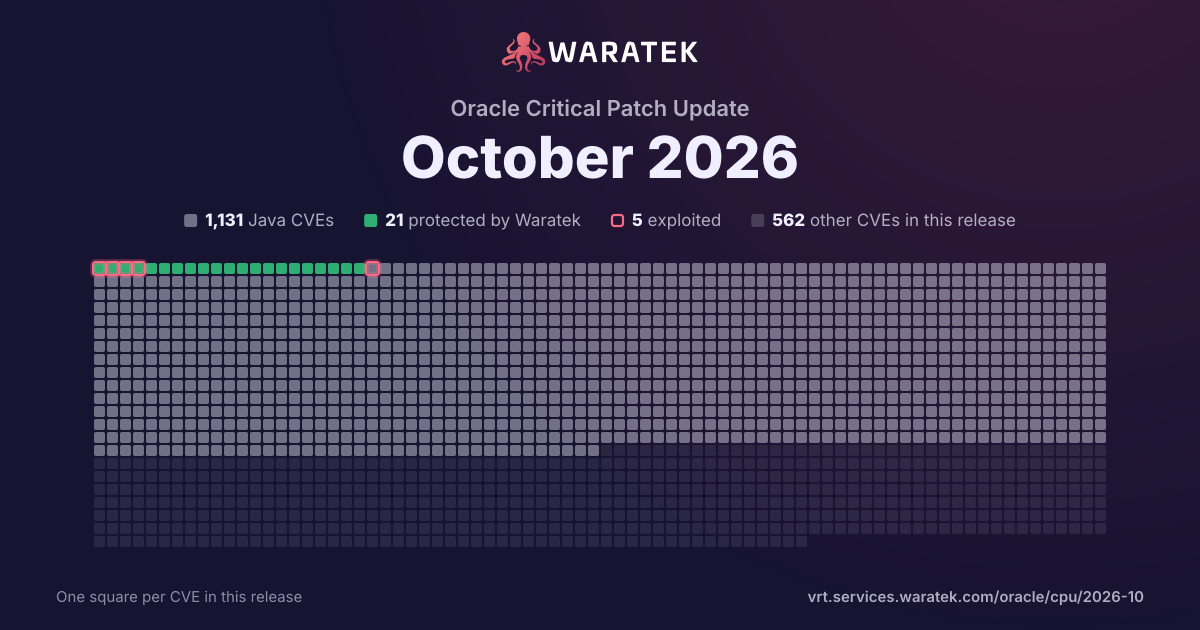
By status
21Protected by Waratek1Mitigation candidate1,109No exploit published13Outside Waratek scope549Not applicable
5Exploited, marked by the ring
No exploit published. For 858 of them, Oracle's security advisory is the source of public detail.
Protected by Waratek. Waratek RASP can block exploitation of these on systems that have not applied the patch yet.
Overview 123 matches · 89 in Waratek scope · 0 protected · 0 exploited · 0 CISA KEV · 0 public PoC · 0 EPSS ≥ 0.5
123matches
89in Waratek scope72.4%
0protected0.0%
0exploited0.0%
0CISA KEV0.0%
0public PoC0.0%
0EPSS ≥ 0.50.0%
Protected by Waratek
0
0.0%
Rule in development
0
0.0%
Mitigation candidate
0
0.0%
No exploit published
89
72.4%
Outside Waratek scope
4
3.3%
Not applicable
30
24.4%
Withdrawn CVE
0
0.0%
blocked by ARMR today
0
0.0%
partly blocked
0
0.0%
not blocked
123
100.0%
not established
0
0.0%
unrecorded
0
0.0%
Exploited
0
0.0%
Working exploit published
0
0.0%
Proof of concept only
4
3.3%
Forecast only
0
0.0%
No public exploit
119
96.7%
split by
peak 91 / quarter
Q3 221
No exploit published1
Low1
not blocked1
No public exploit1
Q4 220
Q1 230
Q2 230
Q3 230
Q4 231
Not applicable1
Low1
not blocked1
No public exploit1
Q1 241
No exploit published1
Low1
not blocked1
No public exploit1
Q2 240
Q3 241
Not applicable1
Low1
not blocked1
No public exploit1
Q4 240
Q1 250
Q2 250
Q3 250
Q4 250
Q1 267
No exploit published2
Not applicable5
Low7
not blocked7
Proof of concept only1
No public exploit6
Q2 2618
No exploit published5
Not applicable13
Low18
not blocked18
Proof of concept only3
No public exploit15
Q3 263
No exploit published1
Not applicable2
Low3
not blocked3
No public exploit3
Q4 2691
No exploit published79
Outside Waratek scope4
Not applicable8
Low91
not blocked91
No public exploit91
Q4 22Q2 23Q4 23Q2 24Q4 24Q2 25Q4 25Q2 26Q4 26
| CVE | Severity | Published▾ | Status | Exploitation | Description |
|---|---|---|---|---|---|
| CVE-2026-57236 | Low | 2026-06-25 | Not applicable | No public exploit | Nokogiri is an open source XML and HTML library for the Ruby programming language. Prior to 1.19.4, calling Document#encoding= with an invalid encoding (e.g., a non-string, or a string containing a null byte) raises an exception, but only after freeing the document's current encoding string without replacing it. The document is left referencing freed memory, so the next call to Document#encoding reads invalid memory, which can cause a segfault or leak freed bytes into a Ruby String. Affects the CRuby (libxml2) implementation only; JRuby is not affected. This vulnerability is fixed in 1.19.4. |
| CVE-2026-57234 | Low | 2026-06-25 | Not applicable | No public exploit | Nokogiri is an open source XML and HTML library for the Ruby programming language. Prior to 1.19.4, the NONET parse option, which Nokogiri turns on by default for Nokogiri::XML::Schema (see CVE-2020-26247), was not correctly enforced on the JRuby implementation. As a result, a schema parsed with default options could still cause external resources to be fetched over the network, potentially enabling SSRF or XXE attacks. This vulnerability is fixed in 1.19.4. |
| CVE-2026-56130 | Low | 2026-06-25 | No exploit published | No public exploit | "Remember me" cookie age is not verified on the server. This potentially allows an attacker to intercept a valid cookie and reuse it indefinitely, even after the configured expiration time has passed. This issue affects all Apache Shiro versions from 1.2.4 through 2.x, and 3.0.0-alpha-1, only when RememberMe functionality is enabled. Upgrade to version 3.0.0 or later, which fixes the issue. |
| CVE-2026-54906 | Low | 2026-06-24 | Not applicable | Proof of concept only | concurrent-ruby is a modern concurrency tools for Ruby. Prior to 1.3.7, Concurrent::ReadWriteLock#release_write_lock does not verify that the calling thread acquired the write lock. Any thread with access to the lock object can release an active write lock held by another thread. A second writer can then enter its critical section while the first writer is still running. Concurrent::ReadWriteLock#release_read_lock also decrements the shared counter even when no read lock is held. Calling it on a fresh lock changes the counter from 0 to -1, after which normal read acquisition raises Concurrent::ResourceLimitError. This is a synchronization correctness issue in the public Concurrent::ReadWriteLock API. This vulnerability is fixed in 1.3.7. |
| CVE-2026-54905 | Low | 2026-06-24 | Not applicable | Proof of concept only | concurrent-ruby is a modern concurrency tools for Ruby. Prior to 1.3.7, Concurrent::ReentrantReadWriteLock can incorrectly grant a write lock after one thread acquires the read lock 32,768 times. The lock stores a thread's local read and write hold counts in one integer. The low 15 bits are used for the read hold count, and bit 15 is used as WRITE_LOCK_HELD. After 32,768 reentrant read acquisitions, the local read count crosses into the write-lock bit. try_write_lock then treats the thread as already holding a write lock and returns true without setting the global RUNNING_WRITER bit. This breaks the core mutual-exclusion guarantee: the caller is told it has a write lock, but other threads can still hold or acquire read locks at the same time. This vulnerability is fixed in 1.3.7. |
| CVE-2026-48931 | Low | 2026-06-22 | Not applicable | No public exploit | A flaw in Node.js HTTP Agent can cause a client to accept as valid a response that is send before the client has sent the request. This vulnerability affects all supported release lines: **Node.js 22**, **Node.js 24**, and **Node.js 26**. |
| CVE-2026-42770 | Low | 2026-06-09 | Not applicable | No public exploit | Issue summary: When EVP_PKEY_derive_set_peer() is called with a DHX (X9.42) peer key, the peer key is not properly checked for the subgroup membership. Impact summary: A malicious peer which presents an X9.42 key carrying the victim's p and g parameters, a forged q = r (a small prime factor of the cofactor (p−1)/q_local), and a public value Y of order r can recover the victim's private key after a small number of key exchange attempts. When EVP_PKEY_derive_set_peer() is called with a DHX (X9.42) peer key, the subgroup membership check Y^q ≡ 1 (mod p) is performed using the peer's own q parameter, not the local key's q. The peer's domain parameters are then matched against the domain parameters of the private key, but the value of q is not compared. A malicious peer who presents an X9.42 key carrying the victim's p, g, a forged q = r (a small prime factor of the cofactor), and a public value Y of order r passes all checks. The shared secret then takes only r distinct values, leaking priv mod r. Repeating for each small-prime factor of the cofactor and combining via CRT recovers the full private key (Lim–Lee / small-subgroup-confinement attack). The realistic attack surface is narrow: principally CMP deployments with long-lived RA/CA DHX keys and bespoke enterprise or government applications using X9.42 DHX static keys with interactive protocols and therefore this issue was assigned Low severity. The FIPS modules in 4.0, 3.6, 3.5, 3.4, 3.1.2 and 3.0 are affected by this issue. |
| CVE-2026-42768 | Low | 2026-06-09 | Not applicable | No public exploit | Issue summary: The CMS_decrypt and PKCS7_decrypt functions are vulnerable to Bleichenbacher-style attack when an attacker is able to provide the CMS or S/MIME messages and observe the error code and/or decryption output. Impact summary: The Bleichenbacher-style attack allows an attacker to use the victim's vulnerable application as a way to decrypt or sign messages with the victim's private RSA key. The attack is possible in 2 variants. 1. The decryption API (CMS_decrypt(), PKCS7_decrypt()) is used without providing the recipient certificate. In this case OpenSSL iterates over every KeyTransRecipientInfo (KTRI) without stopping at the first success. An attacker who authors a message with two KTRI entries — the first one wrapping a real CEK under the victim's public key, the second with an arbitrary probe ciphertext — obtains opportunity to iterate the 2nd KTRI to get a valid PKCS#1 v1.5 padding if the error code of the application is available. That is a Bleichenbacher oracle (Bleichenbacher, CRYPTO '98): an adaptive-chosen-ciphertext side channel from which the attacker decrypts any RSA ciphertext to the victim's key or forges any PKCS#1 v1.5 signature under it. 2. When the decryption API (CMS_decrypt(), PKCS7_decrypt()) is provided with the recipient certificate, and the recipient is not found, a random key is substituted. An attacker who authors a message and is able to compare both error code and the result of the decryption, can mount a Bleichenbacher oracle. We are not aware of any applications that provide a remote attacker an opportunity to mount an attack described in these scenarios. We consider the existence of such application very unlikely, and for this reason this CVE has been evaluated as Low severity. To avoid these attacks, when RSA PKCS#1 v1.5 Key Transport is in use, the invoked EVP_PKEY_decrypt() will use the implicit rejection mechanism described in draft-irtf-cfrg-rsa-guidance. In previous OpenSSL releases the implicit rejection was explicitly disabled. The implicit rejection mechanism always returns a plaintext value, the symmetric key. This result is deterministic for the ciphertext and the private key. The length of the decryption result can happen to match the length of the key of the symmetric cipher that was used for the content encryption. When a certificate is not provided, the last RecipientInfo producing a key that looks valid will be used. It may cause getting garbage content on decryption. As a proper way to deal with this a recipient certificate has to be provided to identify the particular RecipientInfo for decryption. The FIPS modules in 4.0, 3.6, 3.5, and 3.4 are not affected by this issue, as CMS and S/MIME processing happens outside the OpenSSL FIPS module boundary. |
| CVE-2026-42578 | Low | 2026-05-13 | No exploit published | Proof of concept only | Netty is an asynchronous, event-driven network application framework. Prior to 4.2.13.Final and 4.1.133.Final, Netty's HttpProxyHandler constructs HTTP CONNECT requests with header validation explicitly disabled. The newInitialMessage() method creates headers using DefaultHttpHeadersFactory.headersFactory().withValidation(false), then adds user-provided outboundHeaders without any CRLF validation. This allows an attacker who can influence the outbound headers to inject arbitrary HTTP headers into the CONNECT request sent to the proxy server. This vulnerability is fixed in 4.2.13.Final and 4.1.133.Final. |
| CVE-2026-43514 | Low | 2026-05-12 | No exploit published | No public exploit | Observable Timing Discrepancy vulnerability when comparing AJP secret in Apache Tomcat. This issue affects Apache Tomcat: from 11.0.0-M1 through 11.0.21, from 10.1.0-M1 through 10.1.54, from 9.0.0.M1 through 9.0.117, from 8.5.0 through 8.5.100, from 7.0.0 through 7.0.109. Older unsupported versions may also be affected. Users are recommended to upgrade to version 11.0.22, 10.1.55 or 9.0.118 which fix the issue. |
| CVE-2026-22741 | Low | 2026-04-29 | No exploit published | No public exploit | Spring MVC and WebFlux applications are vulnerable to cache poisoning when resolving static resources. More precisely, an application can be vulnerable when all the following are true: * the application is using Spring MVC or Spring WebFlux * the application is configuring the resource chain support https://docs.spring.io/spring-framework/reference/web/webmvc/mvc-config/static-resources.html#page-title with caching enabled * the application adds support for encoded resources resolution * the resource cache must be empty when the attacker has access to the application When all the conditions above are met, the attacker can send malicious requests and poison the resource cache with resources using the wrong encoding. This can cause a denial of service by breaking the front-end application for clients. |
| CVE-2026-22746 | Low | 2026-04-22 | No exploit published | No public exploit | Vulnerability in Spring Spring Security. If an application is using the UserDetails#isEnabled, #isAccountNonExpired, or #isAccountNonLocked user attributes, to enable, expire, or lock users, then DaoAuthenticationProvider's timing attack defense can be bypassed for users who are disabled, expired, or locked.This issue affects Spring Security: from 5.7.0 through 5.7.22, from 5.8.0 through 5.8.24, from 6.3.0 through 6.3.15, from 6.5.0 through 6.5.9, from 7.0.0 through 7.0.4. |
| CVE-2026-34073 | Low | 2026-03-31 | Not applicable | No public exploit | cryptography is a package designed to expose cryptographic primitives and recipes to Python developers. Prior to version 46.0.6, DNS name constraints were only validated against SANs within child certificates, and not the "peer name" presented during each validation. Consequently, cryptography would allow a peer named bar.example.com to validate against a wildcard leaf certificate for *.example.com, even if the leaf's parent certificate (or upwards) contained an excluded subtree constraint for bar.example.com. This issue has been patched in version 46.0.6. |
| CVE-2026-21716 | Low | 2026-03-30 | Not applicable | No public exploit | An incomplete fix for CVE-2024-36137 leaves `FileHandle.chmod()` and `FileHandle.chown()` in the promises API without the required permission checks, while their callback-based equivalents (`fs.fchmod()`, `fs.fchown()`) were correctly patched. As a result, code running under `--permission` with restricted `--allow-fs-write` can still use promise-based `FileHandle` methods to modify file permissions and ownership on already-open file descriptors, bypassing the intended write restrictions. This vulnerability affects **20.x, 22.x, 24.x, and 25.x** processes using the Permission Model where `--allow-fs-write` is intentionally restricted. |
| CVE-2026-21715 | Low | 2026-03-30 | Not applicable | No public exploit | A flaw in Node.js Permission Model filesystem enforcement leaves `fs.realpathSync.native()` without the required read permission checks, while all comparable filesystem functions correctly enforce them. As a result, code running under `--permission` with restricted `--allow-fs-read` can still use `fs.realpathSync.native()` to check file existence, resolve symlink targets, and enumerate filesystem paths outside of permitted directories. This vulnerability affects **20.x, 22.x, 24.x, and 25.x** processes using the Permission Model where `--allow-fs-read` is intentionally restricted. |
| CVE-2026-22735 | Low | 2026-03-20 | No exploit published | No public exploit | Spring MVC and WebFlux applications are vulnerable to stream corruption when using Server-Sent Events (SSE). This issue affects Spring Foundation: from 7.0.0 through 7.0.5, from 6.2.0 through 6.2.16, from 6.1.0 through 6.1.25, from 5.3.0 through 5.3.46. |
| CVE-2026-1703 | Low | 2026-02-02 | Not applicable | No public exploit | When pip is installing and extracting a maliciously crafted wheel archive, files may be extracted outside the installation directory. The path traversal is limited to prefixes of the installation directory, thus isn't able to inject or overwrite executable files in typical situations. |
| CVE-2026-1225 | Low | 2026-01-22 | No exploit published | No public exploit | ACE vulnerability in configuration file processing by QOS.CH logback-core up to and including version 1.5.24 in Java applications, allows an attacker to instantiate classes already present on the class path by compromising an existing logback configuration file. The instantiation of a potentially malicious Java class requires that said class is present on the user's class-path. In addition, the attacker must have write access to a configuration file. However, after successful instantiation, the instance is very likely to be discarded with no further ado. |
| CVE-2025-15224 | Low | 2026-01-08 | Not applicable | Proof of concept only | When doing SSH-based transfers using either SCP or SFTP, and asked to do public key authentication, curl would wrongly still ask and authenticate using a locally running SSH agent. |
| CVE-2024-36137 | Low | 2024-09-07 | Not applicable | No public exploit | A vulnerability has been identified in Node.js, affecting users of the experimental permission model when the --allow-fs-write flag is used. Node.js Permission Model do not operate on file descriptors, however, operations such as fs.fchown or fs.fchmod can use a "read-only" file descriptor to change the owner and permissions of a file. |
| CVE-2024-20925 | Low | 2024-02-17 | No exploit published | No public exploit | Vulnerability in the Oracle Java SE, Oracle GraalVM Enterprise Edition product of Oracle Java SE (component: JavaFX). Supported versions that are affected are Oracle Java SE: 8u391; Oracle GraalVM Enterprise Edition: 20.3.12 and 21.3.8. Difficult to exploit vulnerability allows unauthenticated attacker with network access via multiple protocols to compromise Oracle Java SE, Oracle GraalVM Enterprise Edition. Successful attacks require human interaction from a person other than the attacker. Successful attacks of this vulnerability can result in unauthorized update, insert or delete access to some of Oracle Java SE, Oracle GraalVM Enterprise Edition accessible data. Note: This vulnerability applies to Java deployments, typically in clients running sandboxed Java Web Start applications or sandboxed Java applets, that load and run untrusted code (e.g., code that comes from the internet) and rely on the Java sandbox for security. This vulnerability does not apply to Java deployments, typically in servers, that load and run only trusted code (e.g., code installed by an administrator). CVSS 3.1 Base Score 3.1 (Integrity impacts). CVSS Vector: (CVSS:3.1/AV:N/AC:H/PR:N/UI:R/S:U/C:N/I:L/A:N). |
| CVE-2023-38546 | Low | 2023-10-18 | Not applicable | No public exploit | This flaw allows an attacker to insert cookies at will into a running program using libcurl, if the specific series of conditions are met. libcurl performs transfers. In its API, an application creates "easy handles" that are the individual handles for single transfers. libcurl provides a function call that duplicates en easy handle called [curl_easy_duphandle](https://curl.se/libcurl/c/curl_easy_duphandle.html). If a transfer has cookies enabled when the handle is duplicated, the cookie-enable state is also cloned - but without cloning the actual cookies. If the source handle did not read any cookies from a specific file on disk, the cloned version of the handle would instead store the file name as `none` (using the four ASCII letters, no quotes). Subsequent use of the cloned handle that does not explicitly set a source to load cookies from would then inadvertently load cookies from a file named `none` - if such a file exists and is readable in the current directory of the program using libcurl. And if using the correct file format of course. |
| CVE-2022-2047 | Low | 2022-07-07 | No exploit published | No public exploit | In Eclipse Jetty versions 9.4.0 thru 9.4.46, and 10.0.0 thru 10.0.9, and 11.0.0 thru 11.0.9 versions, the parsing of the authority segment of an http scheme URI, the Jetty HttpURI class improperly detects an invalid input as a hostname. This can lead to failures in a Proxy scenario. |