
Oracle Critical Patch Update October 2026
Released October 2026 · Oracle's advisory ↗ · ← Security Patch Update, September 2026 · Security Patch Update, November 2026 →
1,693 CVEs in this release, one square each
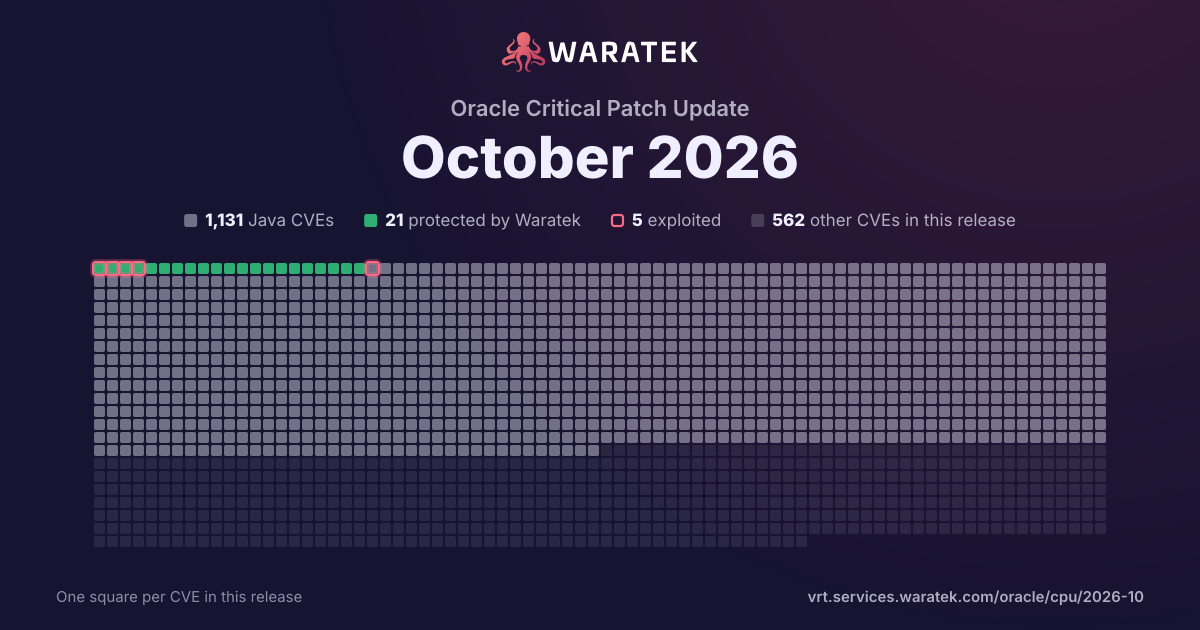
By status
20Protected by Waratek1Mitigation candidate1,111No exploit published12Outside Waratek scope549Not applicable
5Exploited, marked by the ring
No exploit published. For 855 of them, Oracle's security advisory is the source of public detail.
Protected by Waratek. Waratek RASP can block exploitation of these on systems that have not applied the patch yet.
Overview 27 matches · 1 protected · 0 exploited · 0 CISA KEV · 0 public PoC · 0 EPSS ≥ 0.5
Protected by Waratek
1
3.7%
Rule in development
0
0.0%
Mitigation candidate
0
0.0%
No exploit published
26
96.3%
blocked by ARMR today
1
3.7%
partly blocked
0
0.0%
not blocked
26
96.3%
not established
0
0.0%
unrecorded
0
0.0%
Exploited
0
0.0%
Working exploit published
0
0.0%
Proof of concept only
0
0.0%
Forecast only
0
0.0%
No public exploit
27
100.0%
| CVE | Severity | Published▾ | Status | Exploitation | Description |
|---|---|---|---|---|---|
| CVE-2026-64607 | Medium | 2026-07-31 | No exploit published | No public exploit | HttpClient based on the classic i/o model fails to correctly release the underlying connection back to the connection manager if it encounters an invalid or unsupported `Content-Encoding` header value in the response message. Please note this defect does not affect HttpClient based on the async i/o model. This issue affects Apache HttpComponents Client: from 5.0-alpha1 through 5.6.2. |
| CVE-2026-59901 | High | 2026-07-29 | No exploit published | No public exploit | Netty is an asynchronous, event-driven network application framework. Prior to versions 4.1.136.Final and 4.2.16.Final, the `Bzip2Decoder` handler in Netty's compression codec pipeline is vulnerable to a denial-of-service attack through a malformed bzip2 stream that permanently captures the event-loop thread in an infinite loop. The vulnerability exists in the run-length encoding (RLE) state machine within [`Bzip2BlockDecompressor.read()`]. This issue has been fixed in versions 4.1.136.Final and 4.2.16.Final. |
| CVE-2026-59900 | Medium | 2026-07-29 | No exploit published | No public exploit | Netty is an asynchronous, event-driven network application framework. Prior to versions 4.1.136.Final and 4.2.16.Final, Netty's HTTP/2-to-HTTP/1.x translation layer (`Http2StreamFrameToHttpObjectCodec` and `InboundHttp2ToHttpAdapter`) fails to deduplicate or validate `Host` headers when an HTTP/2 client supplies both the `:authority` pseudo-header and a literal `host` header in a single HEADERS frame. The translator maps `:authority` to `Host` and separately copies the literal `host` header, producing an `HttpRequest` object containing two `Host` headers with attacker-controlled differing values. This issue has been fixed in versions 4.1.136.Final and 4.2.16.Final. |
| CVE-2026-59899 | Medium | 2026-07-29 | No exploit published | No public exploit | Netty is an asynchronous, event-driven network application framework. Prior to versions 4.1.136.Final and 4.2.16.Final, `HttpContentEncoder` (the superclass of the production handler `HttpContentCompressor`) maintains a per-channel `ArrayDeque<CharSequence>` named `acceptEncodingQueue` that accumulates attacker-controlled data without any size limit. The queue is filled on the I/O thread for every inbound HTTP request and drained only when the application later writes a non-1xx response. This creates a resource exhaustion vulnerability when an attacker exploits HTTP/1.1 pipelining to flood the connection with requests faster than the application produces responses. This issue has been fixed in versions 4.1.136.Final and 4.2.16.Final. |
| CVE-2026-59898 | Medium | 2026-07-29 | No exploit published | No public exploit | Netty is an asynchronous, event-driven network application framework. Prior to versions 4.1.136.Final and 4.2.16.Final, ab attacker can force WebSocket upgrade via the lax V07 (or V08) handshaker by sending `Sec-WebSocket-Version: 7` and omitting `Connection: Upgrade` / `Upgrade: websocket` headers, completing a protocol switch that a proxy would not recognize as an Upgrade request and enabling HTTP request smuggling / protocol-confusion attacks. This issue has been fixed in versions 4.1.136.Final and 4.2.16.Final. |
| CVE-2026-66299 | High | 2026-07-28 | No exploit published | No public exploit | Uncontrolled Resource Consumption vulnerability in Apache Tomcat's WebSocket chat example. This issue affects Apache Tomcat: from 11.0.0-M20 through 11.0.24, from 10.1.24 through 10.1.57, from 9.0.89 through 9.0.120. Users who have followed the security guidance to remove the examples web application are not affected by this issue. Users are recommended to remove the examples web application or to upgrade to version 11.0.25, 10.1.58 or 9.0.121 (when released), which fix the issue. |
| CVE-2026-48586 | High | 2026-07-27 | No exploit published | No public exploit | Improper Handling of Highly Compressed Data (Data Amplification) vulnerability in Apache Thrift C++, Java, Python, Go, D, C/GLib bindings. This issue affects Apache Thrift: before 0.24.0. Users are recommended to upgrade to version 0.24.0, which fixes the issue. |
| CVE-2026-43871 | High | 2026-07-27 | No exploit published | No public exploit | Loop with Unreachable Exit Condition ('Infinite Loop') vulnerability in Apache Thrift Python, Go, PHP and Java bindings.This issue affects Apache Thrift: before 0.24.0. Users are recommended to upgrade to version 0.24.0, which fixes the issue. |
| CVE-2026-66144 | High | 2026-07-24 | No exploit published | No public exploit | Although remote policy references are not retrieved during policy normalization, if they are manually retrieved via the API it can cause a denial of service attack if a huge policy is retrieved. Users are recommended to upgrade to version 3.2.3, which fixes this issue by imposing a default maximum size on data read from remote policy references. |
| CVE-2026-66143 | High | 2026-07-24 | No exploit published | No public exploit | It is possible to bypass the maximum number of normalized policy alternatives that was introduced in Apache Neethi 3.2.2 via certain crafted policies, which may lead to a denial of service attack via resource consumption. Users are recommended to upgrade to version 3.2.3, which fixes this issue. |
| CVE-2026-66142 | High | 2026-07-24 | No exploit published | No public exploit | Apache Neethi is vulnerable to uncontrolled recursion when parsing policies that lack policy Ids or with deeply nested structures, which may lead to a denial of service attack when parsing policies due to runtime memory exhaustion. Users are recommended to upgrade to version 3.2.3, which fixes this issue. |
| CVE-2026-56817 | High | 2026-07-21 | Protected by Waratek | No public exploit | Netty is a network application framework for development of protocol servers and clients. In versions 4.2.0.Final through 4.2.15.Final and 4.1.0.Final through 4.1.135.Final, any caller that can deliver bytes to a Netty channel pipeline containing `XmlDecoder` can send XML with a `DOCTYPE` declaration to an `AsyncXMLInputFactory` instantiated with no security configuration, leaving DTD and entity handling active depending on Aalto XML async parser behavior and creating conditional XML external entity risk. This issue is fixed in versions 4.1.136.Final and 4.2.16.Final. |
| CVE-2026-56816 | High | 2026-07-21 | No exploit published | No public exploit | Netty is a network application framework for development of protocol servers and clients. Prior to 4.2.16.Final, Netty's `Http3FrameCodec` buffers incoming data for HTTP/3 reserved frame types up to the wire-specified payload length without limits; `decodeFrame` trusts `payLoadLength`, allowing an attacker to open multiple QUIC streams and send reserved frames with very large payload lengths to cause memory exhaustion and denial of service. This issue is fixed in version 4.2.16.Final. |
| CVE-2026-56746 | Medium | 2026-07-21 | No exploit published | No public exploit | Netty is a network application framework for development of protocol servers and clients. Versions 4.2.0.Final through 4.2.15.Final and 4.1.0.Final through 4.1.135.Final, are vulnerable to security control bypass during the origin evaluation process. CorsHandler provides a shortCircuit() configuration designed to reject unauthorized cross-origin requests immediately, acting as a security control before requests reach the application. However, due to a logical operator error in the origin evaluation process, this protection can be entirely bypassed. An attacker can bypass the short-circuit mechanism by sending a request with an Origin: null header. This failure forwards unauthorized requests to the backend application, bypassing intended access controls. This issue is fixed in versions 4.1.136.Final and 4.2.16.Final. |
| CVE-2026-56745 | High | 2026-07-21 | No exploit published | No public exploit | Netty is a network application framework for development of protocol servers and clients. In versions 4.2.0.Final through 4.2.15.Final and 4.1.0.Final through 4.1.135.Final, the `SpdyHttpDecoder` handler in Netty's SPDY-to-HTTP codec allocates a pooled `ByteBuf` when processing a client-initiated `SYN_STREAM` frame with `FLAG_FIN=0` and stores the partially constructed `FullHttpRequest` in `messageMap`; when the remote peer sends `RST_STREAM` for that stream or the accumulated content exceeds `maxContentLength`, the decoder removes the entry but does not release the pooled `ByteBuf`, causing native memory exhaustion. This issue is fixed in versions 4.1.136.Final and 4.2.16.Final. |
| CVE-2026-55851 | High | 2026-07-21 | No exploit published | No public exploit | Netty is a network application framework for development of protocol servers and clients. In versions 4.2.0.Final up to (but not including) 4.2.16.Final, and 4.1.0.Final up to (but not including) 4.1.135, the `HAProxyMessageDecoder` in Netty's `codec-haproxy` module performs protocol version detection by reading the 13th byte as a signed Java `byte` and widening it to `int` without masking; a PROXY protocol v2 binary prefix followed by version byte `0xFF` sign-extends to `-1`, collides with the decoder's need-more-data sentinel, and causes `ByteToMessageDecoder` to accumulate inbound bytes in an unbounded `cumulation` buffer until direct memory is exhausted. This issue is fixed in versions 4.1.136.Final and 4.2.16.Final. |
| CVE-2026-55833 | High | 2026-07-21 | No exploit published | No public exploit | Netty is a network application framework for development of protocol servers and clients. Prior to 4.1.136.Final and 4.2.16.Final, Netty SPDY header decoding continues inflating zlib-compressed header blocks after the raw header parser has exceeded `maxHeaderSize` and marked the frame truncated in `SpdyFrameCodec`, allowing a remote peer to send a small compressed `HEADERS` block that expands into much larger raw header data and causes compression-amplified CPU and allocation churn. This issue is fixed in versions 4.1.136.Final and 4.2.16.Final. |
| CVE-2026-8384 | Medium | 2026-07-14 | No exploit published | No public exploit | In Eclipse Jetty, an HTTP URI of this form: /public;/../admin/secret.txt results in an unresolved path of: /public/../admin/secret.txt instead of the expected: /admin/secret.txt Jetty itself is not affected, as it will not serve the secret.txt file because it will not pass the alias checker (only resolved resources are served). However, web applications that rely on resolved paths being provided by Jetty may be confused when receiving an unresolved path. |
| CVE-2026-6790 | Medium | 2026-07-14 | No exploit published | No public exploit | In Eclipse Jetty, for HTTP/1, HTTP/2 and HTTP/3 requests, there is no strict check that the request authority (host and port) matches what provided in the Host header (if present). This was not enforced in earlier HTTP RFC (for example, in RFC 2616), but it is in the latest RFC (9110 and 9112). This mismatch can cause a number of problems that may be classified as vulnerabilities such as: * URI constructions (for example, for redirects -- this is typical for login pages) * Virtual host selection * Reverse proxying * Misleading logs * Etc. Given that the latest RFCs require that request authority and Host header must match, Jetty should enforce this invariant. |
| CVE-2026-59889 | Medium | 2026-07-14 | No exploit published | No public exploit | jackson-databind contains the general-purpose data-binding functionality and tree-model for Jackson Data Processor. From 2.18.0 until 2.18.9, 2.21.5, 2.22.1, 3.1.5, and 3.2.1, UnwrappedPropertyHandler.processUnwrapped() replays buffered JSON for a @JsonUnwrapped property and calls prop.deserializeAndSet() without a prop.visibleInView(ctxt.getActiveView()) guard, allowing a property annotated with both @JsonView and @JsonUnwrapped to be written from attacker JSON under a less-privileged active view. This issue is fixed in versions 2.18.9, 2.21.5, 2.22.1, 3.1.5, and 3.2.1. |
| CVE-2026-59888 | Medium | 2026-07-14 | No exploit published | No public exploit | jackson-databind contains the general-purpose data-binding functionality and tree-model for Jackson Data Processor. From 2.15.0 until 2.18.8, 2.21.4, and 3.1.4, Java Records using a PropertyNamingStrategy can bypass @JsonIgnore because POJOPropertiesCollector._removeUnwantedIgnorals() records an ignored component under its original implicit name before _renameUsing() applies the naming strategy, allowing the renamed JSON key to be assigned to the Record constructor parameter. This issue is fixed in versions 2.18.8, 2.21.4, and 3.1.4. |
| CVE-2026-59083 | Critical | 2026-07-14 | No exploit published | No public exploit | Improper Handling of URL Encoding (Hex Encoding) vulnerability in Apache Tomcat's rewrite valve allowed security constraint bypass for some configurations. This issue affects Apache Tomcat: from 11.0.0-M1 through 11.0.23, from 10.1.0-M1 through 10.1.56, from 9.0.0.M1 through 9.0.119, from 8.5.0 through 8.5.100. Other versions that have reached end of support may also be affected. Users are recommended to upgrade to version 11.0.24, 10.1.57 or 9.0.120, which fix the issue. |
| CVE-2026-10051 | Medium | 2026-07-14 | No exploit published | No public exploit | In Eclipse Jetty, a first HTTP/1.1 request with trailers causes the server to retain the trailers in subsequent requests performed over the same connection. Subsequent request that do not have trailers report the trailers of the first request. Subsequent request that do have trailers report the union of trailers of the first request and the current request. |
| CVE-2026-49844 | Medium | 2026-07-10 | No exploit published | No public exploit | Improper encoding of non-finite floating-point values during MapMessage JSON serialization in Apache Log4j API produces output that is not valid JSON. This issue affects Apache Log4j API versions 2.13.1 through 2.25.4 and version 2.26.0. The fix for CVE-2026-34481 did not cover all code paths: when a MapMessage contains a non-finite IEEE 754 value (NaN, Infinity, or -Infinity), MapMessage.asJson() emits the corresponding bare token. RFC 8259 does not permit these tokens, so a conformant parser rejects the resulting document. The defect is reachable only when both of the following conditions hold: * The application uses the message resolver https://logging.apache.org/log4j/2.x/manual/json-template-layout.html#event-template-resolver-message of JsonTemplateLayout or any other layout that relies on MapMessage.asJson() or MapMessage.getFormattedMessage(new String[]{"JSON"}). * The application logs a MapMessage that contains an attacker-controlled floating-point value. An attacker who can supply a non-finite value can cause the affected layout to emit malformed JSON, which may corrupt the enclosing log record or disrupt downstream log ingestion and parsing. Users are advised to upgrade to Apache Log4j API 2.25.5 or 2.26.1, both of which emit RFC 8259-compliant JSON for non-finite values. |
| CVE-2026-54291 | High | 2026-07-06 | No exploit published | No public exploit | pgjdbc is an open source postgresql JDBC Driver. In releases 42.7.4 through 42.7.11, channelBinding=require connections can be silently downgraded from SCRAM-SHA-256-PLUS with channel binding to plain SCRAM-SHA-256 without it, losing the man-in-the-middle protection the setting is meant to guarantee. An attacker who can intercept the TLS connection can trigger the downgrade with a certificate whose signature algorithm has no tls-server-end-point channel-binding hash, because the bundled com.ongres.scram:scram-client returns an empty byte array instead of failing and pgJDBC ScramAuthenticator checks only that the server advertised a PLUS mechanism, without rejecting the empty binding or checking that the negotiated mechanism uses channel binding. This issue is fixed in version 42.7.12. |
| CVE-2026-54428 | High | 2026-07-01 | No exploit published | No public exploit | Allocation of resources without limits or throttling in the HTTP/2 HPACK decoder in Apache HttpComponents Core (5.4.2 and earlier, 5.5-beta1 and earlier) allows an remote attacker to cause a denial of service through memory exhaustion by sending oversized compressed header blocks before the HTTP/2 SETTINGS acknowledgement causes the configured header list size limit to be applied. |
| CVE-2026-54399 | High | 2026-07-01 | No exploit published | No public exploit | Uncontrolled Resource Consumption vulnerability in the HTTP/1.1 message parser in Apache HttpComponents Core (5.4.2 and earlier, 5.5-beta1 and earlier) allows an remote attacker to cause a denial of service through memory exhaustion by sending messages with excessive number of headers / excessive header length |