
Oracle Critical Patch Update October 2026
Released October 2026 · Oracle's advisory ↗ · ← Security Patch Update, September 2026 · Security Patch Update, November 2026 →
1,693 CVEs in this release, one square each
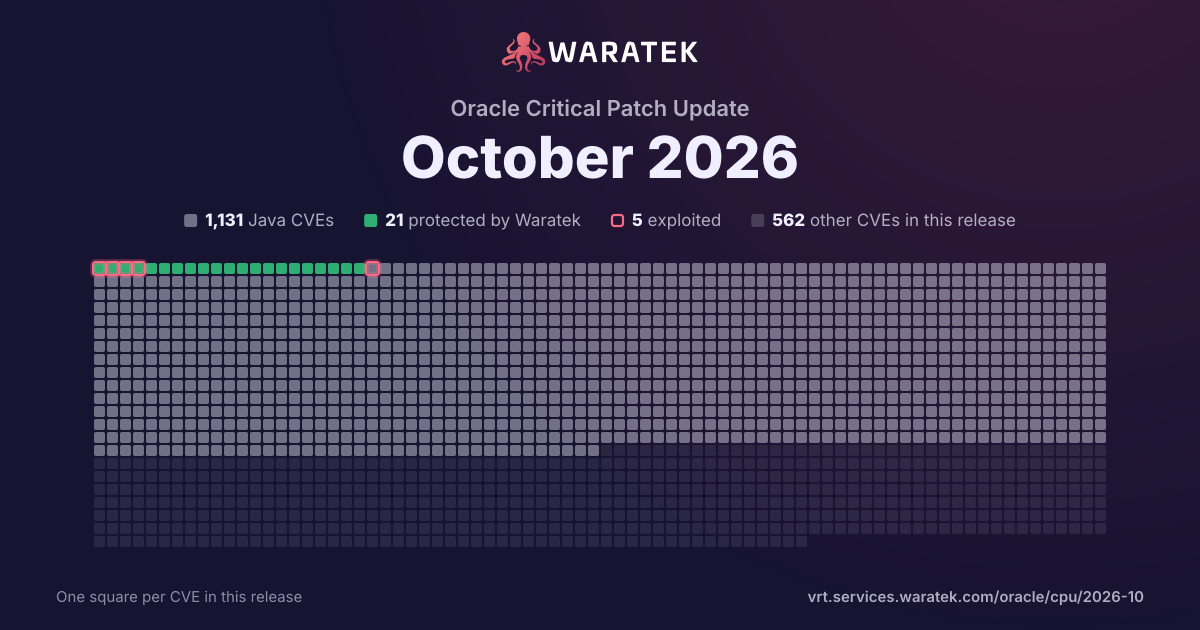
By status
20Protected by Waratek3Mitigation candidate1,109No exploit published12Outside Waratek scope549Not applicable
7Exploited, marked by the ring
No exploit published. For 855 of them, Oracle's security advisory is the source of public detail.
Protected by Waratek. Waratek RASP can block exploitation of these on systems that have not applied the patch yet.
Overview 16 matches · 1 protected · 0 exploited · 0 CISA KEV · 1 public PoC · 0 EPSS ≥ 0.5
Protected by Waratek
1
6.2%
Rule in development
0
0.0%
Mitigation candidate
0
0.0%
No exploit published
15
93.8%
blocked by ARMR today
1
6.2%
partly blocked
0
0.0%
not blocked
15
93.8%
not established
0
0.0%
unrecorded
0
0.0%
Exploited
0
0.0%
Working exploit published
0
0.0%
Proof of concept only
16
100.0%
Forecast only
0
0.0%
No public exploit
0
0.0%
split by
peak 9 / quarter
Q3 221
Protected by Waratek1
High1
blocked by ARMR today1
Proof of concept only1
Q4 220
Q1 230
Q2 230
Q3 230
Q4 230
Q1 240
Q2 240
Q3 240
Q4 240
Q1 250
Q2 251
No exploit published1
High1
not blocked1
Proof of concept only1
Q3 250
Q4 250
Q1 261
No exploit published1
High1
not blocked1
Proof of concept only1
Q2 264
No exploit published4
High4
not blocked4
Proof of concept only4
Q3 269
No exploit published9
High9
not blocked9
Proof of concept only9
Q3 22Q1 23Q3 23Q1 24Q3 24Q1 25Q3 25Q1 26Q3 26
| CVE | Severity | Published▾ | Status | Exploitation | Description |
|---|---|---|---|---|---|
| CVE-2026-68494 | High | 2026-08-04 | No exploit published | Proof of concept only | The fix released in jackson-core 2.18.6 and 2.21.1 for CVE-2026-18401 (GHSA-72hv-8253-57qq, number length constraint bypass in the non-blocking parser) is incomplete. This record covers the remaining bypass. The earlier fix wired validateIntegerLength() into a new _setIntLength() helper and invoked it wherever the integer portion of a number is decided: a terminator byte arrives, a '.' or 'e'/'E' is seen, or input ends inside a fully buffered value. It was not invoked on the attacker-relevant path where the parser runs out of input while still inside the MINOR_NUMBER_INTEGER_DIGITS minor state and returns NOT_AVAILABLE to the caller. As a result, an attacker who streams JSON to a non-blocking parser in many small chunks, without ever sending a terminator byte, keeps the parser inside MINOR_NUMBER_INTEGER_DIGITS indefinitely. _textBuffer.expandCurrentSegment() grows the accumulator on every chunk while validateIntegerLength() is never called. The accumulator is bounded only by maxStringLength (20 MiB by default) rather than by maxNumberLength (1000 by default), an amplification of roughly 20,000x over the documented limit. Because Java char values occupy two bytes, a single connection can be driven to approximately 40 MiB of heap before the validator finally fires when the value completes. The equivalent fraction-path code is correct: _finishFloatFraction() calls _setFractLength() before its NOT_AVAILABLE return. The missing call affects the integer-digit paths in _startPositiveNumber(), _startNegativeNumber() and _finishNumberIntegralPart() in NonBlockingUtf8JsonParserBase. Impact: reactive frameworks such as Spring WebFlux/Reactor, Quarkus, Helidon and Vert.x feed inbound HTTP or gRPC bytes to the async parser as they arrive, which is precisely the chunked-feed shape required. Operators who set StreamReadConstraints.maxNumberLength expecting it to cap memory per number value do not get that guarantee; memory accumulates per concurrent connection and attacker-controlled concurrency can exhaust the JVM heap. The synchronous parsers (UTF8StreamJsonParser, ReaderBasedJsonParser) and the async parser operating on complete input are not affected. Exploitation requires only the ability to stream data to a parsing endpoint; no privileges or user interaction are needed. This issue affects com.fasterxml.jackson.core:jackson-core from version 2.15.0 through 2.18.7, and from 2.19.0 through 2.21.3, and tools.jackson.core:jackson-core from 3.0.0 through 3.1.3. Versions prior to 2.15.0 are not affected, because StreamReadConstraints -- which defines the maxNumberLength setting -- was first introduced in jackson-core 2.15.0, so no such constraint exists to be bypassed in earlier releases. Note that GHSA-r7wm-3cxj-wff9 states the affected 2.x range without a lower bound. The 2.22.x and 3.2.x release lines are not affected: those branches were created after the fix commit landed on 2026-05-21 and therefore contain it from their initial releases (2.22.0, tagged 2026-06-03, and 3.2.0, tagged 2026-06-08). |
| CVE-2026-10050 | High | 2026-08-04 | No exploit published | Proof of concept only | In Eclipse Jetty, the Digest authentication server-side component uses ISO-8859-1 to encode the password as bytes. This was done because the initial specification for HTTP did not specify explicitly a charset, and it was assumed to be ISO-8859-1 for historical reasons. If the password contains characters that cannot be represented in ISO-8859-1, they are silently replaced by `?`. This happens with passwords that contain Chinese, Cyrillic or Greek characters, for example: `αβ123` converts to `??123`. An attacker can send a request with a digest `Authorization` header crafted with a password made of only `?` characters; the server would match any password of the same length that contains non-ISO-8859-1 characters. Recent HTTP Digest [RFC-7616](https://datatracker.ietf.org/doc/html/rfc7616) supports a `charset` parameters that defaults to UTF-8 that allows for correct encoding/decoding of passwords. |
| CVE-2026-56822 | High | 2026-07-29 | No exploit published | Proof of concept only | Netty is an asynchronous, event-driven network application framework. Prior to versions 4.1.136.Final and 4.2.16.Final, the OcspServerCertificateValidator forwards the SslHandshakeCompletionEvent before the asynchronous OCSP validation completes. This allows the client's downstream handlers to send sensitive application data (e.g., HTTP requests) to a revoked server before the channel is closed by the OCSP check. n io.netty.handler.ssl.ocsp.OcspServerCertificateValidator#userEventTriggered, when an SslHandshakeCompletionEvent is received, the validator immediately calls ctx.fireUserEventTriggered(evt). It then initiates an asynchronous OCSP query using OcspClient.query. Because the handshake completion event is forwarded immediately, downstream handlers in the client's pipeline are notified that the TLS handshake is successful. They may then begin reading and processing incoming application data or sending outgoing data. If the OCSP response later indicates the server's certificate is REVOKED, the validator closes the channel, but by this time, the client may have already leaked sensitive data to a revoked server or processed malicious responses from it. This issue has been fixed in versions 4.1.136.Final and 4.2.16.Final. |
| CVE-2026-56821 | High | 2026-07-29 | No exploit published | Proof of concept only | Netty is an asynchronous, event-driven network application framework. Prior to versions 4.1.136.Final and 4.2.16.Final, the OcspServerCertificateValidator flags an out-of-date OCSP response but does not stop processing it, so an expired GOOD response is still reported as VALID, letting an on-path attacker replay a stale GOOD response to bypass revocation of a since-revoked certificate. Exploitation can lead to certificate revocation bypass via replay of an expired OCSP response. Any application using OcspServerCertificateValidator is affected; a revoked certificate can be accepted. This issue has been fixed in versions 4.1.136.Final and 4.2.16.Final. |
| CVE-2026-56819 | High | 2026-07-21 | No exploit published | Proof of concept only | Netty is a network application framework for development of protocol servers and clients. In versions 4.2.0.Final through 4.2.15.Final and 4.1.0.Final through 4.1.135.Final, a remote unauthenticated peer can leak one direct `ByteBuf` per HTTP/2 `DATA` frame in applications that enable HTTP/2 content decompression via `DelegatingDecompressorFrameListener`. When a `DATA` frame is processed for a stream whose decompressor has already been closed, `Http2Decompressor.decompress(...)` calls `decompressor.writeInbound(data.retain())` and does not release the retained buffer on the error path, eventually exhausting direct memory and crashing the JVM. This issue is fixed in versions 4.1.136.Final and 4.2.16.Final. |
| CVE-2026-55831 | High | 2026-07-21 | No exploit published | Proof of concept only | Netty is a network application framework for development of protocol servers and clients. Prior to 4.1.136.Final and 4.2.16.Final, Netty's SPDY SETTINGS decoder accepts a peer-declared SETTINGS entry count up to the 24-bit frame-length limit and materializes every unique setting ID in `DefaultSpdySettingsFrame`, allowing a remote SPDY/3.1 peer to send a syntactically valid roughly 2 MiB SETTINGS frame that creates 262144 map entries and amplifies network input into heap growth and ordered-map insertion work. This issue is fixed in versions 4.1.136.Final and 4.2.16.Final. |
| CVE-2026-56741 | High | 2026-07-17 | No exploit published | Proof of concept only | JLine is a Java library for handling console input. Prior to 3.30.14, 4.0.16, and 4.2.1, the JLine3 Telnet server remote-telnet module does not apply an upper bound to terminal dimensions received via the Telnet NAWS option, and TelnetIO.handleNAWS() in TelnetIO.java:856-879 reads client-supplied width and height as 16-bit unsigned integers and passes values such as 65535x65535 to setTerminalGeometry(), allowing an unauthenticated remote attacker to repeatedly alternate values and trigger continuous expensive rendering work that causes CPU exhaustion and denial of service. This issue is fixed in versions 3.30.14, 4.0.16, and 4.2.1. |
| CVE-2026-56740 | High | 2026-07-17 | No exploit published | Proof of concept only | JLine is a Java library for handling console input. Prior to 3.30.14, 4.0.16, and 4.2.1, the JLine3 Telnet server remote-telnet module does not limit the number of environment variables a client may inject via the Telnet NEW-ENVIRON option, and TelnetIO.readNEVariables() in TelnetIO.java:1127-1180 stores each variable pair in a HashMap held by ConnectionData, allowing an unauthenticated attacker to flood unique variable pairs before the terminating IAC SE byte and exhaust JVM heap memory with an OutOfMemoryError. This issue is fixed in versions 3.30.14, 4.0.16, and 4.2.1. |
| CVE-2026-44891 | High | 2026-07-17 | No exploit published | Proof of concept only | Netty is a network application framework for development of protocol servers and clients. Prior to 4.1.136.Final and 4.2.16.Final, io.netty.handler.codec.stomp.StompSubframeDecoder fails to limit the total number of headers or their cumulative size per frame, and the maxLineLength parameter only restricts individual header lines. An attacker can send a large number of short headers that are accumulated in memory inside DefaultStompHeadersSubframe until the JVM throws an OutOfMemoryError, causing denial of service for servers exposing a STOMP endpoint based on StompSubframeDecoder. This issue is fixed in versions 4.1.136.Final and 4.2.16.Final. |
| CVE-2026-54512 | High | 2026-06-23 | No exploit published | Proof of concept only | jackson-databind contains the general-purpose data-binding functionality and tree-model for Jackson Data Processor. From 2.10.0 until 2.18.8, 2.21.4, and 3.1.4, jackson-databind's PolymorphicTypeValidator (PTV) is the primary safety mechanism guarding polymorphic deserialization. When polymorphic typing is enabled and a type identifier contains generic parameters (i.e. the type ID string contains <), DatabindContext._resolveAndValidateGeneric() validates only the raw container class name (the substring before <) against the configured PTV. If the container type is approved, the method parses the full canonical type string via TypeFactory.constructFromCanonical() and returns the fully parameterized type without ever validating the nested type arguments against the PTV. The nested type arguments are then resolved, instantiated, and populated as beans during deserialization. An attacker who controls the type ID can therefore place a denied class as a generic type parameter of an allowed container — for example java.util.ArrayList<com.evil.Gadget> when only java.util.ArrayList is allow-listed. The container passes the PTV check; com.evil.Gadget is loaded via Class.forName(name, true, loader), instantiated, and its properties are set from attacker-controlled JSON. This completely bypasses an explicitly configured PTV allow-list. This vulnerability is fixed in 2.18.8, 2.21.4, and 3.1.4. |
| CVE-2026-42587 | High | 2026-05-13 | No exploit published | Proof of concept only | Netty is an asynchronous, event-driven network application framework. Prior to 4.2.13.Final and 4.1.133.Final, HttpContentDecompressor accepts a maxAllocation parameter to limit decompression buffer size and prevent decompression bomb attacks. This limit is correctly enforced for gzip and deflate encodings via ZlibDecoder, but is silently ignored when the content encoding is br (Brotli), zstd, or snappy. An attacker can bypass the configured decompression limit by sending a compressed payload with Content-Encoding: br instead of Content-Encoding: gzip, causing unbounded memory allocation and out-of-memory denial of service. The same vulnerability exists in DelegatingDecompressorFrameListener for HTTP/2 connections. This vulnerability is fixed in 4.2.13.Final and 4.1.133.Final. |
| CVE-2026-42585 | High | 2026-05-13 | No exploit published | Proof of concept only | Netty is an asynchronous, event-driven network application framework. Prior to 4.2.13.Final and 4.1.133.Final, Netty incorrectly parses malformed Transfer-Encoding, enabling request smuggling attacks. This vulnerability is fixed in 4.2.13.Final and 4.1.133.Final. |
| CVE-2026-42583 | High | 2026-05-13 | No exploit published | Proof of concept only | Netty is an asynchronous, event-driven network application framework. Prior to 4.2.13.Final and 4.1.133.Final, Lz4FrameDecoder allocates a ByteBuf of size decompressedLength (up to 32 MB per block) before LZ4 runs. A peer only needs a 21-byte header plus compressedLength payload bytes - 22 bytes if compressedLength == 1 - to force that allocation. This vulnerability is fixed in 4.2.13.Final and 4.1.133.Final. |
| CVE-2026-33870 | High | 2026-03-27 | No exploit published | Proof of concept only | Netty is an asynchronous, event-driven network application framework. In versions prior to 4.1.132.Final and 4.2.10.Final, Netty incorrectly parses quoted strings in HTTP/1.1 chunked transfer encoding extension values, enabling request smuggling attacks. Versions 4.1.132.Final and 4.2.10.Final fix the issue. |
| CVE-2025-48734 | High | 2025-05-28 | No exploit published | Proof of concept only | Improper Access Control vulnerability in Apache Commons. A special BeanIntrospector class was added in version 1.9.2. This can be used to stop attackers from using the declared class property of Java enum objects to get access to the classloader. However this protection was not enabled by default. PropertyUtilsBean (and consequently BeanUtilsBean) now disallows declared class level property access by default. Releases 1.11.0 and 2.0.0-M2 address a potential security issue when accessing enum properties in an uncontrolled way. If an application using Commons BeanUtils passes property paths from an external source directly to the getProperty() method of PropertyUtilsBean, an attacker can access the enum’s class loader via the “declaredClass” property available on all Java “enum” objects. Accessing the enum’s “declaredClass” allows remote attackers to access the ClassLoader and execute arbitrary code. The same issue exists with PropertyUtilsBean.getNestedProperty(). Starting in versions 1.11.0 and 2.0.0-M2 a special BeanIntrospector suppresses the “declaredClass” property. Note that this new BeanIntrospector is enabled by default, but you can disable it to regain the old behavior; see section 2.5 of the user's guide and the unit tests. This issue affects Apache Commons BeanUtils 1.x before 1.11.0, and 2.x before 2.0.0-M2.Users of the artifact commons-beanutils:commons-beanutils 1.x are recommended to upgrade to version 1.11.0, which fixes the issue. Users of the artifact org.apache.commons:commons-beanutils2 2.x are recommended to upgrade to version 2.0.0-M2, which fixes the issue. |
| CVE-2022-34169 | High | 2022-07-19 | Protected by Waratek | Proof of concept only | The Apache Xalan Java XSLT library is vulnerable to an integer truncation issue when processing malicious XSLT stylesheets. This can be used to corrupt Java class files generated by the internal XSLTC compiler and execute arbitrary Java bytecode. Users are recommended to update to version 2.7.3 or later. Note: Java runtimes (such as OpenJDK) include repackaged copies of Xalan. |