
Oracle Critical Patch Update October 2026
Released October 2026 · Oracle's advisory ↗ · ← Security Patch Update, September 2026
1,693 CVEs in this release, one square each
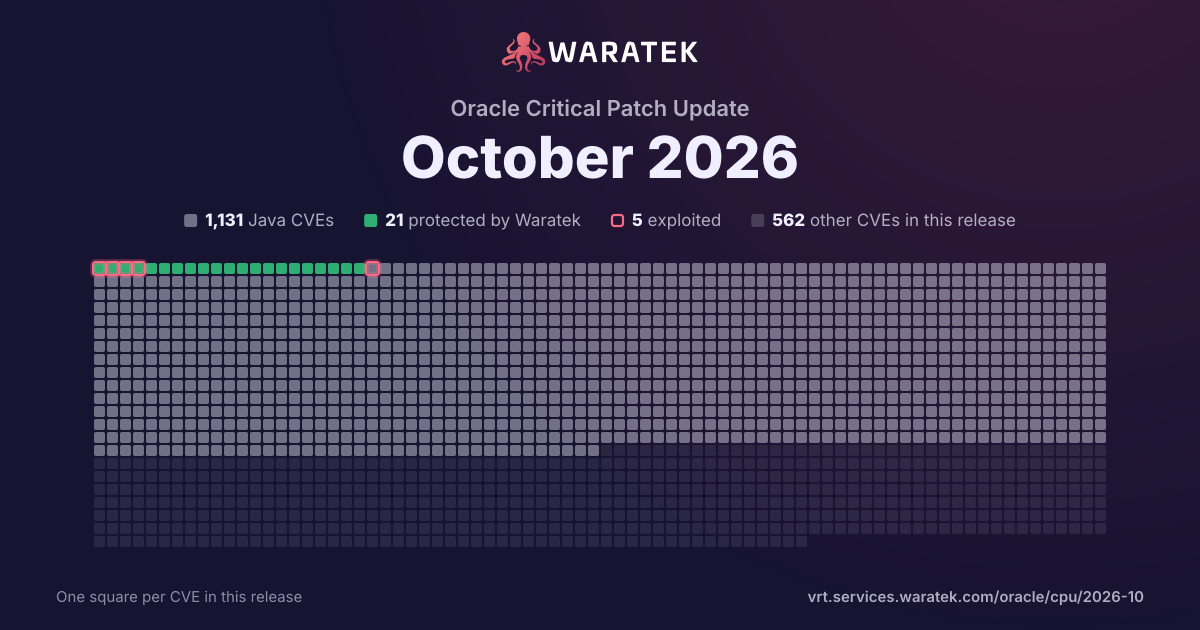
By status
21Protected by Waratek1Mitigation candidate1,109No exploit published13Outside Waratek scope549Not applicable
5Exploited, marked by the ring
No exploit published. For 858 of them, Oracle's security advisory is the source of public detail.
Protected by Waratek. Waratek RASP can block exploitation of these on systems that have not applied the patch yet.
Overview 90 matches · 2 protected · 1 exploited · 1 CISA KEV · 2 public PoC · 2 EPSS ≥ 0.5
Protected by Waratek
2
2.2%
Rule in development
0
0.0%
Mitigation candidate
1
1.1%
No exploit published
87
96.7%
blocked by ARMR today
2
2.2%
partly blocked
0
0.0%
not blocked
88
97.8%
not established
0
0.0%
unrecorded
0
0.0%
Exploited
1
1.1%
Working exploit published
0
0.0%
Proof of concept only
12
13.3%
Forecast only
0
0.0%
No public exploit
77
85.6%
split by
peak 44 / quarter
Q3 221
Protected by Waratek1
High1
blocked by ARMR today1
Proof of concept only1
Q4 220
Q1 230
Q2 230
Q3 230
Q4 231
Mitigation candidate1
High1
not blocked1
Exploited1
Q1 241
No exploit published1
High1
not blocked1
No public exploit1
Q2 240
Q3 240
Q4 240
Q1 250
Q2 251
No exploit published1
High1
not blocked1
Proof of concept only1
Q3 250
Q4 250
Q1 261
Protected by Waratek1
High1
blocked by ARMR today1
No public exploit1
Q2 2618
No exploit published18
High18
not blocked18
Proof of concept only4
No public exploit14
Q3 2623
No exploit published23
High23
not blocked23
Proof of concept only6
No public exploit17
Q4 2644
No exploit published44
High44
not blocked44
No public exploit44
Q4 22Q2 23Q4 23Q2 24Q4 24Q2 25Q4 25Q2 26Q4 26
| CVE | Severity | Published▾ | Status | Exploitation | Description |
|---|---|---|---|---|---|
| CVE-2026-91668 | High | 2026-10-20 | No exploit published | No public exploit | Vulnerability in the Oracle Data Integrator product of Oracle Fusion Middleware (component: Dictionary Repository). Supported versions that are affected are 12.2.1.4.0 and 14.1.2.0.0. Easily exploitable vulnerability allows low privileged attacker with network access via SQL to compromise Oracle Data Integrator. Successful attacks of this vulnerability can result in takeover of Oracle Data Integrator. CVSS 3.1 Base Score 8.8 (Confidentiality, Integrity and Availability impacts). CVSS Vector: (CVSS:3.1/AV:N/AC:L/PR:L/UI:N/S:U/C:H/I:H/A:H). |
| CVE-2026-91552 | High | 2026-10-20 | No exploit published | No public exploit | Vulnerability in the Oracle WebCenter Sites product of Oracle Fusion Middleware (component: WebCenter Sites). Supported versions that are affected are 12.2.1.4.0 and 14.1.2.0.0. Easily exploitable vulnerability allows unauthenticated attacker with network access via HTTP to compromise Oracle WebCenter Sites. Successful attacks of this vulnerability can result in unauthorized access to critical data or complete access to all Oracle WebCenter Sites accessible data. CVSS 3.1 Base Score 7.5 (Confidentiality impacts). CVSS Vector: (CVSS:3.1/AV:N/AC:L/PR:N/UI:N/S:U/C:H/I:N/A:N). |
| CVE-2026-91542 | High | 2026-10-20 | No exploit published | No public exploit | Vulnerability in the Oracle WebCenter Sites product of Oracle Fusion Middleware (component: WebCenter Sites). Supported versions that are affected are 12.2.1.4.0 and 14.1.2.0.0. Easily exploitable vulnerability allows unauthenticated attacker with network access via HTTP to compromise Oracle WebCenter Sites. Successful attacks of this vulnerability can result in unauthorized access to critical data or complete access to all Oracle WebCenter Sites accessible data. CVSS 3.1 Base Score 7.5 (Confidentiality impacts). CVSS Vector: (CVSS:3.1/AV:N/AC:L/PR:N/UI:N/S:U/C:H/I:N/A:N). |
| CVE-2026-91504 | High | 2026-10-20 | No exploit published | No public exploit | Vulnerability in the Oracle WebCenter Content product of Oracle Fusion Middleware (component: Content Portal Suite). Supported versions that are affected are 12.2.1.4.0 and 14.1.2.0.0. Difficult to exploit vulnerability allows low privileged attacker with network access via HTTP to compromise Oracle WebCenter Content. Successful attacks of this vulnerability can result in takeover of Oracle WebCenter Content. CVSS 3.1 Base Score 7.5 (Confidentiality, Integrity and Availability impacts). CVSS Vector: (CVSS:3.1/AV:N/AC:H/PR:L/UI:N/S:U/C:H/I:H/A:H). |
| CVE-2026-91502 | High | 2026-10-20 | No exploit published | No public exploit | Vulnerability in the Oracle WebLogic Server product of Oracle Fusion Middleware (component: Core). Supported versions that are affected are 12.2.1.4.0, 14.1.1.0.0, 14.1.2.0.0 and 15.1.1.0.0. Easily exploitable vulnerability allows unauthenticated attacker with network access via TLS to compromise Oracle WebLogic Server. Successful attacks of this vulnerability can result in unauthorized update, insert or delete access to some of Oracle WebLogic Server accessible data as well as unauthorized read access to a subset of Oracle WebLogic Server accessible data and unauthorized ability to cause a partial denial of service (partial DOS) of Oracle WebLogic Server. CVSS 3.1 Base Score 7.3 (Confidentiality, Integrity and Availability impacts). CVSS Vector: (CVSS:3.1/AV:N/AC:L/PR:N/UI:N/S:U/C:L/I:L/A:L). |
| CVE-2026-91494 | High | 2026-10-20 | No exploit published | No public exploit | Vulnerability in the Oracle Identity Manager Connector product of Oracle Fusion Middleware (component: LDAP Gateway). Supported versions that are affected are 12.2.1.4.0 and 14.1.2.1.0. Difficult to exploit vulnerability allows unauthenticated attacker with network access via TCP to compromise Oracle Identity Manager Connector. Successful attacks of this vulnerability can result in unauthorized creation, deletion or modification access to critical data or all Oracle Identity Manager Connector accessible data as well as unauthorized access to critical data or complete access to all Oracle Identity Manager Connector accessible data. CVSS 3.1 Base Score 7.4 (Confidentiality and Integrity impacts). CVSS Vector: (CVSS:3.1/AV:N/AC:H/PR:N/UI:N/S:U/C:H/I:H/A:N). |
| CVE-2026-91493 | High | 2026-10-20 | No exploit published | No public exploit | Vulnerability in the Oracle Identity Manager Connector product of Oracle Fusion Middleware (component: LDAP Gateway). Supported versions that are affected are 12.2.1.4.0 and 14.1.2.1.0. Easily exploitable vulnerability allows unauthenticated attacker with network access via LDAP to compromise Oracle Identity Manager Connector. Successful attacks of this vulnerability can result in unauthorized access to critical data or complete access to all Oracle Identity Manager Connector accessible data. CVSS 3.1 Base Score 7.5 (Confidentiality impacts). CVSS Vector: (CVSS:3.1/AV:N/AC:L/PR:N/UI:N/S:U/C:H/I:N/A:N). |
| CVE-2026-91492 | High | 2026-10-20 | No exploit published | No public exploit | Vulnerability in the Oracle Identity Manager Connector product of Oracle Fusion Middleware (component: SAP ERP+). Supported versions that are affected are 12.2.1.4.0 and 14.1.2.1.0. Difficult to exploit vulnerability allows unauthenticated attacker with network access via HTTP to compromise Oracle Identity Manager Connector. While the vulnerability is in Oracle Identity Manager Connector, attacks may significantly impact additional products (scope change). Successful attacks of this vulnerability can result in unauthorized creation, deletion or modification access to critical data or all Oracle Identity Manager Connector accessible data as well as unauthorized access to critical data or complete access to all Oracle Identity Manager Connector accessible data. CVSS 3.1 Base Score 8.7 (Confidentiality and Integrity impacts). CVSS Vector: (CVSS:3.1/AV:N/AC:H/PR:N/UI:N/S:C/C:H/I:H/A:N). |
| CVE-2026-91489 | High | 2026-10-20 | No exploit published | No public exploit | Vulnerability in the Oracle Identity Manager Connector product of Oracle Fusion Middleware (component: LDAP Gateway). Supported versions that are affected are 12.2.1.4.0 and 14.1.2.1.0. Easily exploitable vulnerability allows low privileged attacker with logon to the infrastructure where Oracle Identity Manager Connector executes to compromise Oracle Identity Manager Connector. Successful attacks of this vulnerability can result in unauthorized creation, deletion or modification access to critical data or all Oracle Identity Manager Connector accessible data as well as unauthorized access to critical data or complete access to all Oracle Identity Manager Connector accessible data. CVSS 3.1 Base Score 7.1 (Confidentiality and Integrity impacts). CVSS Vector: (CVSS:3.1/AV:L/AC:L/PR:L/UI:N/S:U/C:H/I:H/A:N). |
| CVE-2026-91488 | High | 2026-10-20 | No exploit published | No public exploit | Vulnerability in the Oracle Identity Manager Connector product of Oracle Fusion Middleware (component: Generic REST). Supported versions that are affected are 12.2.1.4.0 and 14.1.2.1.0. Easily exploitable vulnerability allows low privileged attacker with logon to the infrastructure where Oracle Identity Manager Connector executes to compromise Oracle Identity Manager Connector. Successful attacks of this vulnerability can result in unauthorized creation, deletion or modification access to critical data or all Oracle Identity Manager Connector accessible data as well as unauthorized access to critical data or complete access to all Oracle Identity Manager Connector accessible data. CVSS 3.1 Base Score 7.1 (Confidentiality and Integrity impacts). CVSS Vector: (CVSS:3.1/AV:L/AC:L/PR:L/UI:N/S:U/C:H/I:H/A:N). |
| CVE-2026-91407 | High | 2026-10-20 | No exploit published | No public exploit | Vulnerability in the Oracle Identity Manager product of Oracle Fusion Middleware (component: REST WebServices). Supported versions that are affected are 12.2.1.4.0 and 14.1.2.1.0. Easily exploitable vulnerability allows low privileged attacker with network access via HTTP to compromise Oracle Identity Manager. Successful attacks of this vulnerability can result in takeover of Oracle Identity Manager. CVSS 3.1 Base Score 8.8 (Confidentiality, Integrity and Availability impacts). CVSS Vector: (CVSS:3.1/AV:N/AC:L/PR:L/UI:N/S:U/C:H/I:H/A:H). |
| CVE-2026-91358 | High | 2026-10-20 | No exploit published | No public exploit | Vulnerability in the Oracle Business Process Management Suite product of Oracle Fusion Middleware (component: Case management Service (11g+)). Supported versions that are affected are 12.2.1.4.0 and 14.1.2.0.0. Easily exploitable vulnerability allows unauthenticated attacker with network access via HTTP to compromise Oracle Business Process Management Suite. Successful attacks of this vulnerability can result in unauthorized access to critical data or complete access to all Oracle Business Process Management Suite accessible data as well as unauthorized update, insert or delete access to some of Oracle Business Process Management Suite accessible data. CVSS 3.1 Base Score 8.2 (Confidentiality and Integrity impacts). CVSS Vector: (CVSS:3.1/AV:N/AC:L/PR:N/UI:N/S:U/C:H/I:L/A:N). |
| CVE-2026-91259 | High | 2026-10-20 | No exploit published | No public exploit | Vulnerability in the Oracle Identity Manager product of Oracle Fusion Middleware (component: OIM Legacy UI). Supported versions that are affected are 12.2.1.4.0 and 14.1.2.1.0. Easily exploitable vulnerability allows low privileged attacker with network access via HTTP to compromise Oracle Identity Manager. Successful attacks of this vulnerability can result in takeover of Oracle Identity Manager. CVSS 3.1 Base Score 8.8 (Confidentiality, Integrity and Availability impacts). CVSS Vector: (CVSS:3.1/AV:N/AC:L/PR:L/UI:N/S:U/C:H/I:H/A:H). |
| CVE-2026-91239 | High | 2026-10-20 | No exploit published | No public exploit | Vulnerability in the Oracle SOA Suite product of Oracle Fusion Middleware (component: Fabric Layer). Supported versions that are affected are 12.2.1.4.0 and 14.1.2.0.0. Easily exploitable vulnerability allows low privileged attacker with network access via multiple protocols to compromise Oracle SOA Suite. Successful attacks of this vulnerability can result in takeover of Oracle SOA Suite. CVSS 3.1 Base Score 8.8 (Confidentiality, Integrity and Availability impacts). CVSS Vector: (CVSS:3.1/AV:N/AC:L/PR:L/UI:N/S:U/C:H/I:H/A:H). |
| CVE-2026-91238 | High | 2026-10-20 | No exploit published | No public exploit | Vulnerability in the Oracle SOA Suite product of Oracle Fusion Middleware (component: Fabric Layer). Supported versions that are affected are 12.2.1.4.0 and 14.1.2.0.0. Easily exploitable vulnerability allows low privileged attacker with network access via HTTP to compromise Oracle SOA Suite. Successful attacks of this vulnerability can result in unauthorized creation, deletion or modification access to critical data or all Oracle SOA Suite accessible data and unauthorized ability to cause a partial denial of service (partial DOS) of Oracle SOA Suite. CVSS 3.1 Base Score 7.1 (Integrity and Availability impacts). CVSS Vector: (CVSS:3.1/AV:N/AC:L/PR:L/UI:N/S:U/C:N/I:H/A:L). |
| CVE-2026-91237 | High | 2026-10-20 | No exploit published | No public exploit | Vulnerability in the Oracle SOA Suite product of Oracle Fusion Middleware (component: Fabric Layer). Supported versions that are affected are 12.2.1.4.0 and 14.1.2.0.0. Easily exploitable vulnerability allows unauthenticated attacker with network access via HTTP to compromise Oracle SOA Suite. Successful attacks of this vulnerability can result in unauthorized access to critical data or complete access to all Oracle SOA Suite accessible data. CVSS 3.1 Base Score 7.5 (Confidentiality impacts). CVSS Vector: (CVSS:3.1/AV:N/AC:L/PR:N/UI:N/S:U/C:H/I:N/A:N). |
| CVE-2026-91229 | High | 2026-10-20 | No exploit published | No public exploit | Vulnerability in the Oracle SOA Suite product of Oracle Fusion Middleware (component: Fabric Layer). Supported versions that are affected are 12.2.1.4.0 and 14.1.2.0.0. Difficult to exploit vulnerability allows low privileged attacker with network access via HTTP to compromise Oracle SOA Suite. Successful attacks of this vulnerability can result in takeover of Oracle SOA Suite. CVSS 3.1 Base Score 7.5 (Confidentiality, Integrity and Availability impacts). CVSS Vector: (CVSS:3.1/AV:N/AC:H/PR:L/UI:N/S:U/C:H/I:H/A:H). |
| CVE-2026-91228 | High | 2026-10-20 | No exploit published | No public exploit | Vulnerability in the Oracle SOA Suite product of Oracle Fusion Middleware (component: Fabric Layer). Supported versions that are affected are 12.2.1.4.0 and 14.1.2.0.0. Easily exploitable vulnerability allows low privileged attacker with network access via HTTP to compromise Oracle SOA Suite. Successful attacks of this vulnerability can result in unauthorized access to critical data or complete access to all Oracle SOA Suite accessible data as well as unauthorized update, insert or delete access to some of Oracle SOA Suite accessible data. CVSS 3.1 Base Score 7.1 (Confidentiality and Integrity impacts). CVSS Vector: (CVSS:3.1/AV:N/AC:L/PR:L/UI:N/S:U/C:H/I:L/A:N). |
| CVE-2026-91227 | High | 2026-10-20 | No exploit published | No public exploit | Vulnerability in the Oracle SOA Suite product of Oracle Fusion Middleware (component: Fabric Layer). Supported versions that are affected are 12.2.1.4.0 and 14.1.2.0.0. Difficult to exploit vulnerability allows low privileged attacker with network access via HTTP to compromise Oracle SOA Suite. Successful attacks of this vulnerability can result in takeover of Oracle SOA Suite. CVSS 3.1 Base Score 7.5 (Confidentiality, Integrity and Availability impacts). CVSS Vector: (CVSS:3.1/AV:N/AC:H/PR:L/UI:N/S:U/C:H/I:H/A:H). |
| CVE-2026-91226 | High | 2026-10-20 | No exploit published | No public exploit | Vulnerability in the Oracle SOA Suite product of Oracle Fusion Middleware (component: Fabric Layer). Supported versions that are affected are 12.2.1.4.0 and 14.1.2.0.0. Difficult to exploit vulnerability allows low privileged attacker with network access via HTTP to compromise Oracle SOA Suite. Successful attacks of this vulnerability can result in takeover of Oracle SOA Suite. CVSS 3.1 Base Score 7.5 (Confidentiality, Integrity and Availability impacts). CVSS Vector: (CVSS:3.1/AV:N/AC:H/PR:L/UI:N/S:U/C:H/I:H/A:H). |
| CVE-2026-91223 | High | 2026-10-20 | No exploit published | No public exploit | Vulnerability in the Oracle SOA Suite product of Oracle Fusion Middleware (component: Fabric Layer). Supported versions that are affected are 12.2.1.4.0 and 14.1.2.0.0. Easily exploitable vulnerability allows low privileged attacker with network access via HTTP to compromise Oracle SOA Suite. Successful attacks of this vulnerability can result in takeover of Oracle SOA Suite. CVSS 3.1 Base Score 8.8 (Confidentiality, Integrity and Availability impacts). CVSS Vector: (CVSS:3.1/AV:N/AC:L/PR:L/UI:N/S:U/C:H/I:H/A:H). |
| CVE-2026-91219 | High | 2026-10-20 | No exploit published | No public exploit | Vulnerability in the Oracle SOA Suite product of Oracle Fusion Middleware (component: Fabric Layer). Supported versions that are affected are 12.2.1.4.0 and 14.1.2.0.0. Easily exploitable vulnerability allows unauthenticated attacker with network access via HTTP to compromise Oracle SOA Suite. While the vulnerability is in Oracle SOA Suite, attacks may significantly impact additional products (scope change). Successful attacks of this vulnerability can result in unauthorized access to critical data or complete access to all Oracle SOA Suite accessible data. CVSS 3.1 Base Score 8.6 (Confidentiality impacts). CVSS Vector: (CVSS:3.1/AV:N/AC:L/PR:N/UI:N/S:C/C:H/I:N/A:N). |
| CVE-2026-91217 | High | 2026-10-20 | No exploit published | No public exploit | Vulnerability in the Oracle SOA Suite product of Oracle Fusion Middleware (component: Fabric Layer). Supported versions that are affected are 12.2.1.4.0 and 14.1.2.0.0. Easily exploitable vulnerability allows unauthenticated attacker with network access via HTTP to compromise Oracle SOA Suite. While the vulnerability is in Oracle SOA Suite, attacks may significantly impact additional products (scope change). Successful attacks of this vulnerability can result in unauthorized access to critical data or complete access to all Oracle SOA Suite accessible data. CVSS 3.1 Base Score 8.6 (Confidentiality impacts). CVSS Vector: (CVSS:3.1/AV:N/AC:L/PR:N/UI:N/S:C/C:H/I:N/A:N). |
| CVE-2026-91215 | High | 2026-10-20 | No exploit published | No public exploit | Vulnerability in the Oracle SOA Suite product of Oracle Fusion Middleware (component: Fabric Layer). Supported versions that are affected are 12.2.1.4.0 and 14.1.2.0.0. Easily exploitable vulnerability allows low privileged attacker with network access via HTTP to compromise Oracle SOA Suite. Successful attacks of this vulnerability can result in takeover of Oracle SOA Suite. CVSS 3.1 Base Score 8.8 (Confidentiality, Integrity and Availability impacts). CVSS Vector: (CVSS:3.1/AV:N/AC:L/PR:L/UI:N/S:U/C:H/I:H/A:H). |
| CVE-2026-91213 | High | 2026-10-20 | No exploit published | No public exploit | Vulnerability in the Oracle Business Process Management Suite product of Oracle Fusion Middleware (component: BPM Composer). Supported versions that are affected are 12.2.1.4.0 and 14.1.2.0.0. Easily exploitable vulnerability allows low privileged attacker with network access via HTTP to compromise Oracle Business Process Management Suite. Successful attacks of this vulnerability can result in takeover of Oracle Business Process Management Suite. CVSS 3.1 Base Score 8.8 (Confidentiality, Integrity and Availability impacts). CVSS Vector: (CVSS:3.1/AV:N/AC:L/PR:L/UI:N/S:U/C:H/I:H/A:H). |
| CVE-2026-91212 | High | 2026-10-20 | No exploit published | No public exploit | Vulnerability in the Oracle Identity Manager Connector product of Oracle Fusion Middleware (component: Generic REST). Supported versions that are affected are 12.2.1.4.0 and 14.1.2.1.0. Easily exploitable vulnerability allows unauthenticated attacker with network access via HTTP to compromise Oracle Identity Manager Connector. While the vulnerability is in Oracle Identity Manager Connector, attacks may significantly impact additional products (scope change). Successful attacks of this vulnerability can result in unauthorized access to critical data or complete access to all Oracle Identity Manager Connector accessible data. CVSS 3.1 Base Score 8.6 (Confidentiality impacts). CVSS Vector: (CVSS:3.1/AV:N/AC:L/PR:N/UI:N/S:C/C:H/I:N/A:N). |
| CVE-2026-91211 | High | 2026-10-20 | No exploit published | No public exploit | Vulnerability in the Oracle Identity Manager Connector product of Oracle Fusion Middleware (component: Connectors and Connector Server). Supported versions that are affected are 12.2.1.4.0 and 14.1.2.1.0. Easily exploitable vulnerability allows high privileged attacker with network access via SOAP to compromise Oracle Identity Manager Connector. While the vulnerability is in Oracle Identity Manager Connector, attacks may significantly impact additional products (scope change). Successful attacks of this vulnerability can result in unauthorized creation, deletion or modification access to critical data or all Oracle Identity Manager Connector accessible data as well as unauthorized access to critical data or complete access to all Oracle Identity Manager Connector accessible data. CVSS 3.1 Base Score 8.7 (Confidentiality and Integrity impacts). CVSS Vector: (CVSS:3.1/AV:N/AC:L/PR:H/UI:N/S:C/C:H/I:H/A:N). |
| CVE-2026-87420 | High | 2026-10-20 | No exploit published | No public exploit | Vulnerability in the Oracle Service Bus product of Oracle Fusion Middleware (component: Core). The supported version that is affected is 14.1.2.0.0. Easily exploitable vulnerability allows low privileged attacker with network access via HTTP to compromise Oracle Service Bus. Successful attacks of this vulnerability can result in takeover of Oracle Service Bus. CVSS 3.1 Base Score 8.8 (Confidentiality, Integrity and Availability impacts). CVSS Vector: (CVSS:3.1/AV:N/AC:L/PR:L/UI:N/S:U/C:H/I:H/A:H). |
| CVE-2026-87419 | High | 2026-10-20 | No exploit published | No public exploit | Vulnerability in the Oracle Service Bus product of Oracle Fusion Middleware (component: Core). Supported versions that are affected are 12.2.1.4.0 and 14.1.2.0.0. Easily exploitable vulnerability allows low privileged attacker with network access via HTTP to compromise Oracle Service Bus. Successful attacks of this vulnerability can result in takeover of Oracle Service Bus. CVSS 3.1 Base Score 8.8 (Confidentiality, Integrity and Availability impacts). CVSS Vector: (CVSS:3.1/AV:N/AC:L/PR:L/UI:N/S:U/C:H/I:H/A:H). |
| CVE-2026-87369 | High | 2026-10-20 | No exploit published | No public exploit | Vulnerability in the Oracle Service Bus product of Oracle Fusion Middleware (component: Core). Supported versions that are affected are 12.2.1.4.0 and 14.1.2.0.0. Easily exploitable vulnerability allows unauthenticated attacker with network access via HTTP to compromise Oracle Service Bus. Successful attacks of this vulnerability can result in unauthorized ability to cause a hang or frequently repeatable crash (complete DOS) of Oracle Service Bus. CVSS 3.1 Base Score 7.5 (Availability impacts). CVSS Vector: (CVSS:3.1/AV:N/AC:L/PR:N/UI:N/S:U/C:N/I:N/A:H). |
| CVE-2026-87364 | High | 2026-10-20 | No exploit published | No public exploit | Vulnerability in the Oracle Service Bus product of Oracle Fusion Middleware (component: Core). Supported versions that are affected are 12.2.1.4.0 and 14.1.2.0.0. Easily exploitable vulnerability allows low privileged attacker with network access via HTTP to compromise Oracle Service Bus. Successful attacks of this vulnerability can result in takeover of Oracle Service Bus. CVSS 3.1 Base Score 8.8 (Confidentiality, Integrity and Availability impacts). CVSS Vector: (CVSS:3.1/AV:N/AC:L/PR:L/UI:N/S:U/C:H/I:H/A:H). |
| CVE-2026-87359 | High | 2026-10-20 | No exploit published | No public exploit | Vulnerability in the Oracle Service Bus product of Oracle Fusion Middleware (component: Core). Supported versions that are affected are 12.2.1.4.0 and 14.1.2.0.0. Easily exploitable vulnerability allows low privileged attacker with network access via HTTP to compromise Oracle Service Bus. Successful attacks of this vulnerability can result in takeover of Oracle Service Bus. CVSS 3.1 Base Score 8.8 (Confidentiality, Integrity and Availability impacts). CVSS Vector: (CVSS:3.1/AV:N/AC:L/PR:L/UI:N/S:U/C:H/I:H/A:H). |
| CVE-2026-87296 | High | 2026-10-20 | No exploit published | No public exploit | Vulnerability in the Oracle Access Manager product of Oracle Fusion Middleware (component: Authentication Engine). Supported versions that are affected are 12.2.1.4.0 and 14.1.2.1.0. Easily exploitable vulnerability allows unauthenticated attacker with network access via HTTP to compromise Oracle Access Manager. Successful attacks of this vulnerability can result in unauthorized access to critical data or complete access to all Oracle Access Manager accessible data. CVSS 3.1 Base Score 7.5 (Confidentiality impacts). CVSS Vector: (CVSS:3.1/AV:N/AC:L/PR:N/UI:N/S:U/C:H/I:N/A:N). |
| CVE-2026-83426 | High | 2026-10-20 | No exploit published | No public exploit | Vulnerability in the Oracle Access Manager product of Oracle Fusion Middleware (component: Authentication Engine). Supported versions that are affected are 12.2.1.4.0 and 14.1.2.1.0. Difficult to exploit vulnerability allows unauthenticated attacker with network access via HTTP to compromise Oracle Access Manager. While the vulnerability is in Oracle Access Manager, attacks may significantly impact additional products (scope change). Successful attacks of this vulnerability can result in unauthorized creation, deletion or modification access to critical data or all Oracle Access Manager accessible data as well as unauthorized access to critical data or complete access to all Oracle Access Manager accessible data. CVSS 3.1 Base Score 8.7 (Confidentiality and Integrity impacts). CVSS Vector: (CVSS:3.1/AV:N/AC:H/PR:N/UI:N/S:C/C:H/I:H/A:N). |
| CVE-2026-83409 | High | 2026-10-20 | No exploit published | No public exploit | Vulnerability in the Oracle Access Manager product of Oracle Fusion Middleware (component: Authentication Engine). Supported versions that are affected are 12.2.1.4.0 and 14.1.2.0.0. Difficult to exploit vulnerability allows unauthenticated attacker with network access via SAML to compromise Oracle Access Manager. Successful attacks of this vulnerability can result in takeover of Oracle Access Manager. CVSS 3.1 Base Score 8.1 (Confidentiality, Integrity and Availability impacts). CVSS Vector: (CVSS:3.1/AV:N/AC:H/PR:N/UI:N/S:U/C:H/I:H/A:H). |
| CVE-2026-83407 | High | 2026-10-20 | No exploit published | No public exploit | Vulnerability in the Oracle Access Manager product of Oracle Fusion Middleware (component: Authentication Engine). Supported versions that are affected are 12.2.1.4.0 and 14.1.2.0.0. Easily exploitable vulnerability allows unauthenticated attacker with network access via HTTP to compromise Oracle Access Manager. Successful attacks of this vulnerability can result in unauthorized access to critical data or complete access to all Oracle Access Manager accessible data as well as unauthorized update, insert or delete access to some of Oracle Access Manager accessible data and unauthorized ability to cause a partial denial of service (partial DOS) of Oracle Access Manager. CVSS 3.1 Base Score 8.6 (Confidentiality, Integrity and Availability impacts). CVSS Vector: (CVSS:3.1/AV:N/AC:L/PR:N/UI:N/S:U/C:H/I:L/A:L). |
| CVE-2026-83403 | High | 2026-10-20 | No exploit published | No public exploit | Vulnerability in the Oracle Identity Manager product of Oracle Fusion Middleware (component: OIM Legacy UI). Supported versions that are affected are 12.2.1.4.0 and 14.1.2.1.0. Easily exploitable vulnerability allows low privileged attacker with network access via HTTP to compromise Oracle Identity Manager. Successful attacks of this vulnerability can result in takeover of Oracle Identity Manager. CVSS 3.1 Base Score 8.8 (Confidentiality, Integrity and Availability impacts). CVSS Vector: (CVSS:3.1/AV:N/AC:L/PR:L/UI:N/S:U/C:H/I:H/A:H). |
| CVE-2026-83402 | High | 2026-10-20 | No exploit published | No public exploit | Vulnerability in the Oracle Identity Manager product of Oracle Fusion Middleware (component: OIM Legacy UI). Supported versions that are affected are 12.2.1.4.0 and 14.1.2.1.0. Easily exploitable vulnerability allows low privileged attacker with network access via HTTPS to compromise Oracle Identity Manager. Successful attacks of this vulnerability can result in takeover of Oracle Identity Manager. CVSS 3.1 Base Score 8.8 (Confidentiality, Integrity and Availability impacts). CVSS Vector: (CVSS:3.1/AV:N/AC:L/PR:L/UI:N/S:U/C:H/I:H/A:H). |
| CVE-2026-83398 | High | 2026-10-20 | No exploit published | No public exploit | Vulnerability in the Oracle Data Integrator product of Oracle Fusion Middleware (component: Data Transforms). Supported versions that are affected are 12.2.1.4.0 and 14.1.2.0.0. Easily exploitable vulnerability allows unauthenticated attacker with network access via HTTP to compromise Oracle Data Integrator. Successful attacks of this vulnerability can result in unauthorized access to critical data or complete access to all Oracle Data Integrator accessible data as well as unauthorized update, insert or delete access to some of Oracle Data Integrator accessible data. CVSS 3.1 Base Score 8.2 (Confidentiality and Integrity impacts). CVSS Vector: (CVSS:3.1/AV:N/AC:L/PR:N/UI:N/S:U/C:H/I:L/A:N). |
| CVE-2026-101585 | High | 2026-10-20 | No exploit published | No public exploit | Vulnerability in the Helidon product of Oracle Fusion Middleware (component: helidon-cors). Supported versions that are affected are 3.0.0-3.2.21. Easily exploitable vulnerability allows unauthenticated attacker with network access via HTTP to compromise Helidon. While the vulnerability is in Helidon, attacks may significantly impact additional products (scope change). Successful attacks of this vulnerability can result in unauthorized update, insert or delete access to some of Helidon accessible data as well as unauthorized read access to a subset of Helidon accessible data. CVSS 3.1 Base Score 7.2 (Confidentiality and Integrity impacts). CVSS Vector: (CVSS:3.1/AV:N/AC:L/PR:N/UI:N/S:C/C:L/I:L/A:N). |
| CVE-2026-101583 | High | 2026-10-20 | No exploit published | No public exploit | Vulnerability in the Helidon product of Oracle Fusion Middleware (component: helidon-common-mapper). Supported versions that are affected are 4.0.0-4.5.5 and 27.0.0. Difficult to exploit vulnerability allows unauthenticated attacker with network access via HTTP to compromise Helidon. Successful attacks of this vulnerability can result in unauthorized creation, deletion or modification access to critical data or all Helidon accessible data as well as unauthorized read access to a subset of Helidon accessible data and unauthorized ability to cause a partial denial of service (partial DOS) of Helidon. CVSS 3.1 Base Score 7.0 (Confidentiality, Integrity and Availability impacts). CVSS Vector: (CVSS:3.1/AV:N/AC:H/PR:N/UI:N/S:U/C:L/I:H/A:L). |
| CVE-2026-101579 | High | 2026-10-20 | No exploit published | No public exploit | Vulnerability in the Helidon product of Oracle Fusion Middleware (component: helidon-grpc-server). Supported versions that are affected are 3.0.0-3.2.21. Easily exploitable vulnerability allows unauthenticated attacker with network access via HTTP/2 to compromise Helidon. While the vulnerability is in Helidon, attacks may significantly impact additional products (scope change). Successful attacks of this vulnerability can result in unauthorized update, insert or delete access to some of Helidon accessible data as well as unauthorized read access to a subset of Helidon accessible data. CVSS 3.1 Base Score 7.2 (Confidentiality and Integrity impacts). CVSS Vector: (CVSS:3.1/AV:N/AC:L/PR:N/UI:N/S:C/C:L/I:L/A:N). |
| CVE-2026-101572 | High | 2026-10-20 | No exploit published | No public exploit | Vulnerability in the Helidon product of Oracle Fusion Middleware (component: helidon-webclient-http2). Supported versions that are affected are 4.0.0-4.5.5 and 27.0.0. Easily exploitable vulnerability allows unauthenticated attacker with network access via HTTP/2 to compromise Helidon. Successful attacks of this vulnerability can result in unauthorized ability to cause a hang or frequently repeatable crash (complete DOS) of Helidon. CVSS 3.1 Base Score 7.5 (Availability impacts). CVSS Vector: (CVSS:3.1/AV:N/AC:L/PR:N/UI:N/S:U/C:N/I:N/A:H). |
| CVE-2026-101520 | High | 2026-10-20 | No exploit published | No public exploit | Vulnerability in the Oracle Global Lifecycle Management NextGen OUI Framework product of Oracle Fusion Middleware (component: NextGen Installer). Supported versions that are affected are 12.2.1.4.0, 14.1.1.0.0, 14.1.2.0.0, 14.1.2.1.0 and 15.1.1.0.0. Easily exploitable vulnerability allows unauthenticated attacker with network access via HTTP to compromise Oracle Global Lifecycle Management NextGen OUI Framework. Successful attacks of this vulnerability can result in unauthorized ability to cause a hang or frequently repeatable crash (complete DOS) of Oracle Global Lifecycle Management NextGen OUI Framework. CVSS 3.1 Base Score 7.5 (Availability impacts). CVSS Vector: (CVSS:3.1/AV:N/AC:L/PR:N/UI:N/S:U/C:N/I:N/A:H). |
| CVE-2026-91777 | High | 2026-09-23 | No exploit published | Proof of concept only | Forward-reference completion for @JsonIdentityInfo object IDs in FasterXML jackson-databind performs a linear scan of the pending-reference accumulator for every resolved ID. The affected paths are CollectionDeserializer.CollectionReferringAccumulator.resolveForwardReference() and the equivalent implementation in MapDeserializer. When a document first creates N unresolved object-ID references in an identity-enabled collection or map and then defines those same IDs in reverse order, completion performs on the order of N * (N + 1) / 2 identity comparisons, so a shallow document whose size grows linearly causes quadratic CPU work during deserialization. The reporter instrumented equals() calls on the ID class and measured exactly 2,003,000 comparisons at N = 2,000, against zero comparisons in the pending-reference lookup path for an equally sized control in which every reference was already resolved. The input requires no deep nesting and no syntactically unusual JSON. Exploitation requires an application that deserializes attacker-influenced JSON into an identity-enabled collection or map. The fix replaces the repeated linear lookup with a keyed pending-reference structure. |
| CVE-2026-91776 | High | 2026-09-23 | No exploit published | Proof of concept only | TypeDeserializerBase._findDeserializer() in FasterXML jackson-databind caches the resolved deserializer under the raw, attacker-supplied type ID. When name-based polymorphism is configured with a fallback, for example @JsonTypeInfo(use = Id.NAME, defaultImpl = ...), every distinct unrecognized type ID resolves to the same fallback deserializer but is retained as its own key in the _deserializers map. That map has no configurable bound and lives for the lifetime of the type deserializer, so an attacker who can repeatedly supply fresh unknown type IDs causes monotonic memory retention across requests. The reporter observed 10,000 retained entries from 10,000 distinct unknown IDs, against a single entry for a control that repeated one unknown ID the same number of times, isolating attacker-controlled key cardinality from request volume. Exploitation requires an application that enables name-based polymorphism with a defaultImpl or equivalent fallback, accepts attacker-influenced type IDs, and reuses a long-lived ObjectMapper across requests. The fix stops caching fallback resolutions for unrecognized IDs and bounds both the number of cached entries and the length of a cacheable type ID. |
| CVE-2026-89425 | High | 2026-09-23 | No exploit published | Proof of concept only | UTF8DataInputJsonParser._reportInvalidToken() in FasterXML jackson-core builds the offending-token text for its error message by appending Java identifier characters to a StringBuilder in a loop that has no upper bound. Unlike the three sibling parser implementations, including UTF8StreamJsonParser, it never consults ErrorReportConfiguration.getMaxErrorTokenLength() (default 256). A malformed token supplied to a parser created through JsonFactory.createParser(DataInput) is therefore accumulated in full. No StreamReadConstraints setting mitigates this: maxDocumentLength cannot be applied to DataInput sources at all, and maxStringLength does not cover this path because the accumulation bypasses ReadConstrainedTextBuffer. The reporter measured a 20,000,109-character exception message from a 20-million-character malformed token on the DataInput path, against 367 characters for identical input on the InputStream path. Scaling the payload drives the StringBuilder, which also incurs byte-to-char expansion and internal array doubling, to many times the raw payload size and can trigger OutOfMemoryError for the whole JVM. UTF8DataInputJsonParser was introduced in 2.8.0 together with createParser(DataInput); releases before 2.8.0 do not contain the affected class. |
| CVE-2026-77422 | High | 2026-09-23 | No exploit published | Proof of concept only | JLine is a Java library for handling console input. From 3.0.0 until 3.30.15 and 4.3.1, the JLine built-in grep command in builtins/src/main/java/org/jline/builtins/PosixCommands.java accepts a user-controlled regular expression in grep(...) and, unless line-regexp mode is used, automatically adds a dot-star prefix and suffix before compiling it with Java's backtracking regular expression engine. The wrapping expands the backtracking search space, so a short nested-quantifier expression evaluated against non-matching input can consume excessive CPU and indefinitely block a command worker, including in remotely exposed shell sessions. This issue is fixed in versions 3.30.15 and 4.3.1. |
| CVE-2026-89407 | High | 2026-09-22 | No exploit published | Proof of concept only | NumberInput.looksLikeValidNumber() in FasterXML jackson-core pre-validates "stringified numbers" with two regular expressions: PATTERN_FLOAT ([+-]?[0-9]*[\.]?[0-9]+([eE][+-]?[0-9]+)?), present since 2.17.0, and PATTERN_FLOAT_TRAILING_DOT, added in 2.17.2. PATTERN_FLOAT places adjacent quantifiers over the same character class -- an optional [0-9]* run, an optional dot, then a required [0-9]+ run -- so input that ultimately fails to match forces Java's backtracking engine to retry every possible split point of the digit run. Matching cost therefore grows with the square of the input length. An attacker who can supply JSON that an application deserializes into a numeric target type reaches this method through jackson-databind's default String-to-number coercion (StdDeserializer and NumberDeserializers for BigDecimal, BigInteger, Double and Float). Because StreamReadConstraints.maxStringLength defaults to 20,000,000 characters, no constraint bounds the input before it reaches the regex. Testing by the reporter confirmed O(n^2) growth across five consecutive input-size doublings, with a single 160,000-character string consuming roughly 74 seconds in one call; a small number of concurrent requests of ordinary body size can therefore exhaust a server's request-handling thread pool. The affected method does not exist before 2.17.0, so 2.16.x and earlier releases are not affected. The fix replaces both regular expressions with a hand-rolled single-pass scan. |
| CVE-2026-59651 | High | 2026-08-03 | No exploit published | No public exploit | In Bouncy Castle for Java before 1.85, BKS keystore accepts legacy version with 16-bit integrity MAC key. This issue also affects Bouncy Castle for Java LTS before 2.73.12. |
| CVE-2026-59649 | High | 2026-08-03 | No exploit published | No public exploit | In Bouncy Castle for Java before 1.85, OpenPGP user-attribute subpacket length bounded only by JVM max memory. This issue also affects Bouncy Castle for Java LTS before 2.73.12, and Bouncy Castle for Java FIPS (BC-FJA) before bcpg-fips 1.0.13 (1.0.X series), 2.0.13 (2.0.X series) and 2.1.13 (2.1.X series). |
| CVE-2026-59645 | High | 2026-08-03 | No exploit published | No public exploit | In Bouncy Castle for Java before 1.85, OER parser recurses without depth limit on self-referential IEEE 1609.2 schema. This issue also affects Bouncy Castle for Java LTS before 2.73.12, and Bouncy Castle for Java FIPS (BC-FJA) before bcutil-fips 2.0.7 (2.0.X series) and 2.1.7 (2.1.X series). |
| CVE-2026-59642 | High | 2026-08-03 | No exploit published | No public exploit | In Bouncy Castle for Java before 1.85, CMS AuthenticatedData content not bound to MAC when authAttrs present. This issue also affects Bouncy Castle for Java LTS before 2.73.12, and Bouncy Castle for Java FIPS (BC-FJA) before bcpkix-fips 1.0.12 (1.0.X series), 2.0.12 (2.0.X series) and 2.1.12 (2.1.X series). |
| CVE-2026-59639 | High | 2026-08-03 | No exploit published | No public exploit | In Bouncy Castle for Java before 1.85, CMS verifySignatures returns true for SignedData with zero signers. This issue also affects Bouncy Castle for Java LTS before 2.73.12, and Bouncy Castle for Java FIPS (BC-FJA) before bcpkix-fips 1.0.12 (1.0.X series), 2.0.12 (2.0.X series) and 2.1.12 (2.1.X series). |
| CVE-2026-58061 | High | 2026-08-03 | No exploit published | No public exploit | In Bouncy Castle for Java before 1.85, CCM-family modes write plaintext to caller buffer before tag check. This issue also affects Bouncy Castle for Java LTS before 2.73.12, and Bouncy Castle for Java FIPS (BC-FJA) before bc-fips 1.0.2.7 (1.0.X series), 2.0.2 (2.0.X series) and 2.1.3 (2.1.X series). |
| CVE-2026-58060 | High | 2026-08-03 | No exploit published | No public exploit | In Bouncy Castle for Java before 1.85, HSS public-key level count unbounded, enabling huge allocation on verify. This issue also affects Bouncy Castle for Java LTS before 2.73.12, and Bouncy Castle for Java FIPS (BC-FJA) before bc-fips 2.0.2 (2.0.X series) and 2.1.3 (2.1.X series). |
| CVE-2026-58059 | High | 2026-08-03 | No exploit published | No public exploit | In Bouncy Castle for Java before 1.85, Quadratic-time escaping when stringifying X.500 distinguished names. This issue also affects Bouncy Castle for Java LTS before 2.73.12, and Bouncy Castle for Java FIPS (BC-FJA) before bc-fips 1.0.2.7 (1.0.X series), 2.0.2 (2.0.X series) and 2.1.3 (2.1.X series). |
| CVE-2026-14682 | High | 2026-08-03 | No exploit published | No public exploit | In Bouncy Castle for Java before 1.85, Possible OOM from unbounded up-front allocation on a definite-length read. This issue also affects Bouncy Castle for Java LTS before 2.73.12, and Bouncy Castle for Java FIPS (BC-FJA) before bc-fips 1.0.2.7 (1.0.X series), 2.0.2 (2.0.X series) and 2.1.3 (2.1.X series), and before bctls-fips 1.0.24. |
| CVE-2026-13506 | High | 2026-08-03 | No exploit published | No public exploit | In Bouncy Castle for Java before 1.85, Lazy ASN.1 sequence forcing resets nesting-depth guard. This issue also affects Bouncy Castle for Java LTS before 2.73.12, and Bouncy Castle for Java FIPS (BC-FJA) before bc-fips 1.0.2.7 (1.0.X series), 2.0.2 (2.0.X series) and 2.1.3 (2.1.X series). |
| CVE-2026-12860 | High | 2026-08-03 | No exploit published | No public exploit | In Bouncy Castle for Java before 1.85, RSA PKCS#1 verification skips last two hash bytes in NULL-omitted path. This issue also affects Bouncy Castle for Java LTS before 2.73.12. |
| CVE-2026-12817 | High | 2026-08-03 | No exploit published | No public exploit | In Bouncy Castle for Java before 1.85, OpenPGP AEAD decryption skips final tag on chunk-aligned data. This issue also affects Bouncy Castle for Java LTS before 2.73.12, and Bouncy Castle for Java FIPS (BC-FJA) before bcpg-fips 1.0.13 (1.0.X series), 2.0.13 (2.0.X series) and 2.1.13 (2.1.X series). |
| CVE-2026-12803 | High | 2026-08-03 | No exploit published | No public exploit | In Bouncy Castle for Java before 1.85, KCCMBlockCipher MAC does not bind nonce when AAD is absent (cross-nonce AEAD forgery). This issue also affects Bouncy Castle for Java LTS before 2.73.12. |
| CVE-2026-12802 | High | 2026-08-03 | No exploit published | No public exploit | In Bouncy Castle for Java before 1.85, CMS AuthEnvelopedData fails to enforce tag-length on decryption. This issue also affects Bouncy Castle for Java LTS before 2.73.12, and Bouncy Castle for Java FIPS (BC-FJA) before bcpkix-fips 1.0.12 (1.0.X series), 2.0.12 (2.0.X series) and 2.1.12 (2.1.X series). |
| CVE-2026-12185 | High | 2026-08-03 | No exploit published | No public exploit | In Bouncy Castle for Java before 1.85, BKS/UBER keystore allocates from untrusted lengths before integrity check. This issue also affects Bouncy Castle for Java LTS before 2.73.12. |
| CVE-2026-56741 | High | 2026-07-17 | No exploit published | Proof of concept only | JLine is a Java library for handling console input. Prior to 3.30.14, 4.0.16, and 4.2.1, the JLine3 Telnet server remote-telnet module does not apply an upper bound to terminal dimensions received via the Telnet NAWS option, and TelnetIO.handleNAWS() in TelnetIO.java:856-879 reads client-supplied width and height as 16-bit unsigned integers and passes values such as 65535x65535 to setTerminalGeometry(), allowing an unauthenticated remote attacker to repeatedly alternate values and trigger continuous expensive rendering work that causes CPU exhaustion and denial of service. This issue is fixed in versions 3.30.14, 4.0.16, and 4.2.1. |
| CVE-2026-54428 | High | 2026-07-01 | No exploit published | No public exploit | Allocation of resources without limits or throttling in the HTTP/2 HPACK decoder in Apache HttpComponents Core (5.4.2 and earlier, 5.5-beta1 and earlier) allows an remote attacker to cause a denial of service through memory exhaustion by sending oversized compressed header blocks before the HTTP/2 SETTINGS acknowledgement causes the configured header list size limit to be applied. |
| CVE-2026-54399 | High | 2026-07-01 | No exploit published | No public exploit | Uncontrolled Resource Consumption vulnerability in the HTTP/1.1 message parser in Apache HttpComponents Core (5.4.2 and earlier, 5.5-beta1 and earlier) allows an remote attacker to cause a denial of service through memory exhaustion by sending messages with excessive number of headers / excessive header length |
| CVE-2026-54513 | High | 2026-06-23 | No exploit published | No public exploit | jackson-databind contains the general-purpose data-binding functionality and tree-model for Jackson Data Processor. From 2.10.0 until 2.18.8, 2.21.4, and 3.1.4, BasicPolymorphicTypeValidator.Builder.allowIfSubTypeIsArray() allowlists any array type based only on clazz.isArray(), without validating the array's component (element) type against the configured allowlist. A PTV built with allowIfSubTypeIsArray() plus an explicit concrete-type allowlist therefore still permits EvilType[] even though EvilType is not allowlisted. When Jackson deserializes the elements and no per-element type IDs are present, it instantiates the component type directly with no further PTV check, bypassing the allowlist. This vulnerability is fixed in 2.18.8, 2.21.4, and 3.1.4. |
| CVE-2026-54512 | High | 2026-06-23 | No exploit published | Proof of concept only | jackson-databind contains the general-purpose data-binding functionality and tree-model for Jackson Data Processor. From 2.10.0 until 2.18.8, 2.21.4, and 3.1.4, jackson-databind's PolymorphicTypeValidator (PTV) is the primary safety mechanism guarding polymorphic deserialization. When polymorphic typing is enabled and a type identifier contains generic parameters (i.e. the type ID string contains <), DatabindContext._resolveAndValidateGeneric() validates only the raw container class name (the substring before <) against the configured PTV. If the container type is approved, the method parses the full canonical type string via TypeFactory.constructFromCanonical() and returns the fully parameterized type without ever validating the nested type arguments against the PTV. The nested type arguments are then resolved, instantiated, and populated as beans during deserialization. An attacker who controls the type ID can therefore place a denied class as a generic type parameter of an allowed container — for example java.util.ArrayList<com.evil.Gadget> when only java.util.ArrayList is allow-listed. The container passes the PTV check; com.evil.Gadget is loaded via Class.forName(name, true, loader), instantiated, and its properties are set from attacker-controlled JSON. This completely bypasses an explicitly configured PTV allow-list. This vulnerability is fixed in 2.18.8, 2.21.4, and 3.1.4. |
| CVE-2026-41851 | High | 2026-06-09 | No exploit published | No public exploit | Applications which accept user-supplied Spring Expression Language (SpEL) expressions may be vulnerable to a Denial of Service (DoS) attack if the evaluation of a SpEL expression triggers unbounded cache growth. Affected versions: Spring Framework 7.0.0 through 7.0.7; 6.2.0 through 6.2.18; 6.1.0 through 6.1.27; 5.3.0 through 5.3.48. |
| CVE-2026-41850 | High | 2026-06-09 | No exploit published | No public exploit | Applications that evaluate user-supplied Spring Expression Language (SpEL) expressions are vulnerable to an Algorithmic Denial of Service (DoS). By providing a specially crafted expression, an attacker can trigger excessive resource consumption during evaluation, leading to application degradation or unavailability. Affected versions: Spring Framework 7.0.0 through 7.0.7; 6.2.0 through 6.2.18; 6.1.0 through 6.1.27; 5.3.0 through 5.3.48. |
| CVE-2026-41849 | High | 2026-06-09 | No exploit published | No public exploit | An integer overflow vulnerability exists in the evaluation logic of the Spring Expression Language (SpEL). An attacker can exploit this by supplying a specially crafted SpEL expression that triggers excessive resource consumption, resulting in a Denial of Service (DoS). Affected versions: Spring Framework 5.3.0 through 5.3.48. |
| CVE-2026-41848 | High | 2026-06-09 | No exploit published | No public exploit | Applications may be vulnerable to a Regular Expression Denial of Service (ReDoS) attack if an attacker is able to provide a pattern which is then directly or indirectly supplied to one of the following methods in AntPathMatcher: match(String pattern, String path), matchStart(String pattern, String path), extractUriTemplateVariables(String pattern, String path). Affected versions: Spring Framework 7.0.0 through 7.0.7; 6.2.0 through 6.2.18; 6.1.0 through 6.1.27; 5.3.0 through 5.3.48. |
| CVE-2026-41845 | High | 2026-06-09 | No exploit published | No public exploit | Due to incorrect escaping, the use of JavaScriptUtils.javaScriptEscape() may lead to JavaScript code injection in the browser, potentially resulting in a cross-site scripting (XSS) vulnerability. Affected versions: Spring Framework 7.0.0 through 7.0.7; 6.2.0 through 6.2.18; 6.1.0 through 6.1.27; 5.3.0 through 5.3.48. |
| CVE-2026-41842 | High | 2026-06-09 | No exploit published | No public exploit | Spring MVC and WebFlux applications are vulnerable to Denial of Service (DoS) attacks when resolving static resources. Affected versions: Spring Framework 7.0.0 through 7.0.7; 6.2.0 through 6.2.18; 6.1.0 through 6.1.27; 5.3.0 through 5.3.48. |
| CVE-2026-41838 | High | 2026-06-09 | No exploit published | No public exploit | IDs for WebSocket sessions in the spring-websocket module are not cryptographically unpredictable, which may be possible to exploit in combination with inadequate authorization rules. Affected versions: Spring Framework 7.0.0 through 7.0.7; 6.2.0 through 6.2.18; 6.1.0 through 6.1.27; 5.3.0 through 5.3.48. |
| CVE-2026-44248 | High | 2026-05-13 | No exploit published | No public exploit | Netty is an asynchronous, event-driven network application framework. Prior to 4.2.13.Final and 4.1.133.Final, the MQTT 5 header Properties section is parsed and buffered before any message size limit is applied. Specifically, in MqttDecoder, the decodeVariableHeader() method is called before the bytesRemainingBeforeVariableHeader > maxBytesInMessage check. The decodeVariableHeader() can call other methods which will call decodeProperties(). Effectively, Netty does not apply any limits to the size of the properties being decoded. Additionally, because MqttDecoder extends ReplayingDecoder, Netty will repeatedly re-parse the enormous Properties sections and buffer the bytes in memory, until the entire thing parses to completion. This can cause high resource usage in both CPU and memory. This vulnerability is fixed in 4.2.13.Final and 4.1.133.Final. |
| CVE-2026-42587 | High | 2026-05-13 | No exploit published | Proof of concept only | Netty is an asynchronous, event-driven network application framework. Prior to 4.2.13.Final and 4.1.133.Final, HttpContentDecompressor accepts a maxAllocation parameter to limit decompression buffer size and prevent decompression bomb attacks. This limit is correctly enforced for gzip and deflate encodings via ZlibDecoder, but is silently ignored when the content encoding is br (Brotli), zstd, or snappy. An attacker can bypass the configured decompression limit by sending a compressed payload with Content-Encoding: br instead of Content-Encoding: gzip, causing unbounded memory allocation and out-of-memory denial of service. The same vulnerability exists in DelegatingDecompressorFrameListener for HTTP/2 connections. This vulnerability is fixed in 4.2.13.Final and 4.1.133.Final. |
| CVE-2026-42586 | High | 2026-05-13 | No exploit published | No public exploit | Netty is an asynchronous, event-driven network application framework. Prior to 4.2.13.Final and 4.1.133.Final, the Netty Redis codec encoder (RedisEncoder) writes user-controlled string content directly to the network output buffer without validating or sanitizing CRLF (\r\n) characters. Since the Redis Serialization Protocol (RESP) uses CRLF as the command/response delimiter, an attacker who can control the content of a Redis message can inject arbitrary Redis commands or forge fake responses. This vulnerability is fixed in 4.2.13.Final and 4.1.133.Final. |
| CVE-2026-42585 | High | 2026-05-13 | No exploit published | Proof of concept only | Netty is an asynchronous, event-driven network application framework. Prior to 4.2.13.Final and 4.1.133.Final, Netty incorrectly parses malformed Transfer-Encoding, enabling request smuggling attacks. This vulnerability is fixed in 4.2.13.Final and 4.1.133.Final. |
| CVE-2026-42583 | High | 2026-05-13 | No exploit published | Proof of concept only | Netty is an asynchronous, event-driven network application framework. Prior to 4.2.13.Final and 4.1.133.Final, Lz4FrameDecoder allocates a ByteBuf of size decompressedLength (up to 32 MB per block) before LZ4 runs. A peer only needs a 21-byte header plus compressedLength payload bytes - 22 bytes if compressedLength == 1 - to force that allocation. This vulnerability is fixed in 4.2.13.Final and 4.1.133.Final. |
| CVE-2026-42404 | High | 2026-05-01 | No exploit published | No public exploit | Apache Neethi does not impose any restrictions on URIs when manually fetching remote policy references through the PolicyReference API. When an application explicitly calls the API to retrieve a policy from a remote URI, an outbound request is made for arbitrary protocols and internal IP adddresses. From 3.2.2, only http or https URIs are allowed, and link-local/multicast/any-local addresses are forbidden. Users are recommended to upgrade to version 3.2.2, which fixes this issue. |
| CVE-2026-42403 | High | 2026-05-01 | No exploit published | No public exploit | Apache Neethi does not properly detect circular references in policy definitions. When a WS-Policy document contains circular policy references (where Policy A references Policy B which references Policy A), the policy normalization process can enter an infinite loop or cause excessive recursion, leading to a stack overflow or application hang. An attacker can craft malicious policy documents with circular references to cause a Denial of Service condition Users are recommended to upgrade to version 3.2.2, which fixes this issue. |
| CVE-2026-42402 | High | 2026-05-01 | No exploit published | No public exploit | Apache Neethi is vulnerable to a Denial of Service attack through algorithmic complexity in policy normalization. Specially crafted WS-Policy documents can trigger an exponential Cartesian cross-product expansion during the normalization process, causing unbounded memory allocation that exhausts the JVM heap. This occurs when the normalization process generates an excessive number of policy alternatives without bounds, leading to runtime memory exhaustion. Users should upgrade to 3.2.2 which limits the maximum number of normalized policy alternatives. |
| CVE-2026-5598 | High | 2026-04-15 | No exploit published | No public exploit | Covert timing channel vulnerability in Legion of the Bouncy Castle Inc. BC-JAVA core on all (core modules). This vulnerability is associated with program files FrodoEngine.Java. This issue affects BC-JAVA: from 1.71 before 1.80.2, from 1.81 before 1.81.1, from 1.82 before 1.84. |
| CVE-2025-67030 | High | 2026-03-25 | Protected by Waratek | No public exploit | Directory Traversal vulnerability in the extractFile method of org.codehaus.plexus.util.Expand in plexus-utils before 6d780b3378829318ba5c2d29547e0012d5b29642. This allows an attacker to execute arbitrary code |
| CVE-2025-48734 | High | 2025-05-28 | No exploit published | Proof of concept only | Improper Access Control vulnerability in Apache Commons. A special BeanIntrospector class was added in version 1.9.2. This can be used to stop attackers from using the declared class property of Java enum objects to get access to the classloader. However this protection was not enabled by default. PropertyUtilsBean (and consequently BeanUtilsBean) now disallows declared class level property access by default. Releases 1.11.0 and 2.0.0-M2 address a potential security issue when accessing enum properties in an uncontrolled way. If an application using Commons BeanUtils passes property paths from an external source directly to the getProperty() method of PropertyUtilsBean, an attacker can access the enum’s class loader via the “declaredClass” property available on all Java “enum” objects. Accessing the enum’s “declaredClass” allows remote attackers to access the ClassLoader and execute arbitrary code. The same issue exists with PropertyUtilsBean.getNestedProperty(). Starting in versions 1.11.0 and 2.0.0-M2 a special BeanIntrospector suppresses the “declaredClass” property. Note that this new BeanIntrospector is enabled by default, but you can disable it to regain the old behavior; see section 2.5 of the user's guide and the unit tests. This issue affects Apache Commons BeanUtils 1.x before 1.11.0, and 2.x before 2.0.0-M2.Users of the artifact commons-beanutils:commons-beanutils 1.x are recommended to upgrade to version 1.11.0, which fixes the issue. Users of the artifact org.apache.commons:commons-beanutils2 2.x are recommended to upgrade to version 2.0.0-M2, which fixes the issue. |
| CVE-2023-52428 | High | 2024-02-11 | No exploit published | No public exploit | In Connect2id Nimbus JOSE+JWT before 9.37.2, an attacker can cause a denial of service (resource consumption) via a large JWE p2c header value (aka iteration count) for the PasswordBasedDecrypter (PBKDF2) component. |
| CVE-2023-44487 | High | 2023-10-10 | Mitigation candidate | Exploited | The HTTP/2 protocol allows a denial of service (server resource consumption) because request cancellation can reset many streams quickly, as exploited in the wild in August through October 2023. |
| CVE-2022-34169 | High | 2022-07-19 | Protected by Waratek | Proof of concept only | The Apache Xalan Java XSLT library is vulnerable to an integer truncation issue when processing malicious XSLT stylesheets. This can be used to corrupt Java class files generated by the internal XSLTC compiler and execute arbitrary Java bytecode. Users are recommended to update to version 2.7.3 or later. Note: Java runtimes (such as OpenJDK) include repackaged copies of Xalan. |