
Oracle Critical Patch Update October 2026
Released October 2026 · Oracle's advisory ↗ · ← Security Patch Update, September 2026 · Security Patch Update, November 2026 →
1,693 CVEs in this release, one square each
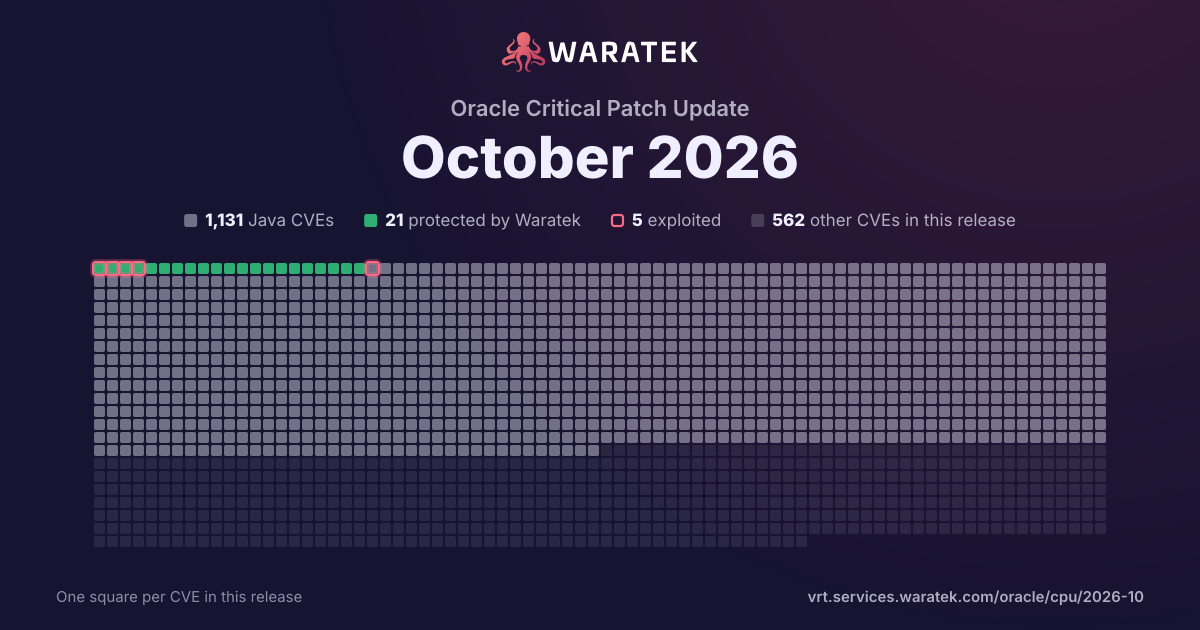
By status
20Protected by Waratek3Mitigation candidate1,109No exploit published12Outside Waratek scope549Not applicable
7Exploited, marked by the ring
No exploit published. For 855 of them, Oracle's security advisory is the source of public detail.
Protected by Waratek. Waratek RASP can block exploitation of these on systems that have not applied the patch yet.
Overview 15 matches · 2 protected · 1 exploited · 1 CISA KEV · 2 public PoC · 1 EPSS ≥ 0.5
Protected by Waratek
2
13.3%
Rule in development
0
0.0%
Mitigation candidate
1
6.7%
No exploit published
12
80.0%
blocked by ARMR today
2
13.3%
partly blocked
0
0.0%
not blocked
13
86.7%
not established
0
0.0%
unrecorded
0
0.0%
Exploited
1
6.7%
Working exploit published
0
0.0%
Proof of concept only
5
33.3%
Forecast only
0
0.0%
No public exploit
9
60.0%
split by
peak 9 / quarter
Q3 221
Protected by Waratek1
High1
blocked by ARMR today1
Proof of concept only1
Q4 220
Q1 230
Q2 230
Q3 230
Q4 231
Mitigation candidate1
High1
not blocked1
Exploited1
Q1 241
No exploit published1
High1
not blocked1
No public exploit1
Q2 240
Q3 240
Q4 241
No exploit published1
High1
not blocked1
No public exploit1
Q1 250
Q2 251
No exploit published1
High1
not blocked1
Proof of concept only1
Q3 250
Q4 250
Q1 261
Protected by Waratek1
High1
blocked by ARMR today1
No public exploit1
Q2 269
No exploit published9
High9
not blocked9
Proof of concept only3
No public exploit6
Q4 22Q2 23Q4 23Q2 24Q4 24Q2 25Q4 25Q2 26
| CVE | Severity | Published▾ | Status | Exploitation | Description |
|---|---|---|---|---|---|
| CVE-2026-44248 | High | 2026-05-13 | No exploit published | No public exploit | Netty is an asynchronous, event-driven network application framework. Prior to 4.2.13.Final and 4.1.133.Final, the MQTT 5 header Properties section is parsed and buffered before any message size limit is applied. Specifically, in MqttDecoder, the decodeVariableHeader() method is called before the bytesRemainingBeforeVariableHeader > maxBytesInMessage check. The decodeVariableHeader() can call other methods which will call decodeProperties(). Effectively, Netty does not apply any limits to the size of the properties being decoded. Additionally, because MqttDecoder extends ReplayingDecoder, Netty will repeatedly re-parse the enormous Properties sections and buffer the bytes in memory, until the entire thing parses to completion. This can cause high resource usage in both CPU and memory. This vulnerability is fixed in 4.2.13.Final and 4.1.133.Final. |
| CVE-2026-42587 | High | 2026-05-13 | No exploit published | Proof of concept only | Netty is an asynchronous, event-driven network application framework. Prior to 4.2.13.Final and 4.1.133.Final, HttpContentDecompressor accepts a maxAllocation parameter to limit decompression buffer size and prevent decompression bomb attacks. This limit is correctly enforced for gzip and deflate encodings via ZlibDecoder, but is silently ignored when the content encoding is br (Brotli), zstd, or snappy. An attacker can bypass the configured decompression limit by sending a compressed payload with Content-Encoding: br instead of Content-Encoding: gzip, causing unbounded memory allocation and out-of-memory denial of service. The same vulnerability exists in DelegatingDecompressorFrameListener for HTTP/2 connections. This vulnerability is fixed in 4.2.13.Final and 4.1.133.Final. |
| CVE-2026-42586 | High | 2026-05-13 | No exploit published | No public exploit | Netty is an asynchronous, event-driven network application framework. Prior to 4.2.13.Final and 4.1.133.Final, the Netty Redis codec encoder (RedisEncoder) writes user-controlled string content directly to the network output buffer without validating or sanitizing CRLF (\r\n) characters. Since the Redis Serialization Protocol (RESP) uses CRLF as the command/response delimiter, an attacker who can control the content of a Redis message can inject arbitrary Redis commands or forge fake responses. This vulnerability is fixed in 4.2.13.Final and 4.1.133.Final. |
| CVE-2026-42585 | High | 2026-05-13 | No exploit published | Proof of concept only | Netty is an asynchronous, event-driven network application framework. Prior to 4.2.13.Final and 4.1.133.Final, Netty incorrectly parses malformed Transfer-Encoding, enabling request smuggling attacks. This vulnerability is fixed in 4.2.13.Final and 4.1.133.Final. |
| CVE-2026-42583 | High | 2026-05-13 | No exploit published | Proof of concept only | Netty is an asynchronous, event-driven network application framework. Prior to 4.2.13.Final and 4.1.133.Final, Lz4FrameDecoder allocates a ByteBuf of size decompressedLength (up to 32 MB per block) before LZ4 runs. A peer only needs a 21-byte header plus compressedLength payload bytes - 22 bytes if compressedLength == 1 - to force that allocation. This vulnerability is fixed in 4.2.13.Final and 4.1.133.Final. |
| CVE-2026-42404 | High | 2026-05-01 | No exploit published | No public exploit | Apache Neethi does not impose any restrictions on URIs when manually fetching remote policy references through the PolicyReference API. When an application explicitly calls the API to retrieve a policy from a remote URI, an outbound request is made for arbitrary protocols and internal IP adddresses. From 3.2.2, only http or https URIs are allowed, and link-local/multicast/any-local addresses are forbidden. Users are recommended to upgrade to version 3.2.2, which fixes this issue. |
| CVE-2026-42403 | High | 2026-05-01 | No exploit published | No public exploit | Apache Neethi does not properly detect circular references in policy definitions. When a WS-Policy document contains circular policy references (where Policy A references Policy B which references Policy A), the policy normalization process can enter an infinite loop or cause excessive recursion, leading to a stack overflow or application hang. An attacker can craft malicious policy documents with circular references to cause a Denial of Service condition Users are recommended to upgrade to version 3.2.2, which fixes this issue. |
| CVE-2026-42402 | High | 2026-05-01 | No exploit published | No public exploit | Apache Neethi is vulnerable to a Denial of Service attack through algorithmic complexity in policy normalization. Specially crafted WS-Policy documents can trigger an exponential Cartesian cross-product expansion during the normalization process, causing unbounded memory allocation that exhausts the JVM heap. This occurs when the normalization process generates an excessive number of policy alternatives without bounds, leading to runtime memory exhaustion. Users should upgrade to 3.2.2 which limits the maximum number of normalized policy alternatives. |
| CVE-2026-5598 | High | 2026-04-15 | No exploit published | No public exploit | Covert timing channel vulnerability in Legion of the Bouncy Castle Inc. BC-JAVA core on all (core modules). This vulnerability is associated with program files FrodoEngine.Java. This issue affects BC-JAVA: from 1.71 before 1.80.2, from 1.81 before 1.81.1, from 1.82 before 1.84. |
| CVE-2025-67030 | High | 2026-03-25 | Protected by Waratek | No public exploit | Directory Traversal vulnerability in the extractFile method of org.codehaus.plexus.util.Expand in plexus-utils before 6d780b3378829318ba5c2d29547e0012d5b29642. This allows an attacker to execute arbitrary code |
| CVE-2025-48734 | High | 2025-05-28 | No exploit published | Proof of concept only | Improper Access Control vulnerability in Apache Commons. A special BeanIntrospector class was added in version 1.9.2. This can be used to stop attackers from using the declared class property of Java enum objects to get access to the classloader. However this protection was not enabled by default. PropertyUtilsBean (and consequently BeanUtilsBean) now disallows declared class level property access by default. Releases 1.11.0 and 2.0.0-M2 address a potential security issue when accessing enum properties in an uncontrolled way. If an application using Commons BeanUtils passes property paths from an external source directly to the getProperty() method of PropertyUtilsBean, an attacker can access the enum’s class loader via the “declaredClass” property available on all Java “enum” objects. Accessing the enum’s “declaredClass” allows remote attackers to access the ClassLoader and execute arbitrary code. The same issue exists with PropertyUtilsBean.getNestedProperty(). Starting in versions 1.11.0 and 2.0.0-M2 a special BeanIntrospector suppresses the “declaredClass” property. Note that this new BeanIntrospector is enabled by default, but you can disable it to regain the old behavior; see section 2.5 of the user's guide and the unit tests. This issue affects Apache Commons BeanUtils 1.x before 1.11.0, and 2.x before 2.0.0-M2.Users of the artifact commons-beanutils:commons-beanutils 1.x are recommended to upgrade to version 1.11.0, which fixes the issue. Users of the artifact org.apache.commons:commons-beanutils2 2.x are recommended to upgrade to version 2.0.0-M2, which fixes the issue. |
| CVE-2024-47072 | High | 2024-11-08 | No exploit published | No public exploit | XStream is a simple library to serialize objects to XML and back again. This vulnerability may allow a remote attacker to terminate the application with a stack overflow error resulting in a denial of service only by manipulating the processed input stream when XStream is configured to use the BinaryStreamDriver. XStream 1.4.21 has been patched to detect the manipulation in the binary input stream causing the the stack overflow and raises an InputManipulationException instead. Users are advised to upgrade. Users unable to upgrade may catch the StackOverflowError in the client code calling XStream if XStream is configured to use the BinaryStreamDriver. |
| CVE-2023-52428 | High | 2024-02-11 | No exploit published | No public exploit | In Connect2id Nimbus JOSE+JWT before 9.37.2, an attacker can cause a denial of service (resource consumption) via a large JWE p2c header value (aka iteration count) for the PasswordBasedDecrypter (PBKDF2) component. |
| CVE-2023-44487 | High | 2023-10-10 | Mitigation candidate | Exploited | The HTTP/2 protocol allows a denial of service (server resource consumption) because request cancellation can reset many streams quickly, as exploited in the wild in August through October 2023. |
| CVE-2022-34169 | High | 2022-07-19 | Protected by Waratek | Proof of concept only | The Apache Xalan Java XSLT library is vulnerable to an integer truncation issue when processing malicious XSLT stylesheets. This can be used to corrupt Java class files generated by the internal XSLTC compiler and execute arbitrary Java bytecode. Users are recommended to update to version 2.7.3 or later. Note: Java runtimes (such as OpenJDK) include repackaged copies of Xalan. |