
Oracle Critical Patch Update October 2026
Released October 2026 · Oracle's advisory ↗ · ← Security Patch Update, September 2026 · Security Patch Update, November 2026 →
1,693 CVEs in this release, one square each
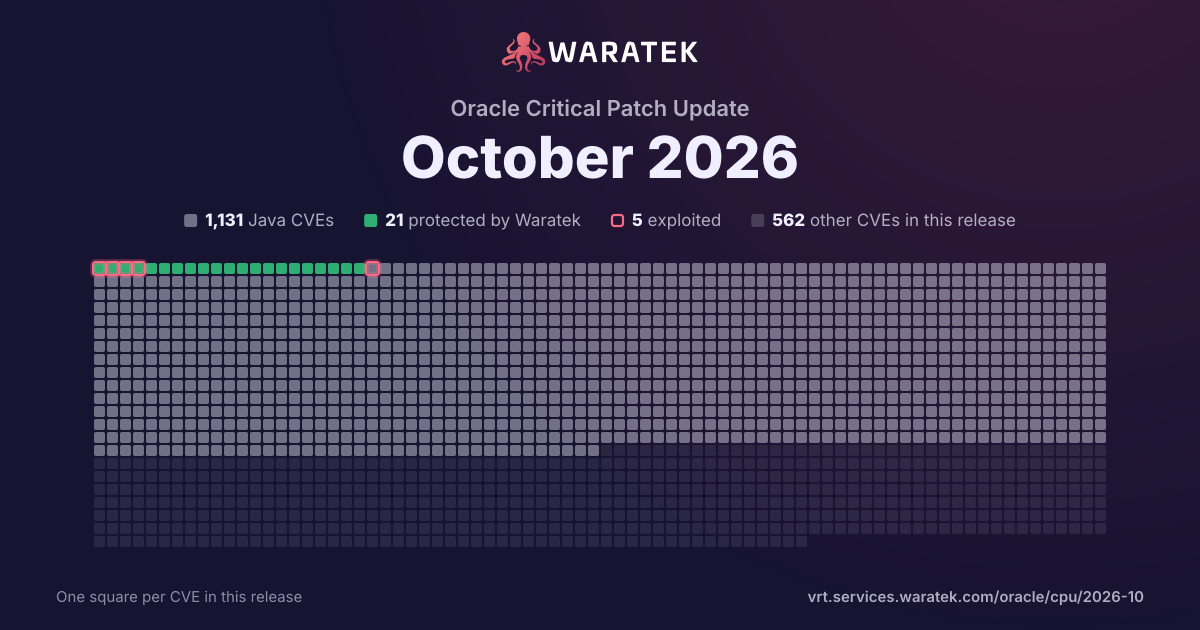
By status
20Protected by Waratek3Mitigation candidate1,109No exploit published12Outside Waratek scope549Not applicable
7Exploited, marked by the ring
No exploit published. For 855 of them, Oracle's security advisory is the source of public detail.
Protected by Waratek. Waratek RASP can block exploitation of these on systems that have not applied the patch yet.
Overview 10 matches · 0 protected · 0 exploited · 0 CISA KEV · 0 public PoC · 0 EPSS ≥ 0.5
10matches
0protected0.0%
0exploited0.0%
0CISA KEV0.0%
0public PoC0.0%
0EPSS ≥ 0.50.0%
Protected by Waratek
0
0.0%
Rule in development
0
0.0%
Mitigation candidate
0
0.0%
No exploit published
10
100.0%
blocked by ARMR today
0
0.0%
partly blocked
0
0.0%
not blocked
10
100.0%
not established
0
0.0%
unrecorded
0
0.0%
Exploited
0
0.0%
Working exploit published
0
0.0%
Proof of concept only
1
10.0%
Forecast only
0
0.0%
No public exploit
9
90.0%
split by
peak 9 / month
Sep 26Oct 26
| CVE | Severity | Published▾ | Status | Exploitation | Description |
|---|---|---|---|---|---|
| CVE-2026-91629 | Medium | 2026-10-20 | No exploit published | No public exploit | Vulnerability in the Oracle Communications Billing and Revenue Management product of Oracle Communications (component: Platform). Supported versions that are affected are 15.0.0.0.0, 15.0.1.0.0, 15.1.0.0.0 and 15.2.0.0.0. Difficult to exploit vulnerability allows low privileged attacker with logon to the infrastructure where Oracle Communications Billing and Revenue Management executes to compromise Oracle Communications Billing and Revenue Management. Successful attacks of this vulnerability can result in unauthorized access to critical data or complete access to all Oracle Communications Billing and Revenue Management accessible data. CVSS 3.1 Base Score 4.7 (Confidentiality impacts). CVSS Vector: (CVSS:3.1/AV:L/AC:H/PR:L/UI:N/S:U/C:H/I:N/A:N). |
| CVE-2026-91628 | Medium | 2026-10-20 | No exploit published | No public exploit | Vulnerability in the Oracle Communications Billing and Revenue Management product of Oracle Communications (component: BRM Server). Supported versions that are affected are 15.0.0.0.0, 15.0.1.0.0, 15.1.0.0.0 and 15.2.0.0.0. Easily exploitable vulnerability allows low privileged attacker with logon to the infrastructure where Oracle Communications Billing and Revenue Management executes to compromise Oracle Communications Billing and Revenue Management. Successful attacks of this vulnerability can result in unauthorized access to critical data or complete access to all Oracle Communications Billing and Revenue Management accessible data. CVSS 3.1 Base Score 5.5 (Confidentiality impacts). CVSS Vector: (CVSS:3.1/AV:L/AC:L/PR:L/UI:N/S:U/C:H/I:N/A:N). |
| CVE-2026-87297 | Medium | 2026-10-20 | No exploit published | No public exploit | Vulnerability in the Oracle Communications Billing and Revenue Management product of Oracle Communications (component: Platform). Supported versions that are affected are 15.0.0.0.0, 15.0.1.0.0, 15.1.0.0.0 and 15.2.0.0.0. Easily exploitable vulnerability allows high privileged attacker with logon to the infrastructure where Oracle Communications Billing and Revenue Management executes to compromise Oracle Communications Billing and Revenue Management. Successful attacks of this vulnerability can result in takeover of Oracle Communications Billing and Revenue Management. CVSS 3.1 Base Score 6.7 (Confidentiality, Integrity and Availability impacts). CVSS Vector: (CVSS:3.1/AV:L/AC:L/PR:H/UI:N/S:U/C:H/I:H/A:H). |
| CVE-2026-83406 | Medium | 2026-10-20 | No exploit published | No public exploit | Vulnerability in the Oracle Communications Billing and Revenue Management product of Oracle Communications (component: Platform). Supported versions that are affected are 15.0.0.0.0, 15.0.1.0.0, 15.1.0.0.0 and 15.2.0.0.0. Easily exploitable vulnerability allows high privileged attacker with logon to the infrastructure where Oracle Communications Billing and Revenue Management executes to compromise Oracle Communications Billing and Revenue Management. Successful attacks of this vulnerability can result in takeover of Oracle Communications Billing and Revenue Management. CVSS 3.1 Base Score 6.7 (Confidentiality, Integrity and Availability impacts). CVSS Vector: (CVSS:3.1/AV:L/AC:L/PR:H/UI:N/S:U/C:H/I:H/A:H). |
| CVE-2026-101807 | Medium | 2026-10-20 | No exploit published | No public exploit | Vulnerability in the Oracle Communications Billing and Revenue Management product of Oracle Communications (component: BRM Server). Supported versions that are affected are 15.0.0.0.0, 15.0.1.0.0, 15.1.0.0.0 and 15.2.0.0.0. Difficult to exploit vulnerability allows unauthenticated attacker with network access via HTTP to compromise Oracle Communications Billing and Revenue Management. Successful attacks of this vulnerability can result in unauthorized update, insert or delete access to some of Oracle Communications Billing and Revenue Management accessible data as well as unauthorized read access to a subset of Oracle Communications Billing and Revenue Management accessible data. CVSS 3.1 Base Score 4.8 (Confidentiality and Integrity impacts). CVSS Vector: (CVSS:3.1/AV:N/AC:H/PR:N/UI:N/S:U/C:L/I:L/A:N). |
| CVE-2026-101793 | Medium | 2026-10-20 | No exploit published | No public exploit | Vulnerability in the Oracle Communications BRM - Elastic Charging Engine product of Oracle Communications (component: Core). Supported versions that are affected are 15.0.0.0.0, 15.0.1.0.0, 15.1.0.0.0 and 15.2.0.0.0. Easily exploitable vulnerability allows low privileged attacker with logon to the infrastructure where Oracle Communications BRM - Elastic Charging Engine executes to compromise Oracle Communications BRM - Elastic Charging Engine. Successful attacks of this vulnerability can result in unauthorized access to critical data or complete access to all Oracle Communications BRM - Elastic Charging Engine accessible data. CVSS 3.1 Base Score 5.5 (Confidentiality impacts). CVSS Vector: (CVSS:3.1/AV:L/AC:L/PR:L/UI:N/S:U/C:H/I:N/A:N). |
| CVE-2026-101792 | Medium | 2026-10-20 | No exploit published | No public exploit | Vulnerability in the Oracle Communications BRM - Elastic Charging Engine product of Oracle Communications (component: Security). Supported versions that are affected are 15.0.0.0.0, 15.0.1.0.0, 15.1.0.0.0 and 15.2.0.0.0. Difficult to exploit vulnerability allows unauthenticated attacker with access to the physical communication segment attached to the hardware where the Oracle Communications BRM - Elastic Charging Engine executes to compromise Oracle Communications BRM - Elastic Charging Engine. Successful attacks of this vulnerability can result in unauthorized creation, deletion or modification access to critical data or all Oracle Communications BRM - Elastic Charging Engine accessible data as well as unauthorized read access to a subset of Oracle Communications BRM - Elastic Charging Engine accessible data. CVSS 3.1 Base Score 5.9 (Confidentiality and Integrity impacts). CVSS Vector: (CVSS:3.1/AV:A/AC:H/PR:N/UI:N/S:U/C:L/I:H/A:N). |
| CVE-2026-101764 | Medium | 2026-10-20 | No exploit published | No public exploit | Vulnerability in the Oracle Communications Billing and Revenue Management product of Oracle Communications (component: BRM Server). Supported versions that are affected are 15.0.0.0.0, 15.0.1.0.0, 15.1.0.0.0 and 15.2.0.0.0. Easily exploitable vulnerability allows low privileged attacker with logon to the infrastructure where Oracle Communications Billing and Revenue Management executes to compromise Oracle Communications Billing and Revenue Management. Successful attacks of this vulnerability can result in unauthorized access to critical data or complete access to all Oracle Communications Billing and Revenue Management accessible data. CVSS 3.1 Base Score 5.5 (Confidentiality impacts). CVSS Vector: (CVSS:3.1/AV:L/AC:L/PR:L/UI:N/S:U/C:H/I:N/A:N). |
| CVE-2026-101606 | Medium | 2026-10-20 | No exploit published | No public exploit | Vulnerability in the Oracle Communications Billing and Revenue Management product of Oracle Communications (component: BRM Server). Supported versions that are affected are 15.0.0.0.0, 15.0.1.0.0, 15.1.0.0.0 and 15.2.0.0.0. Easily exploitable vulnerability allows unauthenticated attacker with network access via TLS to compromise Oracle Communications Billing and Revenue Management. Successful attacks of this vulnerability can result in unauthorized update, insert or delete access to some of Oracle Communications Billing and Revenue Management accessible data as well as unauthorized read access to a subset of Oracle Communications Billing and Revenue Management accessible data. CVSS 3.1 Base Score 6.5 (Confidentiality and Integrity impacts). CVSS Vector: (CVSS:3.1/AV:N/AC:L/PR:N/UI:N/S:U/C:L/I:L/A:N). |
| CVE-2026-19032 | Medium | 2026-09-01 | No exploit published | Proof of concept only | jackson-databind's deserializer for java.nio.file.Path resolves an attacker-supplied URI without restricting the URI scheme. In JDKFromStringDeserializer.NioPathHelper.deserialize, a string bound from untrusted JSON is passed to new URI(value) and then to Path.of(uri). When that throws FileSystemNotFoundException, the code enumerates ServiceLoader<FileSystemProvider> and calls provider.getPath(uri) on the first provider whose scheme matches the attacker-chosen scheme. Untrusted JSON can therefore select and drive an arbitrary registered FileSystemProvider during readValue under a default JsonMapper, and forces provider class loading at the same time. With only the JDK built-in providers (file, jar/zipfs) present, the resolved path is inert and no mount or network I/O occurs; further impact requires a side-effecting third-party FileSystemProvider on the classpath. This affects com.fasterxml.jackson.core:jackson-databind from 2.8.0 before 2.18.10, from 2.19.0 before 2.21.6, and from 2.22.0 before 2.22.2, and tools.jackson.core:jackson-databind from 3.0.0 before 3.1.6 and from 3.2.0 before 3.2.2. Users should upgrade to 2.18.10, 2.21.6, 2.22.2, 3.1.6, or 3.2.2. Binding java.nio.file.Path from untrusted JSON should be avoided regardless of version. |