
Oracle Critical Patch Update October 2026
Released October 2026 · Oracle's advisory ↗ · ← Security Patch Update, September 2026 · Security Patch Update, November 2026 →
1,693 CVEs in this release, one square each
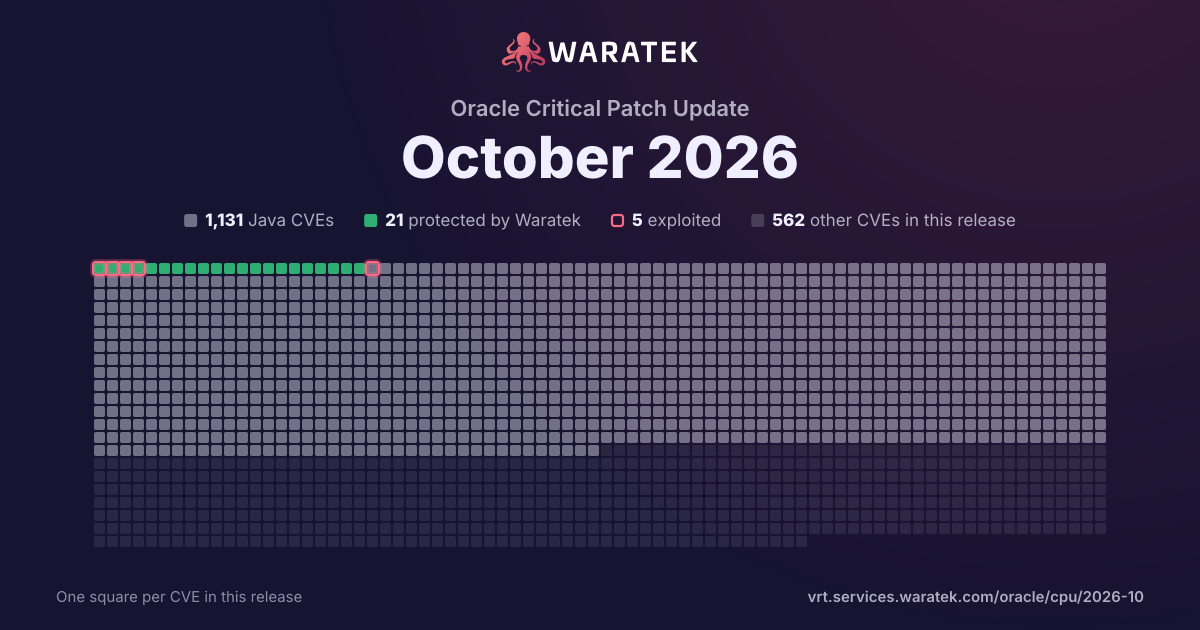
By status
20Protected by Waratek3Mitigation candidate1,109No exploit published12Outside Waratek scope549Not applicable
7Exploited, marked by the ring
No exploit published. For 855 of them, Oracle's security advisory is the source of public detail.
Protected by Waratek. Waratek RASP can block exploitation of these on systems that have not applied the patch yet.
Overview 118 matches · 0 protected · 1 exploited · 1 CISA KEV · 1 public PoC · 1 EPSS ≥ 0.5
Protected by Waratek
0
0.0%
Rule in development
0
0.0%
Mitigation candidate
1
0.8%
No exploit published
117
99.2%
blocked by ARMR today
0
0.0%
partly blocked
0
0.0%
not blocked
118
100.0%
not established
0
0.0%
unrecorded
0
0.0%
Exploited
1
0.8%
Working exploit published
0
0.0%
Proof of concept only
25
21.2%
Forecast only
0
0.0%
No public exploit
92
78.0%
split by
peak 68 / quarter
Q3 222
No exploit published2
High1
Low1
not blocked2
No public exploit2
Q4 220
Q1 230
Q2 232
No exploit published2
Medium2
not blocked2
No public exploit2
Q3 230
Q4 231
Mitigation candidate1
High1
not blocked1
Exploited1
Q1 240
Q2 240
Q3 240
Q4 244
No exploit published4
Critical1
High1
Medium2
not blocked4
Proof of concept only1
No public exploit3
Q1 251
No exploit published1
Medium1
not blocked1
Proof of concept only1
Q2 251
No exploit published1
High1
not blocked1
Proof of concept only1
Q3 252
No exploit published2
Medium2
not blocked2
No public exploit2
Q4 251
No exploit published1
Medium1
not blocked1
No public exploit1
Q1 266
No exploit published6
Critical3
High1
Medium2
not blocked6
Proof of concept only1
No public exploit5
Q2 2668
No exploit published68
Critical9
High27
Medium28
Low3
None1
not blocked68
Proof of concept only11
No public exploit57
Q3 2630
No exploit published30
Critical2
High16
Medium12
not blocked30
Proof of concept only10
No public exploit20
Q3 22Q1 23Q3 23Q1 24Q3 24Q1 25Q3 25Q1 26Q3 26
| CVE | Severity | Published▾ | Status | Exploitation | Description |
|---|---|---|---|---|---|
| CVE-2026-59920 | Medium | 2026-07-29 | No exploit published | Proof of concept only | Netty is an asynchronous, event-driven network application framework. In versions prior to 4.1.136.Final and 4.2.16.Final, Netty's STOMP encoder ( StompSubframeEncoder ) does not escape or validate header values in CONNECT and CONNECTED frames, so raw newline ( \n ) characters in a header value are written directly to the wire, allowing an attacker who controls a header value to inject additional STOMP headers. This happens because the encoder intentionally skips escaping for CONNECT/CONNECTED frames per the STOMP 1.2 specification but never rejects the raw newlines, and since a broker parses each line as a separate header, an attacker controlling a value such as a user-supplied login or passcode can overwrite connection parameters or add authentication/role headers to bypass authentication or escalate privileges (the actual impact is broker-dependent). The issue is fixed in versions 4.1.136.Final and 4.2.16.Final. |
| CVE-2026-59919 | Medium | 2026-07-29 | No exploit published | Proof of concept only | Netty is an asynchronous, event-driven network application framework. In versions prior to 4.1.136.Final and 4.2.16.Final, Netty's HAProxy encoder ( HAProxyMessageEncoder ) writes AF_UNIX source and destination socket addresses into the HAProxy V1 text protocol without validating them for CRLF characters, so an attacker who controls an AF_UNIX address can inject \r\n sequences and split the single PROXY header into multiple lines. This is possible because the V1 protocol uses CRLF as its line terminator and, unlike IPv4/IPv6 addresses whose format checks implicitly reject CRLF, AF_UNIX addresses are only validated for length (up to 108 bytes), allowing a forged second PROXY header line that spoofs the client source/destination IP to a downstream server or load balancer. The issue is fixed in versions 4.1.136.Final and 4.2.16.Final. |
| CVE-2026-59901 | High | 2026-07-29 | No exploit published | No public exploit | Netty is an asynchronous, event-driven network application framework. Prior to versions 4.1.136.Final and 4.2.16.Final, the `Bzip2Decoder` handler in Netty's compression codec pipeline is vulnerable to a denial-of-service attack through a malformed bzip2 stream that permanently captures the event-loop thread in an infinite loop. The vulnerability exists in the run-length encoding (RLE) state machine within [`Bzip2BlockDecompressor.read()`]. This issue has been fixed in versions 4.1.136.Final and 4.2.16.Final. |
| CVE-2026-59900 | Medium | 2026-07-29 | No exploit published | No public exploit | Netty is an asynchronous, event-driven network application framework. Prior to versions 4.1.136.Final and 4.2.16.Final, Netty's HTTP/2-to-HTTP/1.x translation layer (`Http2StreamFrameToHttpObjectCodec` and `InboundHttp2ToHttpAdapter`) fails to deduplicate or validate `Host` headers when an HTTP/2 client supplies both the `:authority` pseudo-header and a literal `host` header in a single HEADERS frame. The translator maps `:authority` to `Host` and separately copies the literal `host` header, producing an `HttpRequest` object containing two `Host` headers with attacker-controlled differing values. This issue has been fixed in versions 4.1.136.Final and 4.2.16.Final. |
| CVE-2026-59899 | Medium | 2026-07-29 | No exploit published | No public exploit | Netty is an asynchronous, event-driven network application framework. Prior to versions 4.1.136.Final and 4.2.16.Final, `HttpContentEncoder` (the superclass of the production handler `HttpContentCompressor`) maintains a per-channel `ArrayDeque<CharSequence>` named `acceptEncodingQueue` that accumulates attacker-controlled data without any size limit. The queue is filled on the I/O thread for every inbound HTTP request and drained only when the application later writes a non-1xx response. This creates a resource exhaustion vulnerability when an attacker exploits HTTP/1.1 pipelining to flood the connection with requests faster than the application produces responses. This issue has been fixed in versions 4.1.136.Final and 4.2.16.Final. |
| CVE-2026-59898 | Medium | 2026-07-29 | No exploit published | No public exploit | Netty is an asynchronous, event-driven network application framework. Prior to versions 4.1.136.Final and 4.2.16.Final, ab attacker can force WebSocket upgrade via the lax V07 (or V08) handshaker by sending `Sec-WebSocket-Version: 7` and omitting `Connection: Upgrade` / `Upgrade: websocket` headers, completing a protocol switch that a proxy would not recognize as an Upgrade request and enabling HTTP request smuggling / protocol-confusion attacks. This issue has been fixed in versions 4.1.136.Final and 4.2.16.Final. |
| CVE-2026-56822 | High | 2026-07-29 | No exploit published | Proof of concept only | Netty is an asynchronous, event-driven network application framework. Prior to versions 4.1.136.Final and 4.2.16.Final, the OcspServerCertificateValidator forwards the SslHandshakeCompletionEvent before the asynchronous OCSP validation completes. This allows the client's downstream handlers to send sensitive application data (e.g., HTTP requests) to a revoked server before the channel is closed by the OCSP check. n io.netty.handler.ssl.ocsp.OcspServerCertificateValidator#userEventTriggered, when an SslHandshakeCompletionEvent is received, the validator immediately calls ctx.fireUserEventTriggered(evt). It then initiates an asynchronous OCSP query using OcspClient.query. Because the handshake completion event is forwarded immediately, downstream handlers in the client's pipeline are notified that the TLS handshake is successful. They may then begin reading and processing incoming application data or sending outgoing data. If the OCSP response later indicates the server's certificate is REVOKED, the validator closes the channel, but by this time, the client may have already leaked sensitive data to a revoked server or processed malicious responses from it. This issue has been fixed in versions 4.1.136.Final and 4.2.16.Final. |
| CVE-2026-56821 | High | 2026-07-29 | No exploit published | Proof of concept only | Netty is an asynchronous, event-driven network application framework. Prior to versions 4.1.136.Final and 4.2.16.Final, the OcspServerCertificateValidator flags an out-of-date OCSP response but does not stop processing it, so an expired GOOD response is still reported as VALID, letting an on-path attacker replay a stale GOOD response to bypass revocation of a since-revoked certificate. Exploitation can lead to certificate revocation bypass via replay of an expired OCSP response. Any application using OcspServerCertificateValidator is affected; a revoked certificate can be accepted. This issue has been fixed in versions 4.1.136.Final and 4.2.16.Final. |
| CVE-2026-66299 | High | 2026-07-28 | No exploit published | No public exploit | Uncontrolled Resource Consumption vulnerability in Apache Tomcat's WebSocket chat example. This issue affects Apache Tomcat: from 11.0.0-M20 through 11.0.24, from 10.1.24 through 10.1.57, from 9.0.89 through 9.0.120. Users who have followed the security guidance to remove the examples web application are not affected by this issue. Users are recommended to remove the examples web application or to upgrade to version 11.0.25, 10.1.58 or 9.0.121 (when released), which fix the issue. |
| CVE-2026-59921 | Medium | 2026-07-28 | No exploit published | Proof of concept only | Netty is an asynchronous, event-driven network application framework. Prior to versions 4.1.136.Final and 4.2.16.Final, HttpPostRequestEncoder constructs multipart HTTP request bodies by directly concatenating user-supplied filenames and field names into Content-Disposition MIME headers without validating or sanitizing CRLF characters (\r\n). Since MIME headers are delimited by CRLF, an attacker who controls the filename can inject arbitrary MIME headers into the multipart body part. The root cause is that neither the encoder nor the FileUpload implementations' setFilename() methods, which only check for null, neutralize CRLF characters before the filename is embedded into the header. This issue has been fixed in versions 4.1.136.Final and 4.2.16.Final. |
| CVE-2026-48586 | High | 2026-07-27 | No exploit published | No public exploit | Improper Handling of Highly Compressed Data (Data Amplification) vulnerability in Apache Thrift C++, Java, Python, Go, D, C/GLib bindings. This issue affects Apache Thrift: before 0.24.0. Users are recommended to upgrade to version 0.24.0, which fixes the issue. |
| CVE-2026-43871 | High | 2026-07-27 | No exploit published | No public exploit | Loop with Unreachable Exit Condition ('Infinite Loop') vulnerability in Apache Thrift Python, Go, PHP and Java bindings.This issue affects Apache Thrift: before 0.24.0. Users are recommended to upgrade to version 0.24.0, which fixes the issue. |
| CVE-2026-56820 | Critical | 2026-07-21 | No exploit published | Proof of concept only | Netty is a network application framework for development of protocol servers and clients. In versions 4.2.0.Final through 4.2.15.Final and prior to 4.1.135.Final, `OcspClient` does not validate that the `CertificateID` in an OCSP response matches the requested `CertificateID`, which can lead to replay attack. `OcspClient.validateResponse` accepts a legitimately signed `GOOD` status response for an unrelated certificate issued by the same CA, allowing bypass of revocation checks for another certificate. This issue is fixed in versions 4.1.136.Final and 4.2.16.Final. |
| CVE-2026-56819 | High | 2026-07-21 | No exploit published | Proof of concept only | Netty is a network application framework for development of protocol servers and clients. In versions 4.2.0.Final through 4.2.15.Final and 4.1.0.Final through 4.1.135.Final, a remote unauthenticated peer can leak one direct `ByteBuf` per HTTP/2 `DATA` frame in applications that enable HTTP/2 content decompression via `DelegatingDecompressorFrameListener`. When a `DATA` frame is processed for a stream whose decompressor has already been closed, `Http2Decompressor.decompress(...)` calls `decompressor.writeInbound(data.retain())` and does not release the retained buffer on the error path, eventually exhausting direct memory and crashing the JVM. This issue is fixed in versions 4.1.136.Final and 4.2.16.Final. |
| CVE-2026-56816 | High | 2026-07-21 | No exploit published | No public exploit | Netty is a network application framework for development of protocol servers and clients. Prior to 4.2.16.Final, Netty's `Http3FrameCodec` buffers incoming data for HTTP/3 reserved frame types up to the wire-specified payload length without limits; `decodeFrame` trusts `payLoadLength`, allowing an attacker to open multiple QUIC streams and send reserved frames with very large payload lengths to cause memory exhaustion and denial of service. This issue is fixed in version 4.2.16.Final. |
| CVE-2026-56746 | Medium | 2026-07-21 | No exploit published | No public exploit | Netty is a network application framework for development of protocol servers and clients. Versions 4.2.0.Final through 4.2.15.Final and 4.1.0.Final through 4.1.135.Final, are vulnerable to security control bypass during the origin evaluation process. CorsHandler provides a shortCircuit() configuration designed to reject unauthorized cross-origin requests immediately, acting as a security control before requests reach the application. However, due to a logical operator error in the origin evaluation process, this protection can be entirely bypassed. An attacker can bypass the short-circuit mechanism by sending a request with an Origin: null header. This failure forwards unauthorized requests to the backend application, bypassing intended access controls. This issue is fixed in versions 4.1.136.Final and 4.2.16.Final. |
| CVE-2026-56745 | High | 2026-07-21 | No exploit published | No public exploit | Netty is a network application framework for development of protocol servers and clients. In versions 4.2.0.Final through 4.2.15.Final and 4.1.0.Final through 4.1.135.Final, the `SpdyHttpDecoder` handler in Netty's SPDY-to-HTTP codec allocates a pooled `ByteBuf` when processing a client-initiated `SYN_STREAM` frame with `FLAG_FIN=0` and stores the partially constructed `FullHttpRequest` in `messageMap`; when the remote peer sends `RST_STREAM` for that stream or the accumulated content exceeds `maxContentLength`, the decoder removes the entry but does not release the pooled `ByteBuf`, causing native memory exhaustion. This issue is fixed in versions 4.1.136.Final and 4.2.16.Final. |
| CVE-2026-55851 | High | 2026-07-21 | No exploit published | No public exploit | Netty is a network application framework for development of protocol servers and clients. In versions 4.2.0.Final up to (but not including) 4.2.16.Final, and 4.1.0.Final up to (but not including) 4.1.135, the `HAProxyMessageDecoder` in Netty's `codec-haproxy` module performs protocol version detection by reading the 13th byte as a signed Java `byte` and widening it to `int` without masking; a PROXY protocol v2 binary prefix followed by version byte `0xFF` sign-extends to `-1`, collides with the decoder's need-more-data sentinel, and causes `ByteToMessageDecoder` to accumulate inbound bytes in an unbounded `cumulation` buffer until direct memory is exhausted. This issue is fixed in versions 4.1.136.Final and 4.2.16.Final. |
| CVE-2026-55833 | High | 2026-07-21 | No exploit published | No public exploit | Netty is a network application framework for development of protocol servers and clients. Prior to 4.1.136.Final and 4.2.16.Final, Netty SPDY header decoding continues inflating zlib-compressed header blocks after the raw header parser has exceeded `maxHeaderSize` and marked the frame truncated in `SpdyFrameCodec`, allowing a remote peer to send a small compressed `HEADERS` block that expands into much larger raw header data and causes compression-amplified CPU and allocation churn. This issue is fixed in versions 4.1.136.Final and 4.2.16.Final. |
| CVE-2026-55831 | High | 2026-07-21 | No exploit published | Proof of concept only | Netty is a network application framework for development of protocol servers and clients. Prior to 4.1.136.Final and 4.2.16.Final, Netty's SPDY SETTINGS decoder accepts a peer-declared SETTINGS entry count up to the 24-bit frame-length limit and materializes every unique setting ID in `DefaultSpdySettingsFrame`, allowing a remote SPDY/3.1 peer to send a syntactically valid roughly 2 MiB SETTINGS frame that creates 262144 map entries and amplifies network input into heap growth and ordered-map insertion work. This issue is fixed in versions 4.1.136.Final and 4.2.16.Final. |
| CVE-2026-56740 | High | 2026-07-17 | No exploit published | Proof of concept only | JLine is a Java library for handling console input. Prior to 3.30.14, 4.0.16, and 4.2.1, the JLine3 Telnet server remote-telnet module does not limit the number of environment variables a client may inject via the Telnet NEW-ENVIRON option, and TelnetIO.readNEVariables() in TelnetIO.java:1127-1180 stores each variable pair in a HashMap held by ConnectionData, allowing an unauthenticated attacker to flood unique variable pairs before the terminating IAC SE byte and exhaust JVM heap memory with an OutOfMemoryError. This issue is fixed in versions 3.30.14, 4.0.16, and 4.2.1. |
| CVE-2026-44891 | High | 2026-07-17 | No exploit published | Proof of concept only | Netty is a network application framework for development of protocol servers and clients. Prior to 4.1.136.Final and 4.2.16.Final, io.netty.handler.codec.stomp.StompSubframeDecoder fails to limit the total number of headers or their cumulative size per frame, and the maxLineLength parameter only restricts individual header lines. An attacker can send a large number of short headers that are accumulated in memory inside DefaultStompHeadersSubframe until the JVM throws an OutOfMemoryError, causing denial of service for servers exposing a STOMP endpoint based on StompSubframeDecoder. This issue is fixed in versions 4.1.136.Final and 4.2.16.Final. |
| CVE-2026-6790 | Medium | 2026-07-14 | No exploit published | No public exploit | In Eclipse Jetty, for HTTP/1, HTTP/2 and HTTP/3 requests, there is no strict check that the request authority (host and port) matches what provided in the Host header (if present). This was not enforced in earlier HTTP RFC (for example, in RFC 2616), but it is in the latest RFC (9110 and 9112). This mismatch can cause a number of problems that may be classified as vulnerabilities such as: * URI constructions (for example, for redirects -- this is typical for login pages) * Virtual host selection * Reverse proxying * Misleading logs * Etc. Given that the latest RFCs require that request authority and Host header must match, Jetty should enforce this invariant. |
| CVE-2026-59889 | Medium | 2026-07-14 | No exploit published | No public exploit | jackson-databind contains the general-purpose data-binding functionality and tree-model for Jackson Data Processor. From 2.18.0 until 2.18.9, 2.21.5, 2.22.1, 3.1.5, and 3.2.1, UnwrappedPropertyHandler.processUnwrapped() replays buffered JSON for a @JsonUnwrapped property and calls prop.deserializeAndSet() without a prop.visibleInView(ctxt.getActiveView()) guard, allowing a property annotated with both @JsonView and @JsonUnwrapped to be written from attacker JSON under a less-privileged active view. This issue is fixed in versions 2.18.9, 2.21.5, 2.22.1, 3.1.5, and 3.2.1. |
| CVE-2026-59888 | Medium | 2026-07-14 | No exploit published | No public exploit | jackson-databind contains the general-purpose data-binding functionality and tree-model for Jackson Data Processor. From 2.15.0 until 2.18.8, 2.21.4, and 3.1.4, Java Records using a PropertyNamingStrategy can bypass @JsonIgnore because POJOPropertiesCollector._removeUnwantedIgnorals() records an ignored component under its original implicit name before _renameUsing() applies the naming strategy, allowing the renamed JSON key to be assigned to the Record constructor parameter. This issue is fixed in versions 2.18.8, 2.21.4, and 3.1.4. |
| CVE-2026-59083 | Critical | 2026-07-14 | No exploit published | No public exploit | Improper Handling of URL Encoding (Hex Encoding) vulnerability in Apache Tomcat's rewrite valve allowed security constraint bypass for some configurations. This issue affects Apache Tomcat: from 11.0.0-M1 through 11.0.23, from 10.1.0-M1 through 10.1.56, from 9.0.0.M1 through 9.0.119, from 8.5.0 through 8.5.100. Other versions that have reached end of support may also be affected. Users are recommended to upgrade to version 11.0.24, 10.1.57 or 9.0.120, which fix the issue. |
| CVE-2026-10051 | Medium | 2026-07-14 | No exploit published | No public exploit | In Eclipse Jetty, a first HTTP/1.1 request with trailers causes the server to retain the trailers in subsequent requests performed over the same connection. Subsequent request that do not have trailers report the trailers of the first request. Subsequent request that do have trailers report the union of trailers of the first request and the current request. |
| CVE-2026-49844 | Medium | 2026-07-10 | No exploit published | No public exploit | Improper encoding of non-finite floating-point values during MapMessage JSON serialization in Apache Log4j API produces output that is not valid JSON. This issue affects Apache Log4j API versions 2.13.1 through 2.25.4 and version 2.26.0. The fix for CVE-2026-34481 did not cover all code paths: when a MapMessage contains a non-finite IEEE 754 value (NaN, Infinity, or -Infinity), MapMessage.asJson() emits the corresponding bare token. RFC 8259 does not permit these tokens, so a conformant parser rejects the resulting document. The defect is reachable only when both of the following conditions hold: * The application uses the message resolver https://logging.apache.org/log4j/2.x/manual/json-template-layout.html#event-template-resolver-message of JsonTemplateLayout or any other layout that relies on MapMessage.asJson() or MapMessage.getFormattedMessage(new String[]{"JSON"}). * The application logs a MapMessage that contains an attacker-controlled floating-point value. An attacker who can supply a non-finite value can cause the affected layout to emit malformed JSON, which may corrupt the enclosing log record or disrupt downstream log ingestion and parsing. Users are advised to upgrade to Apache Log4j API 2.25.5 or 2.26.1, both of which emit RFC 8259-compliant JSON for non-finite values. |
| CVE-2026-54291 | High | 2026-07-06 | No exploit published | No public exploit | pgjdbc is an open source postgresql JDBC Driver. In releases 42.7.4 through 42.7.11, channelBinding=require connections can be silently downgraded from SCRAM-SHA-256-PLUS with channel binding to plain SCRAM-SHA-256 without it, losing the man-in-the-middle protection the setting is meant to guarantee. An attacker who can intercept the TLS connection can trigger the downgrade with a certificate whose signature algorithm has no tls-server-end-point channel-binding hash, because the bundled com.ongres.scram:scram-client returns an empty byte array instead of failing and pgJDBC ScramAuthenticator checks only that the server advertised a PLUS mechanism, without rejecting the empty binding or checking that the negotiated mechanism uses channel binding. This issue is fixed in version 42.7.12. |
| CVE-2026-54399 | High | 2026-07-01 | No exploit published | No public exploit | Uncontrolled Resource Consumption vulnerability in the HTTP/1.1 message parser in Apache HttpComponents Core (5.4.2 and earlier, 5.5-beta1 and earlier) allows an remote attacker to cause a denial of service through memory exhaustion by sending messages with excessive number of headers / excessive header length |
| CVE-2026-55957 | High | 2026-06-29 | No exploit published | No public exploit | Missing Critical Step in Authentication vulnerability in Apache Tomcat when the JNDIRealm was configured to authenticate binds using GSSAPI allowed attackers to authenticate without provided the correct password. This issue affects Apache Tomcat: from 11.0.0-M1 through 11.0.4, from 10.1.0-M1 through 10.1.36, from 9.0.0.M1 through 9.0.100, from 8.5.0 through 8.5.100, from 7.0.0 through 7.0.109. Users are recommended to upgrade to version 11.0.5, 10.1.37 or 9.0.101, which fixes the issue. |
| CVE-2026-55956 | Medium | 2026-06-29 | No exploit published | No public exploit | Improper Authorization vulnerability in Apache Tomcat leads to security constraints specified for the default servlet ignoring any method or method omission configured as part of the constraint. This issue affects Apache Tomcat: from 11.0.0-M1 through 11.0.22, from 10.1.0-M1 through 10.1.55, from 9.0.0.M1 through 9.0.118, from 8.5.0 through 8.5.100, from 7.0.0 through 7.0.109. Other versions that have reached end of support may also be affected. Users are recommended to upgrade to version 11.0.23, 10.1.56 or 9.0.119, which fix the issue. |
| CVE-2026-55955 | Medium | 2026-06-29 | No exploit published | No public exploit | Improper Authentication vulnerability in Apache Tomcat allowed a replay attack against the EncryptionInterceptor in the cluster component. This issue affects Apache Tomcat: from 11.0.0-M1 through 11.0.22, from 10.1.0-M1 through 10.1.55, from 9.0.13 through 9.0.18, from 8.5.38 through 8.5.100, from 7.0.100 through 7.0.109. Users are recommended to upgrade to version 11.0.23, 10.1.56, 9.0.119, which fixes the issue. |
| CVE-2026-55276 | Critical | 2026-06-29 | No exploit published | No public exploit | Always-Incorrect Control Flow Implementation vulnerability in Apache Tomcat meant that special roles and empty authorisation constraints were not included when the effective web.xml was logged. This issue affects Apache Tomcat: from 11.0.0-M1 through 11.0.22, from 10.1.0-M1 through 10.1.55, from 9.0.0.M1 through 9.0.118, from 8.5.0 through 8.5.100. Other versions that have reached end of support may also be affected. Users are recommended to upgrade to version 11.0.23, 10.1.56 or 9.0.119 which fixes the issue. |
| CVE-2026-53434 | Critical | 2026-06-29 | No exploit published | No public exploit | Detection of Error Condition Without Action vulnerability in Apache Tomcat when configuring CRLs for a FFM based connector. This issue affects Apache Tomcat: from 11.0.0-M1 through 11.0.22, from 10.1.0-M7 through 10.1.55, from 9.0.83 through 9.0.118. Users are recommended to upgrade to version 11.0.23, 10.1.56 or 9.0.119, which fixes the issue. |
| CVE-2026-53404 | High | 2026-06-29 | No exploit published | No public exploit | Always-Incorrect Control Flow Implementation vulnerability in Apache Tomcat's rewrite valve meant that if the first condition in an OR chain matched, subsequent non-OR conditions were skipped. This issue affects Apache Tomcat: from 11.0.0-M1 through 11.0.22, from 10.1.0-M1 through 10.1.55, from 9.0.0.M1 through 9.0.118, from 8.5.0 through 8.5.100. Other versions that have reached end of support may also be affected. Users are recommended to upgrade to version 11.0.23, 10.1.56 or 9.0.119, which fix the issue. |
| CVE-2026-56130 | Low | 2026-06-25 | No exploit published | No public exploit | "Remember me" cookie age is not verified on the server. This potentially allows an attacker to intercept a valid cookie and reuse it indefinitely, even after the configured expiration time has passed. This issue affects all Apache Shiro versions from 1.2.4 through 2.x, and 3.0.0-alpha-1, only when RememberMe functionality is enabled. Upgrade to version 3.0.0 or later, which fixes the issue. |
| CVE-2026-56091 | High | 2026-06-25 | No exploit published | No public exploit | When using Apache Shiro with the shiro-guice module in a web servlet context, a specially crafted HTTP request may cause an authentication bypass. This vulnerability is similar to https://www.cve.org/CVERecord?id=CVE-2020-1957 https://www.cve.org/CVERecord , except that it affects the `shiro-guice` module instead of the `shiro-spring` module. This issue affects all Apache Shiro versions through 2.x, and 3.0.0-alpha-1 only when using `shiro-guice` module in a web servlet context. Upgrade to version 3.0.0 or later, which fixes the issue. |
| CVE-2026-54518 | Medium | 2026-06-23 | No exploit published | No public exploit | jackson-databind contains the general-purpose data-binding functionality and tree-model for Jackson Data Processor. From 2.21.0 until 2.21.4 and 3.1.4, UnwrappedPropertyHandler.processUnwrappedCreatorProperties() replays buffered JSON into creator parameters but never consults prop.visibleInView(activeView). The normal property-based creator path gates creator properties on the active view, but this unwrapped-creator replay path bypasses that check, so a constructor parameter annotated with both @JsonView(AdminView.class) and @JsonUnwrapped is populated from attacker JSON even when a more restrictive view is active. This vulnerability is fixed in 2.21.4 and 3.1.4. |
| CVE-2026-54517 | Medium | 2026-06-23 | No exploit published | No public exploit | jackson-databind contains the general-purpose data-binding functionality and tree-model for Jackson Data Processor. From 2.21.0 until 2.21.4 and 3.1.4, in BeanDeserializer._deserializeUsingPropertyBased, the active-view (@JsonView) filter was applied only to creator properties; the regular property-buffering branch performed no prop.visibleInView(activeView) check. A change making SetterlessProperty.isMerging() return true routed setterless Collection/Map properties through this unguarded path, so a setterless collection annotated with a restricted @JsonView is populated from attacker JSON even when the active view excludes it. This vulnerability is fixed in 2.21.4 and 3.1.4. |
| CVE-2026-54516 | Medium | 2026-06-23 | No exploit published | No public exploit | jackson-databind contains the general-purpose data-binding functionality and tree-model for Jackson Data Processor. From 2.21.0 until 2.21.4 and 3.1.4, POJOPropertiesCollector._renameProperties() allows a property with @JsonProperty("renamed") on the getter and @JsonIgnore on the setter to be renamed rather than dropped. With MapperFeature.INFER_PROPERTY_MUTATORS enabled (default), the private backing field is retained; during deserialization BeanDeserializerFactory.addBeanProps() sees hasField()==true, builds a FieldProperty, and makes the backing field writable. An attacker supplying the renamed JSON key writes the backing field directly, bypassing the @JsonIgnore on the setter. This vulnerability is fixed in 3.1.4. |
| CVE-2026-54514 | Medium | 2026-06-23 | No exploit published | No public exploit | jackson-databind contains the general-purpose data-binding functionality and tree-model for Jackson Data Processor. From 2.0.0 until 2.18.8, 2.21.4, and 3.1.4, JDKFromStringDeserializer constructed InetSocketAddress with new InetSocketAddress(host, port), which performs eager DNS name resolution for hostname inputs at deserialization time. An application that binds untrusted JSON into a type containing an InetSocketAddress field issues an attacker-chosen DNS query during readValue, before any application-level validation or connect logic. The fix uses InetSocketAddress.createUnresolved(host, port), deferring DNS to an explicit connect. This vulnerability is fixed in 2.18.8, 2.21.4, and 3.1.4. |
| CVE-2026-54512 | High | 2026-06-23 | No exploit published | Proof of concept only | jackson-databind contains the general-purpose data-binding functionality and tree-model for Jackson Data Processor. From 2.10.0 until 2.18.8, 2.21.4, and 3.1.4, jackson-databind's PolymorphicTypeValidator (PTV) is the primary safety mechanism guarding polymorphic deserialization. When polymorphic typing is enabled and a type identifier contains generic parameters (i.e. the type ID string contains <), DatabindContext._resolveAndValidateGeneric() validates only the raw container class name (the substring before <) against the configured PTV. If the container type is approved, the method parses the full canonical type string via TypeFactory.constructFromCanonical() and returns the fully parameterized type without ever validating the nested type arguments against the PTV. The nested type arguments are then resolved, instantiated, and populated as beans during deserialization. An attacker who controls the type ID can therefore place a denied class as a generic type parameter of an allowed container — for example java.util.ArrayList<com.evil.Gadget> when only java.util.ArrayList is allow-listed. The container passes the PTV check; com.evil.Gadget is loaded via Class.forName(name, true, loader), instantiated, and its properties are set from attacker-controlled JSON. This completely bypasses an explicitly configured PTV allow-list. This vulnerability is fixed in 2.18.8, 2.21.4, and 3.1.4. |
| CVE-2026-49268 | High | 2026-06-17 | No exploit published | No public exploit | A remote attacker can inject LDAP special characters into the Distinguished Name (DN) construction in DefaultLdapRealm class. User-supplied username input is directly concatenated into the LDAP DN template without any escaping of RFC 2253 special characters. This allows an attacker to manipulate the DN structure used for LDAP bind authentication, potentially bypassing authentication or impersonating other users. This issue affects all Apache Shiro versions through 2.2.0, and 3.0.0-alpha-1 when using DefaultLdapRealm Upgrade to Apache Shiro 2.2.1 or 3.0.0-alpha-2 or later, which fixes the issue. |
| CVE-2026-45416 | High | 2026-06-12 | No exploit published | No public exploit | Netty is a network application framework for development of protocol servers and clients. Prior to versions 4.1.135.Final and 4.2.15.Final, SslClientHelloHandler.decode() reads the 24-bit TLS handshake length and, when the ClientHello does not fit in the first record, eagerly allocates `ctx.alloc().buffer(handshakeLength)` (line 161). The guard at line 140 is `handshakeLength > maxClientHelloLength && maxClientHelloLength != 0`, and the commonly-used SniHandler/AbstractSniHandler constructors (SniHandler(Mapping), SniHandler(AsyncMapping), AbstractSniHandler()) pass maxClientHelloLength=0 and handshakeTimeoutMillis=0, so the length guard is disabled and no timeout is scheduled. A 16 MiB request exceeds the default pooled chunk size and becomes a huge/unpooled allocation performed immediately. The buffer is retained in the handler until the channel closes. Versions 4.1.135.Final and 4.2.15.Final patch the issue. |
| CVE-2026-44249 | High | 2026-06-11 | No exploit published | No public exploit | Netty is a network application framework for development of protocol servers and clients. In netty-handler prior to versions 4.1.135.Final and 4.2.15.Final, an attacker can bypass IPv6 subnet rules due to an incorrect masking operation in IpSubnetFilterRule.compareTo(). Valid public IP addresses can bypass the restrictions. Versions 4.1.135.Final and 4.2.15.Final patch the issue. |
| CVE-2026-41001 | Medium | 2026-06-11 | No exploit published | No public exploit | Spring Boot's ArtemisEmbeddedConfigurationFactory uses a fixed, static path for the embedded Artemis message broker's data directory when no explicit path is configured. A local attacker on the same host can pre-create this predictable directory or place a symlink before the application starts. Affected versions: Spring Boot 4.0.0 through 4.0.6; 3.5.0 through 3.5.14; 3.4.0 through 3.4.16; 3.3.0 through 3.3.19; 2.7.0 through 2.7.33. |
| CVE-2026-40992 | Medium | 2026-06-11 | No exploit published | No public exploit | Spring Boot's Mail auto-configuration does not enable hostname verification. Applications that set the relevant JavaMail property, such as spring.mail.properties.mail.smtp.ssl.checkserveridentity=true, are not affected. Affected versions: Spring Boot 4.0.0 through 4.0.6; 3.5.0 through 3.5.14; 3.4.0 through 3.4.16. |
| CVE-2026-41855 | Critical | 2026-06-09 | No exploit published | No public exploit | In an untrusted JMS environment, org.springframework.jms.support.converter.MappingJackson2MessageConverter and org.springframework.jms.support.converter.JacksonJsonMessageConverter allow arbitrary class instantiation, which can lead to unauthorized actions via gadget class deserialization. Affected versions: Spring Framework 7.0.0 through 7.0.7; 6.2.0 through 6.2.18; 6.1.0 through 6.1.27; 5.3.0 through 5.3.48. |
| CVE-2026-41854 | Medium | 2026-06-09 | No exploit published | No public exploit | Due to incorrect host parsing, applications that rely on UriComponentsBuilder to parse and validate an externally provided URL string may be exposed to a server-side request forgery (SSRF) attack. Affected versions: Spring Framework 7.0.0 through 7.0.7; 6.2.0 through 6.2.18. |
| CVE-2026-41853 | Medium | 2026-06-09 | No exploit published | No public exploit | Spring MVC and WebFlux applications are vulnerable to Multipart request smuggling attacks. Affected versions: Spring Framework 7.0.0 through 7.0.7; 6.2.0 through 6.2.18; 6.1.0 through 6.1.27; 5.3.0 through 5.3.48. |
| CVE-2026-41852 | Medium | 2026-06-09 | No exploit published | No public exploit | A vulnerability in Spring Expression Language (SpEL) evaluation logic allows for arbitrary zero-argument method invocation, even within restricted or read-only contexts, which may allow an attacker to invoke unintended application logic. Affected versions: Spring Framework 7.0.0 through 7.0.7; 6.2.0 through 6.2.18; 6.1.0 through 6.1.27; 5.3.0 through 5.3.48. |
| CVE-2026-41851 | High | 2026-06-09 | No exploit published | No public exploit | Applications which accept user-supplied Spring Expression Language (SpEL) expressions may be vulnerable to a Denial of Service (DoS) attack if the evaluation of a SpEL expression triggers unbounded cache growth. Affected versions: Spring Framework 7.0.0 through 7.0.7; 6.2.0 through 6.2.18; 6.1.0 through 6.1.27; 5.3.0 through 5.3.48. |
| CVE-2026-41850 | High | 2026-06-09 | No exploit published | No public exploit | Applications that evaluate user-supplied Spring Expression Language (SpEL) expressions are vulnerable to an Algorithmic Denial of Service (DoS). By providing a specially crafted expression, an attacker can trigger excessive resource consumption during evaluation, leading to application degradation or unavailability. Affected versions: Spring Framework 7.0.0 through 7.0.7; 6.2.0 through 6.2.18; 6.1.0 through 6.1.27; 5.3.0 through 5.3.48. |
| CVE-2026-41848 | High | 2026-06-09 | No exploit published | No public exploit | Applications may be vulnerable to a Regular Expression Denial of Service (ReDoS) attack if an attacker is able to provide a pattern which is then directly or indirectly supplied to one of the following methods in AntPathMatcher: match(String pattern, String path), matchStart(String pattern, String path), extractUriTemplateVariables(String pattern, String path). Affected versions: Spring Framework 7.0.0 through 7.0.7; 6.2.0 through 6.2.18; 6.1.0 through 6.1.27; 5.3.0 through 5.3.48. |
| CVE-2026-41846 | Medium | 2026-06-09 | No exploit published | No public exploit | Spring MVC applications which accept user-supplied values in the cssClass, cssErrorClass, or cssStyle attributes of JSP form tags allow arbitrary HTML/JavaScript code injection, potentially resulting in a cross-site scripting (XSS) vulnerability. Affected versions: Spring Framework 7.0.0 through 7.0.7; 6.2.0 through 6.2.18; 6.1.0 through 6.1.27; 5.3.0 through 5.3.48. |
| CVE-2026-41845 | High | 2026-06-09 | No exploit published | No public exploit | Due to incorrect escaping, the use of JavaScriptUtils.javaScriptEscape() may lead to JavaScript code injection in the browser, potentially resulting in a cross-site scripting (XSS) vulnerability. Affected versions: Spring Framework 7.0.0 through 7.0.7; 6.2.0 through 6.2.18; 6.1.0 through 6.1.27; 5.3.0 through 5.3.48. |
| CVE-2026-41844 | Medium | 2026-06-09 | No exploit published | No public exploit | A Spring MVC or Spring WebFlux application which configures a mapping for "/**" where the view name is not explicitly specified allows an attacker to craft a link resulting in a 302 redirect to an arbitrary external host via the redirect: prefix. Affected versions: Spring Framework 7.0.0 through 7.0.7; 6.2.0 through 6.2.18; 6.1.0 through 6.1.27; 5.3.0 through 5.3.48. |
| CVE-2026-41842 | High | 2026-06-09 | No exploit published | No public exploit | Spring MVC and WebFlux applications are vulnerable to Denial of Service (DoS) attacks when resolving static resources. Affected versions: Spring Framework 7.0.0 through 7.0.7; 6.2.0 through 6.2.18; 6.1.0 through 6.1.27; 5.3.0 through 5.3.48. |
| CVE-2026-41841 | Medium | 2026-06-09 | No exploit published | No public exploit | Spring MVC and WebFlux applications are vulnerable to Information Disclosure attacks when resolving static resources. Affected versions: Spring Framework 7.0.0 through 7.0.7; 6.2.0 through 6.2.18; 6.1.0 through 6.1.27; 5.3.0 through 5.3.48. |
| CVE-2026-41840 | Medium | 2026-06-09 | No exploit published | No public exploit | Spring WebFlux applications are vulnerable to Denial of Service (DoS) attacks when processing multipart requests. Affected versions: Spring Framework 7.0.0 through 7.0.7, 6.2.0 through 6.2.18, 6.1.0 through 6.1.27, 5.3.0 through 5.3.48. |
| CVE-2026-41839 | Medium | 2026-06-09 | No exploit published | No public exploit | A WebFlux application with a compromised subdomain (for example, compromised via cross-site scripting (XSS)) is vulnerable to an escalation attack exchanging a known session ID for that of an authenticated user. Affected versions: Spring Framework 7.0.0 through 7.0.7; 6.2.0 through 6.2.18; 6.1.0 through 6.1.27; 5.3.0 through 5.3.48. |
| CVE-2026-41838 | High | 2026-06-09 | No exploit published | No public exploit | IDs for WebSocket sessions in the spring-websocket module are not cryptographically unpredictable, which may be possible to exploit in combination with inadequate authorization rules. Affected versions: Spring Framework 7.0.0 through 7.0.7; 6.2.0 through 6.2.18; 6.1.0 through 6.1.27; 5.3.0 through 5.3.48. |
| CVE-2026-45292 | High | 2026-05-28 | No exploit published | No public exploit | opentelemetry-java is the Java implementation of the OpenTelemetry API for recording telemetry, and SDK for managing telemetry recorded by the API. Prior to 1.62.0, a vulnerability affects the baggage propagation implementation in opentelemetry-api and opentelemetry-extension-trace-propagators. Parsing oversized baggage causes unbounded memory allocation and CPU consumption. Because baggage is automatically re-injected into every outgoing request, the effect can fan out to downstream services that never received the original malicious request. This vulnerability is fixed in 1.62.0. |
| CVE-2026-48589 | None | 2026-05-25 | No exploit published | No public exploit | Apache Shiro’s Jakarta EE module used the HTTP Referer header in certain cases to issue redirect after a user login. In affected versions, insufficient validation of this client-controlled value could allow an attacker to influence the redirect target in applications using the Jakarta EE module. This issue affects Apache Shiro from 2.0-alpha to 2.2.0, and 3.0.0-alpha-1, only when using shiro-jakarta-ee integration module. |
| CVE-2026-44598 | Medium | 2026-05-25 | No exploit published | No public exploit | With valid login credentials, URL Redirection to Untrusted Site ('Open Redirect'), Server-Side Request Forgery (SSRF) vulnerability in Apache Shiro. This issue affects Apache Shiro from 2.0-alpha to 2.1.0, and 3.0.0-alpha-1, only when using shiro-jakarta-ee integration module. Users are recommended to upgrade to version 2.1.1, or 3.0.0-alpha-2 or later, which fixes the issue by encrypting the cookie. After successful login, Jakarta EE integration module uses shiroSavedRequest cookie to redirect to a particular web page after login. This cookie was not validated, and can be forged to send a HTTP GET request from the server itself to an arbitrary URL from the cookie. |
| CVE-2026-43828 | Medium | 2026-05-25 | No exploit published | No public exploit | Default configurations of Apache Shiro send sensitive cookies in HTTPS session without 'Secure' attribute. This issue affects Apache Shiro from 1.0 to 2.1.0, and 3.0.0-alpha-1. Users are recommended to upgrade to version 2.1.1, or 3.0.0-alpha-2 or later, which fixes the issue. In the affected versions, Shiro-native session manager, as well as Remember-Me manager sends JSESSIONID and rememberMe cookies without 'secure' attribute by default. |
| CVE-2026-43827 | Medium | 2026-05-25 | No exploit published | No public exploit | Default configurations of Apache Shiro have a session fixation vulnerability. This issue affects Apache Shiro from 1.0 to 2.1.0, and 3.0.0-alpha-1. Users are recommended to upgrade to version 2.1.1, or 3.0.0-alpha-2 or later, which fixes the issue. In the affected versions, when a session already exists, it is not invalidated upon successful login, nor is a new session being generated with a new ID. |
| CVE-2026-44248 | High | 2026-05-13 | No exploit published | No public exploit | Netty is an asynchronous, event-driven network application framework. Prior to 4.2.13.Final and 4.1.133.Final, the MQTT 5 header Properties section is parsed and buffered before any message size limit is applied. Specifically, in MqttDecoder, the decodeVariableHeader() method is called before the bytesRemainingBeforeVariableHeader > maxBytesInMessage check. The decodeVariableHeader() can call other methods which will call decodeProperties(). Effectively, Netty does not apply any limits to the size of the properties being decoded. Additionally, because MqttDecoder extends ReplayingDecoder, Netty will repeatedly re-parse the enormous Properties sections and buffer the bytes in memory, until the entire thing parses to completion. This can cause high resource usage in both CPU and memory. This vulnerability is fixed in 4.2.13.Final and 4.1.133.Final. |
| CVE-2026-42587 | High | 2026-05-13 | No exploit published | Proof of concept only | Netty is an asynchronous, event-driven network application framework. Prior to 4.2.13.Final and 4.1.133.Final, HttpContentDecompressor accepts a maxAllocation parameter to limit decompression buffer size and prevent decompression bomb attacks. This limit is correctly enforced for gzip and deflate encodings via ZlibDecoder, but is silently ignored when the content encoding is br (Brotli), zstd, or snappy. An attacker can bypass the configured decompression limit by sending a compressed payload with Content-Encoding: br instead of Content-Encoding: gzip, causing unbounded memory allocation and out-of-memory denial of service. The same vulnerability exists in DelegatingDecompressorFrameListener for HTTP/2 connections. This vulnerability is fixed in 4.2.13.Final and 4.1.133.Final. |
| CVE-2026-42586 | High | 2026-05-13 | No exploit published | No public exploit | Netty is an asynchronous, event-driven network application framework. Prior to 4.2.13.Final and 4.1.133.Final, the Netty Redis codec encoder (RedisEncoder) writes user-controlled string content directly to the network output buffer without validating or sanitizing CRLF (\r\n) characters. Since the Redis Serialization Protocol (RESP) uses CRLF as the command/response delimiter, an attacker who can control the content of a Redis message can inject arbitrary Redis commands or forge fake responses. This vulnerability is fixed in 4.2.13.Final and 4.1.133.Final. |
| CVE-2026-42585 | High | 2026-05-13 | No exploit published | Proof of concept only | Netty is an asynchronous, event-driven network application framework. Prior to 4.2.13.Final and 4.1.133.Final, Netty incorrectly parses malformed Transfer-Encoding, enabling request smuggling attacks. This vulnerability is fixed in 4.2.13.Final and 4.1.133.Final. |
| CVE-2026-42584 | Critical | 2026-05-13 | No exploit published | Proof of concept only | Netty is an asynchronous, event-driven network application framework. Prior to 4.2.13.Final and 4.1.133.Final, HttpClientCodec pairs each inbound response with an outbound request by queue.poll() once per response, including for 1xx. If the client pipelines GET then HEAD and the server sends 103, then 200 with GET body, then 200 for HEAD, the queue pairs HEAD with the first 200. The HEAD rule then skips reading that message’s body, so the GET entity bytes stay on the stream and the following 200 is parsed from the wrong offset. This vulnerability is fixed in 4.2.13.Final and 4.1.133.Final. |
| CVE-2026-42583 | High | 2026-05-13 | No exploit published | Proof of concept only | Netty is an asynchronous, event-driven network application framework. Prior to 4.2.13.Final and 4.1.133.Final, Lz4FrameDecoder allocates a ByteBuf of size decompressedLength (up to 32 MB per block) before LZ4 runs. A peer only needs a 21-byte header plus compressedLength payload bytes - 22 bytes if compressedLength == 1 - to force that allocation. This vulnerability is fixed in 4.2.13.Final and 4.1.133.Final. |
| CVE-2026-42581 | Critical | 2026-05-13 | No exploit published | Proof of concept only | Netty is an asynchronous, event-driven network application framework. Prior to 4.2.13.Final and 4.1.133.Final, HttpObjectDecoder strips a conflicting Content-Length header when a request carries both Transfer-Encoding: chunked and Content-Length, but only for HTTP/1.1 messages. The guard is absent for HTTP/1.0. An attacker that sends an HTTP/1.0 request with both headers causes Netty to decode the body as chunked while leaving Content-Length intact in the forwarded HttpMessage. Any downstream proxy or handler that trusts Content-Length over Transfer-Encoding will disagree on message boundaries, enabling request smuggling. This vulnerability is fixed in 4.2.13.Final and 4.1.133.Final. |
| CVE-2026-42580 | Medium | 2026-05-13 | No exploit published | Proof of concept only | Netty is an asynchronous, event-driven network application framework. Prior to 4.2.13.Final and 4.1.133.Final, Netty's chunk size parser silently overflows int, enabling request smuggling attacks. This vulnerability is fixed in 4.2.13.Final and 4.1.133.Final. |
| CVE-2026-42579 | Critical | 2026-05-13 | No exploit published | Proof of concept only | Netty is an asynchronous, event-driven network application framework. Prior to 4.2.13.Final and 4.1.133.Final, Netty's DNS codec does not enforce RFC 1035 domain name constraints during either encoding or decoding. This creates a bidirectional attack surface: malicious DNS responses can exploit the decoder, and user-influenced hostnames can exploit the encoder. This vulnerability is fixed in 4.2.13.Final and 4.1.133.Final. |
| CVE-2026-42578 | Low | 2026-05-13 | No exploit published | Proof of concept only | Netty is an asynchronous, event-driven network application framework. Prior to 4.2.13.Final and 4.1.133.Final, Netty's HttpProxyHandler constructs HTTP CONNECT requests with header validation explicitly disabled. The newInitialMessage() method creates headers using DefaultHttpHeadersFactory.headersFactory().withValidation(false), then adds user-provided outboundHeaders without any CRLF validation. This allows an attacker who can influence the outbound headers to inject arbitrary HTTP headers into the CONNECT request sent to the proxy server. This vulnerability is fixed in 4.2.13.Final and 4.1.133.Final. |
| CVE-2026-43515 | Critical | 2026-05-12 | No exploit published | No public exploit | Improper Authorization vulnerability when multiple method constraints define an HTTP method for the same extension in Apache Tomcat. This issue affects Apache Tomcat: from 11.0.0-M1 through 11.0.21, from 10.1.0-M1 through 10.1.54, from 9.0.0.M1 through 9.0.117, from 8.5.0 through 8.5.100, from 7.0.0 through 7.0.109. Users are recommended to upgrade to version 11.0.22, 10.1.55 or 9.0.118 which fix the issue. |
| CVE-2026-43514 | Low | 2026-05-12 | No exploit published | No public exploit | Observable Timing Discrepancy vulnerability when comparing AJP secret in Apache Tomcat. This issue affects Apache Tomcat: from 11.0.0-M1 through 11.0.21, from 10.1.0-M1 through 10.1.54, from 9.0.0.M1 through 9.0.117, from 8.5.0 through 8.5.100, from 7.0.0 through 7.0.109. Older unsupported versions may also be affected. Users are recommended to upgrade to version 11.0.22, 10.1.55 or 9.0.118 which fix the issue. |
| CVE-2026-43513 | High | 2026-05-12 | No exploit published | No public exploit | Improper Handling of Case Sensitivity vulnerability in LockOutRealm in Apache Tomcat. This issue affects Apache Tomcat: from 11.0.0-M1 through 11.0.21, from 10.1.0-M1 through 10.1.54, from 9.0.0.M1 through 9.0.117, from 8.5.0 through 8.5.100, from 7.0.0 through 7.0.109. Older unsupported versions may also be affected. Users are recommended to upgrade to version 11.0.22, 10.1.55 or 9.0.118 which fix the issue. |
| CVE-2026-43512 | Critical | 2026-05-12 | No exploit published | No public exploit | DEPRECATED: Authentication Bypass Issues vulnerability in digest authentication in Apache Tomcat. This issue affects Apache Tomcat: from 11.0.0-M1 through 11.0.21, from 10.1.0-M1 through 10.1.54, from 9.0.0.M1 through 9.0.117, from 8.5.0 through 8.5.100, from before 7.0.0. Older unsupported versions any also be affect Users are recommended to upgrade to version 11.0.22, 10.1.55 or 9.0.118 which fix the issue. |
| CVE-2026-42498 | High | 2026-05-12 | No exploit published | No public exploit | Exposure of HTTP Authentication Header to unexpected hosts during WebSocket authentication vulnerability in Apache Tomcat. This issue affects Apache Tomcat: from 11.0.0-M1 through 11.0.21, from 10.1.0-M1 through 10.1.54, from 9.0.2 through 9.0.117, from 8.5.24 through 8.5.100, from 7.0.83 through 7.0.109. Users are recommended to upgrade to version 11.0.22, 10.1.55 or 9.0.118, which fix the issue. |
| CVE-2026-41284 | High | 2026-05-12 | No exploit published | No public exploit | Allocation of Resources Without Limits or Throttling vulnerability in Apache Tomcat. This issue affects Apache Tomcat: from 11.0.0-M1 through 11.0.21, from 10.1.0-M1 through 10.1.54, from 9.0.0.M1 through 9.0.117. Older, unsupported versions may also be affected. Users are recommended to upgrade to version [FIXED_VERSION], which fixes the issue. |
| CVE-2026-41417 | Medium | 2026-05-06 | No exploit published | Proof of concept only | Netty allows request-line validation to be bypassed when a `DefaultHttpRequest` or `DefaultFullHttpRequest` is created first and its URI is later changed via `setUri()`. The constructors reject CRLF and whitespace characters that would break the start-line, but `setUri()` does not apply the same validation. `HttpRequestEncoder` and `RtspEncoder` then write the URI into the request line verbatim. If attacker-controlled input reaches `setUri()`, this enables CRLF injection and insertion of additional HTTP or RTSP requests, leading to HTTP request smuggling or desynchronization on the HTTP side and request injection on the RTSP side. This issue is fixed in versions 4.2.13.Final and 4.1.133.Final. |
| CVE-2026-43869 | High | 2026-05-05 | No exploit published | No public exploit | Improper Validation of Certificate with Host Mismatch vulnerability in Apache Thrift. This issue affects Apache Thrift: before 0.23.0. Users are recommended to upgrade to version 0.23.0, which fixes the issue. |
| CVE-2026-22751 | Medium | 2026-04-21 | No exploit published | No public exploit | Vulnerability in Spring Spring Security. Applications that explicitly configure One-Time Token login with JdbcOneTimeTokenService are vulnerable to a Time-of-check Time-of-use (TOCTOU) race condition. This issue affects Spring Security: from 6.4.0 through 6.4.15, from 6.5.0 through 6.5.9, from 7.0.0 through 7.0.4. |
| CVE-2026-2332 | Critical | 2026-04-14 | No exploit published | Proof of concept only | In Eclipse Jetty, the HTTP/1.1 parser is vulnerable to request smuggling when chunk extensions are used, similar to the "funky chunks" techniques outlined here: * https://w4ke.info/2025/06/18/funky-chunks.html * https://w4ke.info/2025/10/29/funky-chunks-2.html Jetty terminates chunk extension parsing at \r\n inside quoted strings instead of treating this as an error. POST / HTTP/1.1 Host: localhost Transfer-Encoding: chunked 1;ext="val X 0 GET /smuggled HTTP/1.1 ... Note how the chunk extension does not close the double quotes, and it is able to inject a smuggled request. |
| CVE-2026-34481 | Medium | 2026-04-10 | No exploit published | No public exploit | Apache Log4j's JsonTemplateLayout https://logging.apache.org/log4j/2.x/manual/json-template-layout.html , in versions up to and including 2.25.3, produces invalid JSON output when log events contain non-finite floating-point values (NaN, Infinity, or -Infinity), which are prohibited by RFC 8259. This may cause downstream log processing systems to reject or fail to index affected records. An attacker can exploit this issue only if both of the following conditions are met: * The application uses JsonTemplateLayout. * The application logs a MapMessage, or logs an object directly (e.g., via Logger.info(Object), which wraps it in an ObjectMessage), where the message contains an attacker-controlled floating-point value. Users are advised to upgrade to Apache Log4j JSON Template Layout 2.25.4, which corrects this issue. Note: The fix released in version 2.25.4 did not cover all affected code paths. CVE-2026-49844 was assigned to the remaining issue, which concerns the MapMessage.asJson() serialization in Apache Log4j API and is fixed in versions 2.25.5 and 2.26.1. |
| CVE-2026-34480 | Medium | 2026-04-10 | No exploit published | No public exploit | Apache Log4j Core's XmlLayout https://logging.apache.org/log4j/2.x/manual/layouts.html#XmlLayout , in versions up to and including 2.25.3, fails to sanitize characters forbidden by the XML 1.0 specification https://www.w3.org/TR/xml/#charsets producing invalid XML output whenever a log message or MDC value contains such characters. The impact depends on the StAX implementation in use: * JRE built-in StAX: Forbidden characters are silently written to the output, producing malformed XML. Conforming parsers must reject such documents with a fatal error, which may cause downstream log-processing systems to drop the affected records. * Alternative StAX implementations (e.g., Woodstox https://github.com/FasterXML/woodstox , a transitive dependency of the Jackson XML Dataformat module): An exception is thrown during the logging call, and the log event is never delivered to its intended appender, only to Log4j's internal status logger. Users are advised to upgrade to Apache Log4j Core 2.25.4, which corrects this issue by sanitizing forbidden characters before XML output. |
| CVE-2026-34479 | Medium | 2026-04-10 | No exploit published | No public exploit | The Log4j1XmlLayout from the Apache Log4j 1-to-Log4j 2 bridge fails to escape characters forbidden by the XML 1.0 standard, producing malformed XML output. Conforming XML parsers are required to reject documents containing such characters with a fatal error, which may cause downstream log processing systems to drop or fail to index affected records. Two groups of users are affected: * Those using Log4j1XmlLayout directly in a Log4j Core 2 configuration file. * Those using the Log4j 1 configuration compatibility layer with org.apache.log4j.xml.XMLLayout specified as the layout class. Users are advised to upgrade to Apache Log4j 1-to-Log4j 2 bridge version 2.25.4, which corrects this issue. Note: The Apache Log4j 1-to-Log4j 2 bridge is deprecated and will not be present in Log4j 3. Users are encouraged to consult the Log4j 1 to Log4j 2 migration guide https://logging.apache.org/log4j/2.x/migrate-from-log4j1.html , and specifically the section on eliminating reliance on the bridge. |
| CVE-2026-34478 | Medium | 2026-04-10 | No exploit published | No public exploit | Apache Log4j Core's Rfc5424Layout https://logging.apache.org/log4j/2.x/manual/layouts.html#RFC5424Layout , in versions 2.21.0 through 2.25.3, is vulnerable to log injection via CRLF sequences due to undocumented renames of security-relevant configuration attributes. Two distinct issues affect users of stream-based syslog services who configure Rfc5424Layout directly: * The newLineEscape attribute was silently renamed, causing newline escaping to stop working for users of TCP framing (RFC 6587), exposing them to CRLF injection in log output. * The useTlsMessageFormat attribute was silently renamed, causing users of TLS framing (RFC 5425) to be silently downgraded to unframed TCP (RFC 6587), without newline escaping. Users of the SyslogAppender are not affected, as its configuration attributes were not modified. Users are advised to upgrade to Apache Log4j Core 2.25.4, which corrects this issue. |
| CVE-2026-34477 | Medium | 2026-04-10 | No exploit published | No public exploit | The fix for CVE-2025-68161 https://logging.apache.org/security.html#CVE-2025-68161 was incomplete: it addressed hostname verification only when enabled via the log4j2.sslVerifyHostName https://logging.apache.org/log4j/2.x/manual/systemproperties.html#log4j2.sslVerifyHostName system property, but not when configured through the verifyHostName https://logging.apache.org/log4j/2.x/manual/appenders/network.html#SslConfiguration-attr-verifyHostName attribute of the <Ssl> element. Although the verifyHostName configuration attribute was introduced in Log4j Core 2.12.0, it was silently ignored in all versions through 2.25.3, leaving TLS connections vulnerable to interception regardless of the configured value. A network-based attacker may be able to perform a man-in-the-middle attack when all of the following conditions are met: * An SMTP, Socket, or Syslog appender is in use. * TLS is configured via a nested <Ssl> element. * The attacker can present a certificate issued by a CA trusted by the appender's configured trust store, or by the default Java trust store if none is configured. This issue does not affect users of the HTTP appender, which uses a separate verifyHostname https://logging.apache.org/log4j/2.x/manual/appenders/network.html#HttpAppender-attr-verifyHostName attribute that was not subject to this bug and verifies host names by default. Users are advised to upgrade to Apache Log4j Core 2.25.4, which corrects this issue. |
| CVE-2026-34500 | Medium | 2026-04-09 | No exploit published | No public exploit | CLIENT_CERT authentication does not fail as expected for some scenarios when soft fail is disabled and FFM is used in Apache Tomcat. This issue affects Apache Tomcat: from 11.0.0-M14 through 11.0.20, from 10.1.22 through 10.1.53, from 9.0.92 through 9.0.116. Users are recommended to upgrade to version 11.0.21, 10.1.54 or 9.0.117, which fixes the issue. |
| CVE-2026-34487 | High | 2026-04-09 | No exploit published | No public exploit | Insertion of Sensitive Information into Log File vulnerability in the cloud membership for clustering component of Apache Tomcat exposed the Kubernetes bearer token. This issue affects Apache Tomcat: from 11.0.0-M1 through 11.0.20, from 10.1.0-M1 through 10.1.53, from 9.0.13 through 9.0.116. Users are recommended to upgrade to version 11.0.21, 10.1.54 or 9.0.117, which fix the issue. |
| CVE-2026-34483 | High | 2026-04-09 | No exploit published | No public exploit | Improper Encoding or Escaping of Output vulnerability in the JsonAccessLogValve component of Apache Tomcat. This issue affects Apache Tomcat: from 11.0.0-M1 through 11.0.20, from 10.1.0-M1 through 10.1.53, from 9.0.40 through 9.0.116. Users are recommended to upgrade to version 11.0.21, 10.1.54 or 9.0.117 , which fix the issue. |
| CVE-2026-24880 | High | 2026-04-09 | No exploit published | No public exploit | Inconsistent Interpretation of HTTP Requests ('HTTP Request/Response Smuggling') vulnerability in Apache Tomcat via invalid chunk extension. This issue affects Apache Tomcat: from 11.0.0-M1 through 11.0.18, from 10.1.0-M1 through 10.1.52, from 9.0.0.M1 through 9.0.115, from 8.5.0 through 8.5.100, from 7.0.0 through 7.0.109. Other, unsupported versions may also be affected. Users are recommended to upgrade to version 11.0.20, 10.1.52 or 9.0.116, which fix the issue. |
| CVE-2026-5795 | High | 2026-04-08 | No exploit published | No public exploit | In Eclipse Jetty, the class JASPIAuthenticator initiates the authentication checks, which set two ThreadLocal variable. Upon returning from the initial checks, there are conditions that cause an early return from the JASPIAuthenticator code without clearing those ThreadLocals. A subsequent request using the same thread inherits the ThreadLocal values, leading to a broken access control and privilege escalation. |
| CVE-2026-33870 | High | 2026-03-27 | No exploit published | Proof of concept only | Netty is an asynchronous, event-driven network application framework. In versions prior to 4.1.132.Final and 4.2.10.Final, Netty incorrectly parses quoted strings in HTTP/1.1 chunked transfer encoding extension values, enabling request smuggling attacks. Versions 4.1.132.Final and 4.2.10.Final fix the issue. |
| CVE-2026-28369 | Critical | 2026-03-27 | No exploit published | No public exploit | A flaw was found in Undertow. When Undertow receives an HTTP request where the first header line starts with one or more spaces, it incorrectly processes the request by stripping these leading spaces. This behavior, which violates HTTP standards, can be exploited by a remote attacker to perform request smuggling. Request smuggling allows an attacker to bypass security mechanisms, access restricted information, or manipulate web caches, potentially leading to unauthorized actions or data exposure. |