
Oracle Critical Patch Update April 2026
Released April 2026 · Oracle's advisory ↗ · ← Critical Patch Update, January 2026 · Security Patch Update, May 2026 →
421 CVEs in this release, one square each
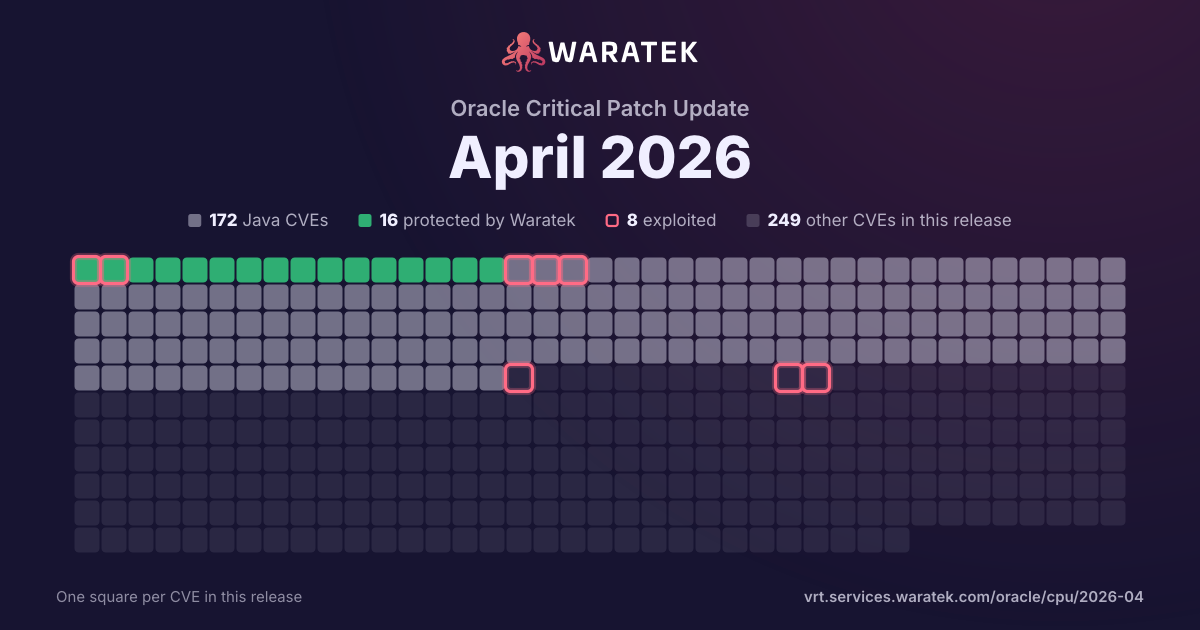
By status
16Protected by Waratek4Mitigation candidate152No exploit published10Outside Waratek scope239Not applicable
8Exploited, marked by the ring
No exploit published. For 51 of them, Oracle's security advisory is the source of public detail.
Protected by Waratek. Waratek RASP can block exploitation of these on systems that have not applied the patch yet.
Overview 8 matches · 1 exploited · 0 CISA KEV · 0 public PoC · 2 EPSS ≥ 0.5
Protected by Waratek
8
100.0%
Rule in development
0
0.0%
Mitigation candidate
0
0.0%
No exploit published
0
0.0%
Outside Waratek scope
0
0.0%
Not applicable
0
0.0%
Withdrawn CVE
0
0.0%
blocked by ARMR today
8
100.0%
partly blocked
0
0.0%
not blocked
0
0.0%
not established
0
0.0%
unrecorded
0
0.0%
Exploited
1
12.5%
Working exploit published
0
0.0%
Proof of concept only
2
25.0%
Forecast only
2
25.0%
No public exploit
3
37.5%
split by
peak 3 / quarter
Q1 222
Protected by Waratek2
High2
blocked by ARMR today2
Forecast only2
Q2 220
Q3 220
Q4 220
Q1 231
Protected by Waratek1
High1
blocked by ARMR today1
Exploited1
Q2 230
Q3 230
Q4 230
Q1 240
Q2 240
Q3 240
Q4 240
Q1 250
Q2 251
Protected by Waratek1
High1
blocked by ARMR today1
No public exploit1
Q3 250
Q4 250
Q1 263
Protected by Waratek3
High3
blocked by ARMR today3
Proof of concept only2
No public exploit1
Q2 261
Protected by Waratek1
High1
blocked by ARMR today1
No public exploit1
Q2 22Q4 22Q2 23Q4 23Q2 24Q4 24Q2 25Q4 25Q2 26
| CVE | Severity | Published▾ | Status | Exploitation | Description |
|---|---|---|---|---|---|
| CVE-2026-22016 | High | 2026-04-21 | Protected by Waratek | No public exploit | Vulnerability in the Oracle Java SE, Oracle GraalVM for JDK, Oracle GraalVM Enterprise Edition product of Oracle Java SE (component: JAXP). Supported versions that are affected are Oracle Java SE: 8u481, 8u481-b50, 8u481-perf, 11.0.30, 17.0.18, 21.0.10, 25.0.2, 26; Oracle GraalVM for JDK: 17.0.18 and 21.0.10; Oracle GraalVM Enterprise Edition: 21.3.17. Easily exploitable vulnerability allows unauthenticated attacker with network access via multiple protocols to compromise Oracle Java SE, Oracle GraalVM for JDK, Oracle GraalVM Enterprise Edition. Successful attacks of this vulnerability can result in unauthorized access to critical data or complete access to all Oracle Java SE, Oracle GraalVM for JDK, Oracle GraalVM Enterprise Edition accessible data. Note: This vulnerability can be exploited by using APIs in the specified Component, e.g., through a web service which supplies data to the APIs. This vulnerability also applies to Java deployments, typically in clients running sandboxed Java Web Start applications or sandboxed Java applets, that load and run untrusted code (e.g., code that comes from the internet) and rely on the Java sandbox for security. CVSS 3.1 Base Score 7.5 (Confidentiality impacts). CVSS Vector: (CVSS:3.1/AV:N/AC:L/PR:N/UI:N/S:U/C:H/I:N/A:N). |
| CVE-2026-27830 | High | 2026-02-26 | Protected by Waratek | No public exploit | c3p0, a JDBC Connection pooling library, is vulnerable to attack via maliciously crafted Java-serialized objects and `javax.naming.Reference` instances. Several c3p0 `ConnectionPoolDataSource` implementations have a property called `userOverridesAsString` which conceptually represents a `Map<String,Map<String,String>>`. Prior to v0.12.0, that property was maintained as a hex-encoded serialized object. Any attacker able to reset this property, on an existing `ConnectionPoolDataSource` or via maliciously crafted serialized objects or `javax.naming.Reference` instances could be tailored execute unexpected code on the application's `CLASSPATH`. The danger of this vulnerability was strongly magnified by vulnerabilities in c3p0's main dependency, mchange-commons-java. This library includes code that mirrors early implementations of JNDI functionality, including ungated support for remote `factoryClassLocation` values. Attackers could set c3p0's `userOverridesAsString` hex-encoded serialized objects that include objects "indirectly serialized" via JNDI references. Deserialization of those objects and dereferencing of the embedded `javax.naming.Reference` objects could provoke download and execution of malicious code from a remote `factoryClassLocation`. Although hazard presented by c3p0's vulnerabilites are exarcerbated by vulnerabilities in mchange-commons-java, use of Java-serialized-object hex as the format for a writable Java-Bean property, of objects that may be exposed across JNDI interfaces, represents a serious independent fragility. The `userOverridesAsString` property of c3p0 `ConnectionPoolDataSource` classes has been reimplemented to use a safe CSV-based format, rather than rely upon potentially dangerous Java object deserialization. c3p0-0.12.0+ and above depend upon mchange-commons-java 0.4.0+, which gates support for remote `factoryClassLocation` values by configuration parameters that default to restrictive values. c3p0 additionally enforces the new mchange-commons-java `com.mchange.v2.naming.nameGuardClassName` to prevent injection of unexpected, potentially remote JNDI names. There is no supported workaround for versions of c3p0 prior to 0.12.0. |
| CVE-2026-27727 | High | 2026-02-25 | Protected by Waratek | Proof of concept only | mchange-commons-java, a library that provides Java utilities, includes code that mirrors early implementations of JNDI functionality, including support for remote `factoryClassLocation` values, by which code can be downloaded and invoked within a running application. If an attacker can provoke an application to read a maliciously crafted `jaxax.naming.Reference` or serialized object, they can provoke the download and execution of malicious code. Implementations of this functionality within the JDK were disabled by default behind a System property that defaults to `false`, `com.sun.jndi.ldap.object.trustURLCodebase`. However, since mchange-commons-java includes an independent implementation of JNDI derefencing, libraries (such as c3p0) that resolve references via that implementation could be provoked to download and execute malicious code even after the JDK was hardened. Mirroring the JDK patch, mchange-commons-java's JNDI functionality is gated by configuration parameters that default to restrictive values starting in version 0.4.0. No known workarounds are available. Versions prior to 0.4.0 should be avoided on application CLASSPATHs. |
| CVE-2026-21452 | High | 2026-01-02 | Protected by Waratek | Proof of concept only | MessagePack for Java is a serializer implementation for Java. A denial-of-service vulnerability exists in versions prior to 0.9.11 when deserializing .msgpack files containing EXT32 objects with attacker-controlled payload lengths. While MessagePack-Java parses extension headers lazily, it later trusts the declared EXT payload length when materializing the extension data. When ExtensionValue.getData() is invoked, the library attempts to allocate a byte array of the declared length without enforcing any upper bound. A malicious .msgpack file of only a few bytes can therefore trigger unbounded heap allocation, resulting in JVM heap exhaustion, process termination, or service unavailability. This vulnerability is triggered during model loading / deserialization, making it a model format vulnerability suitable for remote exploitation. The vulnerability enables a remote denial-of-service attack against applications that deserialize untrusted .msgpack model files using MessagePack for Java. A specially crafted but syntactically valid .msgpack file containing an EXT32 object with an attacker-controlled, excessively large payload length can trigger unbounded memory allocation during deserialization. When the model file is loaded, the library trusts the declared length metadata and attempts to allocate a byte array of that size, leading to rapid heap exhaustion, excessive garbage collection, or immediate JVM termination with an OutOfMemoryError. The attack requires no malformed bytes, user interaction, or elevated privileges and can be exploited remotely in real-world environments such as model registries, inference services, CI/CD pipelines, and cloud-based model hosting platforms that accept or fetch .msgpack artifacts. Because the malicious file is extremely small yet valid, it can bypass basic validation and scanning mechanisms, resulting in complete service unavailability and potential cascading failures in production systems. Version 0.9.11 fixes the vulnerability. |
| CVE-2025-27818 | High | 2025-06-10 | Protected by Waratek | No public exploit | A possible security vulnerability has been identified in Apache Kafka. This requires access to a alterConfig to the cluster resource, or Kafka Connect worker, and the ability to create/modify connectors on it with an arbitrary Kafka client SASL JAAS config and a SASL-based security protocol, which has been possible on Kafka clusters since Apache Kafka 2.0.0 (Kafka Connect 2.3.0). When configuring the broker via config file or AlterConfig command, or connector via the Kafka Kafka Connect REST API, an authenticated operator can set the `sasl.jaas.config` property for any of the connector's Kafka clients to "com.sun.security.auth.module.LdapLoginModule", which can be done via the `producer.override.sasl.jaas.config`, `consumer.override.sasl.jaas.config`, or `admin.override.sasl.jaas.config` properties. This will allow the server to connect to the attacker's LDAP server and deserialize the LDAP response, which the attacker can use to execute java deserialization gadget chains on the Kafka connect server. Attacker can cause unrestricted deserialization of untrusted data (or) RCE vulnerability when there are gadgets in the classpath. Since Apache Kafka 3.0.0, users are allowed to specify these properties in connector configurations for Kafka Connect clusters running with out-of-the-box configurations. Before Apache Kafka 3.0.0, users may not specify these properties unless the Kafka Connect cluster has been reconfigured with a connector client override policy that permits them. Since Apache Kafka 3.9.1/4.0.0, we have added a system property ("-Dorg.apache.kafka.disallowed.login.modules") to disable the problematic login modules usage in SASL JAAS configuration. Also by default "com.sun.security.auth.module.JndiLoginModule,com.sun.security.auth.module.LdapLoginModule" are disabled in Apache Kafka Connect 3.9.1/4.0.0. We advise the Kafka users to validate connector configurations and only allow trusted LDAP configurations. Also examine connector dependencies for vulnerable versions and either upgrade their connectors, upgrading that specific dependency, or removing the connectors as options for remediation. Finally, in addition to leveraging the "org.apache.kafka.disallowed.login.modules" system property, Kafka Connect users can also implement their own connector client config override policy, which can be used to control which Kafka client properties can be overridden directly in a connector config and which cannot. |
| CVE-2023-26464 | High | 2023-03-10 | Protected by Waratek | Exploited | ** UNSUPPORTED WHEN ASSIGNED ** When using the Chainsaw or SocketAppender components with Log4j 1.x on JRE less than 1.7, an attacker that manages to cause a logging entry involving a specially-crafted (ie, deeply nested) hashmap or hashtable (depending on which logging component is in use) to be processed could exhaust the available memory in the virtual machine and achieve Denial of Service when the object is deserialized. This issue affects Apache Log4j before 2. Affected users are recommended to update to Log4j 2.x. NOTE: This vulnerability only affects products that are no longer supported by the maintainer. |
| CVE-2022-23307 | High | 2022-01-18 | Protected by Waratek | Forecast only | CVE-2020-9493 identified a deserialization issue that was present in Apache Chainsaw. Prior to Chainsaw V2.0 Chainsaw was a component of Apache Log4j 1.2.x where the same issue exists. |
| CVE-2022-23302 | High | 2022-01-18 | Protected by Waratek | Forecast only | JMSSink in all versions of Log4j 1.x is vulnerable to deserialization of untrusted data when the attacker has write access to the Log4j configuration or if the configuration references an LDAP service the attacker has access to. The attacker can provide a TopicConnectionFactoryBindingName configuration causing JMSSink to perform JNDI requests that result in remote code execution in a similar fashion to CVE-2021-4104. Note this issue only affects Log4j 1.x when specifically configured to use JMSSink, which is not the default. Apache Log4j 1.2 reached end of life in August 2015. Users should upgrade to Log4j 2 as it addresses numerous other issues from the previous versions. |