
Oracle Critical Patch Update April 2026
Released April 2026 · Oracle's advisory ↗ · ← Critical Patch Update, January 2026 · Security Patch Update, May 2026 →
421 CVEs in this release, one square each
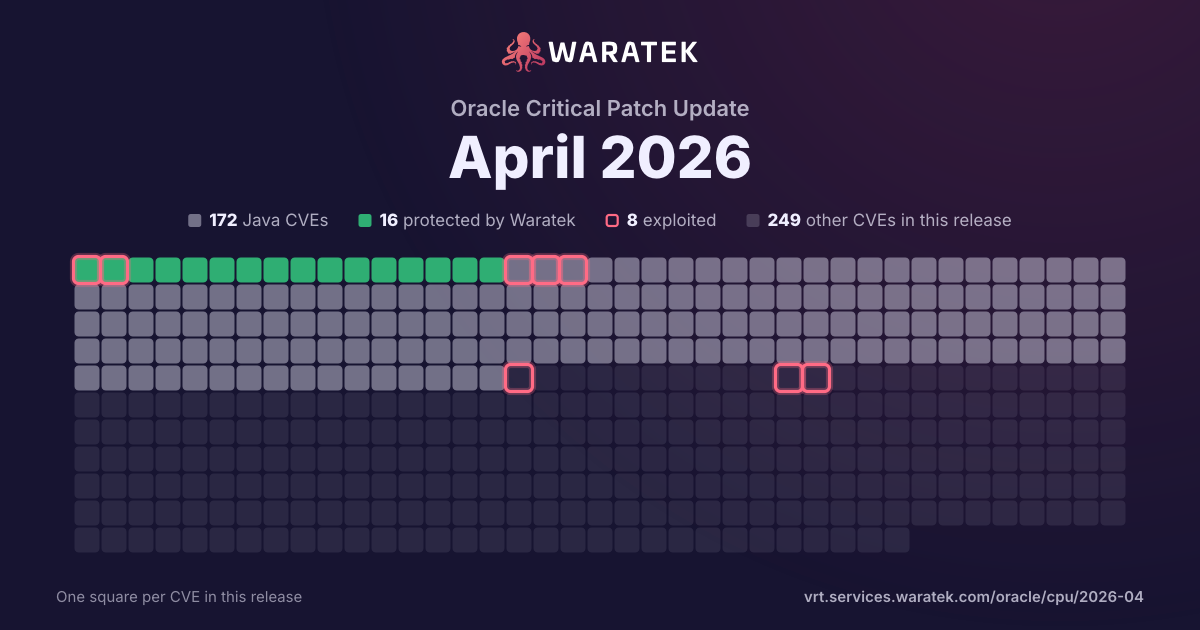
By status
16Protected by Waratek4Mitigation candidate152No exploit published10Outside Waratek scope239Not applicable
8Exploited, marked by the ring
No exploit published. For 51 of them, Oracle's security advisory is the source of public detail.
Protected by Waratek. Waratek RASP can block exploitation of these on systems that have not applied the patch yet.
Overview 2 matches · 0 protected · 1 exploited · 0 CISA KEV · 1 public PoC · 1 EPSS ≥ 0.5
Protected by Waratek
0
0.0%
Rule in development
0
0.0%
Mitigation candidate
2
100.0%
No exploit published
0
0.0%
Outside Waratek scope
0
0.0%
Not applicable
0
0.0%
Withdrawn CVE
0
0.0%
blocked by ARMR today
0
0.0%
partly blocked
0
0.0%
not blocked
2
100.0%
not established
0
0.0%
unrecorded
0
0.0%
Exploited
1
50.0%
Working exploit published
0
0.0%
Proof of concept only
0
0.0%
Forecast only
0
0.0%
No public exploit
1
50.0%
| CVE | Severity | Published▾ | Status | Exploitation | Description |
|---|---|---|---|---|---|
| CVE-2026-34282 | High | 2026-04-21 | Mitigation candidate | No public exploit | Vulnerability in the Oracle Java SE, Oracle GraalVM for JDK, Oracle GraalVM Enterprise Edition product of Oracle Java SE (component: Networking). Supported versions that are affected are Oracle Java SE: 8u481-perf, 11.0.30, 17.0.18, 21.0.10, 25.0.2, 26; Oracle GraalVM for JDK: 17.0.18 and 21.0.10; Oracle GraalVM Enterprise Edition: 21.3.17. Easily exploitable vulnerability allows unauthenticated attacker with network access via multiple protocols to compromise Oracle Java SE, Oracle GraalVM for JDK, Oracle GraalVM Enterprise Edition. Successful attacks of this vulnerability can result in unauthorized ability to cause a hang or frequently repeatable crash (complete DOS) of Oracle Java SE, Oracle GraalVM for JDK, Oracle GraalVM Enterprise Edition. Note: This vulnerability can be exploited by using APIs in the specified Component, e.g., through a web service which supplies data to the APIs. This vulnerability also applies to Java deployments, typically in clients running sandboxed Java Web Start applications or sandboxed Java applets, that load and run untrusted code (e.g., code that comes from the internet) and rely on the Java sandbox for security. CVSS 3.1 Base Score 7.5 (Availability impacts). CVSS Vector: (CVSS:3.1/AV:N/AC:L/PR:N/UI:N/S:U/C:N/I:N/A:H). |
| CVE-2025-27817 | High | 2025-06-10 | Mitigation candidate | Exploited | A possible arbitrary file read and SSRF vulnerability has been identified in Apache Kafka Client. Apache Kafka Clients accept configuration data for setting the SASL/OAUTHBEARER connection with the brokers, including "sasl.oauthbearer.token.endpoint.url" and "sasl.oauthbearer.jwks.endpoint.url". Apache Kafka allows clients to read an arbitrary file and return the content in the error log, or sending requests to an unintended location. In applications where Apache Kafka Clients configurations can be specified by an untrusted party, attackers may use the "sasl.oauthbearer.token.endpoint.url" and "sasl.oauthbearer.jwks.endpoint.url" configuratin to read arbitrary contents of the disk and environment variables or make requests to an unintended location. In particular, this flaw may be used in Apache Kafka Connect to escalate from REST API access to filesystem/environment/URL access, which may be undesirable in certain environments, including SaaS products. Since Apache Kafka 3.9.1/4.0.0, we have added a system property ("-Dorg.apache.kafka.sasl.oauthbearer.allowed.urls") to set the allowed urls in SASL JAAS configuration. In 3.9.1, it accepts all urls by default for backward compatibility. However in 4.0.0 and newer, the default value is empty list and users have to set the allowed urls explicitly. |