
Oracle Critical Patch Update April 2026
Released April 2026 · Oracle's advisory ↗ · ← Critical Patch Update, January 2026 · Security Patch Update, May 2026 →
421 CVEs in this release, one square each
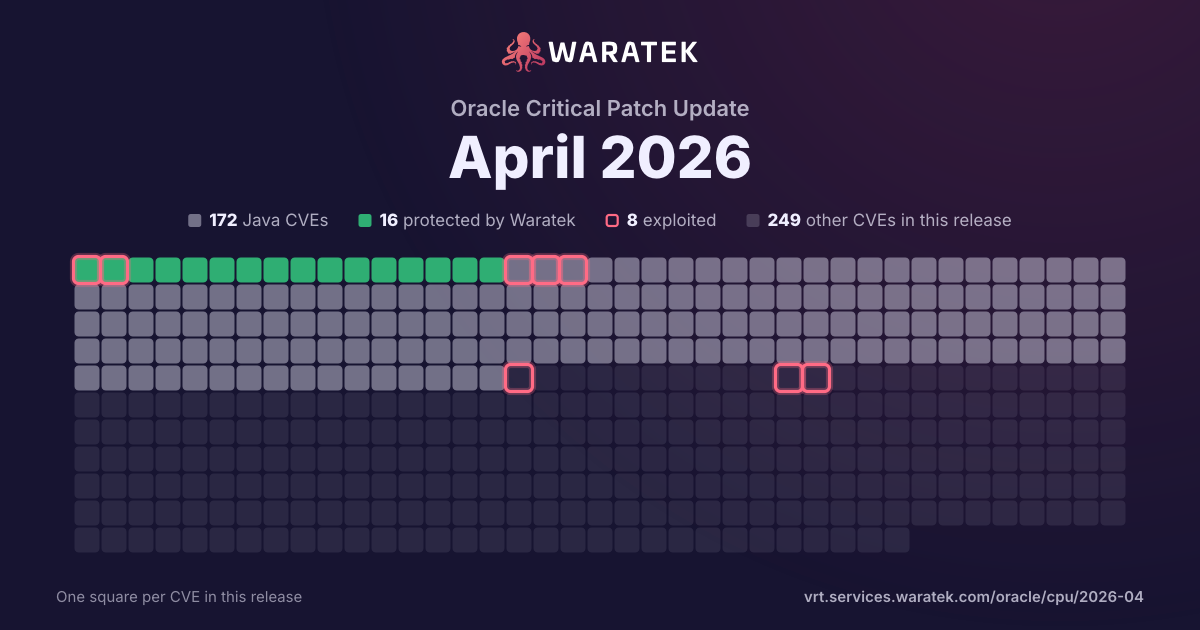
By status
16Protected by Waratek4Mitigation candidate152No exploit published10Outside Waratek scope239Not applicable
8Exploited, marked by the ring
No exploit published. For 51 of them, Oracle's security advisory is the source of public detail.
Protected by Waratek. Waratek RASP can block exploitation of these on systems that have not applied the patch yet.
Overview 17 matches · 0 in Waratek scope · 0 protected · 1 exploited · 0 CISA KEV · 2 public PoC · 2 EPSS ≥ 0.5
17matches
0in Waratek scope0.0%
0protected0.0%
1exploited5.9%
0CISA KEV0.0%
2public PoC11.8%
2EPSS ≥ 0.511.8%
Protected by Waratek
0
0.0%
Rule in development
0
0.0%
Mitigation candidate
0
0.0%
No exploit published
0
0.0%
Outside Waratek scope
0
0.0%
Not applicable
17
100.0%
Withdrawn CVE
0
0.0%
blocked by ARMR today
0
0.0%
partly blocked
0
0.0%
not blocked
17
100.0%
not established
0
0.0%
unrecorded
0
0.0%
Exploited
1
5.9%
Working exploit published
0
0.0%
Proof of concept only
1
5.9%
Forecast only
0
0.0%
No public exploit
15
88.2%
split by
peak 12 / quarter
Q2 241
Not applicable1
Critical1
not blocked1
No public exploit1
Q3 240
Q4 240
Q1 250
Q2 250
Q3 251
Not applicable1
Critical1
not blocked1
No public exploit1
Q4 253
Not applicable3
Critical3
not blocked3
Exploited1
No public exploit2
Q1 2612
Not applicable12
Critical12
not blocked12
Proof of concept only1
No public exploit11
Q2 24Q3 24Q4 24Q1 25Q2 25Q3 25Q4 25Q1 26
| CVE | Severity | Published▾ | Status | Exploitation | Description |
|---|---|---|---|---|---|
| CVE-2026-26284 | Critical | 2026-02-24 | Not applicable | No public exploit | ImageMagick is free and open-source software used for editing and manipulating digital images. Prior to versions 7.1.2-15 and 6.9.13-40, ImageMagick lacks proper boundary checking when processing Huffman-coded data from PCD (Photo CD) files. The decoder contains an function that has an incorrect initialization that could cause an out of bounds read. Versions 7.1.2-15 and 6.9.13-40 contain a patch. |
| CVE-2026-25987 | Critical | 2026-02-24 | Not applicable | No public exploit | ImageMagick is free and open-source software used for editing and manipulating digital images. Prior to versions 7.1.2-15 and 6.9.13-40, a heap buffer over-read vulnerability exists in the MAP image decoder when processing crafted MAP files, potentially leading to crashes or unintended memory disclosure during image decoding. Versions 7.1.2-15 and 6.9.13-40 contain a patch. |
| CVE-2026-25986 | Critical | 2026-02-24 | Not applicable | No public exploit | ImageMagick is free and open-source software used for editing and manipulating digital images. Prior to versions 7.1.2-15 and 6.9.13-40, a heap buffer overflow write vulnerability exists in ReadYUVImage() (coders/yuv.c) when processing malicious YUV 4:2:2 (NoInterlace) images. The pixel-pair loop writes one pixel beyond the allocated row buffer. Versions 7.1.2-15 and 6.9.13-40 contain a patch. |
| CVE-2026-25983 | Critical | 2026-02-24 | Not applicable | No public exploit | ImageMagick is free and open-source software used for editing and manipulating digital images. Prior to versions 7.1.2-15 and 6.9.13-40, a crafted MSL script triggers a heap-use-after-free. The operation element handler replaces and frees the image while the parser continues reading from it, leading to a UAF in ReadBlobString during further parsing. Versions 7.1.2-15 and 6.9.13-40 contain a patch. |
| CVE-2026-25971 | Critical | 2026-02-24 | Not applicable | No public exploit | ImageMagick is free and open-source software used for editing and manipulating digital images. Prior to versions 7.1.2-15 and 6.9.13-40, Magick fails to check for circular references between two MSLs, leading to a stack overflow. Versions 7.1.2-15 and 6.9.13-40 contain a patch. |
| CVE-2026-25968 | Critical | 2026-02-24 | Not applicable | No public exploit | ImageMagick is free and open-source software used for editing and manipulating digital images. Prior to versions 7.1.2-15 and 6.9.13-40, a stack buffer overflow occurs when processing the an attribute in msl.c. A long value overflows a fixed-size stack buffer, leading to memory corruption. Versions 7.1.2-15 and 6.9.13-40 contain a patch. |
| CVE-2026-25898 | Critical | 2026-02-24 | Not applicable | No public exploit | ImageMagick is free and open-source software used for editing and manipulating digital images. Prior to versions 7.1.2-15 and 6.9.13-40, the UIL and XPM image encoder do not validate the pixel index value returned by `GetPixelIndex()` before using it as an array subscript. In HDRI builds, `Quantum` is a floating-point type, so pixel index values can be negative. An attacker can craft an image with negative pixel index values to trigger a global buffer overflow read during conversion, leading to information disclosure or a process crash. Versions 7.1.2-15 and 6.9.13-40 contain a patch. |
| CVE-2026-25897 | Critical | 2026-02-24 | Not applicable | No public exploit | ImageMagick is free and open-source software used for editing and manipulating digital images. Prior to versions 7.1.2-15 and 6.9.13-40, an Integer Overflow vulnerability exists in the sun decoder. On 32-bit systems/builds, a carefully crafted image can lead to an out of bounds heap write. Versions 7.1.2-15 and 6.9.13-40 contain a patch. |
| CVE-2025-68121 | Critical | 2026-02-05 | Not applicable | No public exploit | During session resumption in crypto/tls, if the underlying Config has its ClientCAs or RootCAs fields mutated between the initial handshake and the resumed handshake, the resumed handshake may succeed when it should have failed. This may happen when a user calls Config.Clone and mutates the returned Config, or uses Config.GetConfigForClient. This can cause a client to resume a session with a server that it would not have resumed with during the initial handshake, or cause a server to resume a session with a client that it would not have resumed with during the initial handshake. |
| CVE-2025-15467 | Critical | 2026-01-27 | Not applicable | Proof of concept only | Issue summary: Parsing CMS AuthEnvelopedData or EnvelopedData message with maliciously crafted AEAD parameters can trigger a stack buffer overflow. Impact summary: A stack buffer overflow may lead to a crash, causing Denial of Service, or potentially remote code execution. When parsing CMS (Auth)EnvelopedData structures that use AEAD ciphers such as AES-GCM, the IV (Initialization Vector) encoded in the ASN.1 parameters is copied into a fixed-size stack buffer without verifying that its length fits the destination. An attacker can supply a crafted CMS message with an oversized IV, causing a stack-based out-of-bounds write before any authentication or tag verification occurs. Applications and services that parse untrusted CMS or PKCS#7 content using AEAD ciphers (e.g., S/MIME (Auth)EnvelopedData with AES-GCM) are vulnerable. Because the overflow occurs prior to authentication, no valid key material is required to trigger it. While exploitability to remote code execution depends on platform and toolchain mitigations, the stack-based write primitive represents a severe risk. The FIPS modules in 3.6, 3.5, 3.4, 3.3 and 3.0 are not affected by this issue, as the CMS implementation is outside the OpenSSL FIPS module boundary. OpenSSL 3.6, 3.5, 3.4, 3.3 and 3.0 are vulnerable to this issue. OpenSSL 1.1.1 and 1.0.2 are not affected by this issue. |
| CVE-2026-21636 | Critical | 2026-01-20 | Not applicable | No public exploit | A flaw in Node.js's permission model allows Unix Domain Socket (UDS) connections to bypass network restrictions when `--permission` is enabled. Even without `--allow-net`, attacker-controlled inputs (such as URLs or socketPath options) can connect to arbitrary local sockets via net, tls, or undici/fetch. This breaks the intended security boundary of the permission model and enables access to privileged local services, potentially leading to privilege escalation, data exposure, or local code execution. * The issue affects users of the Node.js permission model on version v25. In the moment of this vulnerability, network permissions (`--allow-net`) are still in the experimental phase. |
| CVE-2025-55130 | Critical | 2026-01-20 | Not applicable | No public exploit | A flaw in Node.js’s Permissions model allows attackers to bypass `--allow-fs-read` and `--allow-fs-write` restrictions using crafted relative symlink paths. By chaining directories and symlinks, a script granted access only to the current directory can escape the allowed path and read sensitive files. This breaks the expected isolation guarantees and enables arbitrary file read/write, leading to potential system compromise. This vulnerability affects users of the permission model on Node.js v20, v22, v24, and v25. |
| CVE-2025-68615 | Critical | 2025-12-23 | Not applicable | No public exploit | net-snmp is a SNMP application library, tools and daemon. Prior to versions 5.9.5 and 5.10.pre2, a specially crafted packet to an net-snmp snmptrapd daemon can cause a buffer overflow and the daemon to crash. This issue has been patched in versions 5.9.5 and 5.10.pre2. |
| CVE-2025-11201 | Critical | 2025-10-29 | Not applicable | Exploited | MLflow Tracking Server Model Creation Directory Traversal Remote Code Execution Vulnerability. This vulnerability allows remote attackers to execute arbitrary code on affected installations of MLflow Tracking Server. Authentication is not required to exploit this vulnerability. The specific flaw exists within the handling of model file paths. The issue results from the lack of proper validation of a user-supplied path prior to using it in file operations. An attacker can leverage this vulnerability to execute code in the context of the service account. Was ZDI-CAN-26921. |
| CVE-2025-11200 | Critical | 2025-10-29 | Not applicable | No public exploit | MLflow Weak Password Requirements Authentication Bypass Vulnerability. This vulnerability allows remote attackers to bypass authentication on affected installations of MLflow. Authentication is not required to exploit this vulnerability. The specific flaw exists within the handling of passwords. The issue results from weak password requirements. An attacker can leverage this vulnerability to bypass authentication on the system. Was ZDI-CAN-26916. |
| CVE-2025-9230 | Critical | 2025-09-30 | Not applicable | No public exploit | Issue summary: An application trying to decrypt CMS messages encrypted using password based encryption can trigger an out-of-bounds read and write. Impact summary: This out-of-bounds read may trigger a crash which leads to Denial of Service for an application. The out-of-bounds write can cause a memory corruption which can have various consequences including a Denial of Service or Execution of attacker-supplied code. Although the consequences of a successful exploit of this vulnerability could be severe, the probability that the attacker would be able to perform it is low. Besides, password based (PWRI) encryption support in CMS messages is very rarely used. For that reason the issue was assessed as Moderate severity according to our Security Policy. The FIPS modules in 3.5, 3.4, 3.3, 3.2, 3.1 and 3.0 are not affected by this issue, as the CMS implementation is outside the OpenSSL FIPS module boundary. |
| CVE-2024-24790 | Critical | 2024-06-05 | Not applicable | No public exploit | The various Is methods (IsPrivate, IsLoopback, etc) did not work as expected for IPv4-mapped IPv6 addresses, returning false for addresses which would return true in their traditional IPv4 forms. |