
Oracle Critical Patch Update April 2026
Released April 2026 · Oracle's advisory ↗ · ← Critical Patch Update, January 2026 · Security Patch Update, May 2026 →
421 CVEs in this release, one square each
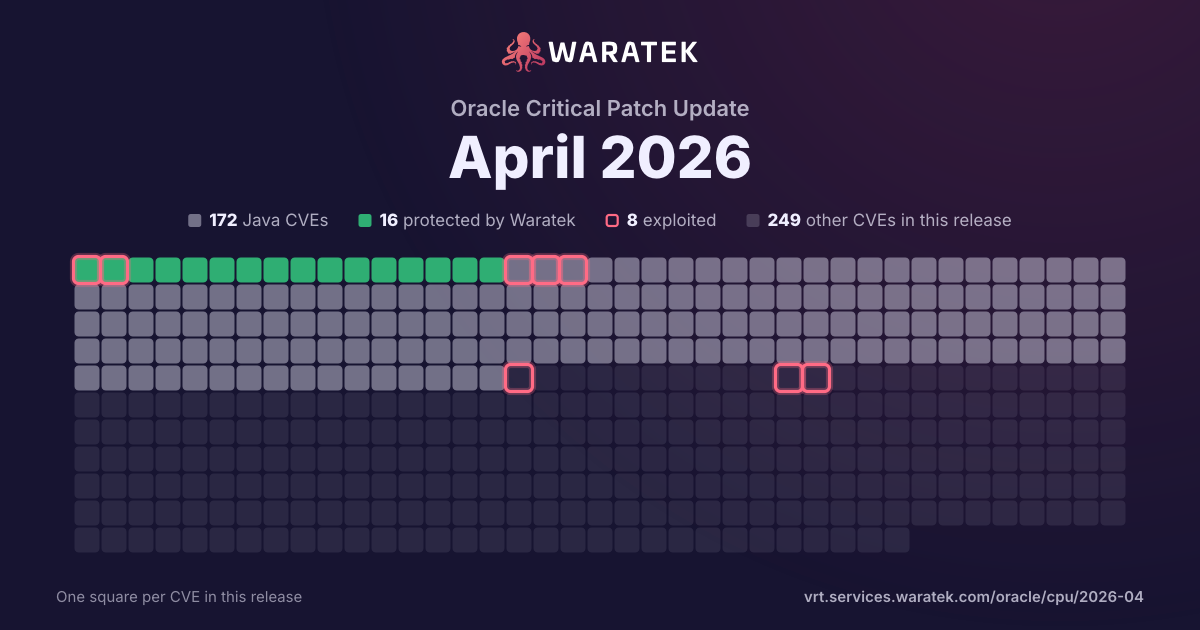
By status
16Protected by Waratek4Mitigation candidate154No exploit published6Outside Waratek scope241Not applicable
8Exploited, marked by the ring
No exploit published. For 51 of them, Oracle's security advisory is the source of public detail.
Protected by Waratek. Waratek RASP can block exploitation of these on systems that have not applied the patch yet.
Overview 17 matches · 7 in Waratek scope · 0 protected · 1 exploited · 0 CISA KEV · 1 public PoC · 0 EPSS ≥ 0.5
17matches
7in Waratek scope41.2%
0protected0.0%
1exploited5.9%
0CISA KEV0.0%
1public PoC5.9%
0EPSS ≥ 0.50.0%
Protected by Waratek
0
0.0%
Rule in development
0
0.0%
Mitigation candidate
1
5.9%
No exploit published
6
35.3%
Outside Waratek scope
0
0.0%
Not applicable
10
58.8%
Withdrawn CVE
0
0.0%
blocked by ARMR today
0
0.0%
partly blocked
0
0.0%
not blocked
17
100.0%
not established
0
0.0%
unrecorded
0
0.0%
Exploited
1
5.9%
Working exploit published
0
0.0%
Proof of concept only
3
17.6%
Forecast only
0
0.0%
No public exploit
13
76.5%
| CVE | Severity | Published▾ | Status | Exploitation | Description |
|---|---|---|---|---|---|
| CVE-2025-9232 | Medium | 2025-09-30 | Not applicable | No public exploit | Issue summary: An application using the OpenSSL HTTP client API functions may trigger an out-of-bounds read if the 'no_proxy' environment variable is set and the host portion of the authority component of the HTTP URL is an IPv6 address. Impact summary: An out-of-bounds read can trigger a crash which leads to Denial of Service for an application. The OpenSSL HTTP client API functions can be used directly by applications but they are also used by the OCSP client functions and CMP (Certificate Management Protocol) client implementation in OpenSSL. However the URLs used by these implementations are unlikely to be controlled by an attacker. In this vulnerable code the out of bounds read can only trigger a crash. Furthermore the vulnerability requires an attacker-controlled URL to be passed from an application to the OpenSSL function and the user has to have a 'no_proxy' environment variable set. For the aforementioned reasons the issue was assessed as Low severity. The vulnerable code was introduced in the following patch releases: 3.0.16, 3.1.8, 3.2.4, 3.3.3, 3.4.0 and 3.5.0. The FIPS modules in 3.5, 3.4, 3.3, 3.2, 3.1 and 3.0 are not affected by this issue, as the HTTP client implementation is outside the OpenSSL FIPS module boundary. |
| CVE-2025-9231 | Medium | 2025-09-30 | Not applicable | No public exploit | Issue summary: A timing side-channel which could potentially allow remote recovery of the private key exists in the SM2 algorithm implementation on 64 bit ARM platforms. Impact summary: A timing side-channel in SM2 signature computations on 64 bit ARM platforms could allow recovering the private key by an attacker.. While remote key recovery over a network was not attempted by the reporter, timing measurements revealed a timing signal which may allow such an attack. OpenSSL does not directly support certificates with SM2 keys in TLS, and so this CVE is not relevant in most TLS contexts. However, given that it is possible to add support for such certificates via a custom provider, coupled with the fact that in such a custom provider context the private key may be recoverable via remote timing measurements, we consider this to be a Moderate severity issue. The FIPS modules in 3.5, 3.4, 3.3, 3.2, 3.1 and 3.0 are not affected by this issue, as SM2 is not an approved algorithm. |
| CVE-2025-9230 | Critical | 2025-09-30 | Not applicable | No public exploit | Issue summary: An application trying to decrypt CMS messages encrypted using password based encryption can trigger an out-of-bounds read and write. Impact summary: This out-of-bounds read may trigger a crash which leads to Denial of Service for an application. The out-of-bounds write can cause a memory corruption which can have various consequences including a Denial of Service or Execution of attacker-supplied code. Although the consequences of a successful exploit of this vulnerability could be severe, the probability that the attacker would be able to perform it is low. Besides, password based (PWRI) encryption support in CMS messages is very rarely used. For that reason the issue was assessed as Moderate severity according to our Security Policy. The FIPS modules in 3.5, 3.4, 3.3, 3.2, 3.1 and 3.0 are not affected by this issue, as the CMS implementation is outside the OpenSSL FIPS module boundary. |
| CVE-2025-26333 | High | 2025-09-25 | Not applicable | No public exploit | Dell BSAFE Crypto-J generates an error message that includes sensitive information about its environment and associated data. A remote attacker could potentially exploit this vulnerability, leading to information exposure. |
| CVE-2025-8869 | Medium | 2025-09-24 | Not applicable | No public exploit | When extracting a tar archive pip may not check symbolic links point into the extraction directory if the tarfile module doesn't implement PEP 706. Note that upgrading pip to a "fixed" version for this vulnerability doesn't fix all known vulnerabilities that are remediated by using a Python version that implements PEP 706. Note that this is a vulnerability in pip's fallback implementation of tar extraction for Python versions that don't implement PEP 706 and therefore are not secure to all vulnerabilities in the Python 'tarfile' module. If you're using a Python version that implements PEP 706 then pip doesn't use the "vulnerable" fallback code. Mitigations include upgrading to a version of pip that includes the fix, upgrading to a Python version that implements PEP 706 (Python >=3.9.17, >=3.10.12, >=3.11.4, or >=3.12), applying the linked patch, or inspecting source distributions (sdists) before installation as is already a best-practice. |
| CVE-2025-9900 | High | 2025-09-23 | Not applicable | Proof of concept only | A flaw was found in Libtiff. This vulnerability is a "write-what-where" condition, triggered when the library processes a specially crafted TIFF image file. By providing an abnormally large image height value in the file's metadata, an attacker can trick the library into writing attacker-controlled color data to an arbitrary memory location. This memory corruption can be exploited to cause a denial of service (application crash) or to achieve arbitrary code execution with the permissions of the user. |
| CVE-2025-47910 | Medium | 2025-09-22 | Not applicable | No public exploit | When using http.CrossOriginProtection, the AddInsecureBypassPattern method can unexpectedly bypass more requests than intended. CrossOriginProtection then skips validation, but forwards the original request path, which may be served by a different handler without the intended security protections. |
| CVE-2025-59476 | Medium | 2025-09-17 | No exploit published | No public exploit | Jenkins 2.527 and earlier, LTS 2.516.2 and earlier does not restrict or transform the characters that can be inserted from user-specified content in log messages, allowing attackers able to control log message contents to insert line break characters, followed by forged log messages that may mislead administrators reviewing log output. |
| CVE-2025-59475 | Medium | 2025-09-17 | No exploit published | No public exploit | Jenkins 2.527 and earlier, LTS 2.516.2 and earlier does not perform a permission check for the authenticated user profile dropdown menu, allowing attackers without Overall/Read permission to obtain limited information about the Jenkins configuration by listing available options in this menu (e.g., whether Credentials Plugin is installed). |
| CVE-2025-59474 | Medium | 2025-09-17 | Mitigation candidate | Exploited | Jenkins 2.527 and earlier, LTS 2.516.2 and earlier does not perform a permission check in the sidepanel of a page intentionally accessible to users lacking Overall/Read permission, allowing attackers without Overall/Read permission to list agent names through its sidepanel executors widget. |
| CVE-2025-41249 | High | 2025-09-16 | No exploit published | No public exploit | The Spring Framework annotation detection mechanism may not correctly resolve annotations on methods within type hierarchies with a parameterized super type with unbounded generics. This can be an issue if such annotations are used for authorization decisions. Your application may be affected by this if you are using Spring Security's @EnableMethodSecurity feature. You are not affected by this if you are not using @EnableMethodSecurity or if you do not use security annotations on methods in generic superclasses or generic interfaces. This CVE is published in conjunction with CVE-2025-41248 https://spring.io/security/cve-2025-41248 . |
| CVE-2025-41248 | High | 2025-09-16 | No exploit published | No public exploit | The Spring Security annotation detection mechanism may not correctly resolve annotations on methods within type hierarchies with a parameterized super type with unbounded generics. This can be an issue when using @PreAuthorize and other method security annotations, resulting in an authorization bypass. Your application may be affected by this if you are using Spring Security's @EnableMethodSecurity feature. You are not affected by this if you are not using @EnableMethodSecurity or if you do not use security annotations on methods in generic superclasses or generic interfaces. This CVE is published in conjunction with CVE-2025-41249 https://spring.io/security/cve-2025-41249 . |
| CVE-2025-9086 | High | 2025-09-12 | Not applicable | No public exploit | 1. A cookie is set using the `secure` keyword for `https://target` 2. curl is redirected to or otherwise made to speak with `http://target` (same hostname, but using clear text HTTP) using the same cookie set 3. The same cookie name is set - but with only a slash as path (`path="/"`). Since this site is not secure, the cookie *should* be ignored. 4. A bug in the path comparison logic makes curl read outside a heap buffer boundary The bug either causes a crash or it potentially makes the comparison come to the wrong conclusion and lets the clear-text site override the contents of the secure cookie, contrary to expectations and depending on the memory contents immediately following the single-byte allocation that holds the path. The presumed and correct behavior would be to plainly ignore the second set of the cookie since it was already set as secure on a secure host so overriding it on an insecure host should not be okay. |
| CVE-2025-58754 | High | 2025-09-12 | Not applicable | Proof of concept only | Axios is a promise based HTTP client for the browser and Node.js. When Axios starting in version 0.28.0 and prior to versions 0.30.2 and 1.12.0 runs on Node.js and is given a URL with the `data:` scheme, it does not perform HTTP. Instead, its Node http adapter decodes the entire payload into memory (`Buffer`/`Blob`) and returns a synthetic 200 response. This path ignores `maxContentLength` / `maxBodyLength` (which only protect HTTP responses), so an attacker can supply a very large `data:` URI and cause the process to allocate unbounded memory and crash (DoS), even if the caller requested `responseType: 'stream'`. Versions 0.30.2 and 1.12.0 contain a patch for the issue. |
| CVE-2025-10148 | Medium | 2025-09-12 | Not applicable | No public exploit | curl's WebSocket code did not update the 32-bit mask pattern for each new outgoing frame as the specification says. Instead it used a fixed mask that persisted and was used throughout the entire connection. A predictable mask pattern allows for a malicious server to induce traffic between the two communicating parties that could be interpreted by an involved proxy (configured or transparent) as genuine, real, HTTP traffic with content and thereby poison its cache. That cached poisoned content could then be served to all users of that proxy. |
| CVE-2025-58057 | Medium | 2025-09-04 | No exploit published | Proof of concept only | Netty is an asynchronous event-driven network application framework for rapid development of maintainable high performance protocol servers & clients. In netty-codec-compression versions 4.1.124.Final and below, and netty-codec versions 4.2.4.Final and below, when supplied with specially crafted input, BrotliDecoder and certain other decompression decoders will allocate a large number of reachable byte buffers, which can lead to denial of service. BrotliDecoder.decompress has no limit in how often it calls pull, decompressing data 64K bytes at a time. The buffers are saved in the output list, and remain reachable until OOM is hit. This is fixed in versions 4.1.125.Final of netty-codec and 4.2.5.Final of netty-codec-compression. |
| CVE-2025-58056 | Low | 2025-09-03 | No exploit published | No public exploit | Netty is an asynchronous event-driven network application framework for development of maintainable high performance protocol servers and clients. In versions 4.1.124.Final, and 4.2.0.Alpha3 through 4.2.4.Final, Netty incorrectly accepts standalone newline characters (LF) as a chunk-size line terminator, regardless of a preceding carriage return (CR), instead of requiring CRLF per HTTP/1.1 standards. When combined with reverse proxies that parse LF differently (treating it as part of the chunk extension), attackers can craft requests that the proxy sees as one request but Netty processes as two, enabling request smuggling attacks. This is fixed in versions 4.1.125.Final and 4.2.5.Final. |