
Oracle Critical Patch Update April 2026
Released April 2026 · Oracle's advisory ↗ · ← Critical Patch Update, January 2026 · Security Patch Update, May 2026 →
421 CVEs in this release, one square each
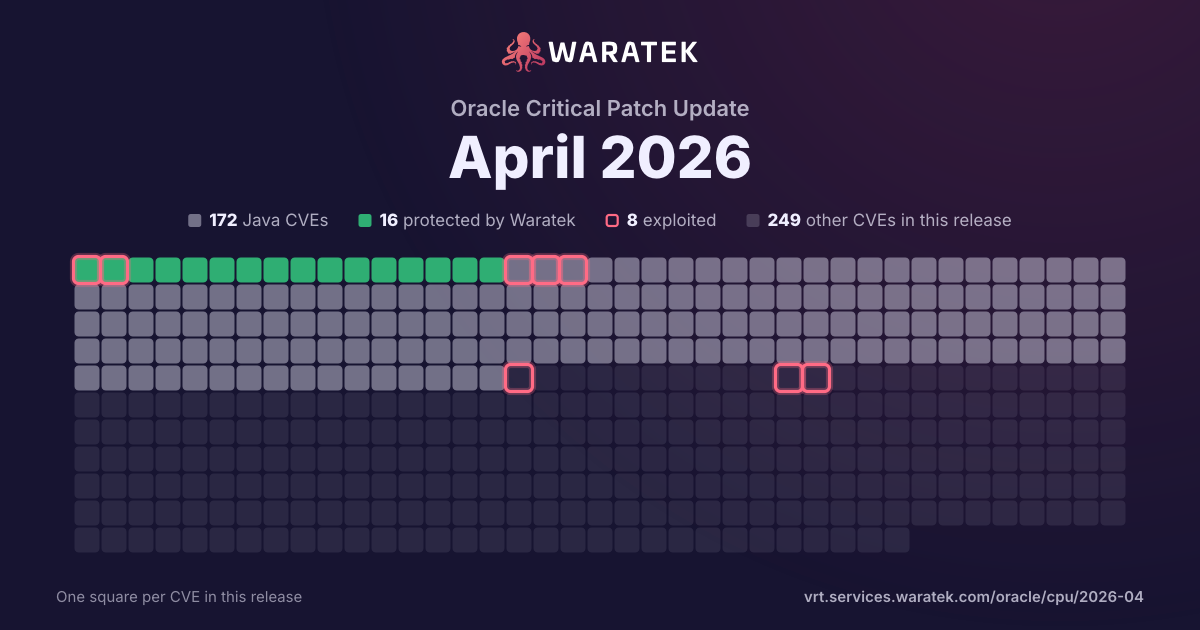
By status
16Protected by Waratek4Mitigation candidate154No exploit published6Outside Waratek scope241Not applicable
8Exploited, marked by the ring
No exploit published. For 51 of them, Oracle's security advisory is the source of public detail.
Protected by Waratek. Waratek RASP can block exploitation of these on systems that have not applied the patch yet.
Overview 5 matches · 0 protected · 0 exploited · 0 CISA KEV · 0 public PoC · 0 EPSS ≥ 0.5
5matches
0protected0.0%
0exploited0.0%
0CISA KEV0.0%
0public PoC0.0%
0EPSS ≥ 0.50.0%
Protected by Waratek
0
0.0%
Rule in development
0
0.0%
Mitigation candidate
0
0.0%
No exploit published
5
100.0%
blocked by ARMR today
0
0.0%
partly blocked
0
0.0%
not blocked
5
100.0%
not established
0
0.0%
unrecorded
0
0.0%
Exploited
0
0.0%
Working exploit published
0
0.0%
Proof of concept only
1
20.0%
Forecast only
0
0.0%
No public exploit
4
80.0%
split by
peak 5 / month
Jan 26
| CVE | Severity | Published▾ | Status | Exploitation | Description |
|---|---|---|---|---|---|
| CVE-2024-4027 | High | 2026-01-30 | No exploit published | No public exploit | A flaw was found in Undertow. Servlets using a method that calls HttpServletRequestImpl.getParameterNames() can cause an OutOfMemoryError when the client sends a request with large parameter names. This issue can be exploited by an unauthorized user to cause a remote denial-of-service (DoS) attack. |
| CVE-2026-22444 | High | 2026-01-21 | No exploit published | No public exploit | The "create core" API of Apache Solr 8.6 through 9.10.0 lacks sufficient input validation on some API parameters, which can cause Solr to check the existence of and attempt to read file-system paths that should be disallowed by Solr's "allowPaths" security setting https://https://solr.apache.org/guide/solr/latest/configuration-guide/configuring-solr-xml.html#the-solr-element . These read-only accesses can allow users to create cores using unexpected configsets if any are accessible via the filesystem. On Windows systems configured to allow UNC paths this can additionally cause disclosure of NTLM "user" hashes. Solr deployments are subject to this vulnerability if they meet the following criteria: * Solr is running in its "standalone" mode. * Solr's "allowPath" setting is being used to restrict file access to certain directories. * Solr's "create core" API is exposed and accessible to untrusted users. This can happen if Solr's RuleBasedAuthorizationPlugin https://solr.apache.org/guide/solr/latest/deployment-guide/rule-based-authorization-plugin.html is disabled, or if it is enabled but the "core-admin-edit" predefined permission (or an equivalent custom permission) is given to low-trust (i.e. non-admin) user roles. Users can mitigate this by enabling Solr's RuleBasedAuthorizationPlugin (if disabled) and configuring a permission-list that prevents untrusted users from creating new Solr cores. Users should also upgrade to Apache Solr 9.10.1 or greater, which contain fixes for this issue. |
| CVE-2026-22022 | High | 2026-01-21 | No exploit published | No public exploit | Deployments of Apache Solr 5.3.0 through 9.10.0 that rely on Solr's "Rule Based Authorization Plugin" are vulnerable to allowing unauthorized access to certain Solr APIs, due to insufficiently strict input validation in those components. Only deployments that meet all of the following criteria are impacted by this vulnerability: * Use of Solr's "RuleBasedAuthorizationPlugin" * A RuleBasedAuthorizationPlugin config (see security.json) that specifies multiple "roles" * A RuleBasedAuthorizationPlugin permission list (see security.json) that uses one or more of the following pre-defined permission rules: "config-read", "config-edit", "schema-read", "metrics-read", or "security-read". * A RuleBasedAuthorizationPlugin permission list that doesn't define the "all" pre-defined permission * A networking setup that allows clients to make unfiltered network requests to Solr. (i.e. user-submitted HTTP/HTTPS requests reach Solr as-is, unmodified or restricted by any intervening proxy or gateway) Users can mitigate this vulnerability by ensuring that their RuleBasedAuthorizationPlugin configuration specifies the "all" pre-defined permission and associates the permission with an "admin" or other privileged role. Users can also upgrade to a Solr version outside of the impacted range, such as the recently released Solr 9.10.1. |
| CVE-2026-21969 | Critical | 2026-01-20 | No exploit published | No public exploit | Vulnerability in the Oracle Agile Product Lifecycle Management for Process product of Oracle Supply Chain (component: Supplier Portal). The supported version that is affected is 6.2.4. Easily exploitable vulnerability allows unauthenticated attacker with network access via HTTP to compromise Oracle Agile Product Lifecycle Management for Process. Successful attacks of this vulnerability can result in takeover of Oracle Agile Product Lifecycle Management for Process. CVSS 3.1 Base Score 9.8 (Confidentiality, Integrity and Availability impacts). CVSS Vector: (CVSS:3.1/AV:N/AC:L/PR:N/UI:N/S:U/C:H/I:H/A:H). |
| CVE-2025-12543 | Critical | 2026-01-07 | No exploit published | Proof of concept only | A flaw was found in the Undertow HTTP server core, which is used in WildFly, JBoss EAP, and other Java applications. The Undertow library fails to properly validate the Host header in incoming HTTP requests.As a result, requests containing malformed or malicious Host headers are processed without rejection, enabling attackers to poison caches, perform internal network scans, or hijack user sessions. |