
Oracle Critical Patch Update April 2026
Released April 2026 · Oracle's advisory ↗ · ← Critical Patch Update, January 2026 · Security Patch Update, May 2026 →
421 CVEs in this release, one square each
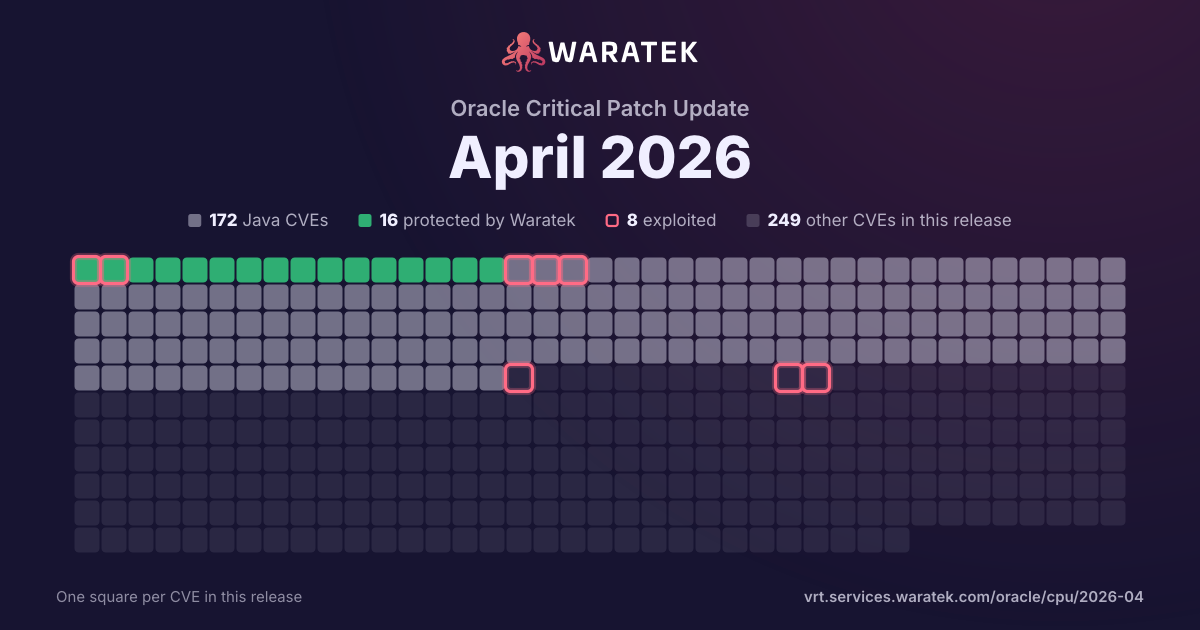
By status
13Protected by Waratek4Mitigation candidate157No exploit published6Outside Waratek scope241Not applicable
8Exploited, marked by the ring
No exploit published. For 51 of them, Oracle's security advisory is the source of public detail.
Protected by Waratek. Waratek RASP can block exploitation of these on systems that have not applied the patch yet.
Overview 4 matches · 0 protected · 0 exploited · 0 CISA KEV · 0 public PoC · 0 EPSS ≥ 0.5
4matches
0protected0.0%
0exploited0.0%
0CISA KEV0.0%
0public PoC0.0%
0EPSS ≥ 0.50.0%
Protected by Waratek
0
0.0%
Rule in development
0
0.0%
Mitigation candidate
0
0.0%
No exploit published
4
100.0%
blocked by ARMR today
0
0.0%
partly blocked
0
0.0%
not blocked
4
100.0%
not established
0
0.0%
unrecorded
0
0.0%
Exploited
0
0.0%
Working exploit published
0
0.0%
Proof of concept only
1
25.0%
Forecast only
0
0.0%
No public exploit
3
75.0%
split by
peak 4 / month
Oct 25
| CVE | Severity | Published▾ | Status | Exploitation | Description |
|---|---|---|---|---|---|
| CVE-2025-61795 | Medium | 2025-10-27 | No exploit published | No public exploit | Improper Resource Shutdown or Release vulnerability in Apache Tomcat. If an error occurred (including exceeding limits) during the processing of a multipart upload, temporary copies of the uploaded parts written to disc were not cleaned up immediately but left for the garbage collection process to delete. Depending on JVM settings, application memory usage and application load, it was possible that space for the temporary copies of uploaded parts would be filled faster than GC cleared it, leading to a DoS. This issue affects Apache Tomcat: from 11.0.0-M1 through 11.0.11, from 10.1.0-M1 through 10.1.46, from 9.0.0.M1 through 9.0.109. The following versions were EOL at the time the CVE was created but are known to be affected: 8.5.0 though 8.5.100. Other, older, EOL versions may also be affected. Users are recommended to upgrade to version 11.0.12 or later, 10.1.47 or later or 9.0.110 or later which fixes the issue. |
| CVE-2024-31573 | Medium | 2025-10-17 | No exploit published | Proof of concept only | XMLUnit for Java before 2.10.0, in the default configuration, might allow code execution via an untrusted stylesheet (used for an XSLT transformation), because XSLT extension functions are enabled. |
| CVE-2025-41254 | Medium | 2025-10-16 | No exploit published | No public exploit | STOMP over WebSocket applications may be vulnerable to a security bypass that allows an attacker to send unauthorized messages. Affected Spring Products and VersionsSpring Framework: * 6.2.0 - 6.2.11 * 6.1.0 - 6.1.23 * 6.0.x - 6.0.29 * 5.3.0 - 5.3.45 * Older, unsupported versions are also affected. MitigationUsers of affected versions should upgrade to the corresponding fixed version. Affected version(s)Fix versionAvailability6.2.x6.2.12OSS6.1.x6.1.24 Commercial https://enterprise.spring.io/ 6.0.xN/A Out of support https://spring.io/projects/spring-framework#support 5.3.x5.3.46 Commercial https://enterprise.spring.io/ No further mitigation steps are necessary. CreditThis vulnerability was discovered and responsibly reported by Jannis Kaiser. |
| CVE-2025-41253 | High | 2025-10-16 | No exploit published | No public exploit | The following versions of Spring Cloud Gateway Server Webflux may be vulnerable to the ability to expose environment variables and system properties to attackers. An application should be considered vulnerable when all the following are true: * The application is using Spring Cloud Gateway Server Webflux (Spring Cloud Gateway Server WebMVC is not vulnerable). * An admin or untrusted third party using Spring Expression Language (SpEL) to access environment variables or system properties via routes. * An untrusted third party could create a route that uses SpEL to access environment variables or system properties if: * The Spring Cloud Gateway Server Webflux actuator web endpoint is enabled via management.endpoints.web.exposure.include=gateway and management.endpoint.gateway.enabled=trueor management.endpoint.gateway.access=unrestricte. * The actuator endpoints are available to attackers. * The actuator endpoints are unsecured. |