
Oracle Critical Patch Update April 2026
Released April 2026 · Oracle's advisory ↗ · ← Critical Patch Update, January 2026 · Security Patch Update, May 2026 →
421 CVEs in this release, one square each
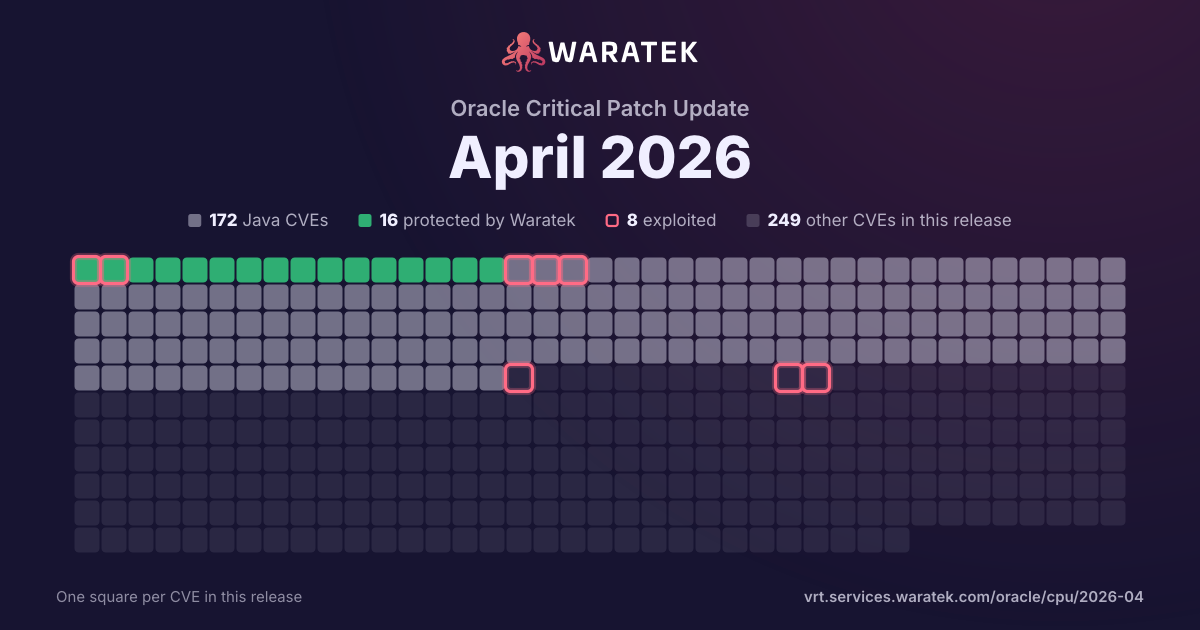
By status
16Protected by Waratek4Mitigation candidate152No exploit published10Outside Waratek scope239Not applicable
8Exploited, marked by the ring
No exploit published. For 51 of them, Oracle's security advisory is the source of public detail.
Protected by Waratek. Waratek RASP can block exploitation of these on systems that have not applied the patch yet.
Overview 239 matches · 0 in Waratek scope · 0 protected · 2 exploited · 0 CISA KEV · 7 public PoC · 4 EPSS ≥ 0.5
239matches
0in Waratek scope0.0%
0protected0.0%
2exploited0.8%
0CISA KEV0.0%
7public PoC2.9%
4EPSS ≥ 0.51.7%
Protected by Waratek
0
0.0%
Rule in development
0
0.0%
Mitigation candidate
0
0.0%
No exploit published
0
0.0%
Outside Waratek scope
0
0.0%
Not applicable
239
100.0%
Withdrawn CVE
0
0.0%
blocked by ARMR today
0
0.0%
partly blocked
0
0.0%
not blocked
239
100.0%
not established
0
0.0%
unrecorded
0
0.0%
split by
peak 109 / quarter
Q1 241
Not applicable1
Medium1
not blocked1
No public exploit1
Q2 243
Not applicable3
Critical1
High1
Medium1
not blocked3
Proof of concept only1
No public exploit2
Q3 241
Not applicable1
High1
not blocked1
Exploited1
Q4 240
Q1 255
Not applicable5
High4
Medium1
not blocked5
Proof of concept only3
No public exploit2
Q2 258
Not applicable8
High4
Medium4
not blocked8
Proof of concept only1
No public exploit7
Q3 2532
Not applicable32
Critical1
High13
Medium14
Low4
not blocked32
Working exploit published2
Proof of concept only7
No public exploit23
Q4 2536
Not applicable36
Critical3
High16
Medium16
Low1
not blocked36
Exploited1
Proof of concept only4
No public exploit31
Q1 26109
Not applicable109
Critical12
High54
Medium39
Low4
not blocked109
Proof of concept only9
No public exploit100
Q2 2644
Not applicable44
High8
Medium32
Low4
not blocked44
Proof of concept only1
No public exploit43
Q1 24Q2 24Q3 24Q4 24Q1 25Q2 25Q3 25Q4 25Q1 26Q2 26
| CVE | Severity | Published▾ | Status | Exploitation | Description |
|---|---|---|---|---|---|
| CVE-2025-4877 | Medium | 2025-08-20 | Not applicable | No public exploit | There's a vulnerability in the libssh package where when a libssh consumer passes in an unexpectedly large input buffer to ssh_get_fingerprint_hash() function. In such cases the bin_to_base64() function can experience an integer overflow leading to a memory under allocation, when that happens it's possible that the program perform out of bounds write leading to a heap corruption. This issue affects only 32-bits builds of libssh. |
| CVE-2025-8961 | Low | 2025-08-14 | Not applicable | Proof of concept only | A weakness has been identified in LibTIFF 4.7.0. This affects the function main of the file tiffcrop.c of the component tiffcrop. Executing manipulation can lead to memory corruption. The attack can only be executed locally. The exploit has been made available to the public and could be exploited. |
| CVE-2025-54571 | Medium | 2025-08-06 | Not applicable | Proof of concept only | ModSecurity is an open source, cross platform web application firewall (WAF) engine for Apache, IIS and Nginx. In versions 2.9.11 and below, an attacker can override the HTTP response’s Content-Type, which could lead to several issues depending on the HTTP scenario. For example, we have demonstrated the potential for XSS and arbitrary script source code disclosure in the latest version of mod_security2. This issue is fixed in version 2.9.12. |
| CVE-2025-8194 | High | 2025-07-28 | Not applicable | No public exploit | There is a defect in the CPython “tarfile” module affecting the “TarFile” extraction and entry enumeration APIs. The tar implementation would process tar archives with negative offsets without error, resulting in an infinite loop and deadlock during the parsing of maliciously crafted tar archives. This vulnerability can be mitigated by including the following patch after importing the “tarfile” module: https://gist.github.com/sethmlarson/1716ac5b82b73dbcbf23ad2eff8b33e1 |
| CVE-2025-8177 | Medium | 2025-07-26 | Not applicable | Proof of concept only | A vulnerability was found in LibTIFF up to 4.7.0. It has been rated as critical. This issue affects the function setrow of the file tools/thumbnail.c. The manipulation leads to buffer overflow. An attack has to be approached locally. The patch is named e8c9d6c616b19438695fd829e58ae4fde5bfbc22. It is recommended to apply a patch to fix this issue. This vulnerability only affects products that are no longer supported by the maintainer. |
| CVE-2025-8176 | Low | 2025-07-26 | Not applicable | Proof of concept only | A vulnerability was found in LibTIFF up to 4.7.0. It has been declared as critical. This vulnerability affects the function get_histogram of the file tools/tiffmedian.c. The manipulation leads to use after free. The attack needs to be approached locally. The exploit has been disclosed to the public and may be used. The patch is identified as fe10872e53efba9cc36c66ac4ab3b41a839d5172. It is recommended to apply a patch to fix this issue. |
| CVE-2025-5449 | Medium | 2025-07-25 | Not applicable | No public exploit | A flaw was found in the SFTP server message decoding logic of libssh. The issue occurs due to an incorrect packet length check that allows an integer overflow when handling large payload sizes on 32-bit systems. This issue leads to failed memory allocation and causes the server process to crash, resulting in a denial of service. |
| CVE-2025-54090 | Medium | 2025-07-23 | Not applicable | No public exploit | A bug in Apache HTTP Server 2.4.64 results in all "RewriteCond expr ..." tests evaluating as "true". Users are recommended to upgrade to version 2.4.65, which fixes the issue. |
| CVE-2025-4878 | Low | 2025-07-22 | Not applicable | No public exploit | A vulnerability was found in libssh, where an uninitialized variable exists under certain conditions in the privatekey_from_file() function. This flaw can be triggered if the file specified by the filename doesn't exist and may lead to possible signing failures or heap corruption. |
| CVE-2025-27210 | High | 2025-07-18 | Not applicable | Working exploit published | An incomplete fix has been identified for CVE-2025-23084 in Node.js, specifically affecting Windows device names like CON, PRN, and AUX. This vulnerability affects Windows users of `path.join` API. |
| CVE-2025-27209 | High | 2025-07-18 | Not applicable | No public exploit | The V8 release used in Node.js v24.0.0 has changed how string hashes are computed using rapidhash. This implementation re-introduces the HashDoS vulnerability as an attacker who can control the strings to be hashed can generate many hash collisions - an attacker can generate collisions even without knowing the hash-seed. * This vulnerability affects Node.js v24.x users. |
| CVE-2025-6965 | High | 2025-07-15 | Not applicable | Working exploit published | There exists a vulnerability in SQLite versions before 3.50.2 where the number of aggregate terms could exceed the number of columns available. This could lead to a memory corruption issue. We recommend upgrading to version 3.50.2 or above. |
| CVE-2025-53643 | Low | 2025-07-14 | Not applicable | No public exploit | AIOHTTP is an asynchronous HTTP client/server framework for asyncio and Python. Prior to version 3.12.14, the Python parser is vulnerable to a request smuggling vulnerability due to not parsing trailer sections of an HTTP request. If a pure Python version of aiohttp is installed (i.e. without the usual C extensions) or AIOHTTP_NO_EXTENSIONS is enabled, then an attacker may be able to execute a request smuggling attack to bypass certain firewalls or proxy protections. Version 3.12.14 contains a patch for this issue. |
| CVE-2025-6395 | Medium | 2025-07-10 | Not applicable | No public exploit | A NULL pointer dereference flaw was found in the GnuTLS software in _gnutls_figure_common_ciphersuite(). |
| CVE-2025-32990 | High | 2025-07-10 | Not applicable | No public exploit | A heap-buffer-overflow (off-by-one) flaw was found in the GnuTLS software in the template parsing logic within the certtool utility. When it reads certain settings from a template file, it allows an attacker to cause an out-of-bounds (OOB) NULL pointer write, resulting in memory corruption and a denial-of-service (DoS) that could potentially crash the system. |
| CVE-2025-32989 | Medium | 2025-07-10 | Not applicable | No public exploit | A heap-buffer-overread vulnerability was found in GnuTLS in how it handles the Certificate Transparency (CT) Signed Certificate Timestamp (SCT) extension during X.509 certificate parsing. This flaw allows a malicious user to create a certificate containing a malformed SCT extension (OID 1.3.6.1.4.1.11129.2.4.2) that contains sensitive data. This issue leads to the exposure of confidential information when GnuTLS verifies certificates from certain websites when the certificate (SCT) is not checked correctly. |
| CVE-2025-32988 | High | 2025-07-10 | Not applicable | No public exploit | A flaw was found in GnuTLS. A double-free vulnerability exists in GnuTLS due to incorrect ownership handling in the export logic of Subject Alternative Name (SAN) entries containing an otherName. If the type-id OID is invalid or malformed, GnuTLS will call asn1_delete_structure() on an ASN.1 node it does not own, leading to a double-free condition when the parent function or caller later attempts to free the same structure. This vulnerability can be triggered using only public GnuTLS APIs and may result in denial of service or memory corruption, depending on allocator behavior. |
| CVE-2024-43394 | High | 2025-07-10 | Not applicable | No public exploit | Server-Side Request Forgery (SSRF) in Apache HTTP Server on Windows allows to potentially leak NTLM hashes to a malicious server via mod_rewrite or apache expressions that pass unvalidated request input. This issue affects Apache HTTP Server: from 2.4.0 through 2.4.63. Note: The Apache HTTP Server Project will be setting a higher bar for accepting vulnerability reports regarding SSRF via UNC paths. The server offers limited protection against administrators directing the server to open UNC paths. Windows servers should limit the hosts they will connect over via SMB based on the nature of NTLM authentication. |
| CVE-2025-5987 | High | 2025-07-07 | Not applicable | No public exploit | A flaw was found in libssh when using the ChaCha20 cipher with the OpenSSL library. If an attacker manages to exhaust the heap space, this error is not detected and may lead to libssh using a partially initialized cipher context. This occurs because the OpenSSL error code returned aliases with the SSH_OK code, resulting in libssh not properly detecting the error returned by the OpenSSL library. This issue can lead to undefined behavior, including compromised data confidentiality and integrity or crashes. |
| CVE-2025-5372 | High | 2025-07-04 | Not applicable | No public exploit | A flaw was found in libssh versions built with OpenSSL versions older than 3.0, specifically in the ssh_kdf() function responsible for key derivation. Due to inconsistent interpretation of return values where OpenSSL uses 0 to indicate failure and libssh uses 0 for success—the function may mistakenly return a success status even when key derivation fails. This results in uninitialized cryptographic key buffers being used in subsequent communication, potentially compromising SSH sessions' confidentiality, integrity, and availability. |
| CVE-2025-5351 | Medium | 2025-07-04 | Not applicable | No public exploit | A flaw was found in the key export functionality of libssh. The issue occurs in the internal function responsible for converting cryptographic keys into serialized formats. During error handling, a memory structure is freed but not cleared, leading to a potential double free issue if an additional failure occurs later in the function. This condition may result in heap corruption or application instability in low-memory scenarios, posing a risk to system reliability where key export operations are performed. |
| CVE-2025-5318 | High | 2025-06-24 | Not applicable | No public exploit | A flaw was found in the libssh library in versions less than 0.11.2. An out-of-bounds read can be triggered in the sftp_handle function due to an incorrect comparison check that permits the function to access memory beyond the valid handle list and to return an invalid pointer, which is used in further processing. This vulnerability allows an authenticated remote attacker to potentially read unintended memory regions, exposing sensitive information or affect service behavior. |
| CVE-2025-52967 | Medium | 2025-06-23 | Not applicable | No public exploit | gateway_proxy_handler in MLflow before 3.1.0 lacks gateway_path validation. |
| CVE-2025-6069 | Medium | 2025-06-17 | Not applicable | No public exploit | The html.parser.HTMLParser class had worse-case quadratic complexity when processing certain crafted malformed inputs potentially leading to amplified denial-of-service. |
| CVE-2025-47436 | Medium | 2025-05-14 | Not applicable | No public exploit | Heap-based Buffer Overflow vulnerability in Apache ORC. A vulnerability has been identified in the ORC C++ LZO decompression logic, where specially crafted malformed ORC files can cause the decompressor to allocate a 250-byte buffer but then attempts to copy 295 bytes into it. It causes memory corruption. This issue affects Apache ORC C++ library: through 1.8.8, from 1.9.0 through 1.9.5, from 2.0.0 through 2.0.4, from 2.1.0 through 2.1.1. Users are recommended to upgrade to version 1.8.9, 1.9.6, 2.0.5, and 2.1.2, which fix the issue. |
| CVE-2025-43967 | High | 2025-04-21 | Not applicable | No public exploit | libheif before 1.19.6 has a NULL pointer dereference in ImageItem_Grid::get_decoder in image-items/grid.cc because a grid image can reference a nonexistent image item. |
| CVE-2025-43966 | High | 2025-04-21 | Not applicable | No public exploit | libheif before 1.19.6 has a NULL pointer dereference in ImageItem_iden in image-items/iden.cc. |
| CVE-2024-56406 | High | 2025-04-13 | Not applicable | No public exploit | A heap buffer overflow vulnerability was discovered in Perl. Release branches 5.34, 5.36, 5.38 and 5.40 are affected, including development versions from 5.33.1 through 5.41.10. When there are non-ASCII bytes in the left-hand-side of the `tr` operator, `S_do_trans_invmap` can overflow the destination pointer `d`. $ perl -e '$_ = "\x{FF}" x 1000000; tr/\xFF/\x{100}/;' Segmentation fault (core dumped) It is believed that this vulnerability can enable Denial of Service and possibly Code Execution attacks on platforms that lack sufficient defenses. |
| CVE-2025-29482 | Medium | 2025-04-07 | Not applicable | Proof of concept only | Buffer Overflow vulnerability in libheif 1.19.7 allows a local attacker to execute arbitrary code via the SAO (Sample Adaptive Offset) processing of libde265. |
| CVE-2025-0453 | High | 2025-03-20 | Not applicable | Proof of concept only | In mlflow/mlflow version 2.17.2, the `/graphql` endpoint is vulnerable to a denial of service attack. An attacker can create large batches of queries that repeatedly request all runs from a given experiment. This can tie up all the workers allocated by MLFlow, rendering the application unable to respond to other requests. This vulnerability is due to uncontrolled resource consumption. |
| CVE-2025-22869 | High | 2025-02-26 | Not applicable | No public exploit | SSH servers which implement file transfer protocols are vulnerable to a denial of service attack from clients which complete the key exchange slowly, or not at all, causing pending content to be read into memory, but never transmitted. |
| CVE-2025-26791 | Medium | 2025-02-14 | Not applicable | Proof of concept only | DOMPurify before 3.2.4 has an incorrect template literal regular expression, sometimes leading to mutation cross-site scripting (mXSS). |
| CVE-2025-0725 | High | 2025-02-05 | Not applicable | Proof of concept only | When libcurl is asked to perform automatic gzip decompression of content-encoded HTTP responses with the `CURLOPT_ACCEPT_ENCODING` option, **using zlib 1.2.0.3 or older**, an attacker-controlled integer overflow would make libcurl perform a buffer overflow. |
| CVE-2024-45339 | High | 2025-01-28 | Not applicable | No public exploit | When logs are written to a widely-writable directory (the default), an unprivileged attacker may predict a privileged process's log file path and pre-create a symbolic link to a sensitive file in its place. When that privileged process runs, it will follow the planted symlink and overwrite that sensitive file. To fix that, glog now causes the program to exit (with status code 2) when it finds that the configured log file already exists. |
| CVE-2024-6387 | High | 2024-07-01 | Not applicable | Exploited | A security regression (CVE-2006-5051) was discovered in OpenSSH's server (sshd). There is a race condition which can lead sshd to handle some signals in an unsafe manner. An unauthenticated, remote attacker may be able to trigger it by failing to authenticate within a set time period. |
| CVE-2024-24790 | Critical | 2024-06-05 | Not applicable | No public exploit | The various Is methods (IsPrivate, IsLoopback, etc) did not work as expected for IPv4-mapped IPv6 addresses, returning false for addresses which would return true in their traditional IPv4 forms. |
| CVE-2024-24789 | Medium | 2024-06-05 | Not applicable | Proof of concept only | The archive/zip package's handling of certain types of invalid zip files differs from the behavior of most zip implementations. This misalignment could be exploited to create an zip file with contents that vary depending on the implementation reading the file. The archive/zip package now rejects files containing these errors. |
| CVE-2024-37059 | High | 2024-06-04 | Not applicable | No public exploit | Deserialization of untrusted data can occur in versions of the MLflow platform running version 0.5.0 or newer, enabling a maliciously uploaded PyTorch model to run arbitrary code on an end user’s system when interacted with. |
| CVE-2023-5388 | Medium | 2024-03-19 | Not applicable | No public exploit | NSS was susceptible to a timing side-channel attack when performing RSA decryption. This attack could potentially allow an attacker to recover the private data. This vulnerability affects Firefox < 124, Firefox ESR < 115.9, and Thunderbird < 115.9. |