
Oracle Critical Patch Update April 2026
Released April 2026 · Oracle's advisory ↗ · ← Critical Patch Update, January 2026 · Security Patch Update, May 2026 →
421 CVEs in this release, one square each
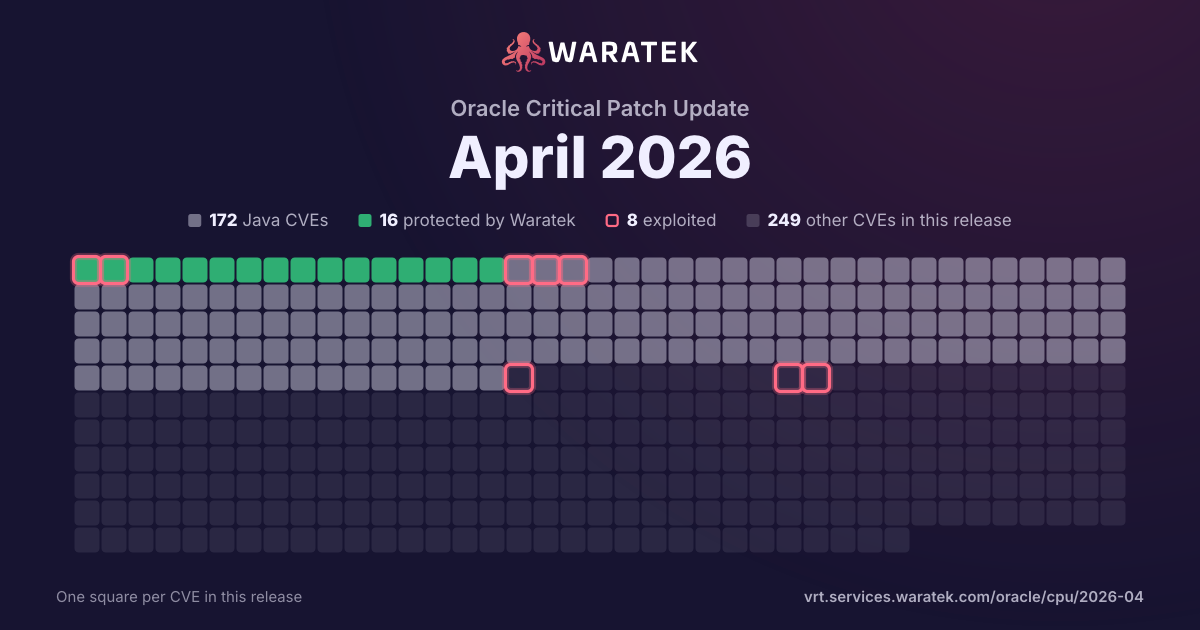
By status
13Protected by Waratek4Mitigation candidate157No exploit published6Outside Waratek scope241Not applicable
8Exploited, marked by the ring
No exploit published. For 51 of them, Oracle's security advisory is the source of public detail.
Protected by Waratek. Waratek RASP can block exploitation of these on systems that have not applied the patch yet.
Overview 16 matches · 6 in Waratek scope · 1 protected · 0 exploited · 0 CISA KEV · 1 public PoC · 1 EPSS ≥ 0.5
16matches
6in Waratek scope37.5%
1protected6.2%
0exploited0.0%
0CISA KEV0.0%
1public PoC6.2%
1EPSS ≥ 0.56.2%
Protected by Waratek
1
6.2%
Rule in development
0
0.0%
Mitigation candidate
0
0.0%
No exploit published
5
31.2%
Outside Waratek scope
0
0.0%
Not applicable
10
62.5%
Withdrawn CVE
0
0.0%
blocked by ARMR today
1
6.2%
partly blocked
0
0.0%
not blocked
15
93.8%
not established
0
0.0%
unrecorded
0
0.0%
Exploited
0
0.0%
Working exploit published
0
0.0%
Proof of concept only
16
100.0%
Forecast only
0
0.0%
No public exploit
0
0.0%
split by
peak 9 / month
Jan 269
Protected by Waratek1
No exploit published1
Not applicable7
Critical2
High3
Medium3
Low1
blocked by ARMR today1
not blocked8
Proof of concept only9
Feb 262
No exploit published1
Not applicable1
High2
not blocked2
Proof of concept only2
Mar 263
No exploit published2
Not applicable1
High3
not blocked3
Proof of concept only3
Apr 262
No exploit published1
Not applicable1
High1
Medium1
not blocked2
Proof of concept only2
Jan 26Feb 26Mar 26Apr 26
| CVE | Severity | Published▾ | Status | Exploitation | Description |
|---|---|---|---|---|---|
| CVE-2026-34305 | High | 2026-04-21 | No exploit published | Proof of concept only | Vulnerability in the Oracle WebLogic Server product of Oracle Fusion Middleware (component: Web Services). Supported versions that are affected are 12.2.1.4.0, 14.1.1.0.0, 14.1.2.0.0 and 15.1.1.0.0. Easily exploitable vulnerability allows unauthenticated attacker with network access via HTTP to compromise Oracle WebLogic Server. Successful attacks of this vulnerability can result in unauthorized access to critical data or complete access to all Oracle WebLogic Server accessible data. CVSS 3.1 Base Score 7.5 (Confidentiality impacts). CVSS Vector: (CVSS:3.1/AV:N/AC:L/PR:N/UI:N/S:U/C:H/I:N/A:N). |
| CVE-2026-34304 | Medium | 2026-04-21 | Not applicable | Proof of concept only | Vulnerability in the MySQL Server product of Oracle MySQL (component: InnoDB). Supported versions that are affected are 8.0.0-8.0.45, 8.4.0-8.4.8 and 9.0.0-9.6.0. Easily exploitable vulnerability allows high privileged attacker with network access via multiple protocols to compromise MySQL Server. Successful attacks of this vulnerability can result in unauthorized ability to cause a hang or frequently repeatable crash (complete DOS) of MySQL Server. CVSS 3.1 Base Score 4.9 (Availability impacts). CVSS Vector: (CVSS:3.1/AV:N/AC:L/PR:H/UI:N/S:U/C:N/I:N/A:H). |
| CVE-2026-33870 | High | 2026-03-27 | No exploit published | Proof of concept only | Netty is an asynchronous, event-driven network application framework. In versions prior to 4.1.132.Final and 4.2.10.Final, Netty incorrectly parses quoted strings in HTTP/1.1 chunked transfer encoding extension values, enabling request smuggling attacks. Versions 4.1.132.Final and 4.2.10.Final fix the issue. |
| CVE-2026-33013 | High | 2026-03-20 | No exploit published | Proof of concept only | Micronaut Framework is a JVM-based full stack Java framework designed for building modular, easily testable JVM applications. Versions prior to both 4.10.16 and 3.10.5 do not correctly handle descending array index order during form-urlencoded body binding in theJsonBeanPropertyBinder::expandArrayToThreshold, which allows remote attackers to cause a DoS (non-terminating loop, CPU exhaustion, and OutOfMemoryError) via crafted indexed form parameters (e.g., authors[1].name followed by authors[0].name). This issue has been fixed in versions 4.10.16 and 3.10.5. |
| CVE-2026-3288 | High | 2026-03-09 | Not applicable | Proof of concept only | A security issue was discovered in ingress-nginx where the `nginx.ingress.kubernetes.io/rewrite-target` Ingress annotation can be used to inject configuration into nginx. This can lead to arbitrary code execution in the context of the ingress-nginx controller, and disclosure of Secrets accessible to the controller. (Note that in the default installation, the controller can access all Secrets cluster-wide.) |
| CVE-2026-27727 | High | 2026-02-25 | No exploit published | Proof of concept only | mchange-commons-java, a library that provides Java utilities, includes code that mirrors early implementations of JNDI functionality, including support for remote `factoryClassLocation` values, by which code can be downloaded and invoked within a running application. If an attacker can provoke an application to read a maliciously crafted `jaxax.naming.Reference` or serialized object, they can provoke the download and execution of malicious code. Implementations of this functionality within the JDK were disabled by default behind a System property that defaults to `false`, `com.sun.jndi.ldap.object.trustURLCodebase`. However, since mchange-commons-java includes an independent implementation of JNDI derefencing, libraries (such as c3p0) that resolve references via that implementation could be provoked to download and execute malicious code even after the JDK was hardened. Mirroring the JDK patch, mchange-commons-java's JNDI functionality is gated by configuration parameters that default to restrictive values starting in version 0.4.0. No known workarounds are available. Versions prior to 0.4.0 should be avoided on application CLASSPATHs. |
| CVE-2026-25646 | High | 2026-02-10 | Not applicable | Proof of concept only | LIBPNG is a reference library for use in applications that read, create, and manipulate PNG (Portable Network Graphics) raster image files. Prior to 1.6.55, an out-of-bounds read vulnerability exists in the png_set_quantize() API function. When the function is called with no histogram and the number of colors in the palette is more than twice the maximum supported by the user's display, certain palettes will cause the function to enter into an infinite loop that reads past the end of an internal heap-allocated buffer. The images that trigger this vulnerability are valid per the PNG specification. This vulnerability is fixed in 1.6.55. |
| CVE-2025-15467 | Critical | 2026-01-27 | Not applicable | Proof of concept only | Issue summary: Parsing CMS AuthEnvelopedData or EnvelopedData message with maliciously crafted AEAD parameters can trigger a stack buffer overflow. Impact summary: A stack buffer overflow may lead to a crash, causing Denial of Service, or potentially remote code execution. When parsing CMS (Auth)EnvelopedData structures that use AEAD ciphers such as AES-GCM, the IV (Initialization Vector) encoded in the ASN.1 parameters is copied into a fixed-size stack buffer without verifying that its length fits the destination. An attacker can supply a crafted CMS message with an oversized IV, causing a stack-based out-of-bounds write before any authentication or tag verification occurs. Applications and services that parse untrusted CMS or PKCS#7 content using AEAD ciphers (e.g., S/MIME (Auth)EnvelopedData with AES-GCM) are vulnerable. Because the overflow occurs prior to authentication, no valid key material is required to trigger it. While exploitability to remote code execution depends on platform and toolchain mitigations, the stack-based write primitive represents a severe risk. The FIPS modules in 3.6, 3.5, 3.4, 3.3 and 3.0 are not affected by this issue, as the CMS implementation is outside the OpenSSL FIPS module boundary. OpenSSL 3.6, 3.5, 3.4, 3.3 and 3.0 are vulnerable to this issue. OpenSSL 1.1.1 and 1.0.2 are not affected by this issue. |
| CVE-2025-11187 | Medium | 2026-01-27 | Not applicable | Proof of concept only | Issue summary: PBMAC1 parameters in PKCS#12 files are missing validation which can trigger a stack-based buffer overflow, invalid pointer or NULL pointer dereference during MAC verification. Impact summary: The stack buffer overflow or NULL pointer dereference may cause a crash leading to Denial of Service for an application that parses untrusted PKCS#12 files. The buffer overflow may also potentially enable code execution depending on platform mitigations. When verifying a PKCS#12 file that uses PBMAC1 for the MAC, the PBKDF2 salt and keylength parameters from the file are used without validation. If the value of keylength exceeds the size of the fixed stack buffer used for the derived key (64 bytes), the key derivation will overflow the buffer. The overflow length is attacker-controlled. Also, if the salt parameter is not an OCTET STRING type this can lead to invalid or NULL pointer dereference. Exploiting this issue requires a user or application to process a maliciously crafted PKCS#12 file. It is uncommon to accept untrusted PKCS#12 files in applications as they are usually used to store private keys which are trusted by definition. For this reason the issue was assessed as Moderate severity. The FIPS modules in 3.6, 3.5 and 3.4 are not affected by this issue, as PKCS#12 processing is outside the OpenSSL FIPS module boundary. OpenSSL 3.6, 3.5 and 3.4 are vulnerable to this issue. OpenSSL 3.3, 3.0, 1.1.1 and 1.0.2 are not affected by this issue as they do not support PBMAC1 in PKCS#12. |
| CVE-2026-23490 | High | 2026-01-16 | Not applicable | Proof of concept only | pyasn1 is a generic ASN.1 library for Python. Prior to 0.6.2, a Denial-of-Service issue has been found that leads to memory exhaustion from malformed RELATIVE-OID with excessive continuation octets. This vulnerability is fixed in 0.6.2. |
| CVE-2026-0915 | High | 2026-01-15 | Not applicable | Proof of concept only | Calling getnetbyaddr or getnetbyaddr_r with a configured nsswitch.conf that specifies the library's DNS backend for networks and queries for a zero-valued network in the GNU C Library version 2.0 to version 2.42 can leak stack contents to the configured DNS resolver. |
| CVE-2025-15224 | Low | 2026-01-08 | Not applicable | Proof of concept only | When doing SSH-based transfers using either SCP or SFTP, and asked to do public key authentication, curl would wrongly still ask and authenticate using a locally running SSH agent. |
| CVE-2025-15079 | Medium | 2026-01-08 | Not applicable | Proof of concept only | When doing SSH-based transfers using either SCP or SFTP, and setting the known_hosts file, libcurl could still mistakenly accept connecting to hosts *not present* in the specified file if they were added as recognized in the libssh *global* known_hosts file. |
| CVE-2026-22184 | Medium | 2026-01-07 | Not applicable | Proof of concept only | zlib versions up to and including 1.3.1.2 include a global buffer overflow in the untgz utility located under contrib/untgz. The vulnerability is limited to the standalone demonstration utility and does not affect the core zlib compression library. The flaw occurs when a user executes the untgz command with an excessively long archive name supplied via the command line, leading to an out-of-bounds write in a fixed-size global buffer. |
| CVE-2025-12543 | Critical | 2026-01-07 | No exploit published | Proof of concept only | A flaw was found in the Undertow HTTP server core, which is used in WildFly, JBoss EAP, and other Java applications. The Undertow library fails to properly validate the Host header in incoming HTTP requests.As a result, requests containing malformed or malicious Host headers are processed without rejection, enabling attackers to poison caches, perform internal network scans, or hijack user sessions. |
| CVE-2026-21452 | High | 2026-01-02 | Protected by Waratek | Proof of concept only | MessagePack for Java is a serializer implementation for Java. A denial-of-service vulnerability exists in versions prior to 0.9.11 when deserializing .msgpack files containing EXT32 objects with attacker-controlled payload lengths. While MessagePack-Java parses extension headers lazily, it later trusts the declared EXT payload length when materializing the extension data. When ExtensionValue.getData() is invoked, the library attempts to allocate a byte array of the declared length without enforcing any upper bound. A malicious .msgpack file of only a few bytes can therefore trigger unbounded heap allocation, resulting in JVM heap exhaustion, process termination, or service unavailability. This vulnerability is triggered during model loading / deserialization, making it a model format vulnerability suitable for remote exploitation. The vulnerability enables a remote denial-of-service attack against applications that deserialize untrusted .msgpack model files using MessagePack for Java. A specially crafted but syntactically valid .msgpack file containing an EXT32 object with an attacker-controlled, excessively large payload length can trigger unbounded memory allocation during deserialization. When the model file is loaded, the library trusts the declared length metadata and attempts to allocate a byte array of that size, leading to rapid heap exhaustion, excessive garbage collection, or immediate JVM termination with an OutOfMemoryError. The attack requires no malformed bytes, user interaction, or elevated privileges and can be exploited remotely in real-world environments such as model registries, inference services, CI/CD pipelines, and cloud-based model hosting platforms that accept or fetch .msgpack artifacts. Because the malicious file is extremely small yet valid, it can bypass basic validation and scanning mechanisms, resulting in complete service unavailability and potential cascading failures in production systems. Version 0.9.11 fixes the vulnerability. |