
Oracle Critical Patch Update April 2026
Released April 2026 · Oracle's advisory ↗ · ← Critical Patch Update, January 2026 · Security Patch Update, May 2026 →
421 CVEs in this release, one square each
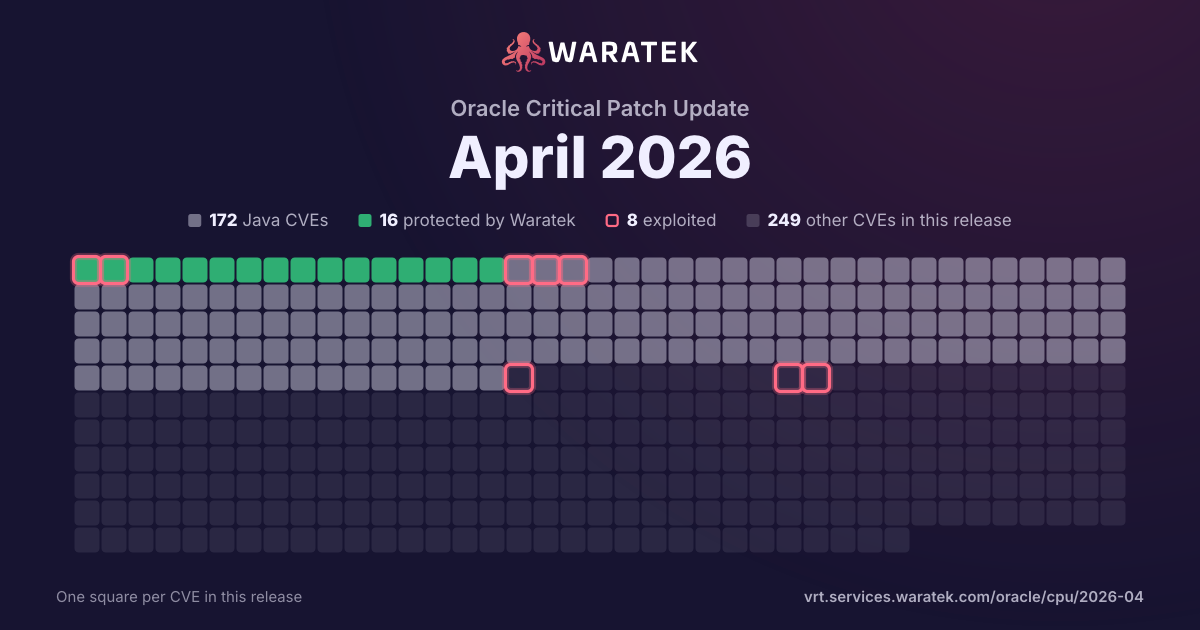
By status
13Protected by Waratek1Rule in development3Mitigation candidate157No exploit published6Outside Waratek scope241Not applicable
8Exploited, marked by the ring
No exploit published. For 51 of them, Oracle's security advisory is the source of public detail.
Protected by Waratek. Waratek RASP can block exploitation of these on systems that have not applied the patch yet.
Overview 10 matches · 0 protected · 0 exploited · 0 CISA KEV · 0 public PoC · 0 EPSS ≥ 0.5
10matches
0protected0.0%
0exploited0.0%
0CISA KEV0.0%
0public PoC0.0%
0EPSS ≥ 0.50.0%
Protected by Waratek
0
0.0%
Rule in development
0
0.0%
Mitigation candidate
0
0.0%
No exploit published
10
100.0%
blocked by ARMR today
0
0.0%
partly blocked
0
0.0%
not blocked
10
100.0%
not established
0
0.0%
unrecorded
0
0.0%
Exploited
0
0.0%
Working exploit published
0
0.0%
Proof of concept only
10
100.0%
Forecast only
0
0.0%
No public exploit
0
0.0%
split by
peak 2 / month
Jul 251
No exploit published1
Medium1
not blocked1
Proof of concept only1
Aug 250
Sep 251
No exploit published1
Medium1
not blocked1
Proof of concept only1
Oct 251
No exploit published1
Medium1
not blocked1
Proof of concept only1
Nov 250
Dec 252
No exploit published2
High1
Medium1
not blocked2
Proof of concept only2
Jan 261
No exploit published1
Critical1
not blocked1
Proof of concept only1
Feb 261
No exploit published1
High1
not blocked1
Proof of concept only1
Mar 262
No exploit published2
High2
not blocked2
Proof of concept only2
Apr 261
No exploit published1
High1
not blocked1
Proof of concept only1
Jul 25Aug 25Sep 25Oct 25Nov 25Dec 25Jan 26Feb 26Mar 26Apr 26
| CVE | Severity | Published▾ | Status | Exploitation | Description |
|---|---|---|---|---|---|
| CVE-2026-34305 | High | 2026-04-21 | No exploit published | Proof of concept only | Vulnerability in the Oracle WebLogic Server product of Oracle Fusion Middleware (component: Web Services). Supported versions that are affected are 12.2.1.4.0, 14.1.1.0.0, 14.1.2.0.0 and 15.1.1.0.0. Easily exploitable vulnerability allows unauthenticated attacker with network access via HTTP to compromise Oracle WebLogic Server. Successful attacks of this vulnerability can result in unauthorized access to critical data or complete access to all Oracle WebLogic Server accessible data. CVSS 3.1 Base Score 7.5 (Confidentiality impacts). CVSS Vector: (CVSS:3.1/AV:N/AC:L/PR:N/UI:N/S:U/C:H/I:N/A:N). |
| CVE-2026-33870 | High | 2026-03-27 | No exploit published | Proof of concept only | Netty is an asynchronous, event-driven network application framework. In versions prior to 4.1.132.Final and 4.2.10.Final, Netty incorrectly parses quoted strings in HTTP/1.1 chunked transfer encoding extension values, enabling request smuggling attacks. Versions 4.1.132.Final and 4.2.10.Final fix the issue. |
| CVE-2026-33013 | High | 2026-03-20 | No exploit published | Proof of concept only | Micronaut Framework is a JVM-based full stack Java framework designed for building modular, easily testable JVM applications. Versions prior to both 4.10.16 and 3.10.5 do not correctly handle descending array index order during form-urlencoded body binding in theJsonBeanPropertyBinder::expandArrayToThreshold, which allows remote attackers to cause a DoS (non-terminating loop, CPU exhaustion, and OutOfMemoryError) via crafted indexed form parameters (e.g., authors[1].name followed by authors[0].name). This issue has been fixed in versions 4.10.16 and 3.10.5. |
| CVE-2026-27727 | High | 2026-02-25 | No exploit published | Proof of concept only | mchange-commons-java, a library that provides Java utilities, includes code that mirrors early implementations of JNDI functionality, including support for remote `factoryClassLocation` values, by which code can be downloaded and invoked within a running application. If an attacker can provoke an application to read a maliciously crafted `jaxax.naming.Reference` or serialized object, they can provoke the download and execution of malicious code. Implementations of this functionality within the JDK were disabled by default behind a System property that defaults to `false`, `com.sun.jndi.ldap.object.trustURLCodebase`. However, since mchange-commons-java includes an independent implementation of JNDI derefencing, libraries (such as c3p0) that resolve references via that implementation could be provoked to download and execute malicious code even after the JDK was hardened. Mirroring the JDK patch, mchange-commons-java's JNDI functionality is gated by configuration parameters that default to restrictive values starting in version 0.4.0. No known workarounds are available. Versions prior to 0.4.0 should be avoided on application CLASSPATHs. |
| CVE-2025-12543 | Critical | 2026-01-07 | No exploit published | Proof of concept only | A flaw was found in the Undertow HTTP server core, which is used in WildFly, JBoss EAP, and other Java applications. The Undertow library fails to properly validate the Host header in incoming HTTP requests.As a result, requests containing malformed or malicious Host headers are processed without rejection, enabling attackers to poison caches, perform internal network scans, or hijack user sessions. |
| CVE-2024-29371 | High | 2025-12-17 | No exploit published | Proof of concept only | In jose4j before 0.9.6, an attacker can cause a Denial-of-Service (DoS) condition by crafting a malicious JSON Web Encryption (JWE) token with an exceptionally high compression ratio. When this token is processed by the server, it results in significant memory allocation and processing time during decompression. |
| CVE-2025-67735 | Medium | 2025-12-16 | No exploit published | Proof of concept only | Netty is an asynchronous, event-driven network application framework. In versions prior to 4.1.129.Final and 4.2.8.Final, the `io.netty.handler.codec.http.HttpRequestEncoder` has a CRLF injection with the request URI when constructing a request. This leads to request smuggling when `HttpRequestEncoder` is used without proper sanitization of the URI. Any application / framework using `HttpRequestEncoder` can be subject to be abused to perform request smuggling using CRLF injection. Versions 4.1.129.Final and 4.2.8.Final fix the issue. |
| CVE-2024-31573 | Medium | 2025-10-17 | No exploit published | Proof of concept only | XMLUnit for Java before 2.10.0, in the default configuration, might allow code execution via an untrusted stylesheet (used for an XSLT transformation), because XSLT extension functions are enabled. |
| CVE-2025-58057 | Medium | 2025-09-04 | No exploit published | Proof of concept only | Netty is an asynchronous event-driven network application framework for rapid development of maintainable high performance protocol servers & clients. In netty-codec-compression versions 4.1.124.Final and below, and netty-codec versions 4.2.4.Final and below, when supplied with specially crafted input, BrotliDecoder and certain other decompression decoders will allocate a large number of reachable byte buffers, which can lead to denial of service. BrotliDecoder.decompress has no limit in how often it calls pull, decompressing data 64K bytes at a time. The buffers are saved in the output list, and remain reachable until OOM is hit. This is fixed in versions 4.1.125.Final of netty-codec and 4.2.5.Final of netty-codec-compression. |
| CVE-2025-53864 | Medium | 2025-07-11 | No exploit published | Proof of concept only | Connect2id Nimbus JOSE + JWT 10.0.x before 10.0.2 and 9.37.x before 9.37.4 allows a remote attacker to cause a denial of service via a deeply nested JSON object supplied in a JWT claim set, because of uncontrolled recursion. NOTE: this is independent of the Gson 2.11.0 issue because the Connect2id product could have checked the JSON object nesting depth, regardless of what limits (if any) were imposed by Gson. |